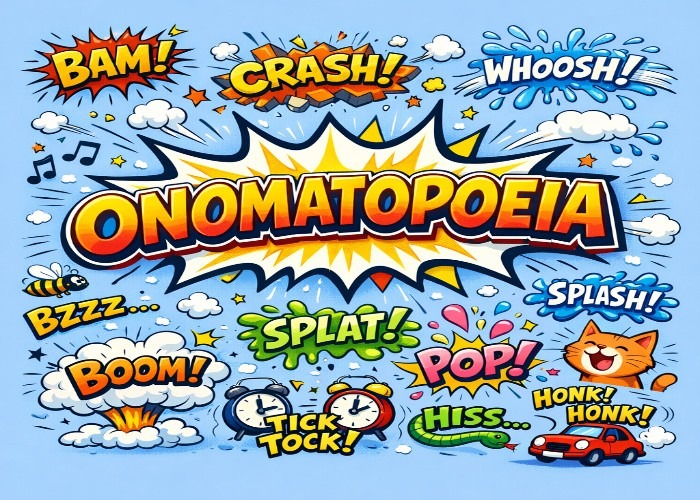
What is Onomatopoeia?
Onomatopoeia is a word that imitates the sound it describes. The word sounds like the actual noise.
The quick test: Say the word out loud. Does it sound like what it means? That's onomatopoeia.
Examples:
- "Buzz" sounds like a bee buzzing
- "Splash" sounds like water splashing
- "Crack" sounds like something breaking
What's NOT onomatopoeia:
- Metaphor (comparison without sound imitation)
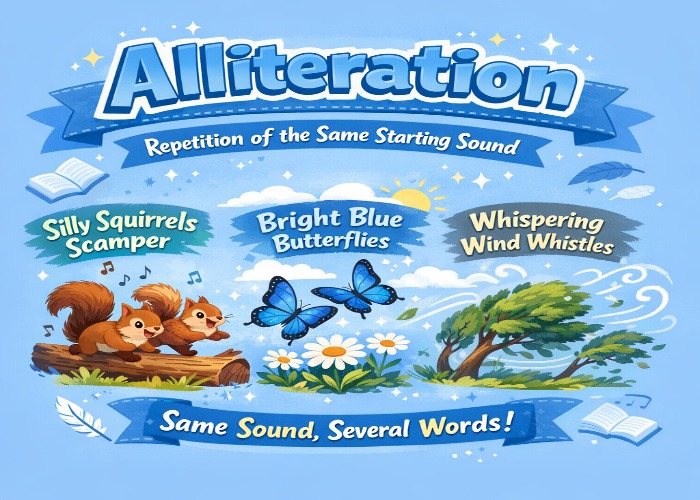
- Alliteration (repeated consonant sounds that don't mimic noise)
- Regular descriptive words ("loud," "quiet")
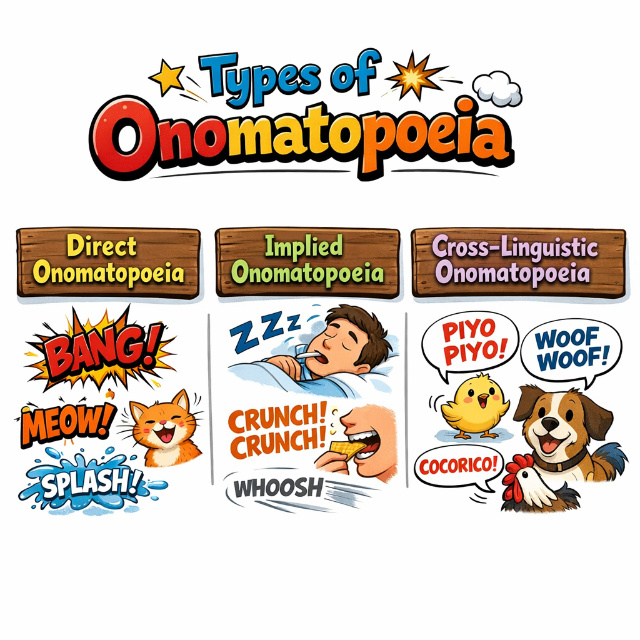
Types of Onomatopoeia
1. Direct Onomatopoeia
Words that directly imitate sounds.
Examples: buzz, hiss, meow, crash, bang
Usage: Most common type. The word sounds exactly like the noise.
2. Implied Onomatopoeia
Words that suggest sound through their phonetics without directly imitating it.
Examples: "murmur" (soft m-sounds), "slither" (sliding s-sound)
Usage: Creates sound impression without exact imitation.
3. Cross-Linguistic Onomatopoeia
Same sounds represented differently across languages.
Examples:
- Dog bark: "woof" (English), "wau" (German), "wan wan" (Japanese)
- Cat meow: "meow" (English), "miau" (Spanish), "nyan" (Japanese)
- Rooster crow: "cock-a-doodle-doo" (English), "cocorico" (French), "kikiriki" (Spanish)
Why it matters: Shows onomatopoeia is cultural interpretation of sound, not universal.
ANALYZING ONOMATOPOEIA IN POETRY OR PROSE?
We’ll write your expert analysis on how sound words shape rhythm, tone, and reader perception.
- Exploration of how phonetic sounds mimic action or emotion
- Insight into the interplay between sound and meaning
- A polished essay demonstrating sophisticated stylistic analysis
- Expert Phonetic Analysis
Understand how the sound of a word becomes part of its meaning.
Get Started NowHow to Use Onomatopoeia Effectively
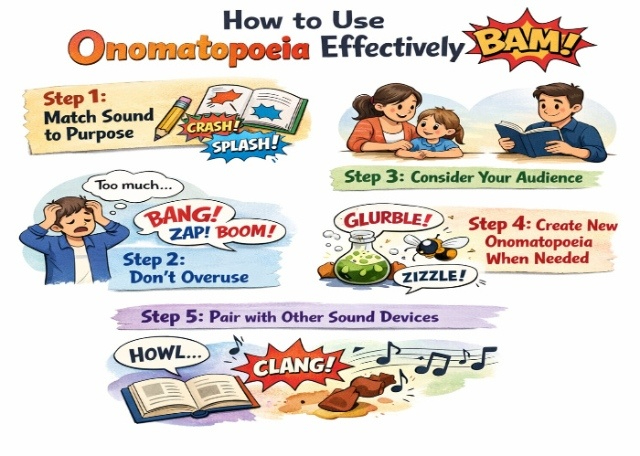
Step 1: Match Sound to Purpose
For action: Bang, crash, smash
For nature: Rustle, whisper, whoosh
For quiet: Hush, murmur, tiptoe
For loud: Roar, boom, thunder
Choose words that match the intensity and type of sound.
Step 2: Don't Overuse
Too much onomatopoeia becomes cartoonish.
Overdone: "The door slammed with a bang as he stomped with a thud down the stairs that creaked and groaned."
Balanced: "The door slammed. His footsteps echoed down the stairs."
Use for emphasis, not every action.
Step 3: Consider Your Audience
Children's books: More onomatopoeia (fun, engaging)
Adult literary fiction: Selective use (powerful moments)
Poetry: Strategic placement (sound patterns)
Academic writing: Minimal (professional tone)
Step 4: Create New Onomatopoeia When Needed
Writers invent sound words if existing ones don't fit.
Examples:
- Lewis Carroll: "outgrabe," "burbled"
- Gwendolyn Brooks: "SUSHES"
- Dr. Seuss: Various invented sounds
Remember: If it sounds like what you mean, it works.
Step 5: Pair with Other Sound Devices
Combine onomatopoeia with alliteration for stronger effects.
Example: "The snake slithered and hissed" (alliteration + onomatopoeia)
Onomatopoeia vs Related Devices
1. Onomatopoeia vs Alliteration
Onomatopoeia: Words sound like what they mean ("buzz")
Alliteration: Repeated consonant sounds ("Peter Piper picked")
| The overlap: Some alliteration uses onomatopoeia ("slithering snake"), but they're different devices. |
Do you want to know a bit more about alliteration? No need to worry. We have an alliteration guide that covers everything you need to know.
2. Onomatopoeia vs Imagery
Onomatopoeia: Creates sound through word choice
Imagery: Creates sensory experience (all five senses)
| Relationship: Onomatopoeia is auditory imagery, one type of sensory detail. |
Interested in imagery? Learn more about it in our imagery guide.
Common Onomatopoeia Examples
These sound words appear in everyday speech constantly.
Animal Sounds
Examples:
- Buzz (bees, flies)
- Hiss (snakes, steam)
- Meow (cats)
- Woof/Bark (dogs)
- Moo (cows)
- Chirp (birds, crickets)
- Roar (lions, engines)
- Quack (ducks)
Example in context: "The bees buzzed lazily around the garden."
Water Sounds
Examples:
- Splash (water hitting surface)
- Drip (water drops)
- Gurgle (water flowing)
- Trickle (small water flow)
- Plop (something dropping in water)
- Swoosh (water rushing)
Example in context: "Rain dripped steadily from the gutters."
Impact Sounds
Examples:
- Bang (explosion, door slam)
- Crash (collision)
- Thud (heavy impact)
- Clang (metal hitting metal)
- Crack (breaking)
- Smash (violent breaking)
- Thump (dull impact)
Example in context: "Thunder cracked overhead."
Human Sounds
Examples:
- Whisper (quiet speech)
- Murmur (low talking)
- Giggle (quiet laughter)
- Chuckle (low laugh)
- Sigh (breath release)
- Grunt (effort sound)
- Snore (sleeping sound)
Example in context: "She sighed deeply."
Movement Sounds
Examples:
- Zoom (fast movement)
- Whoosh (air rushing)
- Swish (sweeping motion)
- Rustle (leaves, paper)
- Creak (old wood, hinges)
- Clatter (multiple objects falling)
Example in context: "Leaves rustled in the breeze."
Onomatopoeia Examples from Poetry
Poets use sound words to create vivid auditory imagery.
"The Bells" by Edgar Allan Poe
"Hear the sledges with the bells
Silver bells!
What a world of merriment their melody foretells!
How they tinkle, tinkle, tinkle,
In the icy air of night!"
| Sound words: "tinkle" Why it works: The word "tinkle" mimics small bell sounds. Repetition emphasizes the continuous ringing. |
"Hear the loud alarum bells
Brazen bells!
What tale of terror, now, their turbulency tells!
In the startled ear of night
How they scream out their affright!
Too much horrified to speak,
They can only shriek, shriek,
Out of tune."
| Sound words: "scream," "shriek" Why it works: Harsh sounds mimic alarm bells. "Shriek" repeats like a persistent alarm noise. |
"Jabberwocky" by Lewis Carroll
"'Twas brillig, and the slithy toves
Did gyre and gimble in the wabe;
All mimsy were the borogoves,
And the mome raths outgrabe."
| Sound words: "outgrabe" Why it works: Carroll invented onomatopoeia. "Outgrabe" sounds like a strange creature noise, even though it's nonsense. |
"Splinter" by Carl Sandburg
"The voice of the last cricket
across the first frost
is one kind of good-by.
It is so thin a splinter of singing."
| Sound words: "splinter," "singing" Why it works: "Splinter" mimics the thin, breaking quality of a cricket's final chirp. |
"Cynthia in the Snow" by Gwendolyn Brooks
"It SUSHES.
It hushes
The loudness in the road.
It flitter-twitters,
And laughs away from me."
| Sound words: "SUSHES," "hushes," "flitter-twitters" Why it works: Made-up onomatopoeia ("SUSHES") captures snow's soft sound. "Flitter-twitters" mimics light, quick movements. |
DOES YOUR ACTION OR DESCRIPTION SOUND SILENT?
We’ll inject precise onomatopoeia to elevate your draft before your deadline.
- Quick identification of moments needing sound effects
- Seamless integration of words like clang, hiss, or rustle
- Express editing service for immediate impact
- Urgent Sonic Enhancement
A quick edit that makes your scenes go from quiet to KA-POW!
Get Started NowOnomatopoeia Examples from Literature
Writers use sound words to make scenes vivid and immediate.
"The Raven" by Edgar Allan Poe
"Once upon a midnight dreary, while I pondered, weak and weary,
Over many a quaint and curious volume of forgotten lore—
While I nodded, nearly napping, suddenly there came a tapping,
As of some one gently rapping, rapping at my chamber door."
| Sound words: "tapping," "rapping" Why it works: The words sound like knocking. Repetition mimics persistent knocking pattern. |
"The Wind in the Willows" by Kenneth Grahame
"The Mole had been working very hard all the morning, spring-cleaning his little home. First with brooms, then with dusters; then on ladders and steps and chairs, with a brush and a pail of whitewash; till he had dust in his throat and eyes, and splashes of whitewash all over his black fur."
| Sound words: "splashes" Why it works: "Splashes" sounds like whitewash hitting surfaces. |
"The Tell-Tale Heart" by Poe
"It increased my fury, as the beating of a drum stimulates the soldier into courage."
| Sound words: "beating" Why it works: "Beating" mimics heartbeat rhythm. The b-sound reinforces the percussion quality. |
"Ulysses" by Alfred, Lord Tennyson
"The long day wanes; the slow moon climbs; the deep
Moans round with many voices."
| Sound words: "Moans" Why it works: "Moans" captures the ocean's low, mournful sound. |
Onomatopoeia Examples from Comics
Comic books rely heavily on visual sound effects.
Classic Comic Sound Effects
Action sounds:
- POW! (punch)
- BAM! (impact)
- THWACK! (hitting sound)
- KAPOW! (explosive impact)
- WHAM! (collision)
Example: Batman comics use "POW!" and "BAM!" as visual text during fight scenes.
Movement sounds:
- ZOOM (fast movement)
- SWOOSH (air displacement)
- WHOOSH (rushing past)
- ZIP (quick motion)
Example: The Flash's speed trail includes "ZOOM" and "WHOOSH."
Machine sounds:
- VROOM (engine)
- BEEP (electronic)
- BUZZ (machinery)
- WHIRR (spinning)
Example: Car chase scenes show "VROOM VROOM" emanating from vehicles.
Weapon sounds:
- BANG (gunshot)
- PEW PEW (laser)
- CLANG (sword)
- ZAP (electricity)
Example: Science fiction comics show "ZAP!" for ray guns and "PEW PEW!" for lasers.
Onomatopoeia Examples in Advertising
Marketers use sound words to make products memorable.
Food & Beverage
Examples:
- "Snap, Crackle, Pop" (Rice Krispies)
- "Fizz" (carbonated drinks)
- "Sizzle" (cooking meat)
- "Crunch" (chips, cereal)
Why it works: Sound words make you hear (and want to taste) the product. "Snap, Crackle, Pop" became the cereal's identity.
Technology
Examples:
- "Click" (cameras, computers)
- "Beep" (electronics)
- "Buzz" (vibration mode)
- "Ping" (notifications)
Why it works: Sound words make technology feel responsive and alive.
Cleaning Products
Examples:
- "Scrub" (cleaning action)
- "Swoosh" (wiping)
- "Splash" (water)
Why it works: Action sounds suggest effectiveness. You can imagine the product working.
Common Onomatopoeia Mistakes
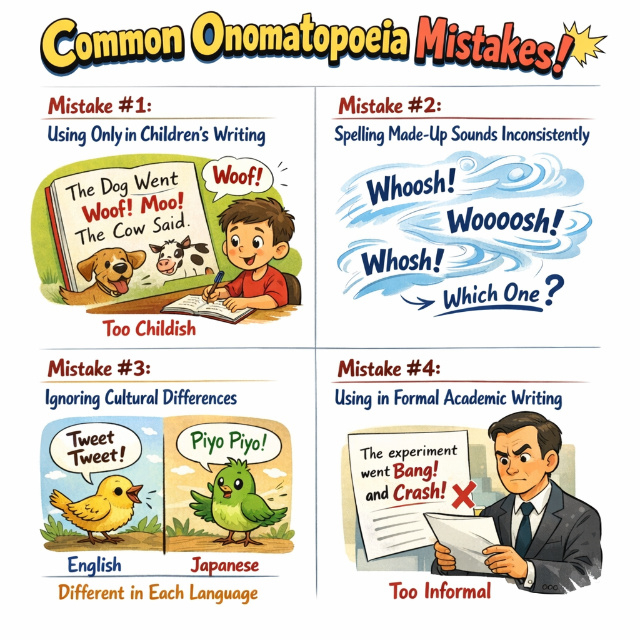
Mistake #1: Using Only in Children's Writing
Wrong assumption: Onomatopoeia is childish and doesn't belong in serious writing.
Reality: Poets, literary authors, and journalists use it effectively. It's about HOW you use it, not whether you use it.
Mistake #2: Spelling Made-Up Sounds Inconsistently
Wrong: "The machine beeped. Later, the beaping continued."
Right: "The machine beeped. Later, the beeping continued."
If you invent a sound word, spell it consistently.
Mistake #3: Ignoring Cultural Differences
Problem: Assuming onomatopoeia is universal.
Reality: Different languages represent sounds differently. "Cock-a-doodle-doo" makes no sense to non-English speakers.
Mistake #4: Using in Formal Academic Writing
Wrong context: "The experiment resulted in a big boom."
Right context: "The experiment produced an explosion."
Academic writing typically avoids onomatopoeia except when quoting or analyzing it.
Writing about how sound creates atmosphere? Our premium essay writing service provides an analysis showing exactly how onomatopoeia shapes sensory experience.
Downloadable Resource
FROM SIMPLE SOUNDS TO COMPLEX STYLISTIC ANALYSIS.
Get a complete scholarly package: identification, analysis, and interpretation of onomatopoeia in your text.
- Full cataloging of sound devices in your assigned literature
- Thematic and rhetorical analysis written in academic style
- “Ready to Submit” essay with proper citations
- Complete Sound Device Dossier
Don’t just list the sounds, present a masterful analysis of their function.
Get Started NowThe Bottom Line
Onomatopoeia makes language sound like what it describes. By choosing words that mimic actual noises, writers create immediate sensory experiences, making readers hear the buzz, crash, or whisper.
The best onomatopoeia feels natural, not gimmicky. Used strategically, it transforms flat descriptions into vivid, auditory scenes.
Master onomatopoeia analysis, and you understand how sound shapes meaning.
Want more sound devices? Explore our complete literary devices guide with examples.


-19964.jpg)
-20128.jpg)


-20008.jpg)
-20016.jpg)