What Makes a Study Guide Effective vs Ineffective?
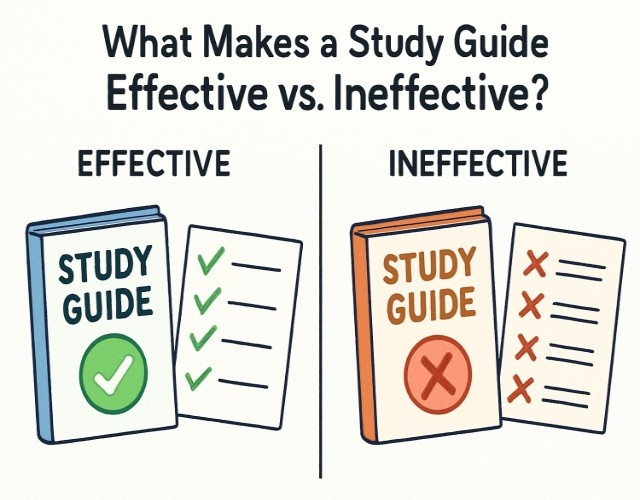
Effective study guides are testing tools, not reading materials. Understanding this fundamental difference determines whether your guide helps or wastes your time.
The Recognition vs Recall Problem
Most students create study guides that present information to be recognized rather than questions to be answered. They write detailed summaries, highlight key points, and organize content beautifully. Then they read their guide repeatedly, mistaking familiarity for understanding. This builds recognition, you see concepts and think "yes, I know this", but exams test recall, your ability to produce information without prompts.
A 2024 study tracked 600 students across four semesters. Students who created question based study guides scored an average of 22% higher than students who created summary-based guides, despite spending similar time on guide creation. The difference was the cognitive process: question creators practiced retrieval while summary creators only practiced recognition.
What Effective Study Guides Include:
|
What Ineffective Study Guides Include:
|
Students who spend 10 hours creating a comprehensive summary guide would learn more by spending 3 hours creating a question, based guide and 7 hours using it for retrieval practice.
For students managing multiple courses and discovering they're spending more time creating elaborate study guides than actually studying, many use an essay writing service for specific papers, redirecting that time toward creating truly effective study materials for exams.
How Do You Structure Information in Study Guides?
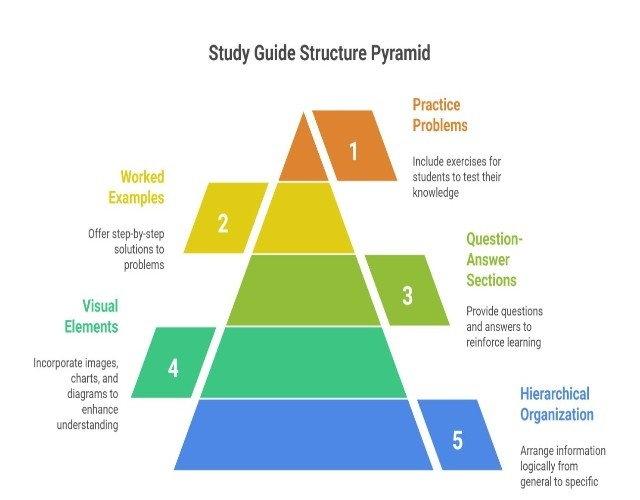
The organization determines whether your brain can efficiently encode and retrieve information. Use these proven structures for creating effective study guides.
1. Use Hierarchical Organization
Structure your study guide with main concepts at the top, subconcepts below, and supporting details at the bottom. This hierarchy mirrors how your brain organizes knowledge and makes relationships between concepts visible.
For a biology chapter on cellular respiration:
|
This structure shows both breadth (the three major processes) and depth (details within each process). Students using hierarchical organization recall 35% more information than those using linear note formats.
2. Include Visual Elements
Your brain processes visual information 60,000 times faster than text. Effective study guides include diagrams, flowcharts, concept maps, comparison tables, and visual hierarchies. These aren't decorative; they're memory encoding tools.
For chemistry, include molecular structures with labeled bonds. For history, create timelines showing concurrent events. For literature, draw character relationship maps. For statistics, make comparison tables of different tests and when to use each.
Creating these visuals requires a deep understanding of relationships and processes. The visual product then serves as a retrieval cue during review. Students who include visual elements in study guides report spending less time reviewing while remembering more.
3. Create Question Answer Sections
Transform every major concept into questions that test understanding. Don't just list what mitosis is, ask questions that force you to explain, compare, apply, and analyze.
Example transformation:
| Ineffective (summary style): "Mitosis is cell division resulting in two identical daughter cells. Stages: prophase, metaphase, anaphase, telophase." |
Effective (question-based):
|
The questions force retrieval and application. You can't answer them by recognizing information; you must produce explanations from memory.
4. Include Worked Examples and Practice Problems
For STEM subjects, your study guide must include problems to solve, not just concepts to review. Mathematics, physics, chemistry, and statistics require procedural knowledge that only develops through practice.
Include 5 to10 practice problems per concept, showing full solutions with explanations. When studying, cover the solutions and work problems independently. This reveals whether you truly understand versus just recognizing methods.
A 2023 study of engineering students found that those whose study guides included practice problems scored 28% higher on exams than those with concept only guides. The problem practice built the procedural fluency exams actually test.
Many students creating comprehensive study guides for their STEM courses find that using a professional essay writing service for humanities papers allows them to allocate sufficient time to include worked examples and practice problems in their technical study materials.
What Should You Include in Each Study Guide Section?
Every effective study guide section needs specific elements that facilitate active learning. Here's exactly what to include.
1. Core Concepts Section
Start each topic with the big picture, what's the main idea, and why does it matter? Provide 2 to 3 sentence overviews before diving into details. This context helps your brain file information correctly.
Then break into key concepts as questions:
|
Leave space after each question to write answers from memory during review. The act of retrieving and writing strengthens retention significantly.
2. Examples and Applications
Include 3 to 5 concrete examples for each abstract concept. Examples make concepts memorable and demonstrate how to apply knowledge. Generic understanding that "osmosis moves water across membranes" is less useful than knowing how osmosis explains why plants wilt without water, how kidney dialysis works, and why you shouldn't drink seawater.
| For each example, ask: "How does this illustrate the concept?" This forces you to connect specific cases to general principles, building a flexible understanding that transfers to novel situations. |
3. Common Mistakes and Misconceptions
Explicitly list what students typically get wrong. If students commonly confuse correlation with causation in statistics, include that warning with examples. If students mix up affect versus effect in writing, highlight the distinction.
Research shows that confronting misconceptions directly improves retention by 40% compared to simply presenting correct information. When you study, you'll recognize and avoid these errors rather than discovering them too late on the exam.
4. Comparison Charts
When studying multiple related concepts, create side by side comparison tables. This format forces you to understand distinctions and prevents confusion during exams.
Example for psychology study guide comparing different therapy approaches:
| Approach | Key Techniques | Best For | Duration | Theoretical Basis |
|---|---|---|---|---|
| CBT | Thought records, behavioral experiments | Anxiety, depression | 12 to 20 sessions | Cognitive theory |
| Psychodynamic | Free association, interpretation | Personality issues | Long term | Freud, unconscious |
| Humanistic | Active listening, reflection | Self-actualization | Variable | Rogers, growth |
The table makes differences obvious and creates a retrieval structure. When asked about CBT on an exam, you automatically recall how it differs from other approaches.
5. Self-Test Sections
End each major topic with a self-test section: 5 to 10 questions testing everything covered. Format these like mini exams with space for answers. When reviewing, complete the self test before looking at your guide, identifying gaps in knowledge while you can still address them.
Include multiple question types:
This variety ensures you're prepared for any question format the actual exam uses. |
For students balancing the creation of comprehensive study guides across multiple courses, many strategically use a reliable essay writing service for specific major papers, ensuring they have adequate time to include all critical elements in their exam preparation materials.
How Do You Use Your Study Guide for Maximum Learning?
Creating the guide is only half the value; using it correctly is what produces exam success. Most students create guides and then use them passively, wasting their effort.
1. Active Recall Practice
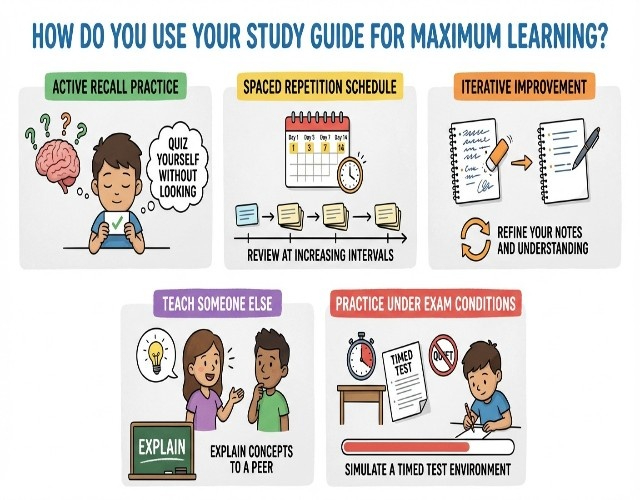
Never just read your study guide. Cover answers and force yourself to retrieve information. See a question, close the guide, write your answer, then check. This retrieval practice is what builds durable memories, not passive reading.
Research consistently shows that testing yourself produces 2 to 3 times better retention than reviewing material. Students report that this feels harder and less productive than reading, but the discomfort signals actual learning happening.
2. Spaced Repetition Schedule
Review your study guide multiple times, using intervals that increase in length. After creating it, review it that evening. Review again in 2 to 3 days, then a week later, then two weeks later. Each successful retrieval strengthens memory and extends how long you remember. This spacing produces dramatically better retention than cramming with multiple reviews in one day.
A 2024 study found students using spaced review retained 78% of material after six weeks versus 24% retention from massed review.
3. Iterative Improvement
Update your study guide after each review session. When you discover gaps, add questions addressing them. When you master easy material, remove it to focus on difficult content. Your guide should evolve, becoming more targeted as exams approach. This iterative process ensures your study time focuses on actual weaknesses rather than repeatedly reviewing already mastered material.
Students using evolving guides report spending 30 to 40% less time studying while achieving better results.
4. Teach Someone Else
Use your study guide to teach concepts to a classmate, study group, or even an imaginary audience. Teaching forces you to organize knowledge, identify gaps, and explain clearly, all processes that strengthen understanding.
Students who regularly teach material to others score 15 to 20% higher on exams than those who only study independently. If you can explain a concept clearly using only your study guide as a prompt, you've truly mastered it.
5. Practice Under Exam Conditions
Use your self test sections to simulate exam conditions: timed, closed notes, no interruptions. This builds confidence and reveals whether you can perform under pressure. Many students discover too late that they know the material in relaxed study sessions but can't access it under exam stress.
Taking practice tests from your study guide 3 to 4 days before the exam, with time to address revealed weaknesses, produces the strongest performance gains.
For students who've created comprehensive study guides but need additional support for major writing assignments to maintain balanced preparation across courses, many use a trusted essay writing service for specific papers, ensuring their study guide practice time isn't compromised by writing deadlines.
Free Downloadable Resources
Conclusion: Build Study Tools, Not Study Documents
Creating effective study guides means building active learning tools that force retrieval and test understanding, not passive reading documents that create false confidence. Students who create question based, hierarchically organized guides with visual elements and practice problems score 18 25% higher on exams than those using summary based guides or no guides at all.
Key Takeaways:
- Transform passive information into active questions that force retrieval practice
- Use hierarchical organization showing relationships between concepts
- Include visual elements (charts, diagrams, concept maps) for faster processing
- Create self-test sections with multiple question types
- Review using active recall and spaced repetition, never passive reading
- Evolve your guide iteratively, focusing on actual weaknesses
Start your next study guide today using these principles. Choose one upcoming exam and create a question based guide with visual organization and self-testing sections. Use it for active recall practice with spaced reviews. Compare your results to previous exams where you used different study methods. The performance difference will convince you that these techniques work.
For students discovering they need to rebalance time between creating comprehensive study guides and completing writing assignments, strategic use of a fast essay writing service for specific papers allows adequate focus on building the study tools that drive exam success.
Transform your study guide creation from time consuming busywork into your most powerful learning activity.