What Is Active Recall and How Does It Work?
Active recall is a study technique where you force yourself to retrieve information from memory without looking at your notes or textbook. Instead of re-reading your materials, you actively test yourself by trying to remember key concepts, definitions, and connections between ideas.
The process works through a mechanism called retrieval practice. Each time you successfully retrieve information from memory, you strengthen the neural pathways associated with that knowledge. Think of it like creating a well-worn path through a forest, the more you walk it, the clearer and easier it becomes to navigate.
Here's what happens in your brain during active recall:
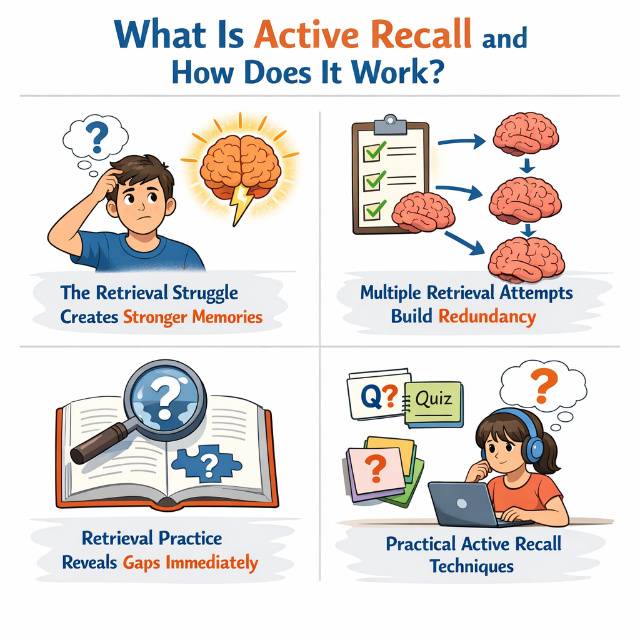
1. The Retrieval Struggle Creates Stronger Memories
When you struggle to remember something, your brain works harder to access that information. Research from cognitive psychology shows this "desirable difficulty" makes memories more durable. The effort of retrieval is what strengthens the memory trace, not the ease of recognition.
2. Multiple Retrieval Attempts Build Redundancy
Each time you practice active recall, your brain creates multiple pathways to the same information. If one pathway weakens, others remain available. Students who practice active recall develop robust knowledge networks that resist forgetting.
3. Retrieval Practice Reveals Gaps Immediately
When you can't recall something, you've identified exactly what needs more work. Passive reading hides these gaps. You think you know the material because it looks familiar. Active recall exposes your weaknesses before the exam does.
A 2024 study published in Cognitive Science tracked 500 college students over one semester. Students using active recall scored an average of 23% higher on final exams compared to those who relied primarily on re-reading. The effect was even stronger for complex material requiring deep understanding rather than simple memorization.
4. Practical Active Recall Techniques
You don't need fancy tools to practice active recall. After reading a section, close your book and write down everything you remember. Use flashcards with questions on one side and answers on the other. Explain concepts out loud as if teaching someone else. Create practice questions and answer them without looking at your notes.
The key is testing yourself before you feel ready. Most students wait until they've reviewed material multiple times. That's backwards. Test yourself immediately after learning, when retrieval is still difficult. That's when the learning effect is strongest.
Why Does Passive Reading Fail Most Students?
Passive reading creates the illusion of competence without building actual retrieval strength. When you read and re-read your textbook, your brain recognizes the information and interprets that recognition as understanding. This metacognitive error, mistaking familiarity for mastery, is why so many students feel confident studying but panic during exams.
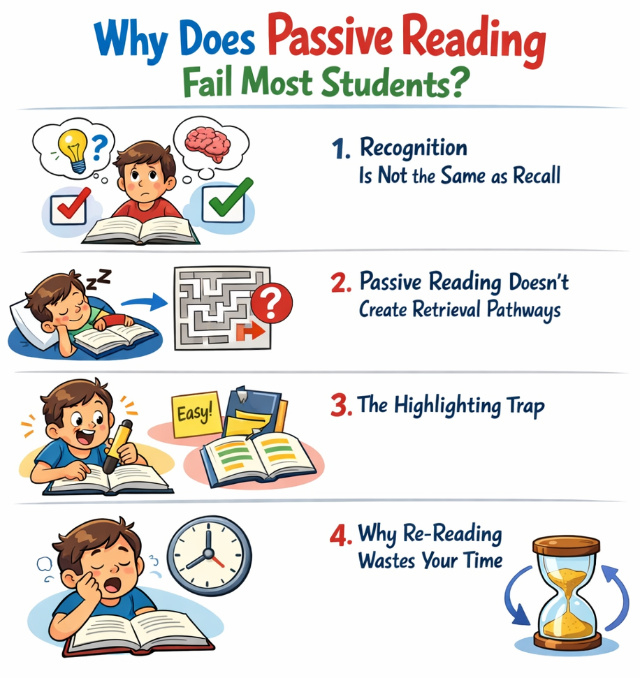
1. Recognition Is Not the Same as Recall
Your brain has two different memory systems: recognition and recall. Recognition is easy, seeing the correct answer and thinking, "yes, that's it." Recall is hard, producing the answer from scratch without prompts. Exams test recall, but passive reading only builds recognition.
Research shows students who study through re-reading overestimate their learning by 30-50%. They feel like they know the material because they recognize it when reading. Then they sit for the exam and can't produce the answers they thought they knew.
2. Passive Reading Doesn't Create Retrieval Pathways
When you read passively, information flows into your brain, but doesn't get organized into retrievable knowledge. You're exposing yourself to the material, but you're not practicing the skill you actually need, pulling information out of memory under pressure.
Think about learning to play basketball. You can watch thousands of hours of basketball games and understand every rule, strategy, and technique. But until you actually practice shooting, dribbling, and playing, you won't be able to perform. Passive reading is like watching games. Active recall is like actually playing.
3. The Highlighting Trap
Highlighting feels productive, but it rarely helps with learning.
A 2023 study found that students who highlighted extensively performed no better than students who didn't highlight at all. Worse, highlighting can harm learning by making you focus on individual facts instead of connections between concepts.
When you highlight, you're making a recognition judgment ("this seems important") rather than a recall effort ("can I explain why this is important?"). You end up with colorful pages and a shallow understanding.
4. Why Re-Reading Wastes Your Time
Each time you re-read material, it becomes more familiar and easier to process. This fluency trick your brain into thinking you're learning more than you actually are. The second reading feels easier because you recognize the information, not because you've strengthened your memory of it.
Students who spend three hours re-reading their notes would learn far more by spending one hour reading and two hours testing themselves. The reading establishes the information; the testing makes it stick.
For major assignments like research papers or thesis work, many students find that combining effective study techniques with targeted support from a trusted essay writing service helps them maintain focus on mastering core concepts while managing their overall workload.
Active Recall vs Passive Reading: What Does the Science Say?
The research comparing active recall vs passive reading is overwhelming active recall winning on every measure that matters for students.
Retention Rates Over Time
| Time Period | Active Recall Retention | Passive Reading Retention | Difference |
|---|---|---|---|
| Immediately | 85-90% | 80-85% | Minimal |
| 24 Hours | 75-80% | 40-50% | 30-35% |
| 1 Week | 60-70% | 10-15% | 50-55% |
| 1 Month | 50-60% | 5-10% | 45-50% |
| The difference compounds dramatically over time. Immediately after studying, both methods show similar retention. But within 24 hours, passive reading retention drops sharply while active recall stays strong. By exam time, students using passive reading have forgotten most of what they studied. |
The Testing Effect Explained
The phenomenon where retrieval practice strengthens memory is called the testing effect. Over 100 years of research confirms that testing yourself is more effective than any other study technique, including:
- Re-reading (50% less effective)
- Concept mapping (30% less effective)
- Summarizing (40% less effective)
- Highlighting (60% less effective)
A landmark 2021 meta-analysis examined 218 studies involving over 47,000 students. Active recall produced medium to large improvements across all subjects, age groups, and materials. The effect held for simple facts, complex concepts, and applied problem-solving.
Transfer of Learning
Active recall doesn't just help you remember what you studied, it improves your ability to apply knowledge in new situations. When you practice retrieving information, you build flexible mental models that transfer to different contexts.
Students using active recall score 15-20% higher on application questions that require using concepts in unfamiliar scenarios. Passive reading helps you recognize information but doesn't prepare you to use it creatively.
The Spacing Effect Multiplier
Active recall becomes even more powerful when combined with spaced repetition. Testing yourself repeatedly over increasing intervals (one day, three days, one week) produces retention rates above 80% even months later.
Students who combine active recall with spacing learn material in 40% less time than students using passive reading with cramming. You study less but remember more.
Brain Imaging Evidence
fMRI studies show that active recall activates the prefrontal cortex and hippocampus regions critical for long-term memory formation. Passive reading primarily activates visual processing areas without engaging memory consolidation systems.
This explains why active recall feels harder but works better. The cognitive effort is the mechanism that strengthens memory, not a bug in the system.
When managing multiple demanding courses, some students strategically use an essay writing service for specific assignments, freeing up time to practice active recall on their most challenging subjects where deep mastery matters most.
How to Implement Active Recall in Your Study Routine
Start immediately after learning new material. Don't wait until you've reviewed multiple times. The best moment for your first retrieval attempt is right after you finish reading a section or attending a lecture.
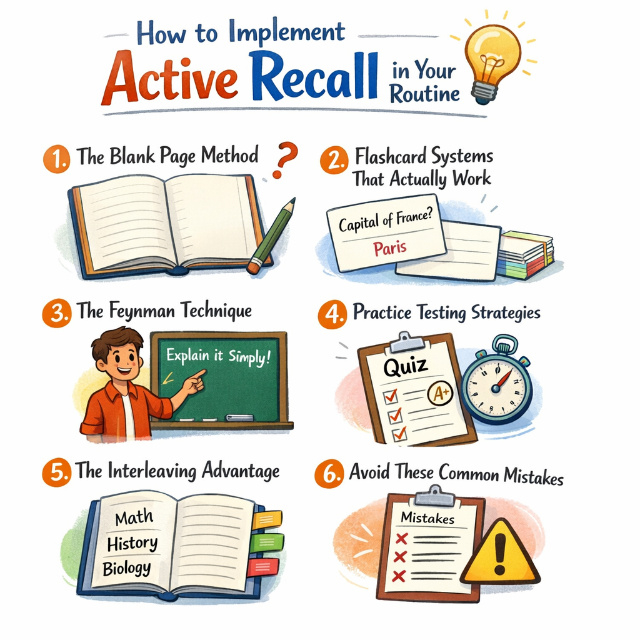
1. The Blank Page Method
Close your notes and open a blank document or page. Write down everything you remember about what you just learned. Don't organize it perfectly, just dump your memory onto the page.
This takes 5-10 minutes but reveals exactly what stuck and what didn't. Go back and review only the parts you couldn't recall. Then test yourself again later that day.
2. Flashcard Systems That Actually Work
Create flashcards with meaningful questions, not simple definitions. Instead of "What is mitochondria?" write "Explain how mitochondria produce ATP and why this matters for cell function."
Good flashcards require you to reconstruct explanations, not just recognize single words. Use digital flashcard apps that automatically schedule reviews based on your performance; harder cards appear more frequently.
3. The Feynman Technique
Explain the concept out loud as if teaching a complete beginner. Use simple language and avoid jargon. When you get stuck, you've found a gap in your understanding.
This method combines active recall with elaboration, forcing you to retrieve information and organize it into a coherent explanation. Students report this technique makes complex topics click in ways reading never could.
3. Practice Testing Strategies
Create your own practice questions as you study. After each chapter or lecture, write 5-10 potential exam questions. Then answer them without looking at your notes.
For math and science, redo problem sets from memory without referring to solved examples. For humanities, write essay outlines covering key themes and arguments.
Many students find that while they handle practice questions independently, they benefit from reliable essay writing service support for high-stakes papers where both content mastery and sophisticated argumentation matter.
4. The Interleaving Advantage
Don't study one topic until you've mastered it, then move to the next. Instead, mix topics together during your study sessions. This makes retrieval harder but creates stronger, more flexible memories.
After studying Topic A for 20 minutes, switch to Topic B, then Topic C, then back to Topic A. This forces your brain to discriminate between concepts and strengthens retrieval pathways.
Schedule Multiple Retrieval Sessions
One retrieval session isn't enough. Plan at least three spaced retrieval sessions:
- First session: Same day as learning
- Second session: 1-2 days later
- Third session: One week later
Each successful retrieval makes the memory stronger and more permanent. Students who follow this schedule report spending less total time studying while achieving higher exam scores.
5. Avoid These Common Mistakes
- Don't give up when retrieval feels hard. The struggle is the point. Difficulty retrieving information means you're building stronger memories.
- Don't look at the answer too quickly. Spend 30-60 seconds genuinely trying to recall before checking. Even failed retrieval attempts strengthen future recall if you fully engage the effort.
- Don't abandon reading entirely. You need to read or attend lectures to encode information initially. Active recall is what you do after that initial exposure to make the learning stick.
For students balancing heavy course loads, combining active recall for exam preparation with strategic use of a fast essay writing service for specific assignments creates an effective time management strategy that prioritizes deep learning where it matters most.
Conclusion: Active Recall Wins. Now Start Using It
The evidence is clear: active recall vs passive reading isn't even a close contest. Active recall produces 50-80% retention after one week while passive reading drops to 10-15%. Students using retrieval practice score 15-25% higher on exams while spending less total time studying.
Key Takeaways:
- Active recall strengthens memory through retrieval practice, not just recognition
- Passive reading creates the illusion of learning without building recall strength
- Testing yourself immediately after learning produces the strongest memory formation
- Combining active recall with spaced repetition creates long-term retention above 80%
- The discomfort of retrieval is the mechanism that makes memories stick
Stop wasting hours re-reading textbooks that create false confidence. Start practicing active recall today, close your notes, test yourself, and watch your retention skyrocket. The first few sessions will feel difficult because you're actually learning instead of just recognizing information.
For students managing multiple demanding courses, mastering active recall for your core subjects while strategically using an urgent essay writing service for specific assignments creates a powerful combination of deep learning where you need it most and high-quality work across all your commitments.
Transform your study sessions from passive information exposure to active knowledge building. Your grades will thank you.