-19511.jpg)
What Makes Finals Week So Stressful?
Finals week creates unique stress because it compresses 15+ weeks of learning into high-stakes evaluations that occur simultaneously, eliminates the regular routine that normally structures your days, removes the buffer time usually available for recovery between assignments, and coincides with end-of-semester obligations outside academics. Unlike regular academic stress distributed across a semester, finals concentrate pressure into a single period where failure consequences feel magnified.
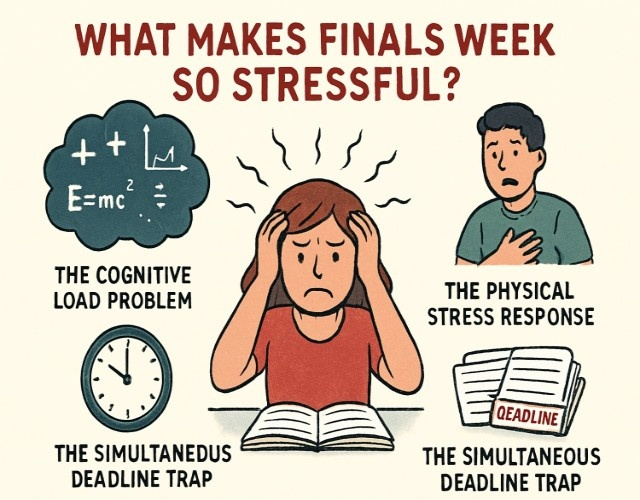
1. The Cognitive Load Problem
Your brain processes information through working memory with limited capacity. During finals, you're simultaneously managing information from four to six different courses requiring distinct knowledge bases, tracking exam times and locations, plus paper deadlines across multiple platforms, making constant priority decisions about which material deserves study time, and monitoring stress responses that consume cognitive resources needed for actual studying.
This cognitive overload explains why finals week feels different from regular busy periods. You're not just working hard; you're exceeding your brain's processing capacity, while sleep deprivation further reduces that capacity.
2. The Physical Stress Response
Academic stress triggers the same physiological responses as physical threats. Your body releases cortisol and adrenaline, preparing for fight-or-flight when you need to sit still and concentrate.
Chronic activation during finals week causes sleep disruption (students average 5-6 hours during finals compared to 7-8 hours during regular weeks), digestive problems (40-60% of students report gastrointestinal issues), immune suppression, making illness more likely, and muscle tension, causing headaches in 50-70% of students.
Understanding these physical responses helps you recognize that feeling terrible during finals is a normal biological reaction to abnormal pressure, not a personal weakness.
3. The Simultaneous Deadline Trap
Finals week stress intensifies because deadlines cluster together rather than spacing naturally. This creates problems, including no recovery periods between exams, impossible prioritization when three exams happen in 48 hours, and compressed study time where material that should receive 30-40 hours of review must be squeezed into 8-12 hours of cramming.
How Can You Prepare for Finals Week to Reduce Stress?
Reduce finals stress through advance preparation by creating a comprehensive exam schedule with specific study blocks allocated by exam weight and difficulty two weeks before finals begin, identifying your three highest-stakes exams that deserve 60-70% of available study time, preparing study materials including condensed notes and practice problems before finals week starts, and scheduling non-negotiable self-care including sleep hours, meal times, and exercise.
Students who begin finals preparation 10-14 days early report 40-50% lower stress levels and achieve grades averaging 5-10% higher than those who start studying when finals week begins.
1. Map Your Finals Schedule
Create a master calendar showing every deadline two weeks before finals. Collect all exam dates, times, locations, and formats. Note paper due dates and submission requirements.
Calculate the percentage each final counts toward your grade. This prevents the panicked midnight realization that your chemistry exam happens in nine hours. It also reveals if your workload genuinely exceeds manageable capacity, allowing time to seek help before crisis mode.
2. The 60-30-10 Priority Rule
Not all finals deserve equal study time. Allocate 60% of study time to your two or three highest-stakes exams, those worth 30-40% of your grade, in your major, or where you're currently borderline between letter grades. Allocate 30% to medium-stakes exams worth 20-25% where you have a comfortable grade cushion. Allocate 10% to lower-stakes finals worth 15-20% where you're already secure or where additional studying won't significantly change outcomes.
This feels counterintuitive because anxiety makes everything feel equally urgent. But strategic triage based on actual stakes produces better overall outcomes than attempting perfect preparation for everything.
3. Pre-Create Study Materials
Before finals week begins, reduce your semester's notes to 5-10 pages per class covering key concepts, formulas, and theories. Collect or create practice problems with solutions. Make flashcards, formula sheets, or concept maps. Write down concepts you don't understand to ask during review sessions.
Creating these materials before finals week means your limited time during finals goes toward active studying rather than passive note organization.
4. Schedule Non-Negotiable Self-Care
The biggest finals week mistake is treating sleep, meals, and exercise as optional luxuries. This backfires because sleep deprivation impairs memory retention by 20-40%, poor nutrition reduces concentration, and sedentary stress increases anxiety rather than relieving it.
Schedule these as fixed appointments: sleep from 11:30 PM to 6:30 AM (minimum 6-7 hours), meals at 8 AM, 1 PM, and 7 PM for 30 minutes each, and movement at 5 PM for 20-30 minutes. Protecting these fundamentals maintains the baseline cognitive function required for effective studying.
What Are the Best Stress Management Techniques During Finals?
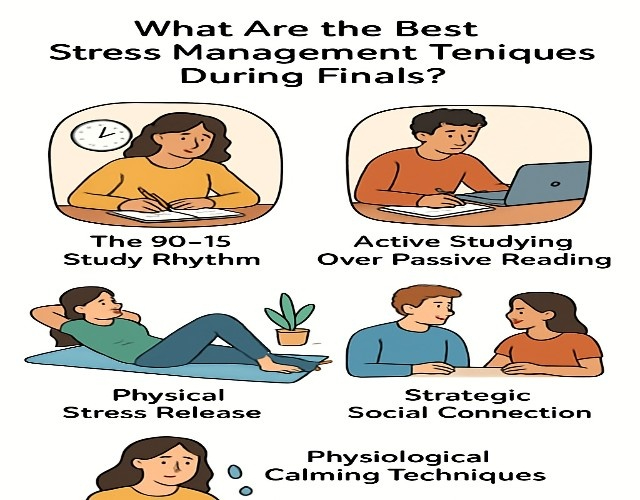
The most effective stress management techniques during finals combine 90-minute focused study blocks with 15-minute complete mental breaks, active recall practice rather than passive rereading, physical stress release through 20-30 minutes of daily movement, strategic social connection providing emotional support without extended time commitment, and physiological calming through controlled breathing. Students who implement structured stress management alongside studying report 30-45% lower cortisol levels during finals week and perform better on exams than peers who dedicate those 30-45 minutes to additional study time.
| Stress Management Techniques | How It Works? | Key Benefits |
|---|---|---|
| 90–15 Study Rhythm | Study in focused 90-minute blocks followed by 15-minute complete breaks away from your desk. | Improves information retention, reduces mental fatigue, and lowers stress compared to marathon study sessions. |
| Active Studying Over Passive Reading | Allocate 60% of time to high-value tasks (practice problems, self-testing, teaching aloud), 30% to medium-value review, and only 10% to passive reading. | Maximizes learning efficiency, boosts recall, and prevents false productivity. |
| Physical Stress Release | Engage in 20–30 minutes of daily movement such as walking, stretching, workouts, or yoga. | Reduces cortisol, improves focus, relieves tension headaches, and enhances study quality. |
| Strategic Social Connection | Schedule short, intentional social interactions like quick calls, shared meals, or focused study groups. | Provides emotional support, reduces isolation, and prevents burnout without sacrificing productivity. |
| Physiological Calming Techniques | Use breathing exercises and body-based relaxation methods during high-anxiety moments. | Quickly lowers anxiety, steadies focus, and helps regain mental control under pressure. |
How Do You Prioritize When Everything Feels Urgent?
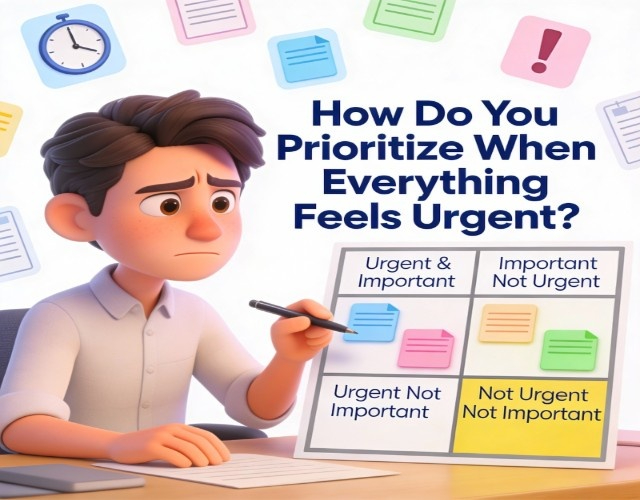
Prioritize effectively during finals by applying a weighted priority system calculating each final's grade impact multiplied by your current grade security to identify which exams deserve disproportionate study time, implementing hard cutoffs where you stop studying for lower-stakes exams once you've achieved sufficient preparation even if you feel you could improve further, and using decision frameworks that reduce the cognitive load of constant priority evaluation.
Students who prioritize based on calculated impact rather than emotional intensity achieve 8-12% higher semester GPAs because they optimize limited study time toward finals that meaningfully affect academic outcomes.
1. The Weighted Priority System
| Calculate actual priority by multiplying factors: Grade Weight × Current Security × Subject Difficulty = Priority Score. |
| For example, a chemistry final worth 35% of grade, where you currently have 78% (borderline B/C) in a very difficult subject, might score: 3.5 × 2 × 3 = 21 points. A psychology final worth 25% where you currently have 91% (secure A) in a medium difficulty subject might score: 2.5 × 1 × 2 = 5 points. |
This math reveals that chemistry deserves 4× more study time than psychology, despite psychology also being a final.
2. The Sufficient Preparation Cutoff
Perfectionism during finals is inefficient. Once you've reached sufficient preparation for a final, where you can explain key concepts without notes, correctly answer 70-80% of practice problems, can write coherent essay outlines, and understand the exam format, stop and redirect time to higher-priority exams.
Three hours of studying might improve your score from 70% to 85%. Three additional hours might improve it from 85% to 88%. Those same three hours on a higher-priority exam could prevent a grade catastrophe.
3. Emergency Triage for Impossible Situations
Sometimes your finals schedule genuinely exceeds manageable capacity. When you have three major finals in 36 hours plus papers due, identify the highest-impact final that gets 50-60% of your available study time. Determine acceptable outcomes for others; often, a B- instead of an A- doesn't change your semester GPA significantly.
When facing multiple high-stakes exams plus assignments worth 10-15% of grades in less critical courses, a trusted essay writing service support can handle those lower-weight assignments, allowing you to focus your limited capacity on exams where performance meaningfully impacts your academic outcomes and future opportunities.
Contact professors about impossible clusters before the last minute. Some allow earlier exam dates or extensions, especially if you're normally a strong student.
4. Decision Fatigue Management
Constant priority decisions deplete mental energy. Pre-decide daily schedules the night before. Standardize routine decisions by eating the same breakfast and wearing similar clothes. Use implementation intentions like "At 2 PM, I will go to the library's third floor, open my chemistry notes, and work on practice problems for 90 minutes." Limit social plans and commitments, as each "maybe" requires mental energy to reconsider throughout the day.
When Should You Seek Help During Finals Week?
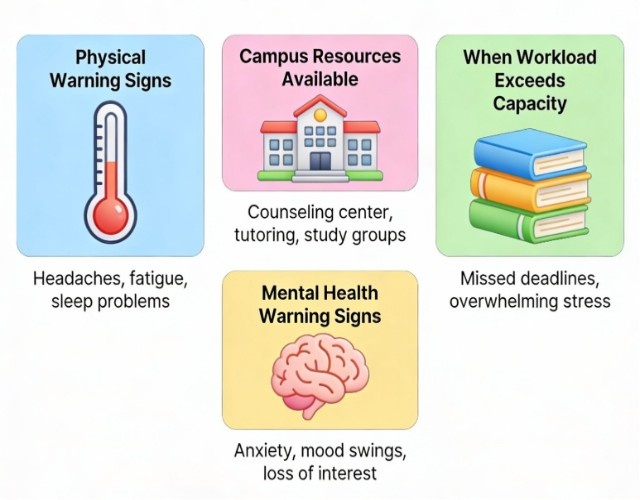
Seek help during finals week when physical symptoms interfere with basic functioning, including inability to sleep more than 3-4 hours nightly despite exhaustion, persistent nausea or digestive issues preventing normal eating, or anxiety attacks that disrupt studying, when you recognize that your current workload genuinely exceeds healthy capacity even with perfect time management, or when feelings of hopelessness emerge as stress responses.
Campus counseling centers report that 30-40% of finals week appointments are with students who delayed seeking help until experiencing crisis symptoms that could have been prevented with earlier intervention.
1. Physical Warning Signs
Stress crosses from normal into dangerous when sleep disruption becomes severe (less than 4 hours for 3+ consecutive nights, unable to fall asleep despite exhaustion), when physical symptoms persist (ongoing nausea, persistent headaches unrelieved by usual remedies, dizziness or chest tightness), or when concentration completely fails (reading the same page repeatedly without comprehension, unable to focus for even 15-minute periods).
These symptoms indicate your stress response has overwhelmed your body's capacity to cope. Pushing through risks, serious health consequences, and worsening academic performance.
2. Campus Resources Available
Most campuses offer multiple support services designed specifically for finals week pressure. Campus counseling centers provide crisis appointments, often with same-day availability during finals. Many offer drop-in stress management workshops, relaxation rooms with meditation guidance, and extended hours during finals week.
Academic support services, including writing centers, tutoring programs, and academic coaching, help students manage overwhelming workload situations before they become grade-threatening emergencies. These services are included in your tuition; using them isn't admitting failure; it's accessing resources you've already paid for.
3. When Workload Exceeds Capacity
Sometimes you've done everything right, started early, prioritized strategically, maintained self-care, and the workload still exceeds what one person can reasonably accomplish in the time available. This isn't personal failure; it's a structural problem with academic calendaring.
When you're genuinely overextended, a reliable essay writing service can provide support for lower-stakes assignments, allowing you to focus your energy on the highest-priority exams while maintaining your health and wellbeing. This strategic delegation prevents the complete breakdown that occurs when you attempt impossible things without support.
4. Mental Health Warning Signs
Seek immediate help if you experience feelings of hopelessness extending beyond normal stress, thoughts of self-harm or that others would be better off without you, complete inability to care about outcomes that previously mattered, panic attacks that don't respond to calming techniques, or substance use increasing significantly to cope with stress.
These signs indicate stress has triggered mental health concerns requiring professional intervention. Campus counseling can provide immediate crisis support. National resources include the Crisis Text Line (text HOME to 741741) and the 988 Suicide and Crisis Lifeline.
Final Recommendations
Managing finals week stress requires accepting that you can't perfectly prepare for everything when deadlines cluster impossibly. Strategic prioritization based on calculated impact rather than emotional urgency, maintenance of baseline self-care even when it feels like a luxury, and knowing when to seek help all matter more than additional study hours.
Key strategies that work:
- Start preparation 10-14 days before finals begin.
- Prioritize using the 60-30-10 rule based on actual grade stakes.
- Study in focused 90-minute blocks with complete 15-minute breaks.
- Maintain 6-7 hours of sleep and 20-30 minutes of physical movement daily.
- Seek help when workload exceeds capacity or physical symptoms emerge.
Finals week challenges everyone, but systematic stress management produces better grades and protects your health better than sacrificing wellbeing for unsustainable study hours. When you're managing impossible deadlines where delegation becomes necessary for survival, a fast essay writing service can provide the strategic support that allows you to focus on what matters most while maintaining your mental and physical health.
Your ability to manage stress, prioritize strategically, and maintain basic well-being during high-pressure periods will serve you throughout your career. Finals week is practice for real-world situations requiring you to perform well under constraints. Learning these skills now pays dividends far beyond this semester.