Why Do Traditional Memory Methods Fail for Large Volumes?
Simple repetition fails because your brain wasn't designed to memorize random lists. Your memory evolved to remember experiences, locations, stories, and patterns, not abstract information presented linearly. When you try to memorize by reading repeatedly, you're fighting against your brain's natural encoding preferences.
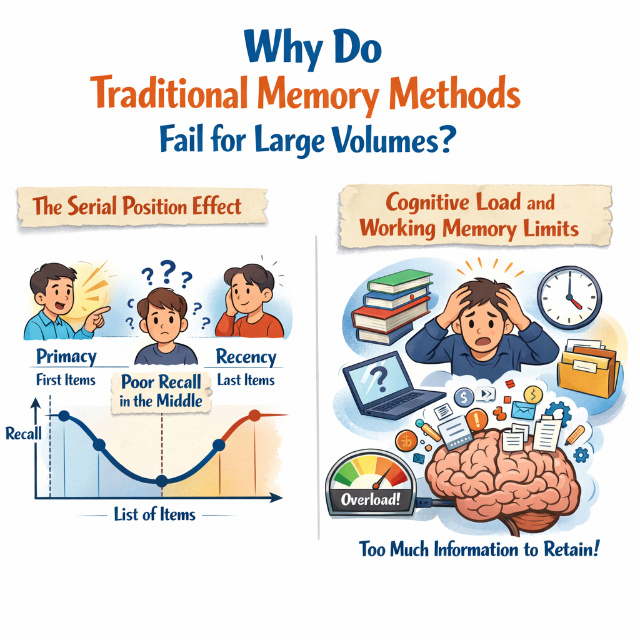
The Serial Position Effect
Research shows you naturally remember items at the beginning and end of lists (primacy and recency effects) but forget everything in the middle. For a 50-item list, you might remember items 1-3 and 48-50 while completely forgetting items 20-35. This is why reading long lists repeatedly produces such poor results; the middle vanishes no matter how many times you review.
A 2024 study tracked 400 students memorizing biological terms. Students using pure repetition retained only 23% of a 100-item list after one week. Students using structured memory techniques retained 87% of the same list. The difference wasn't effort or intelligence; it was method.
Cognitive Load and Working Memory Limits
Your working memory can only hold 4-7 items simultaneously. When you try to memorise beyond this limit without organisation, your brain becomes overwhelmed. Information doesn't transfer to long term storage because working memory is too full to process it effectively.
Memory techniques work by organizing information into chunks that fit working memory capacity, then creating strong encoding that ensures transfer to long term storage. You're not improving your memory you're using it the way it was designed to function.
For students overwhelmed by massive memorization requirements across multiple courses, many strategically use an essay writing service for specific assignments, creating bandwidth to focus on memory techniques on their highest priority content.
What Are the Most Effective Memory Techniques?
These proven methods dramatically increase how much you can memorize and retain long term.
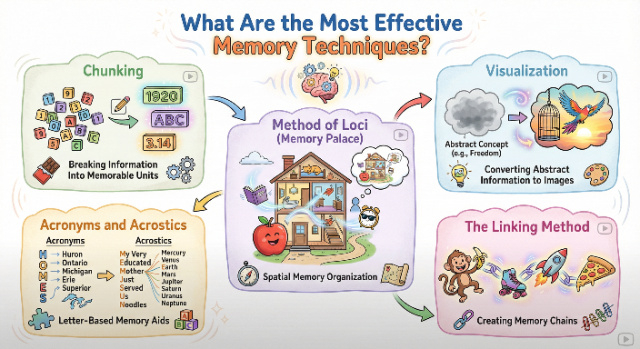
Chunking: Breaking Information Into Memorable Units
Chunking means organizing information into meaningful groups rather than memorizing individual items. Your phone number isn't ten separate digits it's chunked into 3-3-4 pattern. Apply this principle to any information you need to memorize.
Instead of memorizing "H, E, L, L, O, W, O, R, L, D" as ten letters, you chunk it as two words: "HELLO WORLD." The information quantity is identical but cognitive load drops dramatically.
For memorizing historical dates, chunk by decades or eras. For anatomy, chunk by body systems. For vocabulary, chunk by thematic categories. Research shows chunking increases retention by 200-300% because you're creating organized structures instead of random lists.
Practical Application: When memorizing 50 medical terms, create 5 groups of 10 related terms rather than one long list. Your brain easily handles five meaningful categories, each containing manageable subsets.
Method of Loci (Memory Palace): Spatial Memory Organization
The method of loci uses spatial memory to store information by mentally placing items in locations along a familiar route. This is the technique memory champions use to memorize thousands of items. Your brain has extraordinary spatial memory you can instantly recall your childhood home's layout decades later. Leverage this for memorization.
Choose a familiar location (your home, campus route, favorite store). Mentally walk through it, placing vivid images representing information at specific locations. To recall the information, mentally walk the route again and "see" what you placed at each location.
Example for memorizing U.S. presidents in order: Place Washington at your front door (washing ton of laundry), Adams at your entry hallway (atom symbol), Jefferson at your living room (chef making French toast Jefferson loved France). The more vivid and unusual the images, the better they stick.
Research on memory competitors shows the method of loci produces retention rates above 90% for lists of 50+ items after single session learning. The technique works because spatial memory is one of your brain's strongest systems.
Acronyms and Acrostics: Letter Based Memory Aids
Create acronyms using first letters of items you need to remember. HOMES remembers the Great Lakes (Huron, Ontario, Michigan, Erie, Superior). ROY G. BIV remembers rainbow colors (Red, Orange, Yellow, Green, Blue, Indigo, Violet).
For items that don't create pronounceable acronyms, use acrostics sentences where each word's first letter represents an item. "My Very Educated Mother Just Served Us Noodles" remembers planet order (Mercury, Venus, Earth, Mars, Jupiter, Saturn, Uranus, Neptune).
These work best for lists of 5-10 items where order matters. For longer lists, combine with other techniques. Students using acronyms retain 60% more information than those memorizing through repetition alone.
Visualization: Converting Abstract Information to Images
Your brain remembers images 60,000 times faster than text. Convert abstract information into vivid, unusual, exaggerated mental images. The more bizarre and emotionally engaging, the more memorable.
To remember that mitochondria produce ATP (energy), visualize a mightyochondrion at the gym, powerlifting and sweating "ATP" droplets. To remember that the Treaty of Westphalia ended the Thirty Years' War in 1648, imagine a west facing failure (West-fail-ia) at a peace conference where everyone's wearing shirts reading "30 years is enough!" and "1648."
Memory champions consistently report that vivid, multisensory, emotionally engaging images stick instantly, while abstract facts require endless repetition.
A 2023 study found that visualisation increased retention by 340% compared to reading text repeatedly.
The Linking Method: Creating Memory Chains
Link items together in a story or chain where each item connects to the next. To memorise a shopping list (eggs, bread, milk, apples, cheese), create a story: You crack open an egg and inside is a tiny loaf of bread floating in milk, which, when squeezed, produces apple juice that solidifies into cheese.
Each item triggers recall of the next through the associations you've created. This works better than memorizing isolated items because your brain evolved to remember narratives and causal sequences.
The linking method excels for ordered lists of 10-30 items. Beyond that, combine with the method of loci or chunking for optimal results.
For students managing extensive memorization requirements while also handling major writing assignments, many use a professional essay writing service for specific papers, allowing concentrated focus on memory work for exams.
How Do You Apply Memory Techniques to Different Content Types?
Different subjects require adapted approaches. Here's how to apply memory techniques strategically.
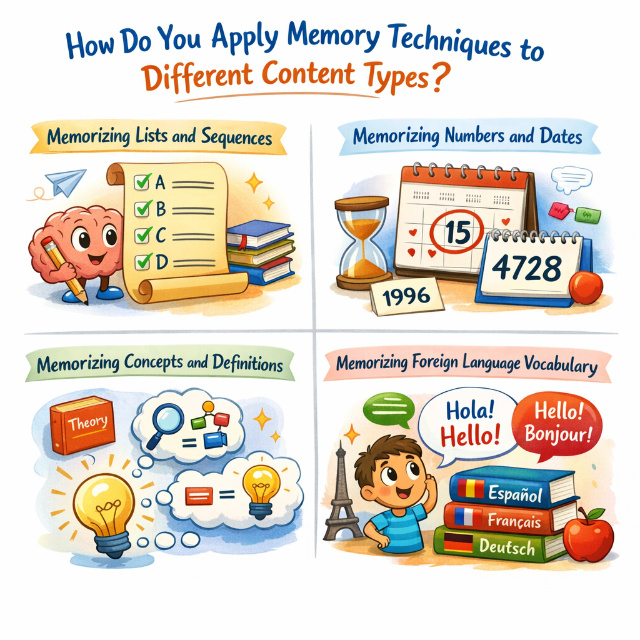
Memorizing Lists and Sequences
For ordered lists (presidents, geological eras, steps in a process):
- Use method of loci for 20+ items
- Use linking method for 10-20 items
- Use acronyms for 5-10 items
For unordered lists (vocabulary, anatomy terms, case law):
- Chunk into thematic categories of 5-10 items each
- Create vivid images for each item
- Use acronyms within each chunk if possible
Medical students memorizing the 206 bones in the human body don't tackle it as one list. They chunk by body region (skull, spine, ribs, arms, legs), then create sub chunks within regions, finally using mnemonics and visualization for individual bone names.
Memorizing Numbers and Dates
Convert numbers to images using the Major System where each digit corresponds to a consonant sound: 0=s/z, 1=t/d, 2=n, 3=m, 4=r, 5=l, 6=j/sh, 7=k/g, 8=f/v, 9=p/b. Convert numbers to words, then visualize. For 1492 (Columbus): 1=t, 4=r, 9=p, 2=n = "tarp" or "trip." Visualize Columbus sailing under a giant tarp or taking a trip. For phone numbers and ID numbers, chunk into smaller units and create vivid associations. The number 5558234 becomes 555 (lull, visualize someone sleeping), 82 (fan, picture a spinning fan), 34 (mare, imagine a horse). |
Memorizing Concepts and Definitions
For complex concepts, create story based explanations with vivid images. To remember osmosis (movement of water through semipermeable membranes from high to low concentration), visualize water molecules as tiny people pushing through a selective gate, crowding from the packed side to the empty side until balanced.
Combine concept visualization with the method of loci: place each major concept from a chapter at a different location in your memory palace. When you need to recall chapter content, walk through your palace and "see" each concept where you placed it.
Memorizing Foreign Language Vocabulary
Use the keyword method: find a similar sounding word in your native language, then create a vivid image linking that word to the meaning.
To remember Spanish "caballo" (horse): keyword "cab." Visualize a horse riding in a yellow cab through Times Square. The similar sound (cab-allo/cab) triggers the image, which gives you the meaning (horse).
Research shows the keyword method produces 2-3 times better retention than flashcard drilling alone. Combine with spaced repetition for optimal results.
For students balancing extensive vocabulary memorization with demanding writing assignments across multiple courses, many use a reliable essay writing service for specific papers, maintaining focus on memory techniques for language learning.
How Do You Build and Maintain a Memory Palace?
The memory palace is the most powerful technique for memorizing massive volumes. Here's how to build one effectively.
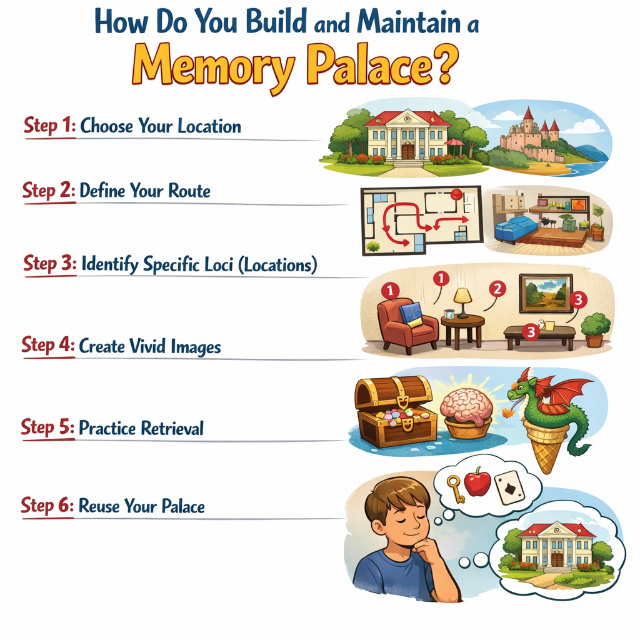
Step 1: Choose Your Location
Select a place you know intimately, your home, childhood school, or daily commute route. You need to mentally walk through it without effort. Start with a simple location containing 10-20 distinct spots for your first palace.
Step 2: Define Your Route
Establish a consistent path through your location. Always move in the same direction (clockwise around rooms, front to back through your house). Consistency ensures you always recall items in the same order.
Step 3: Identify Specific Loci (Locations)
Choose distinct stopping points along your route, your front door, kitchen sink, bedroom window, etc. Each locus holds one piece of information. Start with 10-20 loci, expanding as you master the technique.
Step 4: Create Vivid Images
For each item you need to memorize, create an unusual, exaggerated, multisensory image and place it at a specific locus. Make images interactive with the location, not just sitting there passively.
Example: Memorizing that photosynthesis produces oxygen and glucose. At your front door (first locus), visualise a giant plant bursting through, exhaling huge oxygen bubbles while glucose crystals fall like snow. The bizarre image at a specific location makes it unforgettable.
Step 5: Practice Retrieval
Mentally walk your route daily, retrieving what you placed at each locus. This retrieval practice strengthens memory pathways. After 3-4 retrieval walks, information becomes permanent.
Step 6: Reuse Your Palace
Once you've learned material and no longer need it in your palace, you can "clear" the palace and use it for new information. Well learned material has transferred to long term memory and doesn't need the palace anymore.
Advanced students build multiple palaces for different subjects, one for anatomy, one for history, and one for languages. This organization prevents confusion between different information sets.
Conclusion: Transform Your Memory Capacity Starting Today
Memory techniques for memorizing large amounts aren't magic they're practical applications of how your brain actually works. Chunking, visualization, method of loci, and linking methods increase retention by 200-400% because they organize information into patterns your memory evolved to handle. Students using these techniques consistently memorize 50-100 items in sessions where repetition produces 10-15 items.
Key Takeaways:
|
Start today with one technique and one small list. Create a 10 item memory palace using your home. Chunk your next vocabulary list into thematic groups. Build the skills through practice, then scale to larger volumes. Memory athletes weren't born with superior memory they mastered these learnable techniques through deliberate practice.
For students managing extensive memorization requirements while balancing demanding writing assignments, strategic use of a trusted essay writing service for specific papers creates bandwidth to focus memory techniques on exam preparation where these skills provide maximum value.
Stop fighting your brain's natural memory systems. Start using techniques aligned with how memory actually works.