-19771.jpg)
What Slows Down Your Reading Speed?
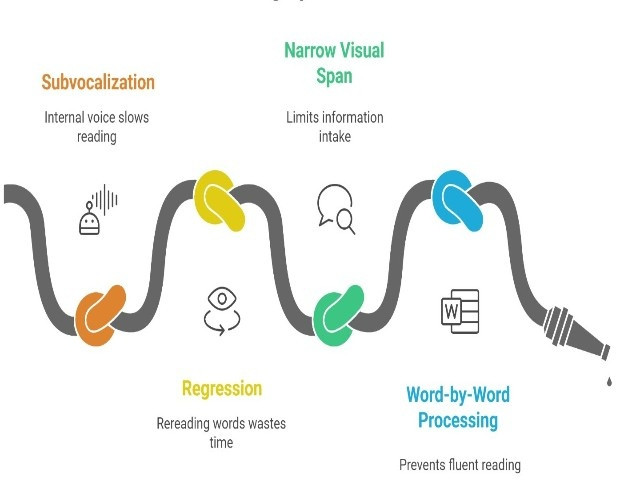
Reading speed is limited by subvocalization where you mentally pronounce each word limiting speed to speaking pace of 150-250 words per minute, regression where eyes jump backward rereading text accounting for 10-30% of reading time, narrow focus processing only 1-2 words per eye fixation requiring more fixations per line, word-by-word reading rather than chunking related words together, poor concentration causing mind-wandering requiring rereading, inadequate vocabulary forcing you to pause at unfamiliar words, and lack of reading purpose making you read everything at same pace regardless of importance.
Research indicates that untrained readers make 4-6 eye fixations per line of text, each lasting 200-250 milliseconds, with 10-15% of time spent on regressions, moving eyes backward. Studies show that eliminating just regression behavior increases reading speed by 15-25% without comprehension loss, while reducing subvocalization can double reading speed once mastered.
1. Subvocalization: The Biggest Speed Limiter
Most people learned to read by sounding out words aloud, then internalized this as silent pronunciation. Your eyes can process words far faster than your mouth can speak them, but mental pronunciation restricts reading speed to speaking pace.
Research shows subvocalization limits reading to 150-250 words per minute, the pace of normal speech, even though your brain can process visual information at 400-700+ words per minute.
Why does it persist?
- Deeply ingrained habit from learning to read as children.
- Creates a feeling of "hearing" the text, improving perceived comprehension.
- Helps with difficult or important passages where careful processing matters.
- Automatic response requiring conscious effort to overcome.
| Studies indicate that 85-90% of readers subvocalize at least partially, with complete elimination being difficult and sometimes counterproductive for complex material requiring deep processing. |
2. Regression: The Hidden Time Thief
Your eyes don't move smoothly across lines; they jump in quick movements called saccades, pausing briefly at fixation points. Regression occurs when eyes jump backward to reread words or phrases.
Research shows untrained readers regress 10-15 times per 100 words, with each regression costing 200-400 milliseconds. Over a 300-page textbook, regressions add 2-4 hours of unnecessary reading time.
Common regression triggers:
- Lack of focus, causing missed information.
- Uncertainty about understanding requiring confirmation.
- Unfamiliar vocabulary or complex concepts.
- Poor lighting or formatting makes text harder to process.
- Habit rather than actual comprehension problems.
| Studies reveal that 60-70% of regressions are habitual rather than necessary, meaning you're rereading text you actually did process the first time. |
3. Narrow Visual Span
Average readers process 1-2 words per fixation, requiring 6-8 fixations per line of typical textbook text. Trained speed readers expand peripheral vision processing 3-5 words per fixation, cutting fixations per line to 2-3. This fundamental shift, reading word groups rather than individual words, accounts for 40-50% of speed reading improvement. Research shows peripheral vision training increases reading speed by 30-50% within 4-6 weeks of consistent practice.
4. Word-by-Word Processing
Reading "The student went to the library" as seven separate words is far slower than processing "The student" and "went to the library" as two meaningful chunks. Your brain naturally groups related words when processing spoken language, but most readers don't apply this to written text.
| Research indicates chunking reduces cognitive load while actually improving comprehension by 10-15% as your brain processes meaningful phrases rather than reconstructing meaning from individual words. |
What Are the Most Effective Speed Reading Techniques?
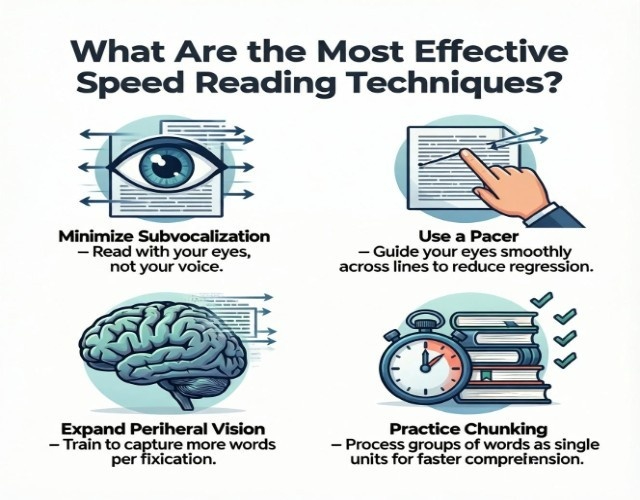
The most effective speed reading techniques include using a visual pacer like your finger or pen moving steadily under words to prevent regression and maintain forward momentum, practicing peripheral vision expansion exercises to increase words processed per fixation from 1-2 to 3-5 words, minimizing subvocalization through distraction techniques or faster reading speeds that make pronunciation impossible, learning to skim strategically by reading first and last sentences of paragraphs plus topic sentences for less critical material, and developing meta-guiding where you move your finger down the center of the page in zigzag pattern training eyes to use peripheral vision.
Research shows that students practicing these techniques 15-20 minutes daily increase reading speed by 40-60% within 4-6 weeks while maintaining 70-80% comprehension. Studies indicate that combining multiple techniques produces better results than focusing on single methods, with 75-80% of speed reading improvement coming from eliminating regressions and expanding visual span rather than reducing subvocalization.
1. The Pointer/Pacer Method
How it works:
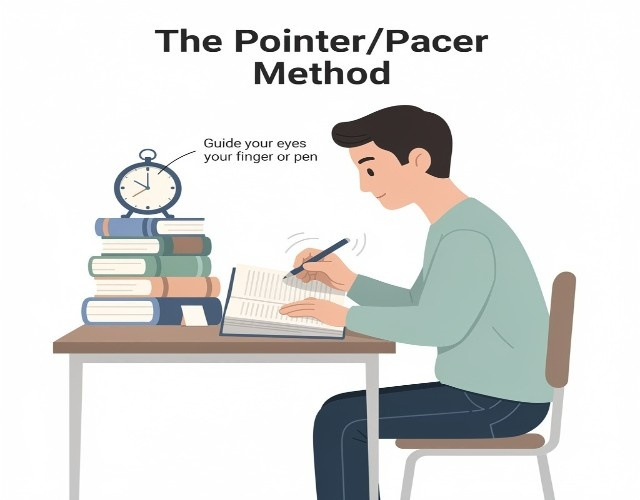
- Use your finger, pen, or pointer to guide your eyes across lines.
- Move the pointer slightly faster than comfortable, forcing your eyes to keep up.
- Prevents regression by giving eyes a target to follow.
- Maintains focus, reducing mind-wandering.
Practice steps:
|
Research shows the pointer method increases reading speed by 20-35% immediately, with no training, simply by preventing regression and maintaining focus. Studies indicate 70-75% of readers experience measurable improvement on the first attempt.
2. Peripheral Vision Expansion

Train your eyes to process more words per fixation through deliberate practice:
Exercise 1: Focus expansion
|
Exercise 2: Word group reading
|
Exercise 3: Forced speed reading
|
Research indicates peripheral vision exercises increase words per fixation by 40-60% after 3-4 weeks of daily 15-minute practice sessions, with 65-70% of improvement being permanent.
3. Reducing Subvocalization
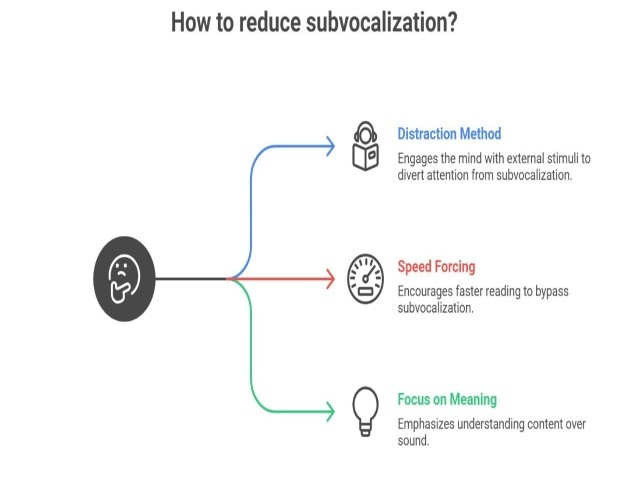
Complete elimination is difficult and unnecessary, but reducing subvocalization significantly improves speed:
Technique 1: Distraction method
|
Technique 2: Speed forcing
|
Technique 3: Focus on meaning, not sound
|
Studies show these techniques reduce subvocalization by 40-60%, increasing reading speed to 350-500 words per minute for most practitioners, though complete elimination is rare and may not be desirable for complex material.
4. Strategic Skimming vs. Speed Reading
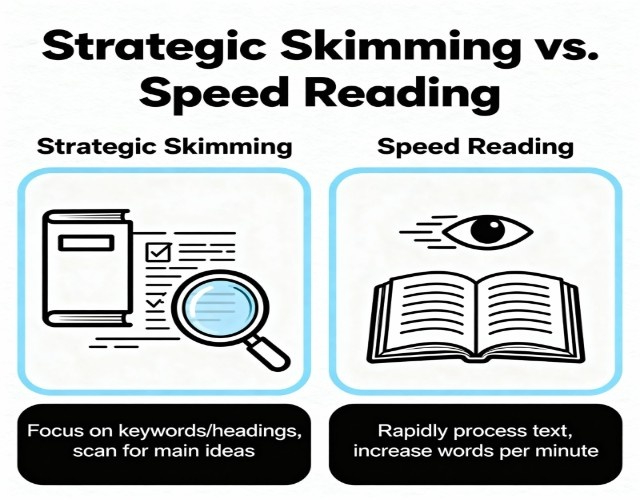
Know when to skim versus when to speed read:
Appropriate for skimming:
|
Requires careful speed reading:
|
Skimming technique:
|
Research shows strategic skimming reduces reading time by 60-75% with 40-50% information retention, sufficient for supplemental material not requiring deep understanding.
When facing overwhelming reading loads where even strategic skimming leaves you short on time, an essay writing service can handle assignments in less critical courses, allowing you to focus reading time on essential materials directly impacting your learning and grades.
How Do You Practice Speed Reading Effectively?
Practice speed reading effectively by starting with easier material like novels or magazine articles rather than dense textbooks allowing skill development without comprehension pressure, dedicating 15-20 minutes daily to focused practice using timers and tracking progress, implementing progressive speed increases where you read slightly faster than comfortable gradually raising baseline speed, testing comprehension regularly through summarization or questions to ensure techniques don't sacrifice necessary understanding, and being patient as meaningful improvement typically requires 4-8 weeks of consistent daily practice.
Research shows that students practicing 15-20 minutes daily improve reading speed by 35-50% after one month and 60-80% after three months. Studies indicate that inconsistent practice yields 40-50% less improvement than daily practice, with skill regression occurring within 2-3 weeks if practice stops before habits solidify.
1. Structured Practice Plan
| Weeks | Focus Area | Daily Time | Daily Practice Routine |
|---|---|---|---|
| Week 1–2 | Baseline & Pacer Introduction | 15 minutes | • Measure baseline (read 3 min, count words, divide by 3) • Practice pointer/pacer method with comfortable material •Gradually increase pointer speed by 10–15% • End with timed reading and track WPM |
| Week 3–4 | Peripheral Vision Expansion | 20 minutes | • 5 min: Peripheral vision exercises using divided columns. • 10 min: Speed reading with pacer • 5 min: Comprehension check via short summary. |
| Week 5–6 | Subvocalization Reduction | 20 minutes | • Use distraction techniques (counting, humming) • Force reading speed beyond the subvocalization limit • Visualize concepts instead of hearing words • Track speed improvements |
| Week 7–8 | Integration & Refinement | 15–20 minutes | • Combine all techniques naturally •Practice with real course materials • Adjust approach by content type • Reinforce and solidify new habits |
Research shows this structured progression produces 50-70% better results than unfocused practice, with 80-85% of students completing the program achieving 300-500 words per minute reading speeds.
2. Tracking Progress Systematically
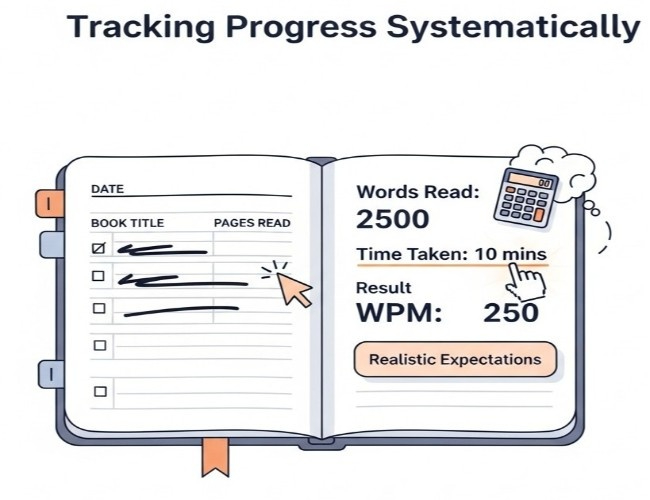
Create a reading log:
|
Calculate words per minute:
| 1. Read for exactly 3 or 5 minutes. 2. Count total words read. 3. Divide by minutes (words ÷ 3 = WPM). 4. Test comprehension through 3-5 questions. 5. Calculate comprehension percentage. |
Realistic expectations:
| Week 1: 200-250 WPM baseline for most students. |
| Week 4: 275-325 WPM (25-35% improvement). |
| Week 8: 350-450 WPM (50-75% improvement). |
| Week 12: 400-500 WPM (75-100% improvement). |
Studies indicate visible progress motivates continued practice, with students tracking metrics showing 60-70% better adherence to practice schedules compared to those practicing without measurement.
3. Comprehension Maintenance Strategies
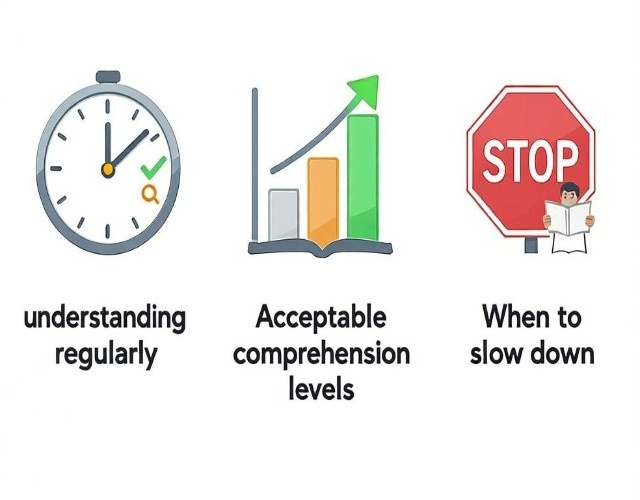
Test understanding regularly:
|
Acceptable comprehension levels:
| Comprehension Level | Interpretation | Recommended Action |
|---|---|---|
| 85–90% | Full comprehension | Normal reading speed is appropriate |
| 70–80% | Strong understanding | Suitable for speed reading most academic material |
| 60–70% | Basic understanding | Acceptable for less critical or supplemental readings |
| Below 60% | Insufficient comprehension | Reading speed is too fast; slow down |
When to slow down:
|
Research shows speed reading works best for narrative, descriptive, and moderately technical content, producing 15-25% comprehension loss on highly technical or mathematical material where slower reading is more efficient.
When Should You Use Speed Reading vs. Normal Reading?
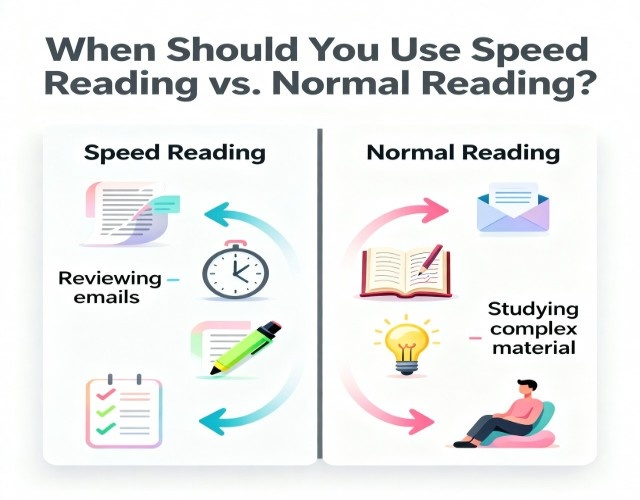
Use speed reading for survey reading before detailed study, supplemental or background materials not directly tested, review of previously learned content, leisure reading, news articles and general interest pieces, and initial passes through research sources to determine relevance, while maintaining normal or slower reading speeds for complex new concepts requiring deep processing, mathematical or technical content with formulas and diagrams, material you'll be tested on extensively, content requiring critical analysis and evaluation, literary analysis requiring close reading, and anything you need to remember long-term or apply immediately.
Research indicates that students who adjust their reading speed based on material type and purpose achieve 20-30% better academic outcomes than those who read everything at the same pace.
Studies show that 55-65% of assigned college reading can be speed read effectively, while 35-45% genuinely requires slower, careful reading, meaning strategic application of speed reading can reduce total reading time by 30-40% without sacrificing necessary learning.
1. Material Type Decision Matrix
Speed reading appropriate (70-80% comprehension acceptable)
| Material Type | When Speed Reading Is Appropriate | Goal of Speed Reading |
|---|---|---|
| Textbook Chapters | First pass before detailed study | Identify key concepts, locate sections needing focus, and build a mental framework |
| Supplemental Articles | When content is not directly tested | Gain context, review familiar topics, and absorb supporting evidence |
| Review Materials | After initial learning | Refresh known concepts and complete practice efficiently |
| Research Source Evaluation | Early screening stage | Assess relevance, decide which sources need deep reading, and flag key sections |
Careful reading required (85-90%+ comprehension needed
| Material Type | When Careful Reading Is Required | Reason for Slower Reading |
|---|---|---|
| Primary Learning Materials | First exposure to complex concepts; exam-covered chapters; foundational content | Full comprehension is essential for future topics and assessments |
| Technical Content | Math proofs, formulas, scientific mechanisms, code, technical specifications | Precision and accuracy are required; skipping details leads to errors |
| Analysis-Required Materials | Literary texts, primary sources, and argumentative content | Requires interpretation, critical thinking, and immediate application |
2. Purpose-Based Speed Adjustment
Reading purpose determines the appropriate speed
| Reading Purpose | Recommended Speed (WPM) | Primary Goals |
|---|---|---|
| General Understanding | 400–600 WPM | Grasp main ideas, key points, basic arguments, build context, and prepare for deeper study |
| Learning & Retention | 250–350 WPM | Remember exam material, apply concepts in assignments, and build a detailed understanding |
| Analysis & Evaluation | 150–250 WPM | Critically evaluate arguments, perform close reading, analyze logic, and compare perspectives |
| Memorization & Application | 100–200 WPM | Master formulas, definitions, procedures, technical details, and precise facts |
Studies indicate flexible speed adjustment based on purpose improves both efficiency and effectiveness, with students practicing variable speeds completing assignments 35-45% faster while scoring 5-10% higher on comprehension assessments.
What Are Common Speed Reading Myths and Realities?
Common speed reading myths include the belief that speed readers achieve 1000+ words per minute with full comprehension which research shows is impossible as comprehension drops below 50% above 700-800 WPM, that photographic memory or special abilities are required when actually technique and practice drive improvement, that speed reading works equally well for all material types when actually it's most effective for narrative and descriptive content but less useful for technical or mathematical material, that you must eliminate subvocalization completely when partial reduction is sufficient and easier to achieve, and that speed reading sacrifices understanding when properly applied it reduces comprehension by only 10-20% while doubling reading speed creating net efficiency gains.
Research demonstrates that average trained speed readers achieve 400-700 words per minute with 70-80% comprehension, which is 2-3 times faster than untrained readers but far below exaggerated claims of 1000+ WPM.
Studies show these realistic speeds still reduce total reading time by 40-60% making them highly valuable for managing college reading loads.
Myth 1: "You Can Read 1000+ WPM with Full Comprehension."
Reality:
- Average college students read 200-250 WPM with 85-90% comprehension.
- Trained speed readers achieve 400-700 WPM with 70-80% comprehension.
- Elite speed readers reach 800-1000 WPM with 60-70% comprehension.
- Above 1000 WPM, comprehension drops below 50% making it skim reading.
| Research shows physical limitations of eye movement and cognitive processing set upper bounds around 700-800 WPM for reading with meaningful comprehension. Claims of 1000-2000+ WPM represent skimming, not true reading. |
Myth 2: "Speed Reading Destroys Comprehension"
Reality:
- Speed reading reduces comprehension by 10-20% typically.
- For supplemental material, 70-80% comprehension is often sufficient.
- Net efficiency gain: 2x speed with 80% comprehension = 1.6x information per time unit.
- Strategic application means speed reading appropriate materials, not everything.
| Studies show the comprehension trade-off is worthwhile for 50-60% of college reading, where perfect understanding isn't necessary, while careful reading remains important for complex learning materials. |
Myth 3: "Subvocalization Must Be Eliminated Completely"
Reality:
- Complete elimination is extremely difficult and often counterproductive.
- Reducing by 40-60% provides most speed benefits.
- Some subvocalization helps comprehension of complex material.
- Complete elimination may reduce comprehension more than speed gained justifies.
| Research indicates that partial subvocalization reduction to the 350-500 WPM range provides an optimal balance of speed and comprehension for most academic reading. |
Myth 4: "Speed Reading Requires Special Abilities"
Reality:
- Technique and practice determine improvement, not innate ability.
- 75-80% of students achieve 40-60% speed increases with 4-8 weeks of practice.
- No special cognitive abilities required beyond normal reading capability.
- Consistent practice matters more than natural talent.
| Studies show that motivation and consistent practice predict speed reading success better than baseline reading ability or cognitive testing scores. |
Myth 5: "Apps and Courses Are Necessary"
Reality:
- Basic techniques can be learned and practiced independently.
- Consistent daily practice matters more than expensive courses.
- Free resources and self-directed practice produce similar results to paid programs.
- The main value of courses is structured practice and accountability.
| Research indicates self-taught speed readers using free resources achieve 80-90% of the improvement seen in formal training programs when they maintain consistent daily practice schedules. |
Key Takeaways
Speed reading techniques can significantly improve college reading efficiency when applied strategically:
- Average students read 200-250 WPM while trained speed readers achieve 400-700 WPM, representing a realistic 2-3x speed improvement with 70-80% comprehension maintained
- Most effective techniques include using visual pacers to prevent regression, expanding peripheral vision to process word groups, reducing subvocalization, and strategic skimming for appropriate materials
- Improvement requires consistent practice with 75-80% of students achieving 40-60% speed increases after 4-8 weeks of daily 15-20 minute practice sessions
- Speed reading works best for narrative and descriptive content, moderately well for expository academic writing, and poorly for highly technical or mathematical material
- Strategic application means speed reading 50-60% of college reading (supplemental materials, reviews, surveys) while carefully reading 40-50% (complex new concepts, technical content, tested material)
Speed reading represents a valuable tool for managing overwhelming college reading loads, but not a universal solution for all reading tasks. The key is developing flexible reading speeds adjusted to material type, difficulty, and purpose rather than attempting to speed-read everything uniformly.
When practiced consistently and applied strategically, speed reading techniques reduce total reading time by 30-50% creating substantial hours for other academic demands or much-needed rest.
Understanding that different materials warrant different reading speeds allows you to work smarter rather than just faster. Survey reading at 500+ WPM provides an efficient overview, moderate speed reading at 350-450 WPM handles most learning materials adequately, and slower reading at 200-300 WPM remains appropriate for complex or critical content. This variable-speed approach optimizes both efficiency and effectiveness across your reading demands.
When reading volume becomes genuinely unsustainable even with improved efficiency, recognizing workload limits and seeking strategic support through a reliable essay writing service for assignments in less critical courses during peak-demand periods allows you to focus reading time on essential materials that directly advance your learning and understanding rather than attempting impossible completeness that leaves you exhausted and retaining nothing.
Download our free Speed Reading Practice Tracker & Workbook with 8-week structured exercises, daily progress logs, and comprehension checks based on proven techniques that increase reading speed by 40-60% within 4-8 weeks.