ASA Citation Style Guide (Paper Setup Specifications)
Page Layout:
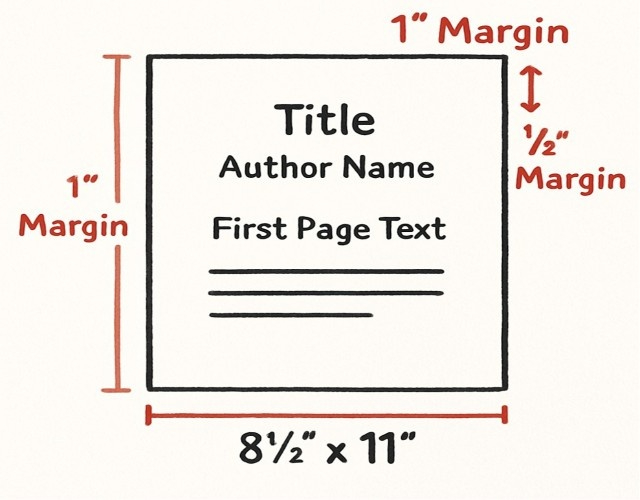
- Margins: 1.25 inch LEFT, 1 inch top/bottom/right
- Font: Arial 12pt (entire paper, including references)
- Spacing: Double-space everything, no extra spaces anywhere
- Indent: 0.5 inch first line of each paragraph (Tab key)
- Header: Running head (UPPERCASE, max 50 characters) flush left, page number flush right
Title Page Elements:
- Running head and page number (top of page)
- Paper title (centered, bold, middle of page)
- Your full name (centered, below title)
- Institution/department
- Course info or journal submission details
- Instructor name and date (student papers)
Remember! No separate abstract page for most student papers; however, you still need to check your assignment requirements.
References Page:
- Starts new page after main text
- "REFERENCES" centered at top (all caps, not bold)
- Double-spaced entries
- Hanging indent (first line flush left, next lines indent 0.5 inch)
- Alphabetize by author's last name
ASA In-Text Citation Format
The Signature ASA Colon
ASA's defining feature: colon before page numbers, no "p." or "pp."
- Basic citation:
Social mobility varies by region (Martinez 2024). - Citation with page number:
Social mobility varies significantly (Martinez 2024:112). - Compare to APA (wrong for ASA):
Wrong: (Martinez, 2024, p. 112) is APA format, not ASA
Right: (Martinez 2024:112) is ASA format
Author in Text vs Parenthetical
- Author named in sentence:
Martinez (2024:112) demonstrates significant regional variation. - Parenthetical (author not named):
Regional variation remains significant (Martinez 2024:112). - General reference (no page):
Martinez (2024) examined urban social mobility patterns.
Multiple Authors
Two authors:
- In text: Smith and Johnson (2024:45) found...
- Parenthetical: (Smith and Johnson 2024:45)
Three or more authors:
- All citations: (Rodriguez et al. 2023:78)
- Narrative: Rodriguez et al. (2023:78) demonstrate...
Direct Quotes
Short quote (under 40 words):
The research confirms "social capital facilitates upward mobility" (Chen 2024:156).
Long quote (40+ words):
Indent entire quote 0.5 inch, double-space, no quotation marks, citation after final period:
Chen (2024:156) explains the mechanisms through which social capital operates in urban communities, demonstrating that network density and resource access combine to create mobility opportunities that transcend traditional socioeconomic barriers.
Special Cases
No author: Use title:
- Article: ("Urban Sociology" 2024:23)
- Book: (Sociology Handbook 2024:89)
Organization author:
(American Sociological Association 2024:12)
First use can spell out, later abbreviated: (ASA 2024:12)
Multiple works, one citation:
(Brown 2022:45; Garcia 2023:67; Wilson 2024:23)
Secondary source:
Durkheim's theory (qtd. in Ritzer 2024:89)
List only Ritzer in References, the source you read.
ASA CITATIONS CONFUSING YOU?
Need Help with ASA Citations? We’ve Got You Covered
- Professor-approved ASA style for sociology papers
- Every colon, margin, indent perfect
- References alphabetized correctly
- Zero formatting mistakes
Stop stressing over sociology formatting.
Order NowASA References Page Formats
Core Reference Pattern
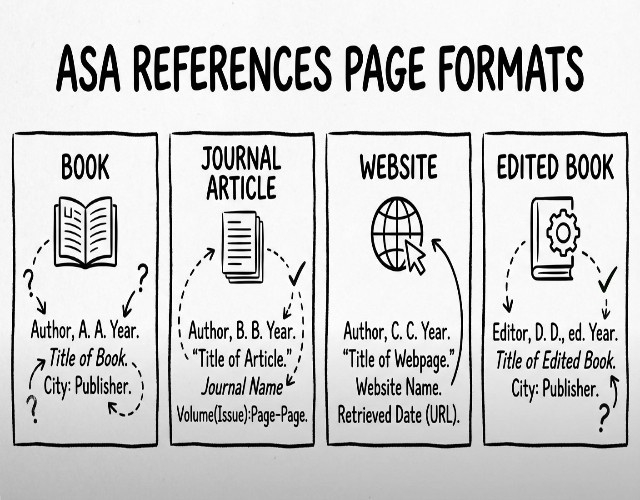
Author(s). Year. "Article Title" or Book Title. Location: Publisher.
Key rules:
- Full first names (not initials like APA)
- List ALL authors (never "et al." in references)
- Sentence case for article titles
- Title case for book/journal titles
| Remember! A properly formatted ASA reference page helps maintain clarity and consistency in academic writing. |
Book Citations
Single author:
Thompson, Rebecca. 2024. Understanding Social Stratification. Boston: Beacon Press.
Two authors:
Martinez, Luis, and Sarah Chen. 2023. Urban Sociology Methods. New York: Oxford UP.
Three or more authors (list ALL):
Johnson, Mark, Jennifer Williams, Robert Lee, and Amanda Davis. 2024. Contemporary Social Theory. Chicago: University of Chicago Press.
Edited book:
Rodriguez, Maria, editor. 2023. Readings in Social Research. Cambridge: Cambridge UP.
Book chapter:
Williams, Karen. 2024. "Gender and Social Interaction." Pp. 78-102 in Handbook of Sociology, edited by David Chen. London: Sage.
Journal Article Citations
Standard format with DOI:
Author(s). Year. "Article Title in Sentence Case." Journal Name in Title Case Volume(Issue): Page-Page. doi:xxxxx.
Real citation:
Chen, Michael, and Lisa Rodriguez. 2024. "Social capital in immigrant communities." American Journal of Sociology 129(4):456-489. doi:10.1086/sociology 2024.04.
Without DOI:
Thompson, Sarah. 2023. "Urban poverty and social networks." Sociology Quarterly 64(2):234-267.
Key differences from APA:
- Full first names (not initials)
- Quotation marks around article title
- Colon between volume(issue) and pages
- List all authors
Website and Online Sources
Webpage:
Author. Year. "Page Title." Retrieved Month Day, Year (URL).
Real citation:
American Sociological Association. 2024. "Research Ethics Guidelines." Retrieved December 20, 2024 (https://www.asanet.org/ethics).
Online article:
Martinez, Roberto. 2023. "Understanding gentrification patterns." Sociological Insights Online. Retrieved December 20, 2024 (https://www.socinsights.com/gentrification).
No date:
Williams, Jennifer. n.d. "Social mobility research." Retrieved December 20, 2024 (https://www.sociology.edu/mobility).
Data Sets and Research Materials
Data set:
General Social Survey. 2022. General Social Survey, 1972-2022 Cumulative File. Chicago: NORC. Retrieved December 20, 2024 (https://gss.norc.org).
Government report:
U.S. Census Bureau. 2023. American Community Survey 2023. Washington, DC: U.S. Government Printing Office.
Organization report:
Pew Research Center. 2024. Social Trends in America 2024. Washington, DC: Pew Research Center.
Overwhelmed by ASA formatting? Let a professional paper writing service format every detail, citations, margins, and full author names precisely for you.
Other Sources
Dissertation:
Rodriguez, Maria. 2023. Social Networks in Urban Communities (Doctoral dissertation). Department of Sociology, Harvard University, Cambridge, MA.
Conference paper:
Chen, David. 2024. "New methods in qualitative sociology." Paper presented at the Annual Meeting of the American Sociological Association, August 10, Montreal, Canada.
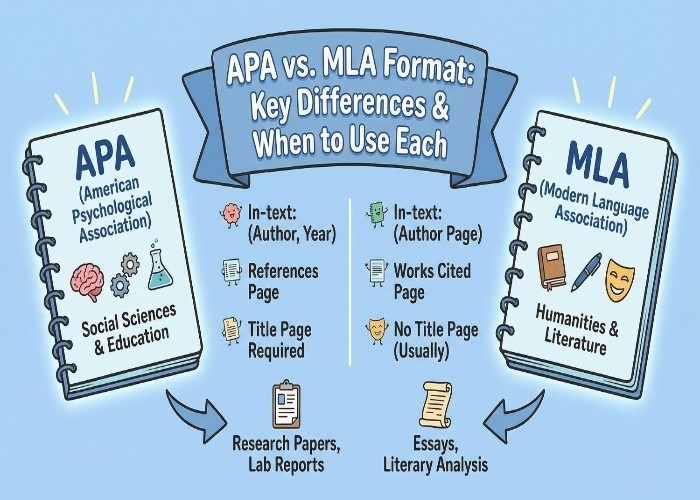
ASA vs APA: Brief Comparison
| Feature | ASA Style | APA Style |
|---|---|---|
| Citation punctuation | (Smith 2024:45) | (Smith, 2024, p. 45) |
| Author names in references | Smith, Jennifer. 2024. | Smith, J. (2024). |
| Listing multiple authors | Lists all authors; never uses “et al.” in references | Uses “et al.” after 20 authors |
| Margins | 1.25 inch left; 1 inch top, bottom, and right | 1 inch on all sides |
| Font | Arial 12-pt preferred | Times New Roman or Calibri is acceptable |
| When to use | Sociology, social work, and criminology papers | Psychology, education, and nursing papers |
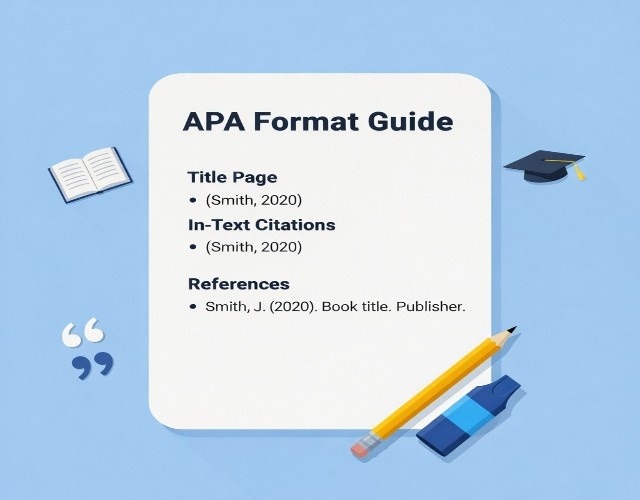
Want to learn more about APA formatting? Follow our APA format guide for a more detailed explanation.
PERFECT ASA FORMATTING, GUARANTEED
Formatting That Meets What Professors Actually Check
- Formatting that meets ASA submission standards
- Every citation, reference entry perfect
- Full author names, colons, everything right
- Margins, fonts, spacing; all correct
Stop wrestling with ASA rules
Order NowASA Heading Formats
Three Heading Levels
Level 1: CENTERED, BOLD, ALL UPPERCASE
LITERATURE REVIEW
Level 2: Flush Left, Bold, Title Case
Social Capital Theory
Level 3: Indented, Bold, Title Case, Period
Text starts immediately on the same line.
Using Headings
Use levels in order, don't skip from 1 to 3. If you need only one level, use Level 1. If two levels, use 1 and 2.
ASA citation Example structure:
METHODS (Level 1)
Data Collection (Level 2)
Survey Design. (Level 3) The survey instrument included...
Common ASA Formatting Mistakes
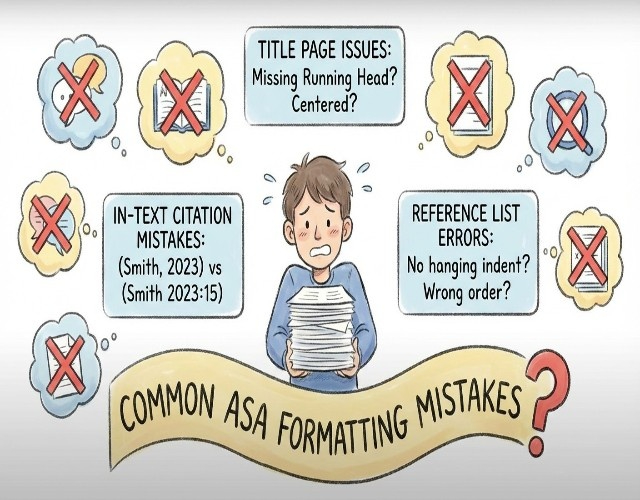
Mistake 1: Wrong Citation Punctuation
- Incorrect: (Smith 2024, 45) uses a comma instead of a colon.
- Incorrect: (Smith, 2024:45) includes a comma after the author’s name.
- Incorrect: (Smith 2024, p. 45) follows APA formatting, not ASA.
- Correct: (Smith 2024:45) uses a colon after the year, as required in ASA style.
- Fix: Colon directly after year, no comma, no "p."
Mistake 2: Using Initials in References
- Incorrect: Smith, J. 2024. Social Theory. Boston: Press.
- Correct: Smith, Jennifer. 2024. Social Theory. Boston: Press.
- Fix: Always spell out full first names.
Mistake 3: 1-Inch Left Margin
- Incorrect: 1-inch margins on all sides (APA/MLA).
- Correct: 1.25-inch LEFT margin, 1-inch others.
- Fix: Set the left margin to 1.25 inches in page setup.
Mistake 4: Times New Roman Font
- Incorrect: Times New Roman throughout.
- Correct: Arial 12pt throughout.
- Fix: Change the entire document to Arial.
Mistake 5: Using "et al." in References
- Incorrect: Martinez, Roberto, et al. 2024. Book Title.
- Correct: Martinez, Roberto, Jennifer Smith, and David Lee. 2024. Book Title.
- Fix: List ALL authors in references (use "et al." only in in-text citations).
Mistake 6: Wrong Title Capitalization
- Incorrect: Chen, Susan. 2024. "Race And Educational Attainment: A Study."
- Correct: Chen, Susan. 2024. "Race and educational attainment: A study."
- Fix: Sentence case for article titles, capitalize only the first word and proper nouns.
Mistake 7: Missing Retrieval Dates
- Incorrect: ASA. 2024. "Ethics." https://www.asanet.org/ethics.
- Correct: ASA. 2024. "Ethics." Retrieved December 20, 2024 (https://www.asanet.org/ethics).
- Fix: Include the retrieval date for online sources.
Mistake 8: Wrong Heading Format
- Incorrect Literature Review (centered, title case, not bold)
- Correct: LITERATURE REVIEW (centered, bold, all caps)
- Fix: Follow the exact Level 1 heading format.
SOCIOLOGY PAPER DUE TOMORROW?
Let Expert Writers Handle Your Formatting While You Focus on Research
- Tell us your citation style requirements.
- Every colon, every reference: perfect
- Delivered on time, guaranteed
- We write and format in ASA
Stop panicking. Start submitting.
Order NowASA Citation Style Guide (Tables and Figures)
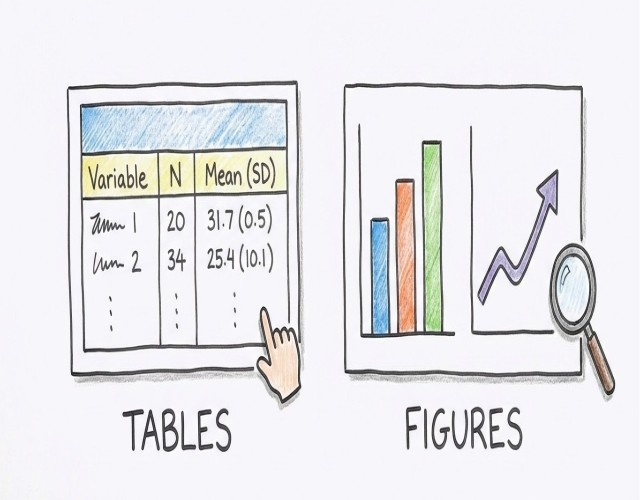
Table Format
Place tables on separate pages after the References section. Format:
Table number and title (above table, flush left):
Table 1. Social Mobility by Region and Education Level, 2023
Table content:
- Horizontal lines only (no vertical lines)
- Double-spaced
- Source note below: Source: U.S. Census Bureau 2023.
Figure Format
Place figures on separate pages after the References section.
Figure number and caption (below figure, flush left)
Figure 1. Income inequality trends, 1990-2023.
Source: General Social Survey 2023.
In text: Refer as "Table 1" or "Figure 2" or "(see Table 1)."
Overwhelmed by ASA formatting? Let a professional essay writing service format every detail, citations, margins, and full author names precisely for you.
Free ASA Format Downloadable Resources
ASA Paper Template
Pre-formatted document with correct margins, font, headers
ASA Citation Quick Reference
One-page guide for in-text citations and references
ASA References Examples
20+ source types formatted correctly
ASA vs APA Comparison
Side-by-side format differences
ASA Formatting Checklist
Pre-submission verification list
Master ASA Format
ASA formatting follows clear patterns once you understand sociology's citation priorities. The signature colon-before-pages format, wider left margin, and full author names distinguish ASA from other social science styles.
Most mistakes come from APA habits (adding commas) or using citation generators (which often get ASA wrong). Use this guide as a reference, double-check every colon, and verify full names in references. You may also refer to the citation styles guide to check every citation before you proceed with writing your paper.
Need Perfect ASA Formatting Without the Headache?
From ASA to APA, Our Experts Handle Every Citation Detail While You Focus on Content
- Tell us your citation style requirements (APA, ASA, MLA, Chicago, etc.)
- Share your sources and paper guidelines
- Zero formatting errors, guaranteed
- Receive your paper with error-free references
Free revisions until you're 100% satisfied.
Order Now
-19434.jpg)
-19334.jpg)
-19329.jpg)
-19406.jpg)