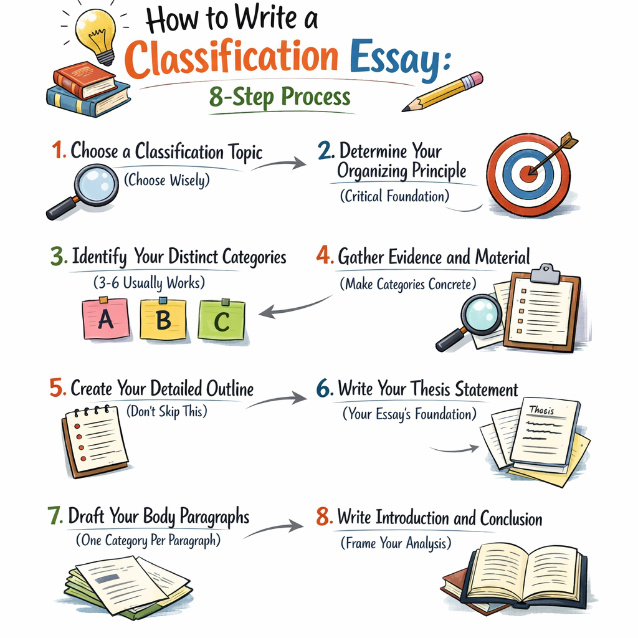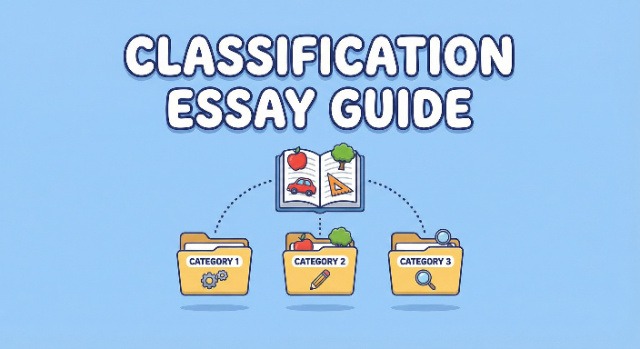
Step 1: Choose a Strong Classification Topic
Understanding Topic Requirements
A strong classification essay topic must meet several critical requirements: it should be broad enough to allow multiple distinct categories (typically 3-6), specific enough to analyze deeply within your word limit, interesting to your target audience, and manageable within your assignment parameters. The ideal topic naturally suggests clear divisions without being so obvious that your analysis becomes simplistic.
Avoid topics too narrow for meaningful classification. "Types of red sedans" offers limited analytical potential compared to "types of car buyers by purchase motivation." Similarly, avoid topics so broad that they could generate dozens of categories. "Types of people" is unmanageably broad, while "types of college roommates" provides clear boundaries for classification.
Brainstorming Strategies
Free association brainstorming: Set a timer for 10 minutes and list every topic that comes to mind related to your course subject or assignment prompt. Don't evaluate ideas during brainstorming—capture everything. You might start with "students," leading to "types of students," then "study habits," "procrastination styles," "learning preferences," and "time management approaches."
Category testing: For each potential topic, quickly brainstorm possible categories. If you can easily identify 3-6 distinct categories, the topic shows promise. If you struggle to identify even three categories or immediately think of 10+ categories, the topic needs adjustment. This quick test saves time by eliminating weak topics early.
Personal interest check: You'll write more effectively about topics that genuinely interest you. Which topics on your brainstorming list spark curiosity? Which connect to your experiences, observations, or questions? Personal interest sustains motivation through the drafting and revision process.
Evaluating Topic Strength
Strong classification topics share key characteristics:
- clear boundaries (readers understand what's included and excluded)
- familiar examples (you can identify specific instances of each category)
- analytical potential (categorization reveals interesting patterns or insights)
- audience relevance (readers care about understanding this topic better).
Test potential topics by asking:
- Can I clearly explain why this topic matters?
- Will readers find my categorization useful or insightful?
- Do I have access to specific examples for each category?
- Can I maintain one consistent organizing principle throughout?
- If you answer "yes" to all questions, proceed with confidence.
For 100+ pre-vetted topics across 15 categories, explore our comprehensive classification essay topics collection.
Step 2: Determine Your Organizing Principle
What Is an Organizing Principle?
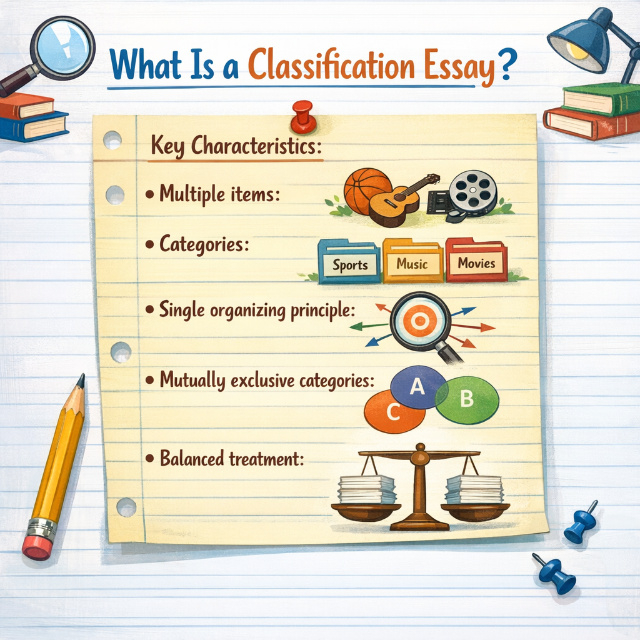
Your organizing principle is the single, consistent criterion you use to divide your topic into categories. It answers the question: "Based on what characteristic am I grouping these items?" This principle determines which similarities and differences matter for categorization and must be applied consistently to all items you're classifying.
For example, you could classify restaurants using different organizing principles: by cuisine type (Italian, Mexican, Thai), by price range (budget, moderate, upscale), by service style (fast food, casual dining, fine dining), or by target demographic (family-friendly, romantic, business-oriented). Each principle creates a different classification system—you must choose ONE and stick with it throughout your essay.
Common Organizing Principles
- Function or purpose: Categorizing items by what they do or achieve (types of study strategies by learning goal, categories of apps by user purpose, classifications of exercise by fitness objective)
- Quality or performance level: Grouping by effectiveness, difficulty, or competence (beginner/intermediate/advanced skill levels, low/medium/high quality tiers, ineffective/moderately effective/highly effective approaches)
- Behavior or characteristics: Categorizing by actions, traits, or patterns (student types by study habits, leadership styles by decision-making approach, social media users by engagement patterns)
- Demographics or attributes: Grouping by age, experience, location, or other demographic factors (generation-based consumer categories, career stage professional types, geographic market segments)
- Chronological development: Categorizing by time period or evolutionary stage (historical periods, developmental stages, technology generations, trend cycles)
- Frequency or commonality: Grouping by how often something occurs (rare/occasional/frequent patterns, uncommon/typical/universal experiences)
Choosing the Best Principle
Strong organizing principles share several qualities:
- significance (they reveal meaningful insights about your topic)
- consistency (they can be applied to all items being classified)
- clarity (readers can understand and apply the principle)
- analytical value (they help readers see your topic in new ways)
Weak organizing principles tend to be arbitrary (organizing restaurants by exterior color reveals nothing meaningful), inconsistent (can't be applied equally to all items), or superficial (don't lead to deeper understanding). Test your organizing principle by asking: "Does this criterion reveal something important about my topic? Can I apply it consistently? Will readers find this way of categorizing useful?"
Document your organizing principle clearly in your thesis statement so readers understand your classification system from the start. This transparency helps readers follow your logic and evaluate your categories fairly.
Imagine Submitting Without the Panic
Your Essay. Written by Pros. Delivered on Time
100% original. 100% human. Satisfaction guaranteed
Step 3: Identify Your Categories
Determining Category Number
Most effective classification essays contain 3-6 categories. Two categories create a simple comparison rather than true classification—consider writing a compare and contrast essay instead. Seven or more categories become difficult to develop adequately in typical essay lengths (1,000-2,000 words), with each category receiving insufficient attention.
The ideal number depends on your topic's natural divisions and your word limit. A 1,000-word essay works best with 3-4 categories (200-250 words each). A 2,000-word essay can accommodate 5-6 categories. More categories require longer essays to maintain balanced development.
Creating Distinct Categories
Categories must be mutually exclusive—each item should fit clearly into only one category based on your organizing principle. Test for overlap by asking: "Could a single item reasonably belong to multiple categories?" If yes, refine your organizing principle or redefine category boundaries.
Overlapping categories (incorrect): Classifying social media users as "frequent posters," "influencers," and "teenagers" creates overlap—teenagers can be frequent posters or influencers.
Distinct categories (correct): Classifying social media users as "lurkers" (passive observers), "casual sharers" (occasional posters), and "content creators" (regular original content producers) creates clear distinctions.
Categories should also be comprehensive—together, they should cover the significant aspects of your topic. While you don't need to account for every possible variation, major types should be represented. If someone asks "What about [type]?" and you haven't addressed it, your classification may be incomplete.
Naming Your Categories
Choose category names that are
- descriptive (clearly indicating category characteristics)
- parallel (using similar grammatical structure)
- memorable (easy for readers to remember and distinguish).
Avoid vague names like "Type A," "Type B," "Type C"—use meaningful labels.
Weak category names: "Group 1," "Group 2," "Group 3."
Strong category names: "Procrastinators," "Steady Workers," "Overachievers."
Weak category names: "Teachers who lecture," "Teachers who don't lecture," "Other teachers."
Strong category names: "Traditional Lecturers," "Facilitators," "Hybrid Instructors."
Parallel structure in category names creates professional polish and helps readers process your classification system. If one category name is a noun phrase, make all category names noun phrases. If one uses adjectives, use adjectives for all.
Step 4: Gather Evidence and Examples
Why Examples Matter
Abstract categories become meaningful through concrete examples that illustrate defining characteristics. Readers need specific instances to understand what each category looks like in practice. Without strong examples, your classification essay reads like a dry list of definitions rather than an engaging analysis with real-world applications.
Strong examples serve multiple purposes: they
- clarify category definitions
- prove categories exist in reality (not just theory)
- engage readers through recognizable scenarios
- strengthen your analytical credibility by demonstrating a thorough understanding of your topic.
Finding Effective Examples
Personal observation: Draw from your own experiences and observations. If classifying types of students, recall specific classmates whose behaviors exemplify each category. Personal observations provide authentic detail that generic examples lack.
Research and reading: Consult course materials, articles, or books related to your topic. Academic sources may provide case studies, data, or research findings that illustrate your categories. For example, psychology texts provide examples of personality types, and business case studies illustrate management approaches.
Current events and media: News articles, social media trends, popular culture, and current events offer timely examples that readers recognize. Classifying types of social movements becomes more concrete when you reference Black Lives Matter, #MeToo, or climate activism as specific instances.
Hypothetical scenarios: When appropriate, create realistic hypothetical examples that typify each category. Introduce hypothetical examples clearly: "Consider Sarah, a typical overachiever who..." Hypothetical examples work well when combined with real examples for balanced illustration.
Example Quality Criteria
Strong examples are
- specific (including concrete details rather than vague descriptions)
- relevant (directly illustrating category characteristics)
- varied (representing different aspects of the category)
- appropriate (matching your essay's tone and audience expectations).
Weak example: "Some procrastinators wait until the last minute to do things."
Strong example: "Mike exemplifies the classic procrastinator: he starts his ten-page research paper at 11 PM the night before it's due, convinced that deadline pressure enhances his creativity, fueled by energy drinks and mounting panic as the submission deadline approaches."
Aim for 2-4 specific examples per category. Multiple examples demonstrate a comprehensive understanding and make categories more credible than single examples. Vary example types—combine personal observation, research findings, and recognizable scenarios for the richest illustration.
Your Time Is Worth More Than This
Get Hours Back. Get a Better Essay
Zero AI. Zero plagiarism. Just expert-level writing.
Step 5: Create Your Classification Essay Outline
Why Outlining Matters for Classification
Classification essays demand more structured outlining than many other essay types because organizational consistency is crucial. Your outline ensures you've applied your organizing principle consistently, developed categories equally, and arranged elements logically before you begin drafting. Time invested in detailed outlining prevents major revision problems later.
Outlining forces you to think through category development, transitions between categories, and the logical flow of your entire essay. It reveals problems—overlapping categories, unbalanced development, weak examples—when they're easy to fix. Revising an outline takes minutes; revising a complete draft takes hours.
Basic Classification Essay Outline Structure
I. Introduction
- Hook (attention-grabbing opening)
- Background information (context about topic)
- Organizing principle explanation
- Thesis statement (naming all categories)
II. Category 1: [Name]
- Topic sentence introducing category
- Definition and key characteristics
- Example 1 (specific, detailed)
- Example 2 (specific, detailed)
- Analysis (significance of this category)
- Transition to next category
III. Category 2: [Name]
- Topic sentence introducing category
- Definition and key characteristics
- Example 1 (specific, detailed)
- Example 2 (specific, detailed)
- Analysis (significance of this category)
- Transition to next category
[Continue for each category]
V. Conclusion
- Restate thesis (different wording)
- Synthesize categories (relationships, patterns)
- Explain the significance of the classification system
- Final insight or practical application
For detailed outline templates with examples, see our classification essay outline guide.
Organizational Strategies
Choose a logical order for presenting categories. Common strategies include:
- Least to most important: Building toward your most significant category creates emphasis and momentum. Works well when one category clearly deserves featured attention.
- Most to least common: Starting with familiar, frequently encountered categories helps readers connect immediately, moving to less common categories. Effective for topics where some categories are widely recognized.
- Simple to complex: Beginning with straightforward categories and progressing to more nuanced categories helps readers build understanding gradually. Good for complex topics requiring foundational knowledge.
- Chronological: When categories represent developmental stages, historical periods, or sequential progression, chronological order makes intuitive sense.
- No inherent order: Some classification systems have no natural hierarchy—categories are simply different types without ranking. In such cases, arrange categories for balanced flow and smooth transitions.
Step 6: Draft Your Classification Essay
Writing an Engaging Introduction
Your introduction must accomplish four essential tasks: capture the reader's attention, provide topic context, explain your organizing principle, and present a clear thesis statement naming your categories. These elements work together to prepare readers for your classification system.
Hook strategies for classification essays:
- Surprising statistic: "While 90% of college students consider themselves 'good planners,' only 30% consistently complete work before deadlines."
- Thought-provoking question: "Have you ever wondered why some people thrive under deadline pressure while others need weeks of advance planning?"
- Relatable scenario: "It's midnight before the paper is due. While procrastinators panic and steady workers sleep peacefully after finishing days ago, overachievers review their completed work one final time."
- Provocative statement: "The way you approach deadlines reveals more about your personality than any personality test."
After hooking readers, provide a brief background explaining why your topic matters and what readers will gain from understanding your classification system. Then introduce your organizing principle explicitly: "Students can be categorized by their approach to deadlines and time management..."
End your introduction with a strong thesis statement that names your topic, organizing principle, and all categories: "College students can be classified by study habits into three distinct types: procrastinators who work best under pressure, steady workers who maintain consistent schedules, and overachievers who complete assignments well ahead of deadlines."
Developing Body Paragraphs
Each category receives its own body paragraph (or multiple paragraphs for complex categories in longer essays). Follow a consistent structure for each category paragraph:
- Topic sentence: Introduce the category clearly, connecting to your thesis. "The first type, procrastinators, consistently delay work until approaching deadlines creates enough pressure to motivate action."
- Definition and characteristics: Explain what defines this category, listing 3-5 distinguishing characteristics. "Procrastinators share common traits: they underestimate task duration, overestimate their ability to work quickly under pressure, use elaborate justification systems ('I work better under pressure'), and experience cyclical patterns of stress and relief."
- Specific examples: Provide 2-4 detailed examples illustrating category characteristics. Use specific names, behaviors, and scenarios. "Mike, a typical procrastinator, consistently starts ten-page papers the night before they're due. He tells himself deadline pressure sparks creativity, though his grades and stress levels tell a different story."
- Analysis: Explain the significance, implications, or consequences of this category. Don't just describe—analyze. "Understanding procrastination patterns helps students recognize self-defeating behaviors and develop more effective time management strategies."
- Transition: Connect smoothly to the next category. "While procrastinators thrive on last-minute pressure, steady workers take a markedly different approach to academic work."
Maintain parallel structure across category paragraphs—if one paragraph discusses causes, effects, and examples, structure all paragraphs similarly. This consistency creates professional polish and helps readers navigate your classification system.
TRY BEFORE YOU BUY
Free Essay. Zero Risk. Real Experts.
Zero risk. 100% human-written. Guaranteed.
Writing Effective Transitions
Classification essays require strong transitions between categories to maintain flow and highlight relationships. Effective transitions serve multiple purposes: they signal category shifts, show contrasts or connections between categories, maintain visibility of your organizing principle, and guide readers through your classification system smoothly.
Transitional phrases for classification essays:
- "Unlike procrastinators, steady workers..."
- "While the previous category focuses on X, this type emphasizes Y..."
- "In contrast to both previous categories, this final type..."
- "Another distinct category emerges when examining..."
- "Moving from X to Y reveals..."
Avoid abrupt category shifts that feel choppy. Each transition should acknowledge what came before while introducing what comes next, creating continuity through your entire essay.
Crafting a Strong Conclusion
Your conclusion must synthesize your classification system, not simply restate categories. Move beyond summary to offer insights about relationships between categories, implications of your classification, or practical applications readers can use.
Weak conclusion: "In conclusion, there are three types of students: procrastinators, steady workers, and overachievers. Each type has different characteristics."
Strong conclusion: "Understanding these three approaches to academic work reveals that successful students don't all follow the same formula. While steady workers' consistency offers advantages, even procrastinators and overachievers can achieve academic success by understanding their patterns and managing their unique challenges. The key lies not in conforming to a single 'correct' approach, but in recognizing your natural tendencies and developing strategies that work with, not against, your instincts."
Strong conclusions offer final insights that make readers think: "So what? Why does this classification matter?" Answer these questions explicitly to demonstrate the value of your analytical framework.
Step 7: Revise and Polish Your Essay
Content Revision Checklist
- Organizing principle consistency: Review every paragraph. Have you maintained the same organizing principle throughout? Did you accidentally introduce additional criteria? Inconsistency destroys classification logic.
- Category distinctness: Can readers clearly differentiate categories? Are boundaries clear, or do categories overlap? Test by asking whether a single item could fit equally into multiple categories—if yes, refine boundaries.
- Balanced development: Measure paragraph lengths. Does each category receive roughly equal attention? Dramatic imbalances (three paragraphs for Category A, one paragraph for Category B) suggest problems with your classification system or development strategy.
- Example strength: Are examples specific and vivid, or vague and generic? Do they clearly illustrate category characteristics? Add concrete details to strengthen weak examples.
- Transition effectiveness: Read your essay, focusing only on transitions. Do they smoothly connect categories? Do they show relationships between categories? Strengthen weak or missing transitions.
- Thesis-category alignment: Does your thesis accurately name all categories? Have you added or eliminated categories during drafting without updating your thesis? Ensure perfect alignment between thesis and body paragraphs.
Structural Revision
- Introduction effectiveness: Does your hook engage readers immediately? Does your introduction explain your organizing principle clearly? Is your thesis specific and comprehensive?
- Logical category order: Does your category sequence make sense? Would a different order improve flow or comprehension? Consider rearranging categories if your current order feels random or awkward.
- Conclusion strength: Does your conclusion synthesize rather than simply restate? Have you explained why your classification matters? Does it offer final insights beyond summary?
- Paragraph unity: Does each paragraph focus clearly on one category? Have you mixed discussions of multiple categories in a single paragraph? Separate mixed content into distinct paragraphs.
Style and Grammar Revision
- Sentence variety: Do you vary sentence length and structure, or do all sentences follow the same pattern? Mix simple, compound, and complex sentences for engaging prose.
- Word choice precision: Have you chosen specific, accurate words, or relied on vague, general language? Replace weak verbs (is, has, does) with stronger action verbs. Eliminate empty intensifiers (very, really) that add no meaning.
- Parallel structure: When listing category characteristics or examples, use parallel grammatical structure. "Procrastinators delay work, justify their behavior, and experience stress" (parallel verb phrases) reads better than "Procrastinators delay work, are justifiers of behavior, and stress is experienced" (mixed structures).
- Active voice preference: Use active voice ("Students complete assignments") rather than passive voice ("Assignments are completed by students") for clearer, more direct writing. Passive voice is acceptable when the actor is unknown or unimportant.
- Grammar and mechanics: Proofread carefully for errors in punctuation, spelling, subject-verb agreement, and pronoun reference. Read aloud to catch errors your eyes might skip when reading silently.
Peer Review Strategy
If possible, have someone read your essay and answer these questions:
- Can you clearly explain my organizing principle after reading my introduction?
- Can you describe each category in your own words?
- Which category is most clearly developed? Which is least clear?
- Where did transitions feel smooth? Where did shifts feel abrupt?
- What's the most memorable example? Why?
- After reading, what's your main takeaway about my topic?
Peer feedback reveals whether your classification system makes sense to readers beyond yourself. Confusion points indicate needed clarification.
Limited Time Offer for New Customers
First Essay Free — Up to 2 Pages
Offer won't last. No AI. No catch.
8 Common Classification Essay Mistakes to Avoid
1. Forgetting to Establish an Organizing Principle
Mistake: Jumping directly into categories without explaining the basis for classification. Readers don't understand why you grouped items this way.
Solution: Explicitly state your organizing principle in your introduction: "This essay classifies students based on their approach to time management and deadline completion."
Why it matters: Without a clear organizing principle, your essay appears arbitrary. Readers can't evaluate whether your categories make sense if they don't understand your classification logic.
2. Mixing Multiple Organizing Principles
Mistake: Starting with one criterion (classifying movies by genre), then switching mid-essay to another criterion (classifying by target age), then using yet another (classifying by budget).
Solution: Choose one organizing principle before drafting and maintain it consistently throughout every paragraph. If you want to discuss multiple ways to classify something, write separate essays or clearly separate sections.
Why it matters: Mixed principles create confusion and violate classification logic. Readers can't follow a classification system that keeps changing its basis.
3. Creating Only Two Categories
Mistake: Dividing a topic into just two categories: "good students and bad students," "successful leaders and unsuccessful leaders," "healthy food and unhealthy food."
Solution: If you have only two categories, write a comparison essay instead. True classification requires at least three categories. Add nuance—"good, average, and poor students" or "authoritarian, democratic, and laissez-faire leaders."
Why it matters: Two categories don't demonstrate classification thinking—they demonstrate simple binary division, more appropriate for comparison essays.
4. Developing Categories Unequally
Mistake: Writing three detailed paragraphs with multiple examples for Category A, one short paragraph for Category B, and barely mentioning Category C.
Solution: Plan balanced development before drafting. If you can't develop a category fully, eliminate it or combine it with another category. Aim for similar paragraph lengths (within 50 words) and example counts (within 1-2 examples) across categories.
Why it matters: Unequal development suggests incomplete analysis or that some categories don't merit inclusion. Readers notice the imbalance and question your classification system's validity.
5. Using Overlapping Categories
Mistake: Creating categories where items could fit into multiple groups equally. Example: classifying drivers as "aggressive," "distracted," and "teenage"—teenagers can be aggressive or distracted.
Solution: Ensure categories are mutually exclusive based on your organizing principle. Test each category against others: "Could a single item logically belong to more than one category?" If yes, redefine categories or refine your organizing principle.
Why it matters: Overlapping categories demonstrate flawed logic. Classification requires distinct groupings where each item fits clearly into one category.
6. Using Generic Examples
Mistake: Vague, abstract examples that don't bring categories to life: "Some people in this category might do certain things," or "Students sometimes behave this way."
Solution: Provide specific, detailed examples with concrete details: names, behaviors, scenarios, dialogue, and sensory details. "Sarah, a typical overachiever, begins studying for finals three weeks in advance, creates detailed color-coded study guides, and attends every professor's office hours."
Why it matters: Generic examples lack persuasive power and fail to clarify category characteristics. Specific examples make abstract categories concrete and memorable.
7. Missing Transitions Between Categories
Mistake: Abruptly jumping from one category to the next without connecting them: discussing Category A, then suddenly starting Category B with no transition.
Solution: Use transitional phrases to connect categories: "Unlike procrastinators, steady workers...", "While Category A focuses on X, Category B emphasizes Y...", "The final category differs from both previous types..."
Why it matters: Missing transitions create choppy, disconnected writing. Readers lose track of your classification system's logic without smooth connections between categories.
8. Weak or Missing Thesis Statement
Mistake: Introduction without clear thesis: "There are different types of students" or "This essay discusses various leadership approaches."
Solution: Write a specific thesis naming your topic, organizing principle, and all categories: "Based on time management approaches, college students can be classified into three types: procrastinators, steady workers, and overachievers."
Why it matters: Your thesis provides the roadmap for your entire essay. Weak theses leave readers confused about your classification system and unsure what to expect in body paragraphs.
Deadlines Don't Wait. Neither Do We
Get a Custom Essay in as Little as 3 Hours
100% human-written. On-time delivery guaranteed
Writing Tips from Expert Writers
Start with Strong Prewriting
The difference between successful and struggling classification essay writers often comes down to time invested in prewriting. Successful writers spend 30-40% of total writing time planning: brainstorming topics, testing organizing principles, identifying categories, gathering examples, and creating detailed outlines. This upfront investment prevents major structural problems during drafting.
Don't skip the outline. Even if you typically write without outlining, classification essays demand structured planning. The time you invest in outlining saves hours of revision later.
Maintain Analytical Focus
Remember that classification essays analyze—they don't just describe. After defining and illustrating each category, always explain its significance. Ask yourself: "So what? Why does this category matter? What does its existence reveal about my topic?" Answer these questions explicitly to demonstrate critical thinking beyond simple categorization.
Strong analytical statements move beyond "this category exists" to "this category reveals X about my topic" or "understanding this category helps us see Y pattern." Analysis distinguishes sophisticated classification essays from simple descriptive lists.
Use Specific Language
Replace vague, general language with specific, precise terms. Instead of "some students," write "approximately 40% of college students" or "students like Sarah who..." Instead of "things," name specific objects, behaviors, or phenomena. Specific language demonstrates thorough understanding and creates more professional, credible writing.
Vague language examples: things, stuff, some, many, various, certain, often, sometimes. Specific alternatives: precise percentages, named individuals, exact objects, defined behaviors, measured frequencies
Read Your Essay Aloud
Reading aloud reveals problems you miss when reading silently. Your ear catches awkward phrasing, missing transitions, repetitive sentence patterns, and unclear explanations that your eyes skip. Read aloud slowly, listening critically to your word choices, sentence flow, and paragraph transitions.
If you stumble while reading aloud, that's a rough spot that needs revision. If transitions feel abrupt when spoken, readers will feel the same abruptness. Use this technique during revision to identify problems worth fixing.
Seek Feedback Before Final Submission
Even experienced writers benefit from reader feedback. Ask someone to read your draft and explain your classification system back to you. If they misunderstand your organizing principle or confuse categories, you need a clearer explanation. If they question why you classified something a particular way, you need better justification.
Fresh eyes catch errors, inconsistencies, and unclear passages you've read too many times to notice. Allow time for feedback and revision before your deadline—don't seek feedback the night before submission when you can't act on it.
Free Classification Essay Writing Resources
Downloadable Templates and Guides
1. Classification Essay Writing Process Checklist (PDF) Step-by-step checklist covering all seven stages of classification essay writing from topic selection through final revision. Print and check off each step to ensure nothing is missed. Includes timeline suggestions for multi-day writing projects.
2. Organizing Principle Decision Matrix (PDF) Interactive worksheet for evaluating potential organizing principles. Rate each principle on significance, consistency, clarity, and analytical value to identify the strongest choice for your topic.
3. Category Development Worksheet (PDF) Structured template for planning each category before drafting. Includes space for category name, defining characteristics, examples (with details), analysis notes, and transition planning. Complete one worksheet per category.
4. Example Bank Template (PDF) Organized template for collecting and storing examples during research and brainstorming. Categorizes examples by type (personal observation, research findings, current events, hypothetical scenarios) with space for detailed notes.
5. Revision Checklist for Classification Essays (PDF) Comprehensive three-tier checklist covering content revision (consistency, balance, distinctness), structural revision (order, transitions, thesis-body alignment), and style revision (sentence variety, word choice, grammar). Use during multiple revision passes.
Master Classification Essay Writing
Writing effective classification essays requires systematic planning, consistent application of organizing principles, and balanced category development with specific examples. Success comes not from following a rigid formula but from understanding classification logic and adapting the process to your specific topic and purpose. The strategies in this guide provide a foundation—your analytical thinking and careful execution bring classification essays to life.
Remember the seven essential steps: choose a strong topic, determine a clear organizing principle, identify distinct categories, gather specific examples, create a detailed outline, draft with attention to balance and transitions, and revise for consistency and clarity. Time invested in each step produces stronger final essays with less frustration during drafting.
Ready to apply these strategies? Review our classification essay outline templates for structural guidance.
Better Essays. Better Grades. Less Stress. Our professional writers have helped thousands of students succeed — you're next. Trusted. Confidential. 100% human-written.