Classification Essay Thesis Formulas: 3 Proven Templates
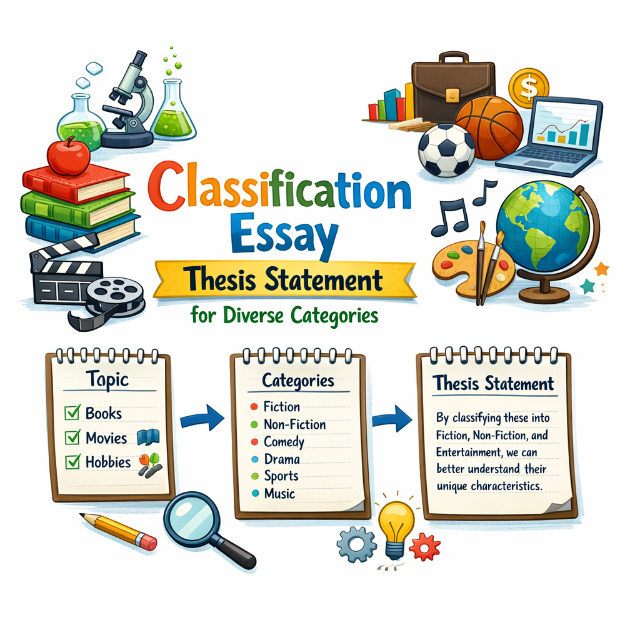
Strong classification thesis statements accomplish three tasks: identify your topic, state your organizing principle, and name all categories in logical order.
Here are three formulas that work copy the structure, plug in your content:
Formula 1: Basic Three Part (Most Common)
[Topic] can be classified by [organizing principle] into [#] types:
[Category 1], [Category 2], and [Category 3]. |
Formula 2: Advanced Descriptive
|
Formula 3: Sophisticated Significance
[Topic] can be classified by [organizing principle] into [#] types
[Category 1], [Category 2], and [Category 3] each [significance statement
showing why categories matter]. |
Mastering classification essay type is easy! Learn the essential steps in our complete guide to the classification and division essay.
Basic Classification Thesis Statement: Formula & 20 Examples
| Structure: Topic + Organizing Principle + Categories Listed |
Classification Thesis Examples for Education Topics
1. Study habits: "College students can be classified by deadline management approach into three types: procrastinators who work best under pressure, steady workers who maintain consistent schedules, and overachievers who complete assignments well before deadlines."
2. Note taking methods: "Note taking strategies can be classified by organization style into four types: linear note-taking following lecture sequence, Cornell method dividing pages systematically, mind mapping creating visual connections, and outline format using hierarchical structure."
3. Learning styles: "Students can be classified by primary information processing method into four types: visual learners who retain information through images and diagrams, auditory learners who learn best through listening, kinesthetic learners who need hands on experience, and reading/writing learners who prefer text based materials."
4. Teaching approaches: "Teachers can be classified by instructional approach into three distinct categories: traditional lecturers who deliver content through direct instruction, facilitators who guide student centered learning, and hybrid instructors who blend both methods strategically."
5. Test preparation: "Test preparation strategies can be classified by timing pattern into three types: crammers who study intensively the night before, gradual reviewers who study consistently over weeks, and practice test takers who focus on simulated exams."
Unsure About Your Thesis? Let Our Writers Craft Your Perfect Classification Essay!
Why risk a weak thesis when our experts can build your entire classification?
- Strong, arguable thesis statements that guide your essay
- Logical category development that supports your argument
- Smooth transitions and professional academic flow
- Original content written specifically for your assignment
Stop worrying about structure, get a complete essay written for you!
Get Started NowTechnology Classification Essay Thesis Statements
6. Social media users: "Social media users can be classified by engagement level into three distinct types: lurkers who observe passively, casual sharers who participate occasionally, and content creators who produce original material regularly."
7. Smartphone dependency: "Smartphone users can be classified by dependency level into four types: constantly connected users who check devices every few minutes, balanced users who maintain healthy boundaries, minimal checkers who use phones only for essential tasks, and deliberate non users who reject smartphone ownership entirely."
8. Email management: "Email management styles can be classified by organizational approach into four types: inbox zero achievers who clear emails daily, organized filers who use folder systems, search dependent hoarders who never delete, and notification ignorers who check sporadically."
9. Video game players: "Video game players can be classified by primary motivation into four types: competitive esports players focused on winning and rankings, story driven players seeking narrative experiences, social connection players using friendship games, and casual relaxation players seeking stress relief."
10. Online shopping: "Online shopping behaviors can be classified by purchasing approach into four types: impulse buyers making spontaneous decisions, comparison shoppers researching extensively before purchase, review dependent buyers trusting other customers' experiences, and cart abandoners who browse without buying."
Psychology Classification Thesis Statement Examples
11. Decision making: "Decision making styles can be classified by approach into four types: analytical planners who research extensively, intuitive gut-followers who trust instincts, consensus seekers who value group input, and impulsive actors who decide quickly without deliberation."
12. Conflict resolution: "Conflict resolution approaches can be classified by strategy into five types: competing to win at others' expense, accommodating to maintain relationships, avoiding to escape confrontation, compromising to find middle ground, and collaborating to create mutually beneficial solutions."
13. Stress management: "Stress management strategies can be classified by coping mechanism into four types: exercise releasers who use physical activity, social supporters who seek help from others, avoidance deniers who ignore stressors, and problem focused copers who address root causes directly."
14. Procrastination: "Procrastination types can be classified by underlying motivation into four categories: perfectionist delayers who fear imperfection, rebellion resistors who reject external control, overwhelmed avoiders who face too many demands, and thrill seeking last minute workers who crave deadline pressure."
15. Communication styles: "Communication styles can be classified by directness level into four types: direct assertive communicators who state needs clearly, passive indirect communicators who hint rather than ask, passive aggressive communicators who express hostility indirectly, and aggressive hostile communicators who attack others."
Need inspiration? Find your perfect idea with our list of engaging classification essay topics.
Business Classification Essay Thesis Examples
16. Leadership styles: "Leadership styles can be classified by decision making authority into four types: autocratic directors who make unilateral decisions, democratic collaborators who seek team input, laissez faire delegators who give complete autonomy, and transformational inspirers who motivate through vision."
17. Employee work styles: "Employee work styles can be classified by collaboration preference into four types: independent self starters who work best alone, collaborative team players who thrive in groups, structured task followers who need clear direction, and innovative experimenters who create new approaches."
18. Networking approaches: "Networking styles can be classified by relationship building approach into four types: strategic connectors who network for specific goals, authentic relationship builders who prioritize genuine connections, transactional exchangers who focus on immediate benefits, and reluctant avoiders who network only when necessary."
19. Job search strategies: "Job seekers can be classified by application strategy into four types: mass appliers who apply to hundreds of positions, targeted researchers who carefully select opportunities, networkers who leverage personal connections, and passive waiters who rely on recruiter outreach."
20. Career changers: "Career changers can be classified by primary motivation into four types: passion pursuers seeking fulfilling work, burnout escapers fleeing stressful careers, salary increasers chasing higher compensation, and lifestyle seekers prioritizing work life balance."
Stuck on structure? See our classification essay examples to understand how great essays are built from the ground up.
Advanced Classification Essay Thesis Formula (8 Examples)
The advanced classification essay thesis formula adds descriptive detail to each category, giving readers a clearer preview of your essay's content.
Structure: Topic + Organizing Principle + Categories with Brief Descriptors
When to use: More sophisticated analysis, longer essays (1,500+ words), upper level courses
Advanced Classification Thesis Statements Across Topics
21. Friendship types: "Friendships can be classified by intimacy level into three categories: acquaintances sharing limited interaction based on circumstantial proximity, close friends maintaining regular meaningful contact through shared experiences and trust, and best friends forming deep bonds with complete vulnerability and unconditional support."
22. Parenting styles: "Parenting approaches can be classified by control and warmth levels into four distinct categories: authoritarian parents demanding obedience with minimal warmth, permissive parents imposing few restrictions while providing high warmth, authoritative parents balancing structure with emotional support, and uninvolved parents providing minimal guidance or emotional connection."
23. Travel preferences: "Travel styles can be classified by experience priority into four types: luxury relaxation seekers prioritizing comfort and pampering, budget backpackers maximizing experiences while minimizing costs, cultural immersion travelers living like locals to understand authentic lifestyles, and adventure seekers pursuing physically challenging or risky experiences."
24. Pet ownership: "Pet owners can be classified by involvement level into four categories: pet parent devoted owners treating animals as family members with premium care, casual caretakers providing standard care without excessive attachment, minimal effort owners meeting only basic needs, and regretful reluctant owners questioning their pet decision."
25. Exercise motivation: "Gym goers can be classified by primary motivation into four distinct types: appearance focused individuals pursuing aesthetic goals like weight loss or muscle building, health driven exercisers preventing disease and maintaining physical function, stress-relief seekers using exercise for mental health management, and social connection seekers viewing gyms as community spaces."
26. News consumption: "News consumers can be classified by engagement frequency into four types: multiple times daily checkers monitoring breaking news constantly, once daily readers following regular schedules for news updates, weekly check-ins readers catching major stories periodically, and headline-only skimmers avoiding detailed news engagement."
27. Restaurant diners: "Restaurant diners can be classified by adventurousness level into four categories: same order creatures always choosing familiar dishes for comfort and predictability, menu explorers trying new items each visit to expand culinary horizons, dietary restricted diners selecting based on health or ethical requirements, and recommendation-followers trusting servers' and friends' suggestions over personal preferences."
28. Reading preferences: "Book readers can be classified by genre preference into four types: fiction escapists seeking imaginative narratives for entertainment and emotional engagement, non fiction learners pursuing knowledge and skill development, mixed genre hoppers varying reading based on mood and curiosity, and re-readers returning to beloved books for comfort rather than seeking new titles."
Sophisticated Classification Thesis Examples (5 Samples)
Sophisticated classification thesis statements go beyond listing categories to explain why the classification matters or what it reveals about the topic.
Structure: Topic + Organizing Principle + Categories + Significance Statement When to use: Research papers, advanced analysis, when you want to preview analytical depth |
Significance Based Classification Thesis Statement Examples
29. Social media users (with significance): "Social media users can be classified by engagement level into three distinct types lurkers who observe passively, casual sharers who participate occasionally, and content creators who produce original material regularly each serving essential functions in maintaining the engagement ecosystem platforms depend on."
30. Leadership styles (with significance): "Leadership styles can be classified by decision making authority into four types as autocratic directors, democratic collaborators, laissez faire delegators, and transformational inspirers, each producing distinct organizational outcomes in team performance, employee satisfaction, and innovation rates."
31. Decision making approaches (with significance): "Decision making styles can be classified by information processing approach into four types such as analytical planners, intuitive gut followers, consensus seekers, and impulsive actors, each demonstrating unique strengths and weaknesses depending on decision context, time pressure, and stakes involved."
32. Study habits (with significance): "College students can be classified by deadline management approach into three types procrastinators, steady workers, and overachievers each approach reflecting different psychological relationships with time pressure, perfectionism, and academic motivation that significantly impact both performance and wellbeing."
33. Conflict resolution (with significance): "Conflict resolution approaches can be classified by strategy into five types including competing, accommodating, avoiding, compromising, and collaborating with each approach proving optimal in different contexts based on relationship importance, time constraints, and power dynamics between parties."
Perfect Your Thesis; Let Our Editors Transform Your Classification Essay!
Why settle for a weak thesis when we can refine it into a masterpiece?
- Professional editing and reorganization of your categories
- Strengthened thesis and enhanced analytical depth
- Polished language, grammar, and academic tone
- Detailed feedback to help you grow as a writer
Don't just submit; excel. Let us perfect what you've started!
Order TodayHow to Write a Classification Essay Thesis (6 Steps)
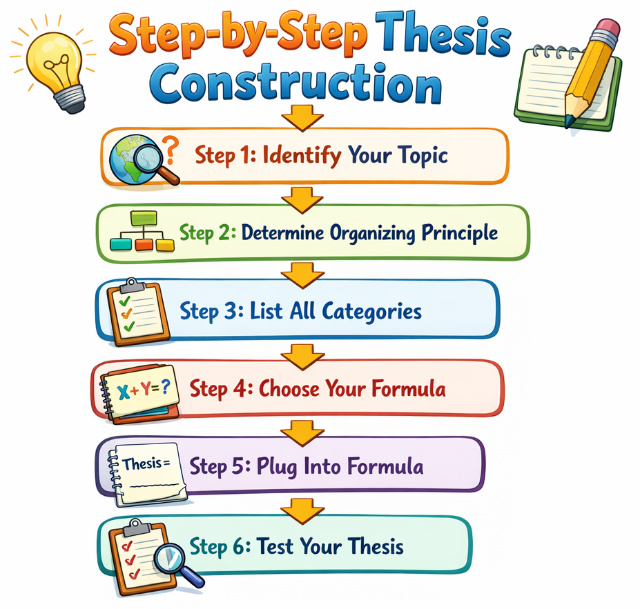
Step 1: Identify Your Classification Essay Topic
What you're classifying: Students, users, approaches, styles, methods
Example: "Social media users"
Step 2: Choose Your Organizing Principle
The criterion you'll use: By what standard are you grouping them?
Example: "by engagement level" (not by age, platform, or content type)
Step 3: List Your Classification Categories
How many groups: Typically 3-6 categories
Example:
- Lurkers (passive observers)
- Casual sharers (occasional participants)
- Content creators (regular producers)
Step 4: Select Your Thesis Statement Formula
Select based on essay level:
- Formula 1: Basic essays, straightforward topics
- Formula 2: Intermediate essays, need descriptors
- Formula 3: Advanced essays, emphasize significance
Step 5: Write Your Classification Essay Thesis
Using Formula 1: "Social media users can be classified by engagement level into three distinct types: lurkers who observe passively, casual sharers who participate occasionally, and content creators who produce original material regularly."
Using Formula 2: "Social media users can be classified by engagement level into three distinct types: lurkers who consume content without posting or commenting, casual sharers who post 1-3 times monthly and engage through occasional likes, and content creators who post daily while building followings through consistent original material."
Using Formula 3: "Social media users can be classified by engagement level into three distinct types lurkers, casual sharers, and content creators each serving essential functions in the engagement ecosystem that platforms depend on for success."
Step 6: Test Your Classification Thesis Statement
Ask these four questions:
- Can readers identify what I'm classifying? (Topic clarity)
- Do they know my organizing principle? (Criterion clarity)
- Can they name all my categories? (Category clarity)
- Do they know discussion order? (Organization preview)
If any answer is "no," revise to add missing elements.
Before you write, map it out! Use our classification essay outline template for a clear and organized draft.
Classification Thesis Statement Mistakes & How to Fix Them
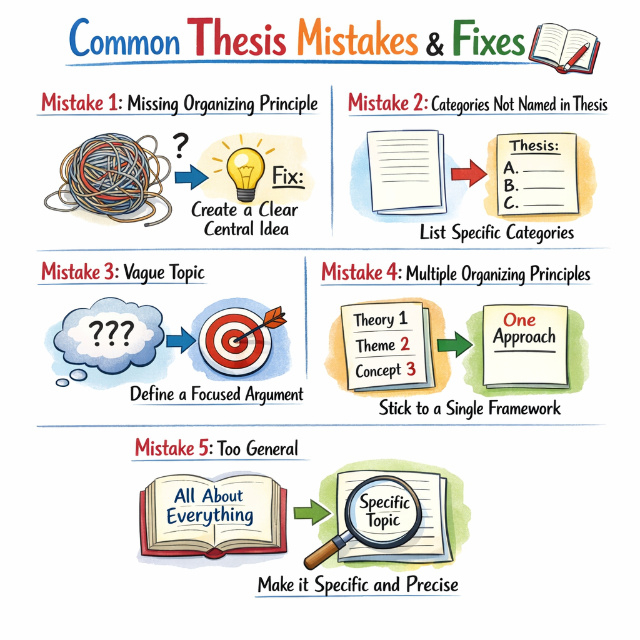
1. Missing Organizing Principle in Classification Thesis
Weak: "There are three types of students."
- Missing: What criterion creates these types?
Fixed: "Students can be classified by study approach into three types: procrastinators, steady workers, and overachievers."
2. Not Naming Categories in Your Classification Thesis Statement
Weak: "Social media users can be classified by engagement level into different types."
- Missing: What ARE the types?
Fixed: "Social media users can be classified by engagement level into three types: lurkers, casual sharers, and content creators."
3. Using Vague Topics in Classification Thesis
Weak: "People can be classified into different personality types."
- Too broad: Which people? Which personalities?
Fixed: "College students can be classified by stress management approach into four types: exercise releasers, social supporters, avoidance deniers, and problem focused copers."
4. Multiple Organizing Classification Thesis Principles Error
Weak: "Students can be classified by study location and personality type into several categories."
- Two principles: location AND personality (inconsistent)
Fixed: "Students can be classified by study location preference into four types: library studiers, home workers, cafe studiers, and group space collaborators."
5. Classification Thesis Statement Too General
Weak: "There are many types of social media users with different behaviors."
- Doesn't preview anything specific
Fixed: "Social media users can be classified by engagement level into three distinct types: lurkers who observe passively, casual sharers who participate occasionally, and content creators who produce original material regularly."
When to Revise Your Classification Essay Thesis Statement
- During outlining: If categories overlap or organizing principle proves inconsistent
- During drafting: If you discover category needs splitting or combining
- During revision: If body paragraphs don't match thesis preview
Common Reasons To Revise Classification Thesis:
- Categories overlap (need redefinition)
- Organizing principle inconsistent across categories
- Category added/removed during writing
- Clearer wording discovered for principle or categories
Don't treat the thesis as unchangeable; revise when the body content reveals a better approach.
Classification Thesis Statement Checklist (Before Submitting)
- Topic clearly identified: Readers know what you're classifying
- Organizing principle stated explicitly: Readers understand your classification criterion
- All categories named in thesis: Not "several types" or "different categories", actual names
- Logical category order: Preview the sequence readers will encounter
- Appropriate formula for essay level: Basic for simple essays, sophisticated for advanced
- Avoids common mistakes: No vagueness, no multiple principles, no missing elements
- Matches essay content: Thesis previews what body paragraphs actually deliver
Struggling with thesis development? Our premium essay writing service creates strong classification thesis statements matched to your topic and assignment requirements.
Downloadable Resouces
Fillable PDF Worksheet: Find a guided, step by step template to build your own classification thesis using three proven formulas, with fillable fields for topic, principle, categories, and a built in revision checklist.
Digital Interactive Template: This Google Forms version offers an interactive, self paced way to construct a thesis, with dropdowns, text fields, and automated self review questions to ensure clarity and completeness before submission.
Printable “Thesis Menu”: Get a quick reference sheet with three thesis formulas, an example bank across topics (education, tech, psychology), and a blank section to draft your own thesis ideal for brainstorming and drafting.
Revision Station Handout: This concise guide identifies five common thesis mistakes with before/after examples and provides a practice section for students to revise weak theses, perfect for peer review or self editing.
Need Premium Thesis? Get a Custom Classification Essay with Authentic Samples!
A great classification essay needs a perfect thesis; we deliver both.
- Custom-researched thesis statement tailored to your topic
- Real-world illustrations that bring your categories to life
- Seamless integration of evidence to support your arguments
- Citations from credible, up-to-date sources
Go beyond theory. Get an essay that shows and tells.
Order NowClassification Essay Thesis Statement: Final Tips
A strong classification essay thesis statement clearly identifies your topic, organizing principle, and categories in one concise sentence that guides your entire essay structure.
Use our comprehensive classification essay guide to master the process and earn an A+ grade on your assignment.
Remember: your thesis is the roadmap for your essay. Choose the formula that matches your assignment complexity: basic for straightforward topics, advanced for deeper analysis, sophisticated when you want to show significance. Always name your specific categories rather than saying "three types," ensure your organizing principle is clear, and revise if your categories evolve during writing.
Whether you write it yourself or get expert help, the goal is a thesis that's clear, specific, and sets up a logical classification structure your readers can follow.

-19438.jpg)