-19438.jpg)
Classification Essay Outline Template
Here's your complete classification essay outline resource templates you can copy immediately, structure breakdowns showing exactly what goes where, and format variations for different classification essay lengths.
I. INTRODUCTION (10-15% of essay)
A. Hook: [Includes attention grabbing opening such as a surprising fact, question, or interesting scenario]
|
II. CATEGORY 1: [Name] A. Topic sentence: [Define this category and its key characteristic]
|
III. CATEGORY 2: [Name]
A. Topic sentence: [Define this category and its key characteristic]
|
IV. CATEGORY 3: [Name]
A. Topic sentence: [Define this category and its key characteristic]
|
V. CONCLUSION (10-15% of essay)
A. Restate thesis: [Rephrase your thesis - don't copy-paste]
|
Choose your topic before outlining. Browse Classification Essay Topics for 240+ topic ideas organized by category with pre suggested classifications.
Need More Than Just an Outline?
Our Writers Create Classification Essays That Impress Professors Every Day
- Professionally written introduction, body, and conclusion
- Academic-level research and proper citations
- Perfectly balanced categories with smooth transitions
- Free plagiarism report and quality certificate
Don't just plan your essay; have it written for you!
Get Started NowMain Classification Essay Outline Template (3 Categories)
This standard template works for most classification essays (750-1,500 words). Copy this structure and fill in your specific content:
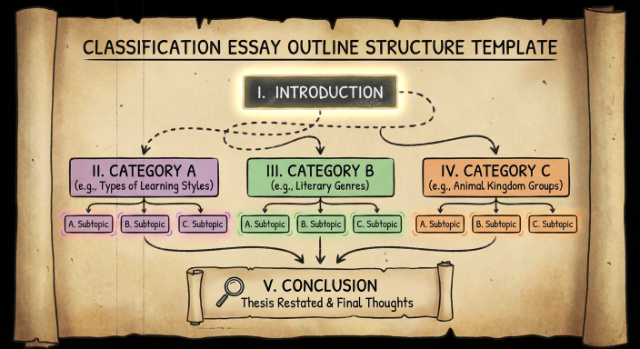
Template Structure
I. INTRODUCTION
A. Hook/Attention Grabber
- Format: Surprising fact, provocative question, relatable scenario, or unexpected statistic
- Length: 1-2 sentences
- Purpose: Make readers want to continue
B. Background/Context
- Format: Brief overview of your topic
- Length: 2-3 sentences
- Purpose: Establish why classification matters
Note: Don't reveal categories yet save for thesis
C. Thesis Statement
- Format: [Topic] can be classified by [organizing principle] into [number] types: [Category 1], [Category 2], and [Category 3]
- Length: 1-2 sentences
- Purpose: Preview your entire classification system
II. BODY PARAGRAPH - CATEGORY 1
A. Topic Sentence
- Format: [Category name] represents/includes [items] that [key defining characteristic]
- Length: 1 sentence
- Purpose: Introduce category clearly
B. Defining Characteristics
- Format: List 2-3 specific traits distinguishing this category
- Length: 2-3 sentences
- Purpose: Explain what makes this category unique
C. Concrete Detail 1
- Format: Specific example with names, numbers, observable details
- Length: 3-4 sentences
- Purpose: Show category characteristics in action
D. Concrete Detail 2
- Format: Different example demonstrating same characteristics
- Length: 3-4 sentences
- Purpose: Prove category pattern with variety
E. Analysis
- Format: Explain why examples fit this category and what it reveals
- Length: 2-3 sentences
- Purpose: Connect examples to organizing principle
F. Transition
- Format: Connect to next category or show contrast
- Length: 1 sentence
- Purpose: Create flow between categories
III. BODY PARAGRAPH - CATEGORY 2
Same structure as Category 1
- Topic sentence
- Defining characteristics
- Example 1 (3-4 sentences)
- Example 2 (3-4 sentences)
- Analysis (2-3 sentences)
- Transition (1 sentence)
IV. BODY PARAGRAPH - CATEGORY 3
Same structure as Category 1 & 2
- Topic sentence
- Defining characteristics
- Example 1 (3-4 sentences)
- Example 2 (3-4 sentences)
- Analysis (2-3 sentences)
- No transition needed (conclusion follows)
V. CONCLUSION
A. Restate Thesis
- Format: Rephrase your thesis using different wording
- Length: 1-2 sentences
- Purpose: Remind readers of classification system
B. Synthesize Relationships
- Format: Explain how categories relate, progress, or interact
- Length: 2-3 sentences
- Purpose: Show bigger picture beyond individual categories
C. Broader Significance
- Format: Why this classification matters beyond the essay
- Length: 1-2 sentences
- Purpose: Give readers actionable insight or perspective
Classification Essay Structure & Format Breakdown
Understanding proper proportions ensures balanced essays. Here's how to divide your word count:
Section Percentages
| Section | Percentage | 1,000-Word Essay | 1,500-Word Essay | 2,000-Word Essay |
|---|---|---|---|---|
| Introduction | 10-15% | 100-150 words | 150-225 words | 200-300 words |
| Body (Total) | 70-80% | 700-800 words | 1,050-1,200 words | 1,400-1,600 words |
| Per category (3 total) | 23-27% each | 233-267 words | 350-400 words | 467-533 words |
| Conclusion | 10-15% | 100-150 words | 150-225 words | 200-300 words |
Categorization Essay Formats Explained by Length
SHORT FORMAT (750-1,000 words)
Structure:
Category paragraph format:
|
Best for: Basic assignments, timed essays, straightforward topics
MEDIUM FORMAT (1,200-1,500 words)
Structure:
Category paragraph format:
|
Best for: Standard college assignments, balanced analysis
LONG FORMAT (1,800-2,500 words)
Structure:
Category paragraph format:
|
Best for: Research papers, complex topics, advanced analysis
Classification Essay Body Paragraph Outline (PEEL Method)
Each category paragraph should follow this proven structure for clarity and coherence:
PEEL Framework for Classification Essay
P - POINT (Topic Sentence)
Format: [Category name] represents [items] characterized by [key trait].

Illustration: "Procrastinators represent students characterized by deadline-driven
work patterns, typically starting assignments 12-48 hours before submission."?
E - EVIDENCE (Concrete Examples)
Format: Specific example with names, numbers, observable actions.
Illustration: "Mike exemplifies this approach: he begins his ten-page research
paper at 11 PM the night before the 8 AM deadline, types 800-1,000 words
per hour fueled by three energy drinks, and submits at 7:47 AM, 13 minutes
before the cut-off."
E - EXPLANATION (Analysis)
Format: Explain why evidence fits category and what it reveals.

Illustration: "This pattern demonstrates procrastinators' belief that time
pressure enhances focus and creativity, despite the stress and risk involved."?
L - LINK (Transition)
Format: Connect to next category or thesis.
Illustration: "While procrastinators thrive on deadline pressure, steady workers
take the opposite approach."
Your thesis is the foundation of your outline, get it right first with help of a classification thesis guide.
Tired of Outlining? Let Us Write Your Essay from Start to Finish!
Our Professional Writers Handle the Hard Work So You Don't Have To
- Professionally researched categories and examples
- Logical organization that flows naturally
- Perfect formatting and academic tone
- Direct communication with your assigned writer
Turn your classification essay from a chore into a guaranteed success.
Order Now4 Category Classification Essay Outline Template
For more complex topics requiring additional categories (1,500-2,000 words):
I. INTRODUCTION (200-250 words)
   A. Hook: [Attention grabber]
   B. Background: [Topic context - 3-4 sentences]
   C. Thesis: [Topic] can be classified by [organizing principle] into four types:
      [Category 1], [Category 2], [Category 3], and [Category 4].

II. CATEGORY 1: [Name] (300-350 words)
   A. Topic sentence
   B. Characteristics (2-3)
   C. Template Entry 1 (specific details)
   D. Template Entry 2
   E. Analysis
   F. Transition

III. CATEGORY 2: [Name] (300-350 words)
   [Same structure]

IV. CATEGORY 3: [Name] (300-350 words)
   [Same structure]

V. CATEGORY 4: [Name] (300-350 words)
   [Same structure]

VI. CONCLUSION (200-250 words)
   A. Restate thesis
   B. Synthesize relationships between all four categories
   C. Broader significance
5 Category Classification Essay Outline Template
For comprehensive analysis of complex topics (2,000+ words):
I. INTRODUCTION (250-300 words)
   A. Hook: [Compelling opening]
   B. Background: [Detailed context - 4-5 sentences]
   C. Thesis: [Topic] can be classified by [organizing principle] into five
      distinct types: [Cat 1], [Cat 2], [Cat 3], [Cat 4], and [Cat 5].

II-VI. CATEGORY PARAGRAPHS (350-400 words each)
   [Each follows same structure:]
    A. Topic sentence
    B. Characteristics (3)
    C. Template Entry 1 (detailed)
    D. Template Entry 2 (detailed)
    E. Template Entry 3 (optional)
    F. Analysis
    G. Transition

VII. CONCLUSION (250-300 words)
   A. Restate thesis
   B. Synthesize relationships (more complex with 5 categories)
   C. Implications
   D. Final insight
When to use 5+ categories:
|
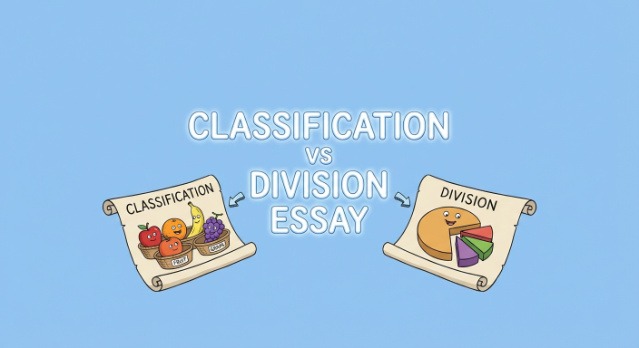
Learn when to classify (group separate items) versus divide (break one whole into parts) with the classification and division essay guide.
Filled Classification Essay Outline Structure
Here's a complete outline filled in to show you exactly how templates work in practice:
Classification Essay Outline Template: Social Media Users
I. Introduction
A. Hook: Scroll through any social media platform and you'll notice distinct patterns some accounts never post, others share occasionally, while some generate constant original content. B. Background: Social media has created over 4.5 billion users worldwide, but not everyone engages the same way. Understanding these behavioral patterns reveals how platforms shape modern communication and community formation. C. Thesis: Social media users can be classified by engagement level into three distinct types: lurkers who observe passively, casual sharers who participate occasionally, and content creators who produce original material regularly. |
II. Category I: Lurkers
A. Topic sentence: Lurkers represent the majority of social media users those who consume content without actively participating through posts, comments, or reactions. B. Characteristics: C. Template 1: Sarah has maintained her Instagram account for five years, follows 247 accounts including friends, brands, and influencers, and scrolls through her feed during her morning commute and lunch break. However, her profile shows only three posts all from 2020 and she's never commented on anyone's content. D. Template 2: Tom uses Twitter to follow tech news and industry leaders, checking his feed 4-5 times daily, but his account has zero tweets, zero followers, and a default profile picture. He absorbs information without contributing. E. Analysis: Lurkers value social media's information access without feeling obligated to perform or maintain public personas. They represent 80-90% of most platforms' user bases despite their invisibility. |
III. Category 2: Casual Sharers
| [Full structure with topic sentence, characteristics, 2 examples, analysis, transition - approximately 250-300 words] |
IV. Category 3: Content Creators
| [Full structure with topic sentence, characteristics, 2 examples, analysis - approximately 250-300 words] |
V. Conclusion
A. Restate Thesis: Understanding social media through engagement patterns of lurkers, casual sharers, and content creators reveals the distinct participation levels that shape online communities. C. Significance: social media continues shaping modern communication, recognizing these patterns helps users engage intentionally rather than unconsciously adopting behaviors that don't serve their goals or well-being. |
Note: This is an OUTLINE showing structure and organization, not a full essay. For complete essays with full paragraph development, see our classification essay examples page.
Classification Essay Paragraph Structure Template
Use this template for each category paragraph to ensure consistent organization:
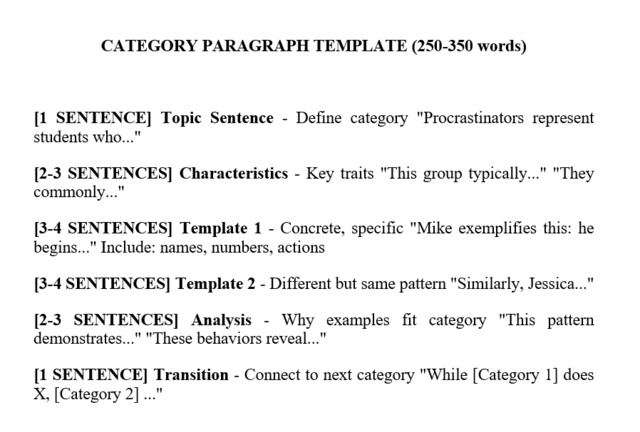
This parallel structure across all category paragraphs creates professional, scannable essays that professors love.
Downloadable Resources
1. Basic 3 Category Classification Outline Template
- Blank fillable format
- Structure markers showing what goes where
- Word count targets per section
- Best for: 750-1,500 word essays
2. Advanced 4 Category Classification Outline Template
- Extended format for complex topics
- Research note sections included
- Category balance checklist
- Best for: 1,500-2,000 word essays
3. Comprehensive 5 Category Outline Template
- Full research paper format
- Source integration markers
- Synthesis planning section
- Best for: 2,000+ word research essays
4. Classification Outline Category Development Worksheet
- Planning tool before outlining
- Organizing principle tester
- Category characteristic brainstorm
- Example planning grids
5. Classification Outline Completion Checklist
- Verify all required elements present
- Balance checker (word counts per category)
- Organizing principle consistency test
- Example quality evaluator
Common Classification Essay Outline Mistakes to Avoid
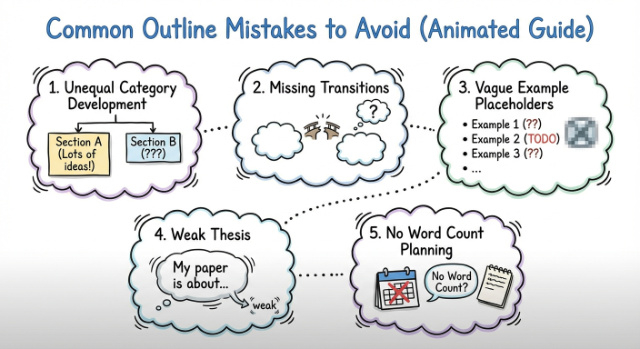
Mistake 1: Unequal Category Development in Outline
Problem: Outline shows one category with 6 illustration points while others have 2 points each.
Fix: Before drafting, ensure each category section in your outline has similar detail levels. If you can only list 2 characteristics for one category but 5 for another, that category may not be distinct enough.
Mistake 2: Missing Transitions Between Categories
Problem: Outline jumps from "End of Category 1" to "Start of Category 2" without connection.
Fix: Include transition planning in your outline: "Transition: While [Category 1] focuses on X, [Category 2] emphasizes Y."
Mistake 3: Vague Template Placeholders
Problem: Outline says "Example 1: student who procrastinates" without specifics.
Fix: Even in outlines, note specific example details: "Example 1: Mike starts 10 page paper at 11 PM the night before, 3 energy drinks, submits 7:47 AM." Specific outlines produce better drafts.
Mistake 4: Weak Thesis in Outline
Problem: Thesis placeholder reads "Thesis: [write later]" or "There are three types of students."
Fix: Write your complete thesis in outline stage: "[Topic] can be classified by [organizing principle] into [#] types: [all categories named]." Your thesis guides the entire outline.
Mistake 5: No Word Count Planning
Problem: The outline lacks length indicators, resulting in a 500-word Category 1 and a 150-word Category 2 in the draft.
Fix: Mark target word counts in outline: "Category 1 (250 words): Topic sentence..." This ensures balanced development.
Master Your Classification Essay Outline: Quick Tips
These classification essay outline templates give you proven structures that produce clear, organized essays. Copy the templates, fill in your specific content, and you've built the framework for successful classification analysis.
Key takeaways:
- Detailed outlines prevent organizational problems before drafting
- Parallel structure across all category sections creates professional essays
- Word count planning ensures balanced category development
- Specific example notes (names, numbers) in outlines translate to stronger drafts
- Templates adapt to any essay length 750 words to 2,500+ words
Start with template selection based on your category count (3, 4, or 5 categories) and essay length. Fill in your thesis statement first, it guides everything else. Plan 2-3 specific examples per category with concrete details. Mark transition connections between categories. Review for balance before drafting. Learn the full 8 step writing process from topic selection through revision with comprehensive classification essay guide.
Need expert help? Visit reliable essay writing service for detailed professional classification analysis with balanced categories and strong evidence.
Classification Essay Outline: Final Takeaways
Copy the 3 category template for standard essays, use the 4 category format for complex topics, or grab the 5 category template for research papers. All templates include word count targets, structural markers, and parallel organization, ensuring balanced category development.
Download all five PDFs, fill in your thesis and examples, and you've built the framework for organized classification analysis. Templates prevent the organizational problems that plague 67% of first drafts by establishing structure before you write a single paragraph.
Why Stress Over Structure When Our Experts Can Write It For You?
We specialize in custom classification essays that get A+ results:
- Expert writers with advanced degrees in your field
- Custom-tailored categories developed just for your topic
- Guaranteed academic integrity and 100% plagiarism-free writing
- On-time delivery with unlimited revisions included
Join thousands of satisfied students
Order Today