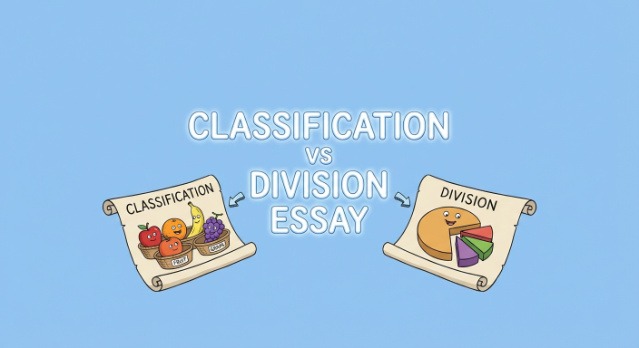
Classification vs Division: Organizing vs Breaking Down
Classification: Organizing Separate Items
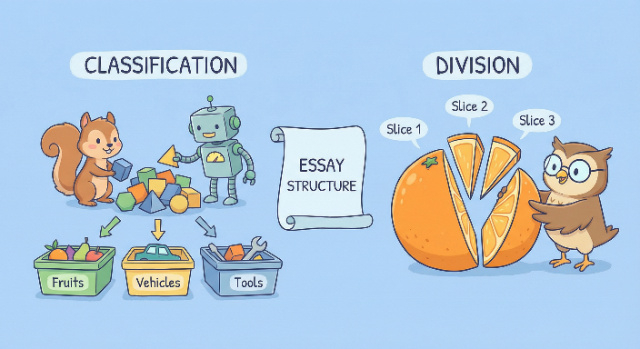
You're classifying when:
- Analyzing multiple separate items (10+ students, 50+ social media users)
- Each item exists independently
- Goal: Reveal patterns among diverse elements
- Question answered: "What types exist?"
Examples:
- College students (many separate people) classified by study approach
- Social media posts (many separate posts) classified by engagement goal
- Teaching methods (many separate approaches) classified by learning theory
Organization:
- Introduction
- Category 1
- Category 2
- Category 3
- Conclusion
Division: Breaking Down One Whole
You're dividing when:
- Analyzing one unified entity's internal structure
- Parts exist only as components of the whole
- Goal: Expose how one thing is organized internally
- Question answered: "What are the parts?"
Examples:
- A university (one institution) is divided into colleges/departments/programs
- The human brain (one organ) is divided into regions by function
- A marketing strategy (one plan) divided into stages/phases
Organization:
- Introduction
- Part 1
- Part 2
- Part 3
- Conclusion
Visit our classification essay topics list to select the perfect classification or division essay for your assignment.
Stuck on Category Development? Let Our Experts Write Your Essay!
Stop Stressing Over Classification Criteria, Get a Professionally Written Essay Instead
- Expert-developed classification and division systems with logical criteria
- Seamless category organization with clear differentiators
- Perfect balance between description and analysis
- Customized to your specific academic level and requirements
Stop trying to figure it out alone let our experts write your A+ essay!
Order NowClassification and Division Essay Comparison Chart
| Element | Classification Essay | Division Essay |
|---|---|---|
| Starting point | Many separate items | One unified whole |
| Process | Group into categories | Break into parts |
| Categories/Parts | 3-6 types based on traits | 2-5 components of structure |
| Organizing principle | Shared characteristics | Structural/functional divisions |
| Example | "Students classified by study habits." | "University divided into colleges." |
| Thesis format | "[Items] can be classified by [principle] into [categories]." | "[Whole] divides into [parts]: [list parts]." |
| When to use | Reveal patterns among multiple items | Explain the internal structure of one entity |
How to Identify Classification vs Division
Ask yourself: "Am I starting with many things or one thing?"
- You're Writing Classification If:
- You have multiple separate items to organize
- Items exist independently of each other
- You're grouping by shared characteristics
- Examples: Types of customers, kinds of movies, categories of stress
- You're Writing Division If:
- You have ONE whole thing to analyze
- You're identifying parts that make up the whole
- Parts only exist as components of the whole
- Examples: Parts of communication, components of an ecosystem, elements of design
- Still Confused? Try This Test:
- Remove one item/part. Does the rest still exist?
- Yes = Classification (removing "action movies" doesn't affect "comedies")
- No = Division (removing "wheels" affects what makes a "car")
- Remove one item/part. Does the rest still exist?
struggling hard to craft a draft for your classification essay? See our classification essay outline to get on the right track.
Classification Type Representation (Full Development)
Classification Essay Topic: Social Media Users
Thesis: "Social media users can be classified by engagement level into three distinct types: lurkers who observe passively, casual sharers who participate occasionally, and content creators who produce original material regularly."
In the bustling digital agora of social media, users are united by the common thread of connectivity, yet profoundly divided by their level of engagement. While a single platform may host billions, a clear taxonomy emerges based on how individuals choose to inhabit these virtual spaces. This spectrum of participation can be classified into three distinct archetypes: the Lurkers, who observe silently from the margins; the Casual Sharers, who participate in the digital conversation intermittently; and the Content Creators, who actively construct the very architecture of the online world.
The largest and most silent class is the Lurkers, who treat social media as a vast, one way window. They are the ultimate consumers, defined by their habit of absorbing content without posting, commenting, or visibly engaging. Their profiles are often sparse or empty, serving more as a viewing license than a public identity. In practice, a Lurker might follow hundreds of accounts from friends to celebrities to niche interest pages and dedicate a significant portion of their daily routine, such as a 30 minute commute, to passive scrolling. Consider Sarah, whose Instagram profile lists 247 accounts she follows, yet her own grid holds only three generic posts from a family vacation in 2020. Similarly, Tom uses his Twitter account exclusively as a real time tech news feed, checking it several times a day to stay informed, despite having never composed a single tweet in his eight years on the platform. This group values the utility of social media for information access, entertainment, and social surveillance without the burden of public performance or personal exposure. Industry analyses often estimate that Lurkers constitute a staggering 80-90% of any platform’s user base, forming the essential, silent audience that gives the digital stage its purpose. They are the bedrock of engagement metrics, the views, the impressions that the entire ecosystem depends upon, yet they remain content to let others fill the silence.
Occupying the middle ground are the Casual Sharers, who engage with the digital community on an occasional, reactive basis. Unlike lurkers, they maintain an active, identifiable profile and participate in the social contract of reciprocity that defines online networks. Their engagement is typically sporadic and prompted by external events: a major life update, a reaction to a friend’s post, or a viral trend that is too compelling to ignore. Characteristics include a modest but consistent friend/follower count, periodic check ins (perhaps a few times a week), and a feed composed largely of reposted memes, shared articles, birthday wishes, and vacation photos. For instance, Maria might log into Facebook primarily to post annual holiday photos and congratulate friends on their achievements, while David uses LinkedIn only when updating his job title or endorsing a former colleague’s skills. They are not building a personal brand or driving a narrative; they are maintaining social ties and occasionally adding their voice to the chorus. This group represents the essential “social” in social media, validating others’ content and ensuring the network feels active and communal. They are the digital equivalent of attendees at a party who participate in conversations but rarely start them, providing the reliable, low stakes engagement that keeps platforms feeling alive and interconnected.
At the apex of the engagement pyramid are the Content Creators, the architects and performers of the digital world. This group is defined by the regular, intentional production and publication of original material, whether educational, entertaining, or artistic. Their profiles are not just identities but channels, portfolios, and stores. Characteristics include a consistent posting schedule, strategic use of platform tools (like Stories, Reels, or live streams), a keen awareness of analytics, and engagement with their audience as a community. An example is Aisha, a graduate student who runs a popular history themed TikTok account, spending hours each week researching, scripting, and editing 60 second videos to build her educational brand. Similarly, Kenji, a hobbyist photographer, curates his Instagram as a professional gallery, using specific hashtags and engaging with followers’ comments to grow his audience. For Creators, social media is a workshop, a stage, and often a source of income or professional opportunity. They are the primary generators of the novel content that lurkers consume and casual sharers circulate. Though they may represent the smallest percentage of users often estimated at 1-2% they are disproportionately powerful, setting trends, driving discourse, and giving the platforms their unique cultural value. Their existence justifies the very infrastructure of the social web.
Ultimately, social media platforms are microcosms of society, complete with their own hierarchies of participation. From the silent majority of Lurkers who watch, to the sociable Casual Sharers who connect, to the inventive Content Creators who build, each group plays a vital, interdependent role. The Lurker provides the audience, the Casual Sharer provides the social glue, and the Creator provides the reason to log on. Understanding this classification is key not only to comprehending digital culture but also to navigating our own place within it. Whether we choose to observe, to converse, or to create defines our digital footprint and shapes the ever evolving landscape of our connected world.
Body Paragraph Structure
Category 1: Lurkers (300 words)
- Definition: Consume content without posting/commenting
- Characteristics: Follow 100+ accounts, scroll 30-60 min daily, empty profiles
- Example 1: Sarah follows 247 accounts, scrolls during commute, and has 3 posts from 2020
- Example 2: Tom uses Twitter for tech news, checks 4-5x daily, zero tweets
- Analysis: Value information access without public performance represents 80-90% of users
Category 2: Casual Sharers (300 words) [Similar structure and characteristics, examples, analysis]
Category 3: Content Creators (300 words) [Similar structure and characteristics, examples, analysis]
Key features:
- Multiple separate people grouped
- Shared trait (engagement level) creates categories
- Each person exists independently
- Organizing principle consistent across all categories
See complete annotated essays at classification essay examples.
Division Essay Example: Full Development
Division Essay Topic: University Structure
Thesis: "The university divides into three main administrative units: the College of Liberal Arts, the College of Sciences, and the School of Professional Studies, each operating semi autonomously while contributing to the university's unified mission."
A modern university, in its mission to cultivate knowledge and prepare citizens, is a complex organism that achieves its goals through deliberate structural organization. To manage its vast intellectual scope, the university is typically divided into distinct administrative units, each with its own focus and expertise. While these units operate with a degree of autonomy, they are unified under the institution’s central mission. This division is most clearly embodied in three primary pillars: the College of Liberal Arts, the College of Sciences, and the School of Professional Studies. Together, these semi autonomous entities create a comprehensive educational ecosystem.
The first pillar, the College of Liberal Arts, forms the intellectual and philosophical heart of the institution. Composed of departments such as English, History, Philosophy, and Modern Languages, its core function is to cultivate critical thinking, communication skills, and a nuanced understanding of the human experience. With a faculty of approximately 120 professors, it serves around 2,500 undergraduates who explore the records, ideas, and cultural expressions of humanity. Beyond traditional majors, this college’s unique contributions include expansive study abroad programs that encourage global perspectives and innovative interdisciplinary majors, like “Culture and Conflict” or “Digital Humanities,” which break down traditional academic silos. This unit ensures that every graduate, regardless of ultimate career path, possesses the analytical and ethical framework necessary for engaged citizenship and lifelong learning.
In contrast, the College of Sciences is dedicated to the systematic exploration of the natural and physical world. This unit comprises departments like Biology, Chemistry, Physics, and Environmental Science. Its primary function is to advance empirical inquiry, teach the scientific method, and prepare students for research and technical fields. Staffed by about 100 research active faculty, it enrolls roughly 1,800 undergraduate students in rigorous laboratory and lecture based curricula. Its defining features are its state of the art research facilities, including a dedicated science library and modernized labs, and its emphasis on undergraduate research opportunities. From sophomores assisting on grant funded projects to seniors presenting at national conferences, the college integrates discovery directly into the student experience, fostering the next generation of innovators and problem solvers.
The third pillar, the School of Professional Studies, bridges academic theory with direct application in the workforce. It houses career oriented programs such as Business Administration, Nursing, Education, and Information Technology. Its function is distinctly pragmatic: to provide students with the specialized skills, certifications, and practical expertise required for specific professions. With 80 faculty members who often bring extensive industry experience, it serves a diverse population of about 2,000 students, including a significant number of adult learners. The school’s unique structure is defined by its strong network of industry partnerships, which facilitate internships and clinical placements, and its flexible course offerings, including evening, online, and accelerated programs designed to meet the needs of working professionals seeking advancement.
In conclusion, the university’s strength and completeness arise from the synergistic operation of these three divisions. The College of Liberal Arts provides the essential foundation in critical thought and cultural literacy. The College of Sciences builds upon this with empirical rigor and discovery. The School of Professional Studies translates knowledge from both into practical competence and career readiness. While each unit operates semi autonomously, tailoring its approach to its distinct domain, they are inextricably linked parts of a singular whole. This tripartite structure ensures the institution can fulfill its unified mission: to educate the whole person for both thoughtful living and professional success in an interconnected world.
Body Paragraph Structure
Part 1: College of Liberal Arts (250 words)
- Components: English, History, Philosophy, and Modern Languages departments
- Function: Provides humanities education and critical thinking development
- Faculty size: 120 professors
- Student enrollment: 2,500 undergraduates
- Unique features: Study abroad programs, interdisciplinary majors
Part 2: College of Sciences (250 words) [Similar structure or components, function, size, features]
Part 3: School of Professional Studies (250 words) [Similar structure or components, function, size, features]
Key features:
- One university broken into parts
- Parts exist as components of the whole
- Each part has a distinct function within the larger structure
- Focus on internal organization, not comparison of separate entities
Combined Classification and Division Essay (Two Level Analysis)
When to combine both classification and division approaches:
- The topic naturally has a hierarchical structure
- Too many items for simple classification (10+ categories)
- Assignment explicitly requires both methods
- Need a comprehensive analysis of a complex system
Two step structure for Classification and Division
Step 1: Division (Break into Major Parts)
- Topic: "Entertainment Media"
- Divide into Film, Music, Gaming
Step 2: Classification (Organize Within Each Part)
- Film = Classify by genre (action, comedy, drama, documentary)
- Music = Classify by style (pop, rock, classical, hip hop)
- Gaming = Classify by platform (console, PC, mobile, VR)
Running Out of Time? Get Your Classification Essay Written in 24 Hours!
Need It Fast? Our Expert Writers Deliver Quality Classification Essays Overnight
- Express service with guaranteed on-time delivery
- Custom categories developed specifically for your topic
- Professional formatting and flawless organization
- Direct writer communication for quick revisions
Your perfect classification essay is just one click away!
Get Started NowHow to Write a Combined Classification and Division Essay
I. Introduction
    A. Thesis: "Entertainment media divides into film, music, and gaming,
       and within each medium, content can be classified by genre to serve
       different audience preferences."

II. Film (Division Part 1)
   A. Overview of film as medium
   B. Action genre (Classification)
   C. Comedy genre (Classification)
   D. Drama genre (Classification)

III. Music (Division Part 2)
   A. Overview of music as medium
   B. Pop style (Classification)
   C. Rock style (Classification)
   D. Classical style (Classification)

IV. Gaming (Division Part 3)
   A. Overview of gaming as medium
   B. Console games (Classification)
   C. PC games (Classification)
   D. Mobile games (Classification)

V. Conclusion
   A. Synthesize relationships across all divisions and classifications
This two level approach provides a comprehensive organizational analysis impossible through either method alone.
Classification vs Division Essay: Decision Framework
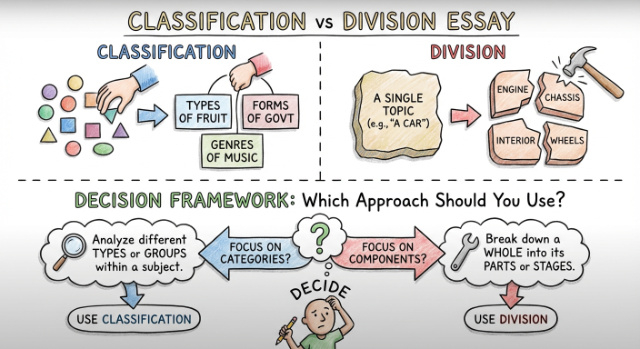
Choose Classification When:
- You're analyzing multiple separate items (5+)
- Items exist independently of each other
- Goal is revealing patterns or types among diverse elements
- Assignment asks to "classify," "categorize," or "group"
- Topic examples: students, users, approaches, strategies, styles
Test question: "Am I organizing separate things or breaking down one thing?" If organizing many things = Classification
Choose Division When:
- You're analyzing one unified whole
- Parts exist only as components of that whole
- Goal is explaining internal structure or organization
- Assignment asks to "divide," "break down," or "analyze parts"
- Topic examples: organizations, systems, processes, bodies, documents
Test question: "Am I organizing separate things or breaking down one thing?" If breaking down one thing = Division
Choose the Combined Approach When:
- The topic has a natural hierarchical structure (major parts + subcategories)
- Simple classification creates 10+ categories (too many)
- Assignment explicitly requires both "division and classification."
- Need two levels of organization for comprehensive analysis
Example assignments:
- "Divide social media platforms into major types, then classify user behaviors within each."
- "Analyze the university structure (division) and student types within each college (classification)."
- "Break down the education system into levels, then categorize teaching approaches at each level."
Classification and Division Essay Thesis Statement Guide
| Thesis Type | Formula | Example |
|---|---|---|
| Classification Thesis | "[Items] can be classified by [organizing principle] into [#] types: [category 1], [category 2], and [category 3]." | "College students can be classified by deadline management approach into three types: procrastinators, steady workers, and overachievers." |
| Division Thesis | "[Whole] divides into [#] main [parts]: [part 1], [part 2], and [part 3], each serving distinct [functions/roles]." | "The university divides into three main administrative units: the College of Liberal Arts, the College of Sciences, and the School of Professional Studies, each operating semi autonomously." |
| Combined Approach Thesis | "[Broad topic] divides into [major parts], and within each [part], [items] can be classified by [principle]." | "The education system divides into elementary, secondary, and higher education, and within each level, teaching approaches can be classified by instructional philosophy." |
Explore thesis formulas for classification and division essays in the Classification Thesis Guide.
Classification and Division Essay Mistakes to Avoid
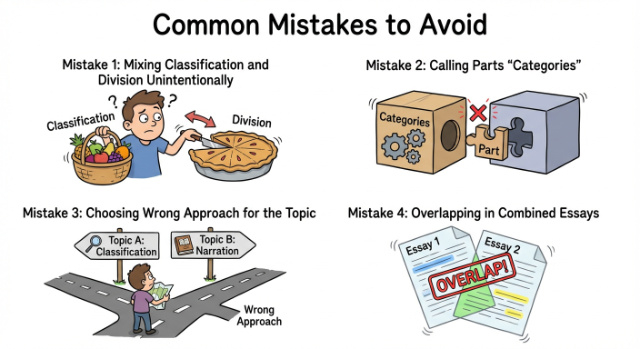
Mistake 1: Mixing Classification and Division Unintentionally
Problem: Starting with classification but accidentally dividing, or vice versa.
Wrong example:
- "Students can be classified into freshmen, sophomores, juniors, and seniors."
- This is actually a division of "college years" into parts, not a classification of separate students by shared traits.
Fixed example:
- "Students can be classified by academic engagement into four types: minimally engaged, assignment completers, active participants, and leadership seekers."
Mistake 2: Calling Parts "Categories"
Problem: Using classification language for division essays.
Wrong: "The university has three categories of colleges..."
Right: "The university divides into three colleges..." OR "comprises three units..."
Language matters:
- Classification uses: categories, types, groups, kinds
- Division uses: parts, components, units, divisions, sections
Mistake 3: Choosing Wrong Approach for the Topic
Problem: Forcing classification when the topic requires division.
Wrong approach: "Classifying the departments of a university."
- This is one university's structure = division, not classification
Right approach: "Dividing the university into academic departments" OR "Classifying universities by organizational structure" (if comparing multiple universities)
Mistake 4: Overlapping in Combined Essays
Problem: Classification within division sections overlaps with other sections.
Example of overlap:
- Film section: Classify by "target audience" (family, adult, teen)
- Music section: Classify by "target audience" (family, adult, teen)
- Problem: Same classification repeated = redundant
Fix: Use different organizing principles per division, or use the same principle consistently if comparing across divisions.
Need expert help? Our trusted essay writing service delivers classification, division, or combined essays with clear organizational structures and balanced development.
Classification and Division Essay: Key Takeaways
Classification organizes multiple separate items into categories based on shared characteristics, while division breaks one unified whole into component parts. Choose classification when analyzing patterns among many items, and division when explaining the internal structure of one entity.
Combined approaches divide broad topics into major parts, then classify items within each part for a comprehensive two level analysis. To acquire the complete 8 step process for classification essays with organizing principles and thesis formulas, visit our comprehensive classification essay guide.
Use the decision framework above to align your approach with the assignment requirements, apply appropriate thesis formulas, and avoid unintentionally mixing approaches.
Want the Best Grade Possible? Let Top Writers Handle Your Classification Essay!
Our Highest-Rated Writers Specialize in Perfect Classification Essays
- Top 5% of our writers selected for your essay
- Guaranteed quality with premium editing included
- Advanced category development and analysis
- Priority support and fastest turnaround times
Join thousands of satisfied students
Order Today
-19438.jpg)