Dissertation Proposal Template
Complete template for doctoral dissertation proposal. Adaptable to any field and citation style. Best for getting your dissertation research approved before you begin.
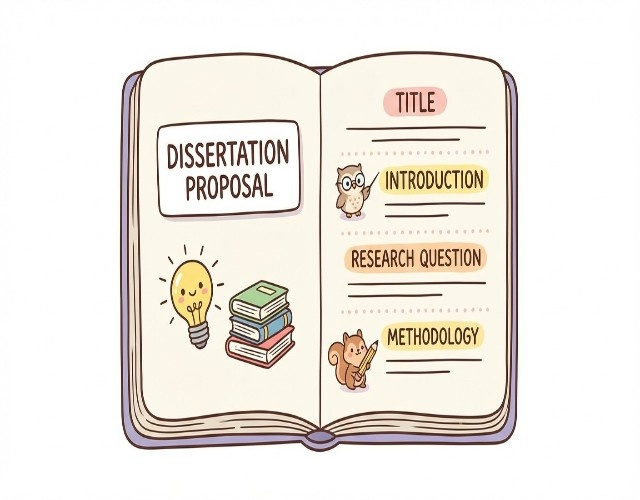
TITLE PAGE
[Centered on page]
[PROPOSED DISSERTATION TITLE: CLEAR AND DESCRIPTIVE]
A Dissertation Proposal Presented to the Faculty of
[Department Name]
[University Name]
In Partial Fulfillment of the Requirements for the Degree of Doctor of Philosophy by
[Your Full Name]
[Month Year]
Proposed Committee:
[Chair Name], Chair
[Member Name]
[Member Name]
[Member Name]
ABSTRACT
[Page number: ii]
Abstract
[150 to 250 words summarizing: research problem, theoretical framework, methodology, expected contributions. Use future tense: "This study will examine..."]
TABLE OF CONTENTS
[Page number: iii]
Table of Contents
| Section | Page |
|---|---|
| Abstract | ii |
| Chapter 1: Introduction | 1 |
| Background | 1 |
| Problem Statement | 4 |
| Purpose and Research Questions | 6 |
| Significance | 8 |
| Theoretical Framework | 10 |
| Chapter 2: Literature Review | 13 |
| Theoretical Foundation | 13 |
| Review of Research | 18 |
| Research Gap | 35 |
| Chapter 3: Methodology | 38 |
| Research Design | 38 |
| Population and Sample | 42 |
| Data Collection | 45 |
| Data Analysis | 50 |
| Timeline | 54 |
| References | 56 |
| Appendices | 70 |
CHAPTER 1: INTRODUCTION
[Start Arabic numbering: Page 1]
Chapter 1: Introduction
Background [Establish broad context and current state of knowledge. 3 to 4 pages.]
The field of [discipline] has increasingly recognized [issue]. Over the past [timeframe], research has demonstrated [what's known]. However, significant questions remain regarding [what's unclear].
[Provide historical context, current trends, and why this topic matters now]
Recent developments in [area] have raised important questions about [topic]. These developments include [specific examples].
Problem Statement [Clear articulation of the research problem. 2 to 3 pages.]
Despite extensive research on [broad topic], little is known about [specific gap]. This gap is problematic because [why it matters].
Evidence of the problem:
- [Evidence source 1 with data/citation]
- [Evidence source 2]
- [Evidence source 3]
The problem is that [clear statement of the problem your dissertation will address].
Contributing factors:
Several factors contribute to this problem:
- [Factor 1]
- [Factor 2]
- [Factor 3]
Purpose and Research Questions
Purpose Statement
The purpose of this [qualitative/quantitative/mixed methods] study is to [action verb: examine, explore, investigate, determine] [what you will study] in order to [intended outcome].
Research Questions
This study will address the following questions:
RQ1: [Primary research question, specific, clear, researchable]
RQ2: [Secondary question]
RQ3: [Tertiary question]
OR Hypotheses (for quantitative studies):
H1: [Hypothesis based on theory]
H2: [Hypothesis]
H0: [Null hypothesis]
Significance of the Study: [Explain contributions to theory, practice, and policy. 2 to 3 pages.]
This research will contribute to [field] in several important ways:
Theoretical Significance
The study will advance [theory] by [specific contribution]. This is important because [why theoretical advancement matters].
Practical Significance
The findings will have implications for [practitioners/educators/policymakers] who [what they do]. Specifically, results will inform [practical application].
Methodological Significance (if applicable)
This study will contribute methodologically by [methodological innovation or application].
Who Benefits
- Researchers: [How researchers benefit]
- Practitioners: [How practitioners benefit]
- Policy makers: [How policy informed]
- [Other stakeholders]: [Benefit]
Theoretical Framework
[Present theories guiding your research. 2 to 4 pages.]
This study is grounded in [Theory Name] developed by [Scholar]. This framework posits that [explanation of theory].
Key Constructs
The theory comprises several key constructs:
- [Construct 1]: [Definition and explanation]
- [Construct 2]: [Definition and explanation]
- [Construct 3]: [Definition and explanation]
Visual representation:
[Include conceptual framework diagram]
Application to Current Study
This framework guides the current research by [how it applies]. Specifically, it helps explain [what it explains] and informs [what it informs: hypothesis, questions, design].
Assumptions, Limitations, and Delimitations
Assumptions
- [Assumption 1 about participants, measures, or context]
- [Assumption 2]
- [Assumption 3]
Limitations
Anticipated limitations include:
- [Limitation 1 and potential impact]
- [Limitation 2]
- [Limitation 3]
Delimitations
This study is deliberately bounded by:
- [Scope decision 1]
- [Scope decision 2]
Definition of Terms
[Term 1]: [Operational definition as used in this study]
[Term 2]: [Definition]
[Term 3]: [Definition]
[Continue with all key terms]
CHAPTER 2: LITERATURE REVIEW
Chapter 2: Literature Review
[15-30 pages demonstrating comprehensive knowledge of field]
IntroductionThis chapter reviews literature relevant to [topic]. The review is organized into [number] sections: (a) theoretical foundations, (b) [theme 1], (c) [theme 2], and (d) research gap.
Theoretical Foundation[Elaborate on theories introduced in Chapter 1. 5 to 8 pages.]
2.1.1 [Theory Name]
[Detailed explanation of theory, its development, key propositions, and empirical support]
[Scholar] (Year) developed [Theory] to explain [phenomenon]. The theory emerged from [context].
Key propositions:
- [Proposition 1]
- [Proposition 2]
- [Proposition 3]
Empirical support: Research has supported these propositions. For example, [Scholar] found [finding], while [Scholar] demonstrated [finding].
Critiques and extensions: Some scholars have questioned [aspect]. [Scholar] extended the theory by [extension].
2.1.2 [Related Theory] (if applicable)
[Additional theoretical foundation]
Review of Research[Organize by themes. 12 to 20 pages.]
2.2 [Major Theme 1]
Early research on [theme] focused on [approach]. [Scholar] established that [finding], while [Scholar] found [finding].
More recent work has shifted to [contemporary focus]. [Scholar] demonstrated [finding].
Subthemes:
2.2.1 [Subtheme]: [Review of literature on subtheme]
2.2.2 [Subtheme]: [Review]
2.3 [Major Theme 2]
[Continue comprehensive review organized thematically]
2.4 [Major Theme 3]
[Additional themes as needed]
Summary and Research Gap[Synthesize literature and identify specific gap. 2-3 pages.]
The literature reviewed reveals [synthesis of what is known]. However, several gaps remain:
Gap 1: [Specific gap with explanation]
Gap 2: [Specific gap]
Gap 3: [Specific gap]
The proposed study will address these gaps by [how your research fills gaps]. Specifically, this research will contribute [specific contribution].
CHAPTER 3: METHODOLOGY
Chapter 3: Methodology
[15 to 25 pages with sufficient detail for the committee to evaluate feasibility]
Research DesignDesign Overview
This study will employ a [specific design] to address the research questions.
Type: [Qualitative/Quantitative/Mixed Methods]
Specific Approach: [Experimental, quasi experimental, survey, case study, phenomenological, ethnographic, grounded theory, etc.]
Rationale: This design is appropriate because [justification connecting design to research questions and theoretical framework].
Paradigm: [Positivist/Post positivist/Constructivist/Critical/Pragmatic]
Population and SampleTarget Population
The target population consists of [detailed description with demographic and relevant characteristics].
Sampling Strategy
Method: [Probability: random, stratified, cluster / Non probability: purposive, convenience, snowball]
Rationale: This sampling method is appropriate because [justification].
Sample Size
The proposed sample size is N = [number].
Recruitment
Participants will be recruited through [specific procedures]:
- [Step 1]
- [Step 2]
- [Step 3]
Inclusion Criteria:
- [Criterion 1]
- [Criterion 2]
- [Criterion 3]
Exclusion Criteria:
- [What disqualifies participation]
[Describe each instrument in detail. 2 to 3 pages per instrument.]
Instrument 1: [Name]
Description: The [Instrument] (Author, Year) measures [construct]. It consists of [number] items using [type of scale].
Scoring: [How scores are calculated and interpreted]
Validity: Construct validity established through [methods]. Convergent validity: r = [value] with [related measure].
Pilot Testing: (if planned) Will pilot test with [N] participants to confirm reliability and clarity.
Instrument 2: [Continue for each instrument]
Researcher-Developed Instruments (if applicable)
[Instrument] will be developed for this study because [rationale].
Development process:
- [Step 1: Literature review, item generation]
- [Step 2: Expert review]
- [Step 3: Pilot testing]
[Detailed step by step procedures. 3 to 5 pages.]
Overview
Data collection will occur between [dates] and will follow these procedures:
Phase 1: Preparation (Timeline)
- [Specific preparation step]
- [IRB approval obtained]
- [Site access secured]
Phase 2: Recruitment (Timeline)
- [Recruitment step 1]
- [Informed consent procedures]
- [Scheduling]
Phase 3: Data Collection (Timeline)
For Interviews:
- Number: [N] semi structured interviews
- Duration: Approximately [minutes]
- Location: [Where conducted]
- Recording: Audio recorded with participant permission
- Protocol: See Appendix A
For Surveys:
- Distribution: [Online/paper/mixed]
- Platform: [Qualtrics/SurveyMonkey/etc.]
- Reminders: [Schedule]
For Observations:
- Settings: [Where]
- Duration: [How long]
- Focus: [What will be observed]
- Recording: [Field notes/video/audio]
For Documents:
- Types: [What documents]
- Source: [Where obtained]
- Purpose: [What they reveal]
Data Management
- Raw data stored [where and how]
- Backups maintained [procedure]
- Retention period: [timeframe]
Data Analysis
Quantitative Analysis (if applicable)
Data will be analyzed using [SPSS/R/SAS/Stata, version].
Preparation:
- Screen for missing data: [handling procedure]
- Check assumptions: [normality, homogeneity, linearity]
- Identify outliers: [detection and handling]
Analyses:
- Descriptive statistics: Means, SDs, frequencies for all variables
- RQ1 analysis: [Specific test] to examine [what]. This test is appropriate because [justification].
- RQ2 analysis: [Specific test and rationale]
- RQ3 analysis: [Specific test and rationale]
- Statistical significance
- Effect sizes
Qualitative Analysis (if applicable)
Qualitative data will be analyzed using [approach: thematic analysis, grounded theory, phenomenological analysis, content analysis].
Process:
- Transcription: All interviews transcribed verbatim
- Initial coding: Open coding using [inductive/deductive] approach
- Focused coding: Group codes into categories
- Theme development: Identify overarching themes
- Validation: Member checking and peer debriefing
Software: [NVivo/Atlas.ti/MAXQDA/Dedoose] will facilitate coding.
Mixed Methods Integration (if applicable)
Qualitative and quantitative data will be integrated [when and how: convergent design, explanatory sequential, exploratory sequential].
Validity and Reliability / TrustworthinessFor Quantitative:
- Internal validity: [Threats and how addressed]
- External validity: [Generalizability considerations]
- Construct validity: [How ensured]
- Statistical conclusion validity: [Power, assumptions]
For Qualitative:
- Credibility: Triangulation, member checking, prolonged engagement
- Transferability: Thick description
- Dependability: Audit trail
- Confirmability: Reflexivity journal
IRB Approval
Will submit IRB application [date]. Anticipated approval [date].
Informed Consent
Participants will receive detailed information about [study purpose, procedures, risks, benefits, voluntary nature, right to withdraw].
Confidentiality
- Pseudonyms for participants
- Data stored securely [specific security measures]
- Access limited to [researcher and committee]
- Data destroyed after [timeframe]
Potential Risks
Risks are minimal and include [risks]. Mitigation strategies include [strategies].
Benefits
Participants may benefit from [direct benefit]. Society benefits from [broader benefit].
Power Dynamics (if applicable)
As [insider/outsider], will address power dynamics through [strategies].
Timeline
Proposed Timeline for Completion
| Phase | Activities | Timeline |
|---|---|---|
| Proposal Defense | Present proposal, revisions, IRB submission | Months 1 to 2 |
| Preparation | Finalize instruments, pilot test, secure access | Months 3 to 4 |
| Data Collection | Recruit and collect data | Months 5 to 8 |
| Data Analysis | Analyze and interpret data | Months 9 to 11 |
| Writing | Draft Chapters 4 to 5 | Months 12 to 14 |
| Revision | Committee feedback and revisions | Months 15 to 16 |
| Defense | Final defense preparation and defense | Month 17 |
Key Milestones:
- Proposal defense: [Target date]
- IRB approval: [Target date]
- Data collection complete: [Target date]
- Full draft to committee: [Target date]
- Dissertation defense: [Target date]
Limitations
Anticipated limitations include:
- [Limitation 1 and how it will be addressed or acknowledged]
- [Limitation 2]
- [Limitation 3]
REFERENCES
[Use appropriate citation style: APA, MLA, Chicago]
[Include all sources cited in proposal; typically 50 to 100+ for comprehensive literature review]
[Alphabetical order, proper formatting, hanging indent]
APPENDIX A: INTERVIEW PROTOCOL
Appendix A
Semi Structured Interview Protocol
Introduction:
[Script: introduce study, confirm consent, explain interview process]
Warm up Questions:
- [Background question]
- [Background question]
Main Questions:
- [Main question 1]
- Probes: [Follow up questions]
- [Main question 2]
- Probes: [Follow ups]
- [Main question 3]
- Probes: [Follow ups]
[Continue with all questions aligned to RQs]
Closing:
Thank you statement, member checking information, contact details.
APPENDIX B: SURVEY INSTRUMENT
Appendix B
Survey Instrument
[Include complete survey with all items, instructions, response scales]
[If using an existing instrument, include a permission letter]
APPENDIX C: INFORMED CONSENT FORM
Appendix C
Informed Consent Form
[Draft consent form following IRB template]
Study Title: [Title]
Principal Investigator: [Your name]
Purpose: [Brief description]
Procedures: [What participants will do]
Risks and Benefits: [Disclosure]
Confidentiality: [How protected]
Voluntary Participation: [Right to withdraw]
Contact Information: [Researcher and IRB contact]
Signature: _________________ Date: _________
APPENDIX D: RECRUITMENT MATERIALS
Appendix D
Recruitment Email/Flyer
[Include all recruitment materials]
APPENDIX E: PERMISSION LETTERS
Appendix E
Site Access Permission / Instrument Permission
[Include any necessary permission letters]
PROPOSAL DEFENSE PREPARATION
Common Defense Questions
About the Problem:
- Why is this problem important?
- What makes this timely/urgent?
- Who cares about this problem?
About the Literature:
- What are the key debates in this area?
- How does your study relate to [major scholar's] work?
- What's the most important contribution from recent research?
About Theory:
- Why this theoretical framework and not others?
- How does theory inform your hypotheses/questions?
- What if your findings contradict the theory?
About Methods:
- Why this design rather than alternatives?
- How will you ensure validity/trustworthiness?
- What if you can't get access/participants?
- What's your plan B if recruitment fails?
- How will you handle [specific methodological challenge]?
About Analysis:
- Walk us through your analysis process
- How will you know when you've reached saturation?
- What software will you use and why?
About Timeline:
- Is this timeline realistic?
- What could delay the study?
- What's your contingency plan?
TYPICAL LENGTH
Dissertation Proposal: 40 to 80 pages (excluding references and appendices)
- Chapter 1: 10 to 15 pages
- Chapter 2: 15 to 30 pages
- Chapter 3: 15 to 25 pages
Varies by field and university
Remember: A proposal is a contract with your committee about what you'll do. Be specific but allow some flexibility for discoveries during research!
What's included
|
Write Your Dissertation With Confidence
Access professionally designed dissertation templates and real examples that simplify every chapter.
- Ready to use dissertation templates for all disciplines
- Expert support for structure, formatting, and citations
- Chapter-wise examples to model your writing
- On time delivery with unlimited revisions
Stop guessing and start writing—our dissertation templates and examples make success achievable.
Order NowPhD Dissertation Template: APA Format
Best for: Psychology, Education, Social Sciences, Nursing, Public Health
What's included
|
Specifications: Times New Roman 12pt, double spaced, 1" margins (1.5" left for binding), APA 7th edition citations
PhD Dissertation Template: Chicago Format
Best for: History, Philosophy, Fine Arts, Religion, and some humanities
What's included
|
Specifications: Times New Roman 12pt, double spaced, 1" margins, Chicago 17th edition
Humanities Dissertation Template: MLA Format
Best for: Literature, Cultural Studies, Languages, Comparative Literature
What's included
|
Specifications: Times New Roman 12pt, double spaced, 1" margins, MLA 9th edition adapted for long form scholarship
STEM Dissertation Template: LaTeX Alternative (Word)
Best for: Engineering, Computer Science, Mathematics, Physics, when the university requires a Word submission
What's included
|
Specifications: Times New Roman or Computer Modern 12pt, double spaced body text, single spaced equations, APA or IEEE citation format.
Choosing the right dissertation topics becomes much easier when you use our dissertation templates, which help you structure your ideas clearly and turn a strong topic into a well-organized final draft.
Professional Doctorate Template (EdD/DBA)
Best for: Doctor of Education (EdD), Doctor of Business Administration (DBA), Doctor of Nursing Practice (DNP)
What's included
|
Specifications: APA 7th edition, emphasis on practical application and actionable findings
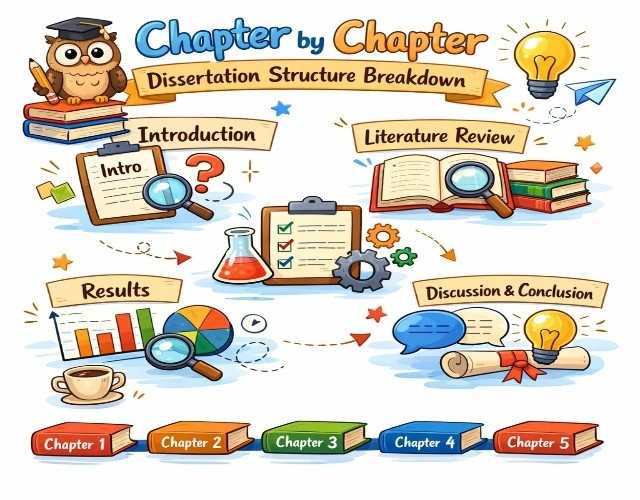
Chapter by Chapter Dissertation Structure Breakdown
Standard doctoral dissertation structure with length expectations for each section.
Standard PhD Dissertation Structure
FRONT MATTER (Roman numerals: i, ii, iii, iv...)
| Component | Required? | Typical Length | Notes |
|---|---|---|---|
| Title Page | Yes | 1 page | Counted as 'i', not printed |
| Copyright Page | Optional | 1 page | Standard for ProQuest submission |
| Abstract | Yes | 1 page | 350 words max typically |
| Dedication | Optional | 1 page | Brief personal dedication |
| Acknowledgments | Optional | 2 to 3 pages | Thank advisors, funders, family |
| Table of Contents | Yes | 4 to 8 pages | Auto generated from headings |
| List of Figures | If 5+ figures | 2 to 4 pages | Auto generated |
| List of Tables | If 5+ tables | 2 to 4 pages | Auto generated |
| List of Abbreviations | If needed | 1 to 2 pages | Discipline specific acronyms |
MAIN CHAPTERS (Arabic numerals: 1, 2, 3...)
| Chapter | Standard Title | % of Total | Typical Length (for 200 page dissertation) |
|---|---|---|---|
| 1 | Introduction | 8 to 10% | 15 to 20 pages |
| 2 | Literature Review | 20 to 25% | 40 to 50 pages |
| 3 | Methodology | 15 to 18% | 30 to 36 pages |
| 4 | Results/Findings | 18 to 22% | 36 to 44 pages |
| 5 | Discussion | 20 to 25% | 40 to 50 pages |
| 6 | Conclusion | 5 to 8% | 10 to 16 pages |
BACK MATTER
| Component | Required? | Typical Length |
|---|---|---|
| References/Bibliography | Yes | 10 to 20 pages (100 to 200+ sources) |
| Appendices | If applicable | Variable (often 20 to 50 pages) |
| Curriculum Vitae | Sometimes (doctoral) | 2 to 3 pages |
What Goes in Each Dissertation Chapter
Chapter 1: Introduction
Purpose: Establish the research problem, significance, and research questions
Must include
- Opening hook establishing importance and timeliness
- Background and context (what's the broader issue?)
- Specific problem statement (what gap are you addressing?)
- Research questions or hypotheses (clearly numbered)
- Purpose statement
- Significance of the study:
1. Theoretical contributions
2. Practical implications
3. Methodological innovations (if applicable)
4. Definition of key terms
5. Assumptions, limitations, and delimitations
6. Organization of the dissertation (chapter previews)
Doctoral level expectations
- More extensive background than master's thesis
- Multiple research questions (typically 2 to 4)
- Clear articulation of original contribution to knowledge
- Situate research in broader scholarly conversation
Common mistakes to avoid
- Vague problem statements that could apply to any study
- Literature review material (save for Chapter 2)
- Missing significance section (why should anyone care?)
- No clear theoretical or practical contributions stated
Chapter 2: Literature Review
Purpose: Demonstrate mastery of the field and justify research gap
Must include
- Introduction, previewing organization of literature review
- Comprehensive review organized thematically (not chronologically)
- Critical analysis showing strengths, limitations, contradictions in existing research
- Theoretical or conceptual framework
- Synthesis showing patterns across studies
- Clear identification of research gap(s)
- Connection to research questions
- Summary and transition to methodology
Organization strategies
- Thematic: organize by concepts/variables
- Methodological: quantitative studies, qualitative studies, mixed methods, then synthesis
- Chronological within themes: show evolution of thinking
- Funnel: from broad context to a precise research gap
Doctoral expectations
- 100-200+ sources (varies by field)
- Seminal works plus recent research (past 5 years)
- International scholarship, not just US-based
- Primary research articles, not textbooks
- Critical analysis, not just summary
- Sophisticated theoretical framework
Common mistakes to avoid
- Annotated bibliography format (study by study summary)
- Missing seminal works in the field
- Only recent sources OR only classic sources
- Minimal synthesis across studies
- No critique of existing research
- Gap not clearly articulated
Chapter 3: Methodology
Purpose: Describe research design and procedures in sufficient detail for replication
Must include for ALL studies
- Research design overview and justification
- Paradigmatic positioning (positivist, interpretivist, critical, pragmatist)
- Detailed procedures
- Data analysis approach
- Ethical considerations
- Limitations of methodology
For QUANTITATIVE dissertations
- Research design: experimental, quasi experimental, correlational, longitudinal, etc.
- Population and sample: target population description
- Sampling method and justification
- Sample size with power analysis
- Participant demographics
- Recruitment procedures
- Inclusion/exclusion criteria
- Attrition analysis (if applicable)
- Variables: Independent, dependent, control variables defined
- Operational definitions
- Instrumentation: Description of all measures
- Reliability evidence (Cronbach's alpha, test retest)
- Validity evidence (construct, criterion, content)
- Permission to use copyrighted instruments
- Pilot testing results
- Data collection procedures: Step by step what happened
- Timeline
- Setting description
- Data analysis: Specific statistical tests for each research question
- Software used (SPSS, R, SAS, etc.)
- Assumptions testing procedures
- Handling missing data
- Alpha level set
For QUALITATIVE dissertations
- Research tradition: phenomenology, grounded theory, ethnography, case study, narrative inquiry
- Site/context selection with rationale
Participant selection
- purposive sampling strategy
- Sample size justification (saturation)
- Participant characteristics
- Recruitment procedures
Data collection methods
- Interviews: structure, number, length, protocol
- Observations: where, when, duration, field note procedures
- Document analysis: types of documents, selection criteria
Data analysis approach
- Specific analytic method (thematic analysis, constant comparison, discourse analysis, etc.)
- Coding procedures (initial, focused, axial)
- Software used (NVivo, Atlas.ti, Dedoose)
- Memo-writing process
Trustworthiness strategies
- Credibility: prolonged engagement, triangulation, member checking
- Transferability: thick description
- Dependability: audit trail
- Confirmability: reflexivity
- Researcher positionality and reflexivity
For MIXED METHODS dissertations
- Mixed methods design type: convergent, explanatory sequential, exploratory sequential, embedded
- Rationale for mixing methods
- Priority and timing of each component
- Integration strategy
- All components from quantitative AND qualitative sections above
Ethical considerations (ALL designs)
- IRB approval and protocol number
- Informed consent procedures
- Confidentiality and anonymity protections
- Data security and storage
- Risks and benefits
- Incentive/compensation (if any)
- Special considerations for vulnerable populations
Chapter 4: Results/Findings
Purpose: Present findings without interpretation (save interpretation for Discussion)
For QUANTITATIVE dissertations
- Preliminary analyses
1. Data screening and cleaning
2. Missing data handling - Assumptions testing (normality, homogeneity, etc.)
- Descriptive statistics (means, SDs, ranges, frequencies)
- Primary analyses organized by research question: Present results for each research question/hypothesis in order
- Report exact test statistics
- Include effect sizes
- Use tables for multiple comparisons
- Use figures for key findings
- Tables and figures: APA formatted, Comprehensive captions
- Referenced in text before appearing
- Should stand alone (readable without text)
- No interpretation of why results occurred (save for Discussion)
For QUALITATIVE dissertations
- Opening: brief overview of findings structure
- Themes/categories with detailed descriptions: Each theme as major section
- Thick description of theme
- Participant quotes as evidence (with identifiers: P3, Interview 2)
- Frequency information (if appropriate)
- Negative cases or disconfirming evidence
- Organization options: By research question, By theme (if themes cut across questions), By case (for case study dissertations, then cross-case themes)
- Visual models or diagrams showing relationships between themes
- Ensure participant voices are prominent (quotes, not just researcher summary)
For MIXED METHODS dissertations
- Present quantitative results first, then qualitative findings (explanatory sequential)
- present qualitative findings first, then quantitative results (exploratory sequential)
- present both simultaneously with integration (convergent)
- Joint display tables or figures showing integration
- Explicit discussion of converging, diverging, or expanding findings
Chapter 5: Discussion
Purpose: Interpret findings, connect to literature, acknowledge limitations, suggest implications
Standard organization:
1. Brief summary of key findings (2 to 3 pages)
2. Interpretation of findings organized by research question or theme
3. Connections to literature (agreement, disagreement, extension)
4. Theoretical implications
5. Practical implications
6. Limitations
7. Recommendations for future research
8. Conclusion
Interpretation section
- Explain what the findings mean
- Why did you get these results?
- What mechanisms might explain patterns?
- Consider alternative explanations
- Be cautious about causal language unless the experimental design
Connections to literature
- Link each major finding to specific studies from literature review
- Identify where results confirm previous research
- Highlight where results contradict or extend existing knowledge
- Explain discrepancies (sample differences, methodological variations)
Theoretical implications
- How do findings advance theoretical understanding?
- What do the results suggest about the theoretical frameworks used?
- Any theoretical refinements needed?
- New conceptual models emerging?
Practical implications:
- Who should care about these findings?
- What actions should practitioners take?
- Policy recommendations (if applicable)
- Implementation considerations
Limitations section:
- Methodological limitations: Sample limitations (size, representativeness, self selection)
- Measurement limitations (self report, instrumentation issues)
- Design limitations (cross-sectional, non experimental)
- Analysis limitations
- Be honest but not defensive
- Explain how limitations might affect interpretation
- Do not excuse away contradictory findings as "limitations"
Future research directions:
- What questions remain unanswered?
- What did your findings reveal that needs investigation?
- Methodological improvements for future studies
- Populations or contexts not examined
- Longitudinal extensions
Chapter 6: Conclusion
Purpose: Synthesize contributions and end with impact
Keep it relatively brief (10 to 16 pages for 200 page dissertation)
Must include
- Very brief summary of entire dissertation (2 to 3 paragraphs max)
- Problem addressed
- Methods used
- Key findings
- Restatement of major contributions
- Final thoughts on significance
- Concluding reflections
For applied/professional doctorates (EdD, DBA)
- Recommendations for practice
- Call to action
- Implementation roadmap
What NOT to include:
- New information not discussed earlier
- New literature
- Detailed methodology or results (already covered)
- "In conclusion..." or "In summary..." (we know it's the conclusion)
Common mistakes to avoid:
- Just repeating Discussion chapter
- Introducing limitations here (should be in Discussion)
- Ending abruptly without synthesis
- Being overly apologetic about limitations
PRO TIP: Explore our thesis templates and examples as well to streamline your dissertation writing, helping you structure your research effectively and present your ideas clearly.
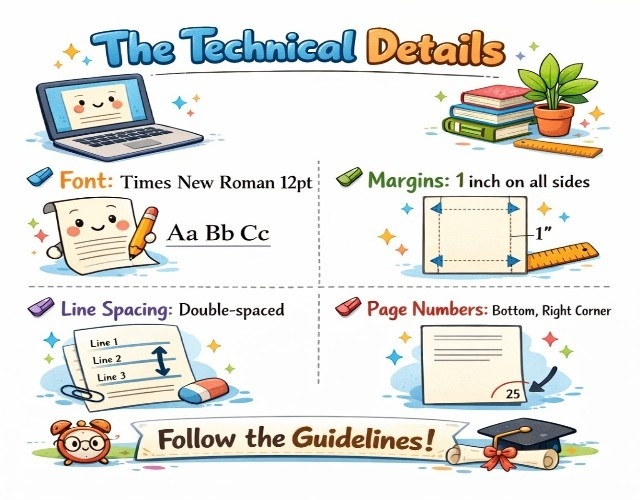
Dissertation Format Requirements: The Technical Details
Doctoral dissertation formatting standards that universities require.
Page Setup
Margins
Font
Line Spacing
Alignment
|
Page Numbering
Front Matter (Roman numerals: i, ii, iii, iv...)
Body Chapters (Arabic numerals: 1, 2, 3...):
Appendices
|
Heading Hierarchy
Use Microsoft Word's built in Heading Styles for automatic Table of Contents generation and PDF accessibility.
Level 1 (Chapter Titles)
Level 2 (Major Sections within Chapters)
Level 3 (Subsections)
Level 4 (Minor Subsections if needed)
|
Tables and Figures
Table Formatting
Figure Formatting
Placement
Numbering
|
Citations and References
Format depends on your field's style guide.
APA 7th Edition (Psychology, Education, Social Sciences, Nursing, Business)
Chicago 17th Edition / Turabian (History, Fine Arts, Some Humanities):
MLA 9th Edition (Literature, Languages, Cultural Studies)
IEEE (Engineering, Computer Science)
Consistency is critical: Pick one style guide and follow it exactly throughout the entire dissertation. |
Common Dissertation Formatting Mistakes to Avoid
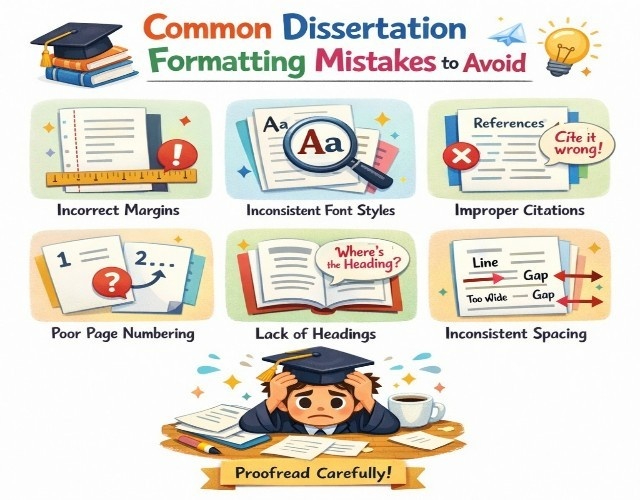
1. Inconsistent fonts: Using Times New Roman in the body but Arial in tables or captions
2. Manual page numbers: Always use Word's automatic page numbering feature
3. Manual Table of Contents: Use Word's auto generate feature from Heading styles
4. Incorrect table/figure placement: Tables and figures appearing before they're referenced in text
5. Missing page breaks before chapters: Each chapter must start on a new page
6. Inconsistent heading capitalization: "Chapter One" then "CHAPTER TWO" then "Chapter 3"
7. Widows and orphans: Single lines of paragraphs stranded at top or bottom of page (fix in Word's Paragraph settings)
8. Inconsistent spacing: Double spacing in some chapters, 1.5 in others
9. Wrong reference format: Mixing APA and MLA styles
10. Missing or incorrect running headers: Some universities require chapter titles in running header
11. Incorrect front matter page numbering: Arabic numbers in front matter or Roman numerals in body
Accessibility Requirements (Critical for 2025 to 2026)
Federal regulations now require digital accessibility for public universities by April 2026. Many universities require accessible PDFs for all dissertations.
Required accessibility features:
Proper heading structure
- Use Word's built in Heading 1, Heading 2, Heading 3 styles
- Never manually bold text to create "headings"
- Logical hierarchy (don't skip from Heading 1 to Heading 3)
Alt text for all visual elements
- Every figure, chart, graph, image must have descriptive alt text
- Right click image then "Edit Alt Text" in Word
- Describe what the visual shows, not just "Figure 3"
- Example: "Bar chart comparing pretest and posttest scores across three groups, showing significant improvement in Group A"
Table accessibility
- Use Word's Insert Table feature, never text boxes
- Designate header row in Table Properties
- Simple table structures (avoid merged cells when possible)
- Provide text summary of complex tables
Document language
- Set document language (English) in Word settings
- Ensures screen readers pronounce correctly
Color contrast
- Text must have 4.5:1 contrast ratio against background
- Don't rely on color alone to convey information (use labels or patterns too)
Meaningful link text
- Link text should describe destination: "APA formatting guide"
- NOT: "Click here" or "Read more"
PDF tagging
- When exporting to PDF, check "Create bookmarks using Headings"
- Export as PDF/A format for long term accessibility
- Check PDF with Adobe Acrobat's Accessibility Checker
How to check in Word
- File, Info, Check for Issues, Check Accessibility
- Resolve all errors before submission
- Warnings are optional but recommended to fix
Universities are increasingly rejecting dissertations that don't meet accessibility standards. Build accessibility in from the start rather than retrofitting later.
Dissertation Templates That Save Time and Stress
Skip formatting headaches and focus on research with expert-approved dissertation examples.
- University standard dissertation formats
- Huma -written content tailored to your subject
- Clear examples for introduction, methodology, and analysis
- 24/7 academic support from experienced writers
Finish your dissertation faster with templates and examples trusted by students worldwide.
Order NowComplete Dissertation Examples (Annotated)
These are real dissertation structures with detailed explanations of what makes each one successful. Use them as models for your own research.

STEM Dissertation Example: Engineering
Degree: Doctor of Philosophy in Mechanical Engineering
Length: 187 pages
Format: APA 7th edition
Institution Type: Research intensive R1 university
Energy Harvesting from Ambient Vibrations Using Piezoelectric Metamaterial Arrays: Design, Optimization, and Implementation
FRONT MATTER (18 pages)
- Title page
- Copyright notice
- Abstract (350 words)
- Dedication
- Acknowledgments (2 pages)
- Table of Contents (4 pages)
- List of Figures (3 pages)
- List of Tables (2 pages)
- List of Symbols and Abbreviations (2 pages)
CHAPTER 1: INTRODUCTION (15 pages)
- Background on energy harvesting challenges
- Current state of piezoelectric energy harvesting
- Limitations of existing approaches
- Metamaterial advantages: theoretical foundation
- Research motivation and industrial applications
Research objectives
1. Design novel piezoelectric metamaterial array configurations
2. Develop an optimization framework for multi frequency harvesting
3. Fabricate and experimentally validate prototype devices
4. Demonstrate practical performance in real world vibration environments, Dissertation organization and chapter overview. Contributions to knowledge
CHAPTER 2: LITERATURE REVIEW (42 pages)
- Section 2.1: Piezoelectric energy harvesting fundamentals (8 pages)
- Section 2.2: Metamaterial theory and applications (10 pages)
- Section 2.3: Energy harvester design approaches (12 pages)
- Section 2.4: Optimization methods in energy harvesting (8 pages)
- Section 2.5: Critical analysis and research gaps (4 pages)
- 147 references, including seminal works and papers from past 5 years
CHAPTER 3: THEORETICAL FRAMEWORK (28 pages)
- Section 3.1: Governing equations for piezoelectric response
- Section 3.2: Metamaterial unit cell design principles
- Section 3.3: Multi scale modeling approach
- Section 3.4: Coupled electromechanical finite element formulation
- Section 3.5: Analytical model validation against known cases
- 23 equations, 12 figures showing theoretical predictions
CHAPTER 4: DESIGN AND OPTIMIZATION METHODOLOGY (34 pages)
- Section 4.1: Design parameters and constraints
- Section 4.2: Multi objective optimization framework
- Objective functions: power output, bandwidth, size
- Constraints: manufacturability, durability, cost
- Section 4.3: Genetic algorithm implementation
- Section 4.4: Finite element modeling setup (COMSOL Multiphysics)
- Section 4.5: Optimization results and Pareto front analysis
- Section 4.6: Selection of optimal designs for fabrication, 28 figures including convergence plots and design evolution
CHAPTER 5: FABRICATION AND EXPERIMENTAL SETUP (22 pages)
- Section 5.1: Materials selection and sourcing
- Section 5.2: Fabrication process flow
- Photolithography
- Piezoelectric layer deposition
- Electrode patterning
- Array assembly
- Section 5.3: Quality control and characterization
- Section 5.4: Experimental test rig design
- Section 5.5: Instrumentation and data acquisition
- 18 figures including SEM images, fabrication schematics, test setup photos
CHAPTER 6: EXPERIMENTAL RESULTS (31 pages)
- Section 6.1: Controlled laboratory testing
- Single frequency excitation (6 pages)
- Multi frequency excitation (8 pages)
- Comparison with conventional harvesters (5 pages)
- Section 6.2: Real world vibration environment testing
- HVAC system mounting (4 pages)
- Bridge structure deployment (6 pages)
- Section 6.3: Long term durability testing (2 pages)
- 42 figures: power output plots, frequency response curves, efficiency comparisons
- 15 tables: comprehensive performance data
CHAPTER 7: DISCUSSION (12 pages)
- Interpretation of key findings
- Comparison with theoretical predictions (model accuracy: 89-94%)
- Explanation of discrepancies
- Practical implications for wireless sensor networks
- Performance metrics comparison with literature
- Scalability considerations
- Economic viability analysis
- Environmental impact assessment
CHAPTER 8: CONCLUSIONS AND FUTURE WORK (8 pages)
- Summary of research contributions
- Answers to research objectives
- Limitations of current work
- Recommendations for future research: Alternative metamaterial configurations
- Integration with power management circuits
- Multi physics optimization including thermal effects
- Large scale array deployments
- Broader impact on sustainable IoT technologies
REFERENCES (12 pages, 147 sources)
APPENDICES (26 pages)
- Appendix A: MATLAB optimization code
- Appendix B: Complete fabrication protocols
- Appendix C: Raw experimental data tables
- Appendix D: Statistical analysis details
- Appendix E: Permissions for copyrighted material
CURRICULUM VITAE (2 pages)
What Makes This STEM Dissertation Strong
1. Original contribution clearly articulated: The introduction explicitly states the novel contribution: designing metamaterial arrays that harvest energy across multiple frequency bands simultaneously. Previous work addressed single frequencies. This advance is quantified: 34% improvement in power density over best existing approach. 2. Theoretical rigor: Chapter 3 develops the mathematical framework from first principles. Equations are numbered and referenced. Model validation against known analytical solutions establishes credibility before applying to novel designs. 3. Appropriate methodology for research questions: The research requires both computational optimization (genetic algorithms) and experimental validation. Chapter 4 details the optimization approach with convergence criteria and parameter sensitivity analysis. Chapter 5 provides fabrication details sufficient for replication. 4. Extensive experimental validation: 42 figures and 15 tables in results chapter show comprehensive testing. Includes both controlled lab conditions and real world deployments. Long term durability testing (1,000 hours) addresses practical concerns. 5. Honest assessment of limitations: Discussion chapter acknowledges that experimental results achieved 89 to 94% of theoretical predictions. Rather than ignoring the gap, the author analyzes potential causes (manufacturing tolerances, damping effects not captured in model). 6. Significant literature base: 147 references demonstrate comprehensive knowledge of the field. References span energy harvesting, metamaterials, optimization, and applications literature. 7. Reproducibility emphasized: Appendices include complete MATLAB code, fabrication protocols, and raw data. Any researcher could replicate this work. 8. Professional quality figures: SEM images, finite element simulation results, and experimental plots are publication ready. Each figure has comprehensive caption explaining what is shown and why it matters. |
Humanities Dissertation Example: History
Degree: Doctor of Philosophy in History
Length: 324 pages
Format: Chicago 17th edition
Institution Type: Research university
The Architecture of Remembrance: War Memorialization and National Identity in Post-WWI Britain, 1918 to 1939
FRONT MATTER (12 pages)
- Title page
- Copyright page
- Abstract (350 words)
- Dedication
- Acknowledgments (3 pages)
- Table of Contents (5 pages)
- List of Figures (1 page: maps, photographs of memorials)
CHAPTER 1: INTRODUCTION,"MEMORY IN STONE" (28 pages)
- Opening vignette: Cenotaph unveiling, November 11, 1920
- Historical context: scale of British WWI losses (722,785 dead)
- The memory boom: monuments, literature, commemorations
- Historiographical intervention
Central argument: "British war memorials constructed 1918 to 1939 functioned not merely as sites of mourning but as contested spaces where competing visions of national identity, imperial, democratic, masculine, maternal, were negotiated through design, inscription, ritual, and debate."
Chapter by chapter overview
- Methodology: archival research, material culture analysis, public reception
- Sources: War Graves Commission archives, local council records, newspapers, personal papers, memorial committee minutes, architectural drawings
- Theoretical framework: Pierre Nora (lieux de mémoire), Jay Winter (sites of memory), material culture theory
CHAPTER 2: "OUR GLORIOUS DEAD", THE LANGUAGE OF SACRIFICE (38 pages)
- Inscriptional choices on local memorials
- Religious vs. secular language
- "Glorious dead" vs. "fallen" vs. "killed": linguistic analysis
- Biblical references and their frequency
- Regional variations in inscription style
- Case studies: Manchester, Birmingham, rural Yorkshire
- Gender implications of memorial language
- Archival evidence of inscription debates
CHAPTER 3: CENOTAPHS AND CROSSES, FORM AND MEANING (42 pages)
- The dominance of the cross form (72% of surveyed memorials)
- Cenotaph adoption after Lutyens' Whitehall design
- Obelisks and classical forms
- Figurative sculpture: prevalence and types
- Architectural debates in memorial design competitions
- Rejection of certain designs (German associated forms)
- Material choices: stone, bronze, local vs. imported materials
CHAPTER 4: CONTESTED GROUND, MEMORIAL SITING CONTROVERSIES (45 pages)
- Public space vs. churchyard placement
- Debates over sacred vs. civic memorialization
- Manchester case study: 4 year dispute over Cenotaph location
- Class tensions in siting decisions
- Accessibility concerns and working class memorial committees
- Gender and exclusion: women's auxiliary service memorialization
CHAPTER 5: THE EMPIRE REMEMBERS, IMPERIAL IDENTITY IN MEMORIAL DESIGN (48 pages)
- Colonial troops representation (or lack thereof)
- Indian, African, Caribbean soldiers in memorial iconography
- Imperial War Graves Commission hierarchies
- Dominion memorials: Canada, Australia, New Zealand, South Africa
- Case study: The Menin Gate and missing names controversy
- Race and remembrance in 1920s to 1930s Britain
CHAPTER 6: MOTHERS, WIDOWS, BEREAVED, GENDERED GRIEF AND MEMORY (52 pages)
- Maternal mourning in memorial iconography
- The "mother and child" memorial motif
- Women's exclusion from memorial committees
- Widows' pensions and memorial responsibilities
- Female only memorials (rare but significant)
- Case study: Women's Service Memorial, Edinburgh
- Letters to the editor: women's voices in memorial debates
CHAPTER 7: ARMISTICE DAY, RITUAL AND NATIONAL UNITY (41 pages)
- Evolution of the November 11 commemoration
- Two minute silence: origins and adoption
- Wreath-laying ceremonies: participants and protocols
- Local variations in ritual practice
- British Legion's role in standardizing commemoration
- Pacifist counter commemorations
- 1930s changes: rise of fascism and commemoration's politicization
CHAPTER 8: CONCLUSION, "LEST WE FORGET" (18 pages)
- Synthesis of findings across chapters
- British memorialization in comparative context (France, Germany)
- Legacy: how 1920s to 1930s choices shaped later commemorations
- Theoretical contributions to memory studies
- Archival discoveries and their significance
- Reflections on historian's relationship to sites of memory
BIBLIOGRAPHY (28 pages)
Archival Sources
- Imperial War Museum Archives
- National Archives (Kew)
- War Graves Commission Archives
- 37 local council archives across Britain
- Private papers collections (12 collections)
- Newspaper collections (22 titles surveyed)
Published Primary Sources
- Memorial dedication programs
- Architectural journals
- Contemporary guidebooks and pamphlets
Secondary Sources: 312 scholarly books and articles
APPENDICES (34 pages)
- Appendix A: Database of surveyed memorials (428 entries)
- Appendix B: Transcribed inscription samples (18 pages)
- Appendix C: Maps showing memorial distribution patterns
- Appendix D: Photographs of representative memorials (24 images)
What Makes This History Dissertation Strong
1. Significant archival research: The dissertation draws on 37 local archives, demonstrating extensive primary source work. The bibliography distinguishes archival from published sources, showing the depth of original research. Memorial committee minutes reveal debates invisible in the finished monuments. 2. Clear argument sustained throughout: The central claim about contested national identity appears in the introduction and is developed through each chapter. Each chapter addresses one dimension of contestation (language, form, siting, imperial identity, gender, ritual). 3. Sophisticated engagement with theory: References Pierre Nora and Jay Winter without letting theory overwhelm historical evidence. Material culture analysis combined with social history creates interdisciplinary framework. 4. Attention to regional and class variation: Doesn't assume a monolithic British experience. Compares urban/rural, northern/southern, working class/elite memorial practices. Manchester case study spans 15 pages with detailed examination of a four year siting controversy. 5. Inclusion of marginalized perspectives: Chapter 6 recovers women's voices through letters to editors and rare women's service memorials. Chapter 5 examines colonial troops' erasure from commemorative landscapes. 6. Methodological transparency: Introduction explains database creation (428 surveyed memorials), sampling strategy, and limitations. Appendix A provides the full dataset. 7. Strong primary source analysis: The dissertation analyzes memorial inscriptions linguistically, architectural drawings formally, and newspaper debates rhetorically. Shows mastery of multiple source types. 8. Historiographical contribution articulated: Introduction situates the work in memory studies and WWI scholarship, explaining how this dissertation revises understanding of interwar Britain by examining memorials as sites of identity negotiation rather than just mourning. 9. Visual evidence integrated: 24 photographs in appendices, referenced throughout text. Images aren't decorative, they're analyzed for design elements, iconography, and spatial relationships. |
Social Sciences Dissertation Example: Sociology
Degree: Doctor of Philosophy in Sociology
Length: 278 pages
Format: APA 7th edition
Institution Type: Research university
Digital Disconnect: How Social Media Algorithms Reshape Social Capital in Adolescent Friendship Networks
FRONT MATTER (16 pages)
- Title page
- Copyright page
- Abstract (350 words)
- Acknowledgments (2 pages)
- Table of Contents (5 pages)
- List of Tables (2 pages)
- List of Figures (2 pages)
- List of Abbreviations (1 page)
CHAPTER 1: INTRODUCTION (22 pages)
- Contemporary adolescence and digital natives
- Social capital theory: Bourdieu, Coleman, Putnam
- The algorithmic turn: platforms as mediators of social ties
Research problem: Social capital literature predates algorithmic curation of social networks
Research questions
1. How do algorithmic content feeds affect adolescents' perception of friendship strength? 2. What patterns exist in algorithmic visibility and social capital accumulation?
3. How do adolescents navigate algorithmically structured friendship maintenance?
- Conceptual framework: bridging social capital theory with platform studies
- Significance for policy (screen time debates) and theory (social capital in digital age)
- Dissertation structure overview
CHAPTER 2: LITERATURE REVIEW (48 pages)
Section 2.1: Social Capital Theory (12 pages)
- Bonding vs. bridging social capital (Putnam, 2000)
- Network closure and trust (Coleman, 1988)
- Cultural and economic capital intersections (Bourdieu, 1986)
- Measurement challenges
Section 2.2: Adolescent Development and Peer Relationships (10 pages)
- Developmental importance of friendships
- Identity formation and social comparison
- Peer influence and conformity
- Historical changes in adolescent social life
Section 2.3: Social Media and Youth (14 pages)
- Platform adoption patterns (2015-2024)
- Effects literature: mixed findings
- Screen time debates
- Cyberbullying, FOMO, mental health
- Critique of deficit model approaches
Section 2.4: Algorithmic Systems and User Experience (10 pages)
- Recommender systems and content curation
- Engagement optimization
- Echo chambers and filter bubbles
- Visibility logic on major platforms
- Platform studies methodology
Section 2.5: Synthesis and Research Gap (2 pages)
CHAPTER 3: THEORETICAL FRAMEWORK (18 pages)
- Integrating social capital theory with algorithmic mediation
- Concept development: "algorithmic social capital."
- Visibility as currency in digital networks
- Weak ties in algorithmically curated feeds
- Hypotheses and propositions
CHAPTER 4: METHODOLOGY (38 pages)
Research Design: Mixed-Methods Convergent
Quantitative Component
- Sample: 847 adolescents (ages 13 to17) across 6 high schools
- Survey instrument: Social capital scale adapted for digital contexts
- Network data collection: friendship nominations + platform connections
- Platform activity tracking (with consent): TikTok, Instagram, Snapchat
- Measures: Perceived friendship closeness (5-item scale, alpha = .87)
- Platform interaction frequency
- Algorithmic visibility (proxy measures)
- Bridging/bonding social capital scales
- Analysis: Social network analysis (UCINET), multilevel modeling (HLM), structural equation modeling (SEM)
Qualitative Component
- In-depth interviews: 64 participants (subset of survey sample)
- Semi-structured protocol (45 to 60 minutes)
- Digital media tours: participants show their feeds and explain
- Focus groups: 8 groups of 6 to 8 students
- Analysis: Thematic analysis (Braun & Clarke), NVivo coding
Integration Strategy
- Convergent design: collect simultaneously, analyze separately, merge findings
- Joint display tables connecting themes to network patterns
Ethical Considerations
- IRB approval (protocol #2024 to 189)
- Parental consent + adolescent assent
- Data security for platform activity
- Trauma informed interviewing (friendships lost online)
- Participant compensation ($25 gift card)
CHAPTER 5: QUANTITATIVE FINDINGS (42 pages)
Sample Characteristics (4 pages)
- Demographics table
- Platform usage patterns
- Network size distributions
Social Network Analysis Results (16 pages)
- Network density and clustering
- Algorithmic visibility patterns
- Ego network analysis
- Correlation between feed prominence and perceived closeness
- Multilevel models predicting social capital from algorithmic factors
Structural Equation Modeling (12 pages)
- Path model: From algorithmic visibility to perceived closeness via interaction frequency
- Mediation analysis
- Goodness of fit indices (CFI = .96, RMSEA = .04)
- Multi-group analysis by platform type
Key Statistical Findings (10 pages)
- 15 tables, 18 figures
- Algorithmic visibility explains 23% of the variance in perceived closeness
- Weak ties less visible in feeds, reducing bridging capital
- Platform differences: Instagram (highest algorithmic effect), Snapchat (lowest)
CHAPTER 6: QUALITATIVE FINDINGS (52 pages)
Theme 1: "Out of Sight, Out of Mind" (14 pages)
- Algorithmic invisibility and friendship drift
- Representative quotes from 12 participants
- Awareness of algorithmic curation varies by digital literacy
Theme 2: Strategic Visibility Work (12 pages)
- Adolescents' attempts to "game the algorithm"
- Posting frequency strategies
- Anxieties about being algorithmically demoted
Theme 3: Algorithmic Notification as Relationship Thermometer (10 pages)
- Platform notifications signal friendship status
- Absence of notifications interpreted as social rejection
- "The algorithm knows my friends better than I do"
Theme 4: Differential Affordances Across Platforms (11 pages)
- Instagram: highly algorithmic, high anxiety
- Snapchat: chronological, less algorithmic mediation, preferred for "real friends"
- TikTok: discovery-focused, not for friend maintenance
Theme 5: Nostalgia for Pre Algorithmic Platforms (5 pages)
- Participants reference "old Instagram" (chronological feed)
- Desire for user control over algorithmic parameters
CHAPTER 7: INTEGRATED DISCUSSION (36 pages)
- Converging findings from quantitative and qualitative data
- Joint display tables showing theme statistic connection
- Theoretical implications: redefining social capital for algorithmic era
- Empirical contributions: quantifying algorithmic effects on perceived closeness
- Divergent findings: survey underestimates anxiety visible in interviews
- Comparison with pre-social media research on adolescent friendships
- Platform differences as a sociological variable
- Limitations: cross-sectional design, self-report measures, generalizability
CHAPTER 8: IMPLICATIONS AND CONCLUSION (18 pages)
- Summary of key findings
- Theoretical contributions to social capital literature
- Policy implications: Platform regulation and algorithmic transparency
- Digital literacy education
- Screen time policies reconsidered through a social capital lens
- Practical implications for parents and educators
- Future research agenda: Longitudinal designs tracking algorithmic changes
- Experimental manipulation of algorithmic parameters
- International comparative studies
- Concluding reflections on adolescence in the algorithmic age
REFERENCES (18 pages, 287 sources)
APPENDICES (42 pages)
- Appendix A: Survey instrument (8 pages)
- Appendix B: Interview protocol (4 pages)
- Appendix C: Codebook for qualitative analysis (12 pages)
- Appendix D: Supplementary statistical tables (10 pages)
- Appendix E: IRB approval letter (2 pages)
- Appendix F: Consent/assent forms (6 pages)
What Makes This Sociology Dissertation Strong
1. Mixed methods integration done right: The dissertation doesn't just bolt qualitative interviews onto quantitative surveys. The convergent design analyzes both independently, then genuinely integrates findings through joint display tables that connect themes to statistical patterns. Chapter 7's integrated discussion shows how interviews explain statistical findings. 2. Rigorous quantitative methods: Uses appropriate advanced techniques: social network analysis for friendship networks, multilevel modeling for nested data (students within schools), structural equation modeling for mediation. Reports full model fit statistics and effect sizes. Sample size (847 participants) provides adequate power. 3. Rich qualitative data: 64 interviews plus 8 focus groups provides substantial qualitative base. "Digital media tours" (participants showing their feeds) is methodologically innovative. Coding process is transparent with full codebook in appendices. 4. Theoretical advancement: Doesn't just apply existing social capital theory proposes "algorithmic social capital" as conceptual development. Shows how algorithmic curation changes the mechanisms through which social capital accumulates. 5. Substantive empirical findings: Key finding that algorithmic visibility explains 23% of variance in perceived friendship closeness is sociologically significant. Platform differences (Instagram vs. Snapchat) reveal that platform design matters for social processes. 6. Attention to adolescent agency: Avoids deficit model of teens as passive victims. Theme 2 ("Strategic Visibility Work") shows adolescents actively navigating algorithmic systems. Respects youth as knowledgeable social actors. 7. Ethical rigor: Extensive detail on trauma informed interviewing for sensitive topics (lost friendships). Data security protocols for platform activity tracking. Appropriate compensation without coercion. 8. Policy relevance clearly articulated: Chapter 8 translates findings into specific policy recommendations: algorithmic transparency requirements, digital literacy curricula, reconsidering screen time limits through social capital lens rather than addiction framing. 9. Honest about limitations: Acknowledges cross sectional design can't establish causation. Notes self report bias. Discusses generalizability limitations (6 schools in one metropolitan area). |
Education Dissertation Example: EdD
Degree: Doctor of Education (EdD)
Length: 215 pages
Format: APA 7th edition
Institution Type: Professional practice doctorate program
Leading Through Crisis: How Elementary Principals Supported Teachers and Students During COVID-19 School Closures, A Multi Case Study
FRONT MATTER (14 pages)
- Title page
- Copyright page
- Abstract (350 words)
- Dedication
- Acknowledgments (2 pages)
- Table of Contents (4 pages)
- List of Tables (2 pages)
- List of Figures (1 page)
CHAPTER 1: INTRODUCTION TO THE PROBLEM OF PRACTICE (18 pages)
- COVID-19 disruption to schooling: March 2020 context
- Elementary principals as crisis managers
- Existing leadership frameworks are inadequate for pandemic response
Problem of practice: "Elementary principals lacked preparation, resources, and guidance for leading during sudden, sustained crisis while supporting teacher well being and student learning continuity."
Purpose statement: "This multi-case study examines how six elementary principals in urban districts navigated COVID-19 school closures to identify effective crisis leadership practices."
Research questions:
1. What leadership practices did elementary principals employ during school closures?
2. How did principals balance teacher support with instructional continuity demands?
3. What resources and supports enabled or hindered principals' crisis response?, Significance for educational leadership practice, Dissertation organization
CHAPTER 2: REVIEW OF LITERATURE (38 pages)
Section 2.1: Educational Leadership Theory (10 pages)
- Instructional leadership (Hallinger & Murphy)
- Transformational leadership (Leithwood)
- Distributed leadership (Spillane)
- Crisis leadership in educational settings (limited pre COVID literature)
Section 2.2: Principals' Role in Teacher Support (8 pages)
- Teacher retention and principal leadership
- Emotional labor of teaching
- Principal actions affecting teacher well-being
Section 2.3: Emergency Remote Teaching During COVID-19 (12 pages)
- Spring 2020 rapid transition literature
- Technology access gaps
- Learning loss concerns
- Teacher stress and burnout reports
Section 2.4: Crisis Management and Organizational Resilience (6 pages)
- Crisis management models from business literature
- Organizational resilience factors
- Adaptation to educational context
Section 2.5: Conceptual Framework (2 pages)
- Adapted the crisis leadership model for elementary principals
CHAPTER 3: METHODOLOGY (28 pages)
Research Design: Qualitative Multi Case Study
- Rationale for case study design (Yin, Stake)
- Six cases: elementary principals in three urban districts
Case Selection
- Purposive sampling criteria:
- Principal for 2+ years pre COVID (established relationships)
- Title I school (high-needs context)
- Geographic diversity (three states)
- Varied district size
Data Collection
- Principal interviews: 3 rounds per principal (Feb 2021, May 2021, Oct 2021)
- Teacher focus groups: 4 to 6 teachers per school
- Document analysis: principal emails, district communications, reopening plans
- Observation: virtual faculty meetings (when allowed)
Data Analysis
- Within case analysis: individual principal portraits
- Cross case analysis: thematic patterns across all six
- Coding process: initial, focused, axial coding (Charmaz)
- NVivo software for code management
- Member checking with all principals
Trustworthiness
- Triangulation through multiple data sources
- Prolonged engagement (10 months)
- Peer debriefing with EdD cohort
- Audit trail maintained
Researcher Positionality
- Former elementary teacher (8 years)
- Personal experience with COVID disruption
- Bracketing strategies to manage assumptions
Ethical Considerations
- IRB approval
- Pseudonyms for principals, schools, districts
- Confidentiality in politically sensitive environment
CHAPTER 4: CASE PORTRAITS (56 pages)
Case 1: Principal Martinez "Leading with Empathy" (9 pages)
- School context: 480 students, 92% free/reduced lunch, urban East Coast
- Leadership approach: teacher well-being prioritized
- Key practices: daily check ins, reduced expectations, transparent communication
- Challenges: district pressure for rigor vs. teacher capacity
- Outcomes: high teacher retention, strong staff morale
Case 2: Principal Johnson "The Instructional Focus" (9 pages)
- School context: 520 students, Title I, Midwest suburb
- Leadership approach: maintaining academic standards
- Key practices: structured distance learning expectations, PD on virtual teaching
- Challenges: parent complaints, teacher burnout
- Outcomes: high student engagement, some teacher turnover
Case 3: Principal Chen, "The Distributed Leader" (10 pages)
- School context: 390 students, diverse urban West Coast
- Leadership approach: empowering teacher leadership
- Key practices: teacher led virtual learning committees, shared decision-making
- Challenges: maintaining coherence across teacher created approaches
- Outcomes: innovative practices emerged, uneven implementation
Case 4: Principal Thompson, "The Equity Warrior" (9 pages)
- School context: 460 students, high poverty, Southern urban
- Leadership approach: technology access and family support prioritized
- Key practices: device distribution, food delivery coordination, home visits
- Challenges: overwhelming logistical demands reduced instructional leadership
- Outcomes: strong family relationships, academic concerns remain
Case 5: Principal Lee, "The Communicator" (9 pages)
- School context: 410 students, suburban Northeast
- Leadership approach: transparent, frequent communication
- Key practices: weekly video updates, open Q&A sessions, survey feedback loops
- Challenges: time intensive, information overload for some
- Outcomes: trust maintained, clear expectations
Case 6: Principal Rodriguez, "The Adaptive Leader" (10 pages)
- School context: 440 students, immigrant community, Southwest
- Leadership approach: flexibility and responsiveness to changing conditions
- Key practices: iterative planning, pilot programs, rapid adjustment
- Challenges: "moving target" exhaustion, hard to evaluate effectiveness
- Outcomes: high adaptability, some confusion from changes
CHAPTER 5: CROSS-CASE ANALYSIS (36 pages)
Theme 1: Prioritizing Relationships Over Compliance (8 pages)
- All principals described relationships as foundation
- Tension with district mandates for accountability
- "Rules vs. relationships" as central dilemma
Theme 2: Communication as Core Leadership Practice (7 pages)
- Frequency, transparency, multi channel communication
- Video messages as humanizing tool
- Listening as much as telling
Theme 3: Managing Up, Principals as Buffers (6 pages)
- Protecting teachers from district pressure
- Negotiating flexibility with central office
- Consequences: principal burnout, political risk
Theme 4: Distributed Leadership Out of Necessity (7 pages)
- Principals couldn't manage alone
- Teacher leadership opportunities increased
- Sustainability questions for post-crisis
Theme 5: Equity Challenges Amplified by Crisis (8 pages)
- Technology access, food insecurity, housing instability
- Principals' expanded roles beyond instructional leadership
- Recognition of limits of school level intervention
CHAPTER 6: DISCUSSION, IMPLICATIONS, AND RECOMMENDATIONS (32 pages)
Interpretation of Findings
- Crisis leadership requires balancing competing demands
- Relationship-focused leadership sustained schools
- Existing leadership frameworks insufficient
Connections to Literature
- Confirms importance of transformational leadership (vision, inspiration)
- Extends distributed leadership theory to crisis contexts
- Challenges instructional leadership model's emphasis on academic press
Implications for Practice
- Principal preparation programs: crisis management training
- District leaders: provide principals flexibility and autonomy during crises
- Principals: prioritize teacher well being as a foundation for student learning
Recommendations for Policy
- Principal workload and span of control
- District-level crisis response planning
- Funding for principal mental health support
Limitations
- Small sample (six principals)
- Single point in pandemic (2021 perspective)
- Principals who volunteered may be more effective leaders
- Retrospective accounts subject to memory bias
Future Research
- Longitudinal study tracking principal practices over multiple years
- Student outcome data correlated with leadership approaches
- Teacher perceptions of principal leadership during crisis
CHAPTER 7: CONCLUSION (8 pages)
- Summary of key findings
- Contributions to educational leadership literature
- Personal reflections on research journey
- Final thoughts on principal resilience and leadership
REFERENCES (12 pages, 178 sources)
APPENDICES (28 pages)
- Appendix A: Principal interview protocol (all three rounds)
- Appendix B: Teacher focus group protocol
- Appendix C: Document analysis protocol
- Appendix D: Codebook with definitions and examples
- Appendix E: Case study database structure
- Appendix F: IRB approval letter
What Makes This EdD Dissertation Strong
1. Clear problem of practice: The dissertation addresses a real world challenge facing practitioners (principals navigating crisis). The problem is specific, timely, and has clear implications for improving practice. 2. Appropriate methodology for professional doctorate: Multi case qualitative study allows deep examination of leadership practices in context. The design prioritizes understanding how principals actually led rather than testing theories. This aligns with EdD focus on applied research. 3. Rich, contextualized data: Six case portraits provide thick description of each principal's context, challenges, and approaches. Readers see the complexity of leadership decisions rather than simplified best practices. 4. Practitioner relevant findings: Cross case themes translate directly to actionable guidance. Recommendations chapter addresses principal preparation programs, district policies, and individual principal practice. 5. Strong triangulation: Data from principal interviews, teacher focus groups, and document analysis provide multiple perspectives on the same events. Member checking with principals validates findings. 6. Honest about tensions and trade offs: The dissertation doesn't present crisis leadership as simple. It surfaces dilemmas principals faced (relationships vs. compliance, teacher well being vs. instructional expectations) and shows how different leaders navigated them. 7. Positionality statement strengthens credibility: Acknowledging former teacher identity and personal COVID experience shows reflexivity. Bracketing strategies demonstrate awareness of potential bias. 8. Implications organized by audience: Separates recommendations for preparation programs, district leaders, and practicing principals. Recognizes different audiences need different takeaways. 9. Contribution to field clearly stated: Chapter 6 explicitly explains how findings extend existing leadership frameworks and identify gaps in crisis leadership literature. |
If your dissertation guidelines feel confusing or inconsistent, let a professional writing service handle the structure and formatting, so you can focus on research while experts ensure it meets university standards.
Business Dissertation Example: DBA
Degree: Doctor of Business Administration (DBA)
Length: 198 pages
Format: APA 7th edition
Institution Type: Professional doctorate program
Digital Transformation in Family Owned Manufacturing Firms: A Multiple Case Study of Succession, Strategy, and Organizational Change
FRONT MATTER (14 pages)
- Title page
- Copyright page
- Abstract (350 words)
- Dedication
- Acknowledgments (2 pages)
- Table of Contents (4 pages)
- List of Tables (2 pages)
- List of Figures (1 page)
CHAPTER 1: INTRODUCTION (16 pages)
Context: Industry 4.0 and manufacturing digitalization , Family business challenges: succession and modernization
Business problem: "Family owned manufacturers face dual challenges of generational succession and digital transformation simultaneously, with limited research addressing how these transitions intersect."
Purpose: "This study examines how five family owned manufacturing firms navigated digital transformation during or immediately following leadership succession."
Research questions:
1. How do succession dynamics influence digital transformation initiatives?
2. What organizational change management approaches enable successful digital adoption?
3. What factors differentiate successful from struggling digital transformation efforts?
Significance for practice: family business owners, consultants, industry associations: Definitions of key terms, Chapter overview
CHAPTER 2: LITERATURE REVIEW (34 pages)
Section 2.1: Family Business Theory (10 pages)
- Three circle model (family, business, ownership)
- Succession challenges and failure rates
- Generational differences in technology adoption
- Stewardship theory vs. agency theory
Section 2.2: Digital Transformation in Manufacturing (12 pages)
- Industry 4.0 technologies: IoT, automation, data analytics, AI
- Digital maturity models
- Implementation challenges and failure factors
- ROI measurement difficulties
Section 2.3: Organizational Change Management (10 pages)
- Kotter's 8 step model
- Resistance to change
- Change leadership
- Culture and organizational readiness
Section 2.4: Conceptual Framework (2 pages)
- Integrated model: succession + digital transformation + change management
CHAPTER 3: METHODOLOGY (24 pages)
Research Design: Multiple Case Study
- Qualitative approach rationale
- Five family owned manufacturers (20 to 500 employees)
Case Selection Criteria: Family owned (2+ generations)
- Manufacturing sector
- Undergoing or recently completed digital transformation (within 3 years)
- Leadership succession occurred within 5 years
- Revenue $10M $250M
- Willing to provide access
Data Collection
- Semi structured interviews: 47 total
- CEOs/owners (5)
- Successor generation leaders (7)
- Senior managers (12)
- IT/technology leads (8)
- Frontline employees (15)
- Company document analysis: strategic plans, financial reports, technology implementation plans
- Site visits and facility tours
- Industry archival data
Data Analysis
- Within case analysis: comprehensive case narrative for each firm
- Cross case pattern analysis (Eisenhardt)
- Coding: structural (deductive from framework), descriptive, pattern (inductive themes)
- NVivo software
- Matrices comparing cases on key dimensions
Quality and Rigor
- Triangulation across data sources and informants
- Member checking with CEOs
- Thick description for transferability
- Chain of evidence maintained
Ethical Considerations
- IRB approval
- Confidentiality agreements (sensitive financial and strategic information)
- Anonymization of companies
- Data security protocols
CHAPTER 4: CASE FINDINGS (62 pages)
Case A: MetalTech Inc., The Successful Transition (12 pages)
- Company profile: 3rd generation, precision metal fabrication, 180 employees, $45M revenue
- Succession: planned 5 year transition, founder to daughter
- Digital initiatives: ERP implementation, automated quality control, predictive maintenance
- Change approach: incremental, extensive training, early wins celebrated
- Financial results: 18% productivity increase, 12% cost reduction over 3 years
- Key success factors: successor's credibility established pre succession, founder supportive, change champions at all levels
Case B: WoodCraft LLC, The Struggling Transformation (13 pages)
- Company profile: 2nd generation, custom furniture, 85 employees, $12M revenue
- Succession: sudden (founder health crisis), to son with limited manufacturing experience
- Digital initiatives: CAD/CAM systems, inventory management software, customer portal
- Change approach: rapid rollout, limited training, top down mandates
- Results: software adoption partial, employee resistance high, implementation over budget
- Challenges: legitimacy questions about the successor, nostalgia for founder's ways, underestimated change magnitude
Case C: PlasticForm Industries, The Gradual Adapter (12 pages)
- Company profile: 4th generation, injection molding, 320 employees, $78M revenue
- Succession: sibling team (two cousins), planned transition
- Digital initiatives: MES (Manufacturing Execution System), IoT sensors, data analytics platform
- Change approach: pilot departments first, learn and adjust, multi year timeline
- Results: mixed, early adopter departments highly successful, laggard departments resistant
- Key factors: consensus leadership style slowed decisions, generational divide among cousins
Case D: FabriTech Partners, The Bold Transformer (12 pages)
- Company profile: 3rd generation, textile manufacturing, 210 employees, $34M revenue
- Succession: granddaughter (first female leader), overlapping 2 years with grandfather
- Digital initiatives: full automation of production line, AI powered demand forecasting, e-commerce platform
- Change approach: "Big bang" implementation with external consultants
- Results: major disruption during implementation, significant short term costs, emerging as industry leader
- Key factors: successor's clear vision, external capital raised, willingness to take risks
Case E: PrecisionParts Co. The Stalled Effort (13 pages)
- Company profile: 2nd generation, automotive parts supplier, 450 employees, $125M revenue
- Succession: incomplete (founder retained CEO, son as COO)
- Digital initiatives: attempted ERP implementation, abandoned after 18 months
- Change approach: conflicting direction from founder vs. successor
- Results: $2.3M sunk costs, employee cynicism, return to legacy systems
- Key factors: incomplete succession, generational conflict, unclear decision authority
CHAPTER 5: CROSS CASE ANALYSIS (38 pages)
Finding 1: Succession Completion Precedes Digital Success (8 pages)
- Comparison: Cases A, D (completed succession) vs. Case E (incomplete)
- Clear authority essential for change management
- Data: decision making timelines, conflict instances, employee interview quotes
Finding 2: Successor Credibility Determines Change Receptiveness (7 pages)
- How successors establish legitimacy
- Technical expertise vs. relational capital
- Case A (high credibility) vs. Case B (legitimacy questioned)
Finding 3: Generational Technology Attitudes Shape Strategy (6 pages)
- Younger successors (Cases A, D): aggressive digital adoption
- Mid-generation successors (Case C): cautious, gradual approach
- Founder involvement (Case E): technology skepticism as barrier
Finding 4: Change Management Approach Matters More Than Technology Choice (8 pages)
- Similar technologies, different outcomes based on implementation
- Training investment correlation with success
- Change champions as critical success factor
Finding 5: External Pressures Accelerate Digital Adoption (5 pages)
- Customer demands for digital integration
- Competitive pressures from non family firms
- Industry standards and certifications
Comparative Matrix: Success Factors Across Cases (4 pages)
- Table comparing all cases on 12 dimensions
- Pattern analysis showing clusters of success factors
CHAPTER 6: DISCUSSION AND IMPLICATIONS (18 pages)
Interpretation and Theoretical Contributions
- Extends family business succession literature: digital transformation as succession challenge
- Advances digital transformation research: family ownership dynamics as contextual factor
- Refines change management theory: authority clarity as prerequisite
Practical Implications For family business owners
- Complete succession before major digital initiatives
- Invest in successor credibility-building
- Budget 2-3x initial technology cost estimates for training and change management
For consultants
- Assess succession status before recommending digital transformation
- Address family dynamics explicitly
- Recommend phased approaches for family firms
For industry associations
- Develop succession + digital transformation playbooks
- Facilitate peer learning among family manufacturers
- Advocate for training subsidies
Limitations
- Five cases limit generalizability
- Manufacturing focus may not transfer to service sectors
- Retrospective accounts of the change process
- Self-selected participants (struggling firms may decline)
- Single country (US) context
Future Research Directions
- Quantitative study with larger sample
- Longitudinal tracking of digital transformation over 5 to 10 years
- Cross-cultural comparison (US vs. European vs. Asian family firms)
- Failed digital transformations (current sample skews toward success)
CHAPTER 7: CONCLUSIONS AND RECOMMENDATIONS (12 pages)
- Summary of key findings
- Contribution to practice: actionable recommendations
- Contribution to theory: succession transformation intersection
- Personal reflections on DBA research journey
- Final thoughts on family business resilience
REFERENCES (10 pages, 156 sources)
APPENDICES (22 pages)
- Appendix A: Interview protocols (by role)
Appendix B: Document analysis checklist
Appendix C: Case study database structure
Appendix D: Company profiles (detailed)
Appendix E: Coding scheme and examples
Appendix F: Cross-case comparison matrices
What Makes This DBA Dissertation Strong
1. Addresses real business problem: The research tackles a practical challenge facing thousands of family owned manufacturers. The problem is specific, measurable, and actionable. 2. Appropriate methodology for professional doctorate: Multiple case study design allows comparison across firms to identify patterns. The approach prioritizes understanding real world implementation over theory testing. 3. Strong access to companies: 47 interviews across 5 companies including CEOs, successors, managers, and frontline employees provides comprehensive perspective. Site visits add observational data beyond interviews. 4. Cases selected for maximum learning: Includes both successful (Cases A, D) and struggling (Cases B, E) transformations. The variation allows identification of success factors by contrast. 5. Practical recommendations organized by audience: Separates implications for business owners, consultants, and industry associations. Each audience gets specific, actionable guidance. 6. Financial data included: Unlike many qualitative studies, this dissertation includes revenue, cost savings, and ROI data where companies shared it. Case A's "18% productivity increase, 12% cost reduction" provides concrete evidence. 7. Executive summary for practitioner audience: The front matter includes a 2 page executive summary, unusual for dissertations but appropriate for DBA targeting practitioner readers. 8. Honest about business realities: Case E (PrecisionParts) shows a failed digital transformation with $2.3M sunk costs. Doesn't cherry pick only success stories. Acknowledges that family conflicts sometimes prevent optimal business decisions. 9. Theoretical contribution clearly stated: Chapter 6 explains how findings extend both family business and digital transformation literatures by examining their intersection. |
From Draft to Submission, We’ve Got You Covered
Combine structured dissertation templates with expert guidance for a submission-ready paper.
- Editable dissertation templates for all academic levels
- Personalized writing and editing assistance
- Plagiarism free work delivered on deadline
- High quality examples that explain what examiners expect
Build a strong dissertation from the first page to the final submission—without the overwhelm.
Order NowBottom Line
You already have the tools most doctoral candidates wish they had sooner. You’ve got professionally designed templates. You’ve got seven annotated examples that clearly show what doctoral level work actually looks like. And you’ve got detailed, chapter by chapter breakdowns that walk you through structuring your research from proposal to final submission, exactly what a solid thesis and dissertation guide is supposed to do.