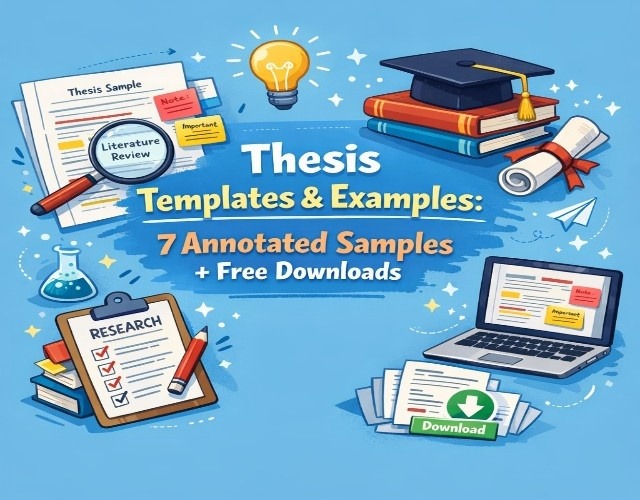
Thesis Outline Template
Best for: Planning your thesis structure before writing
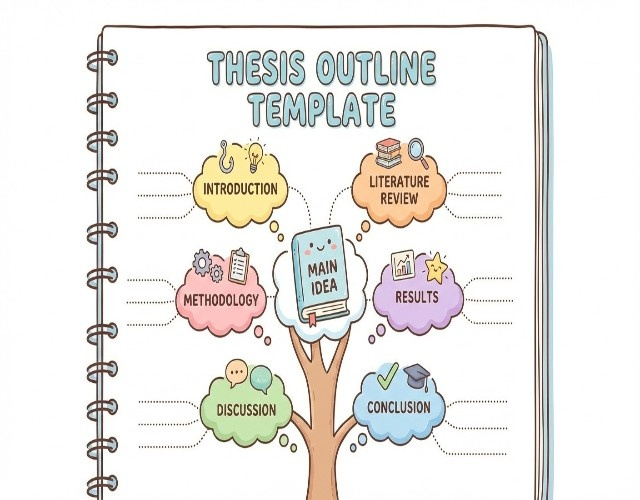
Front Matter
Title Page
- Thesis Title: [Your complete title]
- Your Name:
- Degree: [e.g., Master of Science in Biology]
- Department:
- University:
- Date: [Month Year]
- Committee Chair: [Name]
- Committee Members: [Names]
Abstract (150 to 300 words)
- Research problem/question
- Methods used
- Key findings
- Main conclusions
- Significance of research
Acknowledgments
- Advisor and committee
- Funding sources
- Research participants
- Family/personal support
Table of Contents
- List all chapters and major sections with page numbers
List of Tables
- Table number, title, and page number for each
List of Figures
- Figure number, title, and page number for each
Chapter 1: Introduction (10 to 15% of thesis)
1.1 Background and Context
- What is the broad area of research?
- Why does this topic matter?
- What is the current state of knowledge?
1.2 Problem Statement
- What specific problem are you addressing?
- What gap exists in current research?
- Why is this gap significant?
1.3 Research Questions/Hypotheses
- Primary Research Question: [Your main question]
- Secondary Questions: [Supporting questions]
- Hypotheses: [If applicable - what you predict and why]
1.4 Purpose and Objectives
- What is the purpose of this study?
- What are your specific objectives?
- What will this research accomplish?
1.5 Significance of the Study
- Who benefits from this research?
- What contribution does it make to the field?
- What practical applications exist?
1.6 Scope and Limitations
- Scope: What is included in your study?
- Limitations: What constraints affected your research?
- Delimitations: What did you deliberately exclude?
1.7 Definition of Terms
- Key terms and concepts defined
- Operational definitions for your study
1.8 Organization of the Thesis
- Brief overview of remaining chapters
Chapter 2: Literature Review (20 to 30% of thesis)
2.1 Introduction to Literature Review
- Overview of what this chapter covers
- Organization of the review
2.2 Theoretical Framework
- What theories guide your research?
- How do these theories relate to your topic?
- What conceptual model are you using?
2.3 Major Theme/Topic 1
- Subtheme 1.1: [Key findings from sources]
- Subtheme 1.2: [Key findings from sources]
- Synthesis: How sources relate and what gaps exist
2.4 Major Theme/Topic 2
- Subtheme 2.1: [Key findings from sources]
- Subtheme 2.2: [Key findings from sources]
- Synthesis: Connections and gaps
2.5 Major Theme/Topic 3
- Subtheme 3.1: [Key findings from sources]
- Subtheme 3.2: [Key findings from sources]
- Synthesis: Patterns and contradictions
2.6 Summary and Research Gap
- What does existing research tell us?
- What questions remain unanswered?
- How does your study address these gaps?
Chapter 3: Methodology (15 to 20% of thesis)
3.1 Introduction
- Overview of research approach
- Justification for the methodology chosen
3.2 Research Design
- Type of research (qualitative/quantitative/mixed)
- Research paradigm (positivist/interpretivist/etc.)
- Overall design (experimental/survey/case study/etc.)
3.3 Population and Sample
- Target Population: Who/what are you studying?
- Sample Size: How many participants/cases?
- Sampling Method: How did you select participants?
- Inclusion Criteria: What qualifies for inclusion?
- Exclusion Criteria: What disqualifies participation?
3.4 Data Collection
- Instruments: What tools did you use? (surveys, interviews, equipment)
- Procedures: Step by step data collection process
- Timeline: When was the data collected?
- Pilot Testing: How did you validate your instruments?
3.5 Data Analysis
- Quantitative: Statistical tests and software used
- Qualitative: Coding approach and analysis method
- Validity/Reliability: How did you ensure quality?
3.6 Ethical Considerations
- IRB approval status
- Informed consent procedures
- Confidentiality measures
- Potential risks and mitigation
3.7 Limitations of Methodology
- What methodological constraints existed?
- How might these affect interpretation?
Chapter 4: Results/Findings (20 to 30% of thesis)
4.1 Introduction
- Restate research questions
- Overview of results structure
4.2 Descriptive Statistics (if quantitative)
- Sample demographics
- Descriptive data for all variables
- Tables and figures summarizing data
4.3 Results for Research Question 1
- Present findings objectively
- Include relevant tables/figures
- Report statistical significance (if applicable)
4.4 Results for Research Question 2
- Present findings
- Include supporting data
- Maintain neutral, reporting tone
4.5 Results for Research Question 3
- Present findings
- Visual representations
- Statistical or thematic analysis results
4.6 Additional/Unexpected Findings
- Any significant results not directly related to RQs
- Patterns that emerged unexpectedly
4.7 Summary of Findings
- Brief recap of major results
- Transition to discussion
Note: Results chapter reports findings WITHOUT interpretation. Save analysis for Chapter 5.
Chapter 5: Discussion and Conclusions (20 to 25% of thesis)
5.1 Introduction
- Overview of the study
- Restatement of purpose
5.2 Summary of Key Findings
- Concise summary of main results
- No new data introduced
5.3 Interpretation of Findings
Finding 1: What does this result mean?
- How does it relate to literature?
- Was it expected or surprising?
- What explains this result?
Finding 2: Interpretation and significance
- Connection to theoretical framework
- Comparison with previous studies
Finding 3: Analysis and implications
- Agreement/disagreement with prior research
- Theoretical contributions
5.4 Implications
- Theoretical Implications: How does this advance the field?
- Practical Implications: What real-world applications exist?
- Policy Implications: What should practitioners/policymakers know?
5.5 Limitations
- What constraints affected your study?
- How might limitations affect interpretation?
- What couldn't be addressed?
5.6 Recommendations for Future Research
- What questions remain unanswered?
- What should future studies examine?
- How could methodology be improved?
5.7 Conclusions
- Final synthesis of research
- Contribution to knowledge
- Closing statement on significance
Back Matter
References/Bibliography
- All sources cited in proper format (APA/MLA/Chicago)
- Alphabetically organized
Appendices
- Appendix A: Survey instruments
- Appendix B: Interview protocols
- Appendix C: Consent forms
- Appendix D: Raw data tables (if appropriate)
- Appendix E: Additional materials
Formatting Checklist
- [ ] Consistent margins (usually 1" all sides)
- [ ] Double spaced body text (except block quotes)
- [ ] Page numbers in correct location
- [ ] Headings formatted consistently
- [ ] Tables and figures properly labeled and referenced
- [ ] Citations in correct style throughout
- [ ] Front matter pages numbered with Roman numerals
- [ ] Body pages numbered with Arabic numerals
- [ ] All cross references accurate
Length Guidelines
Master's Thesis: 50 to 100 pages
Doctoral Dissertation: 150 to 300 pages
Chapter breakdown (approximate):
- Chapter 1 (Introduction): 10 to 15 pages
- Chapter 2 (Literature Review): 25 to 40 pages
- Chapter 3 (Methodology): 15 to 20 pages
- Chapter 4 (Results): 20 to 30 pages
- Chapter 5 (Discussion): 20 to 25 pages
Note: These are guidelines. Your thesis should be as long as needed to thoroughly address your research.
Remember: This is a template, not a rigid formula. Adjust sections based on your field's conventions and committee's expectations.
What's included
|
Get Your Thesis Done Right With Expert Templates & Examples
Save time and ensure accuracy with ready-to-use thesis structures crafted by professionals.
- Access fully formatted thesis templates for any subject
- Detailed examples to guide your research & writing
- On-time delivery and unlimited revisions
- Expert editing to meet academic standards
Streamline your thesis writing, start with professional templates and examples that guarantee results.
Order NowThesis Proposal Template
Best for: Getting your thesis topic approved before you start
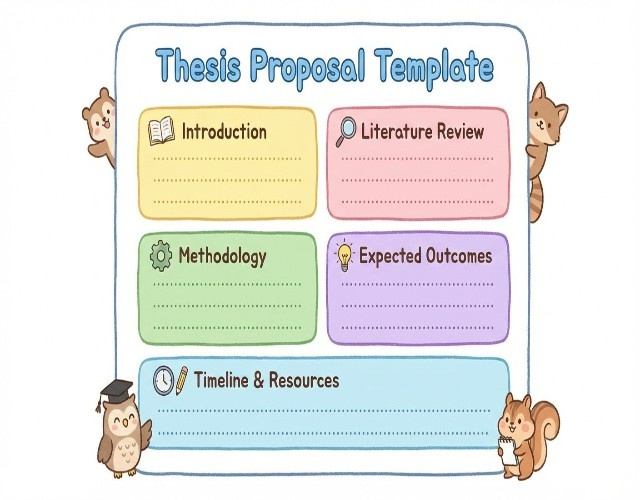
Title Page
Proposed Thesis Title: [Clear, descriptive title, can be refined later]
Student Name:
Student ID:
Program: [e.g., Master of Science in Psychology]
Department:
University:
Date: [Month Year]
Proposed Committee:
- Chair: [Name, Title]
- Member: [Name, Title]
- Member: [Name, Title]
1. Introduction (2 to 3 pages)
1.1 Background and Context
What you're addressing:
- What is the broad research area?
- Why is this topic important?
- What is currently known about this issue?
Example structure: "[Your field] has increasingly recognized the importance of [broad topic]. Recent developments in [area] have revealed that [context]. However, [what remains unclear or problematic]."
1.2 Problem Statement
The specific issue:
- What gap exists in current knowledge?
- What problem needs solving?
- Why does this gap/problem matter?
Fill in: "Despite research on [broader topic], little is known about [specific gap]. This is problematic because [why it matters]. Understanding [your focus] is essential for [who/what benefits]."
1.3 Research Questions
Primary Research Question:
[Your main question, should be specific, focused, and answerable]
Secondary Research Questions:
- [Supporting question 1]
- [Supporting question 2]
- [Supporting question 3; if needed]
OR Hypotheses (for experimental research):
- H1: [What you predict and why]
- H2: [Second prediction]
- H0: [Null hypothesis]
1.4 Purpose and Objectives
Purpose:
The purpose of this study is to [what you will do] to [what you aim to achieve].
Specific Objectives:
- To examine [objective 1]
- To analyze [objective 2]
- To determine [objective 3]
- To explore [objective 4]
1.5 Significance of the Study
Contributions:
- Theoretical: How will this advance understanding in your field?
- Practical: What real world applications will result?
- Methodological: Are you using innovative methods?
Who benefits:
- Researchers in [field]
- Practitioners who [work in area]
- Policymakers addressing [issue]
- Communities affected by [problem]
2. Literature Review (4 to 6 pages)
2.1 Theoretical Framework
Guiding theories:
- What established theories inform your research?
- How do they explain the phenomenon you're studying?
- What conceptual model are you adopting?
Diagram: [Include visual of your conceptual framework if helpful]
2.2 Review of Related Literature
Theme 1: [Major topic area]
- What has been studied?
- What are the key findings?
- What debates exist?
- Who are the major researchers?
Key sources:
- Author (Year): [Brief finding relevant to your research]
- Author (Year): [Brief finding]
- Author (Year): [Brief finding]
Theme 2: [Second major topic]
- Current state of knowledge
- Methodological approaches used
- Remaining questions
Key sources:
- Author (Year): [Finding]
- Author (Year): [Finding]
Theme 3: [Third major topic]
- What consensus exists?
- What contradictions appear?
- What gaps remain?
Key sources:
- Author (Year): [Finding]
- Author (Year): [Finding]
2.3 Research Gap
What's missing:
- What has NOT been studied?
- What questions remain unanswered?
- What populations/contexts are understudied?
- What methodological limitations exist in prior work?
How your study addresses the gap: "While previous research has examined [X], no studies have investigated [Y]. This research will address this gap by [your approach]."
3. Methodology (5 to 7 pages)
3.1 Research Design
Overall approach:
- Type: [Qualitative / Quantitative / Mixed Methods]
- Design: [Experimental / Survey / Case Study / Ethnography / etc.]
- Paradigm: [Positivist / Interpretivist / Critical / Pragmatic]
Justification:
This design is appropriate because [explain why this approach best answers your research questions].
3.2 Population and Sample
Target Population:
[Who/what you're studying; be specific about characteristics]
Sample Size:
- Proposed N = [number]
- Justification: [Why this number? Power analysis? Saturation?]
Sampling Strategy:
- Method: [Random / Stratified / Purposive / Convenience / Snowball]
- Rationale: [Why this method?]
Inclusion Criteria:
- [Criterion 1]
- [Criterion 2]
- [Criterion 3]
Exclusion Criteria:
- [What disqualifies participation]
Recruitment:
[How will you find and recruit participants?]
3.3 Data Collection
Instruments/Tools:
- Primary instrument: [Survey / Interview protocol / Observation checklist / Equipment]
- Description: [What it measures/captures]
- Reliability/Validity: [Established psychometrics or pilot testing plan]
- Secondary data: [If applicable]
Procedures:
- [Step 1 of data collection]
- [Step 2]
- [Step 3]
- [Continue with detailed steps]
Timeline:
- Pilot testing: [Dates]
- Data collection: [Start date] to [End date]
- Analysis: [Dates]
3.4 Data Analysis
Quantitative Analysis:
- Software: [SPSS / R / SAS / Stata]
- Descriptive statistics: [What you'll calculate]
- Inferential tests: [Which tests and why]
- RQ1 analysis: [Specific test]
- RQ2 analysis: [Specific test]
Qualitative Analysis:
- Approach: [Thematic / Content / Discourse / Grounded Theory]
- Coding process: [Initial leading to Focused then Thematic]
- Software: [NVivo / Atlas.ti / MAXQDA / Manual]
Ensuring Quality:
- Validity: [How you'll ensure accuracy]
- Reliability: [How you'll ensure consistency]
- Credibility: [For qualitative, triangulation, member checking]
3.5 Ethical Considerations
IRB Approval:
[Status: Will submit / Submitted / Approved Date]
Informed Consent:
- How will consent be obtained?
- What information will participants receive?
Confidentiality/Anonymity:
- How will you protect participant identity?
- Where will data be stored?
- Who has access?
Potential Risks:
- [Any risks to participants]
- [Mitigation strategies]
Benefits:
[How participants or society benefit]
3.6 Limitations
Anticipated limitations:
- [Limitation 1] [How you'll minimize impact]
- [Limitation 2] [Mitigation strategy]
- [Limitation 3] [Acknowledgment of constraint]
4. Expected Results and Implications (2 to 3 pages)
4.1 Expected Findings
What you anticipate: Based on [theory/prior research], this study is expected to find:
- [Prediction 1]
- [Prediction 2]
- [Prediction 3]
Rationale: [Why you expect these results]
4.2 Potential Implications
Theoretical Contributions:
- How will findings advance theory in your field?
- What new understanding will emerge?
Practical Applications:
- How can practitioners use these findings?
- What changes might be recommended?
Policy Implications:
- What should policymakers know?
- What decisions might this inform?
4.3 Future Research Directions
What questions will your study raise for future investigation?
5. Timeline (1 page)
Proposed Schedule
| Phase | Activities | Timeline |
|---|---|---|
| Proposal | Proposal defense, revisions, IRB submission | [Months] |
| Preparation | Finalize instruments, pilot test, recruit | [Months] |
| Data Collection | Gather data from participants | [Months] |
| Analysis | Analyze data, interpret results | [Months] |
| Writing | Draft chapters 4 to 5, revisions | [Months] |
| Defense | Prepare defense, defend thesis | [Month/Year] |
Key Milestones:
- IRB approval: [Target date]
- Data collection complete: [Target date]
- Full draft submitted: [Target date]
- Thesis defense: [Target date]
6. Budget (if applicable)
Estimated Costs
| Item | Cost | Justification |
|---|---|---|
| Participant incentives | $[amount] | [Why needed] |
| Software licenses | $[amount] | [What software] |
| Equipment/supplies | $[amount] | [What items] |
| Travel | $[amount] | [Where/why] |
| Transcription services | $[amount] | [Hours needed] |
| TOTAL | $[total] |
Funding Sources:
- [Grant / Fellowship / Department funding / Self funded]
7. References
[List all sources cited in your proposal in proper format , APA/MLA/Chicago]
Formatting notes:
- Alphabetical by author last name
- Hanging indent
- Consistent citation style
- Include DOI/URL for online sources
Appendices
Appendix A: Survey Instrument
[Include draft survey/questionnaire]
Appendix B: Interview Protocol
[Include interview questions/guide]
Appendix C: Consent Form
[Include draft consent form]
Appendix D: Recruitment Materials
[Include flyers, emails, scripts]
Appendix E: Additional Materials
[Any other supporting documents]
Formatting Guidelines
Length: 15 to 25 pages (excluding references and appendices)
Format:
- Font: Times New Roman, 12pt
- Spacing: Double spaced
- Margins: 1" all sides
- Page numbers: Bottom center or top right
- Headings: Consistent hierarchy
Organization:
- Clear section headings
- Logical flow
- Professional tone
- No typos or grammatical errors
Remember: Your proposal is a contract with your committee about what you'll do. Be specific enough to demonstrate feasibility, but allow some flexibility for discoveries during research.
What's included
|
Chapter by Chapter Thesis Structure Breakdown
Standard thesis structure with length expectations for each section.
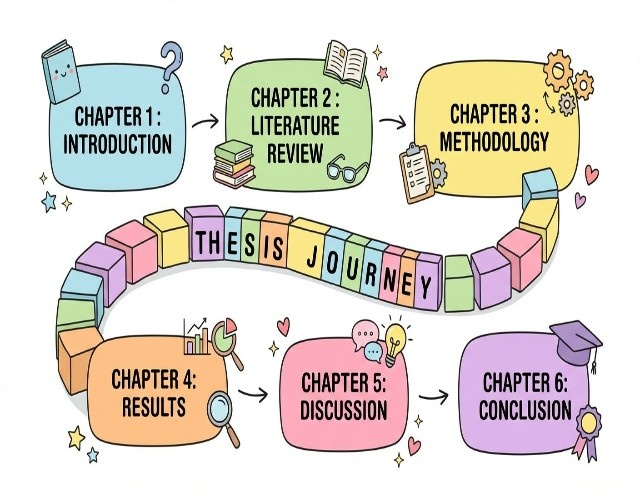
Standard Master's Thesis Structure
FRONT MATTER (Roman numerals: i, ii, iii, iv...)
| Component | Required? | Typical Length |
|---|---|---|
| Title Page | Yes | 1 page (counted as 'i', not printed) |
| Copyright Page | Optional | 1 page |
| Abstract | Yes | 1 page (150 to 350 words) |
| Acknowledgments | Optional | 1 to 2 pages |
| Table of Contents | Yes | 2 to 4 pages (auto generated) |
| List of Figures | If applicable | 1 to 2 pages |
| List of Tables | If applicable | 1 to 2 pages |
| List of Abbreviations | If needed | 1 page |
MAIN CHAPTERS (Arabic numerals: 1, 2, 3...)
| Chapter | Standard Title | % of Total | Typical Length (for 10 to page thesis) |
|---|---|---|---|
| 1 | Introduction | 10% | 8 to 12 pages |
| 2 | Literature Review | 25% | 20 to 30 pages |
| 3 | Methodology | 15% | 12 to 18 pages |
| 4 | Results/Findings | 20% | 15 to 25 pages |
| 5 | Discussion | 25% | 20 to 30 pages |
| 6 | Conclusion | 5% | 5 to 8 pages |
BACK MATTER
| Component | Required? | Typical Length |
|---|---|---|
| References/Bibliography | Yes | 5 to 10 pages (50 to 100+ sources) |
| Appendices | If applicable | Variable |
| Curriculum Vitae | Sometimes (doctoral) | 1 to 2 pages |
What Goes in Each Chapter
Chapter 1: Introduction
Purpose: Hook the reader, establish significance, state your research questions
Must include
- Opening hook (statistic, anecdote, surprising fact)
- Background and context (what's the problem?)
- Research gap (what don't we know?)
- Research questions or thesis statement
- Significance (why does this matter?)
- Scope and limitations
- Thesis structure preview
Common mistakes to avoid
- Starting too broadly ("Since the beginning of time...")
- Defining basic terms in detail (save for literature review)
- Including results or conclusions
- Exceeding 12 pages for master's level
Chapter 2: Literature Review
Purpose: Show you understand the existing research and where your work fits
Must include
Thematic organization (not a chronological list of studies)
- Critical analysis, not just summary
- Identification of gaps, contradictions, or limitations in existing research
- Theoretical or conceptual framework
- Clear connection to your research questions
Structure options
- By theme (if cross disciplinary)
- By methodology (quantitative studies, qualitative studies, mixed methods).
- Chronological within themes (showing evolution)
- Funnel structure
Minimum sources by level
- Undergraduate honors: 30 to 40 sources
- Master's: 50 to 80 sources
- Doctoral: 100+ sources
Common mistakes to avoid
- Literature summary without synthesis
- Missing seminal works in the field
- Relying too heavily on textbooks (use primary sources)
- No clear research gap identified
Chapter 3: Methodology
Purpose: Explain exactly what you did so others could replicate it
Must include
For Quantitative Studies
- Research design (experimental, correlational, longitudinal, etc.)
- Participants: sample size, demographics, recruitment, inclusion/exclusion criteria
- Materials: instruments, surveys, equipment (with reliability/validity data)
- Procedure: step by step what happened
- Data analysis plan: specific statistical tests planned
For Qualitative Studies
- Research design (case study, phenomenology, grounded theory, ethnography, etc.).
- Participants: purposive sampling rationale, characteristics
- Data collection: interviews (how many, how long), observations (where, when), documents
- Analysis approach: thematic analysis, discourse analysis, etc. (with specific steps).
- Trustworthiness: credibility, transferability, dependability, confirmability strategies
For Mixed Methods
- Design type (convergent, explanatory sequential, exploratory sequential)
- How qualitative and quantitative components relate
- Integration strategy
- All components from above for each method
All studies must include
- Ethical considerations: IRB approval, informed consent, confidentiality protections
- Limitations of the methodology
Common mistakes to avoid
- Vague descriptions ("participants were interviewed")
- Missing information about sample size justification
- No pilot testing mentioned
- Ignoring ethical considerations
Chapter 4: Results/Findings
Purpose: Report what you found without interpretation (that's for Discussion)
For Quantitative Studies
- Descriptive statistics first (means, SDs, ranges
- Tables and figures for main findings
- Statistical test results with exact statistics
- Effect sizes reported
- Organized by research question or hypothesis
For Qualitative Studies
- Themes with detailed descriptions
- Participant quotes as evidence (with participant identifiers: P3, Interview 2)
- Thick description of context
- Negative cases or disconfirming evidence acknowledged
Format rules
- Tables and figures should stand alone (complete captions)
- Reference tables in text before they appear: "As shown in Table 3..."
- Never interpret here, just report: "Group A scored higher than Group B" (not "because...")
Common mistakes to avoid
- Interpreting results (save for Discussion)
- Including every piece of data (select what's relevant)
- Poor table formatting (cluttered, unlabeled)
- No visual representation of key findings
Chapter 5: Discussion
Purpose: Explain what your results mean, compare to past research, acknowledge limitations
Must include
- Brief summary of key findings (2 to 3 paragraphs).
- Interpretation: What do these findings mean? Why did you get these results?
- Comparison with literature: How do your findings align or conflict with previous studies?
- Theoretical implications: What does this add to our understanding?
- Practical implications: How can practitioners use this?
- Limitations: What are the weaknesses of your study?
- Future research directions: What should researchers do next?
Structure tip: Organize by research question or by theme
Common mistakes to avoid
- Just repeating the Results chapter
- Overstating findings ("this proves...")
- Ignoring contradictory results
- Limitations section that's too brief or defensive
Chapter 6: Conclusion
Purpose: Wrap up with take-home messages
Must include
- Very brief summary of entire thesis (1 to 2 paragraphs)
- Restatement of key findings and their significance
- Final thoughts on contribution to the field
- Call to action (for applied fields) or research agenda (for basic research)
Keep it short: 5 to 8 pages maximum. Don't introduce new information.
Common mistakes to avoid
- Starting with "In conclusion..." (we know it's the conclusion)
- Repeating the discussion chapter word for word
- Introducing new literature or findings
- Ending abruptly without synthesis
Choosing the right thesis topics is the first step toward a successful research project, as it determines your focus, sources, and overall direction
Thesis Format Requirements: The Technical Details
Standard formatting rules that most universities require.
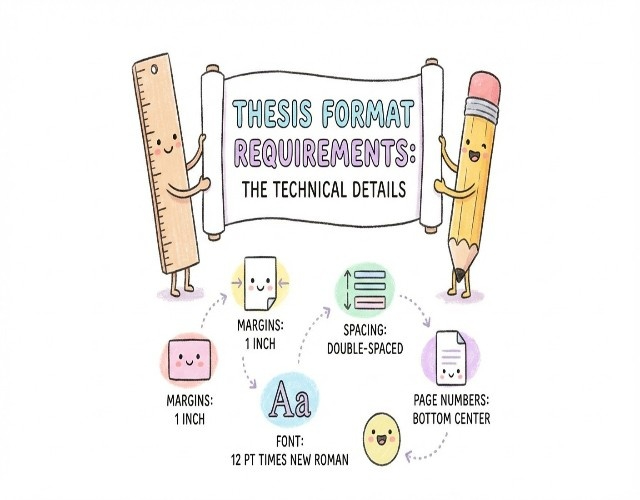
Page Setup
Margins
Font
Spacing
Alignment
|
Page Numbering
Front Matter (Roman numerals: i, ii, iii, iv...)
Body Chapters (Arabic numerals: 1, 2, 3...)
Appendices
|
Heading Hierarchy
Use Word's built in Heading Styles for automatic Table of Contents generation.
Level 1 (Chapter Titles)
Level 2 (Major Sections)
Level 3 (Subsections)
Level 4 (If needed)
|
CHAPTER 3: METHODOLOGY
Research Design
This study employed a mixed methods convergent design...
Participants
Recruitment. Participants were recruited through...
Tables and Figures
Placement
Numbering
Captions
Formatting rules
|
Citations and References
Format depends on your field's style guide:
APA 7th Edition (Psychology, Education, Social Sciences, Nursing)
MLA 9th Edition (Literature, Languages, Humanities)
Chicago 17th Edition (History, Fine Arts, Some Business)
Consistency is critical: Choose one style guide and follow it exactly. |
Common Formatting Mistakes to Avoid
- Inconsistent fonts (Times New Roman in body, Arial in tables)
- Manual page numbers (use Word's automatic numbering)
- Manual Table of Contents (use Word's auto generate feature)
- Widows and/or orphans (single lines stranded at top/bottom of page)
- No page breaks before chapters (chapters must start on a new page
- Inconsistent heading capitalization (Chapter One vs. CHAPTER TWO)
- Missing figure/table numbers
- References cited but not in the reference list (or vice versa)
Need Templates for a dissertation? Leverage our dissertation templates and examples to structure your work efficiently
Accessibility Requirements (NEW for 2025 to 2026)
Many universities now require accessibility, compliant PDFs:
Required elements
- Proper heading structure (use Word styles, not manual bold)
- Alt text for all figures and tables
- Tagged PDF when exporting
- Sufficient color contrast (4.5:1 minimum for body text)
- Meaningful link text (not "click here")
How to check in Word: Go to File, then Info, select Check for Issues, and choose Check Accessibility. Resolve all errors before exporting your document to PDF.
This is especially important if your university requires a digital only submission or ProQuest upload.
Complete Thesis Examples (Annotated)
These are real thesis structures with annotations showing what makes each one work. Use them as models for your own.
STEM Thesis Example: Computer Science
Degree Level: Master of Science in Computer Science
Length: 87 pages
Format: APA 7th edition
Mitigating Algorithmic Bias in Facial Recognition Systems Through Diverse Training Dataset Optimization
I. INTRODUCTION (8 pages): Background on facial recognition technology deployment
- Problem statement: bias in misidentification rates across demographics
- Research gap: limited work on dataset optimization methods
- Thesis statement: "This research demonstrates that strategically augmenting training datasets with demographically diverse samples reduces misidentification rates by 34% across underrepresented groups while maintaining overall system accuracy."
- Research objectives and scope: Significance for industry and policy
II. LITERATURE REVIEW (22 pages)
- Current facial recognition architectures
- Documented bias patterns in commercial systems
- Existing mitigation approaches (algorithmic, dataset-based, post-processing)
- Gaps in current research
- Theoretical framework: fairness metrics in machine learning
III. METHODOLOGY (15 pages)
- Research design: experimental with comparative analysis
- Dataset selection and augmentation strategy
- Evaluation metrics: accuracy, false positive rates, fairness measures
- System architecture and implementation
- Ethical considerations and IRB approval
IV. IMPLEMENTATION (12 pages)
- Baseline system specifications
- Dataset augmentation process
- Training procedures and parameters
- Testing protocols
V. RESULTS (18 pages)
- Baseline performance metrics
- Post-augmentation performance improvements
- Statistical analysis (ANOVA, t-tests)
- Performance across demographic groups
- Visualizations: confusion matrices, ROC curves, fairness plots
VI. DISCUSSION (9 pages)
- Interpretation of findings
- Comparison with existing approaches
- Implications for deployment
- Limitations and threats to validity
- Future research directions
VII. CONCLUSION (3 pages)
- Summary of contributions
- Practical recommendations
- Broader impact on AI ethics
REFERENCES (6 pages, 89 sources)
APPENDICES
A: Dataset demographics
B: Complete statistical tables
C: Code repositories (GitHub links)
What Makes This STEM Thesis Strong
|
Thesis Made Simple: Templates & Examples at Your Fingertips
Avoid formatting stress, get ready to use thesis templates and real examples that guide you step by step.
- Professionally designed thesis templates for all disciplines
- Sample chapters to model your own research
- Fast, reliable delivery with unlimited revisions
- Expert guidance on citations, formatting, and structure
Stop struggling, use professional templates and examples to craft a flawless thesis with ease.
Order NowHumanities Thesis Example: English Literature
Degree Level: Master of Arts in English Literature
Length: 112 pages
Format: MLA 9th edition
Unspeakable Trauma: Narrative Silence and Fragmentary Form in Contemporary Post Conflict Fiction
I. INTRODUCTION: The Language of the Unspoken (12 pages)
- Opening: analysis of a key passage from The English Patient; Critical context: trauma theory in literary studies
- Research question: How do contemporary authors represent experiences that resist language?
- Thesis statement: "Contemporary post conflict novelists employ deliberate narrative silence, fragmentary chronology, and typographic disruption not as stylistic choices but as formal necessities, the only means of authentically representing trauma that exceeds language itself."
- Scope: three primary texts (Ondaatje, Danticat, Sebald)
- Theoretical framework: Caruth, Felman, LaCapra; Chapter overview
II. THEORETICAL FRAMEWORK: Trauma, Memory, and Representation (18 pages)
- Caruth's theory of traumatic repetition
- Felman and Laub on testimony and witnessing
- LaCapra's distinction between acting out and working through
- Critiques of trauma theory (Leys, Kansteiner)
- Application to literary analysis
III. "THE GAPS BETWEEN THE WORDS": Narrative Silence in Ondaatje's The English Patient (25 pages)
- Close reading of key passages
- Analysis of elision and omission patterns
- The role of the unnamed burn patient
- Silence as ethical response to violence
- Comparison with Ondaatje's earlier works
IV. FRAGMENTED CHRONOLOGIES: Non Linear Time in Danticat's The Dew Breaker (24 pages)
- Structure of the interconnected stories
- Temporal disruption as formal mimesis of traumatic memory
- The revelation of the father's past
- Haiti's political history as context
- Interview material with Danticat
V. TYPOGRAPHIC DISRUPTION: Material Form in Sebald's Austerlitz (22 pages)
- Analysis of photographs and their placement
- Unattributed speech and missing quotation marks
- Sentence length and rhythm as representation of memory
- The architecture of memory in the novel
- Sebald's use of actual historical images
VI. CONCLUSION: Toward an Ethics of Representation (9 pages)
- Synthesis of findings across three authors
- Implications for trauma representation
- Ethical obligations of the reader
- Areas for future research
- Final reflections on silence and witnessing
WORKS CITED (102 sources)
Social Sciences Thesis Example: Psychology
Degree Level: Master of Science in Applied Psychology
Length: 94 pages
Format: APA 7th edition
The Longitudinal Effects of Workplace Mindfulness Training on Employee Burnout and Job Satisfaction: A 12 Month Randomized Controlled Trial
I. INTRODUCTION (10 pages)
- Workplace burnout as a public health concern
- Mindfulness-based interventions: overview
- Gap in longitudinal research
- Research questions
1. Does workplace mindfulness training reduce burnout over 12 months?
2. Does training improve job satisfaction?
3. Do effects persist after training ends? - Hypotheses: Specific, directional predictions for each outcome
Study significance
II. LITERATURE REVIEW (24 pages)
- Burnout: definition, measurement, prevalence
- Job satisfaction: models and measurement
- Mindfulness: mechanisms and measurement
- Review of mindfulness interventions in workplace settings
- Methodological critiques of existing studies
- Gaps addressed by current study
III. METHODOLOGY (18 pages)
- Participants: Sample: 127 employees (64 intervention, 63 control)
- Recruitment: three mid sized tech companies
- Demographics: age, gender, years employed, job role
- Inclusion/exclusion criteria
- Attrition analysis
Procedure
- Randomization process
- Intervention: 8 week MBSR based program (2 hours/week)
- Control: waitlist
- Assessment timepoints: baseline, post-intervention, 3 month, 6 month, 12 month
Measures
- Maslach Burnout Inventory (MBI)
- Job Satisfaction Survey (JSS)
- Five Facet Mindfulness Questionnaire (FFMQ)
- Demographic questionnaire
- Reliability coefficients reported
Data Analysis
- Mixed-model repeated measures ANOVA
- Effect sizes (Cohen's d)
- Intent to treat analysis
- Power analysis (post-hoc)
Ethical Considerations
- IRB approval number
- Informed consent procedures
- Confidentiality protections
IV. RESULTS (16 pages)
- Participant flow diagram (CONSORT)
- Descriptive statistics (Table 1)
- Burnout outcomes: Significant time × group interaction
- Intervention group: 27% reduction from baseline to 12-month
- Control group: no significant change
- Job satisfaction outcomes: Significant improvement in intervention group, maintained at 12 months
- Mindfulness as mediator (mediation analysis)
- Figures: line graphs showing trajectories over time
V. DISCUSSION (20 pages)
- Interpretation of findings
- Comparison with previous short-term studies
- Theoretical implications: mechanisms of sustained change
- Practical implications for organizations
- Limitations
1. Self report measures only
2. Sample limited to the tech industry
3. No active control group - Attrition (18% by 12 months)
- Strengths of the study
- Future directions: need for multi site trials, objective measures, cost benefit analysis
VI. CONCLUSION (3 pages)
- Summary of key findings
- Contributions to the field
- Recommendations for practice
REFERENCES (7 pages, 114 sources)
APPENDICES
A: Recruitment materials
B: Informed consent form
C: Complete survey instruments
D: Detailed statistical tables
What Makes This Social Science Thesis Strong
|
Business Thesis Example: MBA
Degree Level: Master of Business Administration
Length: 78 pages
Format: APA 7th edition
The Impact of AI Chatbot Implementation on Customer Satisfaction and Service Costs: A Case Study of Three European Retailers
I. EXECUTIVE SUMMARY (2 pages)
- Problem and objectives
- Methodology overview
- Key findings (measurable outcomes)
- Recommendations
II. INTRODUCTION (8 pages)
- Rise of AI chatbots in customer service
- Business case: cost reduction vs. customer experience
- Gap: limited real world implementation studies
- Research questions
1. How does chatbot implementation affect customer satisfaction scores?
2. What cost savings do retailers achieve?
3. What implementation factors predict success? - Scope: three case study companies
III. LITERATURE REVIEW & THEORETICAL FRAMEWORK (16 pages)
- AI chatbot technology overview
- Customer satisfaction theory (SERVQUAL model)
- Service quality in retail
- Cost benefit analysis frameworks
- Implementation success factors
- Gaps in existing research
IV. METHODOLOGY (12 pages)
Research Design
- Multiple case study approach (Yin, 2018)
- Three European retailers: Fashion (Company A), Electronics (Company B), Home Goods (Company C)
Data Collection
- Semi structured interviews: 15 managers, 8 IT specialists, 22 customer service reps.
- Customer satisfaction surveys: pre and post implementation (n=1,847 and n=2,103)
- Financial data: service cost reports (6 months pre, 12 months post)
- Chatbot interaction logs: 47,000+ conversations analyzed
Analysis Methods
- Thematic analysis for interview data
- Statistical comparison of satisfaction scores (t tests)
- Cost analysis using the ROI framework
- Content analysis of chatbot conversations
V. CASE STUDY FINDINGS (24 pages)
Company A: Fashion Retailer
- Implementation details
- Customer satisfaction: 7% decrease initially, recovered to baseline by month 8
- Cost savings: 23% reduction in service costs
- Key success factors: gradual rollout, human handoff option
Company B: Electronics Retailer
- Implementation details
- Customer satisfaction: maintained, slight improvement for simple queries
- Cost savings: 31% reduction
- Success factors: excellent training data, narrow scope
Company C: Home Goods Retailer
- Implementation details
- Customer satisfaction: 12% decrease, did not recover
- Cost savings: 19% reduction
- Failure factors: rushed implementation, poor escalation protocols
Cross Case Analysis
- Patterns across cases
- Success vs. failure factors
- Customer segment differences
VI. DISCUSSION & RECOMMENDATIONS (12 pages)
- Interpretation of findings
- Comparison with literature
- Theoretical contributions
- Practical recommendations
1. Pilot with low stakes inquiries
2. Invest in quality training data
3. Maintain easy human escalation
4. Monitor satisfaction metrics continuously
5. Set realistic ROI expectations (18 to 24 months) - Implementation roadmap for retailers
VII. LIMITATIONS & FUTURE RESEARCH (3 pages)
- Case study generalizability
- European context may not transfer globally
- 12 months timeframe limitations
- Suggested research directions
VIII. CONCLUSION (2 pages)
- Summary of key findings
- Implications for retail management
- Final recommendations
REFERENCES (4 pages, 67 sources)
APPENDICES
A: Interview protocols
B: Survey instruments
C: Financial analysis details
D: Company profiles (anonymized)
What Makes This MBA Thesis Strong
|
Undergraduate/Honors Thesis Example
Degree Level: Bachelor of Arts, Honors Thesis in Public Health
Length: 42 pages
Format: APA 7th edition
Food Deserts and Health Outcomes: Analyzing the Relationship Between Grocery Store Access and Obesity Rates in Urban Philadelphia
I. INTRODUCTION (5 pages)
- Definition of food deserts
- Health disparities in urban areas
- Philadelphia as a case study
- Thesis statement: "Limited access to healthy food retailers in Philadelphia neighborhoods is significantly associated with higher obesity rates, even after controlling for income, education, and race."
- Research questions
- Significance
II. LITERATURE REVIEW (10 pages)
- Food desert research: definitions and measurements
- Health effects of food access
- Previous studies linking food environment to obesity
- Socioeconomic confounding factors
- Philadelphia specific context
III. METHODOLOGY (8 pages)
Data Sources
- USDA Food Access Research Atlas
- Philadelphia Department of Public Health obesity data (2024)
- US Census (demographic data)
- Geographic Information Systems (GIS) mapping
Variables
- Independent: distance to nearest full
- service grocery store
- Dependent: neighborhood obesity prevalence
- Controls: median income, education levels, racial composition
Analysis
- Multiple regression analysis
- GIS mapping of food deserts and obesity rates
- Descriptive statistics
IV. RESULTS (8 pages)
- Descriptive statistics table
- Regression results: significant relationship between grocery distance and obesity
- Maps showing geographic overlap
- Scatter plots
V. DISCUSSION (8 pages)
- Interpretation of findings
- Comparison with other cities
- Policy implications
- Limitations: correlation not causation, missing variables (physical activity, food preference)
- Suggestions for intervention programs
VI. CONCLUSION (3 pages)
- Summary
- Call for policy action
- Future research needs
REFERENCES (38 sources)
APPENDIX: Data Sources and Coding
What Makes This Undergraduate Thesis Strong
|
Short Thesis Example: Thesis Introduction
Can't see the full thesis yet? Here's what a strong introduction chapter looks like.
Example Introduction: Education Thesis
From: "Teacher Burnout and Student Achievement: A Mixed Methods Analysis of Elementary Schools in High Poverty Districts"
Chapter 1: Introduction
Teacher burnout has reached crisis levels in American public schools. A 2024 RAND Corporation survey found that 58% of teachers report frequent emotional exhaustion, 47% experience depersonalization in student interactions, and 32% have considered leaving the profession within the past year (Steiner & Woo, 2024). While these statistics underscore a workforce sustainability issue, they also raise a critical educational equity question: How does teacher burnout affect the students who depend on those teachers for learning?
The relationship between teacher well being and student outcomes has received growing attention in educational research (Klusmann et al., 2023; Ryan et al., 2022), yet significant gaps remain. First, most studies examine teacher and student outcomes separately rather than analyzing them as interconnected systems. Second, quantitative studies document correlations but provide limited insight into the mechanisms through which teacher burnout affects instruction. Third, research has largely focused on secondary schools, leaving elementary settings, where single teachers spend entire days with the same students, under examined.
This thesis addresses these gaps through a mixed methods study of 12 elementary schools in high poverty urban districts. I combine quantitative analysis of teacher burnout surveys and student achievement data with qualitative interviews and classroom observations to answer three research questions:
- Is there a measurable relationship between teacher burnout levels and student achievement in reading and mathematics?
- How do burned out teachers describe changes in their instructional practices?
- What school level factors moderate the relationship between teacher burnout and student outcomes?
I hypothesize that higher teacher burnout will be associated with lower student achievement gains, and that this relationship will be mediated by observable changes in instructional quality (e.g., reduced feedback, less differentiation, lower engagement). I further hypothesize that strong school leadership and collaborative teacher cultures will buffer against these negative effects.
This research matters for three reasons. First, if teacher burnout directly harms student learning, addressing teacher well being becomes not just a labor issue but an educational equity imperative. Students in high poverty schools already face systemic disadvantages; burned out teachers compound those inequities. Second, understanding the mechanisms through which burnout affects instruction can inform targeted interventions. If the problem is primarily reduced feedback, solutions might focus on manageable assessment strategies. If the problem is emotional disengagement, social emotional support for teachers may be necessary. Third, identifying protective factors (e.g., strong principals, collegial support) can guide school improvement efforts.
The thesis proceeds as follows.
- Chapter 2 reviews literature on teacher burnout, student achievement, and the connections between them, establishing the theoretical framework of emotional labor and instructional quality.
- Chapter 3 details the mixed methods research design, including the 12 school sample, survey instruments, interview protocols, and statistical analysis plan.
- Chapter 4 presents quantitative findings on the burnout achievement relationship.
- Chapter 5 presents qualitative findings from teacher interviews and classroom observations, illuminating how burnout manifests in daily practice.
- Chapter 6 discusses implications for theory, policy, and practice, with recommendations for supporting both teachers and students.
What Makes This Introduction Strong
|
Use the above templates and examples as a starting point, but save time and ensure perfection by letting our legit essay writing service adapt the structure, integrate research, and polish your draft for submission ready quality.
Free Downloadable Thesis Templates
Master's Thesis Template: APA Format
Master's Thesis Template: MLA Format
Master's Thesis Template: Chicago/Turabian Format
Honors Thesis Template
Finish Your Thesis Faster With Expert Examples
Save time and stay confident with proven thesis examples and templates created by academic professionals.
- Comprehensive thesis templates for all academic levels
- Detailed examples that clarify complex sections
- Personalized editing to ensure high-quality submission
- Guaranteed timely delivery with 24/7 support
Achieve your academic goals efficiently, let our expert examples and templates guide you from draft to submission.
Order NowBottom Line
You’ve got thesis templates and annotated examples that show exactly what works. You’ve got detailed chapter by chapter breakdowns, clear structure guides, and tips to avoid common pitfalls.
Now you face a choice: spend the next 6 to 12 months figuring it all out on your own, juggling research, writing, and formatting, or leverage expert guidance to finish faster and with confidence.
Our comprehensive thesis and dissertation guide walks you through every step, from selecting your focus and conducting research to drafting, revising, and preparing for defense. And if you hit a wall at any stage, whether it’s with methodology, analysis, or citations, we’re here to help you move forward efficiently.