What is a Thesis?
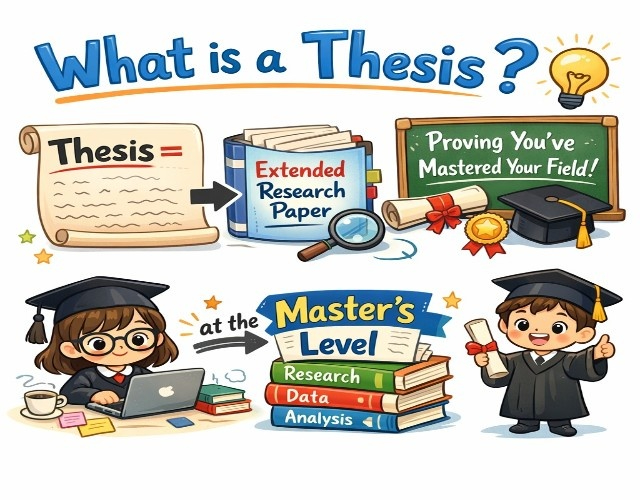
A thesis is a substantial research paper required for earning a master's degree, demonstrating your mastery of a subject through comprehensive research, analysis, and synthesis of existing knowledge.
Unlike undergraduate papers, a thesis requires:
- Original analysis of your topic (not just summarizing what others said).
- Comprehensive research across multiple sources.
- Substantial length (typically 50-100 pages).
- Formal structure with specific required chapters.
- Defense before a committee of faculty experts.
The Three Essential Thesis Components
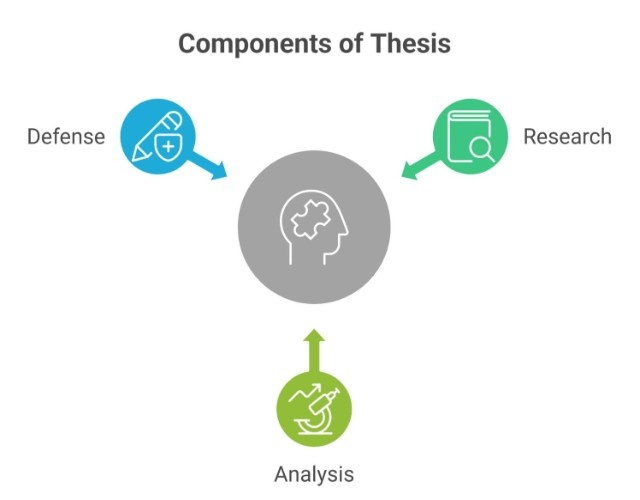
1. Research: Extensive investigation of existing literature and potentially new data collection
2. Analysis: Your original interpretation, synthesis, and contribution to understanding the topic
3. Defense: Oral presentation to your thesis committee explaining and defending your work
Purpose of a Master's Thesis
Graduate programs require theses to ensure you can:
- Conduct independent research: Plan, execute, and complete a major research project without constant supervision
- Synthesize complex information: Pull together ideas from multiple sources and develop coherent arguments
- Contribute to your field: Add new insights, even if incremental, to existing scholarship
- Demonstrate expertise: Prove you've achieved master level understanding of your subject area
- Prepare for professional work: Develop research and writing skills essential for many careers
- Gateway to doctoral study: For students planning PhDs, the thesis demonstrates readiness for dissertation-level work
Not all master's programs require theses; some offer non thesis options with additional coursework or comprehensive exams instead. However, thesis programs are common in research focused fields and provide valuable experience in sustained, independent scholarly work.
What Makes a Good Thesis?
Strong theses share these qualities:
- Clear research question: Focused inquiry that guides the entire project
- Comprehensive literature review: Thorough analysis of existing research on your topic
- Appropriate methodology: Research methods suited to answering your question
- Original analysis: Your unique contribution, interpretation, or synthesis
- Logical organization: Clear structure that guides readers through your argument
- Significant findings: Results or conclusions that matter to your field
- Professional presentation: Proper formatting, citation, and academic writing throughout
Bad thesis: Summarizes what five books say about a topic without adding analysis or insight Good thesis: Analyzes how those five books' arguments relate to each other, identifies gaps they don't address, and presents your original interpretation supported by evidence See the difference? Good theses demonstrate your ability to think critically and contribute meaningfully to scholarly conversation, not just report what others have said. |
If you’re unsure where to begin, browsing sample thesis topics can spark new ideas.
Ready to Start Your Thesis or Dissertation?
From proposal to final defense, our academic experts guide the entire process.
- Research questions + topic development
- Proposal writing + committee-ready formatting
- Literature review & methodology support
- Editing, revisions, & polish for submission
Start your project with confidence, get expert guidance every step of the way.
Order NowWhat is a Dissertation?
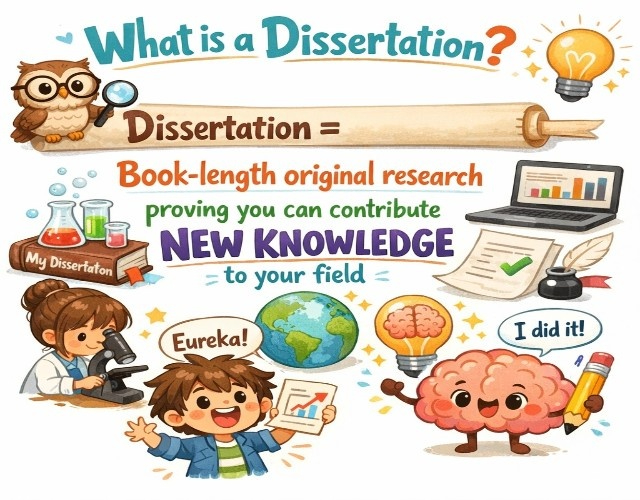
A dissertation is an extensive original research project required for earning a doctoral degree (PhD or equivalent), demonstrating your ability to conduct independent research that makes a significant original contribution to your field.
 Dissertations differ from theses in fundamental ways:
1. Original contribution required (not just analysis of existing work) 2. Much longer (typically 150-300+ pages)
3. More extensive research (often including primary data collection) 4. Higher level of originality expected
5. More rigorous defense process
6. Publication potential (often adapted into journal articles or books)
The Three Essential Dissertation Components
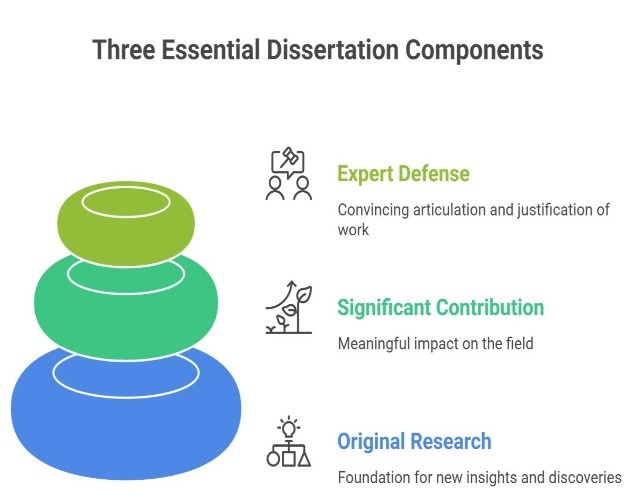
1. Original Research: New data, new methodology, or significantly new interpretation
2. Significant Contribution: Findings that advance knowledge in your field
3. Expert Level Defense: Comprehensive oral examination demonstrating mastery
Purpose of a Doctoral Dissertation
Doctoral programs require dissertations to ensure you can:
- Generate new knowledge: Conduct research that discovers, creates, or significantly extends what's known
- Master research methodology: Design and execute complex research independently
- Think at expert level: Approach problems with the sophistication expected of field leaders
- Contribute scholarship: Produce work worthy of publication in academic venues
- Become an authority: Develop expertise sufficient to be recognized as a subject matter expert
- Prepare for academic/research careers: Demonstrate readiness for faculty positions or high level research roles
The dissertation represents the culmination of your doctoral training, proof that you've achieved the highest level of academic expertise and can function as an independent scholar.
What Makes a Good Dissertation?
Strong dissertations share these qualities:
- Significant original contribution: Fills a genuine gap in existing research or knowledge
- Rigorous methodology: Appropriate, well executed research methods
- Comprehensive literature review: Thorough understanding of your field and where your work fits
- Clear theoretical framework: Solid foundation explaining your approach
- Substantial findings: Results significant enough to warrant publication
- Scholarly writing: Professional academic prose throughout
- Proper defense: Ability to explain and defend every aspect of your work
Bad dissertation: Applies existing theories to a slightly different context without generating new insights Good dissertation: Develops a new theoretical framework, generates original data through innovative methodology, and produces findings that shift how scholars understand the topic The difference? Good dissertations don't just add one more study to a pile; they change conversations in their field. |
Thesis vs Dissertation: Complete Comparison
Understanding the differences helps you know what's expected at each level.
Quick Comparison Table
| Aspect | Master's Thesis | Doctoral Dissertation |
|---|---|---|
| Academic Level | Master's degree | Doctoral/PhD degree |
| Primary Purpose | Demonstrate mastery of field | Contribute original knowledge |
| Length | 50-100 pages typical | 150-300+ pages typical |
| Research Type | Analysis & synthesis of existing work | Original research with new findings |
| Originality Required | Original analysis/interpretation | Significant original contribution |
| Timeline | 1-2 years part-time | 3-7 years full-time |
| Data Collection | Often secondary sources | Usually primary research/data |
| Methodology Chapter | Brief methods section | Extensive methodology chapter |
| Literature Review | Comprehensive but focused | Exhaustive and field-defining |
| Defense | 1-2 hour oral exam | 2-4 hour rigorous examination |
| Committee Size | 2-3 faculty members | 4-6 faculty members |
| Publication Expectation | Not typically required | Often expected/encouraged |
| Impact on Career | Demonstrates competence | Establishes expertise |
Thesis Vs Dissertation Key Differences Explained
1. Originality Requirements
Thesis: Demonstrates that you can conduct research, analyze information critically, and synthesize ideas in original ways. You're showing you understand your field deeply and can engage with it thoughtfully. Original analysis of existing work is sufficient.
Dissertation: Requires generating new knowledge that didn't exist before. You're not just analyzing what others said, you're discovering something new, whether through original data, innovative methodology, novel theoretical frameworks, or groundbreaking interpretations. Original contribution to the field is mandatory.
For Instance:
Thesis: Analyzing how three different economic theories explain income inequality in urban areas, synthesizing their insights into a comprehensive framework
Dissertation: Collecting original wage data from 50 cities, developing a new theoretical model explaining regional inequality patterns, and testing it empirically, producing findings that economists will cite
2. Research Depth and Scope
Thesis: Comprehensive research within a well-defined scope. You might focus on a specific aspect of a larger question, examining it thoroughly within reasonable boundaries.
Dissertation: Exhaustive research that defines the boundaries of knowledge on your topic. Your literature review should cover virtually everything relevant published in your field. Your research should explore your question from multiple angles.
For Instance:
Thesis: Examining 25 studies on social media's impact on teenage mental health, identifying patterns and gaps
Dissertation: Conducting a longitudinal study tracking 500 teenagers over 3 years, collecting data on social media use and mental health outcomes, analyzing patterns, and producing findings that previous research hadn't captured
3. Length and Detail
Thesis: Substantial but manageable. Think extended research paper or short book. Detail appropriate for demonstrating competence.
Dissertation: Book length with exhaustive detail. Every methodological choice is explained and justified. Every potential criticism is anticipated and addressed.
Why the difference matters: Thesis committees expect thoroughness; dissertation committees expect mastery. The extra length in dissertations comes from the extensive methodology explanation, comprehensive literature review, detailed data analysis, and thorough discussion of implications.
4. Timeline Expectations
Thesis: Most master's students complete theses in 1 to 2 years while taking courses or working part-time. The project is substantial but finite.
Dissertation: Doctoral students typically spend 3 to 7 years on dissertations. Many work on them full-time for 2 to 3 years after coursework. The project often feels endless because it evolves as you work, initial plans change based on findings, literature reviews expand, and committees request revisions.
5. Career Impact
Thesis: Demonstrates you can conduct professional level research. Valuable for careers requiring research skills but not typically career-defining by itself.
Dissertation: Often becomes your scholarly identity, "the person who researched X." Opens doors to academic positions, research labs, and expert consulting. Many adapt dissertations into first books or multiple journal articles.
US vs. UK vs. European Definitions
Important: These terms mean different things internationally.
United States
|
United Kingdom & Europe
|
Australia/New Zealand
|
If you're an international student studying in the US or vice versa, verify which terminology your program uses. The required work doesn't change, just what it's called.
How to Write a Thesis (7 Steps)
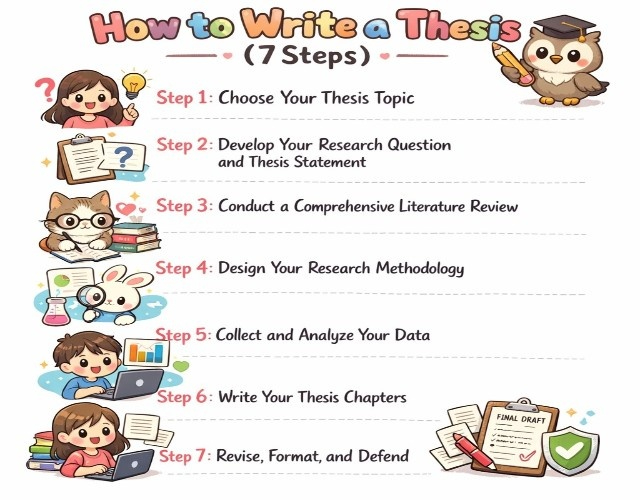
Follow this systematic process to complete your master's thesis successfully.
Step 1: Choose Your Thesis Focus
Your topic determines everything else, so choose strategically.
What makes a strong thesis focus
- Manageable scope: Can be thoroughly researched in 1-2 years with available resources
- Personal interest: You'll spend hundreds of hours on this, pick something you care about
- Research feasibility: Sufficient existing literature and accessible sources
- Academic significance: Matters to your field, even if the contribution is incremental
- Committee approval: Fits within your advisor's expertise and interests
- Career relevance: Aligns with your professional goals when possible
Pro tip: Discuss 3 to 5 potential ideas with your advisor before committing. Their feedback on feasibility and scope saves months of frustration. For more information, check our thesis topics guide.
Step 2: Develop Your Research Question and Thesis Statement
Transform your topic into a focused research question.
Strong research questions are:
- Specific: Clearly defined, not vague or overly broad
- Researchable: Answerable through available methods and sources
- Significant: Worth investigating, adds to field knowledge
- Focused: Manageable within time and resource constraints
Progression from broad idea to research question:
Topic: "Remote work and productivity."
- Weak question: "Does remote work affect productivity?"
- Better question: "How does remote work impact productivity among software developers, and what factors mediate this relationship?"
- Best question: "To what extent does remote work flexibility predict productivity outcomes among software developers in mid-size tech companies, and how do communication tools and management practices moderate this relationship?"
Your thesis statement answers your research question and guides your entire thesis.
Formula: [Research question] + [Your argument/findings] + [Significance]
For Instance: "This thesis examines how remote work flexibility affects software developer productivity through a mixed methods study of 200 developers at mid size companies, finding that flexibility improves productivity only when combined with structured communication protocols and outcome-based management, suggesting that organizations must implement specific practices to realize remote work's benefits."
Step 3: Conduct a Comprehensive Literature Review
Survey existing research to understand your field and position your work.
Literature review purposes:
- Establish context: Show what's known about your topic
- Identify gaps: Reveal what hasn't been adequately studied
- Position your work: Demonstrate where your thesis fits
- Support methodology: Show how others have approached similar questions
- Build credibility: Prove you understand the scholarly conversation
How to conduct an effective literature review:
1. Start broad, then narrow: Begin with overview articles and textbooks, then dive into specialized research 2. Use academic databases: JSTOR, ProQuest, Google Scholar, discipline-specific databases 3. Follow citation trails: Check the references in key articles, they lead to other important sources 4. Set up alerts: Use database alerts to catch new publications while you work 5. Organize as you read: Use citation management software (Zotero, Mendeley, EndNote) 6. Take detailed notes: Record key arguments, methodology, findings, and your analysis 7. Typical literature review length: 15-25 pages (about 25-30% of thesis) |
What to include:
|
What NOT to include:
|
Step 4: Design Your Research Methodology
Plan how you'll answer your research question.
Common thesis methodologies:
- Qualitative: Interviews, focus groups, ethnography, case studies, textual analysis
- Quantitative: Surveys, experiments, statistical analysis of existing data
- Mixed Methods: Combination of qualitative and quantitative approaches
- Theoretical/Conceptual: Analysis and synthesis of existing theories
- Historical/Archival: Analysis of historical documents and primary sources
Choose methodology based on:
- Your research question: What method best answers it?
- Your discipline's norms: What methods are accepted in your field?
- Available resources: What data can you realistically access?
- Your skills: What methods can you competently execute?
- Timeline: What's feasible within your timeframe?
Your methods section should explain:
- Research design and approach
- Data sources and selection criteria
- Data collection procedures
- Analysis methods
- Limitations and how you addressed them
- Ethical considerations (IRB approval if required)
Typical methods section length: 5 to10 pages
Step 5: Collect and Analyze Your Data
Execute your research plan systematically.
Data collection best practices:
- Follow your protocol consistently: Don't change methods midway without committee approval
- Document everything: Keep detailed records of the data collection process
- Manage data carefully: Organize files, back up regularly, maintain confidentiality
- Stay on schedule: Set realistic deadlines for data collection phases
- Communicate with advisor: Update them on progress and any challenges
For primary research:
- Obtain necessary IRB approval before collecting data
- Pilot test surveys or interview protocols
- Track response rates and participation
- Store data securely with appropriate protections
Data analysis approaches:
- Qualitative: Coding, thematic analysis, narrative analysis, grounded theory
- Quantitative: Statistical tests, regression analysis, data visualization
- Mixed Methods: Sequential or concurrent integration of both approaches
Analysis tips:
|
Step 6: Write Your Thesis Chapters
Draft your thesis systematically, one chapter at a time.
Standard thesis structure:
Chapter 1: Introduction (10-15 pages)
- Research context and background
- Research question and objectives
- Significance of the study
- Thesis organization overview
Chapter 2: Literature Review (20-30 pages)
- Theoretical framework
- Review of relevant research
- Identification of research gaps
- How your work addresses gaps
Chapter 3: Methodology (10-15 pages)
- Research design
- Data sources and collection
- Analysis methods
- Limitations
Chapter 4: Results/Findings (20-30 pages)
- Presentation of data
- Analysis of findings
- Tables, figures, charts
- Answers to research question
Chapter 5: Discussion and Conclusion (15-20 pages)
- Interpretation of findings
- Connections to literature
- Implications for theory and practice.
- Limitations
- Future research directions
- Conclusion
Plus front matter: Title page, abstract, table of contents, acknowledgments
Writing strategy:
|
Step 7: Revise, Format, and Defend
Refine your thesis and prepare for the defense.
Revision process:
|
|
|
|
|
Get feedback from multiple sources:
|
Formatting requirements:
Every institution has specific formatting guidelines for theses. Check your graduate school's requirements for:
- Page margins and spacing
- Font type and size
- Heading formats
- Citation style
- Table and figure formatting
- Page numbering
- Required front and back matter
Most common format mistakes:
- Inconsistent spacing or fonts
- Incorrect citation format
- Missing required section
- Improper page numbering
- Tables/figures not formatted correctly
Preparing for your thesis defense:
1. Know your thesis intimately: Reread it multiple times before defense
2. Anticipate questions: What are the weak points? What might committee challenge?
3. Prepare a presentation: Usually 20 30 minutes summarizing key points
4. Practice your defense: Present to friends, classmates, or advisor
5. Understand the format: Is the defense public? How long? Who asks questions?
Stay calm: Committee wants you to succeed, they wouldn't schedule defense if they thought you'd fail
Typical defense format:
- Student presents thesis (20-30 minutes)
- Committee asks questions (60-90 minutes)
- Student leaves while the committee deliberates
- Student returns to hear results (pass, pass with revisions, fail, most pass)
After defense: Incorporate required revisions, submit final thesis to graduate school, celebrate!
How to Write a Dissertation (7 Steps)
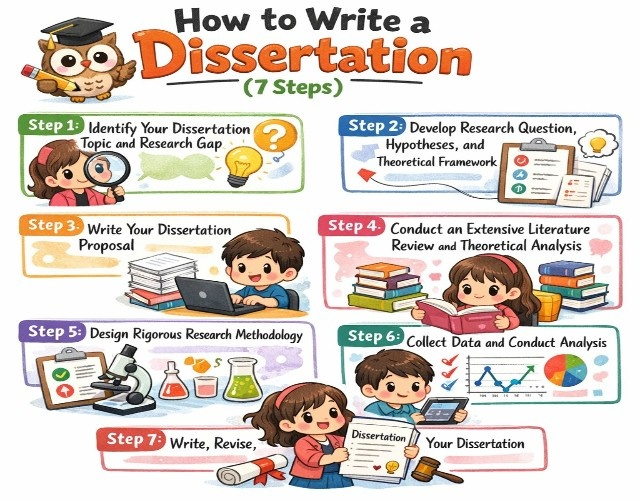
The dissertation process is more extensive but follows a similar structure.
Step 1: Identify Your Dissertation Focus and Research Gap
Your dissertation must address a genuine gap in existing knowledge.
What makes a dissertation a worthy topic:
- Significant gap: Something important that hasn't been adequately studied
- Original contribution: Potential to genuinely advance knowledge
- Research feasibility: Can be completed with available resources and timeline
- Scholarly significance: Will matter to other researchers in your field
- Personal expertise match: Builds on your strengths and interests
- Publication potential: Findings worthy of a journal article or a book
- Career relevance: Positions you as an expert in area valuable to your goals
Pro Tip: Professors value dissertation topics that show critical thinking and originality.
How to identify research gaps:
- Read recent dissertations in your field. What questions do their "future research" sections suggest?
- Analyze meta analyses and systematic reviews. What do they identify as understudied?
- Attend conferences, what are leading scholars calling for?
- Review funding priorities: what topics are agencies supporting?
- Examine contradictory findings where studies disagree and why?
- Look for methodological limitations: Can new methods provide better answers?
- Consider new contexts have theories been tested in diverse populations?
Common mistakes:
Too incremental: "Replicating X study with slightly different sample." Too ambitious: "Solving climate change through technological innovation." |
Step 2: Develop Research Question, Hypotheses, and Theoretical Framework
Create the intellectual foundation for your dissertation.
Strong dissertation research questions:
- Address genuine gaps: Answer something we truly don't know
- Have theoretical grounding: Connect to established frameworks
- Are empirically testable: Can be answered through research
- Generate new insights: Produce findings that matter
Demonstrated progression
Topic: "Teacher burnout in urban schools."
Weak question: "Why do urban teachers experience burnout?"
Better question: "How do organizational factors, student demographics, and resource availability interact to predict burnout rates among urban middle school teachers?"
Dissertation level question: "To what extent do school-level organizational justice perceptions mediate the relationship between working conditions and emotional exhaustion among urban middle school teachers, and how does this relationship vary by teacher demographics and school contexts?"
Develop hypotheses (for quantitative dissertations):
Based on theory and literature, predict what you'll find:
|
|
|
Establish a theoretical framework:
Your dissertation needs a theoretical grounding explaining your approach:
- Identify relevant theories: What frameworks explain your phenomenon?
- Justify theoretical choice: Why is this theory appropriate for your question?
- Show how theory guides your work: How does it inform methodology and interpretation?
Typical theoretical framework section: 10 to 15 pages explaining theories underpinning your research
Step 3: Write Your Dissertation Proposal
Before full research, you'll write and defend a proposal.
Dissertation proposals typically include
Chapter 1: Introduction (15 to 20 pages)
- Problem statement and background
- Research questions and objectives
- Significance of the study
- Key terms and definitions
Chapter 2: Literature Review (40 to 60 pages)
- Theoretical framework
- Comprehensive review of relevant research
- Synthesis showing research gaps
- How your work addresses gaps
Chapter 3: Methodology (20 to 30 pages)
- Research design and approach
- Population and sampling
- Data collection procedures
- Instrumentation
- Analysis plans
- Ethical considerations
- Expected limitations
References: Complete bibliography of sources cited
Appendices: Sample instruments, IRB materials, timeline
Proposal length: 75 to 110 pages, typical
Proposal defense:
After writing proposal, you'll defend it to your committee:
Only after proposal approval do you begin data collection. |
Step 4: Conduct Extensive Literature Review and Theoretical Analysis
Your dissertation literature review is exhaustive, not selective.
Dissertation literature review requirements:
- Comprehensive coverage: Essentially everything published on your topic
- International scope: Not just US research, examine global scholarship
- Historical depth: Show how thinking evolved over time
- Theoretical integration: Demonstrate deep understanding of competing frameworks
- Critical analysis: Don't just summarize, evaluate, synthesize, and identify patterns
- Clear organization: Typically organized thematically or chronologically
- Gap identification: Build a clear case for why your research is needed
- Typical dissertation literature review length: 40-80 pages (20-25% of dissertation)
How comprehensive is "comprehensive"?
|
Organization strategies:
Thematic: Organize around key concepts, theories, or variables |
Chronological: Show historical development of thought |
Methodological: Group by research approaches used |
| Theoretical: Organize by competing theoretical frameworks |
Most dissertation literature reviews use thematic organization with chronological development within themes.
What makes the dissertation lit review different from the thesis:
| Thesis Literature Review | Dissertation Literature Review |
|---|---|
| 15-25 pages | 40-80 pages |
| 30-50 sources | 100-200+ sources |
| Focused on the direct topic | Includes related areas |
| Synthesizes key research | Exhaustive coverage |
| Identifies gaps briefly | Extensively documents gaps |
Step 5: Design a Rigorous Research Methodology
Doctoral research demands methodological sophistication.
The dissertation methodology chapter includes:
- Research Design: Overall approach with detailed justification
- Philosophical Foundations: Epistemological and ontological assumptions
- Population and Sample: Complete description with inclusion/exclusion criteria
- Sampling Strategy: Method with statistical power calculations (quantitative) or saturation rationale (qualitative)
Data Collection
- Detailed procedures
- Instrumentation with validity/reliability evidence
- Pilot testing results
- Timeline
Data Analysis
- Specific analytical techniques with justification
- Software to be used
- How analysis answers research questions
Validity and Reliability
- Threats to validity
- How you'll address them
- Quality criteria
Ethical Considerations
- IRB approval details
- Informed consent procedures
- Confidentiality protections
- Potential risks and benefits
Limitations
- Acknowledged weaknesses
- Why don't undermine findings.
- How you minimized impact
Typical dissertation methodology length: 25 to 40 pages
Common methodological approaches:
Quantitative: Experimental, quasi-experimental, correlational, survey research |
Qualitative: Phenomenology, grounded theory, ethnography, case study, narrative inquiry |
| Mixed Methods: Explanatory sequential, exploratory sequential, convergent parallel |
Your methodology must be so detailed that another researcher could replicate your study from your description alone.
Step 6: Collect Data and Conduct Analysis
Execute your research with rigorous attention to detail.
Data collection for dissertations:
- Timeline: Often 6 to 18 months, depending on methodology
- Documentation: Maintain detailed research logs
- Quality control: Regular checks on data quality and completeness
- Flexibility: Prepared to adapt if challenges arise (with committee approval)
- Communication: Regular updates to the advisor on progress
For quantitative dissertations
- Large sample sizes (power analysis determines minimum)
- Multiple measures of key constructs
- Attention to response rates and missing data
- Preliminary analysis to check data quality
For qualitative dissertations:
- Recruit until reaching saturation (typically 20-30 interviews)
- Detailed transcription of interviews
- Member checking for accuracy
- Reflexivity journals documenting researcher perspective
Data analysis standards:
Quantitative
- Appropriate statistical tests for research questions
- Check assumptions (normality, linearity, etc.)
- Report effect sizes, not just significance
- Consider multiple analytic strategies
- Present clear tables and figures
Qualitative
- Systematic coding process
- Multiple rounds of analysis
- Inter-rater reliability checks
- Thick description providing rich context
- Direct quotes supporting themes
Mixed methods
- Clear integration of qualitative and quantitative
- Demonstrate how each informs the other
- Meta inferences connecting findings
Analysis timeline: 3 to 6 months typical, longer for complex designs
Step 7: Write, Revise, and Defend Your Dissertation
Complete your dissertation and prepare for final defense.
Dissertation structure:
Front Matter
- Title page, copyright, abstract (300-350 words)
- Dedication, acknowledgments (optional)
- Table of contents, list of tables/figures
Chapter 1: Introduction (25-35 pages)
- Problem background and context
- Problem statement
- Purpose and research questions
- Significance
- Definitions
- Organization of study
Chapter 2: Literature Review (40-80 pages)
- Theoretical framework
- Comprehensive literature review
- Summary and research gaps
Chapter 3: Methodology (25-40 pages)
- Research design
- Population and sampling
- Instrumentation
- Data collection
- Data analysis
- Validity/reliability
- Ethical considerations
- Limitations
Chapter 4: Results/Findings (30-50 pages)
- Demographic data
- Analysis organized by research question
- Tables, figures, detailed findings
- Objective presentation (save interpretation for Chapter 5)
Chapter 5: Discussion and Conclusions (30-40 pages)
- Summary of key findings
- Interpretation in light of literature
- Connections to the theoretical framework
- Implications for theory
- Implications for practice
- Implications for policy (if relevant)
- Limitations
- Recommendations for future research
- Conclusions
References: Complete bibliography (often 15-25 pages)
Appendices: IRB approval, instruments, consent forms, supplementary data
Typical dissertation length: 150-300 pages (varies by field)
Writing timeline: 12-24 months for full draft
Revision process:
- Advisor review: Multiple rounds on each chapter (expect 3-5 revisions per chapter)
- Committee review: Full draft reviewed by all members (expect major revisions)
- Final edits: Incorporating all committee feedback
- Format review: Meeting graduate school requirements
The dissertation defense:
Longer and more rigorous than a thesis defense:
- Typically 2-4 hours
- Public presentation (30-45 minutes)
- Committee questioning (90-180 minutes)
- May include closed-door committee deliberation
Defense preparation:
- Know every aspect of your dissertation intimately
- Practice the presentation multiple times
- Anticipate methodological challenges
- Prepare to defend theoretical choices
- Be ready to discuss implications and limitations
? Understand related literature comprehensively
Possible outcomes:
- Pass: Congratulations, Dr.!
- Pass with minor revisions: Most common, typically formatting/clarification
- Pass with major revisions: Requires substantive changes, second defense possible
- Fail: Rare if you've worked closely with the advisor
After successful defense: Complete required revisions, submit final dissertation to graduate school, prepare for publication, and celebrate your achievement!
Turn Your Research Idea Into a Graduate Level Project
We help refine ideas into structured, researchable, and advisor-approved documents.
- Scope narrowing & objective alignment
- Citation accuracy + academic sourcing
- Methodological alignment (quant/qual/mixed)
- Cohesive argumentation & academic tone
Don’t lose momentum, transform your idea into a defendable thesis or dissertation.
Order NowThesis Structural Format
Standard thesis formatting ensures consistency and professionalism.
Standard Thesis Components
Front Matter (appears before Chapter 1):
- Title Page: Title, your name, degree sought, institution, date
- Copyright Page: (if required) Copyright notice
- Abstract: 250-300 word summary of thesis (research question, methods, key findings)
- Acknowledgments: Thank advisors, committee, family, funders (optional)
- Table of Contents: All chapters, sections, and page numbers
- List of Tables: If you have 5+ tables
- List of Figures: If you have 5+ figures
Body Chapters (the actual thesis):
Chapter 1: Introduction
- Background and context
- Problem statement
- Research questions/objectives
- Significance
- Organization overview
- Length: 10-15 pages
Chapter 2: Literature Review
- Theoretical framework
- Review of relevant research
- Research gaps
- Length: 20-30 pages
Chapter 3: Methodology
- Research design
- Data sources
- Collection methods
- Analysis approach
- Length: 10-15 pages
Chapter 4: Results/Findings
- Presentation of findings
- Tables, figures, data
- Organized by research question
- Length: 20-30 pages
Chapter 5: Discussion and Conclusion
- Interpretation of findings
- Connections to literature
- Implications
- Limitations
- Future research
- Conclusion
- Length: 15-20 pages
Back Matter:
- References: Complete bibliography in required style (APA, MLA, Chicago)
- Appendices: Supplementary materials (instruments, raw data, IRB approval)
Format Requirements
Check your institution's specific guidelines, but common requirements include:
Page Setup
- Margins: 1 inch all sides (sometimes 1.5 inches left for binding)
- Font: Times New Roman, 12 point
- Spacing: Double-spaced body text (except abstract, block quotes, references)
- Page numbers: Bottom center or top right
Headings
- Chapter titles: Centered, bold, all caps
- Level 1 headings: Centered, bold, title case
- Level 2 headings: Left-aligned, bold, title case
- Level 3 headings: Indented, bold, sentence case
Citations
- Use consistent style throughout (APA most common for social sciences)
- Every source cited in-text must appear in the references
- Follow the style manual exactly
Tables and Figures
- Number consecutively
- Include descriptive captions
- Referenced in text before they appear
- Placed after the first reference or in the appendix
For detailed templates and examples showing proper thesis formatting, see our thesis template and examples page.
Dissertation Structural Format
Dissertation formatting follows similar principles but with more extensive content.
Standard Dissertation Components
Front Matter: Same as thesis, but with
- Abstract: 300-350 words (longer than thesis abstract)
- Dedication: More common in dissertations
- May include additional acknowledgment of funding sources
Body Chapters:
Chapter 1: Introduction
- More extensive background
- Clear problem statement
- Purpose statement
- Research questions/hypotheses
- Significance to theory, practice, policy
- Definitions of key terms
- Length: 25-35 pages
Chapter 2: Literature Review
- Comprehensive theoretical framework
- Exhaustive review of research
- Synthesis and critique
- Clear gap identification
- Length: 40-80 pages
Chapter 3: Methodology
- Detailed research design with justification
- Philosophical foundations
- Complete population/sampling description
- Detailed procedures
- Instrumentation with validity/reliability
- Analysis plans
- Ethical considerations
- Length: 25-40 pages
Chapter 4: Results/Findings
- Extensive data presentation
- Multiple tables and figures
- Organized systematically
- Thorough analysis
- Length: 30-50 pages
Chapter 5: Discussion and Conclusions
- Interpretation of findings
- Theoretical implications
- Practical implications
- Policy implications (if relevant)
- Comprehensive limitations discussion
- Detailed future research agenda
- Length: 30-40 pages
Back Matter
- References: Often 15-25 pages
- Appendices: May include multiple appendices with extensive supplementary materials
Dissertation Format Specifics
Key differences from thesis formatting:
1. More formal tone: Scholarly voice throughout
2. More detailed captions: Tables and figures require more description
3. More extensive acknowledgments: Funding sources, permissions, contributions
4. Stricter adherence to style: APA, Chicago, or discipline specific styles followed exactly
5. ProQuest requirements: If submitting to ProQuest, additional formatting rules apply
For complete dissertation templates and formatted examples from multiple disciplines, see our dissertation template and examples page.
Dissertation: Taking Over Your Life? Our professional essay writing service connects you with PhD writers in your specific field, people who've completed dissertations and understand exactly what committees expect.
Common Thesis and Dissertation Mistakes to Avoid
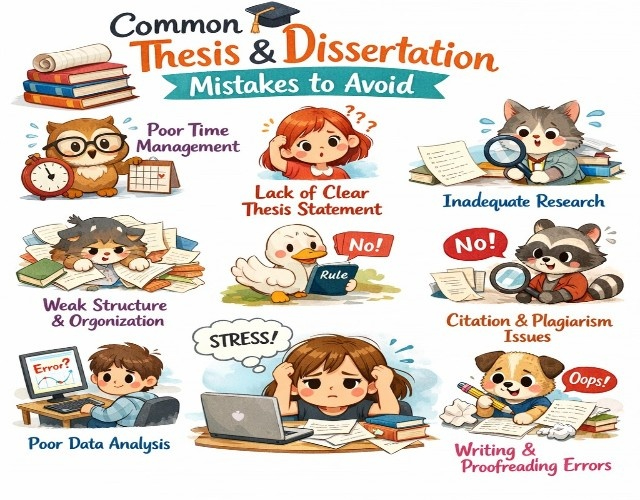
Both thesis and dissertation writers make predictable errors. Here's how to avoid them.
Mistake #1: Choosing a Topic That's Too Broad or Too Narrow
The problem: The topic can't be adequately covered in the available time/space, or there's not enough to say.
How to avoid: Discuss scope with the advisor early. If you can't articulate your project in 2 to 3 sentences, it's probably too broad.
Mistake #2: Starting Without a Clear Research Question
The problem: Writing without a focused question leads to an unfocused, meandering thesis or dissertation.
Sign you have this problem: You can't clearly state what you're trying to find out.
Fix: Force yourself to write your research question in one sentence before substantial writing begins. If you can't, your project isn't ready.
Mistake #3: Weak or Superficial Literature Review
The problem: A literature review that just summarizes sources without synthesis or critical analysis.
What weak lit reviews do:
- Source 1 says X. Source 2 says Y. Source 3 says Z.
- No connections between sources
- No critical evaluation.
- No clear narrative or themes
What strong lit reviews do:
- Group sources thematically
- Show how sources relate to each other
- Critically evaluate methodologies and findings
- Build clear argument for the research gap
How to avoid: As you read, ask: How do these sources connect? Where do they agree/disagree? What patterns emerge? What's missing?
Mistake #4: Methodology Doesn't Match Research Question
The problem: Choosing methods because they're familiar rather than because they answer your question.
How to avoid: After drafting a research question, explicitly ask: "What method best answers this question?" Consult methodology textbooks for your discipline.
Mistake #5: Not Following Your Institution's Format Requirements
The problem: Spending weeks revising format after writing because you didn't check requirements first.
Common format mistakes:
- Wrong margin sizes
- Inconsistent spacing
- Incorrect heading levels
- Citations in wrong style
- Missing required sections
How to avoid:
- Download your graduate school's thesis/dissertation manual BEFORE writing
- Use the provided template if available
- Check requirements for your specific program
- Verify citation style (it varies by field and institution)
Mistake #6: Waiting Too Long to Share Drafts
The problem: Writing the entire thesis/dissertation before getting any feedback, then discovering major problems.
Why this is catastrophic: Fixing structural or methodological problems after writing 200 pages requires essentially starting over.
Better approach:
|
Mistake #7: Underestimating the Timeline
The problem: Assuming the thesis/dissertation will take half the time it actually requires.
Realistic timelines:
Master's Thesis: 12-24 months from topic selection to defense
Doctoral Dissertation: 3-7 years from comprehensive exams to defense
|
How to avoid: Create detailed timeline with advisor. Build in buffer time. Track actual time spent to adjust expectations.
We Handle the Writing, You Handle the Defense
Let professional academic writers do the heavy drafting while you focus on understanding the research.
- Fully written chapters (proposal to conclusion)
- Literature review + data discussion
- Formatting in APA/MLA/Harvard/Chicago
- On-time delivery + unlimited revisions
Submit work you’re proud of, get expert-level drafting without the stress.
Order NowBottom Line
Writing a thesis or dissertation represents the culmination of your graduate education, proof that you've developed expertise, mastered research skills, and can contribute meaningful scholarship to your field.
The key differences: Theses (master's level) demonstrate mastery through comprehensive analysis and synthesis. Dissertations (doctoral level) demonstrate expertise through significant original research contributions. Both follow systematic processes, require committee approval, and demand sustained intellectual effort o;ver months or years.
Success requires: choosing an appropriately scoped topic, developing a clear research question, conducting thorough research, writing systematically, seeking regular feedback, and persevering through inevitable challenges.
Whether you're just starting or stuck midway through, remember: every completed thesis and dissertation was once a blank page. The process is challenging but achievable. Work closely with your advisor, follow the systematic steps outlined above, and don't hesitate to seek help when needed.
Your graduate degree awaits, now you know exactly how to earn it.