Types of Qualitative Research
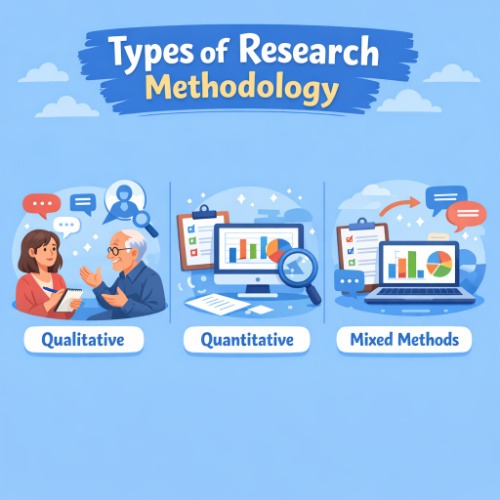
Once you've decided on qualitative research, you need to choose which type of qualitative approach fits your question. Here's a complete breakdown of all types of qualitative research.
1. Phenomenology
Purpose: Understand the lived experience of a phenomenon from multiple perspectives.
Best for: Questions like "What is the experience of [phenomenon]?" or "What does [event] mean to those who experience it?"
Key Features:
- Focuses on consciousness and lived experience
- Typically 5–25 participants who've experienced the phenomenon
- In depth interviews
- Identifies common themes across experiences
2. Grounded Theory
Purpose: Develop a theory grounded in data, explaining a process or phenomenon.
Best for: Questions like "What is the process by which...?" or "How do people navigate [situation]?"
Key Features:
- Iterative process, data collection and analysis happen simultaneously
- Constant comparison method
- Typically 20–60 participants
- Results in a theoretical model explaining the process
3. Ethnography
Purpose: Understand culture, behaviors, and social patterns within a group or setting.
Best for: Questions like "What are the cultural norms of [group]?" or "How does [culture] function?"
Key Features:
- Prolonged immersion in the setting (weeks to years)
- Participant observation
- Field notes, interviews, artifact collection
- Focuses on culture and social patterns
4. Case Study
Purpose: In depth investigation of a single case (person, program, organization, event) in its real world context.
Best for: Questions like "How did [event] unfold?" or "Why was [program] successful/unsuccessful?"
Key Features:
- Bounded system (one case or small number of cases)
- Multiple data sources (interviews, documents, observations)
- Rich, detailed description
- Can be exploratory, descriptive, or explanatory
5. Narrative Research
Purpose: Explore individual stories and life experiences through detailed narratives.
Best for: Questions like "What is the story of [person's experience]?" or "How do people construct their identity through narrative?"
Key Features:
- Focuses on stories as data
- Often biographical
- 1–5 participants (very small sample)
- Chronological or thematic presentation
6. Action Research
Purpose: Solve practical problems while generating knowledge through iterative cycles of action and reflection.
Best for: Questions like "How can we improve [practice]?" in contexts where you're both researcher and practitioner.
Key Features:
- Practitioner led research
- Cyclical (plan, act, observe, reflect, repeat)
- Focus on practical improvement
- Collaboration with participants
Comparison Table: Types of Qualitative Research
| Type | Main Question | Sample Size | Duration | Best For |
|---|---|---|---|---|
| Phenomenology | What is the experience of...? | 5-25 | Months | Understanding lived experiences |
| Grounded Theory | What is the process of...? | 20-60 | 6-12 months | Developing theories |
| Ethnography | What is the culture of...? | Entire group | Months to years | Understanding culture |
| Case Study | How/why did this happen? | 1 (or few) | Months | Deep understanding of one case |
| Narrative | What is the story of...? | 1-5 | Months | Honoring individual stories |
| Action Research | How can we improve...? | Your setting | Ongoing | Improving your own practice |
The Qualitative Research Methodology (Step by Step)
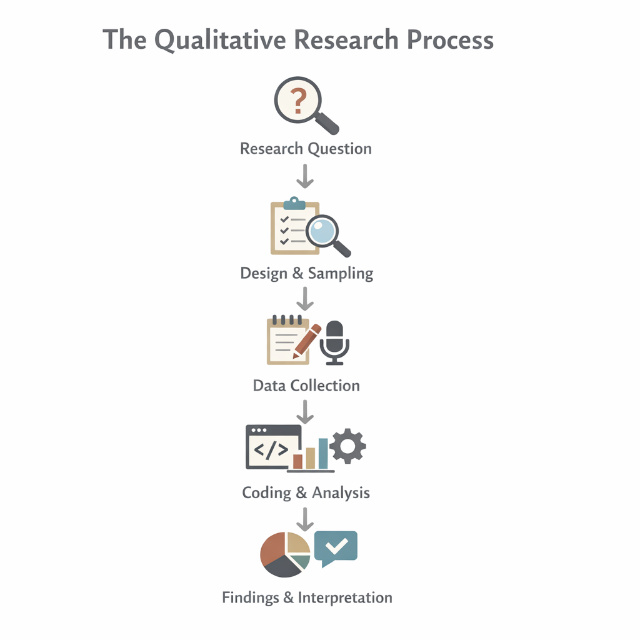
Qualitative research isn't linear; it's iterative and flexible. But here's a systematic process to guide you through.
Step 1: Formulate Your Research Question
Your research question drives everything. Good qualitative research questions explore process, meaning, or experience.
Strong qualitative questions:
- "How do first generation students experience the college transition?"
- "What factors influence nurses' decisions to leave the profession?"
- "Why do small businesses resist adopting new technology?"
Weak qualitative questions:
- "How many students drop out?" (quantitative, needs numbers)
- "Is there a relationship between X and Y?" (quantitative, testing relationships)
| Formula: Use "how," "why," or "what is the experience of..." |
If you wanna know more about quantitative research then have a look at our quantitative research guide.
Step 2: Select Your Research Design
Choose the qualitative research design that matches your question:
- Phenomenology: Understand lived experiences (5-25 participants)
- Grounded Theory: Develop theory from data (20-60 participants)
- Ethnography: Study culture in natural setting (one group, extended time)
- Case Study: Deep dive into one case (1-5 cases)
- Narrative Research: Explore individual stories (1-5 participants)
For detailed comparison, see our research methodology guide.
Step 3: Determine Your Sample and Sampling Strategy
Qualitative sampling is purposeful, not random. You select information rich cases.
Common sampling strategies:
Purposeful Sampling: Select participants with relevant experience
Maximum Variation Sampling: Capture diverse perspectives
Snowball Sampling: Participants refer other participants
Theoretical Sampling: Sample based on emerging theory (grounded theory)
Sample Size Guidelines:
|
Step 4: Design Your Data Collection Protocol
Create interview guides, observation protocols, or focus group questions.
For interviews:
- Start with easy questions to build rapport
- Ask open ended questions
- Use probes ("Can you tell me more about that?")
- Include 8-12 main questions
- Pilot test with 2-3 people
For observations:
- Decide: participant or non participant observation?
- Create observation guide (what to look for)
- Plan field note system
- Consider ethical issues (informed consent)
For focus groups:
- 6-10 participants per group
- Create discussion guide
- Plan how to handle dominant voices
- Consider group dynamics
Step 5: Get IRB Approval
Submit your protocol to your Institutional Review Board (IRB). Include:
- Research purpose and procedures
- Recruitment materials
- Consent forms
- Interview/observation protocols
- Data storage plan
| Allow 4-8 weeks for approval. Don't collect data without IRB approval. |
Stuck in the Data Analysis Phase?
Our research experts handle qualitative coding, thematic analysis, and results interpretation, so you can focus on your findings.
- Professional qualitative coding
- Thematic analysis
- NVivo support
- Complete methodology sections
Most analysis projects delivered within 48-72 hours.
Get Expert HelpStep 6: Recruit Participants
Strategies for recruitment:
- Email potential participants directly
- Post flyers in relevant locations
- Use social media (with IRB approval)
- Work with gatekeepers (principals, managers)
- Offer incentives if appropriate ($20-50 gift cards common)
Track recruitment:
- How many invited vs. agreed
- Demographics of participants
- Reasons for declining (helps explain sample)
Step 7: Collect Your Data
Execute your data collection plan:
Best practices:
- Record interviews (with permission)
- Take detailed field notes
- Memo after each session (initial thoughts)
- Thank participants
- Track consent forms
During data collection:
- You'll notice preliminary patterns
- Your questions may evolve (qualitative is flexible!)
- Continue until saturation
Step 8: Transcribe Your Data
Convert audio recordings to text.
Options:
- Professional transcription services: ($1-2 per minute, accurate)
- AI transcription: Rev.com, Otter.ai (cheaper, needs editing)
- DIY transcription: Time consuming (4-6 hours per 1 hour interview)
Transcription considerations:
- Verbatim vs. cleaned up?
- Include pauses, laughter, emotion?
- Time stamp important sections
Pro tip: Listening while transcribing helps you start noticing patterns.
Step 9: Code and Analyze Your Data
This is where qualitative data analysis happens. (Detailed in Section 3 below.)
Basic process:
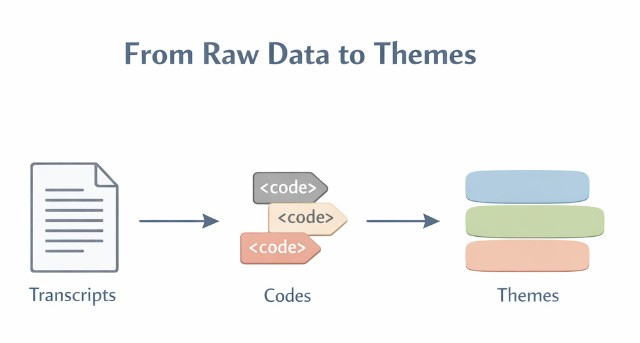
- Read transcripts multiple times
- Generate initial codes
- Group codes into themes
- Review and refine themes
- Define final themes
- Write findings
Step 10: Ensure Quality (Validity & Trustworthiness)
Qualitative research uses different quality criteria than quantitative:
Credibility (vs. internal validity):
- Member checking: Share findings with participants
- Peer debriefing: Discuss analysis with colleagues
- Triangulation: Use multiple data sources
Transferability (vs. external validity):
- Thick description: Rich detail so readers assess fit
- Purposeful sampling: Clear inclusion criteria
Dependability (vs. reliability):
- Audit trail: Document all decisions
- Consistent procedures
Confirmability (vs. objectivity):
- Reflexivity: Acknowledge your biases
- Raw data available for review
Step 11: Write Your Findings
Qualitative results include:
- Description of themes
- Supporting quotes (2-3 per theme)
- Explanation of what themes mean
- How themes relate to each other
Structure:
- Participant demographics
- Theme 1 (with subthemes)
- Description
- Supporting quotes
- Interpretation
- Theme 2...
- Overall synthesis
Step 12: Draw Conclusions and Implications
What do your findings mean?
- How do they answer your research question?
- How do they connect to existing literature?
- What are practical implications?
- What should future research explore?
Detailed Data Collection Methodology for Qualitative Research
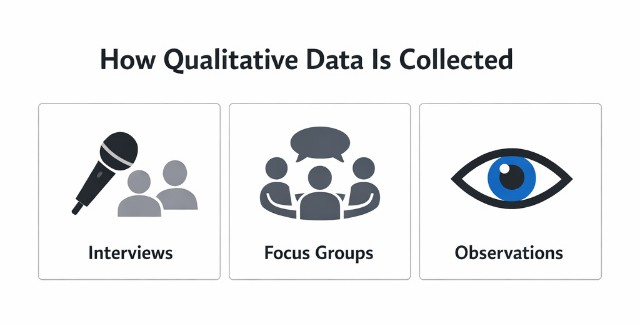
Let's dive deep into how to conduct qualitative research through specific data collection methods.
1. Conducting Effective Interviews
Types of Qualitative Interviews:
a. Structured Interviews
- Fixed questions, same order
- Consistent across participants
- Easier to analyze, less flexible
- Use when: Comparing responses across participants
b. Semi Structured Interviews
- Question guide, flexible order
- Can probe and follow interesting threads
- Balance between structure and flexibility
- Most common in qualitative research
c. Unstructured Interviews
- Conversational, exploratory
- Minimal structure
- Very flexible, harder to analyze
- Use when: Very exploratory or narrative research
How to Design Interview Questions:
Start with easy questions:
- "Tell me about your role as a teacher."
- "How long have you been teaching?"
Move to experience questions:
- "Can you walk me through a typical day?"
- "What challenges do you face?"
Probe deeper:
- "Why do you think that happened?"
- "How did that make you feel?"
End with reflection:
- "What advice would you give to new teachers?"
- "Is there anything else you'd like to share?"
During the Interview:
Building rapport:
- Start with small talk
- Explain purpose and consent
- Share a bit about yourself
- Be genuinely curious
Active listening:
- Maintain eye contact
- Use encouraging nods
- Don't interrupt
- Allow silence (people need time to think)
Effective probes:
- "Can you tell me more about that?"
- "Can you give me an example?"
- "What did you mean by [their phrase]?"
- "How did that feel?"
Interview logistics:
- Location: Quiet, private, comfortable
- Duration: 45-90 minutes typical
- Recording: Always ask permission, test equipment
- Notes: Jot key points even if recording
After the interview:
- Thank participant
- Write memo (initial thoughts, context)
- Note any issues for future interviews
- Start transcription ASAP (while fresh)
2. Running Effective Focus Groups
Focus groups gather 6-10 people to discuss a topic.
When to use focus groups:
- Exploring social norms or group dynamics
- Generating diverse perspectives quickly
- Understanding how people talk about issues
- Brainstorming ideas
Planning your focus group:
Recruitment:
- Recruit 8-12 (expect 6-10 to show)
- Homogeneous enough to be comfortable
- Diverse enough for varied perspectives
- Consider power dynamics (don't mix bosses with employees)
Logistics:
- 90-120 minutes
- Comfortable space with no distractions
- Circular seating
- Provide food/drinks
- Incentives ($25-50 typical)
Discussion guide:
- Welcome and introductions (10 min)
- Ice breaker question (5 min)
- 3-4 main discussion questions (60-90 min)
- Closing question (10 min)
Facilitating:
- Set ground rules (one person at a time, respect all views)
- Draw out quiet participants: "We haven't heard from everyone yet..."
- Manage dominant voices: "Let's hear from others..."
- Stay neutral (don't show agreement/disagreement)
- Use probes to go deeper
Recording:
- Audio record (get permission)
- Video if analyzing interactions
- Assistant takes notes (who said what, dynamics)
Of course if you need to select a topic then you can always have a look at our research methodology topics list.
3. Conducting Observations
Observation involves watching behavior in natural settings.
Types:
Participant Observation:
- You join the activity (ethnography)
- Access to insider perspective
- Risk of "going native" (losing objectivity)
Non Participant Observation:
- You watch without participating
- Maintain distance and objectivity
- May miss insider meanings
Observation planning:
What to observe:
- Setting and physical environment
- Participants and their characteristics
- Activities and interactions
- Verbal and non verbal behavior
- Subtle factors (tone, mood)
Field notes structure:
- Descriptive notes: What you observe (objective)
- Reflective notes: What you think it means (subjective)
- Methodological notes: Issues, decisions
- Separate these clearly
Best practices:
- Write field notes immediately (memory fades fast)
- Include time stamps
- Describe, don't just interpret
- Note your own reactions
- Record exact quotes when possible
4. Collecting Documents
Document analysis uses existing materials.
Types of documents:
- Organizational records (policies, emails, reports)
- Public documents (websites, news articles)
- Personal documents (diaries, letters)
- Visual materials (photos, videos)
Analysis approach:
- Same as interview data (code and theme)
- Note source and context
- Consider author's purpose and audience
- Triangulate with other data sources
Drowning in 200 Pages of Transcripts?
Our research team handles coding, theme development, and analysis: delivering organized, publication ready results.
- Professional NVivo coding
- Thematic analysis
- Inter rater reliability
- Results sections with quotes
4.8 rating from 144,000+ completed research projects.
Get Started NowDetailed Analysis For Qualitative Research
This is where raw data becomes findings. Here are the major qualitative data analysis approaches.
1. Thematic Analysis (Most Common)
Thematic analysis identifies patterns (themes) across qualitative data.
6 Step Process (Braun & Clarke):
Step 1: Familiarize Yourself with Data
Step 2: Generate Initial Codes
Step 3: Search for Themes
Step 4: Review Themes
Step 5: Define and Name Themes
Step 6: Write Up
|
Stuck in the Data Analysis Phase?
Our research experts handle qualitative coding, thematic analysis, and results interpretation, so you can focus on your findings.
- Professional qualitative coding
- Thematic analysis
- NVivo support
- Complete methodology sections
Most analysis projects delivered within 48-72 hours.
Get Expert HelpExample theme write up:
Theme 1: Navigating Unspoken Expectations First-generation students described struggling with "unspoken rules" of college. As one participant explained: "Nobody tells you how college actually works. I didn't know I was supposed to go to office hours or how to read a syllabus." This theme captures the hidden curriculum that advantaged students from college-educated families. Participants felt they were "figuring it out as I go" while their peers seemed to instinctively know how to navigate academic culture.
2. Grounded Theory Approach
Grounded theory develops theory from data through iterative coding.
3 Coding Stages:
1. Open Coding:
- Break data into discrete parts
- Name each part
- Compare constantly
2. Axial Coding:
- Connect codes
- Identify relationships
- Develop categories
3. Selective Coding:
- Identify core category
- Integrate everything around core
- Develop theoretical model
Result: A theory explaining how first generation students navigate the tension between appearing competent and seeking help they need.
3. Content Analysis
Content analysis systematically categorizes content.
Steps:
|
Example: Analyze 100 college websites for how they describe diversity. Categories: mentions of race, gender, international students, first gen, disabilities. Count frequency and compare across institution types.
4. Coding Best Practices
Good codes are:
- Short: 1-3 words
- Descriptive: Captures essence
- Consistent: Applied same way throughout
- Distinct: Not overlapping
Coding tips:
- Start with 50-100 codes (you'll reduce later)
- Use participants' language (in vivo codes)
- Code same data multiple ways if relevant
- Write memos about your codes
- Revise codes as you go
Common coding mistakes:
- Too general ("feelings")
- Too specific ("participant cried on March 3")
- Overlapping codes
- Not defining codes clearly
Software and Tools for Qualitative Research
Qualitative analysis software helps organize, code, and analyze data.
1. NVivo (Most Comprehensive)
Best for: Complex projects, large datasets, team coding
Key features:
- Import documents, audio, video, PDFs
- Hierarchical coding (codes within codes)
- Auto coding tools
- Query tools for pattern analysis
- Visualization (word clouds, charts)
- Team collaboration
Cost: $1,300+ (student discounts available)
When to use: Large projects, dissertation level work, multiple researchers
2. Atlas.ti (Theory Building)
Best for: Grounded theory, building conceptual models
Key features:
- Network views (visual relationship mapping)
- Strong theory building tools
- Semantic analysis
- Multimedia support
Cost: $10-99/month subscription
When to use: When developing theory, when visual mapping is important
3. Dedoose (Cloud Based)
Best for: Mixed methods, smaller budgets, team projects
Key features:
- Cloud based (access anywhere)
- Handles qual and quant data
- Real time collaboration
- Lower cost
- User friendly
Cost: $10.95/month
When to use: Smaller projects, limited budget, need collaboration
4. MAXQDA (Versatile)
Best for: Mixed methods, visual learners
Key features:
- Handles qualitative and quantitative
- Strong visualization
- Easy to learn
- Stats integration
Cost: Similar to NVivo
When to use: Mixed methods projects, when you want visual tools
5. Free/Low Cost Options
Taguette (Free):
- Basic coding
- Multiple users
- Open source
- Limited features but functional
Google Sheets/Excel:
- Create coding spreadsheet
- Column for codes, column for text
- Free and accessible
- Manual but effective for small projects
Word Processor Comments:
- Use comment feature to code
- Copy coded segments to new document
- Organize by code
- Very basic but free
6. Choosing Software
Decision factors:
- Budget (free to $1,300+)
- Project size (pages of data)
- Collaboration needs (solo or team)
- Learning curve (user friendly vs. complex)
- Institution license (does your school have it?)
Most students use: NVivo (if available) or Dedoose (if not)
Pro tip: Learn basics before diving into software. Software helps organize, but you still do the thinking.
Complete Research Examples For Qualitative Research
Let's see qualitative research examples with strong methodology sections.
Example 1: Phenomenology Study
Study: Lived experience of nurses during COVID 19
Research Question: "What is the lived experience of ICU nurses caring for COVID 19 patients?"
Methodology Excerpt: This phenomenological study explored the lived experiences of 18 ICU nurses who cared for COVID-19 patients.
Purposeful sampling recruited nurses who:
(a) worked in ICU during peak pandemic
(b) cared for 10+ COVID patients
(c) continued working through study period.
Data Collection: Semi structured interviews were conducted via Zoom (60-90 minutes). Interview protocol explored daily experiences, emotional responses, coping strategies, and meaning making. Interviews were audio recorded and transcribed verbatim.
Data Analysis: Transcripts were analyzed using Moustakas' phenomenological reduction. First, I identified significant statements (horizonalization). Second, I grouped statements into meaning units. Third, I developed textural descriptions (what participants experienced) and structural descriptions (how they experienced it). Finally, I synthesized these into the essence of the experience.
Trustworthiness: Member checking with 5 participants validated findings. Peer debriefing with two qualitative researchers ensured analytic rigor. An audit trail documented all decisions."
Key Findings: Four themes emerged:
(1) moral injury from inadequate resources
(2) physical and emotional exhaustion
(3) isolation from family/colleagues
(4) finding meaning through patient advocacy.
What made this strong:
- Clear sampling criteria
- Specific data collection procedures
- Named analysis approach
- Trustworthiness strategies
- Participant validation
Example 2: Grounded Theory Study
Study: Process of doctoral student persistence
Research Question: "What is the process by which doctoral students persist through their programs?"
Methodology Excerpt: This grounded theory study examined the process of doctoral persistence. Theoretical sampling was used, starting with 15 students who completed within 5 years, then 15 who took 7+ years, and finally 10 who left ABD. Data collection and analysis occurred simultaneously.
Data Collection: In depth interviews (90 minutes) explored students' journeys through pivotal moments, challenges, and decision points. Follow up interviews (30-45 minutes) tested emerging theory.
Data Analysis: Constant comparative analysis following Charmaz's constructivist grounded theory. Open coding identified 87 initial codes. Axial coding organized codes into 12 categories. Selective coding identified 'navigating the liminal space' as core category. Theoretical saturation was reached after 35 interviews.
Theory Development: The resulting theory, 'Stages of Doctoral Becoming,' explains how students move through
(1) enthusiastic engagement
(2) reality confrontation
(3) identity negotiation
(4) either renewal or exit.
Key Findings: Students who persisted developed three key strategies: creating micro deadlines, building peer accountability, and reframing setbacks as normal rather than personal failure.
What made this strong:
- Iterative sampling
- Constant comparison
- Clear coding stages
- Developed actual theory
- Saturation documented
Example 3: Ethnography Study
Study: Culture of a surgical team
Research Question: "What are the cultural norms and communication patterns of a teaching hospital surgical team?"
Methodology Excerpt: This ethnographic study examined the culture of a surgical team through 6 months of participant observation. I observed 52 surgeries, attended 18 team meetings, and conducted 25 formal interviews with surgeons, residents, nurses, and techs.
Data Collection: Field notes documented observations of communication patterns, decision making processes, hierarchies, and informal norms. I recorded:
(a) descriptive notes (what happened)
(b) reflective notes (my interpretations)
(c) methodological notes (challenges, decisions).
Formal interviews explored perspectives on team culture, training, and collaboration.
Data Analysis: Spradley's developmental research sequence: domain analysis identified cultural domains (hierarchy, communication, learning), taxonomic analysis organized subcategories, componential analysis compared domains, and theme analysis synthesized findings.
Findings: The team operated under three unspoken rules:
(1) 'hierarchy of knowledge' where questioning is discouraged
(2) 'see one, do one, teach one' learning
(3) 'controlled chaos' as cultural ideal where appearing calm under pressure is valued."
What made this strong:
- Extended immersion (6 months)
- Multiple data sources
- Detailed field notes
- Systematic analysis
- Cultural interpretation
Feeling stuck or overwhelmed? Our reliable essay writing service provides personalized support for every stage of qualitative research, from interview design to NVivo coding to final interpretation. Get expert guidance when you need it most.
Common Challenges For Qualitative Research (And How to Solve Them)
Every qualitative researcher faces these challenges. Here's how to handle them.
Challenge 1: Overwhelming Amount of Data
The Problem: 20 interviews = 200+ pages of transcripts. Where do you start?
Solutions:
- Use software: NVivo or Dedoose organizes data
- Start small: Code 3-4 transcripts first, develop initial codebook
- Create summaries: One page summary per interview
- Set schedule: Code 1-2 transcripts per day
- Don't code everything: Focus on research question
Challenge 2: Ensuring Rigor and Trustworthiness
The Problem: How do you prove your findings are credible, not just your opinion?
Solutions:
- Member checking: Share findings with participants
- Peer debriefing: Discuss with colleagues
- Audit trail: Document every decision
- Multiple coders: Have someone else code 10-20% of data, check agreement
- Thick description: Provide rich detail so readers can judge
- Reflexivity: Acknowledge your biases
Challenge 3: Dealing with Researcher Bias
The Problem: You bring assumptions and perspectives to analysis.
Solutions:
- Acknowledge bias: Write reflexive memo about your assumptions
- Bracket preconceptions: Set aside what you "know" to be true
- Challenge interpretations: Ask "Could this mean something else?"
- Peer debriefing: Others catch your blind spots
- Let data surprise you: Don't force data into existing theories
Challenge 4: Achieving Saturation
The Problem: How do you know when you've interviewed enough people?
Solutions:
- Track themes: Note when new themes emerge vs. repeat
- Plan for extra: If you plan 15 interviews, budget for 20
- Conduct analysis early: Don't wait until all data collected
- Document saturation: Note when interviews stop adding new information
- Do confirmation interviews: 2-3 extra interviews to confirm saturation
Challenge 5: Managing Time and Resources
The Problem: Qualitative research is incredibly time intensive.
Solutions:
- Create timeline: Budget 4-6 hours transcription per 1 hour interview
- Budget for transcription: Professional services save time
- Block analysis time: Need large blocks (4+ hours) to stay immersed
- Set milestones: "All interviews by March, all coding by May"
- Use tools efficiently: Software saves time once you learn it
Challenge 6: Writing Compelling Results
The Problem: How do you present themes clearly and compellingly?
Solutions:
- One theme, one section: Clear organization
- Start with description: What is this theme?
- Support with quotes: 2-3 powerful quotes per theme
- Interpret meaning: Don't just describe, explain significance
- Connect themes: Show how themes relate
- Use participant voice: Let quotes carry the story
Challenge 7: Handling Sensitive Topics
The Problem: Participants share traumatic experiences, you feel emotional impact.
Solutions:
- Self care plan: Regular check ins, time between interviews
- Debrief support: Talk with advisor or colleague
- Ethics consultation: Work with IRB on sensitive protocols
- Referral resources: Provide counseling resources to participants
- Recognize secondary trauma: Research on trauma can be traumatic
Free Downloadable Resources for Qualitative Research
Ready to Hand Off Your Qualitative Analysis?
Our Ph.D. research team handles everything, transcription, NVivo coding, thematic analysis, and complete results sections.
- Professional interview transcription
- Expert qualitative coding
- Thematic analysis & interpretation
- Results sections with compelling quotes
Get Qualitative Research Help, 24/7 support
Get Started NowBottom Line
Conducting qualitative research is intensive, but incredibly rewarding. The key is being systematic while remaining flexible, rigorous while staying open to what emerges from your data.
Remember:
- Your research question drives every decision
- Sampling is purposeful, not random
- Data collection and analysis happen iteratively
- Coding is a creative, analytical process
- Software helps organize, but you do the thinking
- Quality comes from transparency and reflexivity
- Great qualitative research tells a compelling story grounded in data
Whether you tackle qualitative research yourself or get expert support, the goal is to produce trustworthy, insightful findings that advance knowledge.
Fora broader methodology context, see our research methodology guide.
Good luck with your qualitative research!