What Is Research Methodology?
Before diving into types of research methodology, let's clarify what research methodology actually means, because there's often confusion between "methodology" and "methods."
Research methodology is your overall strategy for conducting research. It's the philosophical framework that guides how you collect, analyze, and interpret data. Think of it as your research roadmap: it explains why you're taking a specific approach and how that approach will help you answer your research question.
Research methods, on the other hand, are the specific tools and techniques you use, such as surveys, interviews, experiments, and statistical tests. Methods are the what; methodology is the why and how.
1. Why Research Methodology Matters
Your research methodology determines:
- What kind of data will you collect (numbers, words, images, observations)
- How you'll collect it (experiments, interviews, surveys, document analysis)
- How you'll analyze it (statistical tests, thematic analysis, content analysis)
- What conclusions can you draw (causation, correlation, themes, patterns)
- How credible your findings are (validity, reliability, trustworthiness)
Choose the wrong methodology, and you might collect data that can't answer your research question. Choose the right one, and your research flows naturally from question to conclusion.
NEED HELP WITH YOUR RESEARCH METHODOLOGY?
Our research experts help you design the perfect methodology for your project, from research questions to data analysis.
- Expert methodology consultation
- Complete research design support
- Statistical analysis assistance
- Qualitative coding and interpretation
Most research consultations delivered within 24-48 hours.
Get Started Now2. Components of Research Methodology
A complete research methodology includes:
- Research philosophy: Your assumptions about knowledge and reality (positivism, interpretivism, pragmatism)
- Research approach: Qualitative, quantitative, or mixed methods
- Research design: The specific framework (experimental, case study, survey, ethnography)
- Data collection methods: How you'll gather information
- Data analysis techniques: How you'll make sense of your data
- Ethical considerations: How you'll protect participants and maintain integrity
Most students focus only on methods (surveys, interviews) without understanding the broader methodology. That's like choosing ingredients without knowing what dish you're cooking.
The Three Main Research Methodology Approaches
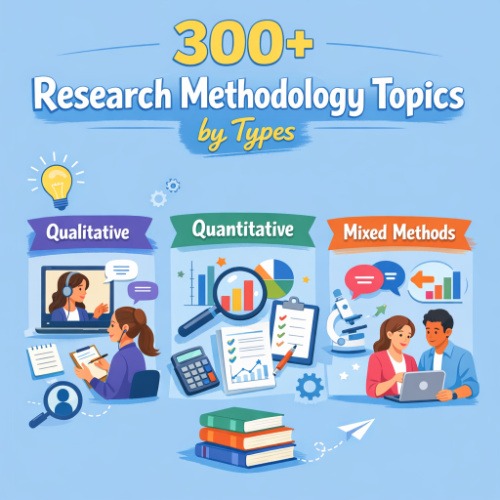
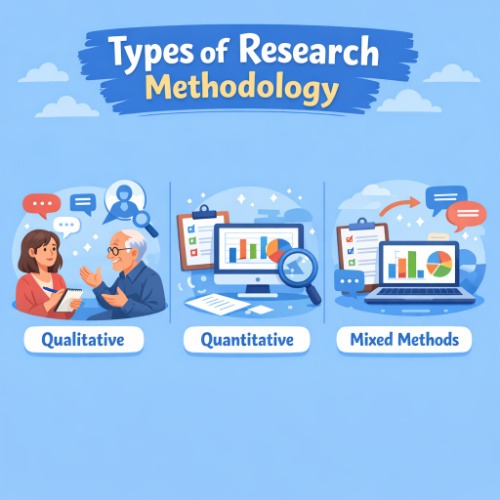
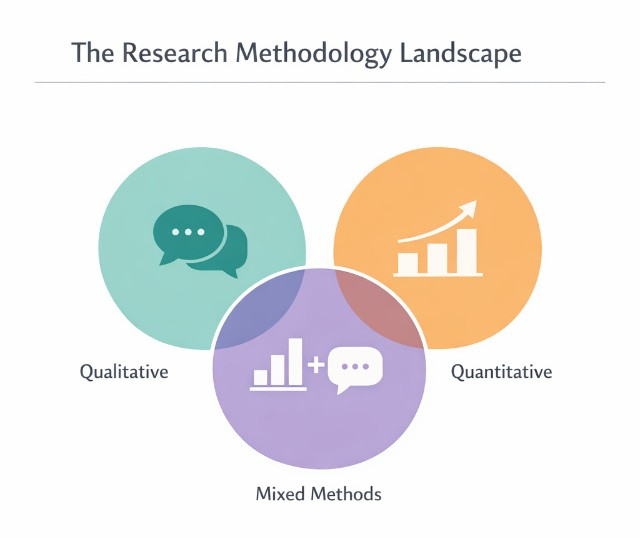
All research methods fall into three main categories: qualitative, quantitative, and mixed methods. Understanding these is essential before choosing your specific types of research methodology.
1. Qualitative Research: Understanding the "Why"
Qualitative research explores meanings, experiences, and perspectives through non numerical data. It answers questions like "Why do students procrastinate?" or "How do nurses experience burnout?"
Key characteristics:
Common methods:
When to use: When you need to understand processes, experiences, meanings, or contexts that can't be quantified. |
For a complete guide to implementing qualitative research, see our qualitative research guide.
2. Quantitative Research: Measuring the "What"
Quantitative research tests theories and examines relationships using numerical data and statistical analysis. It answers questions like "How many students procrastinate?" or "Is there a relationship between sleep and GPA?"
Key characteristics:
Common methods:
When to use: When you need to measure variables, test hypotheses, identify patterns, or make generalizations. |
For a complete guide to implementing quantitative research, see our quantitative research guide.
3. Mixed Methods Research: Getting the Full Picture
Mixed methods research combines qualitative and quantitative approaches to leverage the strengths of both. It answers complex questions that require both numerical data and a deeper understanding.
Key characteristics:
Common designs:
When to use: When a single approach is insufficient, or when you need to triangulate findings. |
4. Quick Comparison Table
| Aspect | Qualitative | Quantitative | Mixed Methods |
|---|---|---|---|
| Purpose | Explore, understand | Measure, test | Comprehensive understanding |
| Data Type | Words, images, observations | Numbers, statistics | Both |
| Sample Size | Small (5-50) | Large (100+) | Both |
| Analysis | Thematic, content analysis | Statistical tests | Both |
| Outcome | Themes, meanings, theories | Patterns, relationships, predictions | Integrated findings |
Qualitative vs Quantitative Research Methodology: Complete Comparison
The qualitative vs quantitative research decision is often the first major choice you'll make. Let's break down every key difference so you can make an informed decision.
Detailed Comparison: Qualitative vs Quantitative
| Dimension | Qualitative Research | Quantitative Research |
|---|---|---|
| Research Philosophy | Interpretivism: reality is subjective, constructed through experience | Positivism: reality is objective, observable, measurable |
| Research Questions | "How?" "Why?" "What is the experience of...?" | "How many?" "How much?" "Is there a relationship between...?" |
| Data Type | Words, images, audio, video, observations | Numbers, measurements, counts, scales |
| Sample Size | Small (5-50 participants) | Large (100-1000+ participants) |
| Sampling Strategy | Purposeful, select information rich cases | Random, select representative sample |
| Data Collection | Interviews, focus groups, observations, documents | Surveys, experiments, tests, structured observations |
| Research Design | Flexible, emergent: can adapt as you learn | Fixed, pre determined:set before data collection |
| Data Analysis | Thematic analysis, coding, content analysis, narrative analysis | Statistical tests (t tests, ANOVA, regression, correlation) |
| Researcher Role | Researcher as instrument: subjective, interpretive | Researcher as objective observer: minimize bias |
| Validity/Reliability | Trustworthiness, credibility, transferability, confirmability | Internal validity, external validity, reliability, objectivity |
| Generalizability | Findings transfer to similar contexts | Findings generalize to larger populations |
| Time Required | Intensive: deep analysis of few cases | Extensive: broad analysis of many cases |
| Result Presentation | Rich descriptions, quotes, themes, narratives | Tables, graphs, statistics, p values |
| Strengths | Deep understanding, contextual richness, captures complexity | Precise measurement, large scale patterns, statistical power |
| Limitations | Not generalizable, time intensive, researcher bias | Misses context and meaning, oversimplifies complexity |
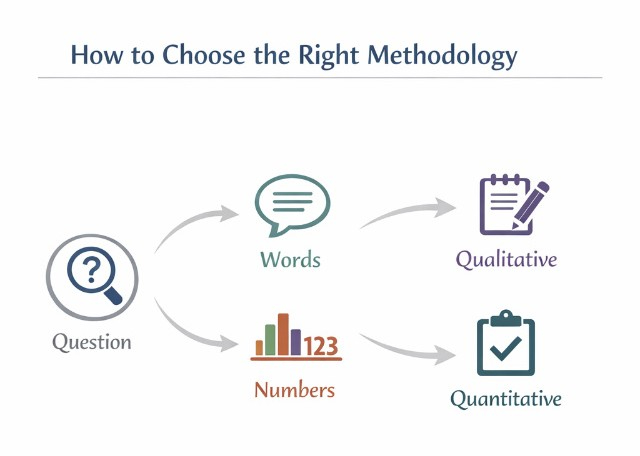
Decision Framework: Should You Use Qualitative or Quantitative?
Use this decision tree to guide your choice:
START HERE: What is your research question?
If your question asks "HOW MANY" or "TO WHAT EXTENT":
- Go Quantitative
- Example:
- "How many students use AI tools?"
- "To what extent does sleep affect GPA?"
If your question asks "HOW" or "WHY" or "WHAT IS THE EXPERIENCE":
- Go Qualitative
- Example:
- "Why do students use AI tools?"
- "How do students experience academic pressure?"
If your question needs BOTH measurement AND understanding:
- Go Mixed Methods
- Example:
- "How prevalent is AI tool use, and why do students choose to use them?"
Same Research Topic, Different Approaches
Let's see how the same topic changes based on methodology:
Research Topic: Student Mental Health
Qualitative Approach:
- Question:
"How do first year college students experience anxiety?" - Method:
Interview 20 first year students about their anxiety experiences - Analysis:
Identify common themes, triggers, and coping strategies - Outcome:
Rich understanding of lived experiences, contextual factors
Quantitative Approach:
- Question:
"What is the prevalence of anxiety among first year college students?" - Method:
Survey 500 first year students using validated anxiety scales - Analysis:
Calculate anxiety prevalence, compare by demographics - Outcome:
Statistical data on how many students experience anxiety, severity levels
Mixed Methods Approach:
- Question:
"What is the prevalence of anxiety, and how do students experience it?" - Method:
Survey 500 students (quantitative), then interview 25 with high anxiety scores (qualitative) - Analysis:
Statistical prevalence + thematic analysis of experiences - Outcome:
Comprehensive picture, both numbers and narratives
Can You Combine Qualitative and Quantitative?
Yes! That's called mixed methods research. You might:
- Use qualitative first to explore an under researched topic, then develop a quantitative survey based on your findings (exploratory sequential design)
- Use quantitative first to identify patterns, then use qualitative to explain why those patterns exist (explanatory sequential design)
- Use both simultaneously to triangulate findings and get a more complete picture (convergent design)
Key Takeaway
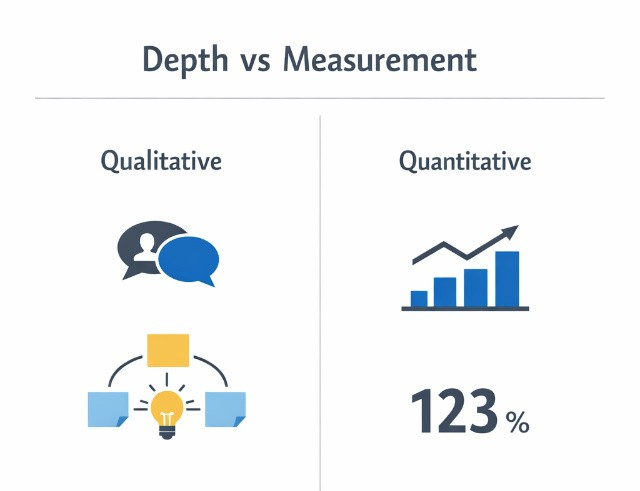
| Qualitative research gives you depth and understanding. Quantitative research gives you breadth and measurement. Mixed methods gives you both. |
How to Choose the Right Research Methodology
Choosing your research methodology isn't arbitrary; it should flow logically from your research question and practical constraints. Here's a step by step process.
Step 1: Start with Your Research Question
Your research question dictates your methodology. Look at the verb:
- "How many..." Quantitative (surveys, experiments)
- "What is the relationship between..." Quantitative (correlation, regression)
- "Does X cause Y..." Quantitative (experimental design)
- "How do people experience Qualitative (interviews, phenomenology)
- "Why do people..." Qualitative (interviews, case studies)
- "What is the process of..." Qualitative (grounded theory, ethnography)
Step 2: Consider Your Research Goals
What do you want to achieve?
Choose Qualitative if you want to:
- Explore a new or under researched topic
- Understand meanings, experiences, or perspectives
- Generate new theories or hypotheses
- Capture complexity and context
- Study processes or change over time
Choose Quantitative if you want to:
- Test existing theories or hypotheses
- Measure variables or outcomes
- Identify patterns or trends
- Make predictions
- Generalize findings to larger populations
Choose Mixed Methods if you want to:
- Validate findings through triangulation
- Explain unexpected quantitative results
- Test a theory developed from qualitative findings
- Get both statistical power and contextual depth
Step 3: Assess Practical Constraints
Be realistic about your resources:
Time Available:
- Quantitative data collection is often faster (send out surveys)
- Qualitative analysis is time intensive (transcribing, coding)
- Mixed methods requires the most time overall
Budget:
- Quantitative may require survey software, statistical software (SPSS, R)
- Qualitative may require transcription services, coding software (NVivo)
- Mixed methods doubles costs
Sample Access:
- Can you access a large representative sample? Quantitative feasible
- Can you access information rich participants? Qualitative feasible
- Limited access? May need to adjust methodology
Your Skills:
- Comfortable with statistics? Quantitative
- Strong interviewer? Qualitative
- Both? Mixed methods
Step 4: Use This Decision Flowchart
START: What type of data will best answer your question?
|
1. Common Mistakes in Methodology Selection
Avoid these pitfalls:
Choosing methodology based on personal preference Choosing methodology based on what's easier Trying to generalize from qualitative research Using quantitative methods for exploratory research Ignoring mixed methods when appropriate |
2. Key Decision Factors Summary
| Factor | Choose Qualitative | Choose Quantitative | Choose Mixed Methods |
|---|---|---|---|
| Research Question | How? Why? | How many? How much? | Both types |
| Existing Knowledge | Little known | Well established | Expanding knowledge |
| Sample Size | Small, purposeful | Large, random | Both |
| Time Available | Flexible | Fixed timeline | Extended timeline |
| Resources | Recording equipment, transcription | Survey tools, statistical software | Both sets of tools |
| Desired Outcome | Deep understanding | Broad patterns | Comprehensive picture |
For detailed implementation of qualitative research methods, see our complete qualitative research guide.
Drowning in Interview Transcripts?
Our research experts handle qualitative data analysis, from coding to theme development to final write up.
- Professional qualitative coding
- Thematic analysis
- NVivo support
- Complete methodology sections
Expert support available 24/7
Get Started NowTypes of Research (Complete Classification Systems)
Beyond the qualitative/quantitative distinction, types of research can be classified in multiple ways. Understanding these classifications helps you position your research correctly.
Classification #1: By Purpose
Basic Research (Pure/Fundamental Research)
Purpose: Advance theoretical knowledge without immediate practical application.
When to Use:
- Academic research focused on theory
- You're exploring fundamental questions
- Practical application isn't immediate concern
Applied Research
Purpose: Solve specific, practical problems using scientific methods.
When to Use:
- You're solving a practical problem
- Stakeholders want actionable findings
- Implementation is the goal
Basic vs Applied: The Spectrum
Most research falls on a spectrum between pure basic and pure applied:
BASIC: Theory driven, Knowledge for knowledge, Long term impact APPLIED: Problem driven, Knowledge for action, Short term solutions |
Classification #2: By Objective
Exploratory Research
Purpose: Explore a new or under studied phenomenon to generate insights and hypotheses.
When to Use:
- Little is known about the topic
- You're developing hypotheses for future research
- You need to understand the scope of an issue
Descriptive Research
Purpose: Describe characteristics of a population or phenomenon without examining cause and effect.
When to Use:
- You want to document current state
- Understanding characteristics is sufficient
- Causation isn't your concern
Explanatory Research (Causal Research)
Purpose: Explain relationships and test cause and effect.
When to Use:
- You want to prove causation
- You can manipulate variables
- You need to explain "why"
Progressive Research Journey:
Research often progresses through these stages:
| EXPLORATORY | DESCRIPTIVE | EXPLANATORY |
| 1. Explore topic (What's going on?) | 2. Describe patterns (What does it look like?) | 3. Explain causes (Why does it happen?) |
| Qualitative interviews | Survey research | Experimental study |
| Generate hypotheses | Test associations | Test causation |
Classification #3: By Research Design
1. Experimental Research
Purpose: Establish causation through controlled manipulation of variables.
When to Use: You want to prove causation and can ethically manipulate variables.
2. Quasi Experimental Research
Purpose: Examine causal relationships when true randomization isn't possible.
When to Use: You want to examine causation but can't randomly assign participants.
3. Non Experimental Research
Purpose: Study variables as they naturally occur without manipulation.
When to Use: Manipulation isn't possible or ethical, or causation isn't your goal.
4. Correlational Research
Purpose: Identify relationships between variables without establishing causation.
When to Use: You want to identify relationships before investing in expensive experiments.
Classification #4: By Time Dimension
1. CrossSectional Research
Purpose: Collect data at one point in time from different groups.
When to Use:
- You need quick results
- Understanding current state is sufficient
- Time and budget are limited
2. Longitudinal Research
Purpose: Study same participants over an extended period to track change over time.
When to Use:
- You want to track change over time
- Development or progression matters
- You have resources for extended study
Types of Longitudinal Studies:
|
Cross Sectional vs Longitudinal:
| Aspect | Cross Sectional | Longitudinal |
|---|---|---|
| Time Commitment | Weeks/months | Years |
| Cost | Lower | Higher |
| Change Over Time | Cannot measure | Can measure |
| Attrition | No issue | Major concern |
| Best For | Current state | Development/change |
Data Collection Research Methodology Overview
Once you've chosen your research methodology, you need to decide how to collect data. Here's an overview of major data collection methods for both qualitative and quantitative research.
1. Qualitative Data Collection Methods
a. Interviews
Types:
- Structured: Fixed questions, same order
- Semi structured: Flexible question guide
- Unstructured: Conversational, exploratory
Best for: In depth understanding of experiences, meanings, or perspectives
b. Focus Groups
Format: 6-10 participants discuss topic guided by moderator
Best for: Exploring group dynamics, social norms, or generating ideas
c. Observations
Types:
- Participant observation: Researcher joins activity
- Non participant observation: Researcher watches without participating
Best for: Understanding behavior in natural settings, identifying what people do (vs. what they say they do)
d. Document Analysis
Sources: Existing documents, records, artifacts, media
Best for: Historical research, understanding organizational practices, or supplementing other data
2. Quantitative Data Collection Methods
1. Surveys/Questionnaires
Types:
- Online surveys: Quick, cheap, wide reach
- Paper surveys: No technology needed
- Phone/mail surveys: Better response from certain populations
Best for: Collecting standardized data from large samples
2. Experiments
Design:
- Random assignment to groups
- Manipulation of independent variable
- Measurement of dependent variable
Best for: Establishing causation
3. Structured Observations
Format: Count or rate behaviors using pre determined categories
Best for: Measuring observable behaviors objectively
4. Secondary Data Analysis
Sources: Existing datasets (government statistics, previous studies, institutional records)
Best for: Large scale patterns, historical trends
3. Choosing Data Collection Methods
Your methodology determines your options:
Qualitative Research:
- Choose based on research question and sample access
- Often uses multiple methods (triangulation)
- Flexibility to adapt during study
Quantitative Research:
- Choose based on variable measurement needs
- Standardization is critical
- Fixed before data collection begins
Mixed Methods:
- Combine methods from both approaches
- Ensure methods complement each other
- Plan integration strategy
For detailed guidance on implementing these methods, see our qualitative research guide or quantitative research guide.
Data Analysis Research Methodology Overview
After collecting data, you need to analyze it. Here's an overview of major analysis techniques for qualitative and quantitative research.
1. Qualitative Data Analysis
a. Thematic Analysis
Purpose: Identify patterns (themes) across qualitative data
Best for: Most qualitative studies, especially when you want to identify common patterns
b. Content Analysis
Purpose: Systematically categorize textual, visual, or audio content
Best for: Large amounts of text, media analysis, or when you want frequencies
c. Grounded Theory Analysis
Purpose: Develop theory from data through constant comparison
Best for: Grounded theory studies, when generating theory
d. Narrative Analysis
Purpose: Analyze stories and how they're constructed
Best for: Narrative research, biography, life history
2. Quantitative Data Analysis
a. Descriptive Statistics
Purpose: Summarize and describe data
Best for: Describing your sample and variables
b. Inferential Statistics
Purpose: Make inferences about populations from samples, test hypotheses
Common Tests:
Comparing groups:
- T test (compare 2 groups)
- ANOVA (compare 3+ groups)
- Chi square (compare categorical variables)
Examining relationships:
- Correlation (relationship between 2 variables)
- Regression (predict one variable from another)
- Factor analysis (identify underlying dimensions)
Best for: Testing hypotheses, generalizing from sample to population
c. Advanced Statistical Techniques
For complex research questions:
- Multiple regression: Predict outcome from multiple predictors
- ANOVA/MANOVA: Compare groups on one or multiple outcomes
- Structural equation modeling: Test complex theoretical models
- Multilevel modeling: Analyze nested data (students within schools)
Research Methodology Software for Data Analysis
1. Qualitative:
- NVivo: Comprehensive coding and analysis
- Atlas.ti: Theory building tools
- Dedoose: Cloud based, mixed methods
- MAXQDA: Combines qual and quant
2. Quantitative:
- SPSS: User friendly, widely used
- R: Free, powerful, requires coding
- SAS: Industry standard for complex analysis
- Stata: Popular in economics and social sciences
- Excel: Basic statistics only
Ensuring Quality in Research Methodology Analysis
1. For Qualitative Research:
- Credibility: Member checking, peer debriefing
- Transferability: Rich description
- Dependability: Audit trail
- Confirmability: Reflexivity
2. For Quantitative Research:
- Validity: Are you measuring what you think?
- Reliability: Would you get same results if repeated?
- Avoid: p hacking, cherry picking results
Mixed Methods Research Methodology
Mixed methods research combines qualitative and quantitative approaches to provide a more complete understanding than either approach alone. Here's what you need to know.
1. What Is Mixed Methods Research?
Mixed methods research intentionally integrates qualitative and quantitative data collection, analysis, and interpretation to answer complex research questions.
Key principle: The combination provides insights that neither approach could achieve alone.
2. Three Main Mixed Methods Designs
a. Convergent Design (Parallel Design)
Structure: Collect both qualitative and quantitative data simultaneously, analyze separately, then merge results for comparison.
| QUANTITATIVE data collection becomes QUANTITATIVE analysis becomes Compare & integrate QUALITATIVE data collection becomes QUALITATIVE analysis |
Purpose: Triangulate findings, validate one type of data with another
When to Use: You want to validate findings through multiple data types
b. Explanatory Sequential Design
Structure: Quantitative data collection and analysis first, then qualitative data collection and analysis to explain results.
| QUANTITATIVE data turns into QUANTITATIVE analysis becomes QUALITATIVE data turns into QUALITATIVE analysis becomes Integration |
Purpose: Use qualitative data to explain unexpected or interesting quantitative findings
When to Use: You have statistical findings that need deeper exploration
c. Exploratory Sequential Design
Structure: Qualitative data collection and analysis first, then quantitative data collection and analysis to test or generalize findings.
QUALITATIVE data turns into QUALITATIVE analysis becomes QUANTITATIVE data turns into QUANTITATIVE analysis becomes Integration |
Purpose: Use qualitative exploration to develop an intervention, instrument, or hypotheses that you then test quantitatively
When to Use: Little is known about the topic, and you want to develop a theory or instrument for wider testing
2. When to Use Mixed Methods
Choose mixed methods when:
- Your research question is too complex for one approach
- You want to validate findings through triangulation
- Quantitative results need qualitative explanation (or vice versa)
- You're developing a new instrument or intervention
- Funders or stakeholders want both numbers and stories
3. Integration Strategies
How to meaningfully combine findings:
- Merge results: Create joint displays (tables/matrices) showing both types of data side by side
- Connect phases: Use results from one phase to inform the next
- Embed one within the other: Use qual to develop a survey or use qual to explain experimental results
- Transform data: Convert qualitative themes into numbers (frequency counts) or quantitative scores into qualitative categories
Common Research Methodology Mistakes (And How to Avoid Them)
| Mistake | Core Problem | How to Avoid |
|---|---|---|
| Choosing methodology first | Method doesn’t match research question | Write question first, then choose method |
| Small sample (quantitative) | Low power, poor generalization | Do power analysis; use adequate sample sizes |
| No saturation (qualitative) | Weak or incomplete themes | Collect data until no new insights emerge |
| Wrong statistical test | Invalid conclusions | Match test to data type and assumptions |
| Ignoring validity & reliability | Meaningless results | Use validated tools; check reliability/credibility |
| Poor research design | Confounding variables | Use controls, clear definitions, comparison groups |
| Ethical issues ignored | Harm, invalid research | IRB approval, consent, confidentiality |
| Correlation is not equal to causation | False causal claims | Use experiments; careful language |
| Poor documentation | No replication or audit trail | Keep records, journals, data versions |
| Methodological misalignment | Paradigm conflict | Align epistemology with methodology |
Need help choosing the right methodology or analyzing your data? Our reliable essay writing service provides comprehensive support, from methodology design to statistical analysis to final interpretation. Get personalized guidance from Ph.D. level researchers.
Free Research Methodology Resources
Research Feeling Overwhelming?
From methodology design to statistical analysis to final write up, our research experts handle it all.
- Custom research design
- Data collection support
- Results interpretation
- Complete methodology sections
Free revisions until you're 100% satisfied.
Get Started NowBottom Line
Choosing the right research methodology is one of the most important decisions you'll make in your research journey. Your methodology should flow naturally from your research question not from personal preference or convenience.
Key takeaways:
- Qualitative research explores depth, experiences, and meanings
- Quantitative research measures variables and tests relationships
- Mixed methods combines both for comprehensive understanding
- Choose methodology based on your research question, not comfort zone
- Each qualitative type (phenomenology, grounded theory, etc.) serves specific purposes
- Research can be classified by purpose, objective, design, and time
- Avoid common mistakes: wrong sample size, inappropriate tests, ignoring ethics
Whether you implement your methodology yourself or get expert help, the key is ensuring your approach matches your research goals.
Good luck with your research!