Personal Statement Examples
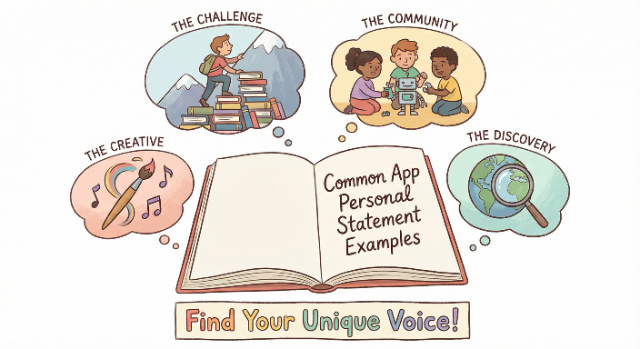
Example #1: Overcoming Challenges (Accepted to Stanford)
| Prompt: The lessons we take from obstacles we encounter can be fundamental to later success. Recount a time when you faced a challenge, setback, or failure. How did it affect you, and what did you learn from the experience? |
Title: The Strategy of Help
The fluorescent lights of the emergency room flickered as I sat beside my mother's hospital bed at 2 AM, chemistry textbook open on my lap. This wasn't unusual. I would spend most of junior year alternating between AP Chem problem sets and insurance paperwork, learning medical terminology faster than I ever learned Spanish.
When my mother was diagnosed with lupus, I became her primary caregiver overnight. My father worked nights, and my sister was only twelve. Someone had to manage medications, coordinate with doctors, and still somehow maintain a 4.0 GPA. I chose to do all of it, convinced I could handle anything.
I couldn't.
The breaking point came during the second semester. I'd stayed up until 3 AM finishing a lab report after an evening at the hospital. Walking into class the next day, I realized I'd left it at home. My teacher offered an extension. I broke down crying in the hallway, not because of the lab report, but because for six months I'd been pretending everything was fine when it wasn't.
That moment taught me something more valuable than any AP class: asking for help isn't a weakness. It is a strategy.
I started small. I asked my chemistry teacher if I could attend office hours for extra support. I talked to our school counselor about my situation. I let my best friend bring dinner to the hospital some nights. Each time I asked for help, the world didn't end. People showed up.
My mother's condition stabilized by senior year, but I'm different now. I still handle challenges head on, but I've learned to build teams instead of going solo. When I started a peer tutoring program at school, I didn't try to run it alone. I recruited five other students and divided responsibilities. When I captain our debate team, I actually listen to my teammates' strategies instead of assuming I have all the answers.
Last month, my chemistry teacher wrote my recommendation letter. She told me she included the story of that breakdown in the hallway, not because it showed weakness, but because what I did next showed growth. I learned chemistry that year, but more importantly, I learned that strength sometimes looks like vulnerability.
What Makes This Example Work
|
SEE THE POSSIBILITY. NOW, ACHIEVE IT FOR YOURSELF.
Let our experts help you from "I want one like that" to "This is my perfect statement."
- Strategic consultation to define your unique angle
- Dedicated writer specializing in your goal (Med, Law, MBA, etc.)
- A process proven by the examples you trust
- Pathway to Personalization
Your story is different. Our expertise is the same.
Get Started NowExample #2: Identity & Background (Accepted to Harvard)
| Prompt: Some students have a background, identity, interest, or talent that is so meaningful they believe their application would be incomplete without it. If this sounds like you, then please share your story. |
Title: Who Gets to Define 'Enough'?
"You're not really Mexican."
I've heard this in both languages from white classmates who said I "talked too proper" and from relatives in Guadalajara who laughed at my accent. Apparently, being fluent in English makes me less Mexican. So does being terrible at making tamales.
I spent most of middle school trying to pick a side. I'd switch between languages depending on who I was talking to, code switching so frequently that I sometimes forgot which version of myself I was performing. At school, I downplayed my Spanish to avoid being stereotyped. At family gatherings, I emphasized it to prove I belonged.
The exhaustion was real.
Everything changed during sophomore year when I started volunteering as a translator at our local immigration clinic. The first family I helped was a mother from Oaxaca who spoke Zapotec and broken Spanish, which shattered my entire framework. She didn't fit the "Mexican" box either. Neither did the Guatemalan father who spoke K'iche', nor the Salvadoran teenager who'd grown up speaking English in Houston before deportation brought her to unfamiliar territory.
I realized I'd been asking the wrong question. Not "Am I Mexican enough?" but "Who gets to define what 'enough' means?"
Now I embrace the complexity. I'm Mexican American, fluent in English, conversational in Spanish, passionate about immigration policy, and yes, still terrible at making tamales. I read Octavio Paz and listen to Bad Bunny. I can analyze Supreme Court decisions on DACA and recite my grandmother's stories about crossing the border in 1985.
At the immigration clinic, I've translated for over 200 families. Some speak perfect Spanish. Some speak indigenous languages and minimal Spanish. Some are second generation immigrants like me, navigating systems in their "native" country that feel completely foreign. What we share isn't language proficiency or cultural performance, it's the experience of existing between worlds.
Next year, I want to study political science and Latin American studies. Not to figure out which side I belong to, but to better understand how we can build systems that don't require people to choose. My application would be incomplete without this story because it's made me who I am: someone comfortable with complexity, someone who translates between worlds, someone who knows identity isn't a checkbox, it's a conversation.
And that conversation is always in two languages.
What Makes This Example Work
|
Need a topic to match your inspiration? Browse our collection of compelling personal statement topics to kickstart your own essay.
Example #3: Law (Accepted to LSE)
UCAS 2026 Format: Three Questions Combined
Question 1: Why do you want to study this course?
My interest in law began not in a courtroom, but at my father's employment tribunal. Watching him navigate a system designed to intimidate workers who challenge unfair dismissal showed me that law isn't just abstract principles, it's the difference between justice and injustice for real people. That hearing lasted three hours. My father prepared for six months. He won. And I understood that legal knowledge is power, but only if you can access it.
I want to study law because I'm fascinated by how legal systems can either protect or exploit vulnerable populations. From reading "The Rule of Law" by Tom Bingham to analyzing recent Supreme Court cases on workers' rights, I've become convinced that understanding law means understanding power structures that have it, who don't, and how to challenge inequalities built into systems we often take for granted.
Question 2: How have your studies prepared you?
My A level subjects have given me the analytical foundation that law requires. In History, studying the 1832 Reform Act taught me to examine how legal change happens slowly and through strategic pressure. In English Literature, close reading of texts like "Bleak House" developed my ability to analyze complex arguments and identify unstated assumptions essential for statutory interpretation.
For my EPQ, I researched "The Effectiveness of Employment Tribunals in Protecting Workers' Rights," interviewing five employment lawyers and analyzing 50 tribunal decisions from 2022-2024. This project taught me legal research methodology and revealed the gap between law in theory and law in practice. Most workers never reach tribunals because they can't afford the process.
Question 3: What else have you done to prepare?
Beyond academics, I've sought practical exposure to legal work. I completed a week's work experience at a local solicitor's office specializing in employment law, where I observed client consultations and researched case law. I volunteer weekly at our community legal advice clinic, helping people understand their rights around housing and employment. Most can't afford solicitors, so I've learned to explain complex legal concepts in plain language.
I'm also Social Mobility Prefect at my school, where I run workshops helping students from underrepresented backgrounds access legal careers. This role has shown me how much talent is wasted when opportunities aren't equally distributed, something I want to change as a lawyer.
What Makes This UCAS Example Work
|
Example #4: Medicine (Accepted to Cambridge)
UCAS 2026 Format: Three Questions Combined
Question 1: Why do you want to study this course?
I want to study medicine because healthcare saved my sister's life, but I've seen firsthand that medical knowledge alone isn't enough. When my younger sister was diagnosed with Type 1 diabetes at age seven, our family entered a world of insulin pumps, blood sugar monitoring, and constant vigilance. The doctors who treated her were brilliant, but the doctor who made the real difference was the one who taught my sister at seven years old to advocate for herself.
Medicine fascinates me because it requires both scientific rigor and human connection. I'm drawn to the challenge of translating complex physiological processes into treatment plans that real patients can follow. Reading "When Breath Becomes Air" by Paul Kalanithi reinforced my belief that the best doctors see patients as whole people, not just collections of symptoms.
Question 2: How have your studies prepared you?
Chemistry and Biology A levels have given me the scientific foundation medicine requires. In Chemistry, studying enzyme kinetics and drug interactions has shown me how medications work at a molecular level. In Biology, my investigation into insulin resistance mechanisms deepened my understanding of diabetes pathophysiology beyond what I'd learned from my sister's diagnosis.
For my EPQ, I investigated "Patient Compliance in Chronic Disease Management," conducting a literature review of 30 studies and interviewing four endocrinologists. This research revealed that 50% of patients don't follow prescribed treatment plans not because they don't understand instructions, but because medical advice often doesn't account for their lived realities.
Question 3: What else have you done to prepare?
I've sought diverse medical experiences to understand healthcare from multiple perspectives. I completed two weeks of work experience at Royal Free Hospital in the diabetes clinic, where I observed consultations and learned about multidisciplinary team approaches to chronic disease management. I volunteer weekly at a care home, where I've learned that medical care for elderly patients requires patience, clear communication, and genuine respect.
I'm also a peer mentor for younger students with chronic illnesses at my school, helping them navigate medical appointments while managing academic demands. This role has taught me that effective healthcare requires understanding not just pathology, but people's entire lives.
What Makes This UCAS Example Work
|
INSPIRED BY OUR EXAMPLES? YOURS WILL BE UNIQUELY YOURS.
We use the same winning principles to craft a 100% original, authentic statement for you.
- Custom narrative built from your experiences
- Same compelling structure, completely unique content
- Authentic voice development, not a template
- Bespoke Story Crafting
Don't just admire a sample. Become one.
Order NowMedical School Personal Statement Examples
Example #5: DO/MD Programs (Accepted to Multiple Schools)
Prompt: Why do you want to become a physician?
Title: Removing Barriers, Not Just Treating Diseases
At 3 AM during my EMT shift, we responded to a call for chest pain. The patient, a 58 year old construction worker, kept insisting he was fine, just needed his antacids. His wife knew better. She'd called 911 because something felt wrong, even though she couldn't explain what.
She was right. The man was having a heart attack. En route to the hospital, as I monitored his vitals and my partner administered aspirin, I watched this stoic man finally admit he'd been ignoring symptoms for days. He couldn't afford to miss work. He didn't have health insurance.
He survived. But that call showed me the problem I want to spend my career addressing: people make medical decisions based on economics, not health.
I want to become a physician who practices medicine, but also advocates for systems change. My 500+ hours as an EMT have shown me that emergency medicine is often the safety net for people without access to primary care. We treat complications that could have been prevented with earlier intervention. My research assistant position at the Health Equity Lab has taught me how social determinants of health, such as housing, employment, and food security, shape medical outcomes as much as genetics do.
During undergrad, I designed a pilot program connecting our student run free clinic with local social services, addressing patients' non medical needs alongside their medical ones. When we helped a diabetic patient access stable housing, her A1C dropped two points, not because we changed her medication, but because she could finally store insulin safely and cook regular meals.
Medicine appeals to me because it's both science and advocacy. I'm drawn to family medicine or internal medicine specialties where I can build long term relationships with patients and address root causes, not just acute symptoms. I want to practice in underserved communities where physicians are needed most.
That construction worker survived, but thousands of others don't because they delay care they can't afford. I want to be the kind of doctor who removes barriers, not just treats diseases.
What Makes This Medical School Example Work
|
Graduate School Personal Statement Examples
Example #6: PhD in Public Health (Accepted to Johns Hopkins)
Title: Confronting Geography: A Vision for Health Systems That Reach Everyone
During my Fulbright year in Peru, I spent six months in a rural clinic where the biggest health problem wasn't disease; it was distance. Patients walked four hours to reach us, often arriving too late for intervention. We treated the emergencies, but we couldn't solve the underlying problem: healthcare is concentrated in cities while 40% of Peru's population lives rurally.
This experience crystallized my research interest: how do we design healthcare delivery systems that reach geographically isolated populations? My undergraduate thesis examined telemedicine adoption in rural Andean communities, conducting 50 interviews with patients, providers, and health administrators. I found that technology alone doesn't solve access; we need culturally adapted implementation that accounts for limited internet, low health literacy, and language barriers.
I want to pursue a PhD in Public Health at Johns Hopkins to develop my research skills in health systems and policy, specifically focusing on innovative delivery models for rural populations. Dr. Martinez's work on mobile health clinics in Latin America aligns perfectly with my interests, and I hope to collaborate with her lab on research examining scalable solutions for rural healthcare access.
My research assistant position in the Global Health Equity Lab has given me experience with mixed methods research, statistical analysis in R, and qualitative coding. I've co authored two papers currently under review examining barriers to maternal health services in rural Peru.
Long term, I want to work at the intersection of research and policy, using evidence to design healthcare systems that serve everyone, not just those who live near hospitals. My Fulbright experience showed me the problem. A PhD will give me the tools to contribute to solutions.
What Makes This Graduate School Example Work
|
Short Personal Statement Examples
Example #7: Scholarship Application (500 words)
Prompt: Explain how this scholarship will help you achieve your educational goals.
Title: Beyond Survival, Toward Engineering
I'm a first generation college student working 25 hours per week to afford community college. This scholarship would mean I could reduce my work hours and take more than two classes per semester, which would transform my timeline from seven years to three.
Currently, I work evenings at Target and weekends at a restaurant. I take classes on Tuesday and Thursday mornings, the only times my schedule allows. At this rate, I'll complete my Associate's degree in 2028 and my Bachelor's in 2031. I'll be 28 years old.
I'm not complaining. I chose this path because education matters more than immediate comfort. But this scholarship would accelerate my goals without forcing me to choose between paying rent and taking a chemistry lab.
My goal is to become a civil engineer specializing in sustainable infrastructure. Growing up in Flint, Michigan, I watched my community suffer from infrastructure failure, lead contaminated water that poisoned children and destroyed trust in government. I want to design water systems that serve communities, especially low income areas often neglected by urban planning.
With this scholarship, I could:
- Take 12 credits per semester instead of 6
- Participate in the summer engineering internship program (currently impossible because I work full time in the summers)
- Join the Society of Women Engineers and attend conferences (membership costs $50 I can't afford)
- Focus on academics instead of survival
I maintain a 3.9 GPA despite working full time. I tutor math at our campus learning center. I've won two academic awards. But I could do more if I had time.
This scholarship isn't just financial assistance, it's an investment in the engineer I'm working to become. Someone who understands how infrastructure inequality affects real people because I've lived it. Someone who won't just design systems, but will advocate for communities that need them most.
I'll graduate regardless. This scholarship would just help me get there faster.
What Makes This Short Example Work
|
Personal Statement Introduction Examples
Example 1 (Narrative Hook): "The first time I truly understood engineering, I was nine years old and staring at the collapsed ruins of my grandmother’s lemonade stand after a storm. While she saw broken wood, I saw a problem to solve: how could we rebuild it to withstand the next one?"
| Why it works: Starts with a vivid, personal memory that establishes a long standing, authentic passion. It frames the subject (engineering) not as an academic choice, but as a fundamental way of seeing the world. |
Example 2 (Dialogue/Provocative Statement): "‘A poet? How will you feed yourself?’ My uncle’s question, though well-intentioned, echoed every practical doubt I’d ever had. It was my physics teacher who offered the unexpected retort: ‘The same way we feed our minds with curiosity and precision.’"
Why it works: Uses dialogue to immediately introduce a central conflict (practicality vs. passion) and creates intrigue by linking seemingly disparate fields (poetry and physics), promising a unique perspective. |
Example 3 (Analytical/Intellectual Curiosity): "Reading Plato’s ‘Allegory of the Cave’ for the third time, I was struck not by the philosopher’s conclusions, but by a logistical flaw: who built the chains? This question launched me from philosophical theory into the material history of power, the space where I want to build my academic career."
| Why it works: Demonstrates deep engagement with a subject, critical thinking, and the ability to derive a novel research question from classic texts. It shows an academic mind in motion from the very first line. |
Example 4 (Simple & Direct): "For me, computer code is more than a language; it is a toolkit for justice. This realization crystallized when I used a simple Python script to analyze local court records and uncover a pattern of disproportionately high bail amounts for minority defendants."
| Why it works: Gets straight to the point, combining personal passion (coding) with a core value (justice). The specific example mentioned promises a story of applied skills and social impact to follow. |
Example 5 (Atmospheric Scene-Setting): "The hum of the server room was my constant companion during the summer of my internship. Amidst the blinking lights and heat waves, I found an unexpected sense of calm a clarity that the chaos of data could be parsed, organized, and understood."
| Why it works: Creates a strong sense of place and atmosphere. It shows comfort in a professional environment and frames a technical setting in personal, almost poetic terms, highlighting a genuine affinity for the work. |
Personal Statement Conclusion Examples
Example 1 (Full Circle Narrative): "Today, when I mentor younger students in robotics, I don’t just hand them the wrench. I tell them the story of the lemonade stand. I show them that resilience isn’t just about rebuilding, but about reimagining from the ground up a principle I now see as the foundation of both engineering and community."
| Why it works: Brilliantly circles back to the introduction’s metaphor (the lemonade stand), demonstrating clear growth and reframing a childhood story into a mature philosophy. It shows application and mentorship. |
Example 2 (Synthesis of Identity & Goals): "I no longer see my identity as a choice between Mexican or American, art or science. My future in biomedical engineering lies at the intersection, where the precision of technology meets a deep understanding of human stories. I am not choosing a side; I am building a bridge between them."
| Why it works: Moves beyond the initial conflict presented in the essay. It synthesizes personal identity with professional ambition, presenting the applicant’s unique background as a distinct academic and career advantage. |
Example 3 (Forward-Looking & Specific): "My experience in the rural clinic showed me the ‘what’ of healthcare inequality. A degree in Public Policy will teach me the ‘how’ of designing systems, crafting legislation, and allocating resources to ensure that geography is never again a determinant of health."
Why it works: Clearly connects past experience to future study. It is forward-looking, specific about the academic tools needed, and reaffirms a clear, impactful mission statement. |
Example 4 (Concise & Powerful Assertion): "I will become a doctor who treats the patient, not just the chart. Because I’ve learned that sometimes, the most important diagnostic tool isn’t a stethoscope, but the willingness to listen to the story behind the symptoms."
| Why it works: Short, memorable, and values-driven. It transforms a lesson learned into a personal oath, leaving the reader with a strong, positive impression of the applicant’s character and patient-centered philosophy. |
Example 5 (Call to Action/Contribution): "The construction worker from my EMT shift survived his heart attack. But the system that forced him to delay care remains. I am applying to medical school not just to treat patients in exam rooms, but to advocate for them in boardrooms and legislative halls, working to dismantle the barriers I witnessed firsthand."
| Why it works: Connects powerfully back to a key story from the essay. It escalates the ambition from individual treatment to systemic change, showing maturity, vision, and a desire to contribute at a higher level. |
Still not sure how to adapt these examples to your story? Our professional essay writing service creates custom essays from scratch same quality as these examples, but 100% original to you.
Downloadable Resources
Want to study these offline or share with teachers? Download free annotated PDF versions:
YOU'VE SEEN WHAT WE CAN DO. NOW, SEE WHAT WE CAN DO FOR YOU.
Provide your details and get a custom outline or draft that brings your story to life.
- Free initial consultation to assess your narrative
- Custom outline based on your background and goals
- A first draft that captures the power of our samples
- Your Story, Our Craft
Take the logical next step from viewer to client.
Order NowBottom Line
The best way to write a great personal statement is to study great personal statements. Use these examples as models, study the structure, notice the techniques, and adapt the approach to your own story. These examples illustrate a key principle discussed in depth in our personal statement guide, your essential handbook for crafting a successful application essay.
These students got into top schools not because they had perfect lives, but because they reflected honestly on real experiences and showed genuine growth. You can do the same.