What Is a Personal Statement?
A personal statement is your chance to show admissions officers who you are beyond grades and test scores. It's a narrative essay, typically 500 to 650 words for college applications or 4,000 characters for UCAS, that tells your story, explains your motivations, and demonstrates why you're a great fit for their program.
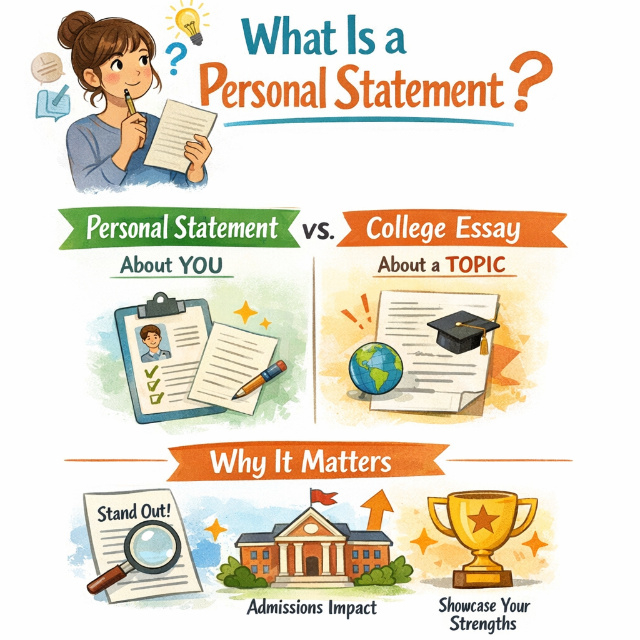
Personal Statement vs. College Essay
These terms are often used interchangeably, but there's a subtle difference:
- Personal statement = broader term covering any application essay (college, grad school, scholarships)
- College essay = specifically refers to undergraduate Common App or Coalition App essays
For this guide, we use "personal statement" to cover all application types.
Why It MattersAdmissions officers read thousands of applications. Your GPA and SAT scores show what you've achieved academically, but your personal statement shows who you are as a person. It's where you demonstrate:
|
A strong personal statement can tip the scales in your favor, especially at competitive schools where most applicants have similar grades.
DAUNTED BY THE "TELL US ABOUT YOURSELF" PROMPT?
We provide the framework and guidance to turn introspection into a standout statement.
- Brainstorming ideas to uncover key themes
- Structure that balances achievement with character
- Editing that sharpens your voice, not replaces it
- Guided Introspection Service
Find clarity in your story. Present your best self with confidence.
Order Now2026 UCAS Personal Statement Changes
If you're applying through UCAS for 2026 entry, the format has changed significantly.
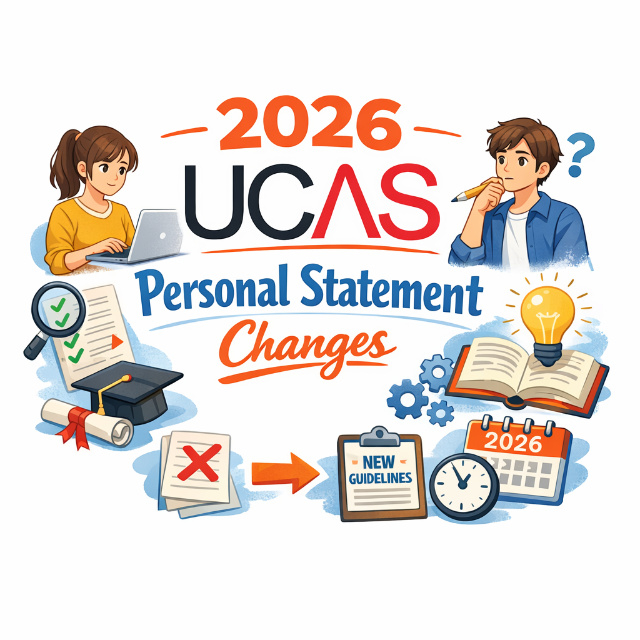
What Changed
Previously, UCAS required one 4,000 character essay written in free form. Starting in 2026, you now answer three specific questions:
- Why do you want to study this course or subject? (minimum 350 characters)
- How have your qualifications and studies helped you prepare for this course or subject? (minimum 350 characters)
- What else have you done to prepare outside of education, and why are these experiences useful? (minimum 350 characters)
What Stayed the Same
- Total character limit: 4,000 characters (including spaces)
- You can distribute the 4,000 characters however you want across the three questions
- All three answers are reviewed together as one statement
Why UCAS Made This Change
Research showed the old free form essay favored students from privileged schools who had more guidance. The new structured format levels the playing field and helps all students know exactly what to include.
Struggling to find detailed templates for each question? See our personal statement format guide.
How to Write a Personal Statement (Step by Step)
Writing a personal statement doesn't have to be overwhelming. Here's the process, broken into manageable steps.
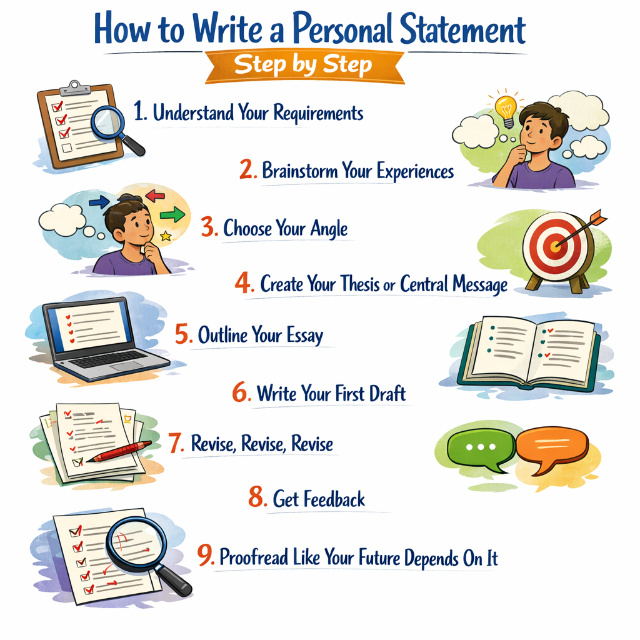
Step 1: Understand Your Requirements
Before you write a single word, know exactly what you're working with:
|
Check the application portal or program website for exact requirements. Don't assume, verify.
Step 2: Brainstorm Your Experiences
Don't start writing yet. First, make a list of experiences that shaped you:
|
You're not writing about all of these, you're finding 1 to 2 experiences that genuinely show who you are.
Step 3: Choose Your Angle
Here's where most people get stuck. You don't need the most dramatic story; you need an authentic one that reveals your values.
Ask yourself:
|
Example: Instead of "I want to write about volunteering," think "I want to show empathy and problem solving through my experience creating a food drive."
Need inspiration? Browse our personal statement topics list for 100+ ideas organized by application type.
Step 4: Create Your Thesis or Central Message
Your personal statement needs a central message, a thread that ties everything together. This isn't stated explicitly, but it's what readers should understand about you by the end.
|
Your central message should connect to why you're a good fit for their program.
Step 5: Outline Your Essay
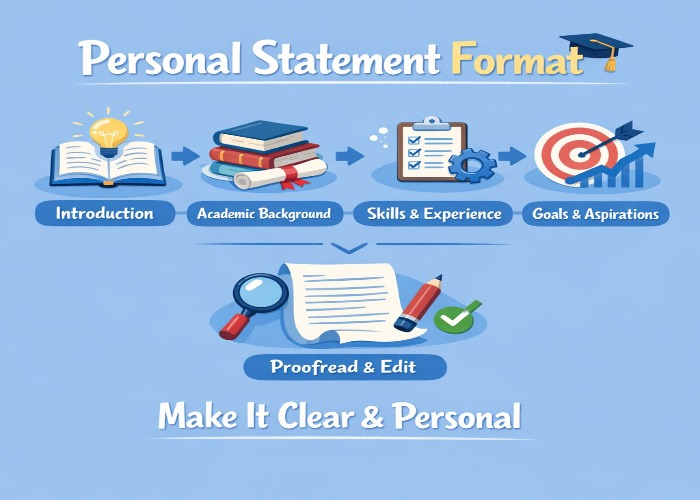
Now outline before you write. A typical structure:
- Opening hook (1 to 2 paragraphs): Start with a specific moment, image, or question that draws readers in
- Main narrative (3 to 4 paragraphs): Tell your story with specific details and reflection
- Connection to future (1 paragraph): Explain how this relates to your goals and their program
- Conclusion (1 paragraph): Bring it full circle, referring back to your opening
For ready to use templates with exact formatting, check out our personal statement format guide.
Step 6: Write Your First Draft
Here's the key: write without editing. Just get your ideas down. You'll revise later.
As you write:
|
Your first draft will be messy. That's normal.
Step 7: Revise, Revise, Revise
Great personal statements are written. Exceptional ones are rewritten.
Revision checklist:
|
Expect 3 to 5 drafts minimum.
Step 8: Get Feedback
Ask 2 to 3 people to read your statement:
|
Listen to patterns in feedback, not one off opinions.
Step 9: Proofread Like Your Future Depends On It
Because it does. Typos and grammatical errors signal carelessness.
|
Personal Statement Tips That Actually Work
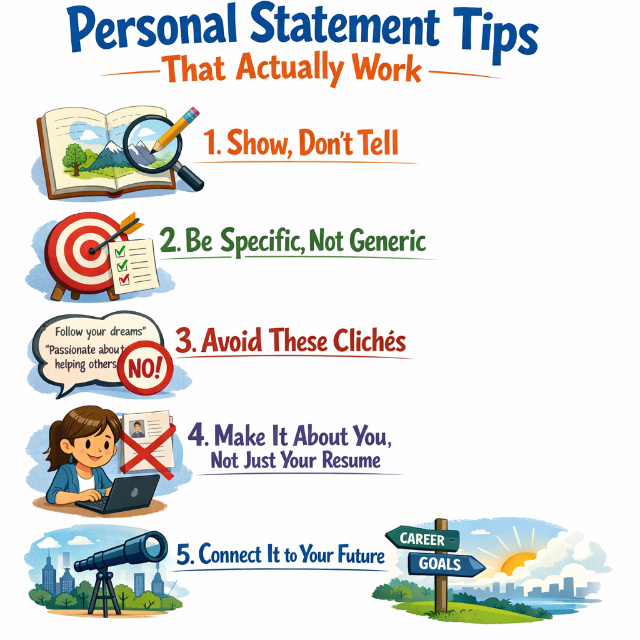
1. Show, Don't Tell
Telling: "I'm a hard worker and very dedicated."
Showing: "I spent three months rebuilding a 1987 Camaro engine, teaching myself from YouTube videos and spending every Saturday at the junkyard finding parts."
Specific details prove your qualities better than adjectives.
2. Be Specific, Not Generic
Admissions officers can spot generic statements instantly.
|
The second version paints a picture and reveals genuine motivation.
Do your research. Mention specific programs, professors, or opportunities at their school. See our personal statement examples guide to get acquainted with how students score top admissions with personal statements.
PERSONAL STATEMENT DEADLINE APPROACHING?
Get expert, stress free help to craft a winning statement on a tight timeline.
- Priority matching with a specialist in your field
- Expedited drafting and revision cycles
- Final proofread for absolute confidence
- Deadline Rescue Package
Beat the clock with a statement you're proud to submit.
Order Now3. Avoid These Clichés
Admissions officers have read these openings thousands of times:
|
Your story is unique. Start with something only you could write.
4. Make It About You, Not Just Your Resume
Your activities list already shows what you did. Your personal statement should show who you are.
|
Focus on reflection and growth, not accomplishments.
5. Connect It to Your Future
Don't just tell your past connect it to why you want to study at their school.
|
Common Personal Statement Mistakes to Avoid
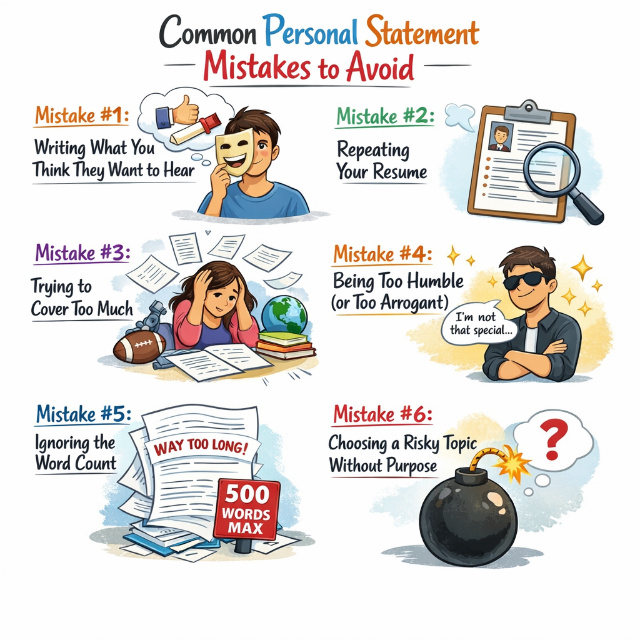
Mistake #1: Writing What You Think They Want to Hear
Admissions officers can spot fake authenticity. They've read thousands of essays about "changing the world" and "making a difference."
Write about what genuinely matters to you, even if it seems ordinary. An honest essay about your love of baking bread is better than a forced essay about curing cancer.
Mistake #2: Repeating Your Resume
Your activities list already shows what you did. Your personal statement should provide context and reflection.
Instead of listing accomplishments, choose one meaningful experience and go deep. Explain why it mattered, what you learned, how it changed you.
Mistake #3: Trying to Cover Too Much
You have 650 words (or 4,000 characters). That's not enough to tell your entire life story.
|
Go deep, not wide.
Mistake #4: Being Too Humble (or Too Arrogant)
There's a balance. You need to advocate for yourself without sounding entitled.
|
State your achievements confidently and explain why they matter.
Mistake #5: Ignoring the Word Count
If the limit is 650 words, don't submit 680. Don't submit 450 either.
|
Aim for 90 to 100% of the maximum word count.
Mistake #6: Choosing a Risky Topic Without Purpose
Some topics (politics, religion, tragedy, controversial issues) can work, but only if handled carefully and connected to genuine growth.
Red flag topics:
|
If you're unsure whether a topic is appropriate, ask a counselor or teacher before proceeding.
Personal Statement AI Detection Concerns
Many students worry about AI detection tools flagging their essays even when they wrote them entirely themselves.
Why Schools Check for AI
Universities started using AI detection tools (Turnitin's AI detector, GPTZero, etc.) after ChatGPT's release. They want to ensure:
- Essays represent the student's authentic voice
- Students developed their own ideas and arguments
- The writing reflects genuine effort and thought
Why Legitimately Written Essays Get Flagged
AI detectors aren't perfect. They sometimes flag human writing as AI generated if:
- The writing is very polished and formal
- Sentence structures are repetitive
- The vocabulary is advanced but generic
- Content lacks personal details and specifics
How to Ensure Your Essay Reads as Human Written
- Write in your natural voice. If you don't normally use words like "moreover," "furthermore," or "thus," don't use them in your essay. Sounds like you.
- Include specific, personal details. AI generated content is generic. Specific memories, sensory details, and personal reflections can't be replicated by AI.
- Vary your sentence structure. Mix short, punchy sentences with longer, more complex ones. Read your essay aloud. Does it sound like how you talk?
- Don't over edit into formality. Some students revise their essays until all personality is gone. Keep the conversational tone.
When to Start Writing Your Personal Statement
For College Applications
Ideal timeline:
- Spring of junior year
- Start brainstorming ideas
- Summer before senior year
- Write your first draft
- September to October of senior year
- Revise and finalize
- November to December
- Submit with applications
Minimum timeline: 4 to 6 weeks before your deadline
Starting early gives you time to write, step away, return with fresh eyes, and revise properly.
For UCAS Applications (UK Universities)
Most UCAS deadlines are:
- October 15 for Oxford, Cambridge, and most medicine/veterinary programs
- January 31 for most other courses
- Start writing by August to September at the latest.
For Graduate School
Timeline varies by program, but most graduate school deadlines fall between December and February.
Start your personal statement 3 to 4 months before your earliest deadline. Graduate statements often require more research and tailoring to specific programs.
Concerned about AI detection? Our personal essay writing service creates essays that sound authentically like you.
Downloadable Resource
Download this comprehensive personal statement workbook to transform the daunting task of application essays into a manageable, meaningful process. This step by step guide provides self-discovery exercises, structured templates, revision frameworks, and application specific strategies that build both your essay and your self-awareness.
FROM GENERIC TO GENUINELY POWERFUL.
We help you move from clichés to a confident, authentic story that resonates.
- Building a narrative around your true motivations
- Ensuring your unique personality shines through
- Authenticity Amplification
- 24/7 Professional Support
Stand out by being sincerely, compellingly you.
Order NowBottom Line
A personal statement is your chance to show admissions officers who you are beyond grades and test scores. Focus on authentic experiences that reveal your values, write in your natural voice, and revise until every word counts.
Key Takeaways:
Whether you write it yourself or get help, the goal is the same: submit something you're proud of that genuinely represents you.