What Is an Illustration Essay?
An illustration essay explains a concept by showing it through multiple concrete examples. The word "illustration" here doesn't mean pictures or drawings; it means demonstrating something clearly through evidence and examples that readers can understand.
Here's what makes these essays different:
Key characteristics:
- Uses 3-5 detailed examples to support the main idea
- Demonstrates concepts through real world scenarios
- Relies on evidence like statistics, anecdotes, and case studies
- Maintains an educational rather than persuasive tone.
Need it Written Today? Ready to Hand it Off?
Our expert writers create hundreds of essays daily:
- Custom research on any topic
- Expert writers across all subjects
- Plagiarism-free guarantee
- Rush delivery available
Join 73,000+ students who've trusted us
Order NowWhen Do You Write Illustrative Essays?
English classes assign them to test whether you can support ideas with evidence. Sociology courses use them to demonstrate understanding of concepts through real world examples. Communication studies require them to show how theories play out in practice. Business courses assign them to illustrate principles through company case studies.
The practical skill you're developing: taking abstract concepts and making them concrete through examples. This matters in professional writing, business reports, technical documentation, training materials, and marketing content, all use illustration techniques.
Why Illustration Essays Matter?
These essays develop critical thinking skills that extend far beyond the classroom. When you learn to support ideas with concrete examples, you're mastering a communication technique used in:
- Business reports that demonstrate market trends with data
- Medical case studies that illustrate treatment effectiveness
- Technical documentation that shows users how systems work
- Marketing materials that prove product benefits with testimonials
- Scientific papers that validate theories through experimental examples
The ability to make abstract concepts concrete through well-chosen examples is valuable in virtually every professional field.
Types of Illustration Essays
Main Types focus on how examples are used to clarify an idea
Single Example Illustration Essay: Uses one extended, detailed example to explain or support the main idea.
Multiple Example Illustration Essay: Uses several brief examples to reinforce and clarify a general point.
Narrative Illustration Essay: Explains an idea through a personal story or real life experience.
Descriptive Illustration Essay: Uses vivid, sensory examples to help readers visualize and understand an abstract concept.
| Some instructors also treat definition based illustration as a variation rather than a separate type, which is why confusion often occurs. |
How to Write an Illustration Essay: Complete Process
Illustrative essay writing breaks down into six clear steps. Follow the steps to write an illustration essay from start to finish for a well organized essay with strong examples.
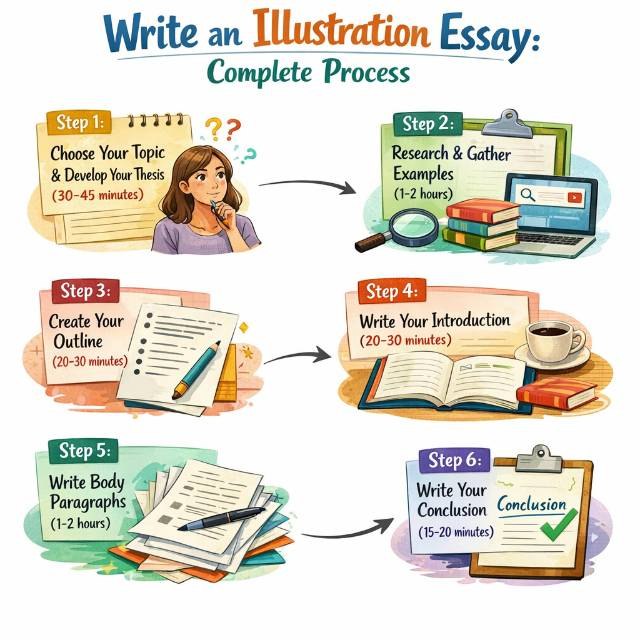
Step 1: Choose Your Topic and Develop Your Thesis (30-45 minutes)
Pick a topic with multiple examples you can access easily. "How smartphones changed dating" works because you can find research, statistics, and observable behaviors. "The meaning of happiness" doesn't work because it's too abstract, with few concrete examples.
Test your topic with these questions:
Can you think of 3-5 specific examples right now? Can you find statistics or research supporting it? Will readers be able to picture what you're describing? Is the topic specific enough to cover thoroughly?
Once you have a workable topic, write your thesis statement. Your thesis should identify what you're illustrating and preview your approach.
Weak thesis: "Social media affects how teenagers communicate." Strong thesis: "Social media has transformed teenage communication through three primary changes: instant visual messaging, public performance of identity, and algorithmically curated social circles." |
The strong illustration essay thesis statement tells readers exactly what to expect and provides a roadmap for your essay structure.
Step 2: Research and Gather Examples (1-2 hours)
You need 3-5 detailed examples minimum. Strong examples include specific details, numbers, names, dates, and exact situations rather than vague descriptions.
Types of examples that work well:
- Statistical evidence: "Teen smartphone users check their phones an average of 96 times daily" beats "Teens check phones a lot."
- Research findings: Reference actual studies with specific results.
- Real world scenarios: Detailed descriptions of how something works in practice.
- Expert testimony: Direct quotes from authorities in the field.
- Personal observation: Specific situations you've witnessed (use sparingly, support with other evidence).
As you research, take organized notes. For each example, record the source, specific details you'll use, and how it connects to your thesis. This saves time during drafting.
Step 3: Organize Your Collected Data (20-30 minutes)
Organize your data before writing. A solid layout prevents you from getting stuck mid draft, wondering what comes next.
A standard illustration essay structure contains:
I. Introduction: Hook, background context, thesis statement
II. Body Paragraph 1: First example with evidence and analysis
III. Body Paragraph 2: Second example with evidence and analysis
IV. Body Paragraph 3: Third example with evidence and analysis
[Add more body paragraphs if needed]
V. Conclusion: Restate thesis, synthesize examples, closing thought
Decide how to order your examples. Most common approaches: strongest example first (grab attention immediately), strongest example last (end with impact), chronological order (if showing development over time), or categorical organization (grouping similar types).
Need outline templates? Check our illustration essay outline page for fill-in-the-blank frameworks.
Step 4: How to Start an Illustration Essay? Introduction (20-30 minutes)
An illustration essay introduction does three jobs: hooks the reader, provides context, and presents your thesis.
Start with a hook that grabs attention:
- Statistical hook: "The average teenager sends 3,339 text messages per month, more than 100 daily."
- Anecdotal hook: Brief, relevant story that sets up your topic.
- Question hook: "When did communication become something that happens in 280 characters or less?"
- Quote hook: Relevant expert statement about your topic.
Then provide background context: Explain just enough for readers to understand why your topic matters. If you're illustrating how online learning changed education, briefly mention the shift from traditional classrooms without writing a history of education.
End with your thesis statement: Place it as the last sentence of your introduction. This positioning feels natural. You've built context, now you're stating exactly what you'll demonstrate.
Step 5: Illustration Essay Elements for Body Paragraphs (1-2 hours)
Each body paragraph focuses on one example. Follow this proven structure for every paragraph:
- Topic sentence: Introduce the specific point this paragraph will illustrate. Connect it to your thesis.
- Present your example: Provide the specific scenario, statistic, or evidence in detail. Use concrete language.
- Analyze the example: Explain how this example demonstrates your thesis point. Never assume readers will make the connection automatically.
- Transition: Connect to your next paragraph or summarize how this example fits your larger argument.
Want to see complete examples? Browse our illustration essay examples with annotations showing exactly how each section works.
Step 6: How to Write a Conclusion for an Illustration Essay (15-20 minutes)
Your conclusion wraps up your illustration without introducing new information.
Strong conclusion contains:
- Restate your thesis (using different words): Remind readers what you demonstrated.
- Synthesize your examples: Show how your examples work together to illustrate your point. Don't just list them again; explain their collective significance.
- Provide broader context: Explain why understanding this topic matters. What's the takeaway?
- End with a memorable closing: a Strong final sentence that gives readers something to think about.
What NOT to do in conclusions:
- Don't introduce new examples or evidence.
- Don't apologize ("This is just my opinion").
- Don't use clichés ("In conclusion" or "To sum up").
- Don't repeat your introduction word-for-word.
Quick Start: 5-Minute Framework for Illustrative Essay
Need to start writing immediately? Use this streamlined framework:

1. Choose Your Illustration Concept (1 minute)
- Pick one clear idea to illustrate
- Make sure you can think of 3-5 concrete examples
2. List Your Examples (2 minutes)
- Write down 3-5 specific examples
- Mix different types (personal, historical, current, statistical)
- Order from least to most impactful
3. Draft Your Illustrative Thesis (1 minute)
- State your concept clearly
- Indicate you'll use examples to demonstrate it
- Example: "Social media transforms modern communication through instant connectivity, viral information spread, and community building across distances."
4. Organize Body Paragraphs (1 minute)
- One paragraph = one developed example
- Include: topic sentence, example details, analysis
Illustration Essay vs. Other Essay Types
Understanding how illustration essays differ from similar assignments helps you approach each task with the right strategy.
| Feature | Illustration Essay | Argumentative Essay | Expository Essay | Descriptive Essay |
|---|---|---|---|---|
| Primary Purpose | Demonstrate through examples | Persuade with evidence | Explain factually | Create a sensory experience |
| Tone | Educational, informative | Persuasive, assertive | Neutral, objective | Vivid, immersive |
| Thesis Focus | "This concept works like..." | "You should believe/do X" | "Here's how X works" | "X looks/feels/seems like..." |
| Evidence Type | Multiple detailed examples | Data, logic, expert opinions | Facts, definitions, process | Sensory details, imagery |
| Example Usage | Central to the entire essay | Supporting evidence only | Clarifying tools | Creates atmosphere |
| Reader Goal | Understand through examples | Be convinced | Learn factual information | Visualize and experience |
| Common Mistakes | Too few examples | Weak reasoning | Personal opinion | Lack of specific details |
Key Takeaway: While other essays may include examples, illustration essays make examples the foundation of the entire piece. Every paragraph should develop a specific example that supports your thesis.
Struggling With Examples or Structure?
Our professional writers specialize in illustration essays that demonstrate concepts with strong, specific evidence.
- Zero plagiarism, 100% original
- Academic tone and detailed analysis
- Expert editing and formatting
- Confidential and reliable
Get a clear, example-driven essay that impresses your professor.
Order NowCommon Illustrative Essay Mistakes (And How to Avoid Them)
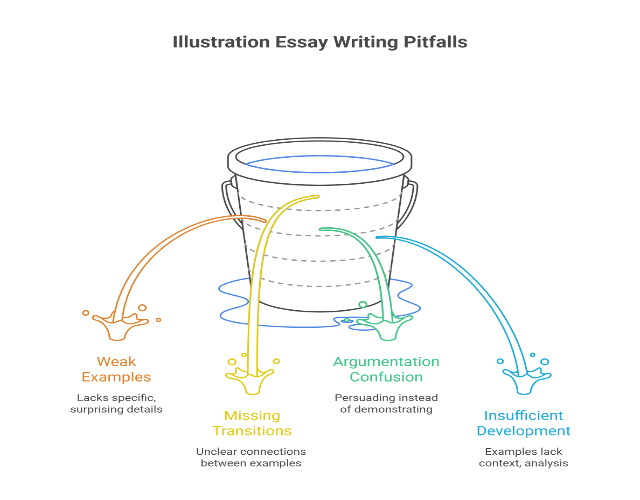
Mistake #1: Using Weak or Obvious Examples
The Problem: Choosing examples that everyone knows or that don't add real insight.
Solution:
Choose examples with:
- Specific data or statistics
- Surprising or lesser-known details
- Personal observations with unique angles
Mistake #2: Forgetting Transition Words
The Problem: Jumping between examples without clear connections.
Solution: Use phrases like:
- "To further illustrate this point..."
- "Another example demonstrates..."
- "This concept also appears in..."
See our complete illustration essay examples for 100+ phrases.
Mistake #3: Confusing Illustration with Argumentation
The Problem: Trying to persuade instead of demonstrating.
Solution: Focus on showing how something works, not proving it's right or wrong.
Mistake #4: Insufficient Example Development
The Problem: Listing examples without explaining them.
Solution: Each example needs:
- Specific details (numbers, names, dates)
- Context (why it matters)
- Analysis (connection to thesis)
Choosing the Right Examples for an Illustration Essay: A Framework
Not all examples are equally effective. Use this hierarchy to select your strongest evidence:
Tier 1: Most Effective
- Statistical evidence with sources
- Case studies with documented outcomes
- Expert observations from authorities
- Research findings from studies
- Historical examples with verified details
Tier 2: Strong Supporting
- Current events from reliable news sources
- Personal experiences with specific details
- Observations with measurable results
- Testimonials from direct participants
Tier 3: Supplementary
- Hypothetical scenarios (use sparingly)
- Common knowledge examples (for context only)
- General trends without specific data
Best practice: Use mostly Tier 1 and Tier 2 examples, with Tier 3 only for introductory context. For topic-specific example selection, see our illustration essays topics guide.
Illustrative Writing for Different Academic Levels
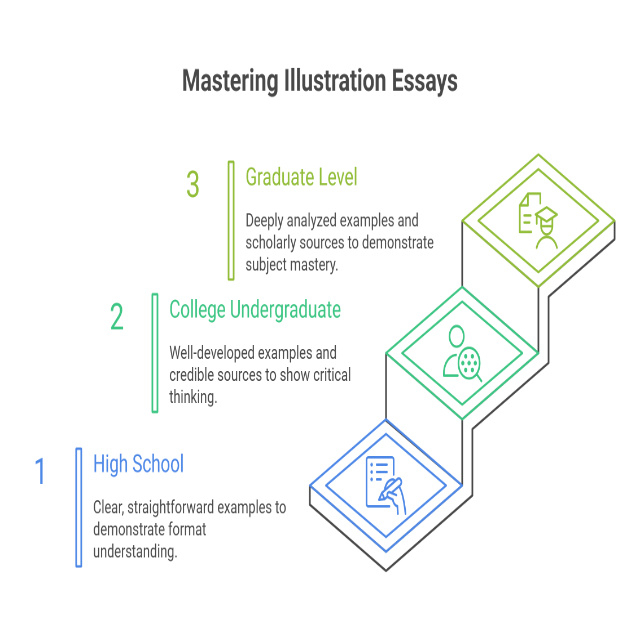
The requirements for an illustration essay vary by educational level. Here's what instructors expect:
Academic Level | Length | Examples Needed | Sources | Complexity | Focus |
High School Level | 500–800 words (3–5 paragraphs) | 2–3 developed examples | 2–3 sources; general references acceptable | Clear, straightforward examples | Demonstrate understanding of the illustration essay format |
College Undergraduate Level | 1,000–1,500 words (5–7 paragraphs) | 3–5 well-developed examples | 4–6 credible sources; proper citation required | Mix of example types with moderate analytical depth | Show critical thinking through purposeful example selection |
Graduate Level | 2,000+ words (8–10+ paragraphs) | 5–7 deeply analyzed examples | 8–12 scholarly sources; extensive citation | Sophisticated analysis; counterexamples considered | Demonstrate subject mastery and advanced research skills |
Adjust your approach based on your current level.
Tips for Stronger Illustration Essays
These strategies separate good essays from great ones:
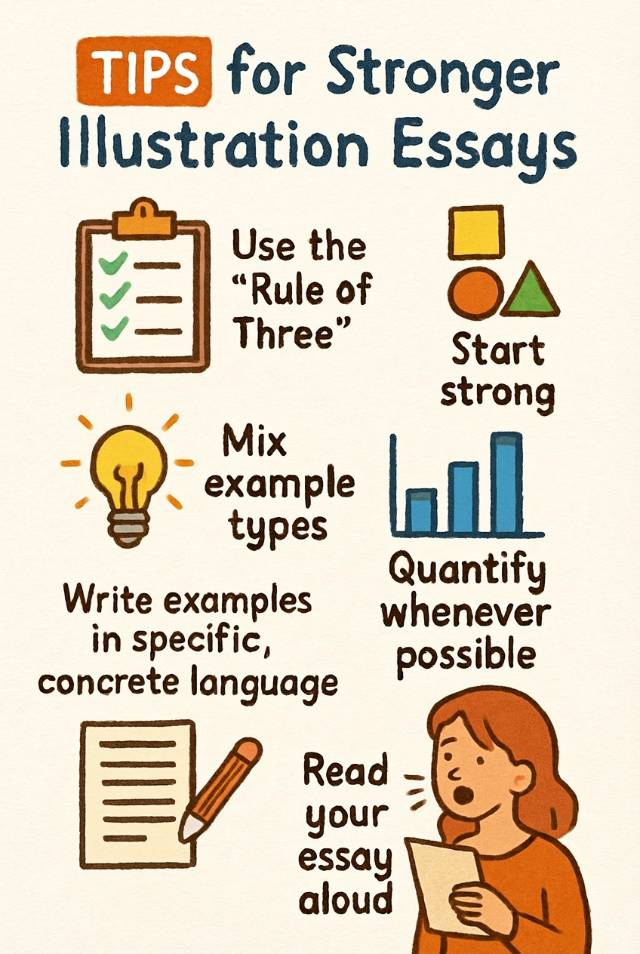
- Use the "Rule of Three": Three examples feel complete without overwhelming readers. Fewer feels thin; more than five requires longer essays with very strong organization.
- Mix example types: Combine statistics with anecdotes, research findings with real-world observations. Variety keeps readers engaged.
- Start strong: Your first body paragraph makes the strongest impression. Lead with your clearest, most compelling example.
- Quantify whenever possible: Specific numbers convince readers more effectively than vague descriptions. "Teen smartphone usage increased 45% between 2019-2024" beats "Teen smartphone usage increased."
- Write examples in specific, concrete language: Avoid abstract descriptions. Instead of "Social media affects relationships," write "When couples check Instagram during dinner, eye contact decreases by an average of 43% according to MIT research on device distraction."
- Read your essay aloud: Hearing your words catches awkward phrasing, missing transitions, and unclear connections that your eyes might skip while reading silently.
Running short on word count? Add more analysis to existing examples or take help from our professional essay writing service, which will explain the "why" and "how" more thoroughly.
Free Downloadable Resources for an Illustration Essay
Ready to Ace Your Illustration Essay?
We’ll help you craft clear, example-driven writing that impresses your professor.
- Original, well-researched writing
- 100% Human writers, no AI
- Fast turnaround even urgent deadlines
- Free revisions until you’re satisfied
Don’t let stress cost your grade let our experts handle the heavy lifting.
Order NowBottom Line
Illustration essays demonstrate concepts through detailed, specific examples rather than arguing for positions. Success requires clear thesis statements, 3-5 well developed examples with concrete evidence, thorough analysis explaining how examples support your thesis, and logical organization connecting examples coherently.
Start by choosing a topic with accessible examples, research thoroughly to find specific evidence, outline your essay structure before drafting, write body paragraphs that present and analyze each example, and revise to ensure every example directly supports your thesis.
Ready to write? Pick your topic, gather your examples, and follow this guide's step by step process.