Why Creating an Outline Matters for Illustration Essays
Creating an outline before writing your illustration essay transforms a potentially scattered draft into a focused, coherent argument. Without an outline, students often discover midway through writing that their examples don't connect logically, some paragraphs lack sufficient detail, or they've accidentally repeated the same point multiple times with different examples.
An outline prevents these common pitfalls by forcing you to think strategically about example selection and organization before committing words to the page. When you map out your essay's structure visually, you can immediately see whether your examples build on each other effectively, whether you have sufficient evidence for each point, and whether your argument flows logically from introduction to conclusion.
The illustration essay outline serves multiple practical purposes. First, it helps you evaluate whether your chosen examples actually support your thesis statement. Sometimes illustration essay topics that seem perfect initially reveal themselves as tangential when you start outlining specific evidence. Second, outlines reveal gaps in your research early, allowing you to find additional sources before you're halfway through a draft. Third, they provide a roadmap that makes actual writing significantly faster—you're filling in predetermined sections rather than figuring out what to say next.
Outlines also improve essay quality by encouraging balanced development. When you see your entire essay structure at once, you notice if one body paragraph has three detailed examples while another has only vague assertions. This bird's-eye view enables you to redistribute information, strengthen weak sections, and ensure each paragraph receives adequate attention. For illustration essays specifically, where the quality and relevance of examples determines success, this structural planning proves invaluable.
Step-by-Step: How to Create Your Illustration Essay Outline

Step 1: Finalize Your Thesis Statement
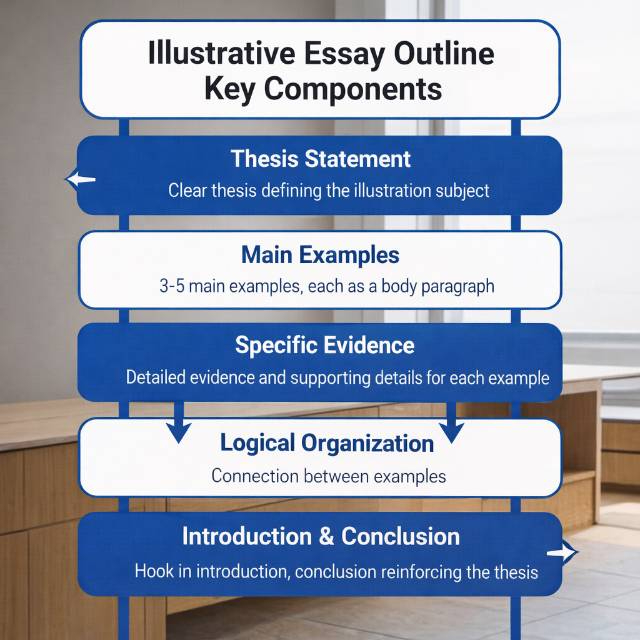
Before outlining anything else, ensure your thesis statement clearly identifies what you're illustrating and why it matters. Your thesis should be specific enough to guide example selection but broad enough to support 3-5 distinct body paragraphs.
Weak thesis: "Social media has effects on teenagers." Strong thesis: "Social media significantly impacts teenage mental health through three primary mechanisms: constant social comparison, exposure to cyberbullying, and disruption of healthy sleep patterns."
The strong thesis immediately suggests your outline structure—three body paragraphs, each addressing one mechanism. Every example you include should directly support one of these three points. If you're struggling to outline your essay, often the problem lies in a vague thesis statement that doesn't provide clear direction.
Step 2: Identify Your Main Examples
List every example, case study, statistic, or piece of evidence you've gathered during research. Then group related examples together and identify the 3-5 strongest, most compelling groups. Each group becomes one body paragraph in your outline. Quality trumps quantity—better to fully develop three powerful examples than superficially mention seven.
Evaluate each potential example using these criteria:
- Is it recent and relevant?
- Does it directly support my thesis?
- Can I explain it in sufficient detail?
- Does it add something unique that other examples don't?
- Will my audience find it credible and compelling?
Examples that don't meet most of these criteria should be cut or relegated to brief mentions within stronger paragraphs.
If you are still confused about identifying examples, review some credible illustration essay examples to get a clear idea.
Step 3: Organize Examples Logically
Decide how to order your body paragraphs. The most common organizational strategies for illustration essays are chronological order (showing development over time), order of importance (strongest example last for maximum impact or first for immediate credibility), and categorical organization (grouping similar types of examples together).
For the social media thesis above, categorical organization works well—one paragraph per mechanism. For a topic like "how climate change affects coastal communities," you might use order of importance, presenting the most devastating impact first to establish urgency. Consider which arrangement best serves your argument and helps readers follow your logic.
Step 4: Add Supporting Details
Under each main example in your outline, list specific details, statistics, quotes, and evidence you'll include. This level of specificity prevents the common mistake of outlining "provide example about cyberbullying" without actually identifying what that example will be. Instead, write "Case study: 2024 Pew Research study showing 42% of teens report experiencing cyberbullying, with documented correlation to anxiety and depression."
Detailed outlines also reveal when you lack sufficient evidence. If you can only list one vague example under a body paragraph heading, that's a red flag requiring additional research before you begin writing. Aim for at least 2-3 specific pieces of evidence per body paragraph.
Step 5: Draft Introduction and Conclusion Notes
Sketch what your introduction will include: the hook that grabs attention, necessary background information, and your thesis statement. For the conclusion, note the main points you'll synthesize and what final impression you want to leave. These don't need to be fully written—bullet points suffice for outline purposes—but having them planned ensures your essay has strong opening and closing.
To learn how to draft a complete essay, review a detailed guide on how to write an illustration essay.
Your Time Is Worth More Than This
Get Hours Back. Get a Better Essay
Zero AI. Zero plagiarism. Just expert-level writing.
Illustration Essay Outline Templates
Basic 5-Paragraph Outline Template
This template works for shorter illustration essays (1,000-1,500 words) with three main examples:
I. Introduction
Hook: [Attention-grabbing opening - statistic, quote, scenario, or question]
Background: [2-3 sentences providing context readers need]
Thesis Statement: [One sentence clearly stating what you're illustrating]
II. Body Paragraph 1: First Main Example
- A. Topic sentence: [Introduce first example and its connection to thesis]
- Example 1 details: [Specific case, study, or evidence]
- Evidence/data: [Statistics, expert quotes, or research supporting example]
- Analysis: [Explain how this example illustrates your thesis point]
- Transition: [Connect to next example]
III. Body Paragraph 2: Second Main Example
- Topic sentence: [Introduce second example]
- Example 2 details: [Specific case, study, or evidence]
- Evidence/data: [Supporting statistics or research]
- Analysis: [Explain connection to thesis]
- Transition: [Bridge to third example]
IV. Body Paragraph 3: Third Main Example
- Topic sentence: [Introduce strongest or final example]
- Example 3 details: [Specific case, study, or evidence]
- Evidence/data: [Supporting statistics or research]
- Analysis: [Explain significance and connection to thesis]
- Transition: [Signal move to conclusion]
V. Conclusion
- Thesis restatement: [Rephrase thesis in light of examples presented]
- Summary: [Brief synthesis of main examples and what they demonstrate]
- Final thought: [Broader implication, call to action, or thought-provoking closing]
Extended Outline Template (5-7 Body Paragraphs)
For longer, more complex illustration essays (2,000-3,000 words):
I. Introduction (1 paragraph)
Hook strategy: [Anecdote, startling statistic, provocative question, or relevant quote]
Context: [Historical background, definition of key terms, or scope of topic]
Thesis statement: [Clear statement of what you're illustrating with preview of main points]
II. Body Section 1: First Major Point (1-2 paragraphs)
- Primary example with detailed explanation
- Supporting evidence (studies, statistics, expert testimony)
- Secondary example reinforcing same point (if using 2 paragraphs)
- Analysis connecting examples to thesis
III. Body Section 2: Second Major Point (1-2 paragraphs)
- Primary example with detailed explanation
- Supporting evidence
- Secondary example if needed
- Analysis and connection to thesis
IV. Body Section 3: Third Major Point (1-2 paragraphs)
- Primary example with detailed explanation
- Supporting evidence
- Secondary example if needed
- Analysis demonstrating thesis point
V. Body Section 4: Fourth Major Point (1 paragraph, optional)
- Additional example
- Address a different aspect
- Evidence and analysis
- Connection to previous points
VI. Conclusion (1 paragraph)
- Thesis restatement with fresh wording
- Synthesis of all major examples
- Significance: Why these examples matter
- Closing thought or broader implication
Annotated Sample Outline
Here's a complete example outline for the topic: "How Student Debt Influences Career Decisions"
I. Introduction
Hook: "Recent graduate Sarah Chen turned down her dream job at a nonprofit to work in corporate finance—not because she preferred the work, but because her $80,000 in student loans demanded it." - Background: Brief context on rising student debt levels (reference 2024 statistics: average debt $37,000, affects 43 million borrowers)
Thesis: "Student loan debt significantly influences post-graduation career decisions by limiting pursuit of lower-paying passions, delaying entrepreneurship, and forcing geographic compromises that prioritize salary over fit."
II. Body Paragraph 1: Abandoning Lower-Paying Passions
Topic sentence: Many graduates abandon intended career paths in education, social work, and nonprofit sectors due to debt repayment pressure
Example 1: 2024 study from Georgetown University showing 58% of education majors with debt over $40,000 switch to higher-paying fields
Example 2: Profile of specific graduate (cite source) who left teaching after two years for corporate training role paying $30,000 more annually
Evidence: Calculate debt-to-income ratios showing how monthly payments consume 15-20% of nonprofit salaries vs. 8-10% of corporate salaries
Analysis: Debt service requirements make lower-paying public service careers financially unfeasible, forcing value-mission tradeoffs
Transition: "Beyond limiting career field choices, debt also affects timing of career moves, particularly entrepreneurship."
III. Body Paragraph 2: Delaying or Preventing Entrepreneurship
Topic sentence: Student debt delays entrepreneurship by creating risk aversion and reducing access to startup capital
Example 1: Federal Reserve study (2023) showing borrowers with student debt are 50% less likely to start businesses in first decade after graduation
Example 2: Case study of would-be entrepreneur who delayed startup for 8 years while paying down debt, missing market opportunity
Evidence: Explain how debt-to-income ratios affect credit scores and loan approval for business financing
Analysis: Monthly payment obligations create safety-seeking behavior, and existing debt reduces borrowing capacity for business ventures
Transition: "Geographic flexibility, another crucial career factor, also suffers under debt burden."
IV. Body Paragraph 3: Geographic Compromises
Topic sentence: Debt forces graduates to prioritize high-cost-of-living markets with higher salaries over preferred locations with better quality of life
Example 1: Research showing debt holders disproportionately cluster in expensive metro areas (NYC, SF, Boston) despite preference surveys indicating desire for smaller cities
Example 2: Interview with graduate who chose Seattle tech job over preferred Portland position due to $15,000 salary difference needed for debt service
Evidence: Cost-of-living adjusted salary requirements when carrying debt vs. debt-free scenarios
Analysis: Debt payments remain constant regardless of location, requiring absolute salary levels that only high-cost markets provide, limiting lifestyle and family planning choices
Transition: "These interconnected impacts reveal how debt fundamentally reshapes career trajectories."
V. Conclusion
Thesis restatement: "As demonstrated through career field choices, entrepreneurship timing, and geographic decisions, student loan debt significantly constrains post-graduation career paths, forcing financial considerations to override personal fit and passion."
Synthesis: Briefly summarize how all three impacts compound—less fulfilling work, in expensive cities, without entrepreneurial opportunity
Significance: Note broader implications for workforce satisfaction, economic dynamism, and social service sectors
Final thought: "Until debt burdens decrease or repayment structures change, graduates will continue making career decisions based on financial necessity rather than professional calling."
You've Done Enough. Let Us Finish It
Get an A-Worthy Essay Without the All-Nighter
No AI. No recycled papers. 100% original or your money back.
Common Outline Mistakes to Avoid

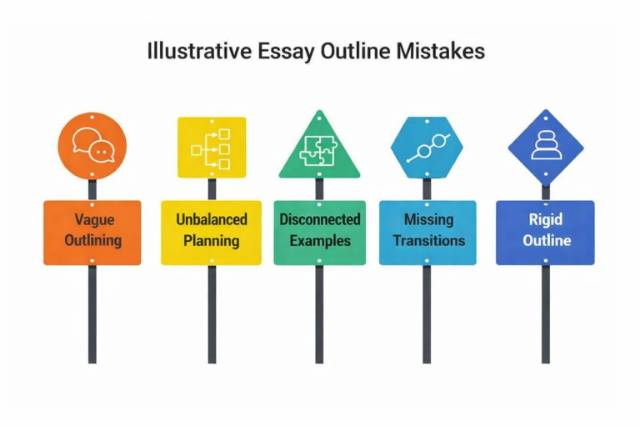
Mistake 1: Outlining Too Vaguely
Weak outline: "Paragraph 1 - talk about social media effects"
Strong outline: "Paragraph 1 - Instagram's impact on body image: 2023 study showing 67% of teenage girls report comparison anxiety, case example of influencer culture effects, analysis of algorithmic amplification"
Vague outlines don't help you write because they don't contain actual content planning. Force yourself to include specific examples, studies, and evidence at the outline stage. If you can't identify these specifics while outlining, you can't suddenly conjure them while drafting.
Mistake 2: Unbalanced Paragraph Planning
Review your outline to ensure each body paragraph contains roughly equivalent detail. If one paragraph has three specific examples with supporting evidence while another has only one vague reference, that imbalance will create a lopsided essay. Redistribute examples or conduct additional research to strengthen weak sections before you begin writing.
Mistake 3: Examples Don't Clearly Connect to Thesis
Every example in your outline should directly support your thesis statement. A common mistake involves including interesting examples that relate tangentially to your topic but don't actually illustrate your specific thesis point. Test each example by asking: "Does this clearly demonstrate the exact point my thesis makes?" If the connection requires mental gymnastics, cut that example.
Mistake 4: Missing Transitions
Note transition strategies in your outline between major sections. How will you bridge from your introduction to your first example? Between body paragraphs? Into your conclusion? Planning transitions during outlining prevents the choppy, disconnected feeling that occurs when you try to create connections while drafting.
Mistake 5: Treating Outline as Unchangeable
Outlines should guide writing, not constrain it. If you discover while writing that a better organizational structure emerges, or that one example doesn't work as well as anticipated, adjust your outline. The outline exists to serve you, not the reverse. Successful writers frequently revise outlines during the drafting process based on what they discover.
From Outline to Essay: Making the Transition
Once your outline is complete, transformation to a full essay becomes straightforward. Each outline point expands into one or more complete sentences. Your outline's main headings become topic sentences. The specific examples and evidence you noted become detailed explanations with proper citations.
Start by expanding your introduction. The hook you identified in your outline becomes a full opening paragraph with your thesis statement positioned as the final sentence. Provide enough background context that readers understand your topic, but don't overwhelm them with information—save detailed explanations for body paragraphs where they support specific examples.
For body paragraphs, begin each with the topic sentence from your outline, then develop the example fully. Include all the specific details, statistics, and evidence you noted, but now in complete sentences with explanatory context. After presenting each example, explain its significance—don't assume readers will automatically understand how it illustrates your thesis. State the connection explicitly.
Maintain paragraph focus by ensuring every sentence within a body paragraph relates to that paragraph's main example. If you find yourself introducing a new example partway through a paragraph, you probably need to create a separate paragraph. Each body paragraph should feel like a complete mini-essay proving one specific aspect of your thesis.
Develop your conclusion by expanding your outline's final notes. Restate your thesis using different words—don't simply copy it from your introduction. Briefly synthesize the main examples you presented, showing how together they prove your point. End with a memorable closing thought that gives readers something to consider beyond your essay.
Throughout the writing process, refer back to your outline frequently to ensure you're staying on track. The outline keeps you focused on your plan rather than wandering into tangents or forgetting key points you intended to make.
Advanced Outlining Strategies
For students comfortable with basic outlining who want to enhance their process, consider these advanced techniques. Create a separate evidence inventory document listing all sources, examples, and statistics you might use, with notes about which thesis points each supports. Then build your outline by pulling from this inventory, ensuring you use your strongest evidence strategically.
Try color-coding your outline by evidence type: blue for statistical data, green for case studies, red for expert testimony. This visual organization helps you see at a glance whether you're relying too heavily on one evidence type or successfully incorporating diverse support. Varied evidence types create more compelling illustration essays than those depending entirely on statistics or only on anecdotes.
Consider creating two competing outlines for complex topics, especially when multiple organizational strategies could work. Draft a chronological outline and a categorical outline, then evaluate which presents your examples most compellingly. This comparative approach often reveals the most effective structure and helps you think critically about why certain arrangements work better than others. To review some smart, easy, and strong topics, you can review a list of 150+ best illustration essay topics online.
Use your outline as a time management tool by estimating how long each section will take to write. If you have three days before your deadline, you might allocate four hours to body paragraphs, one hour to introduction and conclusion, and one hour to revision. Breaking the essay into outlined chunks makes the project feel manageable rather than overwhelming.
Integrating Your Outline with the Writing Process
The relationship between outlining and writing isn't linear—it's iterative. While the outline guides initial drafting, the drafting process often reveals necessary outline adjustments. Successful writers move fluidly between outline revision and draft expansion, treating both as works in progress until the essay reaches completion.
As you write each body paragraph, check whether your outline's planned evidence actually supports your point as effectively as you anticipated. Sometimes research that seemed perfect in abstract doesn't integrate smoothly into prose, requiring you to find alternative examples. Other times, an example you planned to mention briefly turns out to merit fuller development, suggesting outline restructuring.
Pay attention to paragraph length as you draft. If one body paragraph balloons to 500 words while others stay around 200, either your outline misjudged relative importance or you're including unnecessary detail. Consult your outline to refocus—does all that content directly support that paragraph's main example, or have you wandered off topic? Outlines help you recognize and correct such imbalances before they become entrenched in multiple drafts.
After completing your first draft, return to your outline and annotate it with what actually ended up in your essay. Did you include all planned examples? Did new examples emerge during writing? Did you maintain your planned organization or make changes? This post-draft outline review often reveals patterns—perhaps you consistently struggle to develop conclusions, or you regularly find better examples while writing than during research. Recognizing these patterns helps you improve both outlining and writing for future essays.
Conclusion: Your Outline Is Your Essay's Foundation
Creating a thorough illustration essay outline might feel like extra work before the "real" writing begins, but this preparation dramatically improves both the efficiency of your writing process and the quality of your final essay. Students who outline effectively write faster, produce more organized essays, and make fewer structural revisions than those who dive directly into drafting.
Your outline serves multiple purposes throughout the essay creation process: a planning tool during research, a structural guide during drafting, and a quality check during revision. By investing 30-60 minutes in thoughtful outline creation, you save hours of rewriting, reorganizing, and struggling to connect ideas that don't flow logically.
Remember that outlines should be as detailed as needed to guide your writing effectively while remaining flexible enough to accommodate insights that emerge during drafting. The goal isn't creating a perfect outline on your first attempt—it's developing a working structure that helps you transform researched examples into a coherent, persuasive illustration essay.
For additional guidance on writing compelling illustration essays, explore our complete illustration essay guide covering thesis development, example selection, and revision strategies. If you need assistance with outlining, research, or drafting your illustration essay, a professional writing service can provide expert support tailored to your academic level and assignment requirements.
The templates, strategies, and examples provided here give you everything needed to create effective illustration essay outlines for any topic. With solid outlining skills mastered, you're prepared to write clear, well-organized essays that successfully demonstrate your points through compelling, carefully selected examples.
Stop Stressing. Start Submitting. Our professional writers craft essays that impress professors and earn top marks. Trusted by 50,000+ students worldwide
Downloadable Resources
These resources complement our comprehensive illustration essay writing guide, which provides detailed instruction on writing techniques, example integration, and revision strategies. Together, these resources guide you from initial topic selection through final draft completion.