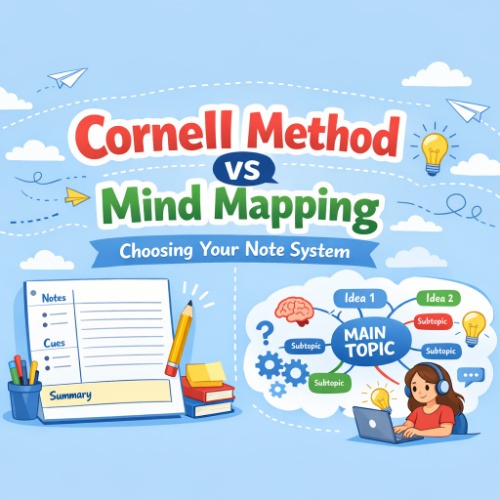
What Is the Cornell Method and How Does It Work?
The Cornell Method divides pages into three sections: a narrow left column for cues, a wide right column for notes, and a bottom section for summary. This structure forces active processing during and after lectures.
1. The Three Section Format
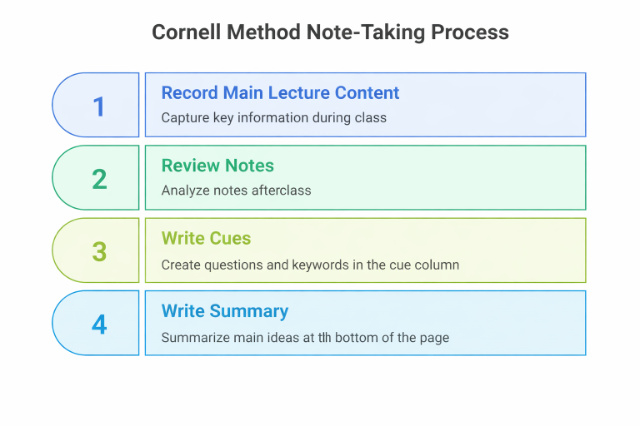
Notes Column (Right, 70% of page): Record main lecture content, details, examples, and explanations during class. Focus on capturing key information rather than transcribing everything verbatim. Use abbreviations and shorthand to keep pace with lectures.
Cue Column (Left, 30% of page): After class, review notes and write questions, keywords, or prompts in this column that correspond to content in the notes section. This transforms passive notes into active study material: the cues become self testing questions.
Summary Section (Bottom, 5-6 lines): At the end of each page or topic, write a 2-3 sentence summary capturing the main ideas. This forces synthesis and provides quick review reference.
2. How to Use Cornell Method Effectively
During lectures, focus on the notes column: capture information efficiently without worrying about the other sections. Immediately after class (within 24 hours), complete the cue column and summary section while material is fresh. This review process is where deep learning occurs.
For studying, cover the notes column and use only the cue column to test yourself. Try answering the questions or explaining the concepts before checking your notes. This retrieval practice builds retention far more effectively than passive re-reading.
A 2024 study of 400 students found those using the Cornell Method with proper cue column completion scored 28% higher on exams than students taking traditional linear notes.
| The self testing structure was the key differentiator: students who only used the notes column without completing cues showed no advantage. |
3. Best Applications for Cornell Method
The Cornell Method excels in:
- Lecture heavy courses with sequential information
- Subjects requiring detailed recall (anatomy, dates, legal cases)
- Courses with clear hierarchical organization
- Fast paced lectures where real time organization is difficult
- Preparing for fact based or detail oriented exams
For students managing Cornell Method note taking across multiple courses while facing writing deadlines, many use an essay writing service for specific papers, creating time to properly complete the cue and summary sections that make Cornell notes effective study tools.
What Is Mind Mapping and How Does It Work?
Mind mapping creates visual diagrams with central concepts branching into related subtopics. This non linear format shows relationships and hierarchies through spatial organization rather than sequential lists.
1. The Radial Structure
Central Topic: Place the main concept in the center of the page. This could be a lecture topic, chapter theme, or problem to solve. Make it visually distinct by using color, a larger size, or shapes.
Primary Branches: Draw 3-7 main branches radiating from the center, each representing a major subtopic or category. Label each branch with a single word or short phrase. Use different colors for each primary branch to create visual distinction.
Secondary Branches: From each primary branch, add secondary branches for supporting details, examples, or related concepts. Continue branching as needed for deeper levels of detail. Keep labels brief: mind maps emphasize connection over comprehensive transcription.
Visual Elements: Add icons, symbols, images, or colors to enhance memory encoding. The visual variety helps information stick and makes the map more engaging to review.
2. How to Create Effective Mind Maps
Start with the central concept before the lecture or reading begins: this primes your brain for relevant information. During lectures, add branches as new topics emerge. Don't worry about perfect organization initially; you can reorganize later.
After class, review and refine your mind map. Add connections between branches using arrows or lines to show relationships. Color code related concepts. Add visual mnemonics that help you remember. This review process deepens understanding of how concepts interconnect.
For studying, recreate the mind map from memory on blank paper. This retrieval practice reveals what you remember and what needs more work. Compare your recreation to the original, then study gaps.
Research shows students using mind mapping for conceptual subjects retain 35% more information and show 40% better understanding of relationships between concepts compared to linear note-taking. The visual-spatial encoding creates stronger memory traces than text alone.
3. Best Applications for Mind Mapping
Mind mapping excels in:
- Conceptual subjects with interconnected ideas
- Brainstorming and creative thinking
- Subjects requiring understanding of relationships (biology systems, literary themes)
- Visual learners who think spatially
- Planning essays or projects
- Reviewing and synthesizing information from multiple sources
For students using mind mapping for conceptual courses while managing detailed writing assignments, many use a professional essay writing service for specific papers, protecting time for the thoughtful mind map creation that builds genuine understanding.
Cornell Method vs Mind Mapping: Direct Comparison
Understanding the differences helps you choose the right method for each situation.
| Feature | Cornell Method | Mind Mapping |
|---|---|---|
| Structure | Linear, sequential, text based | Radial, non linear, visual |
| Best For | Detailed recall, sequential information | Conceptual understanding, relationships |
| Processing Type | Left brain (logical, sequential) | Right brain (visual, spatial) |
| Note Taking Speed | Fast during lectures | Slower, requires more thought |
| Review Method | Self testing with cue column | Reconstruction from memory |
| Best Course Types | STEM, history, law, medicine | Creative subjects, systems thinking |
| Learning Style Match | Auditory, reading/writing learners | Visual, kinesthetic learners |
| Organization | Hierarchical but rigid | Flexible, can reorganize easily |
| Exam Preparation | Excellent for fact recall exams | Excellent for conceptual/essay exams |
| Time Investment | Moderate (cue column completion) | High (map creation and refinement) |
1. Strengths of Cornell Method:
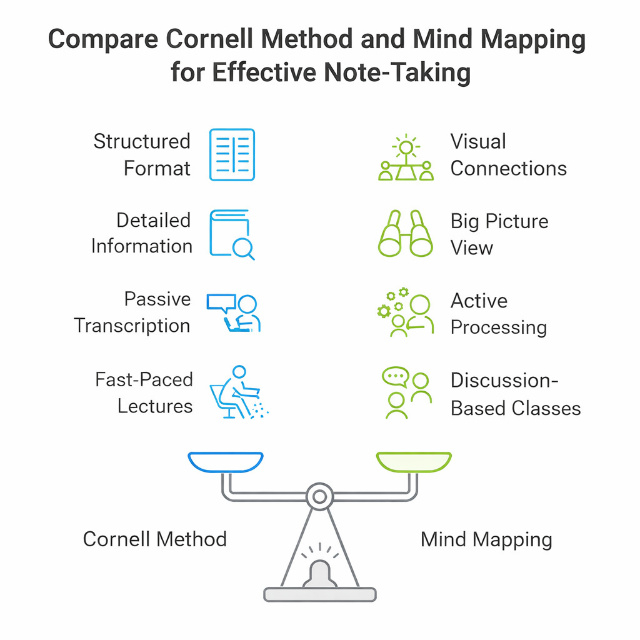
- Structured format is easy to learn and apply consistently
- Efficient for capturing large volumes of detailed information
- Built in review system through cue column
- Works well for fast paced lectures
- Excellent for exam preparation requiring fact recall
- Easy to organize and reference later
2. Weaknesses of Cornell Method:
- Doesn't show relationships between concepts well
- Can feel rigid for creative or non linear thinkers
- Summary writing requires time and effort
- Less engaging for visual learners
- Doesn't work well for discussion based classes
3. Strengths of Mind Mapping:
- Shows connections and relationships visually
- Engages visual memory for stronger retention
- Flexible: can add information anywhere as understanding grows
- Encourages active processing rather than passive transcription
- More engaging and creative than linear notes
- Excellent for seeing "big picture" and how parts connect
4. Weaknesses of Mind Mapping:
- Difficult to create during fast paced lectures
- Requires more space than linear notes
- Can become cluttered with too much detail
- Less suitable for sequential procedural information
- Harder to organize chronologically
- May not capture all details needed for comprehensive exams
5. Decision Framework: Which Should You Use?
Use Cornell Method when:
- Lectures are fast paced and detail heavy
- You need to remember specific facts, dates, or procedures
- The course has clear sequential organization
- Exams focus on recall and detailed knowledge
- You're preparing for standardized tests
- You prefer structured, organized approaches
Use Mind Mapping when:
- You need to understand how concepts interconnect
- The subject involves systems, processes, or relationships
- You're a visual or spatial learner
- You're brainstorming or planning creative projects
- You want to synthesize information from multiple sources
- Exams require conceptual understanding and synthesis
Use Both when:
- Take Cornell notes during lectures for detail capture
- Create mind maps during review for conceptual synthesis
- Complex courses require both factual knowledge and conceptual understanding
For students discovering they need both methods across different courses and finding the time investment challenging, many use a reliable essay writing service for specific papers, maintaining bandwidth for proper note taking and review in their priority courses.
How Do You Adapt or Combine Both Methods?
Most students benefit from strategic flexibility rather than rigid adherence to one method. These hybrid approaches maximize strengths of both systems.
1. Use Cornell for Capture, Mind Mapping for Review
Take Cornell notes during lectures when speed matters: the structured format handles fast information flow well. Later that day, create a mind map synthesizing the main concepts and showing relationships. This combines efficient capture with deep processing.
This two step approach takes more time but produces significantly better understanding and retention. Students using this combination report 30% better exam performance compared to using either method alone.
2. Modified Cornell with Visual Elements
Keep the three section Cornell structure but add visual elements in the notes column: small diagrams, arrows showing relationships, color coding for themes. This hybrid maintains Cornell's organization while incorporating visual memory encoding.
Draw concept connection diagrams in the summary section instead of writing linear summaries. This creates visual synthesis while maintaining the Cornell review system.
3. Digital Mind Mapping with Cornell Principles
Use digital mind mapping software but apply Cornell principles: create one branch for main notes, another for review questions, and a central summary node. This combines mind mapping's visual flexibility with Cornell's study structure.
Tools like MindMeister, XMind, or Coggle allow easy reorganization while maintaining the self testing elements that make Cornell effective.
4. Subject Specific Strategy
Use different methods for different courses based on content type:
- Cornell for: Chemistry, anatomy, history, law, mathematics procedures
- Mind mapping for: Biology systems, literature themes, philosophy, creative subjects, interdisciplinary studies
- Combination for: Economics (Cornell for models/equations, mind maps for theory), psychology (Cornell for studies/terms, mind maps for theoretical frameworks)
| This strategic flexibility ensures you're always using the method that matches the learning task. Students who adapt methods to courses score 20-25% higher than those using one method universally. |
5. Create Conversion Systems
Practice converting Cornell notes into mind maps and vice versa as a study technique. This translation forces deep engagement with material and creates multiple retrieval pathways: you can access information through different organizational schemas.
Take existing Cornell notes and ask: "How would I show these relationships in a mind map?" Take mind maps and ask: "What questions would I put in a cue column?" These conversions are themselves powerful learning activities.
For students wanting to implement sophisticated hybrid systems but struggling with time management across multiple courses, many use a trusted essay writing service for specific assignments, creating space for the thoughtful note taking that drives academic success.
Conclusion: Strategic Method Selection Maximizes Learning
Choosing between the Cornell Method and mind mapping depends on course content, learning style, and exam format rather than one being universally superior. The Cornell Method's structured approach suits detail oriented courses requiring fact recall, while mind mapping's visual organization excels for conceptual subjects requiring synthesis. Students who strategically match methods to courses, or combine both approaches, retain 25-35% more information than those using mismatched or inflexible systems.
Key Takeaways:
- Use Cornell Method for lecture heavy courses, sequential information, and fact recall exams
- Use mind mapping for conceptual subjects, visual learning, and understanding relationships
- Combine both: Cornell for lecture capture, mind maps for review synthesis
- Adapt methods to course requirements rather than forcing one approach universally
- Complete Cornell cue columns and summaries within 24 hours for maximum effectiveness
- Create mind maps after lectures when you have time to process and organize thoughtfully
Start implementing strategic method selection today. Evaluate your current courses: which need detailed recall versus conceptual understanding? Choose appropriate methods for each. Try the hybrid approach of Cornell capture with mind map review. Track your comprehension and exam performance compared to previous semesters using different methods. The improvement will demonstrate that note taking method selection significantly impacts learning outcomes.
For students wanting to implement sophisticated note taking systems across multiple courses but finding time management challenging, strategic use of a fast essay writing service for specific papers creates bandwidth for the proper note taking and review practices that drive academic excellence.
Transform your note taking from passive transcription into active learning by choosing and combining methods strategically based on what each course demands.