
Essential Comparison Example's Elements (Note Them When Studying)
Before checking any example, understand that an effective example study involves active analysis rather than passive reading. Don't simply read examples straight through; analyze them systematically.
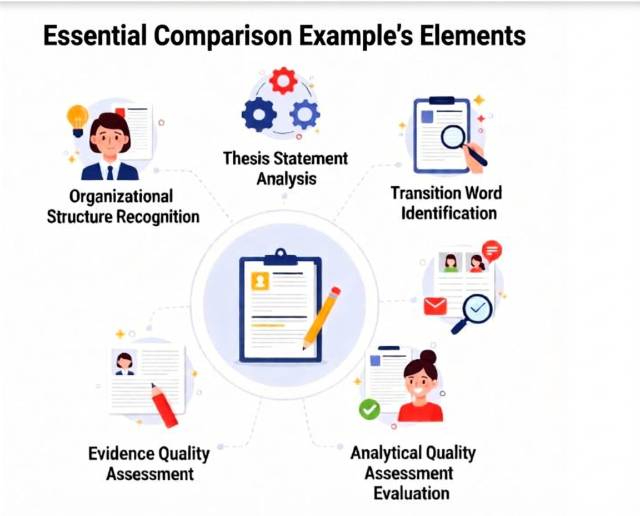
Focus on These Elements:
- Thesis Statement Analysis
- Transition Word Identification
- Evidence Quality Assessment
- Analytical Depth Evaluation
- Organizational Structure Recognition
Understanding how each structure operates, as demonstrated in our detailed compare and contrast essay outlines, clarifies when to use each approach.
Essay Due Tomorrow? Organization Still Unclear?
Our expert writers create comparison essays daily:
- Organize complex comparisons into clear structures
- Balance analysis between subjects perfectly
- Use specific evidence effectively throughout
- Meet any deadline
Zero AI. Just clear, sophisticated comparison analysis.
Order Now6 Complete Compare and Contrast Essay Examples
Example 1: Literature Comparison (High School Level)
Subjects: The Great Gatsby vs. The Catcher in the Rye
Organization: Point-by-point method
Length: 897 words
Grade Level: 11th-12th grade
American Disillusionment: Wealth vs. Authenticity in Fitzgerald and Salinger
American literature's greatest strength lies in its unflinching examination of the American Dream's failures. F. Scott Fitzgerald's The Great Gatsby (1925) and J.D. Salinger's The Catcher in the Rye (1951) both explore profound disillusionment with American society, yet they approach this theme from fundamentally different angles. While Fitzgerald critiques the corrupting influence of wealth and social aspiration, Salinger examines adolescent alienation and the struggle for authentic selfhood, revealing distinct dimensions of cultural discontent that defined their respective eras.
Both novels employ first-person narration to create intimacy with disillusioned protagonists, yet their narrators differ dramatically in reliability and perspective. Nick Carraway in The Great Gatsby serves as a relatively reliable observer who witnesses Gatsby's tragedy from the periphery, maintaining enough distance to analyze events objectively while remaining emotionally engaged. His narration combines participation and observation, allowing readers to understand Gatsby's obsession while recognizing its destructiveness. Conversely, Holden Caulfield narrates The Catcher in the Rye from a psychiatric institution, his judgment clouded by mental instability and adolescent cynicism. Holden's unreliable narration forces readers to interpret events through his distorted lens, questioning which observations reflect reality versus teenage angst. This narrative difference shapes each novel's approach to disillusionment. Fitzgerald presents disillusionment as tragedy observed, while Salinger immerses readers directly in a disillusioned consciousness.
The source of disillusionment differs fundamentally between novels. Gatsby's disillusionment stems from the American Dream's corruption by materialism and class consciousness. He believes wealth can erase his humble origins and win Daisy's love, only to discover that old money's social barriers remain impenetrable regardless of his mansion, parties, or pink suits. His failure reveals how American society's promise of social mobility crumbles against entrenched class hierarchies. The green light at Daisy's dock symbolizes both hope and impossibility, the Dream visible but forever unreachable. In contrast, Holden's disillusionment originates in his perception of universal phoniness and the loss of childhood innocence. He isn't disillusioned by failing to achieve success; he's disillusioned by success itself, which he views as inherently corrupt. Where Gatsby wants to join society's elite, Holden wants to escape society entirely, fantasizing about living in a cabin where he pretends to be deaf and mute. This fundamental difference, Gatsby's desire for inclusion versus Holden's desire for isolation, reflects different aspects of American discontent.
Similarly, both novels use symbolic settings to reinforce their thematic concerns, though these settings function differently. Fitzgerald employs the Valley of Ashes as a literal wasteland between West Egg and New York City, representing the moral decay hidden beneath the Jazz Age's glittering surface. The valley, dominated by Doctor T.J. Eckleburg's disembodied eyes on a billboard, suggests a godless world where material pursuits have replaced spiritual values. Gatsby's parties, meanwhile, epitomize empty excess hundreds of guests who never met their host, consuming his wealth while contributing nothing meaningful. Salinger uses urban settings less symbolically and more psychologically. Holden wanders New York City after expulsion from Pencey Prep, the city's anonymity amplifying his isolation. Settings like the Natural History Museum represent Holden's desire for permanence and stasis; the exhibits never change, while human relationships remain volatile and unreliable. Unlike Fitzgerald's settings, which externalize moral decay, Salinger's settings reflect Holden's internal alienation.
The novels' treatments of relationships reveal different types of disillusionment. The Great Gatsby presents relationships corrupted by materialism and social ambition. Gatsby and Daisy's romance fails because it was always transactional. Daisy married Tom for security and status, while Gatsby pursued Daisy as a symbol of success rather than a real person. Tom and Myrtle's affair is equally hollow, based on Tom's entitlement and Myrtle's social climbing. Even Nick's brief romance with Jordan Baker dissolves when he recognizes her dishonesty. Every relationship in the novel reinforces the theme that American society's materialistic values corrupt human connections. The Catcher in the Rye portrays relationships as sources of both hope and disappointment. Holden idealizes his deceased brother, Allie, and his young sister Phoebe, viewing children as innocent and authentic while dismissing most adults and peers as phonies. His failed attempts at connection, hiring a prostitute but only wanting conversation, calling former girlfriends late at night, demonstrate his desperate loneliness and inability to form genuine relationships. Unlike Gatsby's relationships, which fail due to external social forces, Holden's relationships fail due to his own psychological barriers.
The novels conclude with different resolutions to disillusionment. Fitzgerald offers no hope for redemption or change. Gatsby dies deluded, Tom and Daisy retreat into their protective wealth, and Nick returns to the Midwest, disgusted with Eastern corruption but offering no solutions. The novel's famous final lines, "So we beat on, boats against the current, borne back ceaselessly into the past," suggest that Americans are trapped in a cycle of futile aspiration, forever reaching for receding dreams. This pessimistic conclusion reflects Fitzgerald's view that the American Dream is fundamentally broken. Salinger's ending is more ambiguous and potentially hopeful. Holden's time in the psychiatric institution suggests he might be beginning to heal, and his affection for Phoebe offers a potential path toward authentic connection. His final statement, "Don't ever tell anybody anything. If you do, you start missing everybody," suggests both the pain of connection and its value. Unlike Fitzgerald's deterministic pessimism, Salinger implies that self-awareness and genuine relationships might offer escape from alienation.
Both novels remain essential American literature because they diagnose cultural sickness from different angles. Fitzgerald reveals how material values corrupt social structures and human relationships, while Salinger explores how individuals struggle to maintain authenticity in a society demanding conformity. Together, they illuminate the American Dream's complex failures, its exclusionary social hierarchies, and its psychological toll on those who question its premises. Understanding both novels provides a more complete picture of American disillusionment than either offers alone.
| Why This Works Strong comparative thesis: Opens with a clear argument about how novels approach disillusionment differently, not just that they both address it. Point-by-point organization: Each paragraph examines one criterion (narration, source of disillusionment, settings, relationships, conclusions) for both novels systematically. Balanced analysis: Roughly equal attention to both novels in every paragraph, with smooth transitions between subjects. Extensive transitions: "Conversely," "In contrast," "Similarly," "Unlike," "Where...whereas" guide readers through every comparison. Specific evidence: Direct references to green light, Valley of Ashes, character actions, and exact quotations support all claims. Synthesis conclusion: The Final paragraph explains why both novels together provide a deeper understanding than either alone. |
Example 2: Historical Comparison (High School Level)
Subjects: French Revolution vs. American Revolution
Organization: Block method
Length: 824 words
Grade Level: 10th-11th grade
Revolutionary Paths: Comparing American and French Upheavals
The late 18th century witnessed two world-changing revolutions that overthrew established governments and proclaimed new principles of human rights and popular sovereignty. The American Revolution (1775-1783) and French Revolution (1789-1799) both challenged monarchical authority and established republics based on Enlightenment ideals, yet their causes, methods, and outcomes differed dramatically. While the American Revolution achieved relatively stable republican government through gradual reforms and limited violence, the French Revolution descended into radical extremism and prolonged instability, demonstrating that similar revolutionary goals can produce vastly different results depending on social conditions and revolutionary leadership.
The American Revolution emerged from specific political grievances rather than wholesale social upheaval. British colonial policies after the Seven Years' War, including the Stamp Act, Townshend Acts, and Tea Act, imposed taxation without colonial representation in Parliament, violating British constitutional traditionsthat colonists believed they possessed as English subjects. Colonial resistance began with peaceful protests, petitions, and boycotts before escalating to armed conflict at Lexington and Concord. Importantly, American revolutionaries didn't seek to overthrow social hierarchy entirely; they wanted political independence while largely maintaining existing social and economic structures. Colonial leaders like Washington, Adams, and Jefferson represented educated, property-owning elites whose revolution aimed at political self-governance, not social leveling. The revolution's violence remained relatively constrained, directed primarily against British military forces rather than internal enemies. Even Loyalists, though sometimes harassed, rarely faced systematic execution. The revolution concluded with a written Constitution establishing a federal republican government with checks and balances, guaranteeing rights while protecting property. Though imperfect slavery persisted, women lacked political rights, and voting remained restricted to property owners, the American system achieved remarkable stability, avoiding the counter-revolutionary chaos that plagued other revolutionary movements.
The French Revolution, conversely, emerged from a much deeper social and economic crisis affecting all levels of society. France's absolute monarchy under Louis XVI faced bankruptcy from costly wars and extravagant court spending, while rigid social hierarchy divided society into privileged clergy and nobility versus the overtaxed Third Estate comprising everyone else—from wealthy bourgeoisie to destitute peasants. When Louis XVI convened the Estates-General in 1789 to address the fiscal crisis, the Third Estate's representatives demanded fundamental social restructuring, not merely tax reform. Unlike American revolutionaries seeking independence from external authority, French revolutionaries aimed at completely remaking their own society. The revolution rapidly radicalized beyond moderate reformers' control. Initial goals, constitutional monarchy, legal equality, and abolition of feudal privileges gave way to increasingly extreme demands. The revolution devoured its own leaders: moderate Girondins guillotined by radical Jacobins, who themselves fell to Thermidorian reactionaries. The Reign of Terror (1793-1794) executed tens of thousands, including King Louis XVI, Queen Marie Antoinette, and revolutionary leaders like Danton and Robespierre. Violence wasn't directed just at old regime representatives but at anyone deemed insufficiently revolutionary. The revolution's instability continued through the Directory, Napoleon's coup, Empire, and successive monarchical restorations, with France not achieving a stable republican government until the Third Republic in 1870, nearly a century after 1789.
Comparing these revolutionary paths reveals how social conditions and leadership shape outcomes. The American Revolution succeeded relatively peacefully because colonial society was less rigidly hierarchical than France, colonists possessed experience in self-governance through colonial assemblies, revolutionary leaders shared relatively unified goals, and political independence from Britain allowed reforms without threatening domestic elites fundamentally. France lacked these advantages. French society's rigid hierarchy created deeper social antagonisms, centuries of absolute monarchy left no tradition of representative self-government, revolutionary factions held incompatible visions, and internal revolution threatened elites directly, provoking violent resistance. Additionally, European monarchies' military intervention against France intensified revolutionary paranoia and radicalism, whereas American revolutionaries received foreign support from France and faced no continental invasion after the British defeat.
These revolutionary differences influenced subsequent political development. The United States, despite civil war and social struggles, maintained constitutional continuity and gradual democratic expansion. France experienced repeated revolutionary cycles in 1789, 1830, 1848, and 1870, each attempting to establish a stable republican government, reflecting ongoing tension between revolutionary ideals and social reality. Both revolutions inspired subsequent movements worldwide, but they offered different models: America's gradual constitutionalism versus France's radical social transformation. Modern revolutions continue grappling with this choice between evolutionary and revolutionary change, between preserving social stability while pursuing reform versus accepting violence and chaos as necessary for fundamental transformation.
Understanding both revolutions illuminates why similar goals produce different outcomes. Revolutionary success depends not only on ideological commitment but on social preconditions, leadership quality, external circumstances, and the degree of social transformation attempted. The American and French Revolutions both proclaimed liberty, equality, and self-governance, yet one achieved relative stability while the other endured decades of turmoil, demonstrating that revolutionary ideals alone don't determine results; context and execution matter equally.
| Why This Works Clear block organization: First half analyzes the American Revolution completely, the second half analyzes the French Revolution, and the final section compares directly. Parallel structure: Both subjects discussed using the same categories (causes, violence levels, outcomes) in the same order for easy comparison. Strong thesis: Argues a specific position about why revolutions produced different outcomes, not just that they differed. Historical evidence: Specific events, dates, figures, and policies support all claims with concrete details. Explicit comparison: Final paragraphs directly analyze why differences occurred and what they reveal about revolutionary processes. Broader significance: Conclusion connects historical comparison to ongoing questions about revolutionary change. |
Example 3: Science Comparison (College Level)
Subjects: Solar Energy vs. Wind Energy
Organization: Point-by-point method
Length: 912 words
Grade Level: College (100-200 level)
Renewable Energy Comparison: Solar and Wind Power Viability
As global society confronts climate change and fossil fuel depletion, renewable energy sources have transitioned from experimental alternatives to practical necessities. Solar and wind power currently dominate renewable energy discussions, both offering carbon-free electricity generation with mature, commercially viable technologies. While both energy sources provide sustainable alternatives to fossil fuels, they differ significantly in geographic requirements, consistency of output, scalability potential, and economic considerations. These differences suggest that optimal energy policy requires strategic deployment of both technologies based on regional conditions rather than exclusive commitment to either source alone.
Energy output consistency represents perhaps the most significant operational difference between solar and wind power. Solar panels generate electricity only during daylight hours, with output varying based on cloud cover, seasonal sun angle, and atmospheric conditions. Even in sunny locations, solar panels operate at peak capacity for only 4-6 hours daily, producing zero power at night when residential and commercial electricity demand remains substantial. This diurnal cycle creates significant grid management challenges requiring energy storage systems or complementary power sources for continuous supply. Conversely, wind turbines generate electricity whenever sufficient wind blows, regardless of the time of day. Modern turbines operate in wind speeds from 7-55 mph, producing power during night hours when solar cannot. However, wind patterns vary dramatically from calm periods producing no power to excessive winds requiring turbine shutdown to prevent mechanical damage. While solar's output cycles predictably with daylight patterns, wind's intermittency is less predictable, sometimes producing excess power when demand is low or insufficient power during peak demand. Neither source provides the consistent baseload power that fossil fuel or nuclear plants supply, though their intermittency patterns differ fundamentally.
Geographic requirements further distinguish these technologies. Solar panels function effectively in regions with high annual sunshine the southwestern United States, parts of Africa and Australia, Mediterranean climates, and tropical regions near the equator. Cloud-prone regions with frequent overcast conditions generate substantially less solar power, reducing economic viability. However, solar panels require relatively little space compared to energy output when installed on existing structures' rooftops, parking structures, or previously developed land. Residential rooftop solar allows distributed generation without additional land use. Wind turbines, by contrast, require consistent wind patterns found primarily in coastal areas, elevated terrain, or flat plains where geographic features don't impede airflow. The Great Plains, coastal regions, and offshore locations provide optimal conditions. Wind turbines require substantial spacing to avoid wake effects where upwind turbines reduce the wind available to downwind units, necessitating large land areas for wind farms. Offshore wind farms avoid land use conflicts but face higher installation and maintenance costs. These geographic requirements mean solar suits more locations but requires more units per megawatt of capacity, while wind suits fewer locations but produces more power per installation where conditions are favorable.
Economic considerations, including installation costs, maintenance requirements, and life span, create different financial profiles for each technology. Solar panel installation costs have decreased dramatically over the past decade, dropping from $7-8 per watt in 2010 to approximately $2-3 per watt in 2023 for utility-scale installations. Residential systems cost more per watt due to a smaller scale. Solar panels require minimal maintenance, occasional cleaning, and inverter replacement every 10-12 years, with panels typically warranted for 25-30 years of useful life. Their solid-state nature with no moving parts reduces mechanical failure risk. Wind turbines involve higher initial installation costs ($3-4 per watt for onshore, $5-6 per watt for offshore installations) and substantial maintenance requirements. Turbines contain numerous mechanical components, gearboxes, generators, pitch systems, and yaw mechanisms requiring regular servicing and eventual replacement. Offshore turbines face additional corrosion challenges from saltwater exposure. However, wind turbines produce more power per installation when conditions are favorable, potentially offsetting higher costs with greater output. Levelized cost of energy (LCOE), total lifetime costs divided by total energy produced currently, favors solar at $30-60 per megawatt-hour versus wind at $30-70 per megawatt-hour, though both have achieved grid parity with fossil fuels in many markets.
Environmental impact beyond carbon emissions reveals additional differences. Solar panel manufacturing requires mining and processing silicon, silver, and other materials, with some processes involving hazardous chemicals. End-of-life panel recycling remains underdeveloped, though panels contain valuable materials worth recovering. Solar farms can impact desert ecosystems if constructed on previously undeveloped land, though rooftop installation avoids this. Wind turbines' primary environmental concern involves bird and bat fatalities from collisions with spinning blades, particularly affecting raptors and migratory species. Modern turbines install sensors to detect approaching birds and temporarily stop blades, though this partially reduces power generation. Offshore wind farms may disrupt marine ecosystems during construction, but can create artificial reef effects supporting marine life around turbine foundations. Both technologies have vastly lower environmental impact than fossil fuels when considering full lifecycle emissions, water usage, and land degradation.
Grid integration challenges differ between these sources. Solar's predictable daily cycle allows utilities to anticipate output patterns, scheduling fossil fuel peaking plants or energy storage discharge for evening demand. Mass solar adoption can create "duck curve" problems where midday oversupply requires curtailing solar output while evening demand requires a rapid increase in other generation sources. Wind's less predictable intermittency creates different forecasting challenges, though modern meteorological modeling provides reasonably accurate short-term wind forecasts. Both technologies benefit from geographic diversity, connecting solar or wind farms across large areas smooths output as clouds or calm winds affect different locations at different times.
These technical and economic differences suggest that effective renewable energy policy requires deploying both solar and wind strategically based on regional conditions. Sunny regions with limited wind potential should prioritize solar development, while windy coastal or plains regions should emphasize wind power. Combining both sources provides complementary generation patterns, solar peaking during summer days when cooling demand is high, and wind is often strongest during winter and nighttime hours. Energy storage systems, improved grid connections, and demand management programs help address both technologies' intermittency challenges. Rather than declaring one technology superior, optimal energy transition requires recognizing each technology's strengths and limitations, deploying them where they function most effectively.
| Why This Works Technical sophistication: Uses specific data (costs per watt, LCOE, capacity factors) appropriate for college level analysis. Point-by-point organization: Systematically compares consistency, geography, economics, environment, and grid integration for both sources. Balanced analysis: Presents advantages and disadvantages of both technologies fairly without advocating for one over the other until a supported conclusion. Strong transitions: "Conversely," "By contrast," "However," "Similarly" guide readers through technical comparisons clearly. Synthesis conclusion: Argues for the strategic deployment of both technologies rather than a simplistic "winner" declaration. Appropriate scope: Focuses on practical considerations relevant to energy policy rather than attempting comprehensive coverage of all aspects. |
Example 4: Social Issues (High School Level)
Subjects: Online Learning vs. Traditional Classroom
Organization: Point-by-point method
Length: 756 words
Grade Level: 9th-10th grade
Education Modes: Comparing Online and Traditional Learning
The COVID-19 pandemic accelerated the adoption of online learning, transforming what was once a niche alternative into mainstream educational delivery. As schools and universities now offer hybrid options combining online and face-to-face instruction, students and educators debate which mode better serves learning objectives. While both online and traditional classroom learning can deliver quality education, they differ significantly in flexibility, social interaction, learning environment control, and effectiveness for different student types. Understanding these differences helps students, parents, and educators make informed choices about educational delivery modes.
Flexibility and accessibility represent online learning's most significant advantages over traditional classrooms. Online courses allow students to access lectures, complete assignments, and participate in discussions on their own schedules within deadline parameters. Students who work, have family responsibilities, live in remote areas, or face mobility challenges benefit enormously from this flexibility. A single parent working night shifts can watch recorded lectures during available hours. A student with chronic illness can maintain educational progress during health setbacks without missing physical classes. Additionally, online courses eliminate commuting time and associated costs students save hours weekly previously spent traveling to campus. Traditional classrooms, conversely, require physical presence at specific times and locations, limiting accessibility for students with scheduling conflicts or geographic constraints. However, this rigid scheduling creates a structure that benefits students who struggle with self-discipline. The fixed class times, immediate deadlines, and physical separation between home and school help some students maintain focus and avoid procrastination. What online learning offers in flexibility, traditional classrooms provide in external structure.
Social interaction differs dramatically between formats, affecting both learning quality and student wellbeing. Traditional classrooms facilitate spontaneous discussion, collaborative group work, and informal peer interaction that builds relationships and community. Students can ask questions immediately, engage in debates, work on group projects with face-to-face coordination, and develop friendships through regular physical proximity. These interactions provide emotional support, diverse perspectives, and networking opportunities extending beyond academic content. Teachers can read body language, adjust pacing based on student responses, and provide immediate individualized attention. Online learning, even with video conferencing, cannot fully replicate this social richness. Zoom fatigue, technical difficulties, awkward silences during video discussions, and a lack of informal hallway conversations create social isolation for many students. Text-based discussions in forums lack vocal tone and facial expressions that convey nuance. However, online formats offer advantages for certain students: introverts may participate more freely in written discussions than face-to-face, students in different time zones can contribute asynchronously, and recorded lectures allow reviewing complex material multiple times. The trade-off involves sacrificing social richness for written communication benefits and flexibility.
Learning environment control differs between formats in ways that affect concentration and effectiveness. Traditional classrooms provide dedicated learning spaces designed to minimize distractions, no phones, limited side conversations, ergonomic seating, appropriate temperature and lighting, and teacher oversight, maintaining focus. This controlled environment helps students concentrate on material without competing demands from home life. Students can't simultaneously do laundry, care for siblings, or get distracted by social media while sitting in physical classrooms. Additionally, specialized equipment, laboratory instruments, technical software, art supplies, and athletic facilities available on campus may be unavailable at home. Online learning, conversely, occurs wherever students have internet access, often in home environments filled with distractions. Family members, pets, household chores, personal devices, and comfortable beds compete for attention with coursework. While students can create dedicated study spaces, many lack this option due to shared housing or limited space. However, home learning allows personalizing the environment, preferred music, comfortable clothing, ability to eat or move around freely, which some students find helps rather than hinders concentration. The question becomes whether controlled institutional environments or personalized home spaces better support individual learning styles.
Effectiveness varies based on subject matter and student characteristics. Research suggests online learning works well for self-motivated students studying theoretical subjects requiring primarily reading, writing, and discussion. Advanced students who need minimal guidance benefit from online flexibility. However, hands-on subjects laboratory sciences, performing arts, skilled trades, and physical education, require in-person instruction for proper equipment use, technique demonstration, and immediate feedback. Beginning students or those with learning difficulties benefit from traditional classrooms' immediate teacher access and structured support. Studies show online students drop out at higher rates than traditional students, suggesting the format challenges many learners despite its advantages. Traditional classrooms better serve students needing external motivation, immediate help, and social learning benefits, while online formats suit independent learners who value flexibility and require minimal support.
Neither format is universally superior; each serves different needs, subjects, and student populations effectively. The future likely involves hybrid models combining both formats' advantages: recorded lectures providing flexibility with in-person sessions offering social interaction and hands-on work. Understanding each format's strengths and limitations helps stakeholders make strategic choices about when to employ each educational delivery mode rather than declaring one format categorically better than the other.
| Why This Works Relevant contemporary topic: Addresses issues students currently experience, making the analysis immediately applicable. Balanced perspective: Acknowledges both formats' advantages and disadvantages rather than advocating for one. Clear criteria: Systematically examines flexibility, social interaction, environment control, and effectiveness for each format. Specific examples: Concrete scenarios (single parent, student with chronic illness, laboratory sciences) illustrate abstract points. Mature conclusion: Avoids simplistic "winner" declaration, recognizing that different needs require different approaches. Appropriate length: 756 words suits high school assignment expectations without excessive length. |
Need it Written Today? Ready to Hand it Off?
Our expert writers create hundreds of essays daily:
- Custom research on any topic
- Expert writers across all subjects
- Plagiarism-free guarantee
- Rush delivery available
Join 73,000+ students who've trusted us
Order NowExample 5: Business/Economics (College Level)
Subjects: Keynesian vs. Austrian Economics
Organization: Block method
Length: 891 words
Grade Level: College (200-300 level)
Economic Philosophy Clash: Keynesian and Austrian Approaches to Markets
Modern economic policy debates fundamentally divide between two competing philosophical frameworks: Keynesian economics, emphasizing government intervention to stabilize markets and manage aggregate demand, and Austrian economics, prioritizing free markets, minimal intervention, and individual economic decision-making. While both schools aim to understand how economies function and promote prosperity, they differ profoundly in their assumptions about market efficiency, the role of government, causes of economic cycles, and appropriate policy responses to recession. These theoretical differences produce radically different policy recommendations, explaining persistent disagreements among economists and policymakers about how to address economic challenges.
Keynesian economics, developed by John Maynard Keynes during the Great Depression, assumes that markets left entirely to themselves produce suboptimal outcomes requiring government correction. Keynes argued that aggregate demand total spending in an economy, drives economic activity, and insufficient demand causes recessions and unemployment. When private sector demand falls during economic downturns, the government must increase spending to compensate, maintaining employment and production levels. This "aggregate demand management" can involve fiscal policy (government spending and taxation) or monetary policy (central bank interest rate and money supply manipulation). Keynesian theory accepts that markets don't automatically self-correct quickly; wages and prices are "sticky," meaning they don't adjust immediately to changed conditions. Unemployed workers can't instantly find jobs at lower wages because employers resist wage cuts and workers resist accepting them. This wage stickiness means unemployment can persist unless government intervention increases demand, creating jobs. Keynesians view recessions as market failures requiring correction rather than natural adjustments. Government debt incurred during recessions isn't inherently problematic if it stimulates economic activity, increasing future tax revenue that can repay debt during prosperous periods. This "counter-cyclical" approach to government spending increases during recessions, decreasing during booms, aims to smooth economic cycles, preventing both deep recessions and overheating inflation.
Austrian economics, developed by economists including Ludwig von Mises and Friedrich Hayek, takes fundamentally different positions on these questions. Austrians view markets as complex information-processing systems that coordinate millions of individual decisions through price signals. Prices communicate information about supply, demand, and relative scarcity, allowing individuals to make rational economic decisions without central coordination. Government intervention disrupts these price signals, causing misallocation of resources and creating the very problems it attempts to solve. Recessions, in the Austrian view, are not market failures but necessary corrections following unsustainable booms caused by central bank monetary expansion. When central banks hold interest rates artificially low, entrepreneurs receive false signals about available savings and undertake investments that appear profitable under artificially cheap credit but become unsustainable when rates normalize. The subsequent recession liquidates these malinvestments, reallocating resources to sustainable uses. Government stimulus attempting to prevent this correction merely delays necessary adjustments, prolongs economic distortion, and potentially creates larger crises later. Where Keynesians see recessions requiring government remedy, Austrians see government-caused problems requiring market-based solutions. Austrian economists oppose counter-cyclical fiscal policy, arguing that government spending crowds out more efficient private spending, that deficit spending burdens future generations with debt, and that politicians lack the knowledge to allocate resources better than markets. They advocate minimal government intervention, sound money (currency backed by commodities like gold rather than government fiat), and allowing market processes to coordinate economic activity naturally.
These theoretical differences produce stark policy disagreements. During the 2008 financial crisis and subsequent Great Recession, Keynesian economists advocated for massive government stimulus the American Recovery and Reinvestment Act, which injected $831 billion into the economy through infrastructure spending, tax cuts, and aid to states. They argued this stimulus prevented depression, citing employment data showing job losses slowing after stimulus implementation. Quantitative easing programs, where central banks purchased trillions in government bonds, aimed to increase the money supply and reduce interest rates, encouraging investment and spending. Austrian economists opposed these policies, arguing that artificially low interest rates caused the housing bubble, precipitating the crisis, and further monetary expansion would create future bubbles without addressing underlying malinvestment problems. They advocated allowing failing banks and businesses to collapse, permitting markets to reallocate resources to viable enterprises rather than protecting inefficient institutions. Where Keynesians saw stimulus preventing disaster, Austrians saw postponed reckoning creating greater future problems.
Similarly, ongoing debates about government roles in healthcare, education, infrastructure, and social programs reflect this fundamental divide. Keynesians see these as areas where market failures justify government provision. Healthcare markets suffer from information asymmetry and the inability to exclude non-payers, education creates positive externalities benefiting society beyond individual students, and infrastructure requires coordination beyond individual actors' capabilities. Government provision corrects these market failures, improving aggregate welfare. Austrians counter that government provision creates inefficiency, removes competitive incentives for quality improvement, and empowers bureaucrats lacking market discipline to allocate resources poorly. They prefer market-based solutions even in areas with apparent market failures, arguing that government failures exceed market failures.
Neither framework has empirically triumphed definitively. Keynesian policies appeared successful during World War II mobilization and post-war prosperity, while Austrian warnings about government overreach seemed vindicated by the Soviet collapse and problems in heavily regulated economies. Yet pure Austrian laissez-faire hasn't existed in modern developed economies, making its predictions untestable, while Keynesian stimulus effectiveness remains debated. Critics argue recovery would have occurred regardless, while supporters claim the stimulus prevented worse outcomes. Most modern economists occupy the middle ground, accepting some government stabilization role while recognizing intervention limits and market efficiency benefits.
Understanding both frameworks reveals that economic policy debates reflect deeper philosophical disagreements about human knowledge, government competence, and whether designed interventions or spontaneous market processes better coordinate complex economic activity. These aren't purely technical questions answerable through data alone; they involve fundamental values about individual freedom, collective action, and the proper relationship between government and economy. Recognizing this philosophical foundation helps explain why economic debates persist despite centuries of analysis and why compromise between frameworks often produces actual policy.
| Why This Works Sophisticated theoretical analysis: Engages complex economic concepts appropriately for an upper division college course. Block organization: Full explanation of each economic school before direct comparison clarifies distinct theoretical frameworks. Parallel structure: Discusses the same issues (market efficiency, recession causes, policy recommendations) for both schools. Contemporary relevance: Connects theoretical differences to actual policy debates (2008 crisis, government roles). Academic tone: Maintains objective analysis appropriate for college level economics coursework. Nuanced conclusion: Acknowledges empirical uncertainty and philosophical foundations rather than declaring one framework correct. |
Example 6: RENEWABLE VS. FOSSIL FUEL ENERGY (High School / Early College)
Organization: Point-by-Point
Length: 1,100
Grade Level: Early College
The Energy Crossroads: Comparing Renewable and Fossil Fuel Power
In 2024, renewable energy generated 30% of global electricity, triple the percentage from just fifteen years earlier. This dramatic shift reflects growing awareness that energy choices carry consequences extending beyond immediate power needs. Fossil fuels powered the Industrial Revolution, yet face increasing environmental scrutiny, while renewable sources offer cleaner alternatives with their own limitations. While both renewable and fossil fuel energy sources meet society's power demands, they differ fundamentally in environmental impact, long-term sustainability, and economic considerations, with renewable energy emerging as essential for humanity's future despite higher initial implementation costs.
The most significant difference between renewable and fossil fuel energy lies in environmental impact, particularly greenhouse gas emissions. Fossil fuel combustion releases carbon dioxide and methane that trap heat in Earth's atmosphere. The International Energy Agency reports that fossil fuel energy production accounts for 73% of global greenhouse gas emissions, directly driving climate change. Coal plants emit approximately 2.2 pounds of CO2. per kilowatt-hour, while natural gas plants emit 0.9 pounds per kilowatt-hour. In stark contrast, renewable energy sources produce virtually zero direct emissions during operation. Solar panels and wind turbines generate electricity without combustion, releasing no greenhouse gases during their operational lifespan. While manufacturing involves some emissions, lifecycle analysis shows solar panels offset production emissions within 1-3 years, then generate clean power for 25-30 additional years. This fundamental emissions difference means continued fossil fuel dependence accelerates climate change while renewable adoption mitigates it, making energy choice existential for long-term planetary habitability.
Beyond environmental considerations, renewable and fossil fuel sources differ dramatically in long-term sustainability. Fossil fuels represent finite resources formed over millions of years. Current extraction rates far exceed natural formation, meaning eventual depletion. The U.S. Energy Information Administration estimates proven global oil reserves will last approximately 50 years at current consumption, natural gas 52 years, and coal 130 years, projections ignoring increasing demand from developing nations. Conversely, renewable sources harness replenishing energy flows. Solar power taps the sun's radiation, continuing for billions of years. Wind power captures atmospheric circulation driven by solar heating. These sources literally cannot deplete because they derive from ongoing natural processes rather than finite stored reserves. While fossil fuels guarantee future energy scarcity requiring increasingly difficult extraction, renewable sources offer permanent energy abundance limited only by human capacity to harness them efficiently.
Economic considerations reveal cost structures favoring different sources depending on the timeframe analysis. Fossil fuel plants require relatively low initial capital. A natural gas plant costs approximately $1,000 per kilowatt capacity but incurs ongoing fuel costs throughout operation. These fuel costs fluctuate with commodity markets, creating economic uncertainty. By comparison, renewable installations demand higher initial investment; solar panels cost $3,000-$4,000 per kilowatt installed, but eliminate fuel costs entirely. Once installed, solar and wind facilities generate power at near-zero marginal cost since sunlight and wind are free. This inverted cost structure means fossil fuels favor contexts requiring immediate implementation with limited capital, while renewables favor long-term planning where higher upfront investment yields decades of virtually free energy.
The comparison between renewable and fossil fuel energy reveals divergent trajectories. Fossil fuels offer short-term convenience at the cost of environmental degradation and resource depletion, while renewables demand higher initial investment in exchange for environmental sustainability and permanent abundance. This analysis demonstrates that framing the debate as "which energy source is better" oversimplifies a complex transition requiring strategic thinking. Rather than viewing renewable and fossil fuels as competing options where one must triumph absolutely, effective energy policy must recognize a transitional reality: fossil fuels cannot disappear overnight without economic catastrophe, yet renewable adoption cannot be delayed without environmental catastrophe. The question facing contemporary society isn't whether to choose renewable or fossil fuel energy, but how rapidly we transition from the latter to the former while maintaining economic stability and energy security.
Why This Works Strong thesis: Argues a specific position beyond announcing a comparison Point-by-point structure: Consistent organization throughout Balanced analysis: Equal attention to both subjects Extensive transitions: "In stark contrast," "Conversely," "By comparison." Specific evidence: Statistics, data, sources throughout Analytical depth: Explains WHY differences matter Synthesis conclusion: Goes beyond summary to implications |
Example 7: Middle School Examples (Simpler Analysis)
Organization: Point-by-Point
Length: 502 words
Grade Level: 6th-7th
Comparison Essay Introduction Example
Cats vs. Dogs as Pets
Both cats and dogs make excellent pets, providing companionship and teaching responsibility to their owners. However, they differ significantly in care requirements, behavior, and the type of relationship they form with humans. While dogs require more time, attention, and training, making them better suited for active families with time to invest, cats offer more independent companionship suitable for busy individuals or smaller living spaces. Understanding these differences helps potential pet owners choose the animal that best fits their lifestyle.
Comparison Paragraph Example
Care requirements represent the most practical difference between cats and dogs. Dogs need regular walks multiple times daily, regardless of weather, early morning, afternoon, and evening outings for exercise and bathroom needs. This commitment can't be skipped without consequences: restless dogs may destroy furniture, gain weight, or develop behavioral problems. Dogs also require regular baths, nail trims, and often professional grooming, depending on breed. In contrast, cats use litter boxes, eliminating the need for outdoor bathroom trips. While litter boxes require daily cleaning, this takes less time than walking dogs. Cats groom themselves, needing only occasional brushing and rare baths. For people with busy schedules or limited mobility, cats' lower maintenance requirements provide clear advantages...
For Practice: [Complete 502-word essay continues with behavior, relationship types, and conclusion]
| Why This Works Appropriate simplicity: Uses clear language and straightforward comparisons suitable for middle school level. Relevant subject: The Topic interests this age group and allows personal connection for many students. Clear organization: Point-by-point structure with explicit transitions guides young readers effectively. Specific examples: Concrete details (walking three times daily, litter box cleaning) vs. vague generalities. Balanced analysis: Presents both pets fairly without dismissing either as inferior. |
You can explore a list of topics in our compare and contrast essay topics guide.
Short Compare and Contrast Essay Example
Hybrid Work vs. Fully Remote Work: Which Better Suits Modern Organizations?
In the wake of the global shift in work patterns that followed the COVID-19 pandemic, organizations worldwide are debating whether to adopt hybrid work or fully remote work as their long-term model. Both approaches offer unique advantages and challenges, particularly in terms of productivity, employee satisfaction, and organizational culture. Analyzing these differences reveals that while fully remote work excels in flexibility and autonomy, hybrid work better balances social connection and overall well-being.
One of the most commonly cited benefits of fully remote work is flexibility. Employees can design their own schedules, choose their work environment, and avoid time-consuming commutes. This autonomy supports improved work–life balance and contributes to lower stress levels for many workers. Studies also show that remote work can reduce burnout and increase productivity for tasks requiring deep focus because workers have greater control over their environment and fewer office interruptions.
However, fully remote work is not without drawbacks. Many employees, especially younger workers, report feelings of isolation and disconnection from colleagues. A Gallup survey found that only a minority of Gen Z workers actually prefer fully remote arrangements, with a large share favoring environments that allow in-person interaction. Isolation can hamper informal learning, mentorship opportunities, and creative collaboration, which are often critical components of professional growth.
By contrast, hybrid work models attempt to blend remote flexibility with the social and collaborative benefits of in-office work. In a hybrid setup, employees split their time between remote work and designated office days. This arrangement supports both independent focus and face-to-face connection, helping to maintain team cohesion and workplace identity. Advocates argue that hybrid models allow companies to sustain culture and training while still offering employees flexibility.
Moreover, hybrid work can mitigate some of the mental health concerns associated with fully remote arrangements, such as loneliness and burnout, by providing structured opportunities for social interaction, mentoring, and informal collaboration that occur naturally in physical office spaces.
On the other hand, hybrid work may also present scheduling challenges and reduce flexibility compared with fully remote models. When employees are expected to coordinate in-office days, there can be tension between collaboration goals and individual autonomy. In some cases, inconsistencies in hybrid schedules can also disrupt workflow continuity.
In conclusion, both hybrid and fully remote work models have valid strengths and limitations. Fully remote work offers unmatched flexibility and potential productivity gains, while hybrid work better supports social connectedness and employee well-being. As organizations continue to adapt to post-pandemic labor trends, many are finding that hybrid models offer the most balanced solution, combining the best aspects of autonomy and in-person collaboration in an evolving workplace landscape.
Additional Comparison Essay Examples by Level
Example 8: City Living vs. Suburban Living
"While both urban and suburban areas offer distinct advantages, they differ dramatically in cost of living, space availability, and lifestyle pace..." [892 words, college level]
Example 9: Capitalism vs. Socialism
"Economic systems organize production and distribution fundamentally differently, producing distinct societal outcomes..." [947 words, college level]
Example 10: Monarchy vs. Democracy
"Governance structures fundamentally shape societies' political cultures and individual freedoms..." [867 words, high school level]
Example 11: Traditional Books vs. E-readers
"The reading experience has evolved from exclusively physical books to include digital alternatives..." [743 words, high school level]
Example 12: Public vs. Private Schools
"Educational institutions' funding and governance models significantly affect student experiences and outcomes..." [798 words, high school level]
Example 13: Basketball vs. Soccer
"As two of the world's most popular sports, basketball and soccer share some similarities but differ in pace, physical demands, and global popularity..." [651 words, middle school level]
Example 14: Fast Food vs. Home Cooking
"Meal preparation choices involve trade offs between convenience, cost, nutrition, and time investment..." [689 words, middle school level]
Example 15: Summer vs. Winter Sports
"Seasonal sports offer different physical challenges, equipment requirements, and accessibility..." [623 words, middle school level]
For a detailed review and samples, please visit the compare and contrast essay outlines guide.
Role of Compare-and-Contrast Examples in Accelerating Learning
The Power of Pattern Recognition: Human brains learn effectively through pattern recognition, observing successful models, and replicating their structures. Examples provide three learning advantages that abstract instruction alone cannot:

1. Concrete Visualization: Reading that "good thesis statements argue positions" remains abstract until you see actual thesis statements demonstrating this principle. Examples transform vague guidance into concrete models.
2. Contextual Understanding: Examples show how techniques work together as integrated wholes rather than isolated skills. You see how thesis statements connect to body paragraph structure, how transitions maintain flow, and how evidence supports claims, all working simultaneously.
3. Realistic Expectations: Examples calibrate your understanding of what "good" looks like at your education level. Middle school examples show appropriate complexity. University examples demonstrate sophisticated analysis expected in advanced courses.
These examples demonstrate effective comparison techniques across all levels, but creating your own essay with this level of organization, balance, and analysis takes practice and skill. Our professional essay writing service specializes in crafting comparison essays that mirror these successful patterns while addressing your specific assignment requirements and showcasing your authentic perspective.
Downloadable Compare Contrast Essay Sample Collection
Still Overwhelmed? We're Here
Our professional writers specialize in comparison essays:
- Zero AI, 100% human-written analysis
- Use specific evidence effectively throughout
- Balance analysis between subjects perfectly
- Organize complex comparisons into logical structures
Thousands of students have trusted us with their most challenging essays. You can too.
Order NowBottom Line
These comparison essay examples demonstrate successful comparison essay techniques across every education level and subject area, strong thesis statements arguing specific positions, clear organizational structures guiding readers, balanced analysis treating both subjects equally, extensive transitions making relationships explicit, specific evidence supporting all claims, and synthesis conclusions drawing insights beyond surface observations.
Study these good compare and contrast essay examples matching your assignment level and subject, identify patterns in successful essays, and apply those techniques to your own work. Remember that examples show effective approaches, not templates to copy; your essay must reflect your own analysis in your own voice. Continue developing skills with our complete resource collection. Master the full process with our comprehensive compare and contrast essay guide.
Start your next comparison essay with confidence, armed with concrete models of excellence. You have the examples. You understand the techniques. Now apply them to create your own successful comparison essays.