College application essays are personal narratives (typically 250-650 words) where you show admissions officers who you are beyond grades and test scores. Unlike academic essays that analyze texts, these essays tell your own story using a first-person perspective, specific personal details, and an authentic voice.
The most common is the Common App essay (650 words max) that goes to every Common App school on your list, plus 2-5 supplemental essays per school. Successful essays balance storytelling with reflection, use specific concrete details rather than vague generalities, and reveal character traits your application can't show elsewhere.
Students should start 6-8 weeks before deadlines, brainstorm authentic application essay topics that genuinely matter to them, create detailed outlines before drafting, and revise through multiple passes, focusing on authenticity over polish.
Short on Time? College Application Deadline Approaching Fast?
Our expert writers craft college application essays every single day:
- Work with YOUR stories and authentic voice
- Create compelling narratives admissions officers remember
- Meet any deadline
- Zero Plagiarism, 100% human-written
No AI shortcuts. Just essays that actually get you accepted.
Get Started NowWhat is a College Application Essay?
A college admission essay is a personal narrative, typically 250-650 words, where you show admissions officers who you are beyond your grades, test scores, and activities list.
Think of it as your one chance to sit across from the admissions committee and tell them your story. Except instead of talking, you're writing. And they'll spend maybe 8-12 minutes reading your entire application, with 3-5 minutes focused on your essay.
That's it. A few minutes to make them think, "We want this person on our campus."
What Makes College Essays Different?
You've written dozens of essays for English class. Admission essays are nothing like those.
Academic essays: Third-person perspective, analyze books, cite sources, 5+ pages analyzing someone else's ideas
College Essay Writing: First-person perspective, tell personal stories, reveal character, 1-2 pages exploring YOUR experiences
If your essay assignment reads like an English paper, you're doing it wrong. The purpose is fundamentally different; you're not analyzing external texts, you're revealing who you are through authentic storytelling.
Why Colleges Require Them?
According to the National Association for College Admission Counseling, essay quality ranks as the 5th most important admissions factor at selective colleges. At highly competitive schools, it often becomes the deciding factor between academically similar candidates.
Colleges receive thousands of applications with nearly identical grades and test scores. Your essay is what makes you memorable. It shows how you think and solve problems, what you value and care about, how you write and communicate, and whether you'd contribute something unique to campus.
Remember: Your 3.9 GPA doesn't tell them if you're curious, resilient, or kind. Your essay does. Visit our college application essay examples to understand how your essay should be.
Types of College Application Essays You'll Write
Most applicants write 5-10 essays total across their college applications. Each type serves a specific purpose and requires different strategies.
1. The Common Application Essay (650 Words)
Over 900 colleges accept the Common Application, making this the most important essay you'll write. The Common App essay reaches every school on your list that accepts it, giving you one chance to make a strong impression across multiple applications.
The 2024-2025 cycle offers seven prompts covering identity, challenges overcome, beliefs questioned, problems solved, gratitude, inspiring topics, and any topic of choice.
Your prompt choice matters less than your execution. Admissions officers care about what you reveal about yourself, not which question you answer. Learn how to select and tackle your prompt in our complete Common App essay guide with strategies for all seven prompts.
2. School-Specific Supplemental Essays (150-500 Words)
Competitive colleges require 2-5 supplemental essays beyond your Common App essay. According to a 2024 survey, 82% of selective colleges now require supplemental essays, up from 71% in 2019.
The most common types include:
- "Why This College?" (required by 78% of selective schools)
- "Why This Major?" (54% of schools)
- Community contribution essays (43% of schools)
- Diversity and inclusion statements (38% of schools)
- Intellectual interest essays (31% of schools)
These essays demand research and specificity. Generic responses that could apply to any school immediately signal a lack of genuine interest.
3. Activity and Extracurricular Essays (150-300 Words)
Many applications ask you to elaborate on your most meaningful activity or extracurricular involvement. The Common App provides 150 words for this; individual schools may request longer versions.
These essays shouldn't simply describe what you did. Focus on your specific role, impact, and what you learned rather than explaining the organization's mission or listing accomplishments.
4. Short Answer Questions (25-100 Words)
Some applications include rapid-fire short answers about favorite books, how you spend free time, or what you'd change about your community. These require precision; every word counts.
Approach short answers as snapshots of your personality. Be specific, genuine, and efficient with language. Avoid generic responses like "I like to read" when you could say "I reread 'The Name of the Wind' yearly to discover what I missed."
How to Write Your College Essay: The Complete Process
Writing a strong college essay takes 6-8 weeks. Students who start early produce significantly better work than those who wait until the last minute. Here's the proven process:
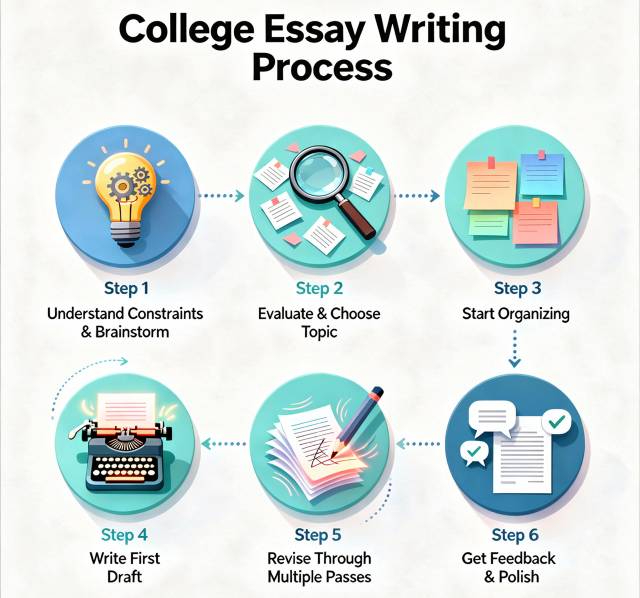
Step 1: Understand Your Constraints & Brainstorm
Before writing anything, know your requirements: Common App enforces 650 words. Supplements typically range from 150 to 500 words. Going over by even one word shows you can't follow basic instructions.
Now brainstorm without censoring. Most students think they need impressive stories. That's backwards; the story matters less than what you reveal about yourself.
Effective brainstorming methods:
- The Moments Method: List 10-15 specific moments when you felt strong emotion, made a difficult choice, or learned something unexpected. Small moments often reveal more than dramatic ones.
- The Values Approach: Identify your 3-5 core values. For each, list experiences demonstrating it in action.
- The Natural Stories: What stories do you tell when getting to know someone? These conversation-starters often make strong essays.
Don't judge ideas yet. Just get them out. Need more structure? Browse our college application essay topics guide with 200+ ideas and evaluation criteria.
Step 2: Evaluate and Choose Your Topic
You've got potential topics. Now narrow to one:
- Genuinely matters to you: Can you write with authentic emotion and specific detail?
- Reveals something significant: Does this show character, values, or growth that grades can't?
- Supports specific details: Do you remember vivid, concrete details? Vague memories make vague essays.
- Fits the word count: Can you explore this fully in 650 words?
- Answers the prompt: Does this directly address the question asked?
Test your topic: Write 2-3 sentences describing what you'd say. If it sounds generic even to you, choose differently.
Step 3: Start Organizing
Don't start writing without a plan. Outlining prevents common mistakes and saves hours during revision.
Map your opening hook, main narrative or theme, key scenes you'll describe, reflections you'll share, and memorable conclusion.
Most successful essays follow either:
- Narrative Structure: One experience that fundamentally changed you. Classic story arc.
- Montage Structure: Multiple experiences connected by a theme. Shows different personality facets.
Neither structure is better. Choose based on your story. Download our fillable college application essay outline templates for both structures with examples.
Step 4: How to Start Your College Essay? Write Your First Draft
Now, actually write. Key: Don't aim for perfection. Just get your story down.
Many students waste hours perfecting their opening. If that's you, skip ahead. Write body paragraphs first, then return to your introduction.
As you draft:
Show, don't tell:
| Wrong: "I learned the importance of perseverance." Right: "After my third failed attempt to extract strawberry DNA in my kitchen, I adjusted my protocol, used colder alcohol, and finally watched cloudy strands materialize in the test tube at 11 PM." |
Use specific details:
| Wrong: "My grandmother was kind." Right: "My grandmother kept wrapped peppermints in her apron pocket, pressing them into my palm with a conspiratorial wink whenever I visited." |
Balance narrative and reflection:
| Don't just describe what happened. Explain what it meant, how it felt, and what you realized. |
Write in your natural voice:
| If you wouldn't say "I was flabbergasted" in conversation, don't write it. |
First drafts are supposed to be rough. You'll fix everything later. Browse our college application essay outline to get blank templates to help you make a perfect draft.
Step 5: Revise Through Multiple Passes
First draft done? Make it better through strategic revision:
- Content Pass: Does your essay answer the prompt? Is your main point clear? Can you cut tangents?
- Structure Pass: Does it flow logically? Are transitions smooth? Is pacing varied?
- Style Pass: Are you showing through details rather than telling? Have you eliminated clichés? Does it sound like you?
- Technical Pass: Grammar, spelling, word count compliance, formatting.
Each pass improves your essay. Don't try to fix everything at once.
Step 6: Get Feedback and Polish
Share your essay with 2-3 trusted readers who know you well. According to college counselors, the most helpful feedback focuses on authenticity, clarity, and impact, not just technical corrections.
- Good feedback: "I don't understand paragraph 3" or "This doesn't sound like you."
- Ignore feedback: "Use fancier vocabulary" or "This story isn't impressive enough."
Critical warning: Essays written or heavily edited by AI show detectable patterns. 73% of admissions officers now use AI detection software, and getting caught means automatic rejection.
Final steps: Proofread ruthlessly (read aloud, your ear catches errors your eyes miss), preview in the application system, verify word count, and submit with confidence.
How to Organize Your College Essay? (Structure Overview)
A successful college essay structure follows predictable patterns regardless of the prompt. Understanding these patterns helps you organize effectively.
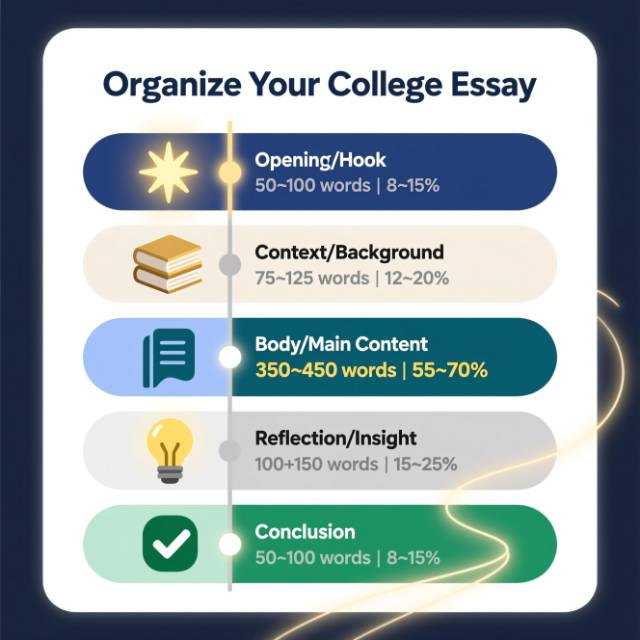
The Anatomy of a 650-Word Essay
- Opening/Hook (50-100 words | 8-15% of essay)
- Context/Background (75-125 words | 12-20% of essay)
- How to Write Body Paragraphs? Main Content (350-450 words | 55-70% of essay)
- Reflection/Insight (100-150 words | 15-25% of essay)
- How to Write a College Essay Conclusion? (50-100 words | 8-15% of essay): End memorably without just restating everything. Connect your story to who you are now, gesture toward your future, and leave readers with a final image or thought.
Stuck on Brainstorming? Can't Find Your Story for College Essay?
Maybe nothing feels "impressive" enough. Maybe you have too many ideas and can't choose. Our expert writers help students daily:
- Help you uncover your strongest stories
- Showcase your authentic personality
- Meet any deadline
- Unlimited Revisions
Just experienced writers who know what admissions officers remember.
Order NowWhat Makes Essays Stand Out: College Essay Writing Tips
Admissions officers read 50-75 essays daily during peak season. After hundreds of essays, most blur together. The memorable ones share specific characteristics.
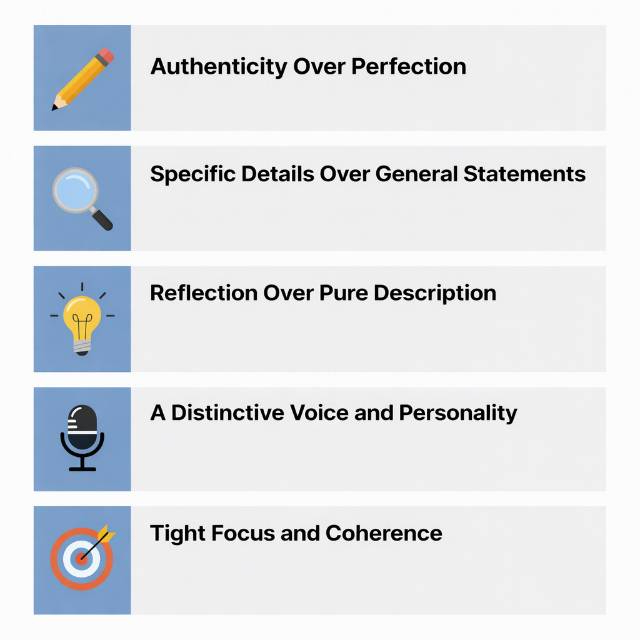
1. Authenticity Over Perfection
- The data: In a 2024 survey of admissions officers, 94% said they prefer authentic essays with minor errors over perfectly polished essays that feel inauthentic or AI-generated.
Remember: Write like you talk. Officers want the real you, not a polished version of who you think they want.
2. Specific Details Over General Statements
- Weak: "Volunteering taught me the importance of giving back."
- Strong: "The moment Mrs. Chen's hands stopped shaking after I taught her to text her grandson, I understood why my Saturdays at the senior center mattered more than I'd realized."
Specific details make writing vivid and prove claims rather than just stating them. They're also impossible to fake, making your essay uniquely yours.
3. Reflection Over Pure Description
Many students write essays that read like: "First this happened, then this happened, then this happened." Strong essays balance description with reflection, explaining what you thought, felt, learned, or realized.
Reflection doesn't mean stating obvious lessons. Aim for insights specific to your experience that reveal your values.
4. A Distinctive Voice and Personality
Your essay should sound like you wrote it, not like a committee or ChatGPT.
According to admissions data, essays with distinctive voices are 2-3 times more likely to be positively remembered days after reading.
Have someone who knows you well read your essay anonymously. Would they recognize you as the author based on voice and perspective? If not, inject more personality.
5. Tight Focus and Coherence
Strong essays explore one experience or theme deeply rather than superficially covering many topics. A detailed examination of one meaningful experience reveals far more than surface-level summaries of ten experiences.
Your application lists activities elsewhere. Your essay should reveal the person behind those accomplishments through moments of growth, challenges faced, values demonstrated, or realizations gained.
Common College Essay Mistakes That Tank Your Chances
Even strong writers make predictable mistakes with their essays. Awareness helps you avoid these pitfalls.
Mistake #1: Choosing Overly Generic Topics
The problem: "My mission trip changed my life." "Soccer taught me teamwork." "Volunteering showed me that helping others matters."
The data: 22% of all essays are about sports, 18% about community service, 14% about overcoming injury. Admissions officers read hundreds on these topics.
The fix: Find the unique angle that makes your experience distinct. Write about one specific moment that challenged assumptions, not volunteer work generally.
Mistake #2: Using AI Tools
Critical warning: 73% of admissions officers now use AI detection software. Many schools explicitly state that AI-generated or heavily AI-edited essays result in automatic rejection.
AI essays show detectable patterns in sentence structure, vocabulary choices, and emotional flatness.
The fix: Write your own essay. Use AI only for basic grammar checking, never for generating or substantially rewriting content.
Mistake #3: Writing a Resume in Prose
Your application already lists achievements. Your essay shouldn't duplicate that in paragraph form.
The fix: Pick ONE experience and explore it deeply. Show the moment you realized what leadership actually means through a specific story.
Mistake #4: Ignoring Word Limits
Applications exceeding word limits are 2.3 times more likely to be rejected at selective schools, even when the content is strong.
The fix: Treat word limits as firm requirements. Going over demonstrates an inability to follow basic instructions.
Mistake #5: Waiting Until the Last Minute
Students starting 6-8 weeks early produce stronger work. Last-minute essays are 1.8 times more likely to contain grammar errors and lack depth.
The fix: Start now, even if your deadline is months away. Beginning early reduces stress and improves quality dramatically.
Mistake #6: Picking Topics You Think They Want
Writing about what you think admissions officers want instead of topics that genuinely matter to you.
The fix: Choose topics you genuinely care about. Passion and authenticity show in your writing quality. Officers spot inauthentic essays immediately.
2024-2025 College Application Cycle: What's Changed
The college admissions landscape evolves constantly. Understanding current trends helps you navigate the process effectively.
1. The AI Detection Reality
73% of admissions officers now use AI detection software, up from 31% in 2023. Schools, including MIT, Stanford, Yale, and most Ivy League institutions, explicitly state that AI-generated essays result in automatic rejection.
Detection software identifies patterns in:
- Sentence structure (overly consistent complexity)
- Vocabulary choices (sophisticated but slightly unnatural)
- Idea development (logical but emotionally flat)
- Voice consistency (lacks personality quirks real humans have)
The takeaway: Write your own essay. Use AI only for basic grammar checking, never for generation or substantial rewriting.
2. Test-Optional Impact on Essays
With 1,800+ schools now test-optional, essays carry more weight in admissions decisions. At schools where 60-70% of applicants don't submit test scores, essays often serve as the primary differentiation factor between academically similar candidates.
3. Increased Supplemental Essay Requirements
82% of selective colleges now require supplemental essays, up from 71% in 2019. Students applying to 8-10 schools typically write 15-25 total essays, including Common App and supplements.
This increase makes planning and time management more critical than ever. Start early and spread work across several months rather than cramming everything into winter break.
4. Holistic Review Emphasis
Colleges increasingly emphasize holistic review, considering essays alongside grades, activities, recommendations, and demonstrated interest. Essays now rank as the 5th most important factor in admissions decisions at selective schools, behind only grades, course rigor, test scores (when submitted), and class rank.
Best Practices for Application Essay Success
Beyond avoiding mistakes, follow these proven strategies:
1. Write Multiple Drafts
First drafts are supposed to be rough. Students who complete 4-6 revision cycles produce essays rated 40% higher than those who stop after 1-2 drafts. Plan for multiple passes, focusing on different elements each time.
2. Read Aloud During Revision
Your ear catches problems your eyes miss. Reading aloud reveals awkward phrasing, sentences that run too long, and whether your essay sounds like you.
3. Use the "So What?" Test
After describing any experience, ask: "So what? Why does this matter?" If you can't answer with genuine insight beyond generic lessons, revise until you can. Reflection should reveal something specific about your thinking or values.
4. Get Distance Before Final Edits
After completing a draft, step away for 24-48 hours if possible. Fresh eyes catch problems you're blind to immediately after writing.
5. Trust Authentic Voice Over Perfect Grammar
94% of admissions officers prefer authentic essays with minor errors over perfectly polished essays that feel inauthentic. Your natural voice matters more than flawless mechanics. Fix obvious errors, but don't edit away your personality.
Your Complete College Essay Timeline
Success requires strategic planning:
| Timeline | What to Do |
|---|---|
| 8–10 Months Before Deadline | Research college requirements, brainstorm ideas, review sample essays, and identify your strongest personal stories. |
| 6–8 Weeks Before Deadline | Choose your essay topic, create a detailed outline, write the first draft, and begin researching supplemental essays. |
| 4–6 Weeks Before Deadline | Revise multiple times, gather feedback, refine your essay, and start drafting supplements. |
| 2–3 Weeks Before Deadline | Proofread carefully, check formatting, finalize supplements, and review essays inside application portals. |
| 1 Week Before Deadline | Complete a final proofread, confirm correct essays are assigned to each school, submit early, and save submission confirmations. |
Revision transforms rough drafts into acceptance-worthy essays, but knowing WHAT to revise and HOW to improve it takes experience most students don't have. Our reliable essay writing service offers detailed developmental editing that enhances your content, structure, and voice, while maintaining your essay's authenticity.
Download Free College Essay Resources
50,000+ Students Trust Us. Now Try Us Free. Your first order is on us — up to 2 pages. See why students keep coming back. No payment required. No strings attached.
Bottom Line
Your application essay is your one chance to show admissions officers who you are beyond grades and test scores. Write about experiences that genuinely matter to you, use specific concrete details rather than vague generalities, balance storytelling with meaningful reflection, and let your authentic voice come through.
Start 6-8 weeks early, create an outline before drafting, revise through multiple passes, and trust that your real story told honestly and specifically will resonate more than any manufactured "impressive" narrative.
- Begin by understanding what a college application essay is and its distinct role in admissions. This foundation helps you approach the task strategically rather than with anxiety.
- Before you submit, verify that your essay meets all technical requirements, covering platform-specific requirements, word count management, and submission best practices.
Your essay is too important to rush or leave to chance. Use these resources to craft essays that authentically represent who you are and maximize your chances at admission to your dream schools.
Start your essay journey now - your future self will thank you for beginning early.