The 2024-2025 Common App Essay Prompts
What you're working with:
- Word limit: 250-650 words (650 max, strictly enforced)
- Number of essays: One essay, one prompt
- Who sees it: Every Common App school on your list
- Deadline: Same as your applications (typically January 1-15)
Prompt popularity (Common App data):
Prompt 7: 24% of students
Prompt 5: 23% of students
Prompt 2: 21% of students
Prompts 1, 3, 4, 6: 32% combined
But popularity doesn't mean "better." Strong essays come from all seven prompts. Choose based on YOUR story, not what's popular. Let's learn about how to write a common app essay for each prompt.
Choosing the right prompt is step one. Writing 650 compelling words? That's the hard part.
You know your story. Turning it into an acceptance-worthy essay is easy for our expert writers. They:
- Match your story to the most effective prompt
- Develop your narrative with specific details
- Write in YOUR authentic voice (never AI)
- Deliver on any deadline
Join thousands of satisfied students
Order NowPrompt 1: Background, Identity, Interest, or Talent
| Full prompt: "Some students have a background, identity, interest, or talent that is so meaningful they believe their application would be incomplete without it. If this sounds like you, then please share your story." |
What This Asks
The broadest prompt basically asks, "What's a core part of who you are?"
It could be a cultural identity, an unusual skill, family background, a defining passion, or an aspect of identity you want admissions to understand.
When to Choose This
Choose if:
- You have a central aspect of identity you want to explain
- Your background significantly shaped your worldview
- You have a talent or interest genuinely central to your life
- Something about you won't make sense without this context
Skip if:
- You're just listing achievements related to your interest
- Your "passion" is something you do, but doesn't deeply define you
- You can't connect this identity aspect to growth or insight
Key Success Factors
Focus on ONE specific aspect of identity, not the entire background. Use concrete scenes showing this identity in action. Reflect on HOW this shapes your perspective or values. Connect past experiences to who you are now.
Common mistake: Generic statements like "My culture taught me about family, hard work, and respect" without specific details or personal insight. Instead, show one specific moment revealing how your background shaped a specific value you hold.
Prompt 2: Challenge, Setback, or Failure
| Full prompt: "The lessons we take from obstacles we encounter can be fundamental to later success. Recount a time when you faced a challenge, setback, or failure. How did it affect you, and what did you learn from the experience?" |
What This Asks
How do you handle adversity? What did you learn? How did you grow? Not asking for your most dramatic hardship asking for a genuine reflection on a difficult experience.
When to Choose This
Choose if:
- You have a specific challenge with a clear learning moment
- You can show concrete growth or changed behavior
- The setback genuinely affected how you approach things
- You can be vulnerable about struggling
Skip if:
- You're just complaining about something hard
- You can't show what you learned or how you changed
- The "challenge" was actually a success story in disguise
- You're trauma-dumping without reflection
Key Success Factors
Choose a genuine failure, not a humble-brag. Show specific actions you took in response. Reflect on what you learned that you didn't know before. Connect the learning to how you approach things now.
Common mistake: "I didn't make varsity freshman year, but worked harder and made it sophomore year. This taught me perseverance." This is actually a success story with no vulnerability or genuine learning. Show a real failure where you struggled, made mistakes, and had to fundamentally change.
Prompt 3: Questioning a Belief or Idea
| Full prompt: "Reflect on a time when you questioned or challenged a belief or idea. What prompted your thinking? What was the outcome?" |
What This Asks
Intellectual curiosity and critical thinking. How do you engage with ideas? What makes you reconsider assumptions?
When to Choose This
Choose if:
- You genuinely changed your mind about something important
- You can show your thinking process
- You questioned something despite social pressure
- You can reflect on why your original belief was insufficient
Skip if:
- You're writing about a time you were "right" all along
- You can't show genuine evolution in thinking
- The belief you challenged was obviously wrong
- You're just describing a debate you won
Key Success Factors
Show what prompted your initial belief. Explain what made you start questioning it. Walk through your thinking process. Reflect on what the change revealed about how you approach ideas.
Common mistake: "I used to think climate change wasn't real because my parents said so. Then I learned the science." No real intellectual engagement, just replaced one authority with another. Show the specific moment or evidence that made you genuinely reconsider.
Prompt 4: Gratitude
| Full prompt: "Reflect on something that someone has done for you that has made you happy or thankful in a surprising way. How has this gratitude affected or motivated you?" |
What This Asks
Recognizing others' impact on you and showing emotional intelligence. What does gratitude look like for you? How does it shape your actions?
When to Choose This
Choose if:
- Someone helped you in a way you didn't expect or initially appreciate
- You can show how gratitude changed your behavior
- You have a specific person and moment to describe
- You can reflect beyond just "I'm thankful."
Skip if:
- You're just saying thanks to parents, teachers, and mentors generically
- You can't show how the gratitude affected you afterward
- The kindness wasn't actually surprising
- You're focusing more on the other person than yourself
Key Success Factors
Choose something genuinely surprising or unexpected. Show specific details of what they did. Reflect on why it was surprising. Explain how this gratitude changed your actions or perspective.
Common mistake: "I'm grateful for my mom, who always supported me. Her sacrifice taught me to work hard." Not surprisingly, generic doesn't show how gratitude affected behavior. Show an unexpected act of kindness from someone you didn't expect to help, and how that changed how you treat others.
Prompt 5: Personal Growth
| Full prompt: "Discuss an accomplishment, event, or realization that sparked a period of personal growth and a new understanding of yourself or others." |
What This Asks
The most popular prompt it's flexible. What changed you? How did you grow? It could be an accomplishment that taught you something unexpected, an event that shifted your perspective, or a realization that changed how you see yourself or others.
When to Choose This
Choose if:
- You have a clear "before and after" moment
- You can show specific behavior or thinking changes
- The growth is genuine, not just "I learned to work hard."
- You can connect the growth to who you are now
Skip if:
- Your "accomplishment" is just listing achievements
- You can't show concrete evidence of growth
- The realization is obvious or superficial
- You're forcing a story to fit this prompt
Key Success Factors
Focus on one specific moment, not a gradual change over the years. Show what you were like before. Explain what sparked the change. Demonstrate how you're different now with specific examples.
Common mistake: "Winning the science fair taught me that hard work pays off and to never give up." The "growth" is a cliché with no specific insight or genuine transformation. Show an unexpected realization from the experience that changed how you approach something specific.
Prompt 6: Intellectual Engagement
| Full prompt: "Describe a topic, idea, or concept you find so engaging that it makes you lose all track of time. Why does it captivate you? What or who do you turn to when you want to learn more?" |
What This Asks
Genuine intellectual curiosity. What fascinates you? How do you pursue learning?
When to Choose This
Choose if:
- You have a genuine intellectual passion (not just a school subject)
- You can show HOW you engage with this interest
- You pursue this interest independently, not just for grades
- You can reflect on WHY it captivates you specifically
Skip if:
- You're just describing a subject you're good at
- You can't show genuine engagement beyond class requirements
- The interest is obviously resume-padding
- You can't explain what specifically fascinates you
Key Success Factors
Show yourself actively engaging with the topic. Explain what specifically fascinates you (not just "I find it interesting"). Describe your learning process. Connect the intellectual engagement to your values or perspective.
Common mistake: "I love biology. I find all aspects of life fascinating. I read biology books and watch documentaries." Generic, doesn't show WHY biology specifically captivates this student or HOW they engage intellectually. Show one specific aspect that captivates you, explain exactly why, and demonstrate your unique way of exploring it.
Prompt 7: Your Choice
| Full prompt: "Share an essay on any topic of your choice. It can be one you've already written, one that responds to a different prompt, or one of your own design." |
What This Asks
Your wildcard. Use it when your story doesn't fit neatly into Prompts 1-6.
When to Choose This
Choose if:
- Your story doesn't naturally fit any other prompt
- You have a unique angle that structured prompts constrain
- You've written something creative that shows who you are
- You want complete freedom in approach
Skip if:
- You're just avoiding the other prompts
- Your story actually does fit another prompt
- You think "open topic" means no strategy needed
Key Success Factors
Still follow basic essay principles (show, don't tell; specific details; reflection). Make sure your essay reveals who you are. Create your own structure that serves your story. Remember, you're still answering "who are you?"
Common mistake: Thinking "any topic" means "no rules" and writing something clever but not revealing. Still focus on showing who you are with specific details and meaningful reflection.
Chosen Your Prompt But Staring at a Blank Page?
Our professional writers help daily:
- Transform your chosen topic into a memorable narrative
- Balance storytelling with meaningful reflection
- Use your authentic voice
- Plagiarism Free Content
Fast turnaround. Unlimited revisions. Zero AI.
Get Started NowCommon App Essay vs. Coalition App Essay vs. Supplemental Essays
Some schools accept both the Common App and Coalition App. Supplemental essays are additional essays required by individual colleges beyond the Common Application essay. Understanding differences helps if you're choosing platforms.
Feature | Common App Essay | Coalition App Essay | Supplemental Essays |
Purpose | Main personal statement for all schools | Main personal statement for Coalition schools | School-specific additional essays |
Word Limit | 650 words exactly | 500–650 words (flexible range) | Typically 150–500 words |
Prompts | 7 prompts | 5 prompts | Varies by school |
Audience | Broad, universal audience | Broad, Coalition member schools | One specific college |
Editing After Submission | Locks after first submission | Can be revised between submissions | Usually editable per school |
Personal Focus | Strong personal narrative | Personal narrative | Focus on fit and goals |
School-Specific Details | Not required | Not required | Required (programs, values, offerings) |
Number of Schools | 900+ member schools | 150+ member schools | Depends on the application list |
Best Use Case | Applying to many colleges | Coalition-focused applications | Demonstrating fit with each school |
Most students choose the Common App because it works for more schools. However, if your target colleges prefer the Coalition App or its prompts fit your story better, the Coalition App can be a smart alternative.
To understand more about the Common App templates, browse our college application essay outlines.
Choose Your Common App Prompt Smartly
With seven options, choosing the right prompt matters less than executing it well, but some prompts fit certain stories better than others.
The Truth About Prompt Choice
What admissions officers say: "The prompt you choose doesn't matter. What matters is what you reveal about yourself."
According to surveys of admissions officers:
- 92% say prompt choice doesn't influence their evaluation.
- 87% say they sometimes forget which prompt students responded to after reading.
- 94% say essay quality matters far more than which question you answered.
Why this matters: Don't agonize over prompt selection. Focus on writing a compelling essay, then choose the prompt that technically fits best.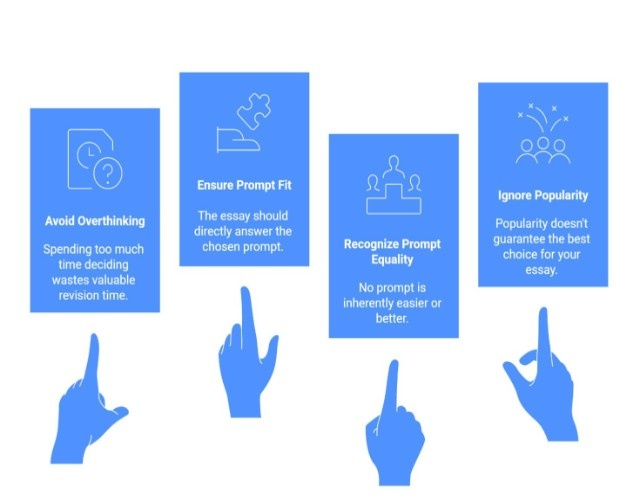
And when you need inspiration or want to see successful essays in action, study our collection of college application essay examples with expert analysis explaining what makes each one effective.
Common Application Essay Best Practices and Strategies
Certain strategies consistently produce stronger Common Application essays regardless of which prompt you choose.
Best Practice 1: Start with Specificity
Weak opening: "I've always been passionate about helping others."
Strong opening: "Mrs. Rodriguez's hands were shaking as she asked if we had any extra bread her grandchildren hadn't eaten since yesterday morning."
The specific opening immediately grounds readers in a concrete moment rather than abstract claims. This pattern should continue throughout your essay.
Best Practice 2: Show, Don't Tell
Telling: "I'm curious and persistent."
Showing: "After three failed attempts to extract strawberry DNA in my kitchen, I adjusted my protocol, used colder alcohol, and watched cloudy strands finally materialize in the test tube at 11 PM on a school night."
The showing version proves the qualities through specific actions rather than claiming them directly.
Best Practice 3: Balance Description and Reflection
Strong essays alternate between showing what happened and explaining what it meant.
Pattern that works:
- Describe a specific moment (showing).
- Reflect on significance (telling).
- Describe another moment (showing).
- Deepen reflection (telling)
This rhythm engages readers while ensuring your essay provides both vivid storytelling and meaningful insight.
Best Practice 4: Write in Your Natural Voice
Unnatural: "I was utterly flabbergasted when this serendipitous occurrence transpired."
Natural: "I couldn't believe it when this happened."
If you wouldn't say it in conversation with a teacher, don't write it in your essay. Admissions officers want your authentic voice, not an impressive vocabulary that sounds forced.
Best Practice 5: Stay Focused on One Central Idea
Common App essays should explore ONE story, theme, or idea deeply rather than covering multiple topics superficially.
Unfocused essay: Tries to mention debate, violin, volunteering, and part-time job
Focused essay: Explores what happened when debate arguments started affecting family dinner conversations
The focused approach reveals more about how you think and who you are through depth.
Best Practice 6: End with Insight, Not Summary
Weak conclusion: "In conclusion, this experience taught me the value of perseverance and helping others."
Strong conclusion: "Now, when I volunteer at the food bank, I notice which clients avert their eyes when asking for help. That small detail, shame about needing food, tells me more about poverty's psychological toll than any statistics could."
The strong conclusion provides new insight rather than rehashing what you've already said.
Best Practice 7: Respect the Common App Essay Word Limit
The limit isn't arbitrary; it's strategic. Admissions officers read 50-75 essays daily during peak season. Longer essays would cause review exhaustion.
650 words forces:
- Tight focus on what matters most.
- Efficient language without fluff.
- Strategic choice of details.
- Disciplined editing
Essays that bump against the limit show you've thought carefully about every word.
Best Practice 8: Avoid Common Clichés
Certain phrases appear so frequently in college essays that they've lost all meaning:
- "I've always been passionate about..."
- "This experience opened my eyes..."
- "I learned the value of hard work..."
- "I hope to make a difference in the world..."
- "Life is like a game of chess..."
When you catch yourself using a cliché, challenge yourself to express the same idea in original language based on your specific experience.
Need more ideas? Explore our detailed Common App Essay Topics Guide to discover what makes a strong and meaningful topic.
These prompts are flexible by design, but that flexibility can be paralyzing. Our reliable essay writing service helps students navigate prompt selection and execution daily. We work with your authentic stories to craft essays that showcase genuine personality and insight, never generic formulas.
Bottom Line
Seven common app essay prompts, one essay, 650 words maximum. Your prompt choice matters far less than your execution. Pick the prompt that naturally fits your story, focus on specific details and genuine reflection, and write in your authentic voice. Start with the experience you want to explore, then match it to whichever prompt asks the question your story answers. Don't overthink prompt selection. Admissions officers care about who you are, not which question you chose to answer.
For comprehensive guidance on every aspect of college essay writing, from brainstorming through final revision, see our complete college application essay guide that walks you through the entire process systematically.
Stop Stressing. Start Submitting.
Our professional writers craft essays that impress professors and earn top marks.
- 100% custom, never resold or recycled
- Written by academic specialists
- Any subject, any deadline
- Money-back guarantee
Trusted by 50,000+ students worldwide
Get Expert Help Now