Basic College Application Essay Structure Guidelines
Regardless of which template you choose, effective college essays follow similar proportions:
Opening/Hook: 50-100 words (8-15% of essay)
- Grab attention immediately
- Set scene with specific details
- Create curiosity about what follows
Context/Background: 75-125 words (12-20% of essay)
- Provide the necessary information readers need
- Avoid excessive backstory
- Keep moving forward
Body/Development: 350-450 words (55-70% of essay)
- This is your main content
- Balance storytelling with reflection
- Use specific examples and vivid details
Reflection/Insight: 100-150 words (15-25% of essay)
- What does your story mean?
- How have you grown?
- What does this reveal about you?
Conclusion: 50-100 words (8-15% of essay)
- Connect to your future
- Show college fit
- Leave a lasting impression
Note: These are flexible guidelines, not rigid rules. Your essay's unique needs determine final proportions.
Short on Time? College Essay Deadlines Getting Close?
Our professional writers organize and structure essays daily
- Build essays around your real experiences
- Use proven narrative and montage frameworks
- Meet tight deadlines without sacrificing quality
- 100% original, human-written content
No confusion. No guesswork. Just clear structure that works.
Get Started NowCollege Essay Template #1: Narrative Structure
Best for: Essays telling one story with a clear beginning, middle, and end. Works well when you face a specific challenge or have a transformative experience.
Use this if your story has:
- A specific moment or event to describe
- Clear before/after transformation
- One main experience to explore deeply
The Framework
OPENING (50-75 words)
Hook readers with a compelling moment:
- Start in the middle of the action
- Use vivid sensory detail
- Create curiosity about what happens next
Fill in:
Scene setting: Where and when?
Sensory details: What did it look/sound/feel like?
Hook: What makes readers want to continue?
CONTEXT (75-100 words)
Provide necessary background:
- What led to this moment?
- Why does this situation matter?
- What was your mindset before?
Fill in:
- What was happening in your life?
- Why were you in this situation?
- What did you believe or think before this experience?
THE CHALLENGE/TURNING POINT (150-200 words)
Describe what happened:
- Show the specific moment things changed
- Use dialogue if relevant
- Focus on concrete details, not vague summaries
Fill in:
- What specifically happened?
- What did you do/say/think?
- What made this moment significant?
- How did you respond initially?
REFLECTION & GROWTH (200-250 words)
Explore what it meant:
- What did you realize or learn?
- How did your thinking change?
- What do you do differently now?
- Why does this matter?
Fill in:
- What surprised you about this experience?
- What did you understand afterward that you didn't before?
- How are you different now?
- What does this reveal about your values or character?
CONCLUSION (75-100 words)
Connect to your future:
- How does this shape who you are now?
- What does it suggest about how you'll contribute in college?
- End with a memorable image or thought
Fill in:
- Who are you now because of this?
- How will this experience influence your future?
- What final image or idea leaves an impression?
College Essay Template #2: Montage Structure
Best for: Essays connecting multiple experiences through a common theme. Works well when showing different facets of your personality that don't fit one narrative.
Use this if your story has:
- Multiple small moments rather than one big event
- A theme connecting different experiences
- Various examples of a quality or interest
The Framework
OPENING (50-75 words)
Introduce your theme:
- Start with an intriguing statement or question
- Hint at the pattern you'll explore
- Make readers curious about connections
Fill in:
- What's your central theme or characteristic?
- How can you introduce it memorably?
- What question will your essay answer?
VIGNETTE #1 (100-125 words)
First glimpse of your theme:
- Describe a specific moment showing this aspect of yourself
- Use concrete details
- Show, don't tell
Fill in:
- Specific scene: What happened?
- Sensory details: What did it look/feel/sound like?
- What does this moment reveal?
VIGNETTE #2 (100-125 words)
Second perspective on your theme:
- Show a different situation revealing the same quality
- Use different settings, people, or contexts
- Maintain specific details
Fill in:
- Different scenes showing the same theme
- How is this situation different from the first?
- What new dimension does this add?
VIGNETTE #3 (100-125 words)
Third angle on your theme:
- Complete the pattern with another specific moment
- Show progression or depth
- Connect to the bigger picture
Fill in:
- Final scene illustrating your theme
- How do these three moments connect?
- What pattern emerges?
SYNTHESIS (150-200 words)
Tie it together:
- Explain what connects these moments
- Reflect on what they reveal about you
- Show how this shapes your perspective or goals
Fill in:
- What's the common thread?
- Why does this pattern matter?
- How does this define who you are?
- How will this influence your college experience?
CONCLUSION (75-100 words)
Look forward:
- Connect your theme to your future
- Show why colleges should care
- End with resonance
Fill in:
- How will you bring this quality to campus?
- What does this suggest about your potential contributions?
- Final thought that lingers?
College Essay Template #3: Standard Five-Paragraph Approach
Best for: Straightforward stories when you need a simple, reliable structure. Works well for direct answers to specific prompts.
Use this if your story:
- Answers a straightforward question
- Has clear main points to make
- Benefits of a traditional organization
The Framework
INTRODUCTION (100-125 words)
Set up your essay:
- Hook with an interesting opening
- Provide brief context
- End with a clear thesis/main point
Fill in:
- Attention-grabbing first sentence
- 2-3 sentences of necessary background
- One sentence stating your main point clearly
BODY PARAGRAPH #1 (125-150 words)
First main point:
- Topic sentence introducing this idea
- Specific evidence or experience
- Explanation of significance
- Connection to your main point
Fill in:
- What's your first key point?
- What specific moment illustrates it?
- Why does this matter?
- How does it support your thesis?
BODY PARAGRAPH #2 (125-150 words)
Second main point:
- Topic sentence introducing a new idea
- Different evidence or experience
- Explanation of significance
- Connection to your main point
Fill in:
- What's your second key point?
- What specific moment illustrates it?
- Why does this matter?
- How does it support your thesis?
BODY PARAGRAPH #3 (125-150 words)
Third main point:
- Topic sentence introducing the final idea
- More evidence or experience
- Explanation of significance
- Connection to your main point
Fill in:
- What's your third key point?
- What specific moment illustrates it?
- Why does this matter?
- How does it support your thesis?
CONCLUSION (100-125 words)
Wrap it up:
- Briefly restate your main point (new words)
- Show broader significance
- Look toward the future
- End memorably
Fill in:
- What have you shown about yourself?
- Why should colleges care?
- How will this influence your college experience?
- Final thought that resonates?
Struggling to Organize Your College Essay? Not Sure Where to Start?
Our experts help students structure college application essays every single day:
- Turn scattered ideas into clear, compelling outlines
- Match the right structure to your story
- Balance storytelling with reflection
- Avoid common outline and flow mistakes
Clear structure first. Strong writing follows.
Get Expert HelpUse These College Essay Templates Correctly
Step 1: Pick Your Structure (2 minutes)
Ask yourself:
Narrative: Do I have one main story to tell?
Montage: Do I have multiple connected experiences?
Standard: Do I have straightforward points to make?
Step 2: Copy the Template (1 minute)
- Download or copy the template to a document
- Keep the section headers
- Delete our example questions after you've filled them in
Step 3: Fill in the Blanks (30-45 minutes)
- Don't write full sentences yet, just note key points
- Be specific: "Mrs. Chen's hands stopped shaking," not "helped someone."
- List evidence, scenes, and details you'll use
- Identify connections and reflections
Step 4: Check Your Work (5 minutes)
Before drafting, verify:
- Every section has content planned
- You have specific details (not vague generalities)
- Reflection balances description
- Flow makes logical sense
- Word counts fit roughly (adjust as needed)
Step 5: Start Drafting (2-3 hours)
Now expand each outline point into full paragraphs. The template tells you exactly what goes where; you just need to write it.
Total planning time: 30-50 minutes
Time saved during drafting: 2-3 hours
Frustration avoided: Immeasurable
College Essay Format Variations by Length
While Common App essays max at 650 words, you'll write essays of varying lengths throughout applications. Here's how to adjust templates:
1. Short Format (250-300 words)
Use for: Coalition App short answer, UC PIQs
Template adjustment:
- Opening: 40-50 words
- One body section: 150-175 words (focus on ONE moment)
- Reflection: 40-50 words
- Brief conclusion: 20-30 words
Skip: Multiple body paragraphs, extensive context, multiple examples.
2. Medium Format (500-650 words)
Use for: Common App, Coalition App main essay
Template adjustment: Use templates as written above
3. Long Format (750-1,000 words)
Use for: ApplyTexas essays, some scholarship essays
Template adjustment:
- Opening: 75-100 words (more scene-setting)
- Add a fourth body paragraph or extend existing paragraphs
- Reflection: 150-200 words (deeper analysis)
- Longer conclusion: 100-125 words
Don't just add fluff; use extra space for deeper reflection and more specific details. If your topic is specific and narrowed, then you can easily overcome this issue. For this purpose, browse our latest college application essay topics.
College Essay's Body Paragraph Structure Template
Each college essay's body paragraph should follow this proven framework:
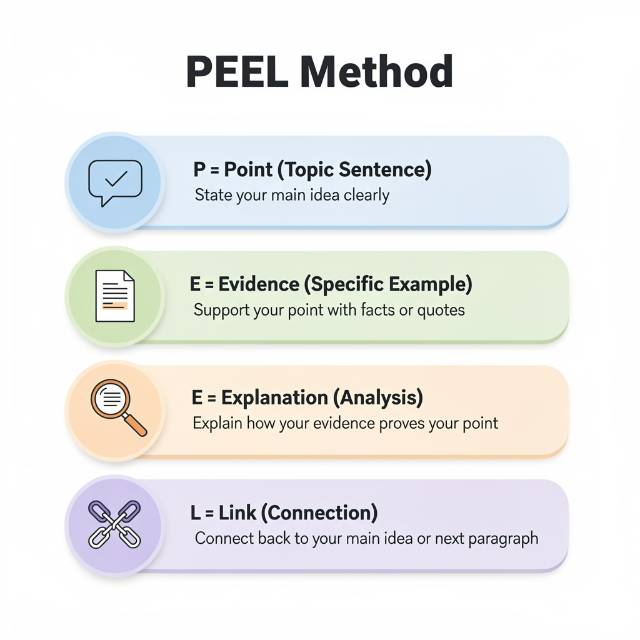
Template Format:
[POINT: Topic sentence introducing this paragraph's focus]
[EVIDENCE: Specific scene/moment]
- What happened?
- Who was involved?
- Sensory details (what you saw/heard/felt)
[EXPLANATION: What it meant]
- What did you realize?
- How did you change?
- What does this reveal about your values/character?
[LINK: Connection]
- How does this support your main point?
- What does this lead to next?
Note: Use this structure for each body paragraph to maintain focus and depth.
Filled Template - College Application Essay Outline Example
Here's what Template #1 (Narrative Structure) looks like when filled in. Note: This is a completed OUTLINE with notes, not a fully drafted essay. OPENING (50-75 words)
CONTEXT (75-100 words)
CHALLENGE/TURNING POINT (150-200 words)
REFLECTION & GROWTH (200-250 words)
CONCLUSION (75-100 words)
Looking for complete essay examples? See our college application essay examples page for full-drafted versions. |
Reason to Use a College Essay Outline
Students who outline first:
- Write 40% faster during drafting
- Need fewer major revisions
- Maintain better focus throughout
- Feel less overwhelmed by the writing process
30 minutes outlining saves 2-3 hours of frustration later.
An outline isn't busywork. It's your roadmap showing exactly where you're going before you start driving.
Templates provide structure, but effective college essays require balancing storytelling with reflection, specific details with broader insights, and authenticity with polish. Our essay writing service specializes in helping students master this balance, creating essays that showcase genuine personality within proven frameworks.
Bottom Line
You've got three proven templates: Narrative for single stories, Montage for connected moments, and Standard for straightforward points. Pick the structure that fits your content, fill in each section with specific notes, and you'll have a clear roadmap before drafting. Thirty minutes outlining now saves hours of restructuring later.
Ready to start writing? See our college application essay guide for complete strategies from brainstorming through final revision.
Still Staring at a Blank Page After Outlining?
We help students move from outline to polished essay:
- Refine structure before drafting
- Strengthen flow and clarity
- Highlight growth and reflection
- Ensure every section serves a purpose
Turn Your Outline Into a Strong Essay
Get Started Now