Understanding Argument Types
Every effective argumentative essay follows a structural model that organizes claims, evidence, and reasoning. While all argumentative essays share common elements, clear thesis, supporting evidence, counterargument refutation, and logical organization, the three main models arrange these components differently to serve different rhetorical purposes. Here is a complete argumentative essay guide to help you get started.
Think of argument models as different tools in a toolbox. Hammers, screwdrivers, and wrenches all build things, but each excels at specific tasks. Similarly, Toulmin, Classical, and Rogerian models all construct arguments, but each fits different situations, audiences, and goals.
Understanding these models makes you a more versatile writer. You'll choose the right approach for your topic rather than forcing every essay into the same structure. This flexibility impresses professors and produces stronger, more effective arguments.
The model you select depends on three primary factors: your topic's controversy level, your audience's receptiveness to your position, and your ultimate goal (analytical breakdown, traditional persuasion, or finding middle ground). A topic perfect for Classical treatment might fail completely if forced into Rogerian structure, and vice versa.
Most students learn Classical structure in high school because it's straightforward and widely applicable. However, college-level writing often demands Toulmin's analytical depth or Rogerian's diplomatic approach for sensitive topics. Mastering all three models elevates your argumentative writing to advanced levels.
Before diving into each model's specifics, review the fundamentals of argumentative essay writing to ensure you understand the basic components all models share: thesis statements, evidence integration, counterarguments, and academic tone.
Complete Model Comparison
Understanding how these models differ helps you select the right approach for your specific assignment. This comparison table highlights key distinctions across multiple dimensions.
| Factor | Toulmin | Classical (Aristotelian) | Rogerian |
|---|---|---|---|
| Developed By | Stephen Toulmin (1958) | Aristotle (384-322 BCE) | Carl Rogers (1970) |
| Best For | Complex policy issues | General academic essays | Controversial topics |
| Audience Type | Neutral/analytical | Receptive/neutral | Hostile/polarized |
| Primary Goal | Logical analysis | Persuasion through reason | Finding common ground |
| Structure | 6 components | 4 parts | 5 parts |
| Difficulty Level | Medium-Hard | Easy-Medium | Hard |
| Academic Level | College+ | High school+ | College+ |
| Overall Tone | Analytical, objective | Persuasive, confident | Conciliatory, diplomatic |
| Counter-argument | Rebuttal section | Refutation section | Presented first, fairly |
| Emotional Appeals | Minimal/none | Limited (pathos) | Minimal/none |
| Example Topics | Healthcare reform, climate policy | School uniforms, standardized testing | Abortion rights, gun control |
| Writing Time | 10-14 hours | 8-12 hours | 12-16 hours |
Key Takeaways from Comparison
Toulmin requires the most analytical thinking. You're breaking arguments into component parts like a scientist dissecting specimens. This model suits students comfortable with logic and comfortable analyzing rather than simply arguing.
Classical offers the most straightforward approach. Its familiar structure, introduction, arguments, refutation, and conclusion mirror what most students learned in high school. Choose Classical when your assignment doesn't specify a model and you're addressing a general academic audience.
Rogerian demands the most sophistication and empathy. You must genuinely understand opposing viewpoints and present them fairly before introducing your position. This model takes the longest because diplomatic balance is harder to achieve than a simple assertion.
The controversy level of your topic provides the clearest selection guidance. Low controversy topics (should students get homework?) work fine with Classical. Medium controversy (should colleges be free?) benefits from Toulmin's analytical depth. High controversy (abortion, gun rights) requires Rogerian's diplomatic approach to avoid alienating readers.
The Toulmin Model
British philosopher Stephen Toulmin developed this model in his 1958 book "The Uses of Argument," revolutionizing how we analyze real-world reasoning. Unlike formal logic's abstract perfection, Toulmin focused on how arguments actually work in practice, messy, nuanced, and complex.
Origin and Purpose
Toulmin noticed that traditional formal logic failed to capture how people argue in reality. Mathematical proofs work perfectly in theory, but real-world arguments involve probability, qualifications, and exceptions. His six-component model provides a framework for constructing and analyzing practical arguments where absolute certainty is impossible.
This model particularly suits academic and professional contexts where intellectual rigor matters more than emotional persuasion. You're building a case through logical analysis rather than rhetorical flourish. Scientists, policy analysts, and legal scholars frequently use Toulmin-style reasoning.
The Six Components Explained
1. Claim (Your Position)
Your claim is what you're arguing, your thesis or main assertion. It must be debatable and specific.
Weak claim: "Healthcare needs improvement."
Strong claim: "The United States should implement a single-payer healthcare system."
Your claim answers the question:
"What exactly am I trying to prove?"
Everything else in your essay supports, qualifies, or defends this claim.
2. Grounds (Evidence/Data)
Grounds are the facts, statistics, studies, and evidence supporting your claim. This is your proof, the concrete information demonstrating your claim's validity.
For the healthcare claim above, grounds might include:
"45,000 Americans die annually from lack of health insurance" or "Administrative costs consume 31% of US healthcare spending versus 16% in Canada's single-payer system."
Grounds must come from credible sources and be relevant to your claim. Weak grounds doom even well-reasoned arguments.
3. Warrant (Reasoning Connection)
The warrant explains why your grounds support your claim—the logical bridge connecting evidence to conclusion. Warrants are often unstated but crucial for argument strength.
For our healthcare example, the warrant might be:
"Preventable deaths violate basic human rights principles that a wealthy nation should uphold."
This explains why the 45,000 deaths statistic matters and connects to the single-payer claim.
Weak arguments often have unstated or flawed warrants. Making warrants explicit strengthens logical clarity.
4. Backing (Support for Warrant)
Backing provides additional evidence supporting your warrant's validity. If someone challenges your warrant, backing defends it. For the human rights warrant above, backing might include:
"The UN Declaration of Human Rights recognizes healthcare as a fundamental right" or "The US Constitution's preamble commits to 'promoting the general welfare."
Not every argument needs extensive backing, but controversial warrants require it.
5. Qualifier (Limitations/Conditions)
Qualifiers acknowledge your claim's limitations using words like "probably," "likely," "in most cases," "generally," or "usually." They demonstrate intellectual honesty by admitting your argument isn't absolute.
Qualified version of healthcare claim:
"The United States should likely implement a single-payer healthcare system, at least for basic coverage."
This qualifier acknowledges complexity without weakening your overall position.
Qualifiers prevent overreach and show you've considered nuance. These are the marks of sophisticated thinking.
6. Rebuttal (Addressing Exceptions)
Rebuttals address conditions under which your claim might not hold or acknowledge opposing arguments. This isn't the same as counterargument refutation in other models, it's recognizing legitimate exceptions or concerns.
For healthcare: "However, implementation costs would initially increase federal spending, requiring either tax increases or spending cuts elsewhere. Transition periods would disrupt existing insurance industry employment."
Strong rebuttals demonstrate you've anticipated objections rather than ignored them.
Your GPA Doesn't Have to Suffer
Expert Writers. Original Essays. Guaranteed Results
Trusted by 50,000+ students. Zero AI. Zero plagiarism.
When to Use the Toulmin Model
Choose Toulmin for topics requiring analytical depth and nuanced examination:
- Policy debates: Healthcare reform, education funding, environmental regulations
- Scientific controversies: Climate change solutions, genetic engineering ethics, AI regulation
- Complex ethical issues: Privacy versus security, individual freedom versus collective good
- Situations with no clear "right" answer: Most real-world problems
Avoid Toulmin for simple topics with obvious answers or when your audience wants straightforward persuasion rather than an analytical breakdown.
Toulmin Structure Example
Topic: Should colleges eliminate standardized testing requirements?
Claim: Colleges should eliminate standardized testing requirements for admissions decisions.
Grounds: SAT/ACT scores correlate more strongly with family income ($100K+ families average 1714 vs. <$20K families average 1326) than with first-year college performance. Test-optional schools report no decrease in academic quality.
Warrant: Fair admissions should assess student potential rather than socioeconomic privilege. Tests measuring privilege more than ability create unjust barriers.
Backing: Educational research demonstrates that high school GPA predicts college success more accurately than standardized tests. Numerous studies show that test prep advantages disproportionately benefit wealthy students.
Qualifier: At least for holistic review institutions with resources to evaluate applications individually; smaller schools lacking resources might reasonably continue using tests for efficiency.
Rebuttal: Some argue that tests provide a standardized comparison across different high schools. However, GPA contextualization through school profiles and transcripts provides better comparison while avoiding income bias.
Review our Toulmin outline template with detailed instructions for each component.
The Classical (Aristotelian) Model
The oldest and most widely taught argumentative structure, developed by Aristotle in ancient Greece over 2,300 years ago. This model has endured because it works; its balanced structure and persuasive appeals create effective arguments for countless topics.
Historical Background and Influence
Aristotle's "Rhetoric" systematized persuasive communication, identifying three essential appeals (ethos, pathos, logos) and a four-part structure still used today. Ancient Greek philosophers, politicians, and lawyers used these principles. Roman orators like Cicero refined them. Medieval scholars preserved them. Modern communication courses teach them.
The Classical model's longevity reflects its psychological effectiveness. Humans respond to credibility (ethos), emotion (pathos), and logic (logos) in predictable ways. Aristotle simply codified what naturally persuades us.
The Three Persuasive Appeals
Ethos (Credibility/Character)
Ethos establishes why readers should trust you and your sources. You build ethos through:
- Demonstrating knowledge of your topic through research depth
- Citing authoritative experts and credible sources
- Acknowledging opposing viewpoints fairly
- Using professional tone and correct grammar
- Showing balanced judgment rather than blind advocacy
Weak ethos undermines even the strongest arguments. If readers doubt your credibility, they'll dismiss your evidence regardless of its quality.
Pathos (Emotional Appeal)
Pathos connects your argument to readers' values, emotions, and experiences. In academic argumentative essays, pathos should be subtle, appeal to shared principles rather than manipulating emotions.
Appropriate pathos includes:
- Highlighting human impact of policies (without melodrama)
- Appealing to shared values (justice, fairness, progress)
- Using compelling real-world examples
- Showing consequences that resonate with readers' concerns
Excessive pathos in argumentative essays appears manipulative. Balance is key; acknowledge emotional dimensions without abandoning logical rigor.
Logos (Logical Reasoning)
Logos is your primary appeal in argumentative essays: facts, statistics, logical reasoning, cause-and-effect relationships, and evidence-based conclusions. Strong logos include:
- Credible statistics from authoritative sources
- Cause-and-effect relationships supported by evidence
- Logical progression from premises to conclusions
- Scientific studies and research findings
- Analogies and comparisons that clarify complex ideas
Argumentative essays rely primarily on logos, with ethos establishing credibility and pathos providing subtle emotional resonance. The ratio is roughly 70% logos, 20% ethos, 10% pathos in most academic contexts.
The Four-Part Structure
Part 1: Introduction and Narration
Your introduction hooks readers and provides context. Start with an attention-grabbing opening, a surprising statistic, a provocative question, compelling anecdote related to your topic. Provide 2-3 sentences of background information so readers understand the issue's importance and relevance.
End with your clear thesis statement declaring your position.
Length: 150-200 words.
Part 2: Confirmation (Your Arguments)
Present 2-3 main arguments supporting your thesis, each in its own body paragraph. Follow the pattern: topic sentence introducing the argument, evidence from credible sources, analysis explaining how the evidence supports your thesis, and transition to the next point.
Each confirmation paragraph should appeal to all three:
- Logos (evidence and reasoning),
- Ethos (credible sources)
- Subtle pathos (showing why this matters).
This is your essay's longest section, typically 3-4 paragraphs of 200-250 words each.
Part 3: Concession and Refutation
Acknowledge the strongest opposing arguments (concession), then explain why they're insufficient or flawed (refutation). This demonstrates intellectual honesty and critical thinking. Presenting opposing views fairly, misrepresenting them (strawman fallacy), undermines your credibility.
Your refutation should be stronger than the concession. Use superior evidence, identify logical flaws, or show how your position addresses concerns that the opposing view overlooks.
Length: 250-300 words.
Part 4: Conclusion
Restate your thesis using fresh wording (don't copy from the introduction). Briefly summarize your main arguments.
Provide broader implications: why your argument matters beyond this specific essay. Some Classical arguments end with explicit calls to action, though this is optional in academic essays.
Avoid introducing new arguments in conclusions. You're wrapping up, not opening new debates.
Length: 150-200 words.
Your GPA Doesn't Have to Suffer
Expert Writers. Original Essays. Guaranteed Results
Trusted by 50,000+ students. Zero AI. Zero plagiarism.
When to Use the Classical Model
Choose Classical for:
- Traditional academic assignments without specific model requirements
- Receptive or neutral audiences open to persuasion
- Topics with relatively clear-cut positions supported by strong evidence
- General argumentative essays in any discipline
- High school and college writing where clarity and organization matter most
The Classical model is your default choice. When unsure which model to use, Classical works effectively for most situations.
Classical Structure Example
Topic: Should high schools start later than 8 AM?
Introduction & Narration: Teen car accidents peak during morning commutes. School buses leave at dawn while students struggle to wake. Yet decades of research confirm adolescent circadian rhythms shift later during puberty, making 6 AM wake-ups biologically harmful. High schools should start no earlier than 8:30 AM to align with teenage biology and improve academic outcomes.
Confirmation 1 (Logos + Ethos): Sleep scientists consistently demonstrate that teenagers need 8-10 hours nightly, with natural sleep cycles shifting toward later bedtimes. Dr. Judith Owens' research shows that school start times before 8:30 AM force teens to wake during their natural sleep cycles, causing chronic sleep deprivation.
Confirmation 2 (Logos): Schools implementing later start times report measurable improvements. Minnesota's Edina schools moved from 7:25 AM to 8:30 AM and saw average SAT scores increase by 200 points. Seattle's shift to 8:45 AM correlated with a 34-minute average sleep increase and a 4.5% grade improvement.
Confirmation 3 (Pathos + Logos): Drowsy driving causes 100,000 crashes annually, with teen drivers disproportionately affected. Later school start times reduce morning accident rates by 16% according to AAA Foundation research. Preventing even a few crashes justifies schedule adjustments.
Refutation: Critics cite logistical challenges, bus scheduling, afternoon activities, and parental work schedules. However, dozens of districts have successfully navigated these adjustments. Benefits to teen health, safety, and academics outweigh temporary inconvenience. Staggered start times across grade levels minimize busing costs.
Conclusion: Evidence overwhelmingly supports later high school start times. Biology, safety data, and academic improvements align. The question isn't whether schools should start later, but how quickly districts can implement changes. Prioritizing convenience over adolescent well-being is indefensible when solutions exist.
See complete Classical model examples showing how ethos, pathos, and logos integrate throughout.
The Rogerian Model
Named after psychologist Carl Rogers, this diplomatic approach revolutionized argumentation by prioritizing understanding over victory. Rather than defeating opponents, Rogerian arguments seek common ground and mutual benefit, particularly powerful for divisive topics where both sides have legitimate concerns.
Origin in Psychology and Communication Theory
Carl Rogers developed person-centered therapy, emphasizing empathy, active listening, and nonjudgmental acceptance. He believed people change positions only when they feel understood and respected, not when attacked or dismissed. His communication principles, published in the 1970s, were adapted into an argumentation model.
The Rogerian approach acknowledges a fundamental truth: when people feel threatened or disrespected, they become defensive and resistant. By validating opposing concerns before presenting your position, you reduce defensiveness and open paths to agreement. This isn't manipulation, it's genuine respect for complexity.
Why the Rogerian Model Is Different
Traditional argumentation seeks to prove opponents wrong. Rogerian argumentation seeks to find solutions that both sides can accept. You're not "winning" a debate; you're negotiating common ground.
This fundamental shift changes everything. Instead of marshaling evidence to demolish opposition, you identify shared values and build from there. Instead of highlighting weaknesses in opposing views, you acknowledge their legitimate concerns. Instead of demanding total victory, you propose a compromise benefiting both sides.
This doesn't mean abandoning your position. You still argue for your view, but you frame it as complementary to opposing concerns rather than oppositional. The tone shifts from confrontation to collaboration.
The Five-Part Structure
Part 1: Introduction (Neutral Ground)
Identify the problem objectively without taking sides yet. Establish that reasonable people disagree and both have valid concerns. Your tone should be balanced and respectful, avoiding loaded language favoring either position.
Example: "Gun violence in America kills 40,000 people annually, while millions of law-abiding citizens value firearm ownership for self-defense, recreation, and Constitutional rights. Both reducing violence and preserving legitimate gun rights represent worthy goals, yet proposed solutions often polarize rather than unite."
This introduction acknowledges both sides' concerns without favoring either. You're establishing neutral ground before taking your position.
Part 2: Opposing View Summary (Fair Representation)
Present the opposing position fully and fairly, using their strongest arguments rather than weak strawmen. Describe their concerns, values, and reasoning as sympathetically as possible. Avoid bias or mockery, represent their position as effectively as they would themselves.
This section demonstrates that you genuinely understand opposition, building trust. Readers holding opposing views should think "Yes, that's exactly our concern" when reading this section. If they don't, you haven't represented them fairly enough.
Example: "Second Amendment advocates rightfully fear government overreach and value Constitutional protections. Historical examples of tyrannical governments disarming citizens before oppression validate these concerns. Many gun owners responsibly use firearms for decades without incident, resenting collective punishment for others' actions. Rural Americans particularly depend on firearms for property protection with police minutes or hours away."
Part 3: Statement of Understanding
Explicitly acknowledge validity in opposing concerns. Identify common values both sides share: safety, freedom, Constitutional rights, and protecting children. Show you've genuinely listened and recognize their position contains legitimate points.
This is crucial for reducing defensiveness. You're not agreeing with their conclusion, but you are validating their concerns as real and important.
Example: "These concerns about individual liberty and Constitutional protection deserve serious consideration. The Second Amendment's framers intentionally protected gun rights, and responsible gun ownership represents a legitimate Constitutional exercise. Fears of government overreach aren't paranoid; history provides ample examples justifying vigilance about state power."
Part 4: Your Position (Stated Respectfully)
Now introduce your position, but frame it as addressing shared concerns rather than opposing theirs. Connect your solution to the values both sides hold. Show how your position complements rather than contradicts legitimate opposing concerns.
Your tone remains diplomatic. You're not declaring opponents wrong; you're offering an alternative approach that addresses concerns both sides share.
Example: "Universal background checks with waiting periods address gun violence while preserving law-abiding citizens' ownership rights. These measures don't prevent legitimate ownership; they prevent impulsive violence and purchases by prohibited individuals. Switzerland's model demonstrates that extensive gun ownership coexists with strong regulations and low violence."
Part 5: Compromise/Benefits (Win-Win Solution)
Propose solutions benefiting both sides, or explain how your position addresses both sets of concerns. Emphasize cooperation over conflict. Show how compromise produces better outcomes than continued polarization.
The goal is to leave readers thinking "Maybe we can find middle ground" rather than "I must defend my position against attack."
Example: "Implementing enhanced background checks while expanding concealed carry reciprocity and removing suppressors from NFA restrictions could satisfy both sides. Gun rights advocates gain regulatory relief and national carry recognition. Gun safety advocates gain measures to reduce prohibited purchases. Both sides compromise, but both sides gain."
Imagine Submitting Without the Panic
Your Essay. Written by Pros. Delivered on Time
100% original. 100% human. Satisfaction guaranteed
When to Use the Rogerian Model
Choose Rogerian for:
- Highly polarizing topics where both sides have legitimate concerns (abortion, gun control, immigration, death penalty)
- Hostile or defensive audiences are unlikely to accept direct persuasion
- Ethical dilemmas without clear absolute answers
- Situations where finding the middle ground matters more than total victory
- Topics involving deep values, beliefs, or identity
Avoid Rogerian for non-controversial topics, receptive audiences, or when one side clearly lacks legitimate arguments. You can't find middle ground between "2+2=4" and "2+2=5."
Challenges and Tips
The Rogerian model is hardest to execute authentically. Common pitfalls include:
Fake Empathy: Readers detect insincere validation. You must genuinely understand and respect opposing concerns. If you view opponents as stupid or evil, Rogerian arguments fail.
Consider: maybe intelligent, well-meaning people disagree for good reasons?
Appearing Weak: Poorly executed Rogerian arguments seem wishy-washy or non-committal. You must eventually take clear positions while maintaining a respectful tone. The goal is diplomacy, not weakness.
Excessive Compromise: Some topics don't require compromise. Human rights violations, for instance, shouldn't be negotiated. Reserve Rogerian for genuinely complex issues with legitimate competing values.
When done well, Rogerian arguments produce the most sophisticated college-level writing. You're demonstrating advanced critical thinking, empathy, and communication skills that impress professors and work in professional contexts.
Study our complete Rogerian model example showing diplomatic tone and effective common-ground strategies.
Deductive vs. Inductive Reasoning
Beyond structural models, arguments use two fundamental reasoning patterns: deductive (general to specific) and inductive (specific to general). Understanding both strengthens your logical analysis regardless of which model you choose.
Deductive Arguments (Top-Down)
Deductive reasoning starts with general principles or premises, then applies them to specific cases to reach certain conclusions. If your premises are true and your logic valid, your conclusion must be true.
Classic Structure:
- Major premise: All humans are mortal
- Minor premise: Socrates is a human
- Conclusion: Therefore, Socrates is mortal
In Essay Form: "The Constitution guarantees equal protection under law (major premise). Discriminatory hiring practices violate equal protection (minor premise). Therefore, anti-discrimination employment laws uphold Constitutional principles (conclusion)."
Strengths:
- Produces certain conclusions if the premises are accepted
- Creates a powerful logical force
- Works excellently for mathematical, legal, and philosophical arguments
Weaknesses:
- Requires audiences to accept your premises
- Real-world premises are rarely absolutely true
- It can seem overly rigid or theoretical
When to Use Deductive Reasoning: Choose deductive approaches for mathematical proofs, legal arguments from established law, philosophical discussions from accepted principles, or any situation where you're applying general rules to specific cases.
Example in Argumentative Essay: "Democratic principles require protecting minority rights against majority tyranny (premise). Hate speech laws allowing majorities to silence minorities threaten this protection (application). Therefore, unrestricted free speech, even offensive speech, better preserves democratic values than hate speech restrictions (conclusion)."
Inductive Arguments (Bottom-Up)
Inductive reasoning observes specific instances, identifies patterns, and then proposes general conclusions. Unlike deduction, inductive conclusions are probable rather than certain; future observations might contradict them.
Classic Structure:
- Swan 1 is white (observation)
- Swan 2 is white (observation)
- Swan 3 is white (observation)
- Therefore, all swans are probably white (conclusion)
This famous example illustrates induction's limitation: the conclusion seemed valid until black swans were discovered in Australia. Inductive conclusions are never 100% certain.
In Essay Form: "Study A shows social media increases teen anxiety (observation). Study B confirms this correlation (observation). Study C replicates these findings (observation). Therefore, social media likely contributes to teen mental health decline (conclusion)."
Strengths:
- Builds from observable evidence to general principles
- Flexible and adaptable to new evidence
- Mirrors the scientific method and empirical research
- Audience-friendly, starts with relatable specifics
Weaknesses:
- Never achieves logical certainty
- Vulnerable to contradictory evidence
- Generalizations may not apply universally
- Quality depends on sample size and representativeness
When to Use Inductive Reasoning: Choose inductive approaches for scientific writing, social science research, pattern-based arguments, or situations where you're building general principles from specific evidence.
Example in Argumentative Essay: "Countries implementing carbon taxes show 12% average emissions reductions (observation). Sweden's carbon tax correlates with a 26% decline, while GDP grew (observation). British Columbia's tax reduced emissions 15% in five years (observation). These patterns suggest carbon pricing effectively reduces emissions without harming economies (conclusion)."
Combining Deductive and Inductive Reasoning
Strong argumentative essays often combine both approaches. You might use inductive reasoning to establish a general principle from evidence, then apply that principle deductively to your specific case.
Example:
Inductive establishment: "Multiple studies demonstrate that higher minimum wages don't significantly reduce employment (observations to general principle)."
Deductive application: "Given that wage increases don't reduce employment (premise), Seattle can raise its minimum wage without job losses (application to conclusion)."
This combination provides empirical foundation (induction) plus logical force (deduction), creating robust arguments resistant to multiple types of attack.
Understanding reasoning types helps you construct stronger arguments and identify logical flaws in opposing positions. Apply these reasoning patterns within your chosen model structure to build compelling, logically sound essays.
One Click Away From Stress-Free
Let Experts Handle Your Essay Tonight
Human writers only. Original work always. Guaranteed.
How to Choose Your Argument Model
Selecting the right model determines your essay's effectiveness before you write a word. Follow this systematic decision-making process to match models to your specific situation.
Decision Framework: Five Key Questions
Question 1: How Controversial Is Your Topic?
Low Controversy (clear majority position, relatively uncontroversial)
Examples: Should students do homework? Are standardized tests useful?
Recommendation: Classical model
Reasoning: Straightforward persuasion works when audiences are receptive
Medium Controversy (reasonable disagreement, nuanced complexity)
Examples: Should college be free? Should AI be regulated?
Recommendation: Toulmin model
Reasoning: Analytical depth suits complex issues without obvious answers
High Controversy (deeply polarizing, values-based conflict)
Examples: Abortion rights, gun control, religious freedom
Recommendation: Rogerian model
Reasoning: Diplomatic approach reduces defensiveness on divisive issues
Question 2: What's Your Audience's Stance?
Receptive/Neutral (open to persuasion, undecided, or mildly opposed)
Recommendation: Classical model
Reasoning: Traditional persuasion effectively convinces open-minded audiences
Analytical/Academic (professors, researchers, policy analysts)
Recommendation: Toulmin model
Reasoning: Logical breakdown impresses audiences, valuing rigorous analysis
Hostile/Polarized (strongly opposed, defensive, emotionally invested)
Recommendation: Rogerian model
Reasoning: Common-ground approach necessary when audiences feel threatened
Question 3: What's Your Primary Goal?
Persuade receptive audience: Classical (traditional convincing)
Analyze complex issue logically: Toulmin (intellectual examination)
Reduce hostility/find middle ground: Rogerian (diplomatic negotiation)
Question 4: What Does Your Assignment Require?
Some professors specify models in rubrics or instructions. When explicitly required, follow assignment directions regardless of other factors. When unspecified, use the decision framework above.
Most general "write an argumentative essay" assignments accept any model executed well. Classical is the safest default for ambiguous assignments.
Question 5: What's Your Skill Level?
- Beginner writers: Start with Classical (most straightforward structure)
- Intermediate writers: Try Toulmin (develops analytical thinking)
- Advanced writers: Attempt Rogerian (requires sophisticated balance)
Don't attempt Rogerian until you've mastered Classical and Toulmin. The diplomatic balance and genuine empathy required are genuinely difficult to achieve without practice.
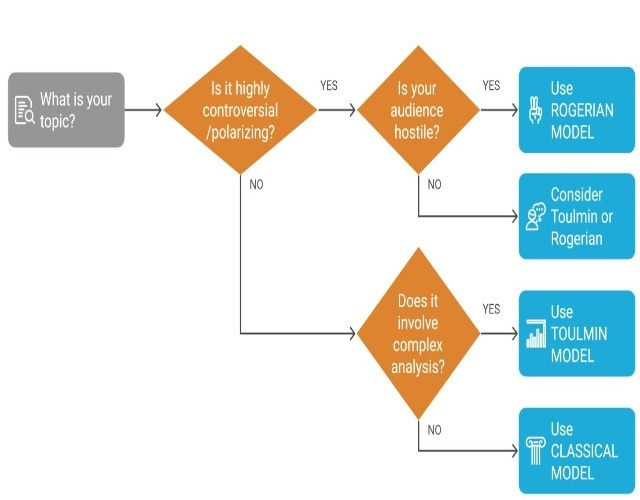
Visual Decision Tree
START: What is your topic?
Is it highly controversial/polarizing?
YES: Is your audience hostile?
YES: Use ROGERIAN MODEL
NO: Consider Toulmin (if complex) or Rogerian (if seeking compromise)
NO: Does it involve complex analysis?
YES: Use TOULMIN MODEL
NO: Use CLASSICAL MODEL
Can You Combine Models?
Advanced writers sometimes blend elements from different models, but this requires skill to maintain coherence. Beginning and intermediate writers should master individual models before experimenting with combinations.
Possible Hybrid Approaches:
- Toulmin structure with Rogerian tone (analytical yet diplomatic)
- Classical structure with Toulmin's qualifier/rebuttal components (traditional persuasion with acknowledged limitations)
- Rogerian common-ground identification with Classical argumentation (establishing shared values before traditional arguments)
However, these hybrids risk confusing readers or creating structural inconsistency. Better to master one model fully than awkwardly blend multiple approaches.
Making Your Final Decision
Consider all five factors, but prioritize controversy level and audience stance. These two factors most strongly predict model effectiveness. A controversial topic facing hostile audiences demands Rogerian regardless of other factors. A straightforward topic with receptive audiences works fine with Classical.
When deciding between Toulmin and Classical for medium-controversy topics, ask: Does my professor value analytical depth or clear persuasion? Academic audiences often prefer Toulmin's intellectual rigor. General audiences prefer Classical's straightforward argumentation.
Same Topic, Three Different Approaches
Seeing how model choice transforms the same basic argument clarifies each model's distinctive character. This example demonstrates identical evidence and position presented through all three structures.
Sample Topic: "Should Social Media Platforms Face Government Content Regulation?"
Same underlying position (yes, they should), same evidence available, but completely different approaches based on the model chosen.
Toulmin Approach (Analytical)
Claim: Social media platforms should face government regulations requiring algorithmic transparency.
Grounds: Studies demonstrate that algorithm-driven content delivery increases teen anxiety 40% above baseline. Internal Facebook research (revealed by whistleblower Frances Haugen) showed Instagram particularly harms teen girls' mental health, yet the company prioritized engagement over well-being. Algorithms amplify misinformation 6x faster than accurate information.
Warrant: Companies prioritizing profit over public health require regulatory intervention, just as tobacco and pharmaceutical companies faced regulation. When corporate profit incentives conflict with public well-being, governments legitimately intervene to protect citizens.
Backing: Historical precedents support regulation when companies harm public health for profit. FDA regulation prevents dangerous drugs despite pharmaceutical profits. FCC regulates broadcast content despite network profits. Consumer protection laws exist precisely because market forces alone don't ensure safety.
Qualifier: Regulations should focus on algorithmic transparency and disclosure requirements rather than content removal to preserve free speech. Government shouldn't dictate what people can say, but it can require platforms to reveal how algorithms amplify content.
Rebuttal: Free speech concerns exist, but transparency doesn't restrict speech; it empowers users with information. European GDPR demonstrates that privacy regulation coexists with thriving tech industries. Some argue that self-regulation suffices, but platforms have repeatedly failed to self-regulate despite years of opportunity.
Analysis: This Toulmin approach provides a logical framework, acknowledging complexity and limitations while building a systematic case for regulation. It appeals to readers' intellectual analysis rather than their emotional reaction.
Try Before You Buy
Get Up to 2 Pages Written Free
Zero risk. 100% human-written. Guaranteed
Classical Approach (Traditional Persuasion)
Introduction & Narration (Ethos + Pathos): Teen suicide rates increased 56% in the decade that social media became ubiquitous. Parents watch helplessly as algorithms designed to maximize screen time manipulate their children's developing minds. Yet tech platforms face zero accountability for psychological harm, operating with less oversight than carnival rides. Social media companies must face algorithmic transparency requirements to protect public mental health.
Confirmation 1 (Logos + Ethos): Internal research Facebook hid from regulators revealed that Instagram causes depression and eating disorders in teenage girls. The company knew its product harmed children, yet prioritized engagement metrics and profit. Dr. Jean Twenge's research demonstrates a direct correlation between social media adoption and teen mental health decline across multiple countries and timeframes.
Confirmation 2 (Logos): Platform algorithms amplify extreme content because controversy drives engagement. MIT research shows false information spreads six times faster than the truth on Twitter's algorithm. YouTube's recommendation system creates radicalization pipelines documented by multiple investigations. These aren't bugs; they're features maximizing ad revenue.
Confirmation 3 (Pathos + Logos): Twenty-two-year-old Alexis Spence documented how Instagram's algorithm trapped her in eating disorder content despite recovery attempts. Her story, shared in Wall Street Journal investigations, represents millions suffering algorithm-driven harm. When corporate profits depend on psychological manipulation, regulation becomes a moral imperative.
Refutation (Addressing Free Speech Concerns): First Amendment advocates fear that content regulation enables censorship. However, transparency requirements don't restrict speech; they reveal how algorithms amplify content. Requiring nutritional labels on food doesn't ban food; requiring algorithmic transparency doesn't ban speech. Users deserve to know how platforms manipulate their attention.
Conclusion: Evidence overwhelmingly demands action. Teen mental health, misinformation spread, and societal polarization stem directly from algorithm design prioritizing engagement over well-being. The only question is how quickly regulators act before more harm occurs. Transparency requirements preserve speech while protecting vulnerable users from manipulative design.
Analysis: This Classical approach uses traditional persuasive structure, employing all three appeals (ethos through research credibility, pathos through teen harm examples, logos through statistical evidence) to build a cumulative case for regulation.
Rogerian Approach (Diplomatic)
Neutral Introduction: Social media platforms transformed communication, enabling connections impossible decades ago, while raising concerns about mental health impacts and misinformation spread. Tech innovators value freedom to develop products without government interference, while parents and mental health professionals worry about platform effects on vulnerable users. Both preserving innovation and protecting users represent worthy goals requiring thoughtful balance.
Opposing View (Tech Industry Concerns): Technology companies rightfully fear regulatory overreach stifling innovation. History shows government regulation often becomes outdated faster than technology evolves, creating unintended consequences. Heavy-handed European Union regulations like GDPR imposed massive compliance costs while providing questionable benefits, potentially disadvantaging smaller competitors unable to afford compliance. First Amendment protections exist precisely because government content involvement threatens free expression. Self-regulation through industry standards allows flexibility and rapid adaptation, impossible with bureaucratic oversight.
Statement of Understanding: These concerns about innovation, free expression, and regulatory burden deserve serious consideration. Government intervention risks unintended consequences, and tech sector success partly stems from a light regulatory touch, allowing experimentation. Freedom to innovate drives American technological leadership globally. Over-regulation could advantage foreign competitors operating under different rules.
Your Position (Framed as Complementary): Algorithmic transparency requirements address these concerns while protecting vulnerable users. Rather than dictating what platforms can display, transparency regulations simply require disclosure of how algorithms prioritize content. This approach preserves innovation and freedom. Companies design algorithms, however they want, but users receive information about content amplification.
Switzerland's approach offers an instructive model: privacy regulations coexist with a thriving tech sector through principles-based rules rather than prescriptive mandates. Transparency doesn't prevent innovation; it empowers user choice. Users knowing how algorithms work can make informed decisions about platform use, just as nutritional labels enable informed food choices without banning products.
Compromise/Benefits: Implementing algorithmic transparency alongside regulatory flexibility creates win-win outcomes. Tech companies gain regulatory certainty through clear transparency standards while maintaining content and feature freedom. Users gain information enabling informed choices and protecting particularly vulnerable populations like teenagers. Regulators achieve public health goals without micromanaging technical implementation.
Voluntary industry standards, with government enforcement only if self-regulation fails, provide a transition path. Give platforms two years to implement transparent disclosure; if insufficient, regulations activate. This approach respects industry innovation while ensuring accountability.
Analysis: This Rogerian approach validates both sides' concerns before proposing a middle ground that benefits both. Rather than framing regulation as punishment, it presents transparency as empowering users while preserving tech freedom. The tone remains diplomatic throughout, seeking collaboration rather than confrontation.
Comparative Analysis: Key Differences
Notice how the same evidence and position transform completely based on model choice:
Toulmin: Most analytical, breaking arguments into logical components with explicit warrants and qualifiers. Appeals primarily to intellectual analysis.
Classical: Most emotionally engaging, using strategic pathos alongside logos while maintaining traditional persuasive structure. Appeals to reason but acknowledges emotional dimensions.
Rogerian: Most diplomatic, emphasizing shared concerns and mutual benefits. Spends equal time on opposing views before presenting a position. Appeals to collaboration over competition.
Topic and evidence remain constant; only the approach changes. This demonstrates model selection's power in shaping reader reception and argument effectiveness.
See these three approaches applied to different topics in our argumentative essay examples collection to further understand model distinctions.
Free Downloadable Resources
Conclusion
Understanding the three main argument types: Toulmin, Classical, and Rogerian, transforms you from a one-approach writer into a strategic rhetorician who matches structure to situation. Each model offers distinct advantages for different topics, audiences, and goals.
The Classical model provides your reliable default: traditional structure, balanced appeals, and straightforward persuasion working effectively for most academic situations. Master Classical first if you're new to argumentative writing.
The Toulmin model adds analytical depth, breaking arguments into logical components with explicit warrants, qualifiers, and systematic rebuttals. Choose Toulmin when intellectual rigor matters more than emotional persuasion—policy debates, scientific controversies, complex ethical issues. This model impresses professors who value sophisticated analysis.
The Rogerian model tackles what others can't: deeply polarizing topics where both sides have legitimate concerns and hostile audiences resistant to traditional persuasion. Emphasizing common ground over confrontation, Rogerian arguments demonstrate the most advanced writing skills but require genuine empathy and diplomatic balance.
Additionally, understanding deductive versus inductive reasoning strengthens arguments regardless of the structural model chosen. Apply general principles to specific cases (deductive) or build general conclusions from specific evidence (inductive) to create logical force supporting your claims.
Explore our complete argumentative essay guide for comprehensive coverage of all aspects. Select your model strategically based on topic controversy, audience receptiveness, and assignment goals.

Get Hours Back. Get a Better Essay Smart students outsource. Our writers deliver higher-quality work in less time. Zero AI. Zero stress. Just results.