What is an Autobiography?
An autobiography is your life story told by you, in your own words, from a first-person perspective. It's not just dates and events it's a narrative exploring what those moments meant, how they shaped you, and what you learned along the way.
Core elements of autobiography:
- Personal narrative using "I," "me," and "my"
- Chronological or thematic structure organizing your life logically
- Factual accuracy with verified dates, names, places, and events
- Personal reflection balancing facts with deeper meaning
- Complete coverage from your beginning to the present day
The term comes from Greek roots: "auto" (self), "bio" (life), and "graphia" (writing), literally, self-life writing.
Why Write an Autobiography?
Autobiographies serve multiple purposes beyond simple documentation:
Autobiography for your family: Create lasting records of personal history for your children, grandchildren, and future descendants. Preserve memories that might otherwise fade, capturing not just events but the emotions and meanings behind them.
Autobiography for yourself: Writing an autobiography offers profound therapeutic value. Reflecting deeply on your life, organizing experiences into coherent narratives, and identifying patterns can be remarkably healing. Many writers discover insights about themselves that they never consciously recognized.
Autobiography for students: Develop essential skills in writing, critical thinking, and self-awareness. Learn to organize complex information and reflect meaningfully on your experiences.
Autobiography for professionals: Establish credibility, share hard-won wisdom, and contribute to personal branding in your field.
Not sure which style fits your story? Our Types of Autobiography guide examines seven different forms with examples and helps you choose the right approach.
Capture Your Life Story Perfectly
Professional autobiography writing assistance tailored to your unique journey
- 100% Original & Authentic
- 24/7 Expert Support
- Structured & Compelling Narrative
- Complete Confidentiality
Join thousands of satisfied students
Get Started NowWho Should Write an Autobiography?
You don't need celebrity status to write an autobiography worth reading. Consider writing if you've:
- Overcome significant challenges others might learn from
- Lived through historical events or social changes worth documenting
- Accumulated professional expertise or life wisdom you want to share
- A compelling need to preserve family history before memories fade
- Simply want to make sense of your unique journey
Your storytelling doesn't need to be extraordinary it needs to be authentic, honestly told, and meaningful to you and your intended audience.
Types of Autobiography
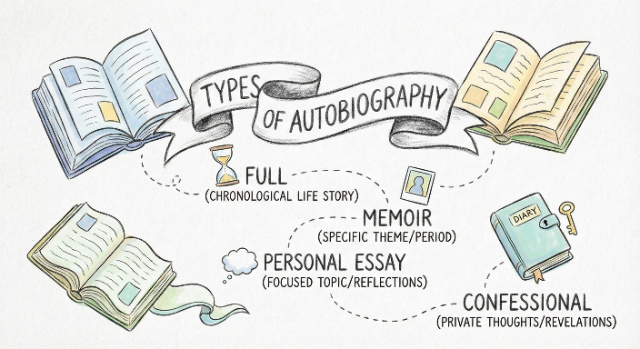
Not all autobiographies follow the same structure. Understanding your options helps you choose the right approach:
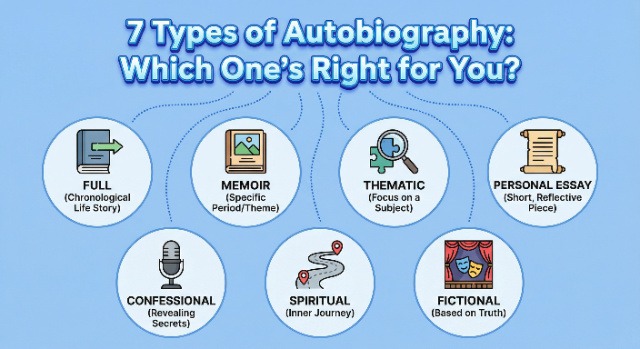
1. Full or Traditional Autobiography
Covers your entire life from birth to present in chronological order. This comprehensive format works best when you've achieved significant accomplishments, lived through notable historical periods, or want to create a complete record for descendants. Full autobiographies typically run 200-400 pages.
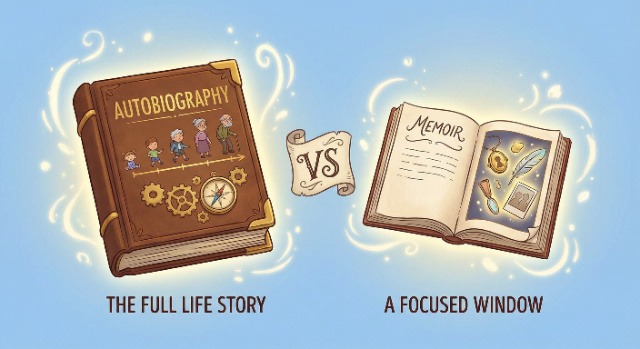
2. Memoir
Focuses intensely on specific periods, relationships, or themes rather than comprehensive coverage. If one transformative experience defines your story more powerfully than your entire chronology, a memoir might serve you better.
3. Personal Essay
The shortest and most focused form, exploring single events or brief periods in depth, typically 10-30 pages. These work excellently for academic assignments or literary magazine submissions.
4. Specialized Forms
Confessional autobiography: Reveals previously hidden aspects of your life
Spiritual autobiography: Chronicles your faith journey
Intellectual autobiography: Traces development of your ideas
Thematic autobiography: Organizes by topics rather than chronology
Exploring different types? Our comprehensive guide to types of autobiography examines each form with examples.
Comparison Chart: Autobiography vs. Related Genres
| Feature | Autobiography | Biography | Memoir |
|---|---|---|---|
| Author | The subject themselves. | Another person (a biographer). | The subject themselves (or a participant in the events). |
| Narrative Perspective | First-person ("I"). | Third-person ("he," "she," "they"). | First-person ("I"). |
| Source Material | Personal memory, diaries, letters, and firsthand experience. | External research: archives, interviews, historical records, others' accounts. | Personal memory, focused on reflection and internal experience. |
| Scope & Structure | Comprehensive and chronological. Covers life from birth (or early childhood) to the present or a late stage. | Comprehensive, but defined by the biographer. Typically chronological, covering a whole life or a major portion. | Selective and thematic. Focuses on a specific period, relationship, or theme (e.g., career, addiction, travel). |
| Primary Goal | To document and narrate the factual story of one's own life. | To document and narrate the factual story of someone else's life. | To explore emotional truth, insight, or transformation within a defined experience. |
| Emphasis | Factual accuracy, completeness, and historical record of a life. | Objective analysis, context, and an authoritative account based on evidence. | Subjectivity, narrative craft, reflection, and personal meaning. |
| Tone & Style | Often formal, informative, and historical. Can be intimate but is driven by chronology. | Analytical, journalistic, or scholarly. Seeks balanced authority. | Literary, intimate, contemplative, and impressionistic. Prioritizes storytelling. |
| Key Strength | Authentic, insider access to the subject's thoughts and private experiences. | Objectivity and broader context, providing a researched perspective the subject might lack. | Depth over breadth; powerful emotional resonance and universal themes from a specific lens. |
| Potential Limitation | Lack of objectivity; can be self justifying or have gaps in self-awareness. | Lacks intimate, firsthand perspective; relies on interpretation of external sources. | Not a full life story; may sacrifice strict chronology/fact for narrative effect. |
Need detailed comparison? Our guide on autobiography vs memoir explores these differences thoroughly.
How to Write an Autobiography: 7 Step Process
Writing an autobiography follows a clear, systematic approach. Here's the complete process from blank page to finished manuscript:
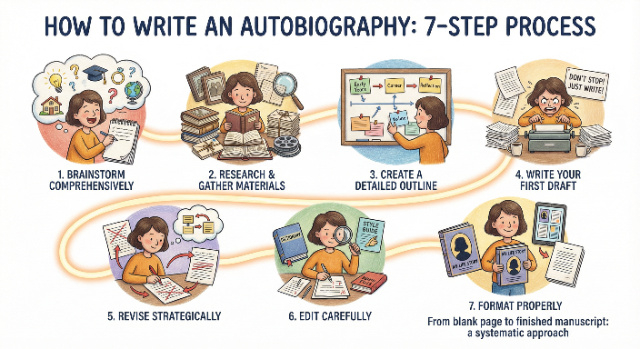
Step 1: Brainstorm Comprehensively
Before writing a single sentence, generate extensive lists without editing or organizing:
A. Major life events: Births, deaths, marriages, divorces, graduations, job changes, relocations, and milestone moments. Include both joyful and difficult events struggles often teach more than successes.
B. Turning points: Moments when your life changed direction. Decisions you made, opportunities that arose, failures that redirected you, or encounters that shifted your perspective.
C. Influential people: Who shaped you? Parents, siblings, teachers, mentors, friends, romantic partners, rivals, or strangers who left lasting impact. For each person, note specific memories and how they influenced your development.
D. Significant places: Where did formative experiences occur? Childhood homes, schools, cities you lived in, workplaces, or meaningful destinations. Places trigger detailed memories of events and emotions.
E. Challenges overcome: What obstacles did you face? How did you respond? What did you learn? Overcoming adversity creates powerful narrative material.
F. Proudest moments: When did you feel most accomplished or fulfilled? These highlights balance difficult material and show your growth.
G. Biggest mistakes: What do you wish you'd done differently? Honest acknowledgment of errors makes your autobiography authentic and relatable.
Don't organize during brainstorming just capture everything. Some memories trigger others through association. Follow those connections.
Step 2: Research and Gather Materials
Memory alone rarely suffices for detailed, accurate autobiography. Supplement your recollections:
Interview family members: Parents, siblings, grandparents, and long time friends remember events you've forgotten. They provide different perspectives on shared experiences and confirm or correct your memories.
Questions to ask:
- What was I like as a child?
- What family challenges did we face?
- What do you remember about my school years?
- What surprised you as I grew up?
- What family stories should I know?
Collect documentation: Gather photographs, school records, report cards, yearbooks, employment documents, certificates, awards, old letters, and journals. These materials refresh memory and provide concrete details about dates, places, and events.
Verify facts: Check dates, confirm spellings of names and places, and ensure memory aligns with historical reality. Small errors undermine your entire narrative's credibility.
Step 3: Organize Your Materials
With brainstorming complete and research gathered, create a detailed outline before drafting. These autobiography writing tips provides structure and prevents writer's block.
Choose your structure
Chronological organization: Moves from earliest memories through present day. This feels natural to most writers and readers, creates clear progression, and ensures comprehensive coverage. Divide into natural life periods: early childhood, adolescence, young adulthood, career development, mature years.
Thematic organization: Groups material by topics or life aspects family, career, relationships, travels, challenges. This highlights patterns clearly but can confuse readers about timeline.
Most successful autobiographies blend approaches primarily chronological with thematic elements woven throughout.
For each chapter, document:
- Chapter title and timeframe
- Main events (3-7 significant experiences)
- People to include
- Key facts and details
- Themes and reflections
- Transition notes
Step 4: How To Start Your Autobiography Draft
Focus on getting your complete story onto paper without worrying about perfection:
Set realistic goals: Commit to achievable targets perhaps 300-500 words daily or one chapter weekly. Consistency beats intensity.
Create your writing schedule: Block specific time slots and treat them as non negotiable appointments. Early mornings, lunch breaks, evenings, or weekends all work choose what fits your life.
Don't wait for inspiration: Show up at your scheduled time and write even when you don't feel inspired. Inspiration emerges during writing, not before.
Writing your introduction: Hook readers with a compelling moment, powerful quote, intriguing question, or glimpse at a crucial turning point. Establish your voice early and explain why your story matters.
Developing body chapters: Use specific details over vague generalizations. Include dialogue that brings people to life. Balance narration (what happened) with reflection (what it meant). Vary pacing slow detailed scenes for crucial moments, quicker summary for less important periods.
Crafting your conclusion: Reflect on your complete life arc, share wisdom gained, acknowledge ongoing growth, and leave readers with something meaningful to contemplate.
Step 5: Revise Strategically
Step away from your draft for at least a week before revising. Fresh eyes catch problems invisible during writing.
Big picture revision first:
- Does your overall organization work?
- Do chapters flow logically?
- Where does your narrative drag or rush?
- What important people, events, or periods need more attention?
- Do recurring themes emerge clearly?
Make structural revisions before enhancing individual passages.
Content enhancement:
- Add sensory details engaging all five senses
- Develop important scenes more fully
- Deepen reflection exploring meaning beyond facts
- Strengthen voice so your personality emerges clearly
Get feedback: Ask 2-3 trusted readers to review your manuscript and provide honest feedback about engagement, clarity, pacing, and authenticity.
Step 6: Edit Carefully
After major revisions, polish your prose to professional quality:
Check grammar and mechanics: Verify spelling, punctuation, and grammar throughout. Ensure verb tense consistency past tense for events, present for reflection.
Enhance style:
- Vary sentence structure mixing short punchy sentences with longer complex ones
- Strengthen verbs replacing weak verbs ("was," "went") with specific alternatives
- Eliminate redundancy removing unnecessary words
- Choose active voice over passive as your default
Final fact-checking: Verify all dates, names, places, and historical events one last time.
Step 7: Format Properly
Apply standard manuscript formatting with appropriate fonts, margins, spacing, and page numbers. Include necessary components like title page, table of contents, and acknowledgments.
Proper structure matters. Our Autobiography Format guide explains standard components, formatting conventions, and provides templates for every section.
How to Find Your Hook and Theme For Autobiography
Knowing how to start an autobiography is often the biggest hurdle. The beginning must capture attention and set the tone for your entire narrative.
Identify Your Core Theme and Motivation: Before writing a single line, ask yourself: What is the central message of my life story? Your story shouldn't be just a list of dates and events. Is it a tale of overcoming adversity, a journey of spiritual discovery, a chronicle of professional innovation, or a testament to the power of family? Identifying this overarching theme for an autobiography will guide every decision you make, from which stories to include to the tone of your writing. Are you writing to heal, to inform, to inspire, or to leave a record for your grandchildren? Clarifying your "why" fuels the entire project.
Brainstorm and Unlock Memories: Sit down with a notebook and use targeted autobiography prompts and life story writing prompts to jog your memory. Don't censor yourself; just write freely in response to questions like: What is your earliest memory? What was a pivotal turning point in your life? Who were your most influential mentors or challengers? What are you most proud of? What lesson was the hardest to learn? Answering a list of autobiography questions to answer is an excellent way to generate raw material and uncover forgotten stories that will enrich your narrative.
Choose a Compelling Starting Point (The Hook): You do not have to start with "I was born in..." in fact, it's often better not to. Your autobiography introduction should begin at a moment of tension, change, or vivid emotion, a hook that pulls the reader into your world. This could be:
A dramatic, life altering event (an accident, a realization, a loss).
A vivid sensory snapshot from your childhood (the smell of your grandmother's kitchen, the feel of your first uniform).
A concise statement of your central conflict or theme.
Review introduction from published works or see autobiography examples to see how masters of the genre grab their audience from the very first sentence.
Create a Working Template: With your theme and memories in mind, sketch a basic autobiography sketch. This is your roadmap and will prevent you from feeling lost midway. A classic autobiography often follows a chronological framework, but you can organize it thematically. Your outline should list potential chapters, each centered on a specific period, relationship, or challenge.
Decide on Scope and Voice: Will your book cover your entire life up to the present, or focus on a specific formative era (like your youth or career)? Also, establish your narrative voice—will it be the wise voice of your present self looking back, or the raw, immediate voice of your younger self experiencing events in the moment? This conscious choice defines the book's personality.
Autobiography Structure: Building Your Narrative Arc
A powerful life story requires more than just a chronological list; it needs a narrative arc. This section delves into the autobiography format and provides a practical autobiography to help you build a compelling manuscript, filled with actionable autobiography writing tips.
Foundational Structure: Chronology vs. Theme: The most common autobiography structure is chronological, moving from childhood to the present. This is clear and easy for readers to follow. However, a thematic structure can be more powerful. This involves grouping stories by topic—such as "Lessons from Failure," "Guiding Mentors," "Places That Shaped Me," or "My Creative Awakenings"—rather than strict timeline. Many successful autobiographies blend both, using a loose chronological flow with chapters that focus on specific themes or relationships. Consider what best way to structure a life story suits your specific experiences and theme.
The Essential Autobiography Outline: Here is a flexible autobiography template to adapt:
Introduction: The hook, theme, and narrative voice establishment.
Early Life & Influences: Family background, cultural context, seminal childhood experiences, and formative relationships. This sets the stage for who you will become.
The Rising Action (Challenges & Education): Adolescence, education, early career, first major struggles, relationships, and quests. This is where the central conflicts of your life deepen.
The Climax (Pivotal Turning Point): The major crisis, decision, achievement, or loss that defines your journey and forces profound change or realization. This is the heart of your story.
The Falling Action (Consequences & Growth): How you dealt with the aftermath of the climax. The new path, the lessons integrated, the person you became as a result.
The Resolution & Present Day: Where you are now, how the journey has settled, and the wisdom you carry forward.
Conclusion: Synthesis and final reflection (covered in detail in the next section).
Incorporate Reflection: Weave the perspective of your present, wiser self throughout the narrative. After describing a key event, pause to reflect on what it meant, what you misunderstood at the time, or how it connects to your life today. This reflective layer is what transforms a recollection into a meaningful autobiography.
How to Write a Conclusion for an Autobiography and Final Steps
The conclusion is your final opportunity to leave a lasting impression and complete the reader's journey. Knowing how to write a conclusion for an autobiography is about providing closure, insight, and a look toward the future. This section also covers the essential final steps to complete your manuscript.
Synthesize, Don't Summarize: Avoid simply relisting the events of your life. The autobiography conclusion should synthesize your experiences. Answer the "so what?" question. How do all the stories you've told connect? What is the overarching message or wisdom you've derived from your journey? Tie the narrative back to the core theme you established in the introduction.
Articulate Your Growth and Legacy: Clearly state how you have changed from the person you were at the beginning of the story. What are the core truths you now live by? What do you hope your story teaches others? This is where you discuss your legacy not in terms of wealth or fame, but in terms of values, lessons, and impact on those around you.
Look to the Present and Future: Bring the story fully into the present moment. Describe your current perspective, ongoing projects, or unrealized dreams. This creates a sense of continuity—your life story is still being written. You might end with a current hope, a philosophical belief about the future, or an ongoing commitment.
Craft a Resonant Final Image or Thought: End with a powerful, concise final thought, a piece of hard won wisdom, a hopeful vision, or a circling back to an image from the book's opening. This is what will linger in the reader's mind after they close the book.
Tell Your Story, Your Way
Expert-guided autobiography writing to preserve your legacy
- Expert Assistance
- Unlimited Revisions
- 24/7 Support
- Perfect Grades Guaranteed
Join thousands of satisfied students
Order HereAutobiography Writing Techniques: Essential Tips
Specific writing techniques elevate your autobiography from simple chronology to compelling narrative:
1. Finding Your Authentic Voice
Voice is what makes your autobiography uniquely yours, your personality on the page. Write the way you speak, use vocabulary natural to you, and express ideas in your characteristic manner. Don't imitate other authors' voices; develop your own.
Readers connect with genuine human voices, not artificial constructions.
2. Show Don't Tell
Transform flat narration into a vivid experience using specific details:
- Telling: "My father was strict."
- Showing: "My father checked my homework every night, initialing each page. Incorrect answers meant redoing the entire assignment, even if only one problem was wrong."
After narrating events factually, explore emotional dimensions. How did you feel? What did the experience mean? How do you understand it differently now?
3. Using Dialogue
Dialogue brings your autobiography to life, breaking up narrative passages and letting readers hear the voices of people who shaped your story. Reconstruct dialogue that captures the essence of what was said and how people spoke, even if not word perfect.
Use dialogue for important conversations, characteristic exchanges revealing personality, and turning point moments.
4. Creating Vivid Scenes
Strong descriptive writing resurrects the past for readers. Engage all five senses not just sight. What did your grandmother's kitchen smell like? What sounds filled your childhood home? What textures defined your experiences?
Use specific concrete nouns: not "flowers" but "red geraniums in clay pots." Not "music" but "Bruce Springsteen's 'Born to Run' crackling through ancient speakers."
5. Handling Difficult Experience
Most lives include painful chapters. Writing about difficult experiences requires extra care:
- Decide how much to share, balancing honesty with privacy
- Focus on your experience rather than assigning blame
- Write honestly but not cruelly, toward yourself or others
- Consider the impact your words might have on people involved
Not everything needs revealing. Some experiences may be too raw or too potentially hurtful to include in full detail.
How to Start an Autobiography: Overcoming Common Challenges
Every autobiographer faces obstacles. Understanding common challenges helps you persevere:
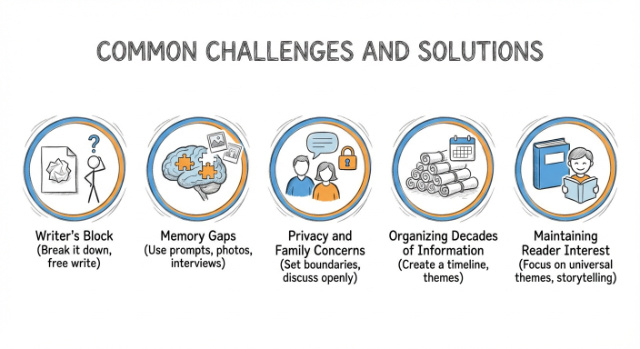
1. Writer's Block
When words won't come:
- Switch to a different chapter you're more excited about
- Free write for 10 minutes without editing
- Talk through a section with someone, then transcribe
- Change your writing environment
- Lower your standards temporarily write badly just to write
Writer's block often stems from perfectionism. First drafts are supposed to be messy.
2. Memory Gaps
If you can't remember important details:
- Accept that perfect memory isn't required
- Acknowledge uncertainty honestly in your text
- Interview relatives who might remember
- Review documents and photographs
- Search historical records for context
Memory gaps sometimes lead to powerful writing when you acknowledge them authentically.
3. Privacy and Family Concerns
Writing honestly about your life often means writing about others:
- Consider changing names and identifying details
- Focus on your experience rather than exposing others' secrets
- Ask permission when possible for sensitive material
- Share advance copies with people featured prominently
- Sometimes omission is wisest you can write completely without every detail
Balance honesty with kindness. Your truth shouldn't unnecessarily harm others.
4. Organizing Decades of Information
When overwhelmed by sheer volume:
- Create a master timeline listing major events with dates
- Group events into logical chapters
- Be selective highlight significant experiences while summarizing less important material
- Ask yourself: Does this reveal something important about who I am? Does it advance my narrative?
You're writing an autobiography, not a comprehensive database. Choose stories that matter most.
5. Maintaining Reader Interest
Create engagement through:
- Vivid scene setting with concrete details
- Focus on internal journey, how experiences changed you
- Thematic organization creates questions readers want answered
- Varied pacing detailed scenes for crucial moments, quick summary for less important periods
- Excellent prose with interesting observations and authentic voice
Need expert help bringing your story to life? Our professional trusted essay writing service pairs you with experienced writers who'll help craft your legacy.
Free Downloadable Resources For Autobiography
Support your writing journey with these comprehensive tools:
Autobiography Planning Workbook: Complete guide with brainstorming exercises, interview questions, and templates.
Complete Timeline Template: Visualize your entire life chronologically, identify natural chapter divisions.
Revision Checklist PDF: Comprehensive checklist ensuring you've addressed all critical elements during revision.
READY TO HAND IT OFF?
On a tight deadline or want professional help for an autobiography? We are here:
- 100% human-written by experienced writers
- Delivered on time, every time
- 24/7 Support
- Unlimited revisions until you're satisfied
Custom autobiography written just for you
Order NowConclusion
Writing an autobiography is one of the most meaningful projects you can undertake. It preserves your memories, shares your wisdom, and creates a lasting legacy for those who come after you.
Remember these key principles:
- Authenticity matters more than perfection. Your genuine voice and honest perspective create connection with readers far more effectively than polished prose that could have been written by anyone.
- Preparation prevents frustration. Time invested in brainstorming, researching, and outlining saves you from writer's block and structural problems later.
- Specific details create vivid reading. Concrete sensory descriptions immerse readers in your experiences better than vague generalizations.
- Balance facts with reflection. Readers want to know not just what happened, but what it meant and how it changed you.
- Persistence pays off. Autobiography writing requires sustained effort over weeks or months, but completing your life story is an achievement you'll treasure forever.
Your story matters. Your experiences, insights, and perspective have value worth sharing. Don't let fear, uncertainty, or perfectionism prevent you from documenting your journey.
Your story is waiting to be told. Now it's time to begin writing the most important story you'll ever tell your own.

-19285.jpg)