Autobiography Examples For Students
A blank page stares back at a student tasked with writing their life story, the cursor blinking with intimidating persistence. Student autobiography examples transform that overwhelming emptiness into a clear roadmap scattered childhood memories suddenly find their proper place, educational milestones connect like puzzle pieces, and future dreams crystallize into articulate paragraphs.
Finding My Voice: The Story of Who I Am
The morning sun streamed through the hospital windows on September 22, 2006, when I took my first breath in Chicago, Illinois. My parents, Robert and Maria Thompson, welcomed me into a modest apartment on the city's south side, where the sounds of jazz music drifted from neighboring windows and the aroma of home-cooked meals filled the hallways every evening. My name is Daniel Thompson, and this autobiography traces the journey that transformed a curious child from Chicago into the determined young person I am today.
Early Childhood Memories
My earliest memories paint vivid pictures of a childhood rich with love, laughter, and learning. Our small two-bedroom apartment became my first classroom, where my grandmother sat beside me every afternoon, her weathered hands turning pages of picture books while her gentle voice brought characters to life. The kitchen table served as my workspace, covered with crayons, construction paper, and endless possibilities.
My father worked long hours at a manufacturing plant, his calloused hands telling stories of hard work and sacrifice. Every evening, despite his exhaustion, he sat on the edge of my bed and listened to me recount my daily adventures. His tired eyes sparkled with genuine interest as I described imaginary kingdoms and heroic quests. My mother balanced her job as a nurse's aide with creating a nurturing home environment. The smell of her famous chicken soup still transports me back to sick days spent on the living room couch, wrapped in blankets and surrounded by her comforting presence.
My older sister, Carmen, played the role of protector, teacher, and occasional tormentor. She taught me to tie my shoes by creating a song about bunny ears and tree trunks. She defended me against neighborhood bullies and shared her Halloween candy when mine disappeared too quickly. Our sibling bond strengthened through shared experiences, whispered secrets, and countless hours of imagination-fueled play in our tiny shared bedroom.
Elementary School Years
Washington Elementary School opened its doors to me in September 2011, and I walked through them clutching my mother's hand with nervous anticipation. The building seemed enormous, its hallways stretching endlessly and filled with unfamiliar faces. My kindergarten teacher, Ms. Rodriguez, possessed a warm smile that immediately calmed my anxious heart. She recognized my shyness and gently encouraged participation without ever making me feel pressured or uncomfortable.
Reading became my sanctuary during these formative years. The school library transformed into my favorite destination, its shelves holding countless adventures waiting to unfold. Mrs. Patterson, the librarian with silver hair and colorful reading glasses, recommended books that matched my growing interests. She introduced me to fantasy worlds, historical adventures, and scientific discoveries that expanded my understanding of possibilities.
Third grade brought unexpected challenges when my family relocated to a different neighborhood. Leaving behind familiar friends and comfortable routines created anxiety that manifested in stomach aches and sleepless nights. Lincoln Elementary School felt foreign, its different layout and unfamiliar faces amplifying my insecurities. However, this transition ultimately strengthened my adaptability and social skills. Making new friends required stepping outside my comfort zone, approaching strangers during lunch periods, and joining playground games already in progress.
My fourth-grade teacher, Mr. Williams, discovered my passion for writing during a simple classroom assignment. He asked students to describe their favorite place, and my detailed description of my grandmother's kitchen earned enthusiastic praise and a spot on the classroom bulletin board. His encouragement ignited a flame that continues burning today. He submitted my short story to a district-wide competition, where it earned honorable mention and validated my emerging identity as a writer.
Middle School Transformation
Roosevelt Middle School represented a significant transition, introducing academic challenges, social complexities, and personal growth opportunities. The larger campus, rotating class schedules, and increased academic expectations initially overwhelmed my organizational systems. Assignments slipped through cracks, deadlines approached without warning, and my grades reflected this disorganization during the first semester.
My parents intervened with structured support rather than punishment. Together, we developed organizational strategies including color-coded folders, weekly planning sessions, and daily homework reviews. These systems gradually became habits, and my academic performance improved significantly by spring. This experience taught me valuable lessons about seeking help, accepting guidance, and implementing systematic approaches to challenges.
Seventh grade introduced me to competitive debate through an afterschool program led by Coach Martinez. Initially, the thought of speaking publicly triggered intense anxiety, my heart racing and palms sweating at the mere suggestion. Coach Martinez recognized my fear and paired me with experienced debaters who modeled confident presentation techniques. Gradually, through practice and encouragement, my voice strengthened and my confidence grew.
My first debate tournament arrived on a cold February morning. My hands trembled as I arranged my notes at the podium, facing judges whose expressions revealed nothing. The opening words caught in my throat momentarily before flowing with increasing confidence. Although my team placed third, the experience felt like a personal victory. Standing at that podium, articulating arguments I had researched and organized, marked a transformative moment in my personal development.
High School Journey
Jefferson High School welcomed me in August 2020, during unprecedented circumstances that challenged students worldwide. The global pandemic transformed educational experiences, replacing classroom interactions with virtual meetings and collaborative projects with independent assignments. Adapting to online learning required discipline, self-motivation, and technological problem-solving skills that extended beyond traditional academic preparation.
My freshman year unfolded primarily through computer screens, yet meaningful connections still emerged. Study groups formed through messaging platforms, virtual clubs maintained community connections, and teachers demonstrated remarkable creativity in engaging students remotely. This challenging period strengthened my appreciation for educational opportunities and highlighted the importance of adaptability in uncertain circumstances.
Returning to in-person learning during sophomore year felt simultaneously exciting and overwhelming. Social skills required recalibration, and academic expectations intensified after pandemic-related adjustments. Joining the school newspaper provided purpose and community during this transition. Writing articles about school events, student achievements, and community issues connected me with diverse classmates while developing practical journalism skills.
Currently, as a junior maintaining a 3.7 GPA, my schedule balances challenging coursework with meaningful extracurricular involvement. Advanced Placement English and History classes challenge my analytical thinking and writing abilities. Serving as assistant editor for the school newspaper demands leadership skills, deadline management, and collaborative problem-solving. Weekend volunteering at the community literacy center allows me to share my passion for reading with younger students who remind me of my own childhood self.
Personal Interests and Achievements
Beyond academic pursuits, photography captures my creative attention during leisure hours. My smartphone camera documents everyday moments that others might overlook morning light filtering through classroom windows, elderly couples walking through parks, children discovering playground adventures. These images tell stories without words, preserving fleeting moments that otherwise disappear into memory.
Music provides another creative outlet, with guitar practice filling evening hours with melody and rhythm. Teaching myself through online tutorials required patience and persistence, qualities that transfer to academic and personal challenges. The calluses on my fingertips represent hours of dedicated practice and the satisfaction of self-directed learning.
Future Aspirations
Looking toward the future, my aspirations combine my passion for writing with my desire to make meaningful impact on society. Pursuing a degree in journalism or communications will provide skills necessary for a career dedicated to storytelling that informs, inspires, and connects communities. I envision working for publications that amplify underrepresented voices and address social issues affecting everyday people.
This autobiography captures my journey from a curious child in a Chicago apartment to a determined young person preparing for the next chapter. Every challenge strengthened my character, every mentor shaped my direction, and every experience contributed to the person I am becoming.
What it shows: This autobiography example demonstrates how to structure a personal narrative around themes of growth, using specific anecdotes to illustrate resilience, mentorship, and evolving passions. What makes it work: Its effectiveness comes from vivid sensory details, a clear narrative arc from childhood to future goals, and reflective insights that connect experiences to personal development. Best for: Students applying to college or for scholarships, as it balances academic achievements, extracurriculars, and personal voice in a compelling, professional format. |
Struggling to Tell Your Story?
If your autobiography feels overwhelming and you don’t know where to start, you’re in the right place.
- Custom written autobiographies
- Authentic, personal storytelling
- Zero AI, fully original content
- Unlimited revisions
Every story is crafted carefully to reflect your voice and experiences.
Start Your AutobiographyAutobiography Example for High School Students
What it shows: Complete autobiography covering birth through age 17, organized chronologically. Perfect for standard high school assignments. What makes it work: Natural teenage voice, specific details (not vague), honest about both successes and struggles, appropriate academic format. Best for: High school English classes, college applications, personal development assignments. |
Autobiography Example for College Students
What it shows: More sophisticated example emphasizing academic journey and career goals. Demonstrates college level analysis and reflection. What makes it work: Deeper reflection than high school version, connects personal experiences to larger themes, professional tone without losing personality. Best for: Undergraduate assignments, scholarship applications, graduate school prep. |
Short Autobiography Example for Students (500 Words)
From Silence to Symphony
For sixteen years, my voice lived in a cage of my own making. It wasn't a lack of thoughts; my mind was a roaring river, but a profound fear that my words, once released, would be inadequate, judged, or worse, ignored. I was the student with the perfect, unmarked notebook, the one who communicated in thoughtful nods and meticulously crafted essays, but never in the spontaneous, terrifying arena of spoken debate.
The cage door was unlocked not with a bang, but with a whisper from Mr. Evans, my AP Literature teacher. After class, he handed back an essay where I had analyzed the defiant silence of a character. In the margin, he’d written: “Your insight is powerful. What might you lose by staying silent?” The question haunted me. I realized my silence wasn't a sanctuary; it was a surrender. I was losing my own narrative.
My revolution began small and shaky. I forced myself to raise my hand once per class, my heart hammering against my ribs as if trying to escape. The first few times, my voice cracked, my points were rushed. But no one laughed. The sky didn't fall. I joined the yearbook staff, not as a writer, but as an interviewer, a role that required listening and then responding. It was a bridge; I wasn't just speaking, I was engaging in a dialogue for a purpose larger than myself.
The true test came with our final project: a fifteen-minute solo presentation on a modern poet. The old fear was a tidal wave. I spent weeks crafting every sentence, practicing in my room until I could recite it backwards. When the day arrived, I stood before the class, my notecards trembling. I took a breath, looked up, and saw not a panel of judges, but my classmates Sarah who was terrified of calculus, David who had bombed his chemistry exam. They were just people, too.
And then, a miracle happened. Midway through, I deviated from my script. A connection I’d never planned sparked in my mind, and I shared it. It was messy, unpolished, and utterly mine. The cage door swung wide open.
Now, I seek the conversations I once fled. I lead study groups, question guest speakers, and advocate for club funding before the student council. My voice is not always the loudest or the most eloquent, but it is present, accounted for, and finally free. I learned that finding your voice isn’t about discovering something new, but about having the courage to use the one you’ve always had.
What it shows: Three different approaches to compressed autobiography proves you can tell a complete story in just 500 words when needed. What makes it work: Laser focused on one theme, every sentence counts, still feels complete despite brevity. Best for: Application essays, contest entries, intro assignments, and getting to know you papers. |
Creative Autobiography Example for Students
What it shows: How to add literary flair such as vivid details, reconstructed dialogue, creative structure while staying truthful. What makes it work: Reads like a story, not a timeline. Uses fiction techniques for nonfiction content. Best for: Creative writing classes, literary magazine submissions, students who hate boring formats. |
These autobiography examples demonstrate proper formatting for academic assignments. Each example follows autobiography format guidelines appropriate for student work.
Famous Classic Autobiography Examples
These established what great autobiography looks like. Study them for structure, voice, and how to make ordinary moments compelling.
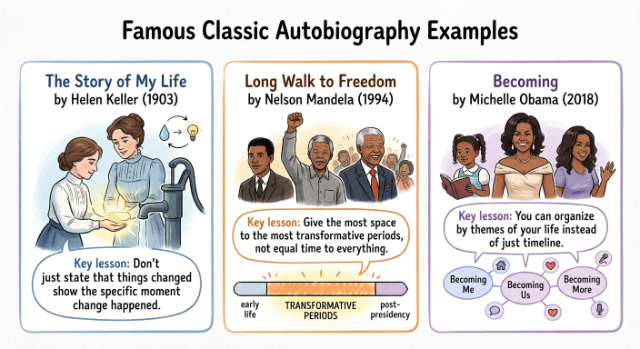
The Story of My Life by Helen Keller (1903)
Why it's useful: Shows how to write about challenges without self-pity. Uses specific sensory details despite her disabilities. Demonstrates transformation through education.
Key lesson: Don't just state that things changed, show the specific moment change happened.
Long Walk to Freedom by Nelson Mandela (1994)
Why it's useful: Balances personal story with historical events. Shows how to write about decades without getting boring. Stays human despite being about extraordinary circumstances.
Key lesson: Give the most space to the most transformative periods, not equal time to everything.
Becoming by Michelle Obama (2018)
Why it's useful: Three-part thematic structure ("Becoming Me," "Becoming Us," "Becoming More") instead of pure chronology. Relatable despite fame. Honest about struggles.
Key lesson: You can organize by themes of your life instead of just by timeline.
Running Out of Time to Write Your Life Story?
Deadlines, emotions, and memories piling up? Let us help you shape them into a powerful narrative.
- Personalized autobiography writing
- Human written, plagiarism-free work
- Confidential and secure process
- Revisions until it feels right
Join thousands of satisfied students
Get Started NowModern Autobiography Examples (2023-2025)
Recent bestsellers showing current trends: raw honesty, reclaiming narratives, challenging institutions.
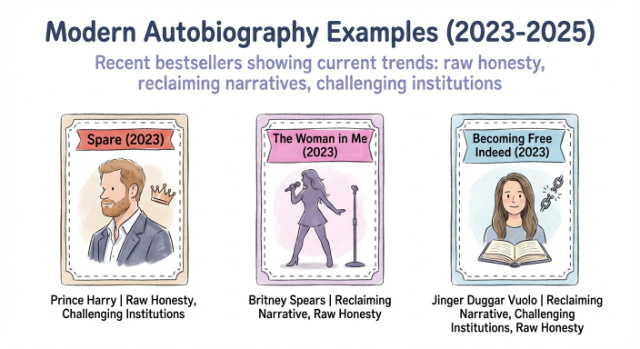
Spare by Prince Harry (2023)
What makes it current: Unprecedented royal candor. Discusses therapy, mental health, family conflict openly. Conversational tone, not formal.
Trend it shows: 2025 readers value vulnerability over polish.
The Woman in Me by Britney Spears (2023)
What makes it current: Reclaiming her story after years of others controlling the narrative. Direct, unfiltered voice.
Trend it shows: Autobiography as empowerment, taking back your own story.
Becoming Free Indeed by Jinger Duggar Vuolo (2023)
What makes it current: Nuanced faith evolution, not simple conversion story. Questions without losing belief.
Trend it shows: Modern spiritual autobiography embraces complexity and doubt.
Specialized Autobiography Examples

Cultural Autobiography Example
What it covers: Heritage, identity, navigating between cultures, immigration experiences, maintaining traditions.
Best for: Assignments focusing on cultural identity, ethnic studies classes, exploring your roots.
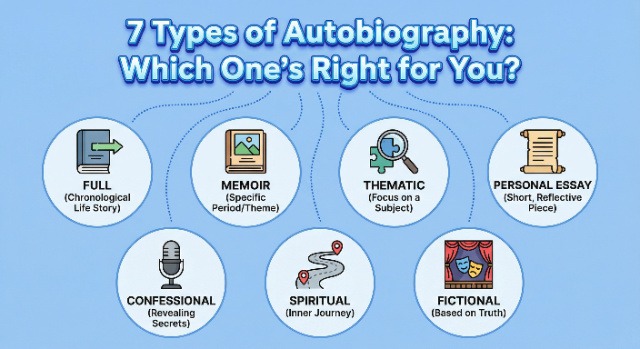
Want to see autobiography genres for every story imaginable? Visit our autobiography types guide to get started on writing your own.
Professional Autobiography Example
What it covers: Career journey, business achievements, leadership development, professional lessons learned.
Best for: Business school applications, professional development, LinkedIn "About" sections, career documentation.
Spiritual Autobiography Example
What it covers: Faith journey, belief development, religious experiences, how spirituality shaped life.
Best for: Religious studies classes, seminary applications, church communities, ministry purposes.
Autobiography Examples for Various Academic Levels
Need something matched exactly to your grade level?
Autobiography Example for Elementary (Grades 3-5):
- Simple chronological structure
- Focus on favorite memories
Autobiography Example for Middle School (Grades 6-8):
- More reflection than elementary
- Beginning to explore identity
Autobiography Example for High School (Grades 9-12):
- Sophisticated analysis
- Future goals emphasis
Autobiography Example for College/University:
- Academic tone
- Career focused
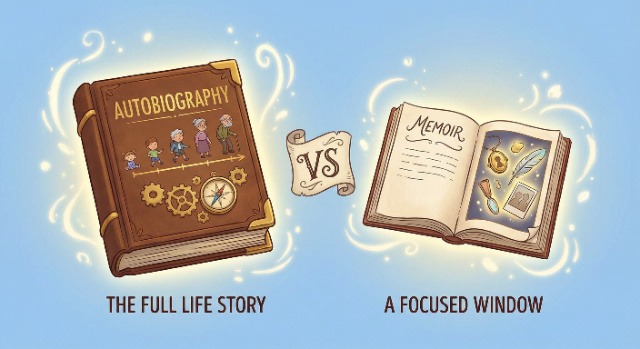
Many examples blur the lines between these related forms. Understanding autobiography vs memoir helps you analyze examples more effectively.
Key Features of a Compelling Autobiography Example
Every strong example shares these qualities:
- Specific details: Not "I went to school" but "Every morning at Roosevelt Elementary, I'd race to claim the beanbag chair by Mrs. Chen's reading corner"
- Honest reflection: Admits struggles and growth, doesn't just list achievements
- Clear structure: You can follow the story easily, transitions make sense
- Natural voice: Sounds like a real person, not a robot or thesaurus
- Focused: Tells a complete story without trying to include every single thing that ever happened
Famous Autobiography Examples & Their Significance
Here's a curated list of notable autobiographies with their core significance summarized in three to four words:
| # | Autobiography | Author | Significance |
|---|---|---|---|
| 1 | The Diary of a Young Girl | Anne Frank | Holocaust witness testimony |
| 2 | Long Walk to Freedom | Nelson Mandela | Anti apartheid leadership journey |
| 3 | I Know Why the Caged Bird Sings | Maya Angelou | Triumph over trauma |
| 4 | The Autobiography of Malcolm X | Malcolm X & Alex Haley | Radical transformation narrative |
| 5 | I Am Malala | Malala Yousafzai | Youth activism courage |
| 6 | Night | Elie Wiesel | Holocaust survival memoir |
| 7 | The Story of My Life | Helen Keller | Overcoming disability inspiration |
| 8 | Bossypants | Tina Fey | Comedic feminist voice |
| 9 | Open | Andre Agassi | Athletic career disillusionment |
| 10 | A Moveable Feast | Ernest Hemingway | Expatriate literary life |
| 11 | My Bondage and My Freedom | Frederick Douglass | Slavery to freedom |
| 12 | The Story of My Experiments with Truth | Mahatma Gandhi | Spiritual political philosophy |
| 13 | Persepolis | Marjane Satrapi | Iranian revolution graphic memoir |
| 14 | Born a Crime | Trevor Noah | Apartheid era humor resilience |
| 15 | Angela's Ashes | Frank McCourt | Irish poverty childhood |
| 16 | Shoe Dog | Phil Knight | Entrepreneurial startup journey |
| 17 | The Year of Magical Thinking | Joan Didion | Grief and mourning |
| 18 | A Writer's Diary | Virginia Woolf | Creative process insight |
| 19 | Down and Out in Paris and London | George Orwell | Poverty exploration memoir |
| 20 | Dreams from My Father | Barack Obama | Racial identity exploration |
| 21 | A Life in Parts | Bryan Cranston | Acting craft dedication |
| 22 | Borrowed Time | Paul Monette | AIDS crisis memoir |
| 23 | Educated | Tara Westover | Self education liberation |
| 24 | Just Kids | Patti Smith | Artistic partnership portrait |
| 25 | Lab Girl | Hope Jahren | Scientist's life story |
| 26 | Man's Search for Meaning | Viktor Frankl | Holocaust psychological survival |
| 27 | My Life | Bill Clinton | Presidential legacy reflection |
| 28 | On Writing: A Memoir of the Craft | Stephen King | Writer's life guide |
| 29 | Out of Africa | Karen Blixen | Colonial Kenya portrait |
| 30 | The Diving Bell and the Butterfly | Jean Dominique Bauby | Locked in syndrome testament |
| 31 | The Glass Castle | Jeannette Walls | Dysfunctional family resilience |
| 32 | The Liars' Club | Mary Karr | Memoir genre revival |
| 33 | The Road from Coorain | Jill Ker Conway | Australian feminist awakening |
| 34 | Wasted: A Memoir of Anorexia and Bulimia | Marya Hornbacher | Eating disorder recovery |
| 35 | When Breath Becomes Air | Paul Kalanithi | Facing mortality memoir |
| 36 | Wild | Cheryl Strayed | Healing through wilderness |
| 37 | Winston Churchill: My Early Life | Winston Churchill | Leadership formative years |
| 38 | Running with Scissors | Augusten Burroughs | Bizarre childhood memoir |
| 39 | Fun Home | Alison Bechdel | Graphic family memoir |
| 40 | Hillbilly Elegy | J.D. Vance | American working class analysis |
And if you're stuck or running out of time? Seek assistance from our professional essay writing service to get the A grade results on your autobiography.
Downloadable Resource For Autobiography Examples
Want everything in one place? Explore a master pack of Free Autobiography Examples that brings together diverse genres, academic levels, and stylistic choices so you can read, compare, and learn from every approach in one seamless collection.
Examples Are a Map. Let Us Be Your Guide.
Let our specialized writers take your memories and transform them into a powerful, polished narrative.
- 100% Personal & Original
- Guaranteed Formatting
- Unlimited Revisions
- 24/7 Support
Your experiences deserve clarity, care, and authenticity.
Get Started NowBottom Line
You've got 20+ autobiography examples covering every grade level, type, and purpose. Download what fits your assignment, study how they're structured, then write your own version. For a comprehensive guide to mastering your story, explore our complete autobiography writing guide.

-19285.jpg)