Complete Annotated Book Review Example: Fiction Review
Sample Review: "Wonder" by R.J. Palacio
[ANNOTATION: Strong opening hook engaging the reader immediately]
R.J. Palacio's "Wonder" tells the story of August Pullman, a fifth grader with severe facial differences attending mainstream school for the first time. This middle grade novel explores themes of kindness, acceptance, and finding courage through adversity with remarkable sensitivity and emotional depth.
[ANNOTATION: Brief summary, only 2 sentences establishing character, situation, and themes. Appropriately concise for reviews.]
The novel's greatest strength lies in its multiple perspective structure.
[ANNOTATION: Clear thesis statement, specific claim about what works well]
Palacio doesn't limit the narrative to August's viewpoint but includes chapters from his sister Via, friends Jack and Summer, and former friend Miranda. This technique creates a rich, three dimensional portrait of how one person's differences affect an entire community. When we read Jack's perspective on befriending August, we understand the social pressures he faces: "I knew if I sat with August, I'd be a dead man" (Palacio 142).
[ANNOTATION: Specific textual evidence with page number supporting claim]
Multiple viewpoints prevent the novel from becoming preachy, instead showing complex realities of kindness and cruelty from many angles.
[ANNOTATION: Demonstrates strong evaluation specific claim + explanation + textual evidence. Model to follow.]
Palacio's characterization feels authentic and age appropriate throughout. August's voice rings true for a ten year old dealing with extraordinary circumstances. He makes Star Wars jokes, loves his dog, and worries about normal kid things alongside his medical challenges. His sister Via feels equally real as a teenager struggling between supporting her brother and wanting her own identity. When Via thinks, "I love August, but sometimes I wish I could walk down the street without people staring," readers understand her conflicted feelings immediately.
[ANNOTATION: Another quote supporting characterization claim. Notice balance of explanation with evidence.]
Parents feel believably protective without being unrealistic. Every character serves clear purpose in exploring the novel's themes.
The novel does have minor weaknesses.
[ANNOTATION: Balanced review acknowledges both strengths and weaknesses]
Some conflicts resolve too neatly, particularly Julian's eventual isolation and the school's swift handling of bullying. Real schools rarely respond so effectively to social cruelty. Additionally, the precepts Mr. Browne shares, while meaningful, occasionally feel forced into the narrative rather than emerging naturally. These minor issues don't significantly detract from the overall impact but prevent the book from feeling completely realistic.
[ANNOTATION: Weaknesses are specific and explained, not just stated. Review contextualizes them as "minor," maintaining overall positive assessment.]
Palacio's writing style remains accessible for middle grade readers while tackling complex emotional territory. She never talks down to her audience or oversimplifies difficult situations. Pacing stays engaging throughout, balancing serious moments with humor and warmth. The Padawan braid incident and Halloween party scenes showcase Palacio's ability to capture authentic middle school social dynamics.
[ANNOTATION: Additional evaluation covering writing style and pacing. Each paragraph focuses on a specific evaluation criterion.]
"Wonder" succeeds brilliantly as both an engaging story and a thoughtful exploration of empathy and acceptance.
[ANNOTATION: Clear overall judgment]
Middle school readers will identify with the characters' struggles while gaining insight into treating others with kindness. Multiple viewpoints create depth rarely found in middle grade fiction. While some conflicts resolve somewhat unrealistically, the emotional truth of characters and relationships remains powerful throughout.
I highly recommend this novel for readers ages 8-14, though adults will find it equally moving.
[ANNOTATION: Specific audience recommendation]
It's particularly valuable for classrooms discussing bullying, empathy, or disability awareness. Readers who enjoyed "The One and Only Ivan" or "Counting by 7s" will appreciate "Wonder's" similar blend of heart and social insight.
[ANNOTATION: Recommendation includes comparison to similar books, helping readers contextualize the recommendation.]
What Makes This Book Review Effective
Strong Thesis and Organization: Opens with context, then immediately identifies the novel's greatest strength, multiple perspectives. Each subsequent paragraph explores a specific evaluation criterion: characterization, weaknesses, writing style, and overall impact.
Appropriate Summary Evaluation Balance: Summary comprises only first paragraph (~15%). Remaining 85% focuses on critical evaluation with specific evidence. Ideal ratio for reviews.
Specific Textual Evidence: Includes three direct quotes, each supporting specific claims. Quotes integrate smoothly into sentences with page numbers for credibility.
Balanced Assessment: Acknowledges significant strengths and minor weaknesses. Creates credibility, even though books have flaws. Contextualizes weaknesses appropriately as "minor."
Age Appropriate Sophistication: Demonstrates middle school critical thinking without attempting college level literary theory. Focuses on accessible elements like character development, multiple perspectives, and theme exploration.
Clear Recommendation: Specifies who would enjoy (ages 8-14) and compares to similar titles. Practical guidance helps readers decide.
UNSURE HOW TO CRITIQUE A CLASSIC?
Transform confusion into a confident, compelling review.
- Guidance on complex narratives & symbolism
- Balanced argument presenting multiple viewpoints
- Polished academic prose
- Money Back Guarantee
Submit with confidence. Understand the text on a deeper level.
Get Started NowBook Review Examples by Education Level: Elementary to College
Elementary Book Review Examples (Grades 3 to 5)
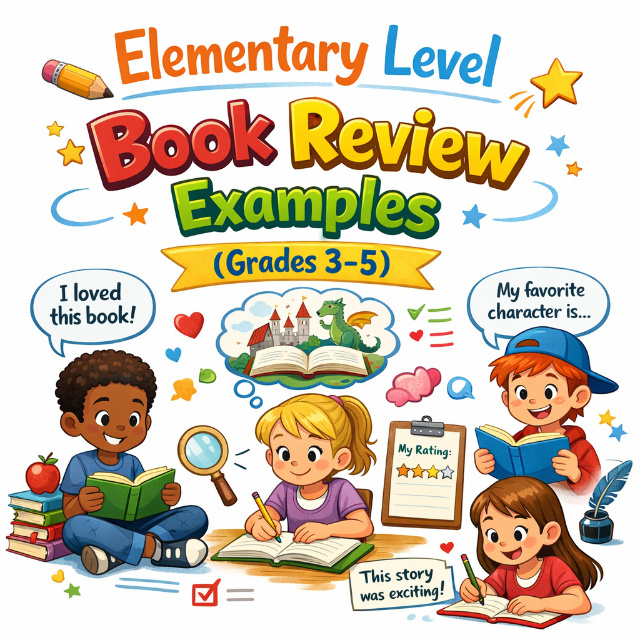
Book Review: "Charlotte's Web" by E.B. White "Charlotte's Web" by E.B. White is a story about a pig named Wilbur and his friend Charlotte, a spider who lives in the barn with him. Wilbur is sad because he might be killed, but Charlotte helps save him by writing words in her web that make him famous. I really liked this book because it made me feel happy and sad at the same time. Charlotte is very smart and kind. She thinks of creative ways to save Wilbur by writing words like "SOME PIG" and "TERRIFIC" in her web. I felt sad when Charlotte died at the end, but I also felt happy because her babies stayed with Wilbur. The book teaches important lessons about friendship. Charlotte helps Wilbur even though she doesn't have to, and she doesn't ask for anything back. It shows that real friends help each other and care about each other. I also learned that all living things matter, even spiders that some people don't like. My favorite part was when Wilbur goes to the fair and wins a medal. I was worried he wouldn't be special enough, but Charlotte's words made everyone notice him. The farmer and his family finally saw how special Wilbur was. I recommend this book to anyone who likes animals and stories about friendship. It's a little sad at the end, but it's still a great book. I think kids in third, fourth, and fifth grade would really enjoy it. |
What Makes This Book Review Effective
- Demonstrates age appropriate evaluation without sophisticated literary analysis
- Explains what happens (brief summary) and expresses personal feelings
- Simple but clear reasoning supports opinions ("I liked it because...")
- Identifies favorite parts and explains why
- Recommendation stays simple and practical
- Vocabulary and sentence structure match elementary capabilities
Middle School Book Review Examples (Grades 6 to 8)
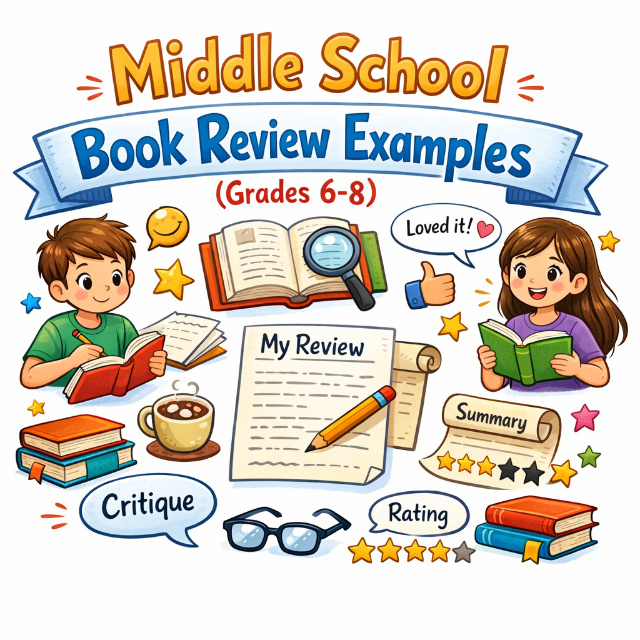
Book Review: "The Giver" by Lois Lowry Lois Lowry's "The Giver" presents a dystopian society where conformity and "Sameness" eliminate pain, but also color, emotion, and choice. Twelve year old Jonas receives the unique assignment of Receiver of Memory, learning from the Giver about the world before Sameness and ultimately questioning his community's foundations. The novel's dystopian world building stands out as exceptionally effective. Lowry reveals the society's disturbing realities gradually, allowing readers to discover alongside Jonas what "release" truly means and how much humanity sacrifices for stability. The bicycle, comfort object, and assignment systems feel plausible and detailed, creating a believable though disturbing world. This careful revelation makes horror more impactful than an immediate explanation would achieve. Jonas's character development from innocent conformist to critical thinker drives the narrative compellingly. His growing awareness mirrors readers' understanding as memories of color, music, and love awaken his consciousness. The scene where Jonas finally perceives color marks a pivotal moment: "The apple had changed... It had happened four times now" (Lowry 23). His transformation feels earned through accumulated experiences rather than sudden change. The Giver himself provides the novel's emotional core. His wisdom, loneliness, and ultimate sacrifice demonstrate the burden of knowledge and memory. The developing relationship between Jonas and the Giver adds warmth to an otherwise stark narrative, making their planning and Jonas's eventual escape emotionally resonant. However, the ending's ambiguity frustrates some readers. While open endings can be powerful, Lowry provides insufficient clarity about whether Jonas and Gabriel survive. Some appreciate interpreting the ending themselves; others find it unsatisfying after the novel's otherwise clear narrative. The ambiguity feels somewhat unearned given the rest of the book's directness. Lowry's writing style suits middle grade and young adult readers perfectly. Prose remains accessible without being simplistic, tackling complex philosophical questions about freedom, safety, and humanity. Pacing stays consistent throughout, building tension naturally toward Jonas's escape. "The Giver" succeeds as both engaging dystopian fiction and a thoughtful exploration of societal values. Middle school readers will find it accessible yet challenging, raising questions about conformity, emotion, and choice that spark meaningful discussions. Despite the somewhat frustrating ending ambiguity, the novel's themes and world building make it worthy of classic status. I recommend this book for readers ages 11-14 who enjoy dystopian fiction with philosophical depth. Fans of "Hunger Games" or "Divergent" will appreciate this earlier, more subtle dystopian exploration. It works exceptionally well for classroom discussions about freedom versus security and the value of human experience. |
What Makes This Book Review Effective
- Sophistication increases noticeably from the elementary level while remaining age appropriate
- Demonstrates structured criticism rather than just personal response
- Genre awareness appears explicitly (identifies dystopian conventions)
- Specific textual evidence supports claims with quotes and page numbers
- Evaluation criteria become more sophisticated (world building, character development, theme)
- Balanced critique emerges clearly (praises strengths, acknowledges controversial ambiguity)
- Comparative context helps readers (mentions similar books)
High School Book Review Examples (Grades 9 to 12)
Book Review: "The Great Gatsby" by F. Scott Fitzgerald F. Scott Fitzgerald's "The Great Gatsby" remains a definitive portrait of the Jazz Age, exploring the American Dream's corruption through Jay Gatsby's doomed pursuit of Daisy Buchanan. Through narrator Nick Carraway's perspective, Fitzgerald crafts a searing critique of 1920s American society's materialism, moral bankruptcy, and class stratification. Fitzgerald's symbolic imagery elevates the novel beyond simple plot into literary art. The green light at Daisy's dock symbolizes Gatsby's unattainable dreams and, by extension, America's perpetual striving toward illusory goals. The eyes of Doctor T.J. Eckleburg overlooking the ash heaps represent both absent moral authority and how appearance replaces substance in modern American life. The valley of ashes itself embodies moral and social decay hiding beneath the era's glittering surface. These symbols integrate seamlessly into the narrative, enriching meaning without feeling heavy handed or artificial. Fitzgerald's prose achieves remarkable lyrical beauty while maintaining narrative momentum. Sentences like "So we beat on, boats against the current, borne back ceaselessly into the past" demonstrate his ability to craft memorable, meaning laden prose. His descriptions evoke the era's sensory richness. Gatsby's parties burst with color, sound, and motion while suggesting emptiness beneath surface glamour. The writing operates on multiple levels simultaneously: engaging plot, symbolic depth, and social commentary. Characterization reveals class and morality with subtle complexity. Gatsby embodies both the American Dream's promise and its delusion; his wealth, built on criminal enterprise, can never buy acceptance into old money society. Daisy represents the beautiful object that loses appeal once possessed, her "voice full of money" exposing how romance and class intertwine inextricably. Tom's brutish confidence stems from inherited wealth and privilege, while Nick's simultaneous attraction to and repulsion from East Egg society mirrors readers' own conflicted responses. The novel's greatest weakness lies in dated gender and racial perspectives. Daisy and Jordan exist primarily as objects of male desire and symbols rather than fully realized characters. Tom's racist eugenics theories, while meant to demonstrate his character's moral bankruptcy, receive insufficient narrative challenge. Modern readers must contextualize these limitations as products of their era while recognizing they diminish the novel's contemporary relevance. Fitzgerald's narrative structure enhances thematic resonance significantly. Nick's retrospective narration allows for judgment alongside sympathy, his disillusionment mirroring readers' growing awareness of Gatsby's delusion. The chronology manipulation learning Gatsby's past through fragmented revelations creates mystery while demonstrating how individuals construct identity narratives, justifying present circumstances. "The Great Gatsby" succeeds brilliantly as both a period piece and a timeless exploration of American mythology. Its critique of wealth, class, and the corruption of idealism remains strikingly relevant. While gender and racial perspectives feel dated, the novel's literary artistry, symbolic depth, and thematic richness justify its canonical status. The prose alone rewards close reading with layered meanings and musical language. I recommend this novel for advanced high school readers and adults appreciating literary fiction emphasizing style, symbolism, and social criticism. Readers preferring plot driven narratives may find it slow paced and overly focused on atmosphere. However, those valuing beautiful prose and cultural criticism will find it exceptional. It pairs excellently with other Jazz Age literature or contemporary analyses of American Dream mythology. |
DEADLINE FOR YOUR BOOK REVIEW LOOMING?
Get a precise, high quality critique delivered fast.
- Express turnaround options available
- Zero fluff, pure critical insight
- Adherence to all rubric requirements
- Unlimited Revisions
Beat the clock without sacrificing quality. We’ve got you.
Order NowWhat Makes This Book Review Effective
- Literary analysis sophistication increases dramatically
- Examines symbolism, prose style, narrative structure using appropriate terminology
- Deeper contextual understanding (positions within Jazz Age culture, American Dream mythology)
- Critical perspective develops beyond simple evaluation (acknowledges dated perspectives, analyzes why)
- Sophisticated vocabulary and sentence structure match college preparatory expectations
- Textual evidence integrates seamlessly with analysis
- Evaluation criteria reflect literary concerns (symbol integration, prose quality, structural choices)
Before/After Book Review Examples: Weak vs Strong
Weak Book Review Example: Before Revision
Book Review: "Holes" by Louis Sachar
"Holes" by Louis Sachar is about a boy named Stanley Yelnats who gets sent to Camp Green Lake, a detention center for boys, even though he didn't do anything wrong. At the camp, the boys have to dig holes every day in the hot sun. The camp is run by the Warden, who is mean and is actually looking for treasure.
Stanley meets a boy named Zero who becomes his friend. Zero can't read, so Stanley teaches him. The book goes back and forth between Stanley's story and stories about his ancestors and about a town called Green Lake from a long time ago.
The book has a lot of characters. There's Stanley, Zero, X-Ray, Squid, Magnet, and other boys at the camp. There's also Mr. Sir and Mr. Pendanski who work at the camp. In the stories about the past, there's Stanley's great grandfather and a woman named Kate Barlow who was a schoolteacher.
I liked this book because it was interesting. The story kept me reading because I wanted to know what would happen. I liked how all the different stories connected at the end. That was cool.
The writing was good and easy to understand. The chapters were short which made it easy to read. I liked Zero as a character because he was nice and loyal to Stanley.
I think other kids would like this book. It's good for people who like adventure stories. The book shows that friendship is important and that you shouldn't judge people.
Problems with This Draft:
- Excessive Summary: 70% summarizes plot without evaluating quality
- Vague Evaluation: "interesting," "good," "cool" provide no specific analysis
- No Textual Evidence: Zero quotes or specific examples
- Missing Critical Analysis: Never addresses how Sachar's craft creates effects
- Weak Organization: Follows plot chronology rather than evaluation criteria
- Simplistic Conclusion: No specific guidance about who would enjoy
Strong Book Review Example: After Revision
Book Review: "Holes" by Louis Sachar
Louis Sachar's "Holes" weaves together multiple timelines spanning generations to create a masterfully plotted middle grade adventure exploring fate, justice, and friendship. Stanley Yelnats IV, wrongfully convicted of theft, endures Camp Green Lake's detention program, digging daily holes in a dried lakebed while discovering unexpected connections between his present circumstances and his family's century old curse.
Sachar's greatest accomplishment lies in the intricate plot structure interconnecting three timelines seamlessly. The novel alternates between Stanley's present day detention, his great great grandfather's Wild West encounter with outlaw Kissin' Kate Barlow, and his great grandfather's Latvian origins with Madame Zeroni. These seemingly disparate stories converge brilliantly in a climax, revealing how past injustices echo through generations. When Stanley carries Zero up the mountain, unknowingly fulfilling his ancestor's broken promise, readers experience genuine delight at recognizing the connection. Foreshadowing remains subtle enough to avoid obviousness while providing satisfying revelations.
Character development succeeds particularly with Stanley and Zero's friendship. Stanley begins as passive and accepting of unjust punishment, telling himself "his great great grandfather had been robbed by Kissin' Kate Barlow, and that's why his family had always been cursed." His evolution into someone who actively defies authority to rescue Zero demonstrates genuine growth. Zero's revelation that he's Hector Zeroni, descendant of Madame Zeroni, who cursed Stanley's family, creates poetic justice as their friendship breaks the generational curse. Their relationship develops authentically through shared struggles rather than forced sentimentality.
Thematic exploration of fate versus personal agency resonates throughout. The Yelnats family blames misfortune on ancient curses rather than examining their own choices. Stanley's eventual success comes not from luck but from the loyalty he chooses to help Zero despite consequences. Sachar suggests that while historical injustices create disadvantages, individual choices matter more than destiny. This message empowers middle grade readers without minimizing systemic inequality.
Sachar's writing style balances accessibility with sophistication. Short chapters maintain pacing perfectly for middle grade readers, creating natural stopping points without sacrificing momentum. Prose remains straightforward without being simplistic: "Stanley was not a bad kid. He was innocent of the crime for which he was convicted. He'd just been in the wrong place at the wrong time." This clarity serves the story effectively while modeling strong sentence variety and structure.
Minor weaknesses include occasionally convenient coincidences. While interconnected timelines create satisfying symmetry, some connections stretch plausibility, particularly Zero being specifically Hector Zeroni. However, fairy tale quality of these coincidences suits middle grade fiction, where poetic justice satisfies readers more than strict realism.
"Holes" succeeds as both entertaining adventure and thoughtfully crafted exploration of intergenerational justice, friendship, and agency. Intricate plotting rewards careful readers while remaining accessible to middle grade audiences. Sachar balances humor and heart, creating characters readers genuinely care about while addressing serious themes like wrongful conviction and systemic failure.
I highly recommend this novel for readers ages 9-14 who enjoy cleverly plotted adventures with satisfying connections. It works excellently for classroom discussion of justice, friendship, and narrative structure. Readers who appreciated "Hatchet" or "The Westing Game" will enjoy "Holes" for its similar blend of adventure and puzzle like plotting.
Improvements in Revision:
- Summary Reduced to 15%: Opening paragraph only
- Specific Evaluation Dominates: 85% focuses on critical analysis
- Textual Evidence Added: Direct quotes demonstrating claims
- Sophisticated Analysis: Explains how techniques create effects
- Clear Organization: Around evaluation criteria, not plot chronology
- Balanced Assessment: Acknowledges strengths and minor weaknesses
- Specific Recommendation: Targets ages, compares similar titles
Book Review Examples by Genre: Fiction, Non Fiction & Biography
Fiction Book Review Example Excerpt
From "The Night Circus" by Erin Morgenstern Morgenstern's greatest achievement lies in atmospheric world building that makes the circus feel tangible and magical simultaneously. The black and white color scheme creates visual distinctiveness that readers can picture clearly, while descriptions of individual tents, the Ice Garden's frozen beauty, and the Cloud Maze's disorientation evoke sensory wonder. When Morgenstern writes, "The circus arrives without warning. No announcements precede it," she establishes the circus's mysterious nature immediately, inviting readers into its enchantment. However, plot pacing suffers from atmospheric emphasis. The central competition between Celia and Marco develops slowly, with long stretches devoted to secondary characters whose connections to the main conflict remain unclear until late in the novel. While Bailey's storyline eventually intersects with the central plot, his extensive chapters feel tangential for much of the book. Readers seeking a plot driven narrative may find the pace frustratingly leisurely, though those valuing atmosphere over action will appreciate the immersive experience. |
What This Excerpt Demonstrates:
- Fiction reviews prioritize narrative elements (world building, pacing, character)
- Specific textual evidence supports atmospheric claims
- Balanced critique acknowledges atmospheric brilliance and plot/character weaknesses
- Genre awareness recognizes that some readers prioritize atmosphere, others need plot momentum
Non Fiction Book Review Example Excerpt
From "Educated" by Tara Westover Westover's memoir combines gripping narrative with thoughtful reflection on education's transformative power. Her straightforward prose conveys extraordinary experiences without melodrama, trusting events' inherent power rather than relying on literary embellishment. When describing her father's paranoid survivalism or her brother's violence, Westover presents facts and lets readers draw conclusions. This restraint strengthens rather than weakens the impact. The memoir's central thesis that education liberates by exposing alternative perspectives develops through accumulated experience rather than explicit argument. Westover shows how exposure to history, philosophy, and different worldviews gradually enabled her to question her family's reality. Her description of learning about the Holocaust demonstrates awakening: "I felt like I was seeing something I wasn't supposed to see." Education didn't simply provide facts; it revealed her sheltered upbringing's limitations. |
What This Excerpt Demonstrates:
- Non fiction reviews evaluate argument quality, evidence presentation, and analytical depth
- Evidence comes from specific memoir passages demonstrating techniques
- Critical analysis examines narrative choices (restraint in prose, complexity in characterization)
- Balanced assessment praises storytelling while noting where deeper critical distance might enhance understanding
Want reviews this strong for YOUR book? Our trusted essay writing service create sophisticated analysis matching your education level perfectly.
Free Book Review Example PDFs & Downloadable Templates
Key Takeaways: Book Review Examples
Studying effective book review examples accelerates writing development more than reading advice alone. Examples demonstrate principles in action, showing exactly how successful reviewers balance summary with evaluation, integrate textual evidence, and maintain analytical tone.
Examples across education levels show skill progression clearly. Elementary reviews demonstrate foundational evaluation with personal response. Middle school introduces structured criticism. High school incorporates literary analysis. College applies theoretical frameworks. Understanding progressions helps you write appropriately for your level.
Return to these examples repeatedly as skills develop. You'll notice different aspects at different stages. Techniques invisible initially become clear with practice. Each review you write strengthens critical thinking and analytical expression.
For complete guidance on the writing process, see our comprehensive Book Review guide.
Your review writing will improve dramatically with deliberate study of successful examples combined with consistent practice. Trust the process, apply observed techniques thoughtfully, and watch your ability flourish.
MASTER THE ART OF THE BOOK REVIEW CRITIQUE.
Learn from models crafted by writing specialists.
- Exemplary reviews that demonstrate best practices
- Analysis that goes beyond plot summary
- Perfect pacing and logical flow
- Full Ownership Rights
Don't just submit an assignment; master a skill.
Order Today