What is Spaced Repetition and Why Does it Work?
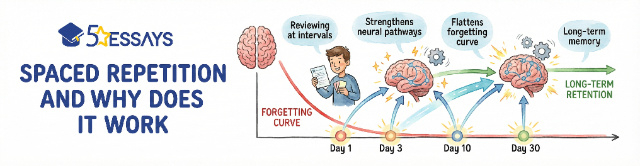
Spaced repetition is a learning technique where you review material at increasing time intervals rather than studying everything repeatedly in short bursts. Instead of reviewing your biology notes five times this week, you review them today, in three days, in one week, in two weeks, and in one month. Each successful retrieval strengthens the memory and extends the duration for which you'll remember it.
The Spacing Effect Explained
Your brain evolved to forget information that doesn't seem important. If you study something once and never reencounter it, your brain treats it as irrelevant and lets the memory fade. But if you're forced to recall that information repeatedly over time, your brain recognizes it as important and consolidates it into long-term memory.
Research from cognitive psychology demonstrates this dramatically. A 2023 study tracked 1,200 medical students learning anatomy terms. Students using spaced repetition schedules retained 87% of terms after six months. Students using massed practice (studying the same total hours but concentrated in shorter periods) retained only 24% after six months. The spacing group spent less total time studying but achieved 3.6 times better retention.
The key is timing your reviews just before you would forget. Review too soon, and your brain doesn't have to work hard to retrieve the information; minimal learning occurs. Review too late, and you've already forgotten, requiring you to relearn rather than strengthen existing memories. The optimal timing creates "desirable difficulty" where retrieval is challenging but successful.
Why Your Brain Needs Struggle
Each time you successfully retrieve information from memory, you strengthen the neural pathways connecting to that memory. This is called retrieval practice, and it's the mechanism that makes spaced repetition so effective. The slight difficulty of recalling information days or weeks later forces your brain to work harder than recognizing information you reviewed yesterday.
Think of memory like a path through a forest. Walking the path once leaves barely a trace. Walking it daily for a week creates a noticeable trail. But if you walk it weekly for months, allowing vegetation to partially regrow between walks, you create a permanent, deeply worn path that won't disappear. Your brain works the same way.
Forgetting Curves and Optimal Intervals
German psychologist Hermann Ebbinghaus discovered that we forget approximately 50% of newly learned information within 24 hours and 70% within a week without review. But each successful retrieval resets this forgetting curve at a higher level. After your first review, you might remember for three days. After your second review, you remember for a week. After your third review, you remember for a month.
The optimal spacing intervals roughly follow: 1 day, 3 days, 1 week, 2 weeks, 1 month, 3 months, 6 months. These intervals vary by content difficulty and individual differences, which is why adaptive spaced repetition systems that track your performance work better than fixed schedules.
For students managing multiple courses and assignments, many find that combining spaced repetition for core knowledge mastery with strategic support from an essay writing service for specific papers allows them to build lasting expertise while meeting all deadlines.
How Does Spaced Repetition Compare to Traditional Study Methods?
Understanding the dramatic differences between spaced repetition and other approaches helps you commit to the method despite its initially counterintuitive nature.
Spaced Repetition vs Cramming
| Factor | Spaced Repetition | Cramming |
|---|---|---|
| Initial Time Investment | Lower per session | Higher (long intensive sessions) |
| Total Time Required | 30-40% less overall | High (must relearn repeatedly) |
| Retention After 1 Week | 70-80% | 20-30% |
| Retention After 6 Months | 80-90% | 5-10% |
| Cognitive Load | Low (distributed practice) | High (mental exhaustion) |
| Exam Performance | Consistently strong | Variable, stress-dependent |
| Long-Term Knowledge | Permanent | Temporary |
Cramming feels efficient but is memory theater. You can hold information in working memory long enough for an exam, but it evaporates within weeks because you never consolidated it into long-term storage. Students who cram for every exam spend their entire academic career relearning the same material repeatedly.
Spaced repetition requires more planning and discipline upfront but produces exponentially better results with less total effort. A 2024 study following 800 undergraduate students across four semesters found that students using spaced repetition spent 35% less time studying while maintaining GPAs 0.4 points higher than matched peers using traditional methods.
Spaced Repetition vs Massed Practice
Massed practice means studying the same material repeatedly in a short time frame, reviewing your chemistry notes five times over two days. This feels productive because you experience rapid improvement during the practice session. But the improvement is temporary.
Spaced repetition distributes those same five reviews over weeks or months, creating permanent retention instead of temporary fluency. The difference lies in allowing time for memory consolidation between reviews. Your brain needs sleep and time to convert short-term memories into long-term storage. Massed practice doesn't allow this consolidation process to occur.
Research consistently shows that massed practice produces strong performance on immediate tests but poor retention over time. Spaced repetition produces adequate immediate performance and excellent long-term retention. For cumulative finals, standardized tests, or professional certifications, spaced repetition is definitely superior.
Spaced Repetition vs Re-Reading
Re-reading is the most common study technique and one of the least effective for long-term retention. When you re-read your textbook, you experience fluency the material feels familiar and comprehensible. But this fluency is recognition, not recall. You're not practicing the skill you need (retrieving information from memory).
Spaced repetition forces active retrieval instead of passive recognition. You must produce answers from memory rather than simply recognizing them on cthe page. This retrieval practice is what builds durable memory traces. Students who replace re-reading with spaced retrieval practice report spending less time studying while remembering significantly more.
A direct comparison study found that students who spent three hours re-reading retained 25% of the material after one month, while students who spent three hours on spaced retrieval practice retained 82% of the material after one month. The activities took the same time but produced vastly different outcomes.
For students facing extensive reading loads across multiple humanities courses, some find that using a professional essay writing service for specific papers creates time to implement spaced repetition for their cumulative exams and certifications, where long-term retention is critical.
How to Implement Spaced Repetition Effectively
The power of spaced repetition comes from consistent application using strategic intervals. Here's exactly how to build a system that works.
Create Your Study Materials First
Transform content into retrievable questions immediately after learning. Don't wait until exam time to create flashcards or study questions. After each lecture or reading session, spend 10-15 minutes converting key concepts into question answer pairs.
Good questions test understanding, not just recognition:
- Bad question: "What is mitosis?"
- Good question: "Explain the four stages of mitosis and what happens to chromosomes during each stage."
The act of creating questions forces you to identify what's actually important and how concepts connect. This initial processing enhances learning before you even start your spaced reviews. Students report this takes less time than traditional note-taking because you're creating direct study material instead of transcribing information you'll later need to process.
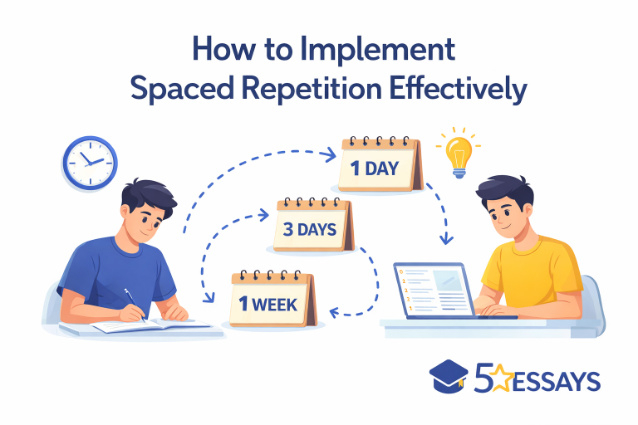
Use the 1-3-7-14-30 Day Schedule
Start with this proven interval pattern and adjust based on difficulty:
- Day 0: Learn the material (lecture, reading, initial study)
- Day 1: First review (should feel relatively easy)
- Day 3: Second review (slightly harder, some forgetting)
- Day 7: Third review (moderate difficulty, strengthens memory)
- Day 14: Fourth review (easier again, memory is consolidating)
- Day 30: Fifth review (should be quite easy, memory is strong)
- Day 60+: Periodic reviews as needed
This schedule creates the optimal "desirable difficulty" at each interval. You're forced to work to retrieve the information, but can still successfully recall it. Each successful retrieval extends the interval before you need to review again.
Track which cards or concepts you get wrong and review those more frequently. Easy items can be spaced out to 3-6 month intervals. Difficult items might need weekly reviews for longer periods before extending intervals.
Implement Active Recall During Reviews
Don't just flip flashcards over immediately. Try to retrieve the answer from memory, speak it out loud, or write it down, then check. This forced retrieval is what strengthens memory. If you instantly flip cards over to check answers, you're practicing recognition rather than recall.
For complex concepts, explain them fully as if teaching someone else. Don't settle for "I kind of remember," force yourself to articulate complete explanations. Incomplete retrieval doesn't provide the full learning benefit.
When you can't recall something, don't just review it once. Work with that concept for 2-3 minutes, create additional connections, then add it back into your review rotation for tomorrow. Failed retrieval is valuable feedback showing exactly where to focus effort.
Mix Topics During Review Sessions
Don't review all biology questions, then all chemistry, then all history. Interleave topics randomly during each review session. This interleaving creates additional cognitive challenge and improves your ability to discriminate between concepts and recognize when to apply each.
Research shows interleaved practice produces 20% better retention than blocked practice (studying one topic at a time). The cognitive challenge of switching between topics forces your brain to work harder, creating stronger memory formation. This approach also better mimics real-world applications where you must recognize which knowledge is relevant without category labels.
Track Your Progress and Adjust
Use a simple tracking system to monitor which concepts you're mastering and which need more work. This could be as simple as a spreadsheet noting dates reviewed and success rate, or as sophisticated as algorithmic software that automatically calculates optimal intervals.
Review your tracking data weekly. If certain concepts consistently cause problems, you need to either review them more frequently or restructure how you're learning them. Maybe the questions aren't specific enough. Maybe you need to connect them to more concrete examples. Failed retrievals aren't failures; they're diagnostic information.
For students managing heavy course loads with both spaced repetition schedules and major writing assignments, many find that using a reliable essay writing service for specific papers allows them to maintain their review schedules without missing critical study intervals.
Best Tools and Systems for Spaced Repetition
Effective implementation requires either disciplined manual tracking or algorithmic software that calculates optimal review schedules automatically.
Digital Spaced Repetition Systems
Anki (Free, cross platform)
Anki is the most powerful spaced repetition software available. It uses the SuperMemo 2 algorithm to calculate optimal review intervals based on your performance. Each time you review a card, you rate difficulty (Again, Hard, Good, Easy) and Anki schedules the next review accordingly.
- Benefits: Completely customizable, powerful add-ons, syncs across devices, handles images and audio, free forever. Used by medical students, law students, and language learners worldwide.
- Drawbacks: Steeper learning curve, requires initial setup time, interface is functional but not beautiful.
Quizlet (Freemium, web and mobile)
Quizlet offers a simpler interface with built-in spaced repetition through its "Learn" mode. The algorithm is less sophisticated than Anki but adequate for most students. The platform includes pre-made flashcard sets for many common courses.
- Benefits: User-friendly interface, quick setup, good mobile apps, a large library of pre-made cards, collaborative features.
- Drawbacks: Advanced features require a subscription, less control over the algorithm, and can't handle complex card formats as well as Anki.
RemNote (Freemium, web-based)
RemNote integrates note-taking with spaced repetition. As you take notes, you can tag concepts for spaced repetition review. This seamless workflow appeals to students who want note-taking and review in one system.
- Benefits: Integrated workflow, built-in spaced repetition, good for conceptual learning, and a clean interface.
- Drawbacks: Relatively new platform, some features are still developing, and premium features require a subscription.
Manual Spaced Repetition Systems
The Leitner Box System
Created in the 1970s, this physical system uses index cards and boxes to implement spaced repetition without software. You need five boxes labeled: Daily, Every 3 Days, Weekly, Every 2 Weeks, Monthly.
How it works: New cards start in Box 1 (Daily). When you get a card correct, it moves to the next box. When you get it wrong, it moves back to Box 1. This creates a natural spacing system where difficult cards appear more frequently and mastered cards appear rarely.
- Benefits: No technology required, tactile satisfaction, forces active writing when creating cards.
- Drawbacks: Time-consuming to manage, can't easily track statistics, difficult to use for large numbers of items, and no backup if you lose physical cards.
Spreadsheet-Based Tracking
Create a simple spreadsheet with columns for: Question, Answer, Last Reviewed, Next Review Date, Success Count. Sort by Next Review Date each day to see what needs review. When you successfully recall an item, extend the next review date according to your chosen interval schedule.
- Benefits: Complete control, works offline, simple to understand, portable across any device with spreadsheet software.
- Drawbacks: Requires manual interval calculations, no automatic scheduling, and easy to fall behind if you don't check daily.
Choosing the Right System for Your Needs
Choose Anki if: You're committed to serious long-term retention (professional exams, medical school, language mastery), you have time for initial setup, and you want maximum customization.
Choose Quizlet if: You want a quick setup with minimal learning curve, you study with classmates and want to share materials, or you prefer a clean, modern interface.
Choose RemNote if: You want integrated note-taking and review, you're building personal knowledge management systems, or you prefer web-based tools.
Choose manual systems if: You prefer physical materials, you're studying small amounts of highly conceptual material, or you find software distracting.
The best system is the one you'll actually use consistently. A simple manual system used daily beats sophisticated software abandoned after two weeks.
Many students find that combining spaced repetition tools for core course content with strategic use of a trusted essay writing service for major papers allows them to maintain consistent review schedules while meeting all academic deadlines.
Common Mistakes That Sabotage Spaced Repetition Success
Even students who understand spaced repetition theory often fail in practice. Avoid these errors that prevent the method from working.
Mistake 1: Waiting Too Long to Start
Students often wait until exam time to create flashcards and start reviewing. By then, it's too late for proper spacing. You need weeks or months of distributed reviews to build lasting retention. Cramming with spaced repetition software the week before an exam provides minimal benefit over traditional cramming.
Solution: Create review materials within 24 hours of learning new content. Start your spaced repetition schedule immediately. Even if an exam is months away, begin spacing now. This feels like "wasting time" on content you won't be tested on soon, but it's actually the optimal moment to begin consolidation.
Mistake 2: Creating Too Many Cards at Once
Students make 200 flashcards in one sitting, then feel overwhelmed by daily review volumes. Your review load compounds quickly; today's new cards become tomorrow's reviews, which become next week's reviews. Creating 50 cards means committing to hundreds of reviews over the coming months.
Solution: Limit new cards to 10-20 per day maximum. This keeps daily review time manageable (15-30 minutes) while still building substantial knowledge over a semester. It's better to fully master 1,000 well-spaced cards than to create 5,000 cards and abandon them within two weeks.
Mistake 3: Making Cards That Test Recognition, Not Recall
Bad cards show you a question and give you multiple choice answers or make you recognize the right answer when you see it. This doesn't build recall strength. You need to produce answers from memory.
Example of a bad card:
Front: "Mitosis includes
- Prophase, Metaphase, Anaphase, Telophase
- Prophase, Anaphase, Telophase, Metaphase?"
Example of a good card:
Front: "List the four stages of mitosis in order and explain what happens to chromosomes in each."
Solution: Force yourself to produce complete answers. For factual information, make yourself recall the entire answer. For concepts, make yourself explain in complete sentences. The harder retrieval challenge produces stronger learning.
Mistake 4: Reviewing Without Really Trying
Students flip through cards quickly, glancing at answers without genuine retrieval attempts. They see "photosynthesis" and immediately flip to see the answer because it "feels familiar." This creates the illusion of study without the benefit of retrieval practice.
Solution: Commit to 10-15 seconds of genuine retrieval effort before checking answers. Speak your answer aloud or write it down. Don't settle for "I kind of remember this" forceful articulation. Even failed attempts that require 15 seconds of thinking provide learning benefits that instant flipping doesn't.
Mistake 5: Inconsistent Review Schedule
Spacing only works if you maintain the schedule. Missing reviews breaks the carefully calculated intervals. Students often study religiously for two weeks, then skip three days, destroying the spacing benefit. Irregular reviews mean memories that were about to consolidate instead decay, requiring you to relearn rather than simply refresh.
Solution: Set a daily review appointment with yourself, ideally at the same time each day. Make reviews non-negotiable like brushing your teeth. Use phone reminders. Start with just 10 minutes daily consistency matters more than duration. If you must miss a day, do a double session the next day to catch up.
Mistake 6: Ignoring Failed Retrievals
Students mark cards "wrong" and immediately move on without addressing why they failed. Each failed retrieval is diagnostic data showing exactly where your understanding has gaps. Ignoring failures means repeatedly testing yourself on material you don't know instead of fixing the problem.
Solution: When you fail to retrieve something, spend 2-3 minutes working with that concept immediately. Review related information, create new connections, explain it aloud, and write it out. Then add it back into tomorrow's review rotation. Failed retrieval should trigger immediate remedial work, not just a note to see it again later.
For students discovering they've made these mistakes and need to recover their study effectiveness quickly, combining corrected spaced repetition practices with targeted support from a fast essay writing service for upcoming papers can help restore academic performance while building better long-term habits.
Conclusion: Building Permanent Knowledge With Spaced Repetition
The research is overwhelming: spaced repetition for long-term retention produces 200-300% better results than traditional study methods while requiring 30-40% less total time. Students using consistent spaced repetition schedules retain 80-90% of material after six months, while traditional cramming produces 20-30% retention after just two weeks.
Key Takeaways:
- Start spaced repetition immediately after learning; waiting until exam time negates the spacing benefit
- Use increasing intervals (1-3-7-14-30 days) to optimize the balance between effort and retention
- Create retrieval-based questions that force production, not just recognition
- Maintain daily review consistency, 10-20 minutes daily beats irregular, longer sessions
- Track and adjust your intervals based on performance 80-90% success rate is optimal
- Combine spaced repetition with other methods (practice problems for STEM, writing practice for humanities)
Stop wasting hundreds of study hours building temporary knowledge that vanishes weeks after each exam. Start implementing spaced repetition today to transform short-term learning into permanent expertise. Your future self, taking cumulative finals, professional certification exams, or applying knowledge in your career, will thank you for building retention that lasts.
For students managing demanding course loads while building long-term knowledge through spaced repetition, strategic use of a legit essay writing service for specific high-stakes papers allows you to maintain consistent review schedules while producing quality work across all academic commitments.
Begin today with just one course and 10 cards. Build the daily habit. Watch your retention compound over weeks into knowledge that lasts years.