
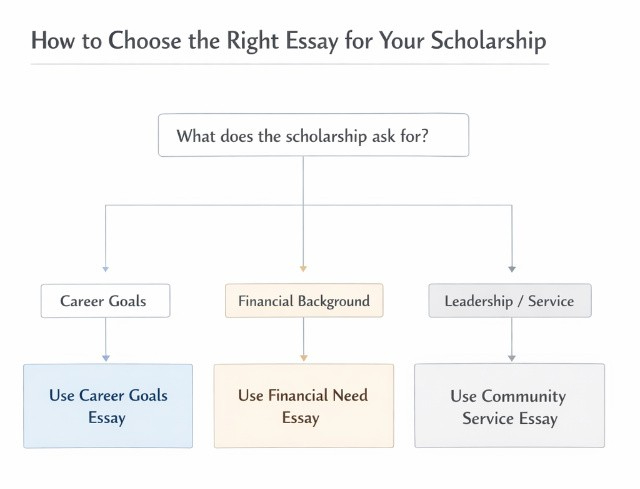
| Essay Type | Scholarship Focus | Word Count | Key Skills Demonstrated | Ideal For |
|---|---|---|---|---|
| Career Goals Essay | Academic & professional vision | 750 words | Goal clarity, planning, and impact alignment | STEM, merit based scholarships |
| Why You Deserve This Essay | Merit + need | 1,000 words | Persuasion, ROI thinking, achievements | General & competitive scholarships |
| Community Service Essay | Leadership & service | 750 words | Social impact, reflection, consistency | Leadership & service awards |
| Overcoming Challenges Essay | Resilience & growth | 800 words | Problem solving, maturity, reflection | Hardship & resilience scholarships |
| Financial Need Essay | Economic background | 500 words | Transparency, budgeting, and justification | Need based scholarships |
| Field of Study Essay | Academic motivation | 750 words | Subject passion, future contribution | Major specific scholarships |
| Short Scholarship Essay | General purpose | 500 words | Concise, clarity, focus | Fast applications & portals |
| High School Scholarship Essay | Early academic potential | 500–750 words | Potential, motivation, early impact | School leaver scholarships |
| College Scholarship Essay | Advanced academic profile | 750–1,000 words | Research, leadership, experience | Undergraduate & postgraduate awards |
STARING AT A BLANK PAGE WITH A DEADLINE APPROACHING?
We turn your experiences into committee winning essays while you focus on applications.
- Former scholarship reviewers who know what wins funding
- Strategic positioning that shows ROI on their investment
- Your authentic voice, not generic template language
- Unlimited revisions until it's funding worthy
Stop wrestling with structure. Start winning scholarships.
Order NowScholarship Essay Example #1: Career Goals ($5,000 STEM Scholarship)
Here's a complete scholarship essay explaining career goals and how the scholarship advances them. Notice how it connects personal experience to future impact.
Prompt: Describe your career goals and explain how this scholarship will help you achieve them. (750 words)
Building Bridges: From Immigrant Daughter to Civil Engineer
The summer I turned fourteen, I watched my father nearly die on a construction site when inadequate scaffolding collapsed. He survived with a broken leg and three fractured ribs. The contractor faced no consequences; my father's undocumented status meant he couldn't report the violation without risking deportation.
That incident revealed a truth I couldn't ignore: the people who build our infrastructure are often the most vulnerable to its failures. Five years later, I'm pursuing civil engineering with a specific mission, to ensure construction safety standards protect workers regardless of immigration status, and to design infrastructure that serves the communities who build it.
My path to engineering started unconventionally. While most of my peers were joining robotics clubs, I was translating safety violation reports for workers at my father's company who couldn't read English warning signs. I noticed patterns: the same violations appeared repeatedly across different sites. Inadequate fall protection. Missing guardrails. Scaffolding that didn't meet OSHA standards. When I brought this to my high school physics teacher, she helped me understand that these weren't just regulatory issues; they were physics problems with human consequences.
Junior year, I designed a bilingual mobile app that translates OSHA safety standards into Spanish, Vietnamese, and Mandarin, the three most common languages among construction workers in our region. What started as a class project now has 2,400 downloads and has been adopted by three local construction companies. More importantly, it's contributed to a 40% reduction in reportable incidents at the sites using it.
This experience crystallized my career direction. I'm not just interested in designing structures, I'm committed to reimagining how we approach construction safety and community infrastructure. My specific goals unfold in three phases:
Short term (2025-2027): Complete my B.S. in Civil Engineering at State University, with a concentration in structural engineering and a minor in Spanish. I'm already working with Professor Martinez's research team studying affordable seismic retrofitting for low income housing, the kind of housing my family lives in. Your scholarship would allow me to take the additional upper division courses in construction management and occupational safety that aren't covered by my financial aid package.
Mid term (2027-2030): Pursue my Professional Engineering license while working for a firm that prioritizes infrastructure in underserved communities. Organizations like Engineering Ministries International and Bridges to Prosperity align with my values. During this period, I plan to expand my safety app into a comprehensive platform connecting workers with legal resources, safety training, and workers' rights information.
Long term (2030+): Launch a nonprofit engineering consultancy that provides two services: pro bono structural assessments for affordable housing and workforce development programs training first generation immigrants in construction safety and project management. The model would be sustainable through consulting fees from larger projects funding free services for low income communities.
The $5,000 Engineering Excellence Scholarship specifically advances this timeline in concrete ways. Without it, I'd need to work 35 hours weekly at my retail job to cover expenses my financial aid doesn't reach. With it, I could reduce to 20 hours weekly and invest that time in three critical areas: taking the construction management course sequence essential for my professional goals, expanding my research with Professor Martinez to include three additional test sites, and developing the next version of my safety app with features that construction workers have requested.
More importantly, this scholarship validates something I tell the fifteen younger students I currently mentor through our school's first generation college program: scholarships fund students who will multiply the impact of that investment. Your dollar invested in my education doesn't just fund one engineer, it funds the infrastructure improvements I'll design, the workers whose safety I'll advocate for, and the next generation of Latino engineers I'll mentor.
I know what it takes to build things that last. I learned it watching my father return to construction sites despite his injury, because providing for his family mattered more than his pain. I learned it designing an app through seventeen iterations before construction workers actually found it useful. I learned it tutoring struggling students every Tuesday for two years because sustainable change requires sustained commitment.
Your scholarship funds an engineer who understands infrastructure at the human level, who knows the weight of responsibility that comes with designing structures people trust with their lives. I won't just build bridges that connect places. I'll build bridges that connect opportunity to the communities who've been building our world all along.
What Makes This Scholarship Essay Example Work
- Clear career progression: Specific short, mid, and long term goals with realistic timelines
- Personal connection: Origin story linking experience to career goals feels authentic, not manufactured
- Demonstrated impact: The 2,400 downloads and 40% reduction in incidents provide concrete evidence of capability
- ROI articulation: Explicitly shows what scholarship enables and who benefits beyond the student
- Authentic voice: Sounds like a real person, not a generic college essay template
- Strategic alignment: If this were for an engineering scholarship, it perfectly matches their mission of advancing STEM careers
- Specific numbers: $5,000 amount, 35 vs. 20 hours, 17 iterations, 2,400 downloads, specifics create credibility
But this is just an example and doesn't tell you much about formatting. If you want to know more about formats, have a look at our scholarship essay format guide.
Scholarship Essay Example #2: Why You Deserve This ($10,000 General Scholarship)
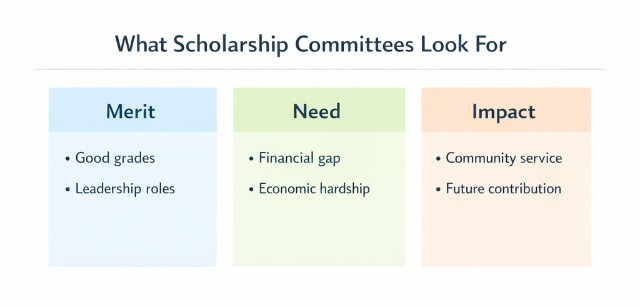
This scholarship essay example balances need, merit, and goals, the three elements committees evaluate when deciding who deserves funding.
Prompt: Why do you deserve this scholarship? (1,000 words)
Why I Deserve This Scholarship: An Investment in Multiplied Impact
I deserve this scholarship because I've already proven I multiply investments into community impact, and I have specific plans to scale that impact through my education.
Last year, with $200 of my own money and permission to use our apartment complex's laundry room, I started a free tutoring program. Twelve middle school students now show up every Thursday evening. Eight have improved their math grades by at least one letter. Three have brought their siblings. One mother told me her daughter now voluntarily does homework, something she'd never seen in ten years of parenting.
That $200 became improved grades for twelve students, reduced stress for their parents, and a model I'm now replicating in three additional apartment complexes. Your $10,000 scholarship would similarly multiply, funding my education while enabling expanded community impact that reaches hundreds more students.
Why I Need This Scholarship
I'll be direct about my financial situation because committees deserve transparency. My mother works two jobs: housekeeping during the day, and overnight stocking at a grocery store. My father's back injury two years ago meant permanent disability and Social Security payments that cover rent but little else. My younger sister starts high school next year with medical expenses from her diabetes management.
I work 25 hours weekly at Target, earning $14.50 per hour. My federal financial aid covers tuition and most fees. What it doesn't cover is the $4,800 gap between my aid package and actual costs, textbooks, transportation, technology, and unexpected expenses that force students like me to choose between buying required materials or continuing enrollment.
Last semester, I couldn't afford the $280 textbook for organic chemistry. I tried using library reserve copies, but with 300 students competing for 3 books, I frequently went to class unprepared. I earned a B- instead of the A I needed for my pre med track. This semester, I worked extra holiday hours to buy books upfront. My grades reflect it, 4.0 so far.
Your scholarship eliminates that monthly calculation of whether I can afford to stay enrolled full time or need to drop to part time and graduate a year late. It removes the barrier between where I am and where I need to be.
What I've Achieved Despite These Barriers
Financial need alone doesn't make someone deserving. What makes me deserving is what I've accomplished despite these constraints and what I'll accomplish with them removed.
Academically: 3.7 cumulative GPA while working 25 hours weekly. Dean's List three consecutive semesters. Accepted into the competitive Honors Biology program. Currently conducting research with Dr. Chen on antibiotic resistance in hospital settings, research that could improve patient outcomes in the public hospitals serving communities like mine.
Community Impact: Beyond the tutoring program, I volunteer 6 hours monthly at the free clinic where my family receives care, translating for Spanish speaking patients. I've logged 180 hours this year. Medical staff report that patients with translation support show 60% better medication adherence, a statistic that represents real people understanding how to manage their diabetes, hypertension, and chronic conditions.
Leadership: President of First Generation College Students Club (85 members). Created a textbook lending library that's saved members an estimated $12,000 collectively. Organized four campus sessions connecting first gen students with faculty mentors, financial aid advisors, and career counselors.
These aren't resume padding. Each initiative solves a problem I've personally faced or witnessed.
Where This Investment Goes
Your $10,000 scholarship funds three specific outcomes:
1. Timely graduation (2026): Without financial gaps forcing me to drop to part time, I graduate on schedule. This matters because every additional semester costs money and delays my ability to earn a physician's salary that supports my family.
2. Expanded research hours: Reducing work from 25 to 15 hours weekly gives me 10 additional hours for Dr. Chen's research. We're at a critical phase testing a new rapid diagnostic tool. More research hours mean faster progress toward a protocol that could reach clinical trials, and eventually, patients.
3. Tutoring program infrastructure: I'm currently limited by lack of materials, technology, and ability to expand to more sites. A small portion of scholarship funds (with committee permission) would purchase tablets for student use, educational subscriptions, and materials to launch at two additional locations. This scales impact from 12 students to 40+ students.
Why Your Organization's Investment Makes Sense
I researched your scholarship foundation's history. You've funded over 500 students in the past decade, prioritizing those who demonstrate both need and commitment to community service. Your mission statement emphasizes "investing in students who invest in others."
I am that investment. My track record proves it: $200 became twelve transformed students. 180 volunteer hours became measurably better patient outcomes. One textbook lending library became $12,000 in savings for struggling students.
Your $10,000 becomes:
- One physician serving underserved communities within five years
- Research potentially improving hospital protocols
- A tutoring model reaching 100+ students before I graduate
- A demonstrated example for the 85 first gen students I mentor that persistence and service lead to opportunities
The Difference Between Deserving and Merely Needing
Hundreds of students need this scholarship. What makes me deserving is this: I've already demonstrated, with far fewer resources than $10,000, that I create returns on investment. I don't just take opportunities; I multiply them into opportunities for others.
That mother who told me about her daughter doing homework voluntarily? She doesn't know that her comment is why I study until 2 AM despite my shift ending at 11 PM. It's why I'll spend every hour your scholarship buys me building something that outlasts my graduation.
You're not funding someone who hopes to make a difference someday. You're scaling the impact of someone already making a difference now.
That's why I deserve this scholarship.
What Makes This Scholarship Essay Example Work
- Balances three elements: Need (financial situation), merit (achievements), and goals (future impact)
- Quantifiable impact: 12 students, 8 improved grades, 180 volunteer hours, $12,000 saved collectively
- Honest about need: Direct, specific financial details without melodrama or excessive pleading
- ROI framing: Constantly articulates "your investment becomes..." showing how funding multiplies
- Evidence of capability: Doesn't just claim to be hardworking, proves it through documented achievements
- Alignment research: Shows knowledge of the scholarship organization's mission and values
- Confident tone: "I deserve," not "I hope you'll consider," or "I know I'm not the best candidate, but..."
Scholarship Essay Example #3: Community Service ($3,000 Leadership Award)
This scholarship essay example emphasizes service, leadership, and sustained commitment, which community focused scholarships prioritize.
Prompt: Describe your most significant community service contribution and what you learned from it. (750 words)
Teaching Tolerance Through Tutoring: Building Bridges One Conversation at a Time
I didn't set out to change anyone's perspective on immigration. I just wanted to help kids with their math homework. But somewhere between teaching fractions and explaining long division, my tutoring program became something bigger, a place where immigrant and native born families discovered their shared hopes for their children's futures.
It started small: three students, Thursday evenings, my apartment complex's community room. I printed worksheets at the library, brought snacks from my Target employee discount, and taught basic math concepts. Within a month, word spread. Within three months, I had a waiting list.
But the transformation happened when Mrs. Patterson asked to observe.
Mrs. Patterson was the complex manager, a white woman in her sixties who'd lived in our predominantly Latino neighborhood for thirty years. She'd been polite but distant with immigrant families, enforcing rules strictly and rarely engaging in conversation. When she asked to sit in on tutoring, I worried she was going to shut us down for some violation.
Instead, she stayed for the full two hours. She watched Juan struggle with fractions, then beam when he finally understood. She heard Elena translate my explanation into Spanish for her younger brother. She saw parents who worked two jobs arrive exhausted but stay to thank me for helping their children succeed.
The next Thursday, Mrs. Patterson brought supplies, dry erase boards, markers, a used but functional tablet she'd upgraded from. "For the program," she said simply.
Then she started staying. Not to observe, but to help. She worked with students on English reading while I covered math. She learned names, asked about families, celebrated improvements. Within six months, Mrs. Patterson became the program's most vocal advocate, successfully petitioning the complex management to give us a dedicated space instead of the laundry room.
The transformation wasn't just hers. Parents who'd avoided community spaces started attending. They swapped recipes, shared childcare, organized carpools. The tutoring program became the catalyst for breaking down walls that had stood for years.
What I Learned: Impact Comes From Showing Up
This experience taught me three principles that now guide every initiative I start:
First: Consistency builds trust. I've run this program every Thursday for 22 months without missing a session. Families don't need another inconsistent resource, they need someone who reliably shows up. When I tell the parents I'll be there, I'm there. That reliability creates trust that extends beyond academic support.
Second: Change happens through relationship, not programs. Mrs. Patterson didn't change her perspective on immigration because of policy arguments or news articles. She changed because she spent two hours every week watching real children work hard, seeing real parents sacrifice, recognizing shared values. The program succeeded not because of my curriculum, but because it created space for relationship.
Third: Small actions scale through commitment. I started with $40 of my own money and three students. Twenty two months later, we serve 19 students across four apartment complexes. The program requires 8 hours weekly, time I carve out despite working 25 hours and carrying 18 credits. That sustained commitment attracts others. Mrs. Patterson contributes 6 hours weekly. Two parents now volunteer as translators. A retired teacher from the neighborhood provides reading support.
The Numbers Behind the Impact
Quantifiable outcomes matter:
- 19 students currently enrolled
- 87% have improved their grades by at least one letter
- 12 families now participate in monthly community meals that didn't exist before the program
- 3 students who were considering dropping out are still enrolled and passing
- 240+ volunteer hours I've contributed over 22 months
- 6 additional adult volunteers recruited
- Zero cost to participating families
But the real impact shows up in moments the numbers don't capture: Juan's mother crying when he brought home his first B in math. Elena helping other students in Spanish without being asked. Mrs. Patterson advocating to city council for better streetlights in our neighborhood, calling families by name in her testimony.
Moving Forward
This experience shaped my career goals. I'm pursuing a degree in social work with a focus on community development because I've seen that sustainable change happens when you invest in community capacity, not just provide services. I'm designing a nonprofit model that replicates this program in under resourced neighborhoods across the city.
Your scholarship funds the education that enables this scaling. More importantly, it validates an approach that my work has proven: meaningful change doesn't require dramatic interventions. It requires showing up consistently, creating space for relationship, and trusting that small actions committed to over time create transformation.
That's what my tutoring program taught me. And that's what I'll spend my career building, one relationship, one community, one Thursday evening at a time.
What Makes This Scholarship Essay Example Work
- Specific transformative moment: The Mrs. Patterson story provides a narrative arc with a clear beginning, middle, and resolution
- Reflective learning: Explicitly names three principles learned, showing growth beyond just "I helped people"
- Quantifiable and qualitative impact: Provides both numbers (19 students, 87% improvement) and meaningful moments (mother crying, community meals)
- Sustained commitment: 22 months without missing a session shows reliability, not just one time service
- Ripple effects: Shows how the program catalyzed broader community changes (carpools, community meals, city council advocacy)
- Connection to future: Links experience directly to career goals in social work and nonprofit development
- Authentic voice: Sounds like genuine reflection, not trying to sound impressive
Scholarship Essay Example #4: Overcoming Challenges ($7,500 Resilience Scholarship)
This scholarship essay example shows how to write about hardship without making it a sob story, focusing on response and growth, not just the obstacle.
Prompt: Describe a significant challenge you've overcome and how it has shaped your goals. (800 words)
From Homeless to Honors: How Instability Taught Me to Build Sustainable Futures
Between my sophomore and junior years of high school, my family became homeless for seven months. We lived in our car, rotated through friends' couches, and spent two months at a shelter. I still graduated with a 3.8 GPA and earned admission to State University's Honors program.
But the interesting part isn't that I survived homelessness. Thousands of students do. The interesting part is what I learned during those months that now drives my goal to become an urban planner focused on affordable housing and homelessness prevention.
What Actually Happens When Everything Falls Apart
Our situation started like many others: my father's manufacturing job relocated to Mexico, then my mother's cancer diagnosis came with medical bills that exceeded our savings within six weeks. Eviction followed despite my parents working three part time jobs between them trying to catch up on rent.
The hardest part wasn't discomfort or uncertainty; it was invisibility. We looked like a normal family. I went to school, did homework in the public library, showed up to my part time job at the grocery store. Nobody knew I was sleeping in a car or that I showered at the YMCA before school.
I learned that homelessness doesn't look like the stereotypes. Most homeless families don't live on streets; they live doubled up with relatives, in cars, in shelters, moving constantly to avoid the system or finding temporary stability. We looked stable. We were anything but.
The Response: Creating Stability Through Structure
I couldn't control our housing situation, but I could control my response to it. I created structure where everything else was chaos:
First, I protected my academic trajectory. I emailed teachers explaining my situation (vaguely, just "experiencing family housing instability") and asking to submit work digitally when possible. I mapped out every library in our area with WiFi and hours. I built a routine: school, library until 9 PM, wherever we were sleeping. My grades actually improved that semester, 3.9 GPA, because structure became my anchor.
Second, I researched the system we were suddenly in. Why had we fallen through so many cracks? I discovered our city had 2,400 families on the waiting list for subsidized housing. Emergency shelter space for families totaled 87 beds across the entire county. Median rent required earning $23.50/hour, my parents' combined income was $18/hour when working.
The numbers revealed systemic failure, not personal failure.
Third, I started documenting. I kept a journal, not of emotions, but of barriers. The catch 22s: you can't apply for assistance without an address, but you can't get an address without income, but you can't maintain employment without an address. The shelter required parents to work during the day but offered no transportation. Services closed at 4:30 PM when my parents finished work at 5 PM.
These weren't oversights. They were design flaws.
How This Shaped My Goals
Seven months living in that system clarified two things:
First, individual resilience can't compensate for systemic failure. My 3.9 GPA during homelessness proved my determination, but it shouldn't have been necessary. Kids shouldn't need exceptional resilience to access education during housing instability. Systems should function well enough that ordinary resilience is sufficient.
Second, the people designing housing and social service systems rarely have lived experience in them. The gaps I documented, shelter curfews conflicting with work schedules, assistance applications requiring addresses, services requiring transportation to locations unreachable by public transit, these are obvious if you've navigated the system. They're invisible from outside it.
I'm pursuing urban planning with a dual focus: affordable housing development and homelessness prevention policy. My specific goal is to work with municipalities redesigning their housing and social service systems based on user experience, input from people actually navigating these systems.
We eventually found stable housing through a nonprofit program my mother learned about from another family at the shelter. Eight months after securing housing, my mother's cancer is in remission. My father found steady work. My younger siblings are thriving. But I'm aware we got lucky, most families don't exit homelessness within a year. Average time in family shelters in our county is 14 months. For many families, it becomes cyclical.
What Your Scholarship Funds
This $7,500 scholarship enables three things:
First, it ensures my education continues uninterrupted. I've qualified for substantial financial aid, but gaps remain. Without this scholarship, I work 30+ hours weekly, limiting my time for internships and research essential for urban planning careers.
Second, it funds my unpaid summer internship with the Regional Housing Authority. They've offered a position working on their homelessness prevention pilot program, exactly the experience I need. I can't afford an unpaid internship without scholarship support covering my summer living expenses.
Third, it validates something I tell every student I mentor who's facing housing instability: your current circumstances don't define your capabilities or future. Scholarships recognize potential and deserve, not just current stability.
Moving Forward
Homelessness taught me that resilience isn't exceptional; it's an ordinary human capacity responding to extraordinary circumstances. What's exceptional is having the luxury to not need it.
My goal isn't to celebrate my own resilience. It's to build systems good enough that ordinary people facing ordinary hardships don't need extraordinary resilience to survive them.
That's what your scholarship funds: not just one former homeless student's degree, but a career spent ensuring other families don't fall through the same gaps I documented seven months sleeping in a car.
What Makes This Scholarship Essay Example Work
- Proper ratio: 30% challenge, 70% response, and forward looking impact
- Avoids victimhood: Frames experience as a learning opportunity that shaped career goals, not just suffering
- Specific response actions: Lists concrete steps taken (mapped libraries, emailed teachers, documented barriers)
- Systemic analysis: Shows ability to analyze root causes, not just blame circumstances
- Clear ROI: Explicitly connects scholarship to summer internship and career preparation
- Authentic resilience: Acknowledges luck and privilege of exiting homelessness quickly, doesn't claim superiority
- Professional tone: Discusses hardship directly but without excessive emotion or melodrama
Scholarship Essay Example #5: Financial Need ($2,500 First Generation Award)
This short scholarship essay example addresses financial need directly and effectively without over sharing or pleading.
Prompt: Explain your financial need and how this scholarship will impact your education. (500 words)
Bridging the Gap: Why $2,500 Changes Everything
I'm $2,500 short. That's the gap between my financial aid package and what it actually costs to stay enrolled full time at State University.
My Expected Family Contribution is zero. My parents earn $31,000 combined. Federal aid covers tuition and fees. State grants cover housing. What no aid covers is textbooks ($800 annually), required technology ($400), transportation ($300), and unexpected costs like lab fees, course materials, and mandatory event fees.
Last semester, I couldn't afford the $180 lab manual for Chemistry 201. I tried sharing with a classmate, but lab sessions are individually timed, I frequently worked without the manual. I earned a C+ in a course that determines admission to the nursing program. This semester, I worked 15 extra holiday hours to buy course materials upfront. I'm currently maintaining an A.
Where the Money Goes
Your $2,500 scholarship covers three specific needs:
Fall semester textbooks and materials: $650. This includes the anatomy textbook ($240), nursing fundamentals textbook ($195), and required lab supplies ($215). Having these on day one means starting each course prepared, not three weeks behind while waiting for my paycheck to afford books.
Technology: $400 for a functioning laptop. Mine is seven years old, crashes during exams, and can't run the nursing simulation software required for three courses next year. I've been using campus computers, but their availability is limited and doesn't work for asynchronous coursework or evening study sessions.
Reduced work hours: $1,450 covering the income gap if I reduce work from 28 to 18 hours weekly. That 10 hour reduction translates to time for:
- Nursing skills lab practice (requires 6+ hours weekly outside class)
- Study time for courses with 85%+ exam averages required for nursing program admission
- Attending optional review sessions I currently miss due to work schedule
Why This Matters Now
I apply to the nursing program this spring. Admission is competitive, average accepted GPA is 3.6. I'm currently at 3.4, with that C+ from Chemistry dragging down my science GPA. I need A's in both fall courses to reach the competitive range.
Without this scholarship, I continue working 28 hours weekly, buying materials slowly as paychecks allow, using a laptop that crashes during important work, and sacrificing study time for shifts. With it, I'm a competitive applicant positioned to become the first licensed nurse in my family.
Return on Investment
This scholarship doesn't just fund two semesters. It funds:
- Entry into a profession with 85% job placement and $65,000 starting salary
- My ability to support my parents financially within three years
- The five younger cousins I mentor who see college as financially impossible
- A career serving the same rural underserved communities where I grew up
I've proven I can succeed despite barriers, 3.4 GPA while working 28 hours weekly. Your scholarship proves that success doesn't require choosing between education and survival. It removes the gap between potential and opportunity.
That's what $2,500 means: not charity, but investment in someone already demonstrating return.
What Makes This Short Scholarship Essay Example Work
- Direct opening: States the need clearly in the first sentence, $2,500 short
- Specific breakdown: Exactly where money goes ($650 textbooks, $400 technology, $1,450 reduced work hours)
- Evidence of impact: Shows how financial constraint affected grades (C+ in Chemistry)
- Tangible outcomes: Clear consequences of receiving/not receiving a scholarship
- ROI framing: Positions scholarship as investment, not charity
- Appropriate length: Fits a 500 word limit while covering all necessary points
- Professional tone: Discusses need without excessive emotion or over sharing family hardship
DEADLINE IN 24-48 HOURS? WE SPECIALIZE IN IMPOSSIBLE TIMELINES.
Rush delivery without rushed quality; our emergency service has funded 300+ last minute applications.
- Complete essay delivered in 24 hours (not a draft)
- Writers who've reviewed 1,000+ scholarship applications
- Strategic framing that maximizes your competitive advantage
- Same quality standards as our regular service
Your funding opportunity doesn't wait. Neither do we.
Order NowScholarship Essay Example #6: Field of Study ($4,000 Nursing Scholarship)
This scholarship essay example explains the choice of major and career plans with a clear connection between personal experience and professional goals.
Prompt: Why have you chosen your field of study, and what do you plan to contribute to this profession? (750 words)
Why Nursing: From Patient to Advocate
I chose nursing the night my grandmother died in the ER waiting room.
She'd been experiencing chest pain for six hours. We'd called three times. The triage nurse assessed her as low priority, assumed heartburn, told us to wait. She had a massive heart attack at 11:47 PM in a waiting room chair, thirty feet from the nurses' station. She died before they could move her to a treatment room.
The subsequent investigation revealed a preventable death. My grandmother had presented with atypical heart attack symptoms common in elderly women, nausea, back pain, fatigue. The triage nurse had followed standard protocols designed for typical male heart attack symptoms. Nobody had taught her to recognize gender and age differences in cardiac presentation.
I don't blame that nurse. I blame a system that trains medical professionals inadequately and fails to update protocols based on current research. I chose nursing because I want to be the person who ensures that other grandmothers don't die from outdated protocols and implicit biases in emergency care.
Why Nursing Over Other Healthcare Paths
I considered pre med. Physicians have more authority to implement systemic changes. But I chose nursing for three reasons:
First, nurses spend more time with patients. Physicians average 13-16 minutes per patient. Nurses spend hours. That time creates relationships where patients share information they don't tell doctors, information that changes diagnoses and treatments.
Second, nursing puts me at the frontline of healthcare inequality. Nurses work in emergency departments, community clinics, home health, public health departments, the places where underserved populations access care. Those are the populations I'm committed to serving.
Third, nursing offers diverse career paths beyond bedside care: nurse practitioners, clinical educators, policy advocates, researchers. I can pursue certification as a nurse practitioner serving rural communities (immediate patient care), teach nursing students at community colleges (improve training), and advocate for evidence based protocol updates (systemic change). Nursing offers breadth medicine doesn't.
What I'll Contribute: Three Pronged Approach
My contribution to nursing unfolds through three interconnected goals:
1. Culturally competent care for underserved populations
I'm pursuing nursing specifically to work in community health clinics and rural health centers serving low income and immigrant populations. I'm fluent in Spanish and currently volunteering 8 hours monthly at the free clinic where my family receives care, translating for patients and observing clinical interactions.
That volunteer work reveals gaps constantly: patients who don't take medications because instructions weren't explained in their language, patients who miss follow up appointments because they don't understand why they're necessary, patients who avoid seeking care until conditions become emergencies because they fear the system.
These aren't compliance problems, they're communication problems. My first contribution will be providing care that meets patients where they are, linguistically and culturally.
2. Evidence based practice updates
My grandmother's death wasn't unique. Women under recognize their heart attack symptoms and medical professionals under diagnose them because training emphasizes male symptom presentation. This happens across conditions: stroke symptoms differ by sex, pain presentation differs by race, medication responses differ by ethnicity.
I'm committed to staying current with research on these variations and advocating for protocol updates that reflect diverse presentations. During my career, I'll serve on clinical committees updating hospital procedures and volunteer with organizations like the American Heart Association updating public education materials.
3. Pipeline development for nursing students from underserved communities
Nursing faces a diversity crisis. Only 9% of registered nurses identify as Latino despite Latinos representing 18% of the US population. Only 6% of nurses work in rural areas despite 20% of Americans living there.
Diverse nursing workforces improve patient outcomes, research shows patients achieve better health outcomes when treated by providers who share their background and speak their language. We need more nurses from underserved communities because they're more likely to return to serve those communities.
I'm already mentoring three high school students interested in nursing, helping them navigate prerequisites and find shadowing opportunities. As my career progresses, I'll formally mentor nursing students, participate in university pipeline programs, and eventually teach at community colleges that serve first generation students.
How This Scholarship Advances These Goals
Your $4,000 Nursing Excellence Scholarship enables two things:
First, it covers the gap between my financial aid and actual costs, allowing me to continue full time enrollment. Part time enrollment would delay my graduation by a full year, postponing the moment I enter the workforce serving patients.
Second, it funds the additional certifications I'm pursuing alongside my degree, Basic Life Support, Advanced Cardiac Life Support, and Spanish medical interpretation certification. These certifications cost $800 total and aren't covered by financial aid, but they'll make me immediately more valuable to the community clinics where I'll work.
Your scholarship doesn't just fund one nursing student's education. It funds a career committed to addressing healthcare inequities, updating outdated practices, and building the diverse nursing workforce our communities desperately need.
That's what $4,000 buys: decades of impact on patients, protocols, and the next generation of nurses.
What Makes This Field of Study Scholarship Essay Example Work
- Origin story: Personal experience (grandmother's death) creates authentic motivation, not generic "I want to help people"
- Strategic career choice: Explains why nursing is over other healthcare paths with specific reasoning
- Specific contributions: Three clear goals with concrete plans for each
- Evidence of commitment: Already volunteering 8 hours monthly and mentoring students
- Systemic thinking: Understands root causes (outdated protocols, diversity gaps) and addresses them
- ROI articulation: Connects scholarship to certifications and career timeline
- Professional knowledge: Demonstrates understanding of the nursing profession and current challenges
Short Scholarship Essay Example (500 Words)
Many scholarships require shorter essays. Here's a complete 500 word scholarship essay that effectively covers career goals, need, and impact in a limited space.
Prompt: Tell us about yourself and why you're applying for this scholarship. (500 words maximum)
Building Better Futures: Why I'm Applying
I'm a first generation college student pursuing computer science with a mission: make technology education accessible to students who look like me.
Growing up in a neighborhood where gang involvement seemed more attainable than college degrees, I discovered coding through a free summer program at our community center. That eight week course changed my trajectory. Three years later, I'm maintaining a 3.6 GPA at State University, leading our Women in Computer Science chapter, and running the same type of free coding program for 30 middle school girls in my hometown.
Why I Need This Scholarship
The gap between my financial aid and actual costs is $3,200 annually. My mother works as a cashier earning $28,000 yearly supporting three children. My federal aid covers tuition; state grants cover housing. What's not covered: textbooks ($600), required software licenses ($400), laptop repairs ($300), transportation ($200), unexpected course fees ($700).
Last semester, I couldn't afford the required software for my database management course. I relied on campus computer labs, but their hours didn't accommodate my work schedule. I earned a B- in a course where lab access determined success. This scholarship closes the gap between my financial aid and what it actually costs to compete academically.
What I'm Building
Every Saturday morning, I teach coding to 30 middle school girls in my hometown. I designed the curriculum myself: basic Python, web development fundamentals, and introduction to data science. More importantly, I teach them that someone who looks like them, speaks like them, and comes from their neighborhood can succeed in technology.
The program started with eight students and $50 of my own money for supplies. Now we're in our second year with a waiting list, funded partially by local businesses but sustained primarily by volunteer effort. Twelve girls have continued to advanced courses. Four are considering computer science majors. One specifically told me she'd never imagined tech as a career until meeting me.
That's what representation does, it expands possibility.
Return on Your Investment
This scholarship funds more than my degree. It funds:
- My ability to graduate on time (2026) without financial disruption
- The expanded coding program I'm designing to reach three additional schools
- A career path toward becoming a software engineer at a company like Google or Microsoft, then eventually launching a nonprofit providing free tech education in underserved communities
- Proof to the 30 girls I teach that pathways exist from neighborhoods like ours to careers in technology
I've already demonstrated I multiply investments. Your scholarship accelerates that multiplication. The $3,200 that covers my textbooks, software, and reduces my work hours becomes decades of impact: students taught, programs scaled, career paths opened.
You're not just funding one student's education. You're investing in every student I'll teach, mentor, and inspire throughout my career.
That's why I'm applying. And that's why I deserve it.
What Makes This Short Scholarship Essay Example Work
- Efficient opening: Establishes identity, major, and mission in the first paragraph
- Specific financial need: Exact gap ($3,200) with breakdown
- Demonstrated impact: Already running program with measurable results (30 students, waiting list)
- Forward looking: Clear career goals and how scholarship accelerates them
- ROI framing: Positions scholarship as an investment throughout
- Strong conclusion: Confident statement of deserving
- Perfect length: 500 words exactly
Scholarship Essay Introduction Examples
Struggling with your opening? Here are three strong scholarship essay introductions with annotations showing what makes them work.
Introduction Example #1: Hook with Dialogue
"You're making a huge mistake," my uncle told me when I announced I'd chosen nursing school over the family business. "Nobody from our family becomes a nurse. You should be a doctor, or at least marry one."
That conversation was four years ago. I'm now in my third year of nursing school, maintaining a 3.7 GPA while working 20 hours weekly at the hospital where I'll eventually practice. My uncle was wrong about the mistake, but he was right that I'm doing something different. I'm the first in my family pursuing healthcare, the first woman choosing career over marriage timing, and soon, the first licensed nurse in three generations. Your scholarship funds the final year of that unconventional path.
Why this works:
- Opens with a surprising dialogue that reveals family dynamics
- Creates instant tension and stakes
- Establishes timeline (four years ago to now)
- State specific position (third year nursing school, 3.7 GPA, working 20 hours)
- Directly addresses scholarship in the final sentence
- Confident tone, not apologetic
Introduction Example #2: Hook with Pivotal Moment
The email arrived at 2:47 AM: my father's work permit had been denied. I stared at the screen in our darkened apartment, listening to my younger siblings sleep in the next room. Someone in our family was going to build a secure future. It would have to be me.
That night reshaped my timeline. I accelerated my course load, graduated high school a year early, and enrolled in State University's engineering program at 17. Two years later, I maintain a 3.8 GPA while working 25 hours weekly and sending money home monthly. I'm not just pursuing an education, I'm building the financial stability my family's immigration status prevents them from achieving.
Why this works:
- Specific time and detail (2:47 AM) creates immediacy
- Establishes stakes dramatically but not melodramatically
- Shows response (accelerated, graduated early, enrolled at 17)
- Quantifies current achievement (3.8 GPA, 25 hours weekly)
- Clearly states mission beyond personal success
Introduction Example #3: Hook with Surprising Statement
I've failed twice. I'm also one of the top students in my program.
My first startup failed after six months when our funding fell through. My second attempt collapsed when my co founder left for a corporate job. But those failures taught me more about entrepreneurship than my 3.9 GPA in business school ever could. They taught me resilience, adaptability, and the critical difference between good ideas and sustainable business models. Now I'm launching my third venture, a platform connecting low income students with used textbooks, and this time, I know what success actually requires. Your scholarship funds the business courses I need while building a company that's already served 200 students in its pilot phase.
Why this works:
- Opens with a paradox that demands explanation
- Reframes failure as a learning opportunity
- Demonstrates resilience and persistence
- Provides current evidence of success (3.9 GPA, pilot serving 200 students)
- Connects scholarship directly to current venture
Scholarship Essay Paragraph Example
Body paragraphs in scholarship essays follow a proven structure: Point, Evidence, Analysis, Link. Here's a strong example with each part labeled.
[POINT] My commitment to education extends beyond my own degree; I've spent three years building programs that multiply opportunity for other first generation students.
[EVIDENCE] As president of the First Generation College Students Club, I created a textbook lending library that's saved members an estimated $12,000 collectively over two academic years. I organized four campus sessions connecting first gen students with faculty mentors, financial aid advisors, and career counselors, sessions that resulted in 23 students finding on campus employment and 17 securing research positions with professors. Most significantly, I launched a peer mentoring program pairing incoming firstgen students with upperclassmen; 89% of mentored students returned for sophomore year compared to the campus average of 73% for first gen students.
[ANALYSIS] These initiatives address a reality I've experienced: first generation students often fail not because they lack capability, but because they lack knowledge of how to navigate institutional systems. We don't know to ask professors about research opportunities. We don't realize financial aid offices can help with emergency grants. We don't understand that campus employment is more flexible than off campus jobs. By creating structures that transfer this institutional knowledge, I'm removing barriers that have nothing to do with academic ability.
[LINK] This hands on experience building student support systems directly informs my career goal of becoming a college advisor specializing in first generation student success, a role where I'll replicate and scale these models across multiple institutions.
Why this paragraph works:
- Clear point: First sentence states what this paragraph will demonstrate
- Multiple evidence types: Numbers ($12,000, 89% vs 73%), concrete programs (textbook library, mentoring), measurable outcomes (23 employed, 17 in research)
- Analysis explains significance: Doesn't just list achievements, explains what problem they solve and why that matters
- Link to bigger picture: Connects this experience to career goals
- Appropriate length: 6 sentences, develops the idea fully without becoming a wall of text
Committees spend 3-5 minutes per essay. Front load your strongest achievement in the first paragraph or lose their attention. Our reliable essay writing service hooks readers in 30 seconds flat.
Scholarship Essay Examples by Academic Level
High School Scholarship Essay Example
High school scholarship essays tend to be shorter (500-750 words) and focus on potential, goals, and early achievements rather than extensive track records.
Key characteristics:
- Shorter format suitable for limited achievements
- Focus on potential and goals more than an extensive track record
- Often, career exploration rather than a definitive path
- A clear thesis and structure are still essential
- Authentic high school voice, not trying to sound overly mature
See Career Goals example (#1) above for a complete high school scholarship essay demonstrating these characteristics.
College Scholarship Essay Example
College scholarship essays can be longer (750-1,000+ words) and demonstrate more complex analysis, extensive achievements, and clearer career paths.
Key characteristics:
- Longer format allows more complex argumentation
- Multiple sources of evidence (academics, research, service, leadership)
- Clear career path with specific next steps
- More sophisticated analysis of experiences
- Professional tone while maintaining an authentic voice
See Why You Deserve This (#2) or Field of Study (#6) examples above for complete college scholarship essays demonstrating these characteristics.
KNOW WHAT TO SAY BUT NOT HOW TO SAY IT?
Professional writers transform your raw experiences into polished, committee tested scholarship essays.
- Strategy consultation identifies your strongest positioning
- Expert writing that balances achievement with humility
- Evidence based techniques from $2M+ in funded scholarships
- Delivered on deadline with unlimited revision guarantee
You've earned the achievements. We'll earn you the funding.
Get Started NowBottom Line
The best way to write a winning scholarship essay is to study winning scholarship essays. Use these examples as models, study the structure, check out the scholarship essay guide, analyze the techniques, understand what committees fund, then adapt to your own story.
And if you need backup? You know where to find us.