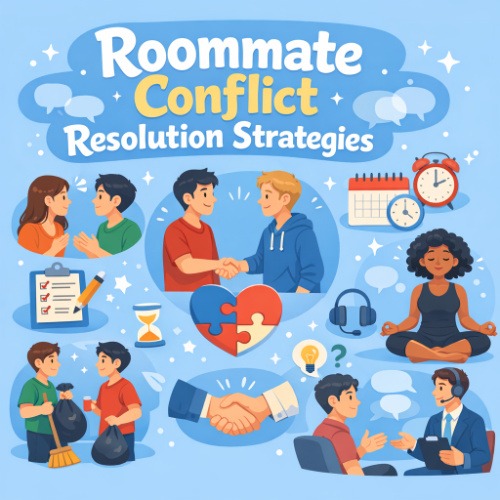
What Are the Most Common Roommate Conflicts?
The most common roommate conflicts include cleanliness and chore disagreements (42% of conflicts) involving dirty dishes, trash removal, and shared space organization, noise and sleep schedule differences (38%) with late-night activities disrupting sleep or daytime needs conflicting with night study, guests and significant others overstaying (31%) creating uncomfortable crowding or privacy loss, borrowing belongings without permission (27%) including food, clothes, and supplies, and temperature control and space usage disagreements (24%) over thermostat settings or personal items in shared areas.
1. Cleanliness and Chore Conflicts
Different cleanliness standards cause the most frequent and emotionally charged roommate disputes.
Common cleanliness issues:
- Dirty dishes left in sink for days or weeks
- Trash not taken out when full
- Personal items cluttering shared spaces
- Bathroom cleaning responsibilities ignored
- Floors, surfaces, or furniture dirty
- Food waste or spills not cleaned immediately
- Different definitions of "clean" or "messy"
Why cleanliness conflicts escalate:
- People genuinely perceive cleanliness differently (what looks messy to you looks fine to them)
- Assumptions that others see mess and choose not to clean (often they truly don't notice)
- Feeling disrespected when mess affects your space
- Cultural or family background differences in household standards
- Passive-aggressive notes or hints instead of direct conversation
Resolution approaches:
- Define specific expectations explicitly (dishes washed within 24 hours, trash out when full)
- Create cleaning schedule with designated responsibilities
- Compromise on standards (moderately tidy, not spotless or chaos)
- Focus on shared spaces primarily (less control over personal areas)
- Use chore apps or charts tracking completion
2. Noise and Sleep Schedule Conflicts
Differing sleep schedules create inevitable friction in shared small spaces.
Common noise issues:
- Roommate stays up late while you sleep early
- Alarm goes off repeatedly waking roommate
- Phone conversations or video calls during sleep hours
- Music, TV, or gaming without headphones
- Friends visiting during quiet hours
- Snoring or other sleep noises
Resolution approaches:
- Establish quiet hours (typically 11pm-8am on weeknights)
- Use headphones for all entertainment after agreed hours
- Take phone calls outside room during quiet hours
- Set single alarm rather than multiple snoozes
- Study or socialize in common areas when roommate sleeping
- Consider white noise machines or earplugs as compromise
- Sleep masks for light sensitivity issues
3. Guest and Significant Other Conflicts
Overnight guests, especially significant others, frequently cause roommate tension.
Common guest issues:
- Significant others staying multiple nights weekly
- Feeling like third wheel in your own room
- Privacy lost when wanting alone time
- Guests using your belongings or food
- Not getting equal "sexile" opportunities
- Friends overstaying welcome during study time
Resolution approaches:
- Agree on guest limits (2-3 nights weekly maximum)
- Text before bringing guests (30-minute notice minimum)
- Equal treatment for both roommates' guests
- Establish "sexile" system with advance notice and time limits
- Guests should not be in room when you're alone there
- No guests during finals or midterm weeks
- Partners cannot have keys or unrestricted access
4. Borrowing and Sharing Conflicts
Unclear boundaries about personal belongings create frustration and violated trust.
Common borrowing issues:
- Taking food without asking or replacing
- Wearing clothes without permission
- Using electronics, chargers, or school supplies
- Finishing shared items (toilet paper, cleaning supplies) without replacing
- Damaging borrowed items
Resolution approaches:
- Establish default "ask first" policy for everything
- Clearly label food and personal items
- Create shared supply list and split costs
- Replace items immediately if borrowed and consumed
- Don't borrow when person isn't home to ask
- Some students keep mini-fridge in closet for absolute food security
When managing roommate conflicts alongside academic stress and coursework deadlines, consider using a professional essay writing service for routine assignments during particularly tense conflict resolution periods, allowing mental and emotional energy for difficult conversations, compromise negotiations, and relationship repair that directly impact your living situation and mental health.
How Do You Have a Productive Conflict Resolution Conversation?
Have productive conflict resolution conversations by choosing private neutral timing when both people are calm (not during argument), starting with positive framing acknowledging what works well, using "I feel" statements describing impact on you without attacking character, listening actively to their perspective without interrupting or getting defensive, brainstorming solutions together rather than demanding compliance, and ending with clear agreements about specific behavior changes including follow-up check-in timeline.
Step-by-Step Conversation Framework
Step 1: Request the conversation appropriately
Don't ambush roommate. Schedule conversation when both have time and mental space.
Request script: "Hey, I'd like to talk about our living situation when you have 20-30 minutes. Would tonight after dinner work, or would tomorrow be better?" |
Avoid:
- Bringing up issues when they're rushing to class
- Starting conversation when either person is tired, stressed, or upset
- Sending long accusatory text messages
- Having a conversation with friends present
- Discussing sensitive issues in public places
Step 2: Start with positive framing
Acknowledge what's working before addressing problems.
Opening script: "Thanks for sitting down with me. I really appreciate [specific positive thing they do]. I want to make sure we're both comfortable living together, and there are a couple of things I'd like to discuss so we can find solutions that work for both of us." |
This approach:
- Reduces defensiveness by recognizing their positive contributions
- Frames conversation as collaborative problem-solving
- Acknowledges your role in finding solutions
- Sets cooperative rather than adversarial tone
Step 3: Describe the problem using "I" statements
Focus on behavior impact on you, not character attacks.
"I" statement structure: "When [specific behavior happens], I feel [emotion] because [reason]. I would appreciate [specific change]." |
Examples:
Poor: "You're so inconsiderate and messy. You never clean anything." |
Poor: "You're so loud and rude. You don't care about anyone else." |
Step 4: Listen actively to their perspective
Allow them to respond fully without interrupting or becoming defensive.
Active listening techniques:
- Make eye contact and give full attention
- Don't interrupt or plan your response while they're talking
- Summarize their points: "So what I'm hearing is..."
- Ask clarifying questions: "Can you help me understand why..."
- Acknowledge their feelings even if you disagree: "I can see why you'd feel that way"
- Avoid dismissing their concerns or experiences
Step 5: Brainstorm solutions together
Generate multiple options collaboratively rather than imposing your solution.
Collaboration approach: "How can we both get our needs met here? What would work for you?" |
Compromise principles:
- Both people should feel heard and respected
- Solutions should be specific and measurable
- Compromise means both people adjust, not one person gets everything
- Focus on behaviors within each person's control
- Be willing to try solution for 2-3 weeks before evaluating
Step 6: Put agreements in writing
Document agreed solutions preventing future misunderstandings.
Written agreement template:
Roommate Agreement - Updated [Date]
Cleanliness:
- Dishes washed within 24 hours or placed in personal bin
- Trash taken out by whoever fills it last
- Shared spaces tidied Sunday evenings
Quiet Hours:
- 11pm-8am weeknights (Sunday-Thursday)
- Headphones required during quiet hours
- Phone calls taken outside room or in bathroom
Guests:
- Text 30 minutes before bringing guests
- Overnight guests maximum 2 nights per week
- No guests during finals weeks
Check-in: We'll revisit this agreement in 3 weeks to see how it's working.
Signed: [Both names and date]
Step 7: Follow up and adjust as needed
Schedule check-in evaluating whether solutions are working.
"Let's chat in a couple weeks to see how this is going and adjust if needed."
Research shows conflicts addressed with structured conversations using "I" statements and written agreements resolve successfully 73% of the time, compared to 29% success for informal complaints or passive-aggressive approaches. |
What Do You Do When Your Roommate Won't Compromise?
When roommates won't compromise, involve your resident advisor (RA) for neutral mediation within 1-2 weeks of unsuccessful direct communication, document specific incidents with dates and details supporting your concerns, understand your housing rights and community standards in residence hall contract, consider requesting roommate meeting with RA and housing coordinator, and begin room change request process if safety, health, or academic performance significantly impacted despite mediation attempts.
When to Involve Your RA
Involve your RA when:
- Direct conversations fail to resolve issue after 2-3 attempts
- Roommate refuses to have conversation at all
- Conflicts escalate to yelling, threats, or intimidation
- Safety concerns (theft, violence, dangerous behavior)
- Roommate violates housing policies (drugs, alcohol, weapons)
- Mental health concerns affecting daily functioning
- You feel uncomfortable addressing issue directly
How RAs help:
- Neutral third-party mediation
- Facilitate structured conversation
- Clarify housing policies and community standards
- Document formal complaints
- Connect you with additional resources
- Initiate conduct proceedings if policy violations occur
- Support room change requests if unresolved
Preparing for RA mediation:
- Write down specific incidents with dates and details
- Bring attempted solutions and their outcomes
- Focus on behaviors, not personality
- Be willing to compromise and listen
- Follow through on agreed solutions
- Update RA if issues continue
Documenting Conflicts
What to document:
- Dates and times of specific incidents
- Exact behaviors causing conflict (not feelings or interpretations)
- Previous conversations and agreements
- Impact on your wellbeing, sleep, or academics
- Photos of messes, damages, or policy violations if relevant
- Text messages or written communications
Documentation format:
October 15, 11:30pm: Roommate had 6 friends over playing loud music. Asked them to quiet down. Music lowered for 10 minutes then increased again. Went to common area to sleep.
October 18, 10pm-1am: Roommate and boyfriend in room. I waited in hallway from 10-10:30pm before texting asking when I could return. No response until 1am.
October 20, morning: Found dirty dishes with moldy food in sink (3rd time this week). Discussed 24-hour dish washing rule on October 10th, but pattern continues.
Documentation provides objective record supporting your concerns during mediation or room change requests.
Understanding Your Housing Rights
Review your housing contract for:
- Quiet hours and noise policies
- Guest policies and overnight limits
- Cleanliness and shared space standards
- Prohibited items and behaviors
- Roommate change procedures and timelines
- Grievance procedures
Common housing rights:
- Safe, clean living environment
- Reasonable quiet for sleep and study
- Access to your room at all times
- Privacy and respect for belongings
- Freedom from harassment, intimidation, or discrimination
- Due process for disputes and conflicts
When roommate violates policies:
- Document violations specifically
- Report to RA or housing coordinator
- Understand conduct process and potential outcomes
- Request interim room change if safety concerns
- Follow formal complaint procedures if needed
How Do You Request a Room Change?
Request room changes by documenting unsuccessful resolution attempts and specific conflict details, meeting with your RA or housing coordinator explaining the situation and impact on wellbeing or academics, completing formal room change request forms available through housing office, understanding availability may be limited especially mid-semester, demonstrating good faith efforts to resolve conflicts, and being flexible about new room assignments which may not be ideal locations or roommates.
Room Change Process
When room changes are appropriate:
- Multiple documented mediation attempts failed
- Safety or health concerns (harassment, threats, severe cleanliness)
- Fundamental incompatibility despite good faith efforts
- Policy violations continuing despite conduct proceedings
- Mental health significantly impacted
- Academic performance suffering due to living situation
Room change request steps:
Document conflict history:
- Previous conversations and mediation attempts
- Specific incidents and their impact
- RA involvement and outcomes
- Why resolution appears impossible
Meet with housing coordinator:
- Explain situation objectively
- Provide documentation
- Demonstrate good faith resolution efforts
- Explain impact on academics or wellbeing
Complete formal request:
- Fill out room change paperwork
- Write statement explaining situation
- Include RA's support or documentation
- Submit within deadlines
Wait for approval and availability:
- Not all requests are approved
- Availability varies by semester and campus
- May take 2-6 weeks for placement
- Emergency situations processed faster
Room change realities:
- Limited availability (especially fall semester)
- May not get preferred building or setup
- New roommate is also random assignment
- Moving mid-semester is disruptive
- Some campuses charge room change fees
- Should be last resort after genuine resolution attempts
Increasing approval chances:
- Document everything thoroughly
- Demonstrate good faith efforts
- Emphasize impact on academics or health
- Involve RA and counseling center if mental health affected
- Be flexible about new placement
- Apply early in semester if possible
When Room Changes Aren't Approved
If stuck with incompatible roommate:
- Minimize time in room (study in library, socialize elsewhere)
- Use headphones and create personal boundaries
- Keep belongings secure and labeled
- Follow agreed rules even if they don't
- Continue documenting issues for future requests
- Focus on academics and self-care
- Seek support from friends, counseling, or RA
- Remember: semester is temporary (16 weeks)
- Plan for different roommate next year
Students who successfully navigate difficult roommate situations develop valuable conflict resolution, communication, and compromise skills applicable throughout personal and professional life.
How Can You Prevent Roommate Conflicts?
Prevent roommate conflicts by creating detailed roommate agreement during first week covering cleanliness, guests, quiet hours, sharing, and personal boundaries, establishing regular check-ins (weekly or biweekly) addressing minor concerns before escalation, communicating directly rather than making assumptions about expectations or feelings, respecting differences in lifestyle and habits without trying to change their personality, and maintaining independent social lives and friendships preventing over-reliance on roommate relationship.
Proactive Conflict Prevention Strategies
Create comprehensive roommate agreement:
Address these topics explicitly in writing during first week:
Sleep and study schedules:
- Typical bedtime and wake-up time
- Quiet hours and study needs
- Alarm preferences and snoozing
Cleanliness standards:
- Frequency of cleaning shared spaces
- Chore division and responsibilities
- Personal clutter boundaries
Guest policies:
- Advance notice expectations
- Overnight guest limits
- Significant others parameters
- Study time vs. social time boundaries
Sharing and borrowing:
- What's shareable (or nothing)
- Permission requirements
- Food policies
Personal boundaries:
- Privacy needs and communication
- Personal space in shared room
- Door open/closed preferences
Establish regular check-ins:
Schedule weekly or biweekly casual conversations:
- "How's the living situation working for you?"
- "Anything we should adjust?"
- "I've been feeling [X] about [Y]. Can we talk about it?"
Small issues addressed early rarely become major conflicts.
Communicate directly and kindly:
- Address minor annoyances within 48 hours
- Assume good intentions (incompetence before malice)
- Be direct rather than hinting or expecting mind-reading
- Use friendly tone for small requests
- Save formal conversations for repeated issues
Maintain independent lives:
- Don't expect roommate to be best friend
- Develop separate friend groups and activities
- Give each other space and privacy
- Don't feel obligated to invite them everywhere
- Respect that you're living together, not joined at the hip
Be flexible and understanding:
- Everyone has bad days or weeks
- Occasional mess or noise is normal
- Compromise means both people adjust
- Cultural or family background affects standards
College is a learning experience for everyone
Research shows students who create written agreements and maintain regular check-ins experience 58% fewer serious conflicts requiring RA intervention compared to those who assume compatibility without explicit communication.
Key Takeaways
Successfully resolve and prevent roommate conflicts through these evidence-based strategies:
Address conflicts within 24-48 hours before resentment builds and situations escalate, as 67% of unresolved conflicts worsen over time while 85% of early-addressed issues resolve successfully. Small annoyances ignored for weeks transform into relationship-destroying resentments requiring room changes or transfers.
Use structured conflict resolution conversations with "I" statements focusing on behavior impact not personality attacks, active listening to understand their perspective, collaborative brainstorming generating solutions together, and written agreements preventing future misunderstandings. This approach resolves 73% of conflicts compared to 29% for informal complaints.
Involve your RA for mediation when direct conversations fail after 2-3 attempts, roommate refuses to engage, or conflicts escalate to safety concerns or policy violations. RAs provide neutral third-party facilitation, clarify housing policies, document formal complaints, and support room change requests if resolution proves impossible.
Request room changes as last resort after documenting unsuccessful resolution attempts, demonstrating good faith efforts to compromise, and explaining impact on academics or mental health. Understand limited availability especially mid-semester, flexibility about new placement, and that new roommate assignments are also random.
Prevent conflicts proactively through comprehensive roommate agreements during first week explicitly addressing cleanliness, guests, quiet hours, sharing, and boundaries, regular check-ins addressing minor concerns before escalation, direct communication without assumptions, and maintaining independent social lives preventing over-reliance on roommate relationship.
The most common roommate conflicts, cleanliness (42%), noise (38%), guests (31%), and borrowing (27%), all stem from different expectations and communication failures rather than fundamental incompatibility. The 58% conflict reduction from written agreements and check-ins demonstrates prevention's effectiveness over reaction.
When managing stressful roommate conflicts alongside demanding academic workload, consider using a trusted essay writing service for routine coursework during particularly difficult conflict resolution periods, allowing mental and emotional energy for having difficult conversations, processing emotions, and finding compromise solutions that directly impact your daily living environment and overall wellbeing throughout college.