The 4-Sentence Rhetorical Precis Format
The rhetorical precis follows Margaret K. Woodworth's exact formula. Each sentence has required elements in a specific order.
1. Overview of Required Sentences
Sentence 1: Author information + Main argument
Sentence 2: How the author develops the argument
Sentence 3: Author's purpose
Sentence 4: Intended audience and/or tone
Let's break down what each sentence must include.
2. Sentence 1: Author + Work + Main Argument
What this sentence does: Introduces the author, identifies the work, and states the thesis or main argument.
Required Elements (in order):
- Author's full name
- Optional: Brief phrase describing author's credentials
- Type of text (article, essay, speech, book chapter)
- Title of work
- Publication date in parentheses
- Rhetorically accurate verb
- THAT clause containing the main argument
Formula:
[Author's full name], [optional credentials], in [his/her] [type of text], [title], ([date]), [rhetorical verb] that [main argument].
Sentence 2: How the Author Develops the Argument
What this sentence does: Explains the methods, evidence, and rhetorical strategies the author uses to support their argument.
Required Elements:
- Author's last name as subject
- Development verb (develops, supports, illustrates, establishes)
- Three methods/strategies (presented in chronological order as they appear in text)
Formula:
[Author's last name] [develops/supports/illustrates] this [argument/claim] by [method 1], by [method 2], and by [method 3].
Sentence 3: Author's Purpose
What this sentence does: States WHY the author wrote this piece and what effect they want to achieve.
Required Elements:
- Author's last name + possessive
- "purpose is to" (standard phrasing)
- Infinitive verb describing the goal
- "in order to" phrase explaining desired outcome
Formula:
[Author's last name]'s purpose is to [infinitive verb phrase] in order to [desired effect on audience].
Sentence 4: Intended Audience and/or Tone
What this sentence does: Identifies WHO the author is writing for and/or characterizes the author's TONE.
Three Acceptable Formulas:
Option A (Audience focus): [Author] writes for [description of audience] as evidenced by [textual clues].
Option B (Tone focus): [Author] adopts a(n) [adjective] tone for [his/her] audience of [description].
Option C (Combined): [Author] establishes a(n) [adjective] tone with [description of audience] by [how tone is created].
Rhetorical Precis Example 1
1. Letter from Birmingham Jail
Martin Luther King Jr.'s "Letter from Birmingham Jail" (1963): A response to white clergymen who criticized King's nonviolent protests as "unwise and untimely."
In "Letter from Birmingham Jail" (1963), Martin Luther King Jr., a Baptist minister and civil rights leader, asserts that nonviolent direct action is necessary to combat racial injustice when legal channels and negotiations have failed. King supports this claim by explaining the four steps of nonviolent campaigns, by responding systematically to critics' concerns about timing and methods, and by citing moral and legal precedents for civil disobedience including examples from Socrates, early Christians, and American patriots. His purpose is to justify nonviolent resistance in order to convince moderate white clergymen that immediate action against injustice is morally necessary rather than destructive. King adopts an earnest yet authoritative tone for his dual audience of white religious moderates who prefer gradual change and the broader community of civil rights supporters seeking validation for direct action.
2. Sentence by Sentence Analysis
Sentence 1 Breakdown:
- Author's full name: Martin Luther King Jr.
- Credentials: "a Baptist minister and civil rights leader" (establishes both religious and moral authority)
- Type of text: Letter (responding to criticism)
- Title: "Letter from Birmingham Jail"
- Date: (1963)
- Rhetorical verb: "asserts" (strong, confident claim)
- THAT clause: "that nonviolent direct action is necessary to combat racial injustice when legal channels and negotiations have failed"
Why this works:
- The verb "asserts" matches King's confident, moral stance
- Credentials establish why he's qualified to speak on this
- The thesis captures his main argument precisely
- Sets up the defensive nature of the letter (responding to critics)
Sentence 2 Breakdown:
Development methods (in chronological order):
Method 1: "by explaining the four steps of nonviolent campaigns"
- Appears early in the letter
- Establishes a logical framework (collection of facts, negotiation, self purification, direct action)
Method 2: "by responding systematically to critics' concerns about timing and methods"
- The middle sections address specific criticisms
- Uses point by point refutation
Method 3: "by citing moral and legal precedents for civil disobedience, including examples from Socrates, early Christians, and American patriots"
- Later sections provide historical/moral justification
- Appeals to the audience's values (especially religious readers)
Why this works:
- Methods presented in the actual order they appear in King's letter
- Specific enough to show understanding (mentions "four steps," names specific historical figures)
- Shows a variety of rhetorical strategies (explanation, refutation, historical precedent)
- Identifies both logos (logical steps) and ethos (historical authority)
Sentence 3 Breakdown:
- Purpose statement: "to justify nonviolent resistance"
- In order to phrase: "in order to convince moderate white clergymen that immediate action against injustice is morally necessary rather than destructive"
Why this works:
- Purpose goes beyond surface ("to respond to critics") to a deeper goal
- "in order to" phrase specifies the exact belief change King wants
- Addresses the specific objection (timing/methods) the clergymen raised
- Recognizes King's defensive position while showing an offensive goal
Sentence 4 Breakdown:
Tone: "earnest yet authoritative"
- Earnest = sincere, passionate about justice
- Authoritative = speaks from a position of moral and intellectual credibility
- "yet" shows the balance between these qualities
Dual audience identification:
- Primary: "white religious moderates who prefer gradual change" (the clergymen)
- Secondary: "broader community of civil rights supporters seeking validation"
Why this works:
- Tone description captures King's actual rhetorical approach
- Recognizes dual audience (immediate/broader)
- Explains why each audience matters to King's purpose
- Acknowledges the published context (the letter became a public document)
What Makes This Precis Excellent:
- All required elements are present in the correct order
- Specific enough to show deep reading
- Rhetorical verb matches the author's approach
- Methods in chronological order
- Purpose goes beyond the surface to the actual goal
- Tone accurately characterized
- Audience clearly identified with evidence
Get Your Rhetorical Precis Written, Done Right
I’ll deliver a complete 4 sentence rhetorical precis that follows Woodworth’s structure and hits every required element.
- Exact rhetorical precis (not a summary)
- Correct argument + methods + purpose + audience/tone
- Strong rhetorical verbs (argues, asserts, suggests, etc.)
- 100% original, deadline ready delivery
Stop second guessing, get a precis you can submit with confidence.
Order Now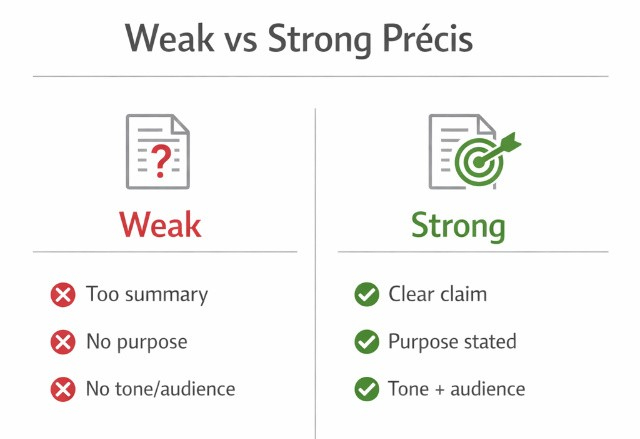
Rhetorical Precis Example 2
1. The Ugly Truth About Beauty
Dave Barry's "The Ugly Truth About Beauty" (1998): Humorous essay about gender differences in self perception.
In "The Ugly Truth About Beauty" (1998), Dave Barry, a humor columnist, argues that women generally do not think of their looks in the same way that men do, with men viewing themselves as average looking regardless of reality while women compare themselves to impossible standards. Barry illuminates this discrepancy by juxtaposing men's perceptions of their looks ("average looking") with women's ("not good enough"), by contrasting female role models (Barbie, Cindy Crawford) with male role models (He Man, Buzz Off), and by comparing men's interests (the Super Bowl, lawn care) with women's (manicures, weight loss). His purpose is to exaggerate and stereotype these differences in order to prevent women from so eagerly accepting society's expectations of physical perfection and to critique men who perpetuate unrealistic beauty standards. Barry ostensibly addresses men in this essay because he opens and closes by directly addressing men ("If you're a man...") and offers advice in a mockingly conspiratorial fashion; however, by using humor to poke fun at both genders' perceptions, he makes the essay palatable to women as well, hoping to convince them to stop obsessively comparing themselves to Barbie.
2. Sentence by Sentence Analysis
Sentence 1 Breakdown:
- Author: Dave Barry
- Credentials: "a humor columnist" (explains the satirical approach)
- Rhetorical verb: "argues" (despite humor, makes a serious claim)
- Thesis: Captures the core comparison (men vs women's self perception)
Why this works:
- Credentials explain why the tone is humorous
- Verb "argues" shows there's a serious point under the comedy
- The thesis is specific about the nature of the difference
Sentence 2 Breakdown:
Three comparison methods:
- Juxtaposing perceptions (uses actual quotes: "average looking" vs "not good enough")
- Contrasting role models (specific examples: Barbie/Cindy vs He Man/Buzz Off)
- Comparing interests (concrete examples show different priorities)
Why this works:
- All three methods involve comparison/contrast (matches Barry's structure)
- Includes specific details from the text (quoted phrases, named examples)
- Shows understanding that the essay is built entirely on contrasts
Sentence 3 Breakdown:
Dual purpose:
- "to prevent women from accepting society's expectations"
- "to critique men who perpetuate unrealistic standards"
Why this works:
- Recognizes that Barry targets both genders despite surface level addressing men
- "exaggerate and stereotype" acknowledges his satirical method
- Shows understanding that humor serves a serious purpose
Sentence 4 Breakdown:
Complex audience analysis:
- Ostensibly addresses men (textual evidence: direct address)
- Actually targets women as well (through humor that makes critique palatable)
Why this works:
- Uses "ostensibly" to show awareness of rhetorical strategy
- Provides textual evidence for both audiences
- Explains HOW Barry reaches both audiences despite appearing to address only men
Rhetorical Precis Example 3
1. Henrietta's Dance
Rebecca Skloot, in her article "Henrietta's Dance" (2000), argues that Henrietta Lacks and her family have been continuously mistreated by doctors and researchers and deserve compensation for their contribution to medicine and the medical community's violation of the family's ethical rights. Skloot supports her argument by providing detailed descriptions of Henrietta Lacks and her family, by documenting how doctors took Henrietta's cells without consent and profited from them while the family remained poor and uninformed, and by revealing the ongoing exploitation through interviews with family members who learned about HeLa cells decades after Henrietta's death. Her purpose is to humanize Henrietta Lacks beyond her cellular contribution in order to persuade readers that bioethical standards must protect both patients and their families from exploitation. Skloot adopts a compassionate yet investigative tone for her audience of general readers interested in medical ethics and science history, using personal narrative to make complex bioethical issues accessible and emotionally resonant.
2. Why This Works
- Strong rhetorical verb: "argues" (Skloot makes a clear ethical claim)
- Specific methods: Name exact strategies (description, documentation, revelation through interviews)
- Clear purpose: Goes beyond "to inform" to the actual goal (change bioethical standards
- Accurate tone: "compassionate yet investigative" captures the balance between empathy and journalism
- Well defined audience: "general readers interested in medical ethics and science history"
Rhetorical Precis Example 4
1. Contemporary Climate Article
In "The Climate Crisis We Can't Ignore" (2024), Dr. Sarah Chen, an environmental scientist, argues that immediate global policy intervention is essential to prevent irreversible environmental damage within the next decade. Chen supports this claim by analyzing three decades of temperature data showing accelerating warming trends, by examining the failure of international climate agreements to produce meaningful emissions reductions, and by projecting the catastrophic consequences of continued inaction through climate modeling. Her purpose is to galvanize policymakers into immediate action in order to prevent crossing critical climate tipping points that would make recovery impossible. Chen adopts an urgent yet scientifically rigorous tone for her dual audience of legislators with decision making power and scientifically literate citizens who can pressure their representatives.
2. Why This Works
- Credentials matter: "environmental scientist" establishes expertise
- Specific evidence types: Data analysis, historical examination, projection modeling
- Urgent purpose: "galvanize...into immediate action" matches climate urgency
- Dual audience: Recognizes both direct (policymakers) and indirect (citizens) targets
- Tone balance: "urgent yet scientifically rigorous" shows passion grounded in data
Need a High Scoring Precis? I’ve Got It
I’ll craft a sharp rhetorical precis that captures what the author claims and how they build it: clean, accurate, and professor proof.
- Thesis captured accurately in Sentence 1
- 3 real development strategies in correct order (Sentence 2)
- Clear purpose + intended effect (Sentence 3)
- Target audience/tone supported by textual clues (Sentence 4)
Get the kind of rhetorical precis that actually earns points.
Order NowRhetorical Precis Example 5
1. Academic Literary Analysis
In "Fitzgerald's Critique of the American Dream" (2023), Professor James Morrison, a scholar of American literature, demonstrates that F. Scott Fitzgerald uses The Great Gatsby to expose the corruption and emptiness at the heart of 1920s American materialism. Morrison supports this argument by analyzing Gatsby's tragic pursuit of wealth as a means to win Daisy, by examining Fitzgerald's symbolic use of the green light and the eyes of Doctor T.J. Eckleberg, and by contextualizing the novel within the economic excess and moral bankruptcy of the Jazz Age. His purpose is to reveal the novel's enduring relevance in order to help contemporary readers understand how Fitzgerald's critique of wealth obsessed culture applies to modern American society. Morrison adopts a scholarly yet accessible tone for his audience of college students and literary enthusiasts, using close textual analysis alongside historical context to make classic literature feel immediately relevant.
Why This Works
- Academic verb: "demonstrates" (proves through evidence, appropriate for scholarly work)
- Literary methods: Analysis of character, symbolism, and historical context
- Bridging purpose: Connects past text to present relevance
- Student friendly: "scholarly yet accessible" acknowledges pedagogical goal
- Specific symbols: Names actual textual elements (green light, Eckleberg's eyes)
Rhetorical Precis Example 6
1. Newspaper Op Ed
In her op ed "Why We Must Reform College Admissions" (2025), Dr. Angela Rodriguez, a university dean, contends that the current college admissions system perpetuates socioeconomic inequality and must be restructured to provide genuine equal opportunity. Rodriguez supports this claim by presenting statistical evidence of the correlation between family income and college acceptance rates, by exposing how legacy admissions and standardized testing favor wealthy applicants, and by proposing specific reforms including income based admissions adjustments and holistic review processes. Her purpose is to persuade university administrators and policymakers to implement systemic changes in order to make higher education accessible to talented students regardless of economic background. Rodriguez adopts a measured yet passionate tone for her audience of educational stakeholders, parents, and concerned citizens, balancing empirical data with moral urgency to make the case for immediate reform.
2. Why This Works
- Credentials: "university dean" (insider perspective with authority)
- Op ed verb: "contends" (arguing against opposition, appropriate for opinion piece)
- Evidence variety: Statistics, exposure/critique, concrete proposals
- Reform purpose: Calls for specific action
- Stakeholder audience: Identifies who has the power to implement change
- Balanced tone: "measured yet passionate" fits op ed genre

If you’re short on time or unsure whether your precis meets academic expectations, reviewing samples or getting feedback from a reliable essay writing service can help you avoid common mistakes and submit with confidence.
Filled Example of Rhetorical Precis
SENTENCE 1 INFORMATION:
- Author's full name: Dr. Maria Thompson
- Author's credentials (if relevant): Professor of Environmental Science at Stanford University
- Type of text (article/essay/speech/etc): Article
- Title: The Urgent Need for Renewable Energy
- Publication date: March 15, 2022
- Main argument (what is the author claiming?): Governments and corporations must invest heavily in renewable energy to prevent catastrophic climate change.
- Best rhetorical verb (argues/claims/suggests/etc): argues
SENTENCE 2 INFORMATION:
How does the author develop the argument? List 3 methods in order:
- By presenting recent scientific data on rising global temperatures and carbon emissions
- By comparing countries that have successfully implemented renewable energy policies to those that have not
- And by addressing common counterarguments about the cost and feasibility of renewable energy
SENTENCE 3 INFORMATION:
- Author's purpose (what do they want to accomplish?): To persuade policymakers and the public of the urgency of transitioning to renewable energy
- Desired outcome (what should change?): Increased funding and support for renewable energy initiatives worldwide
SENTENCE 4 INFORMATION:
- Author's tone (adjective): urgent
- Intended audience (who is this for?): Policymakers, environmental advocates, and the general public interested in climate change
- Evidence of audience (how do you know?): The article includes policy recommendations and explains complex scientific concepts in accessible language
Free Downloadable Templates
Hand Off Your Text, Get a Perfect Precis Back
Send me your article/speech/chapter and I’ll produce a complete rhetorical precis that matches the assignment rules exactly.
- Works for essays, op eds, speeches, and academic articles
- Accurate rhetorical analysis without personal opinion
- Clear, concise, professor friendly language
- Delivered on time, every time
One text in, one polished rhetorical precis out.
Get Expert Help NowBottom Line
The difference between a weak rhetorical precis and a strong one comes down to specificity. Generic phrases like "uses examples" don't prove you read the text. Specific details, precise verbs, and clear analysis do.
Use these examples as models. Study what makes them work. Consult our rhetorical precis guide. Then apply the templates to your own texts.
Good luck with your rhetorical precis!