The rhetorical precis is one of the most valuable academic writing tools because it sharpens both reading and analytical abilities. Our trusted essay writing service specializes in Woodworth's formula.
What Is a Rhetorical Precis?
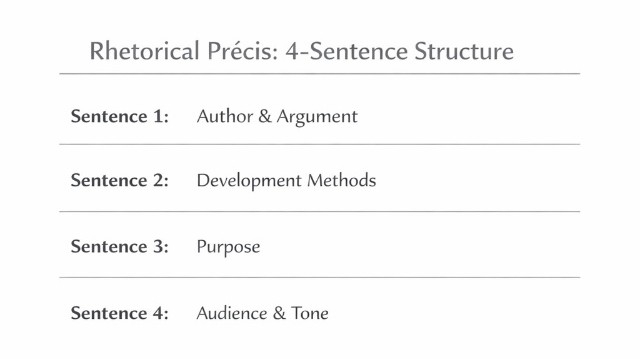
A rhetorical precis is a highly structured 4 sentence paragraph that analyzes both what a text says and how it says it.
Simple definition: A rhetorical precis summarizes the author's argument, explains how they develop it, identifies their purpose, and describes their intended audience, all in exactly four sentences.
Developed by Margaret K. Woodworth in 1988, this format forces you to identify the essential rhetorical elements of any written or spoken text. It's used primarily in AP Language and Composition courses, college rhetoric classes, and advanced literary analysis.
1. The Three Key Characteristics
- Fixed structure: Exactly 4 sentences, each with specific required elements (no more, no less)
- Rhetorical analysis: Examines HOW the author makes their argument, not just what they say
- Objective summary: No personal opinions, only an accurate representation of the author's work
2. What Makes Rhetorical Precis Different?
Rhetorical precis differs from other forms of academic writing in important ways:
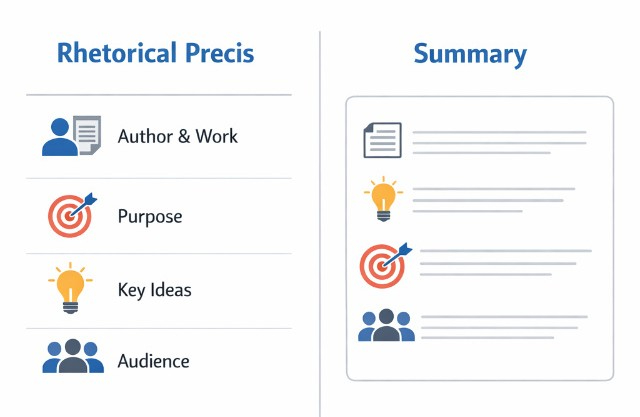
- Not a summary: Summaries condense main ideas. A rhetorical precis analyzes rhetorical strategies.
- Not a critique: You don't evaluate whether the argument is good or bad, just explain how it works.
- Not flexible: The 4 sentence structure is rigid. You can't add a fifth sentence or skip a required element.
- Not personal: Written in third person, present tense. No "I think" or "in my opinion."
If you want more context, have a look at our rhetorical precis examples and templates.
3. Why Do Professors Assign Rhetorical Precis?
Instructors use rhetorical precis to develop critical skills:
- Reading comprehension: Forces close reading to identify exact arguments and methods
- Analytical thinking: Requires you to see HOW arguments are constructed, not just WHAT they claim
- Concise writing: Teaches you to express complex ideas in limited space
- Rhetorical awareness: Develops understanding of persuasive strategies and audience targeting
- Citation practice: Introduces proper attribution and source documentation
Get Your Rhetorical Precis Written, Done Right
We’ll deliver a complete rhetorical precis that follows Woodworth’s structure and hits every required element.
- Exact rhetorical precis (not a summary)
- Correct argument + methods + purpose + audience/tone
- Strong rhetorical verbs (argues, asserts, suggests, etc.)
- 100% original, deadline ready delivery
Stop second guessing, get a precis you can submit with confidence.
Order NowRhetorical Precis vs Summary
Confused about the difference? They serve different purposes and follow different rules.
1. Quick Comparison Table
| Feature | Rhetorical Precis | Summary |
|---|---|---|
| Length | Exactly 4 sentences (100-200 words) | Variable length (typically 1/3 of the original) |
| Structure | Rigid formula, specific order | Flexible paragraph format |
| Focus | What + How (content + rhetoric) | What only (main ideas) |
| Analysis | Required (rhetorical strategies) | Not required |
| Tense | Present tense | Usually present tense |
| Person | Third person only | Third person only |
| Sentences | Each sentence has a specific purpose | Flexible structure |
2. Key Distinction
Summary answers: What are the main ideas of this text?
Rhetorical precis answers: What is the argument? How is it developed? Why was it written? Who is the audience?
Think of a summary as content focused. A rhetorical precis is strategy focused; it examines the author's persuasive techniques and rhetorical choices.
3. When You Need Each Type
Use a rhetorical precis when:
- Assignment specifically says "rhetorical precis"
- You're in an AP Lang or a college rhetoric course
- Asked to analyze persuasive or argumentative texts
- The instructor wants a rhetorical analysis, not just a summary
- Creating an annotated bibliography with a rhetorical focus
Use summary when:
- Assignment says "summarize" without specification
- General reading comprehension task
- Research note taking
- Book reports and article overviews
- No rhetorical analysis required
4. Why the Difference Matters
Using a summary when a rhetorical precis is required (or vice versa) will cost you points. The formats have different goals:
The summary proves you understood the content. Rhetorical precis proves you understood both content AND strategy.
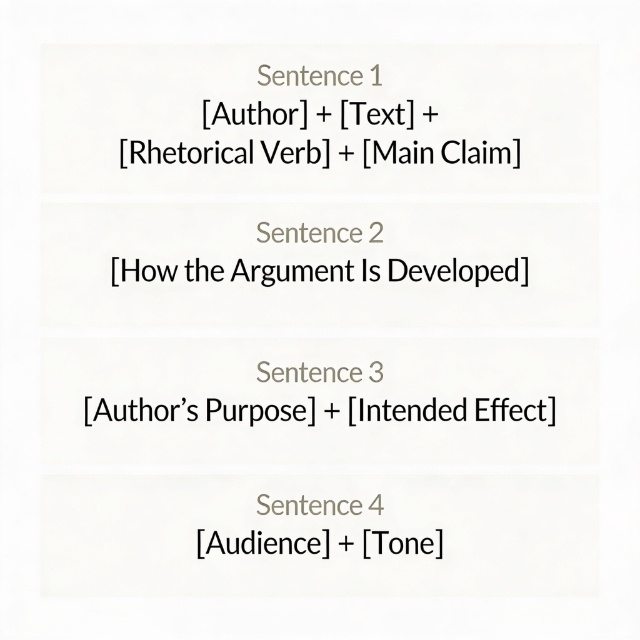
The 4 Sentence Structure
| Sentence | Purpose | Must Include |
|---|---|---|
| Sentence 1 | Identify the text and main idea | Author’s name, type of text, title, date, rhetorical verb, main argument |
| Sentence 2 | Explain how the argument is built | Author’s last name, development verb, 2–3 key strategies used |
| Sentence 3 | State why the author wrote it | Author’s last name, purpose, intended effect |
| Sentence 4 | Identify audience and/or tone | Target audience, tone, or both |
How to Write a Rhetorical Precis (Step by Step)
Writing a rhetorical precis doesn't have to be overwhelming. Follow this proven process.
Step 1: Read the Text Actively
You can't write a precis without deeply understanding the original text.
First reading (overview):
- Identify the topic
- Get a general sense of the argument
- Notice structure and organization
Second reading (analytical):
- Highlight the thesis or main claim
- Mark key supporting points
- Note the rhetorical strategies used
- Identify appeals (ethos, pathos, logos)
- Pay attention to tone and style
Third reading (verification):
- Confirm your understanding of the argument
- Check that you identified the actual thesis
- Verify you understand HOW the argument develops
What to look for:
- Author's credentials and background
- Publication context (where, when, why)
- Clear statement of the argument
- Evidence and support methods
- Persuasive techniques
- Intended audience clues
Don't skip close reading. Your precis can only be as good as your understanding of the text.
Step 2: Identify the Key Elements
Before writing, answer these questions:
For Sentence 1:
- Who is the author? What are their credentials?
- What type of text is this? (article, essay, speech, etc.)
- What is the title and publication date?
- What is the MAIN argument? (Not a topic, but a claim)
- What rhetorical verb best describes how they present it?
For Sentence 2:
- How does the author support their argument?
- What evidence do they use?
- What rhetorical strategies appear?
- In what ORDER do these methods appear?
For Sentence 3:
- WHY did the author write this?
- What do they want readers to DO, THINK, or FEEL?
- What change are they trying to create?
For Sentence 4:
- Who is the intended audience?
- What clues reveal this? (publication, language level, assumed knowledge)
- What is the author's tone?
- How does tone serve the purpose?
Take notes on all these elements before you start writing sentences.
Step 3: Draft Each Sentence
Now write each sentence following the exact formulas from the previous section.
Drafting tips:
Start with Sentence 1:
- Write the author's name and credentials
- Add the work information
- Choose your rhetorical verb carefully
- State the argument in a THAT clause
Move to Sentence 2:
- List the methods/strategies you identified
- Put them in chronological order (as they appear in text)
- Connect with "by... by... and by..."
Write Sentence 3:
- State the purpose with "purpose is to"
- Always include "in order to"
- Make sure the desired outcome is clear
Finish with Sentence 4:
- Describe the audience OR tone (or both)
- Provide evidence for your claims
- Keep it specific, not vague
Don't worry about perfection in the first draft. Just get all the required elements on paper.
Step 4: Revise for Accuracy
Check your draft against the original text.
Verify accuracy:
- Does Sentence 1 capture the MAIN argument accurately?
- Are the methods in Sentence 2 actually in the text?
- Is the purpose in Sentence 3 the author's (not yours)?
- Is the audience/tone description supported by evidence?
Check completeness:
- Are all required elements present?
- Did you include author, title, date, argument, methods, purpose, and audience?
- Is anything missing from the formulas?
Ensure objectivity:
- Remove any personal opinions
- Delete phrases like "I think" or "seems to"
- Keep it third person, present tense
Word choice:
- Are your rhetorical verbs precise?
- Did you avoid weak verbs?
- Is your language clear and specific?
Need a High Scoring Precis? I’ve Got It
I’ll craft a sharp rhetorical precis that captures what the author claims and how they build it: clean, accurate, and professor proof.
- Thesis captured accurately
- 3 real development strategies in correct order
- Clear purpose + intended effect
- Target audience/tone supported by textual clues
Get the kind of rhetorical precis that actually earns points.
Order NowStep 5: Edit for Clarity and Grammar
Polish your precis for the final submission.
Sentence structure:
- Vary sentence length for readability
- Make sure complex sentences are clear
- Check that all clauses connect logically
Grammar and mechanics:
- Verify subject verb agreement
- Check verb tense (should be present)
- Ensure proper punctuation
- Confirm correct citation format
Style:
- Remove unnecessary words
- Tighten vague phrases
- Strengthen weak verbs
- Maintain formal academic tone
Final check:
- Read aloud, does it flow?
- Is each sentence complete?
- Does it meet length requirements (100-200 words)?
Step 6: Format Properly
Follow standard academic formatting.
Basic formatting:
- Single paragraph (4 sentences)
- Standard font (Times New Roman, 12pt)
- Double spaced if required
- Include a bibliographic citation at the end
Citation at end: After your 4 sentence precis, include a full citation in the required format (MLA, APA, Chicago).
Your final precis should be ready to submit after this process.
Common Challenges and Solutions
Every writer hits obstacles with rhetorical precis. Here's how to overcome them.
Challenge 1: Can't Identify the Main Argument
Problem: The text has multiple claims, and you can't figure out which is the MAIN argument.
Solutions:
Look for thesis statements:
- Check the introduction and conclusion
- Find the sentence that everything else supports
- Look for "I argue that" or similar phrasing
Ask "So what?"
- What's the author's biggest claim?
- What point drives everything else?
- If they could make ONE claim, what would it be?
Check topic sentences:
- Do body paragraphs support one central claim?
- What connects all the sections?
Still stuck?
- Identify what the author WANTS from readers
- The main argument usually relates to that goal
Remember: The main argument is a claim, not a topic. "Climate change" is a topic. "Immediate policy intervention is essential to prevent environmental damage" is an argument.
Challenge 2: Sentence 2 is Too Vague
Problem: Your second sentence just says "by using examples and evidence" without specificity.
Solutions:
Be specific about evidence types:
Vague: "by using examples"
Specific: "by citing three decades of temperature data"
Name the rhetorical strategies:
Vague: "by making emotional appeals"
Specific: "by describing the devastating effects on coastal communities"
Include the actual content:
Vague: "by comparing things"
Specific: "by contrasting traditional approaches with modern solutions"
Follow the text's order:
- List methods as they appear chronologically
- Don't jump around or reorganize
Challenge 3: Can't Determine the Purpose
Problem: You're not sure WHY the author wrote this or what they want to achieve.
Solutions:
Look at the conclusion:
- Authors often state their goal explicitly at the end
- Check for calls to action
Consider the genre:
- Op ed? Probably to persuade
- Research article? Probably to inform or demonstrate
- Personal essay? Probably to reveal or explore
Ask what would change if readers agreed:
- Would they act differently?
- Think differently?
- Understand something new?
Check verb choice in your Sentence 1:
- If the author "argues," they want to persuade
- If they "demonstrate," they want to prove
- If they "reveal," they want to expose
Remember: Purpose goes deeper than topic. Don't just say "to inform readers about X." WHY inform them? What's the desired outcome?
Challenge 4: Audience is Unclear
Problem: You can't figure out who the intended audience is.
Solutions:
Check publication:
- Academic journal? Scholars in that field
- Popular magazine? General educated readers
- Newspaper op ed? Citizens and voters
- Website? Consider the site's typical audience
Examine language level:
- Technical jargon? Specialists
- Accessible language? General readers
- Assumes background knowledge? Informed audience
Look for direct address:
- Does the author say "we" or "you"?
- Who does that include?
Consider who can act:
- If purpose requires action, who has that power?
- That's likely the primary audience
When in doubt, describe the audience broadly but specifically: "readers of [publication] and others concerned about [topic]."
Challenge 5: Sentence is Too Long or Complex
Problem: Your sentence runs on forever and becomes confusing.
Solutions:
Break up with semicolons:
- Used strategically, semicolons can separate complex clauses
- But don't overuse them
Simplify clause structure:
- Remove unnecessary modifiers
- Tighten wordy phrases
- Cut redundancy
Use parallel structure:
- "by X, by Y, and by Z" creates rhythm
- Keeps long sentences manageable
Read aloud:
- If you run out of breath, it's too long
- Simplify until it's readable
Remember: Complex is okay. Confusing is not. Your sentences should be sophisticated but clear.
Challenge 6: Wrote a Summary Instead of a Rhetorical Precis
Problem: You summarized content but didn't analyze the rhetoric.
Solution checklist:
- Did you identify rhetorical strategies?
(Not just what the author said, but HOW they said it) - Did you use a rhetorical verb?
(argues, suggests, claims, not "talks about") - Did you explain the PURPOSE?
(Why they wrote it, what they want readers to do) - Did you identify the AUDIENCE?
(Who they're targeting) - Did you follow the 4 sentence structure EXACTLY?
(Not 3 sentences, not 5 sentences)
If you answered no to any of these, you wrote a summary, not a rhetorical precis. Revise to include rhetorical analysis.
There's a huge gap between understanding rhetorical precis requirements and actually writing one well. Writers at our reliable essay writing service are experts in Woodworth's format, choosing perfect rhetorical verbs, analyzing persuasive strategies, and crafting sentences with all required elements in proper order.
Free Downloadable Resources
Now that you know the basics, here are the tools to help you succeed:
Use these resources alongside this guide for complete mastery of the rhetorical precis format.
Hand Off Your Text, Get a Perfect Precis Back
Send me your article/speech/chapter, and I’ll produce a complete rhetorical precis that matches the assignment rules exactly.
- Works for essays, op eds, speeches, and academic articles
- Accurate rhetorical analysis without personal opinion
- Clear, concise, professor friendly language
- Delivered on time, every time
One text in, one polished rhetorical precis out.
Get Expert Help NowBottom Line
A rhetorical precis is your chance to prove you can analyze not just what someone says, but how they say it. Master the 4 sentence structure, use precise rhetorical verbs, and always include argument, methods, purpose, and audience.
The format is rigid for a reason, it trains you to think analytically about persuasion. Whether you write it yourself or get professional help, understanding rhetorical precis makes you a stronger reader and writer.
Good luck with your precis!