What Is a Press Release?
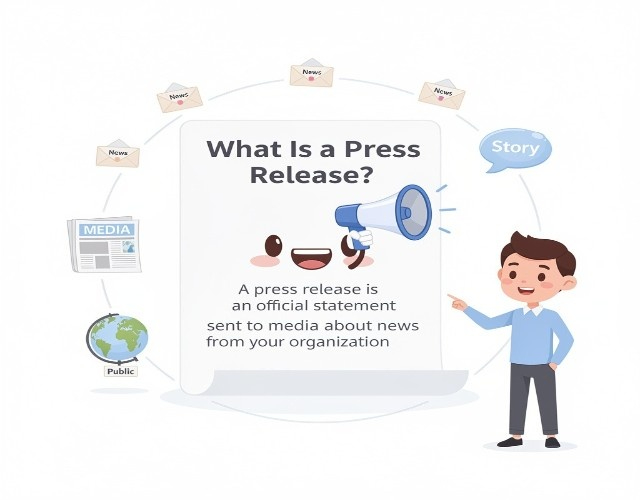
A press release is an official statement issued to media outlets announcing something newsworthy about your organization. Think of it as a news story you write about yourself, crafted to grab journalists' attention and give them everything they need to cover your announcement.
Two main types exist
- Written press releases (most common)
- Recorded press releases (audio/video announcements)
What makes them valuable
Press releases cost nothing compared to paid advertising, yet they can generate significant media coverage. When journalists pick up your story, you earn credibility that advertising can't buy. News outlets need content daily; your press release provides ready to publish material about your company's developments.
A good press release answers who, what, when, where, why, and how in clear, journalistic language. Length typically runs 300 to 800 words (one to two pages). The content lives in public domains, making it both a publicity tool and a marketing asset.
STILL STARING AT A BLANK PAGE?
Urgent deadline? No problem. Our writers work around the clock to deliver polished, plagiarism free press releases
- Professional writers craft your release
- Optimized for media pickup
- Distribution support available
- Unlimited Revisions
Most releases delivered within 24 hours.
Order NowHow to Write a Press Release (Step by Step)
Writing a press release follows a specific structure that journalists expect. Here's the proven process:
Step 1: Add Your Header Information
Start with your company logo centered at the top (200×200 pixels). Place your contact information in the upper right corner, include name, phone number, and email address, so journalists can reach you with questions.
On the upper left, add your release date. Use "FOR IMMEDIATE RELEASE" in all caps when you're ready to publish. If you need media to wait until a specific date, write "EMBARGOED FOR RELEASE UNTIL [DATE]."
Step 2: Write Your Headline
Your headline is critical; it's the first thing journalists see. Keep it under 70 characters, centered, and in 14-point font. Use clear, action-oriented language that includes your main keyword naturally.
- What works: "Local Tech Startup Secures $2M in Series A Funding."
- What doesn't: "Company Announcement Regarding Recent Developments."
The headline should tell the story in one glance. If it's boring or vague, journalists won't read further.
Step 3: Add a Subheading (Optional)
A subheading gives you space to add context that your headline couldn't fit. Keep it under 120 characters in 12-point Times New Roman. This isn't mandatory, but it helps clarify complex announcements.
Step 4: Write the Dateline
Start your first paragraph with your location and date in bold: NEW YORK, January 23, 2026. This tells journalists where and when the news is happening.
Step 5: Craft Your Opening Paragraph
This paragraph must answer: Who, what, when, where, and why. Journalists call this the "inverted pyramid" approach, lead with the most important information, as many readers won't get past this section.
Step 6: Develop Your Body Paragraphs
Use 2 to 4 body paragraphs to elaborate on your opening. Include:
|
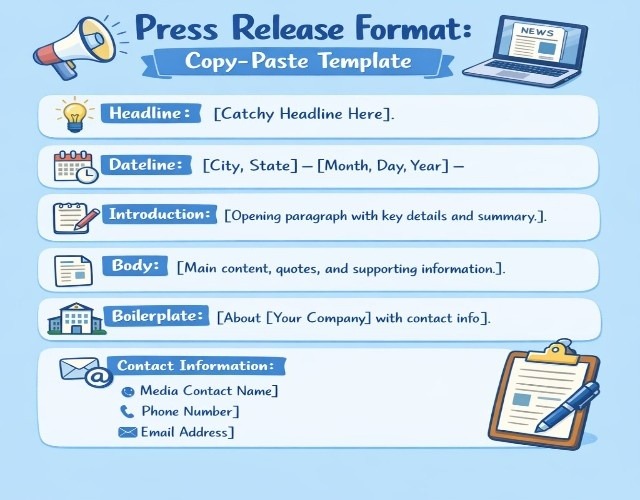
Keep paragraphs single-spaced with double spacing between them. Use 12-point Arial or Times New Roman font. For detailed formatting specifications, see our press release format guide.
Step 7: Add Your Boilerplate
The boilerplate is your "About Us" section that appears at the bottom. It's 100 words or fewer describing your company, your background, any awards, and years in business. This section stays consistent across all your press releases.
Step 8: Include Contact Information
Below the boilerplate, add: "For more information, please contact [Name] at [Phone] or [Email]." Format this in 12-point font to maintain consistency.
Step 9: Add End Notation
If your release runs two pages, center "-more-" at the bottom of page one. On the final page, center three pound signs (###) to signal the end of your document. This tells journalists they've received the complete release.
Step 10: Distribute Your Release
Send your press release to targeted media lists, local news outlets, industry publications, bloggers, and journalists who cover your sector. You can also use distribution services like PR Newswire or eReleases to reach broader audiences and ensure your release appears in search results.
Timing matters as much as targeting. Tuesday through Thursday mornings typically see the best pickup rates.
How to Start a Press Release
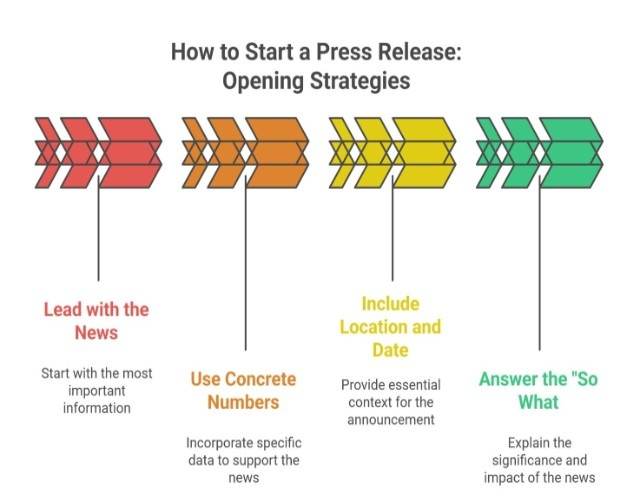
The first 100 words determine whether journalists keep reading. Here's how to hook them:
Four proven opening strategies
- Lead with the news: Don't bury your announcement. State it immediately.
- Use concrete numbers: "Increases revenue by 40%" beats "significantly improves performance."
- Include location and date: Establishes timeliness and relevance
- Answer the "so what": Why should anyone care about this news?
What to avoid
|
Want to see these principles in action? Our press release examples page shows opening paragraphs from product launches, awards, events, and hiring announcements, with analysis of what makes each one effective.
How to Conclude a Press Release
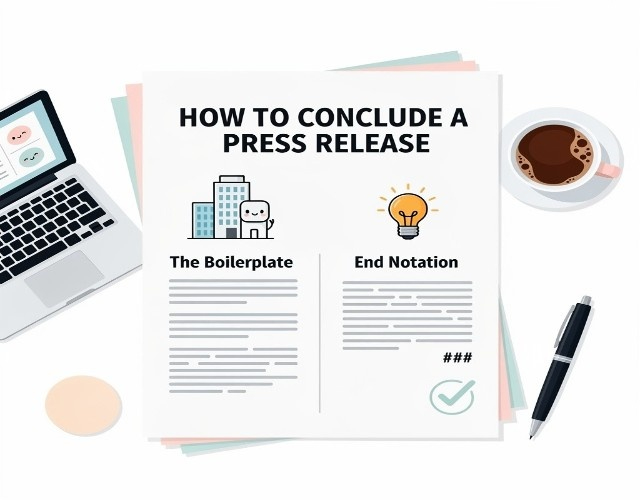
A press release conclusion consists of two essential elements:
1. The Boilerplate
This is your 75 to 100-word "About [Company]" section that provides standard company background. Include what you do, when you were founded, key metrics or achievements, and your website URL. This section stays consistent across all your releases and appears in bold as About [Company Name].
2. End Notation
After the boilerplate, center three pound signs (###) to signal the document is complete, which tells journalists they've received the full release with no missing pages. If your release runs to a second page, center "-more-" at the bottom of page one, then use ### only on the final page.
EXPERT WRITERS STANDING BY
From press releases to essays, our writers handle research, drafting, and formatting, so you can focus on strategy, not paperwork.
- Researched and fact-checked content
- Media-ready formatting
- Unlimited revisions
- Fast turnaround options available 24/7.
Trusted. Confidential. 100% human written.
Order NowPress Release Structure Overview
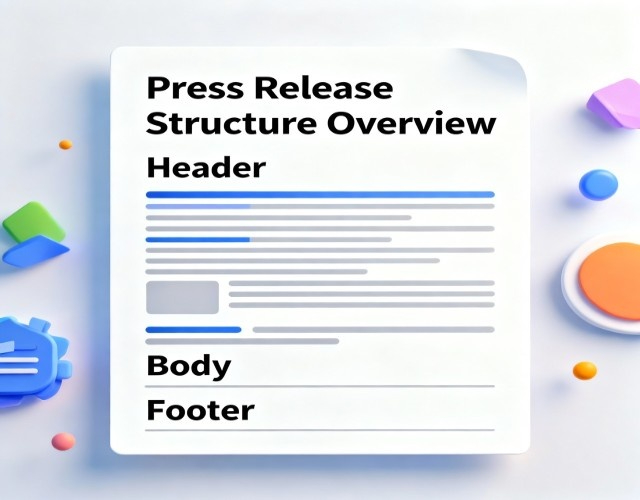
Every effective press release follows the same basic anatomy:
Three main sections
- Header (logo, contact info, release date)
- Body (headline, opening paragraph, supporting details, quote)
- Footer (boilerplate, contact details, end notation)
The opening paragraph does the heavy lifting; it answers who, what, when, where, and why. Body paragraphs add supporting details, quotes, and context. The boilerplate provides a consistent company background.
Word count breakdown
Your opening should be 15 to 20% of the total length, body content 60 to 70%, and boilerplate 10 to 15%. Most releases run 300 to 800 words total.
For exact spacing, fonts, and a copy-paste template, see our press release format guide.
Press Release Topics: What's Worth Announcing
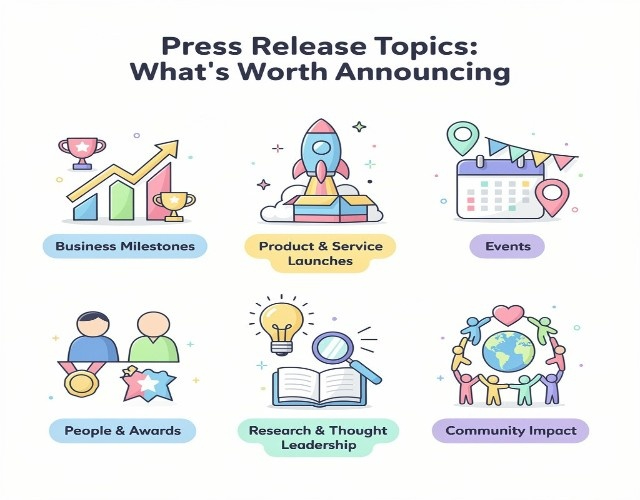
Not everything needs a press release. Here's what actually qualifies as newsworthy:
Business Milestones
- Funding rounds (Series A, B, C announcements)
- Mergers and acquisitions
- New market expansions
- Revenue milestones (first $1M, first $10M, etc.)
- Company anniversaries (5, 10, 25 years)
- Office openings or relocations
Product & Service Launches
- New product releases
- Major product updates or version releases
- Beta program announcements
- Service expansion into new categories
- Technology innovations or patents
- Software integrations or partnerships
Events
- Industry conferences you're hosting
- Speaking engagements at major events
- Grand openings
- Charity fundraisers or community events
- Webinars featuring industry experts
- Trade show participation
People & Awards
- Executive appointments (C-level hires)
- Key leadership promotions
- Industry awards won
- Company rankings (Inc. 5000, Best Places to Work)
- Employee milestone achievements
- Expert commentary on trending topics
Research & Thought Leadership
- Original research findings
- Survey results and data reports
- White paper publications
- Case study releases
- Industry trend analysis
- Educational resource launches
Community Impact
- Charitable donations or sponsorships
- Volunteer initiative launches
- Sustainability achievements
- Scholarship programs
- Local community partnerships
- Corporate social responsibility milestones
The test: Ask yourself, "Would a journalist's audience care about this?" If it only matters to your team or existing customers, it's probably not press release material. Save those updates for newsletters or social media.
Common Press Release Mistakes to Avoid
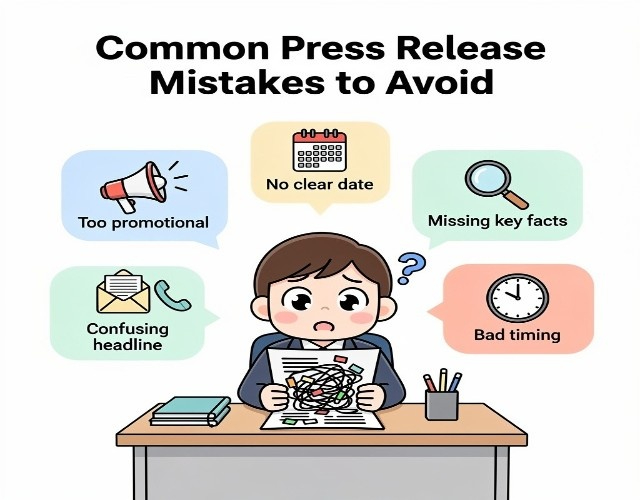
Even experienced marketers make these errors. Here's what to watch out for:
A. Writing Mistakes
1. Being too promotional: Press releases should read like news, not ads. Journalists will ignore anything that sounds like marketing copy.
2. Burying the lead: Don't save your news for paragraph three. Lead with the most important information immediately. 3. Missing the 5 W's: If your opening paragraph doesn't answer who, what, when, where, and why, rewrite it. 4. Using jargon: Write for a general audience. Industry buzzwords and corporate speak alienate journalists and readers. 5. Weak headlines: Generic headlines get ignored. "Company Makes Announcement" tells readers nothing. "Healthcare Startup Secures $5M to Expand Telehealth Access" grabs attention. 6. No quotes: Quotes add human perspective and credibility. Include at least one quote from a company executive or relevant stakeholder. |
B. Formatting Mistakes
1. Wrong contact information: Double check phone numbers and email addresses. Journalists need to reach out to you for follow up questions. 2. Missing boilerplate: Every release needs your company background section. Journalists use this information when writing their stories. 3. Poor formatting: Use standard fonts (Times New Roman or Arial, 12 point), proper spacing, and clear section breaks. Messy formatting suggests unprofessionalism. 4. Forgetting the end notation: Always include ### at the bottom of your final page to signal that the release is complete. |
C. Distribution Mistakes
1. Blasting to everyone: Targeted distribution beats mass emails. Send to journalists who actually cover your industry or beat. 2. Bad timing: Monday mornings and Friday afternoons are the worst times to send releases. Tuesday through Thursday mornings work best. 3. No follow-up: Journalists are busy. A polite follow-up email 24-48 hours after sending can make the difference between coverage and silence. 4. Ignoring local media: Local news outlets often provide the easiest path to coverage, especially for community-focused announcements. 5. Not posting on your website: Create a newsroom or press section on your site. Journalists research companies before writing stories. |
D. Content Mistakes
1. Making it too long: Releases over 800 words rarely get read. Journalists want quick, scannable information. 2. No actual news: Slight product updates, routine business activities, and internal process changes aren't newsworthy. Save press releases for significant announcements. 3. Overhyping: Claims like "game-changing," "revolutionary," and "unprecedented" damage credibility. Let your facts speak for themselves. 4. No proof points: Back up claims with data, metrics, and specifics. "Improves efficiency" means nothing without numbers. 5. Ignoring mobile: Many journalists read releases on phones. Use short paragraphs and clear formatting that works on small screens. |
Need help writing your release? Our professional essay writing service handles everything from the opening to the conclusion, properly formatted and media-ready.
Press Release Distribution
Writing your release is only half the battle; getting it in front of the right people matters just as much. Distribution options include:
1. Direct Distribution
- Email targeted journalists who cover your industry.
- Send to local news outlets in your area.
- Share with business partners and customers.
- Post on your company website newsroom.
- Distribute via social media channels
2. Distribution Services
- PR Newswire (reaches major media outlets).
- eReleases (guaranteed pickup by AP and PR Newswire).
- Business Wire (targets financial and business media).
- PRWeb (affordable option for small businesses).
3. Search engine visibility matters
Distribution services make your release searchable by journalists and customers. This is especially valuable for event announcements, product launches, and time sensitive news.
READY TO GET YOUR PRESS RELEASE PUBLISHED?
Your announcement deserves clarity, structure, and media-ready language. Our academic & business writers craft press releases, essays, and reports that get results.
- Media ready press releases
- Distribution included
- Written by academic specialists
- 100% custom, never resold or recycled
Free revisions until you're 100% satisfied.
Order NowBottom Line
A press release gives you free access to media coverage that paid advertising can't match. Focus on newsworthy content, use the inverted pyramid structure, and write like a journalist, not a marketer. Lead with your most important information, support it with specifics, and make it easy for the media to run your story.
Whether you write it yourself or get professional help, the goal is the same: turn your announcement into coverage that builds credibility and reaches your audience. Good luck.