-19594.jpg)
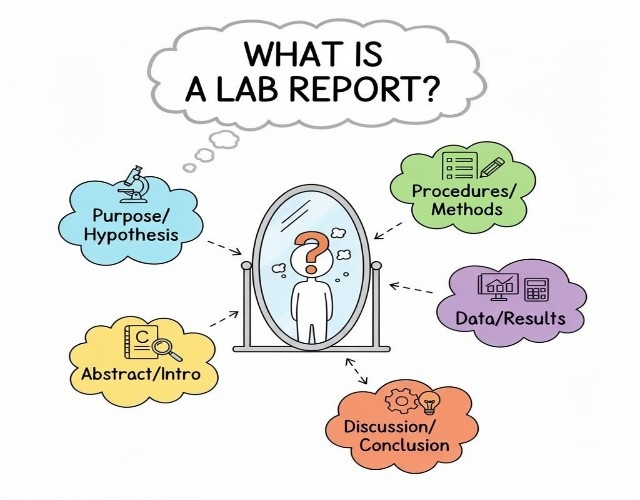
Let's be honest, you're here because you've got a lab report due and you're not sure where to start. Maybe the deadline's tomorrow. Maybe you did the experiment, but your notes are a mess. Either way, you need help, and you need it fast.
Here's the truth: A lab report is your written record of a scientific experiment.
That's it. You're telling the story of what you did in the lab, why you did it, what happened, and what it means.
Think of it like documenting a recipe
|
The difference? Lab reports use scientific language, follow a strict format, and require you to think critically about your data instead of just recording it.
Why Do Professors Make You Write These?
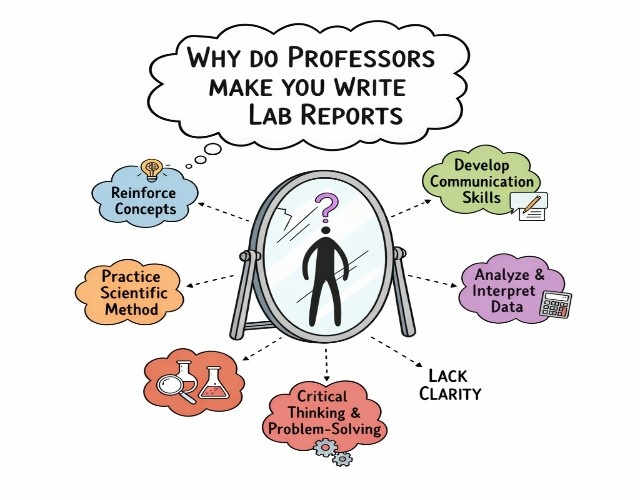
Lab reports serve three real purposes (and none of them are "torture students"):
1. Proving You Understand the Science
Anyone can follow step-by-step instructions. Lab reports prove you actually understand why you did what you did. You're showing critical thinking, not just cookbook following.
2. Learning Professional Communication
Whether you're heading to med school, engineering, research, or industry, you'll be writing reports. This is career prep disguised as homework.
3. Teaching Reproducibility
Science only works if others can replicate your experiment. Your report should contain enough detail that another student could do exactly what you did and get similar results.
Who Writes Lab Reports?
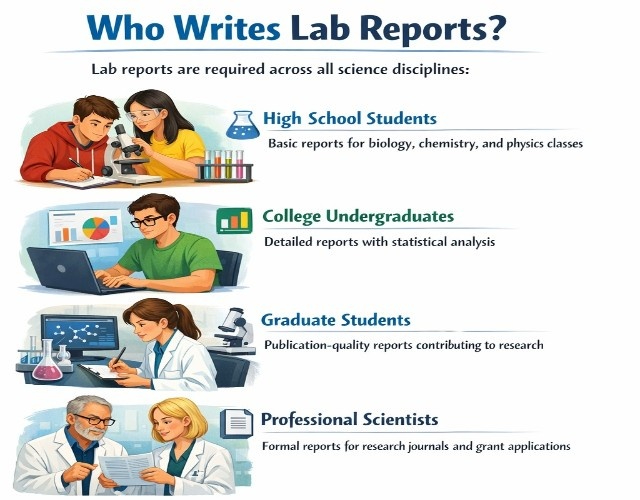
Lab reports are required across all science disciplines:
- High School Students: Basic reports for biology, chemistry, and physics classes.
- College Undergraduates: Detailed reports with statistical analysis.
- Graduate Students: Publication-quality reports contributing to research.
- Professional Scientists: Formal reports for research journals and grant applications.
Your Lab Report: Written by Pros. Delivered on Time.
No more blank-page anxiety. Just tell us what you need; we handle everything else.
- Clear, well-structured scientific writing
- Accurate data analysis & statistical interpretation
- Proper formatting and peer-review–ready citations
- On-time delivery tailored to your requirements
Turn your research into results that stand out.
Order NowLab Report Format: The 7 Essential Sections
Every lab report follows the same basic structure. Here's what you need to include, in order:
1. Title Page
Your title page is the first impression. Make it count.
What to Include:
- Experiment title (specific and descriptive)
- Your name
- Course name and number
- Instructor's name
- Date of experiment and submission date
- Lab partner names (if applicable)
Title Page Example:
The Effects of Temperature on Enzyme Activity in Catalase
John Smith
Biology 201: Molecular Biology
Dr. Sarah Johnson
Experiment Date: October 15, 2024
Submission Date: October 22, 2024
Lab Partners: Maria Garcia, James Chen
| Title Writing Tip: Be specific. "Enzyme Activity Experiment" is vague. "Determining Optimal Temperature for Catalase Activity Using Potato Tissue" tells readers exactly what you did. |
2. Abstract (50-150 Words)
This is your "TL;DR" for scientists. Write it last even though it appears first.
The 4-Sentence Formula:
- Purpose: Why did you do this experiment?
- Methods: How did you do it? (1-2 sentences)
- Results: What did you find? (Include key numbers)
- Conclusion: What does it mean?
Abstract Example:
This experiment investigated how temperature affects catalase enzyme activity in potato tissue. Fresh potato samples were exposed to hydrogen peroxide at five different temperatures (0°C, 20°C, 40°C, 60°C, and 80°C), and oxygen production was measured. Results showed optimal enzyme activity at 40°C, with 15.2 mL of oxygen produced in 3 minutes. Activity decreased significantly at both lower temperatures (8.1 mL at 0°C) and higher temperatures (2.3 mL at 80°C). These findings confirm that enzymes have specific optimal temperature ranges, with activity declining when temperatures denature protein structure.
| Key Point: Include specific numbers. "Enzyme activity increased" is weak. "Enzyme activity increased from 8.1 mL to 15.2 mL" is precise. |
3. Introduction
Your introduction answers: "Why should anyone care about this experiment?"
Structure Your Introduction Like This:
Paragraph 1(The Big Picture): General background on the topic. Start broad. What scientific principle or phenomenon are you investigating?
Example: "Enzymes are biological catalysts that drive nearly every chemical reaction in living organisms. Understanding how environmental factors affect enzyme activity is crucial for applications ranging from food preservation to drug development."
Paragraph 2 (What We Already Know): Previous research and current understanding. What do scientists already know? Cite 2-3 relevant sources here.
Paragraph 3 (The Gap or Question): Gap or question your experiment addresses. What specific question are you answering? Why does it matter?
Paragraph 4 (Your Hypothesis): Your hypothesis and predictions. State your hypothesis clearly. What do you expect to happen and why?
Introduction Length: Typically 1-2 pages (300-500 words)
Example: "Based on enzyme kinetics theory, we hypothesized that catalase activity would increase with temperature up to an optimal point (approximately 40°C), then decrease sharply as proteins denature at higher temperatures."
4. Materials and Methods
This section is your recipe. Another scientist should be able to replicate your experiment exactly using only your methods section.
What to Include:
Materials List: List everything with specifications.
- All equipment (with sizes/specifications)
- All chemicals (with concentrations)
- Any biological specimens
- Safety equipment used
Procedure Description:
Write in the past tense, third person, passive voice.
- Quantities and measurements.
- Time intervals.
- Temperature settings.
- Number of trials.
- Control variables.
| Don't write: "I heated the solution." Write: "The solution was heated to 40°C using a water bath. |
Example Materials Section:
Materials:
- Fresh potato (Solanum tuberosum)
- 3% hydrogen peroxide solution
- Distilled water
- 5 test tubes (18mm x 150mm)
- Graduated cylinder (25mL)
- Thermometer (0-100°C)
- Water baths set to 0°C, 20°C, 40°C, 60°C, 80°C
- Stopwatch
- Cork borer (5mm diameter)
5. Results
Present what happened without interpretation. Save the "why" for the discussion section.
Your Results Section Should Include:
1. Data Tables: Organize your raw data clearly. Include units and label everything.
Table 1: Oxygen Production at Different Temperatures
| Temperature (°C) | Trial 1 (mL) | Trial 2 (mL) | Trial 3 (mL) | Average (mL) |
|---|---|---|---|---|
| 0 | 8.3 | 7.8 | 8.2 | 8.1 |
| 20 | 11.4 | 11.8 | 11.2 | 11.5 |
| 40 | 15.0 | 15.6 | 15.0 | 15.2 |
| 60 | 6.2 | 6.5 | 6.0 | 6.2 |
| 80 | 2.1 | 2.4 | 2.4 | 2.3 |
2. Graphs and Figures: Visual representations of your data. Always include:
- Descriptive title
- Labeled axes with units
- Legend if needed
- Figure number
Statistical Analysis (if applicable):
- Standard deviation
- Error bars
- P-values
- Correlation coefficients
Results Writing Example: "Enzyme activity increased from 8.1 mL of oxygen at 0°C to a maximum of 15.2 mL at 40°C. Activity then decreased to 6.2 mL at 60°C and 2.3 mL at 80°C. The data shows a clear bell-shaped curve with peak activity at moderate temperature (Figure 1)."
What NOT to Write:
Incorrect: "The enzyme denatured at high temperature." (That's interpretation, save it for discussion). Correct: "Oxygen production decreased at temperatures above 40°C." (Just the facts) |
6. Discussion
This is where you interpret your results and show you understand the science.
Structure Your Discussion in 5 Parts:
1. Restate Main Findings (1 paragraph): Start with your most important result.
| Example: "The experiment clearly demonstrated that catalase enzyme activity is temperature-dependent, with optimal function at 40°C." |
2. Explain Results (2-3 paragraphs): Why did you get these results? Connect to scientific principles.
Example: "The increased activity at moderate temperatures reflects higher molecular kinetic energy, resulting in more frequent enzyme-substrate collisions. The sharp decline above 40°C indicates protein denaturation, where the enzyme's three-dimensional structure unfolds, destroying its active site." |
3. Compare to Previous Research (1-2 paragraphs): Do your results align with published studies? If not, why might they differ?
| Cite sources here. Example: "These findings align with Johnson et al. (2023), who reported optimal catalase activity between 37-42°C in mammalian tissue." |
4. Address Limitations (1 paragraph): What could have affected your results? What would you do differently?
| Be honest but not apologetic. Example: "Temperature fluctuations in the water baths (±2°C) may have introduced variability. Future experiments should use thermostatic control for greater precision." |
5. Future Directions (1 paragraph): What questions does your experiment raise? What should be tested next?
| Example: "Future research should investigate pH effects on catalase activity, as enzymes are sensitive to both temperature and pH conditions." |
7. References
List every source you cited in your report. Use the citation style required by your instructor (APA, MLA, or Chicago).
APA Format Example:
Smith, J. A., & Johnson, M. (2023). Enzyme kinetics in extreme environments.
Journal of Biological Chemistry, 298(4), 1234-1245.
https://doi.org/10.1016/j.jbc.2023.01.234
National Center for Biotechnology Information. (2024). Catalase enzyme structure.
Retrieved from https://www.ncbi.nlm.nih.gov/gene/847
MLA Format Example:
Smith, John A., and Maria Johnson. "Enzyme Kinetics in Extreme Environments."
Journal of Biological Chemistry, vol. 298, no. 4, 2023, pp. 1234-1245.
| Citation Tip: Use Google Scholar to find properly formatted citations. Search your source, click "Cite," and copy the APA/MLA format. |
Step-by-Step: How to Write Your Lab Report
Stop staring at a blank page. Follow this order:
Day 1: Write Methods and Results
Start with the easiest sections while the experiment is fresh in your mind.
|
Day 2: Write Discussion
This takes the most brainpower. (1-2 hours)
|
Day 3: Write Introduction
Now that you know your results, you can frame the intro perfectly. (45-60 minutes)
Day 4: Finish Abstract, Title Page, References
Polish and proofread. (30-45 minutes)
|
Total Time: 4-6 hours spread over 3-4 days
Pro Tip: Don't try to write it all in one sitting. Your brain needs breaks to process complex scientific concepts.
Common Lab Report Mistakes (And How to Avoid Them)
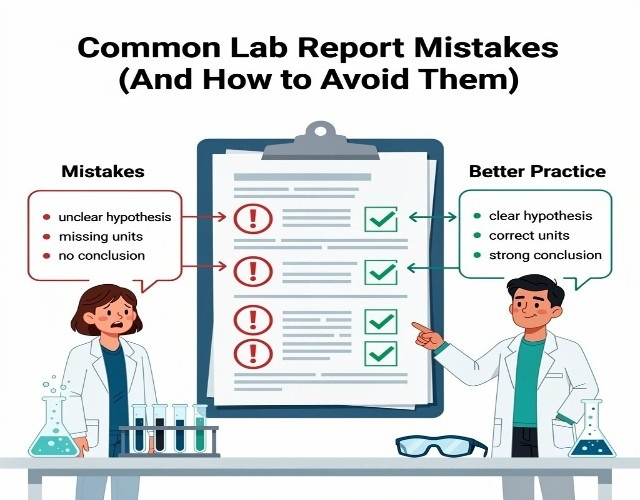
1. Writing in First Person
| Incorrect: "I heated the solution to 50°C." Correct: "The solution was heated to 50°C." |
Use passive voice and third person for scientific objectivity.
2. Including Raw Data Dumps
Don't paste pages of handwritten notes. Organize data into clean, typed tables.
3. Interpreting Results in the Results Section
Keep Results purely factual. Save all interpretation for Discussion.
Incorrect: Results: "The temperature increase caused enzyme denaturation." Correct: Results: "Enzyme activity decreased at temperatures above 60°C." Correct: Discussion: "The decrease likely resulted from protein denaturation." |
4. Vague Language Without Numbers
| Incorrect: "The solution got hot." Correct: "The solution temperature increased from 22°C to 87°C over 5 minutes." |
Always include specific numbers and units.
5. Forgetting Citations
Any fact you didn't discover yourself needs a citation.
This includes:
- Background information in your introduction.
- Theoretical explanations in your discussion.
- Comparison to other studies.
6. Not Proofreading
Typos and formatting errors make you look careless.
Proofread twice:
| 1. Once for content and flow. 2. Once for grammar, spelling, and formatting. |
Why Struggle When Experts Can Do It Better?
Thousands of students trust us to deliver lab reports and essays that get the grades they deserve.
- Expertly written lab reports and research papers
- Precise data presentation and statistical accuracy
- Fully formatted to academic and journal standards
- Original, well-researched, and deadline-focused
Accurate analysis, credible writing, real results.
Order NowLab Report Format by Academic Level
1. High School Lab Reports
| Requirement Area | Details |
|---|---|
| Length | 3–5 pages (approximately 1,000–1,500 words) |
| Main Focus | Following procedures correctly |
| Complexity Level | Basic structure with simple analysis |
| Organization | Clear introduction, body, and conclusion |
| Writing Style | Straightforward, clear, and procedural |
| Citations | 2–3 credible sources acceptable |
| Purpose | Demonstrate understanding and correct application of procedures |
2. College Lab Reports (Undergraduate)
| Requirement Area | Details |
|---|---|
| Length | 5–10 pages (approximately 2,000–3,000 words) |
| Main Focus | Understanding scientific principles |
| Complexity Level | Advanced; statistical analysis required |
| Analysis Type | Quantitative and/or statistical analysis |
| Methodology | Use of appropriate scientific and statistical methods |
| Writing Structure | Formal academic structure (introduction, methods, results, discussion) |
| Citations | 5–8 peer-reviewed academic sources |
| Purpose | Demonstrate comprehension of scientific concepts through data-driven analysis |
3. Graduate Lab Reports
| Requirement Area | Details |
|---|---|
| Length | 10–20+ pages (approximately 3,000–5,000+ words) |
| Main Focus | Contributing to scientific knowledge |
| Complexity Level | Very advanced; publication-quality analysis |
| Research Depth | Original, rigorous, and comprehensive |
| Analysis Type | Advanced statistical and/or theoretical analysis |
| Methodology | Robust, reproducible, and well-documented methods |
| Writing Structure | Journal-style format (abstract, introduction, methods, results, discussion) |
| Citations | 10–15+ recent peer-reviewed sources |
| Purpose | Produce research suitable for academic publication |
Lab Report Examples by Subject
Different science disciplines have slightly different expectations. Here's what to know:
Biology Lab Report Example
Biology reports emphasize observations of living systems and often include:
- Detailed organism descriptions
- Environmental conditions
- Biological variation in results
- Evolutionary or ecological context
Common Biology Lab Topics:
- Enzyme kinetics
- Cell membrane transport
- Photosynthesis rates
- DNA extraction
- Bacterial growth curves
Chemistry Lab Report Example
Chemistry reports focus on chemical reactions, calculations, and purity:
- Detailed chemical equations
- Stoichiometric calculations
- Percent yield and percent error
- Safety considerations
- Reaction mechanisms
Common Chemistry Lab Topics:
- Titration experiments
- Calorimetry
- Synthesis reactions
- Spectroscopy analysis
- Distillation procedures
Physics Lab Report Example
Physics reports emphasize measurements, error analysis, and theoretical models:
- Detailed measurement procedures
- Uncertainty calculations
- Graphical analysis
- Mathematical derivations
- Comparison to theoretical predictions
Common Physics Lab Topics:
- Projectile motion
- Simple harmonic motion
- Electrical circuits
- Optics experiments
- Conservation of energy
Understanding Lab Report Grading Rubrics
Knowing how you'll be graded helps you focus on what matters most. Here's what professors typically evaluate:
| Section | Points | What Professors Look For |
|---|---|---|
| Abstract | 5% | Concise and complete summary of the study (50–150 words) |
| Introduction | 15% | Clear hypothesis, adequate background information, proper citations |
| Methods | 10% | Sufficient detail for replication, written in past tense, well organized |
| Results | 20% | Clear data presentation, appropriate tables/graphs, no interpretation |
| Discussion | 30% | Scientific explanation of results, comparison to literature, acknowledgment of limitations |
| References | 5% | Proper citation format, credible and relevant sources |
| Format / Style | 15% | Professional appearance, correct grammar, proper length and formatting |
How to Analyze Data for Your Lab Report
Strong data analysis separates good reports from great ones. Here's how to do it right:
Creating Effective Data Tables
Table Rules:
- Every table needs a descriptive title
- Include units in column headers
- Number tables consecutively (Table 1, Table 2...)
- Round to appropriate significant figures
- Align numbers for easy comparison
Before and After Example:
Poor Data Table
| Temperature (temp) | Result |
| 20 | 5 |
| 40 | 10 |
| 60 | 4 |
Good Table:
Table 1: Effect of Temperature on Enzyme Activity
| Temperature (°C) | Oxygen Produced (mL) | Standard Deviation (±mL) |
|---|---|---|
| 20 | 5.2 | 0.3 |
| 40 | 10.1 | 0.5 |
| 60 | 4.3 | 0.4 |
Creating Effective Graphs
Graph Types to Use:
- Line Graphs: Best for showing change over time or continuous relationships
- Bar Graphs: Best for comparing discrete categories
- Scatter Plots: Best for showing correlation between two variables
- Pie Charts: Best for showing parts of a whole (use sparingly)
Graph Requirements:
- Descriptive title with figure number
- Labeled axes with units
- Appropriate scale (not too compressed or stretched)
- Legend if multiple data series
- Error bars showing variability
Calculating Key Statistics
- Mean (Average): Add all values and divide by the number of trials. This is your central value.
- Standard Deviation: Measures how spread out your data is. Small SD = consistent results.
- Percent Error:
Percent Error = |Experimental Value - Theoretical Value| / Theoretical Value × 100% - Percent Yield (Chemistry):
Percent Yield = (Actual Yield / Theoretical Yield) × 100%
Struggling with data analysis or creating professional graphs? Data interpretation is often the hardest part of lab reports, especially if your results didn't match your hypothesis. Our professional essay writing service, STEM specialists excel at analyzing experimental data and creating publication-quality figures that meet academic standards.
Downloadable Lab Report Templates
Get started faster with our free templates. Each is formatted correctly and includes helpful prompts.
Perfect for high school and introductory college courses. Includes all seven standard sections with formatting already set up.
For upper-level college courses. Includes sections for statistical analysis, detailed error analysis, and multiple figure/table formatting.
Print this checklist and use it before submitting any lab report. Covers all essential elements to avoid losing easy points.
Use this during your experiments to record data systematically. Makes writing the report much easier.
Quick reference for citing common sources in APA format.
Ready to Write Your Lab Report?
You now have everything you need to write an excellent lab report. Remember:
- Follow the 7-section structure
- Write in past tense, third person
- Include specific numbers and units
- Analyze your data thoroughly
- Discuss limitations honestly
- Cite all sources properly
Download our free templates shared above to get started with proper formatting already in place. Focus on the science, not the formatting.
Ready to Submit a Perfect Lab Report?
Join thousands of students who trust 5StarEssays for their lab reports
- Upload Your Lab Data
- Choose Your Deadline
- Work with Your Expert
- Download & Submit
15,000+ satisfied students • 4.8/5 average rating • Money-back guarantee
Order Now