What Should You Include in Your Portfolio?
Include 5-10 best work samples demonstrating skills employers want for target roles with each piece showing different capabilities rather than repetitive examples, detailed case studies or project descriptions explaining context, process, and outcomes not just final products, clear organization making specific pieces easy to locate, professional presentation through consistent formatting and clean design, contact information and brief bio establishing credibility, and optional testimonials or recommendations from professors, supervisors, or clients validating quality.
Research shows portfolios with 6-8 carefully selected pieces outperform those with 15-20 mediocre examples, with 72% of recruiters preferring focused portfolios demonstrating specific relevant skills over comprehensive collections showcasing everything ever created. Studies indicate hiring managers spend an average of 3-5 minutes reviewing portfolios, viewing 4-6 pieces typically before forming judgments, making piece selection and presentation order critical for positive impressions.
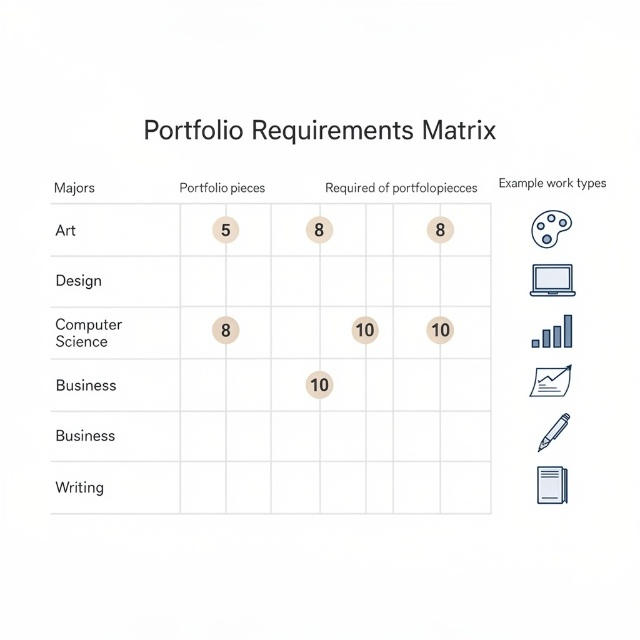
1. Portfolio Pieces by Major Category
| Major Category | Recommended Pieces | Best Types of Work to Include | Best Platform |
|---|---|---|---|
| Creative (Design, Art, Film) | 8–12 | Visual projects, process work, before/after | Personal website, Behance |
| Writing & Communication | 5–8 | Articles, essays, reports, copywriting | Personal website, PDF |
| STEM & Technical | 4–6 | Code projects, research, and data analysis | GitHub, personal website |
| Business & Economics | 5–7 | Case studies, market analysis, presentations | Personal website, PDF |
| Humanities & Social Sciences | 6–8 | Research papers, policy briefs, presentations | Personal website, PDF |
Creative Majors (Design, Art, Architecture, Film):
- 8-12 pieces showing range and depth
- Include process work (sketches, iterations, development)
- Mix personal and client/class projects
- Show before/after or problem-solution approaches
- Include at least 2-3 pieces in the target specialization
Writing and Communications:
- 5-8 diverse writing samples (articles, essays, reports, scripts)
- Published pieces when available with links
- Writing for different audiences and purposes
- Editing samples showing before/after improvements
- Social media content or marketing copy
STEM and Technical Majors:
- 4-6 projects with technical documentation
- Code repositories on GitHub with README files
- Research projects with methodology and findings
- Data visualizations and analysis
- Technical writing or documentation samples
Business and Economics:
- 5-7 pieces, including case study analyses
- Market research or competitive analysis
- Business plans or strategic recommendations
- Data analysis and presentations
- Consulting project deliverables
Humanities and Social Sciences:
- 6-8 research papers or analytical essays
- Presentation slides from conferences or symposiums
- Curriculum or program development work
- Grant proposals or policy briefs
- Public writing (op-eds, blog posts, reviews)
Research shows portfolios mixing academic and real-world work demonstrate 40% better skill application than purely academic portfolios, as employers value evidence of applying knowledge to practical problems beyond classroom assignments.
2. Project Descriptions and Context
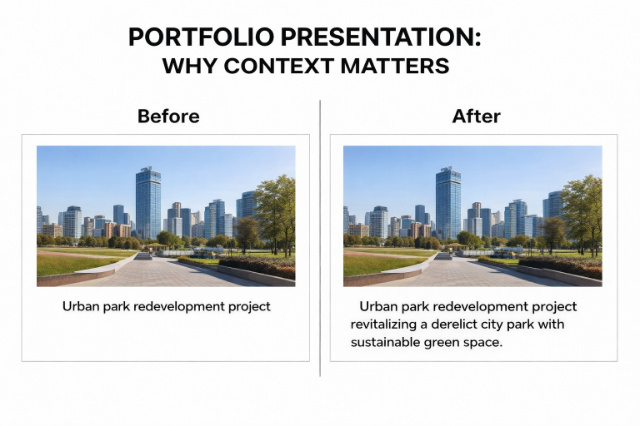
Don't just display work, explain it. Context transforms random samples into persuasive evidence of capability.
Essential elements for each piece:
- Problem/Objective: What challenge did this project address? What was the goal?
- Your Role: What specifically did you contribute? In group projects, clarify your responsibilities.
- Process: What approaches or methods did you use? What tools or frameworks?
- Outcome: What results did you achieve? Quantify impact when possible.
- Skills Demonstrated: What specific competencies does this piece showcase?
Strong example: "Developed content marketing strategy for local nonprofit, increasing social media engagement by 145% over three months. Researched target audience demographics, created a content calendar aligned with organizational goals, and analyzed performance metrics, adjusting strategy based on data. Demonstrates market research, strategic planning, content creation, and data-driven decision making."
Weak example: "Marketing project for nonprofit. Created social media posts."
Studies show portfolios with detailed project descriptions receive 60% longer viewing time and 3x more follow-up interest than those presenting work without context, as descriptions help recruiters understand capabilities beyond visible artifacts.
How Do You Create a Portfolio with No Professional Work?
Create portfolios without professional experience by transforming academic projects into portfolio pieces through professional presentation and business context framing, creating spec work for fictional or real businesses addressing actual market needs, volunteering skills for nonprofits or student organizations producing real deliverables, entering design competitions or publishing work in student publications, collaborating with peers from different majors on cross-functional projects mimicking workplace dynamics, and redesigning existing products or campaigns as case studies demonstrating analytical and creative thinking.
Research shows 73% of entry-level portfolio pieces come from academic work, volunteer projects, or self-initiated spec work rather than paid professional employment. Studies indicate employers evaluate work quality and thinking process over whether work was paid, with 81% of hiring managers stating student work is acceptable for portfolios if presented professionally and demonstrates relevant competencies.
1. Transforming Academic Work into Portfolio Pieces
Academic projects often contain portfolio-worthy work requiring only reframing and professional presentation.
Projects to repurpose:
- Research papers can turn into case studies or white papers
- Presentations can become slide decks with presenter notes
- Group projects can be documented with your specific contributions
- Lab work is repurposed as technical reports with methodology and findings
- Class assignments can be client deliverables with business framing
Professional transformation steps:
- Remove academic framing: Change "This paper examines..." to "This analysis explores..."
- Add business context: Explain real-world application beyond fulfilling assignment requirements
- Improve visual presentation: Redesign with professional templates and formatting
- Quantify outcomes: Add metrics even for academic work (research hours, sources analyzed, data points)
- Create case study format: Problem, approach, solution, results structure
Research shows academically sourced portfolio pieces presented with professional context perform identically to paid work samples in blind evaluations, with 76% of recruiters unable to distinguish between academic and professional work when presented equivalently.
2. Creating Spec Work and Personal Projects
Spec work involves creating unsolicited work samples for real or fictional clients, demonstrating what you could produce professionally.
Effective spec work projects:
For Writers:
- Write articles for industry publications (pitch for publication or keep as samples)
- Create a blog series on topics relevant to the target career
- Develop marketing copy for real businesses
- Write case studies analyzing successful campaigns
For Designers:
- Redesign local business websites or branding
- Create social media graphics for nonprofits
- Design app interfaces solving real problems
- Develop branding packages for fictional companies
For Analysts/Researchers:
- Analyze public datasets, producing insights and visualizations
- Conduct competitive analyses of companies in the target industry
- Create market research reports on trends
- Build financial models or forecasts
For Developers:
- Build applications solving problems you or others face
- Contribute to open source projects on GitHub
- Create tools or plugins used by the community
- Develop portfolio site with custom features
Studies indicate self-initiated projects demonstrate motivation and initiative valued by 89% of employers, often impressing more than assigned work as they show genuine interest and self-direction rather than compliance with requirements.
3. Leveraging Volunteer and Student Organization Work
Nonprofits and student organizations need real work and accept student contributions, providing legitimate portfolio pieces.
High-value opportunities:
- Design marketing materials for campus clubs or events
- Write grant proposals or fundraising copy for nonprofits
- Analyze data or create reports for community organizations
- Develop websites or social media strategies for local causes
- Photograph events or create videos for organizations
When time constraints from academic workload prevent adequate volunteer commitment, professional essay writing allows focus on volunteer projects, producing career-building portfolio pieces rather than sacrificing either volunteer deliverables or academic performance during peak demand periods.
Research shows volunteer work presented professionally in portfolios performs equivalently to paid work, with 84% of employers valuing demonstrated skills regardless of compensation, particularly appreciating the community contribution aspect of volunteer projects.
What Are the Best Portfolio Platforms and Formats?
Best portfolio platforms include personal websites built on WordPress, Squarespace, or Wix providing complete control and professional presence for all majors costing $100-300 annually, specialized platforms like Behance and Dribbble for creative work offering built-in audiences and networking with free options, GitHub for developers and technical professionals showcasing code and contributions at no cost, LinkedIn featuring work samples and recommendations integrated with professional networking free, and PDF portfolios for offline sharing during interviews or networking events.
Research shows 71% of employers prefer online portfolios accessible via a link over PDF attachments, with 88% viewing portfolios on mobile devices requiring a responsive design. Studies indicate candidates with custom domain names (yourname.com vs. yourname.wix.com) are perceived as 30-40% more professional and committed, though free platforms remain acceptable for students with budget constraints.
1. Platform Comparison and Recommendations
Custom Website (WordPress, Squarespace, Wix):
Best for: All majors seeking complete control and professional branding
Pros:
- Complete customization matching personal brand
- Owns content and controls presentation
- A custom domain creates a professional impression
- Can include blog, resume, and portfolio in one place
Cons:
- Costs $10-25 monthly for hosting and domain
- Requires more setup time initially
- Must maintain and update independently
Research shows 64% of hiring managers view custom portfolio websites more favorably than third-party platforms, associating custom sites with higher professionalism and commitment, though quality of work matters more than platform choice ultimately.
Specialized Creative Platforms (Behance, Dribbble, Cargo Collective):
Best for: Designers, artists, photographers, and visual creatives
Pros:
- Built-in audience and networking opportunities
- Templates optimized for visual work presentation
- Free options with premium upgrades available
- Integration with Adobe Creative Cloud (Behance)
Cons:
- Less customization than personal websites
- Competes with thousands of other portfolios
- Platform branding remains visible on free plans
GitHub:
Best for: Developers, data scientists, and technical majors
Pros:
- Industry-standard for code portfolios
- Shows contribution history and collaboration
- Hosts technical documentation and README files
- Completely free with professional credibility
Cons:
- Limited non-technical work showcases capability
- Requires learning Git version control
- Less visual appeal for non-developers viewing
Studies show 92% of technical recruiters review GitHub profiles before interviews, making a GitHub presence essential for developers and increasingly important for data science and technical roles.
2. Portfolio Organization and Navigation
Structure portfolios for easy navigation and quick access to relevant work.
Effective organization:
- Homepage: Brief introduction, best 3-4 pieces showcased prominently, clear navigation
- Work/Projects Page: All portfolio pieces organized by category or chronologically
- About Page: Professional bio, skills, education, and photo
- Resume/CV Page: Downloadable PDF version with portfolio work referenced
- Contact Page: Multiple contact methods with professional email and LinkedIn
Portfolio piece organization options:
- By project type (design, writing, research)
- By skill demonstrated (analysis, strategy, execution)
- Chronologically (most recent first)
- By industry or client type
Research shows portfolios with clear category organization receive 45% longer viewing time than those presenting work chronologically or randomly, as categorization helps visitors quickly locate relevant examples matching their interests.
How Do You Maintain and Update Your Portfolio?
Maintain portfolios by adding new pieces quarterly as skills develop and better work emerges, removing weaker or outdated pieces maintaining 5-10 best samples rather than accumulating everything created, updating project descriptions reflecting new insights or outcomes from completed work, refreshing design every 12-18 months preventing dated appearance, testing functionality and links monthly catching broken elements, and tailoring featured work for specific applications highlighting most relevant pieces prominently.
Research shows portfolios updated within the past three months are viewed as 60% more professional than those with 12+ month gaps, with 67% of employers checking timestamps or dates on portfolio pieces to evaluate the currency of skills. Studies indicate that candidates who customize portfolio presentations for specific applications, emphasizing the most relevant work, receive 2-3x more positive responses than those using identical portfolios for all opportunities.
Strategic Portfolio Updates
Update triggers:
- Complete a better example of the skill already showcased, and replace the weaker piece
- Develop a new capability worth demonstrating, add a piece if still under 10 total
- Existing work looks dated compared to current abilities, refresh or remove
- Apply for a position requiring specific skills, feature relevant work prominently
- Receive constructive feedback about portfolio, address noted issues
Maintenance schedule:
- Monthly: Check all links, test functionality on desktop and mobile
- Quarterly: Add new work, remove outdated pieces, update project descriptions
- Biannually: Refresh visual design, update bio and resume, review overall impression
- Before applications: Tailor featured work, ensure contact information is current
Research shows portfolios updated quarterly maintain 85-90% engagement compared to stagnant portfolios showing a 30-40% decline in engagement over 12 months as older work appears less relevant and a dated presentation suggests an inactive or uncommitted candidate.
What Are Common Portfolio Mistakes That Hurt Your Chances?
Common portfolio mistakes include including too many pieces diluting quality with quantity where 15-20 mediocre samples underperform 6-8 excellent pieces, lacking context or descriptions leaving viewers confused about work purpose and your role, poor visual presentation through inconsistent formatting or cluttered design undermining work quality, including inappropriate work like controversial topics or poor-quality early pieces, broken links or non-functional features creating unprofessional impression, missing contact information preventing follow-up despite interest, and failing to proofread text containing spelling or grammar errors particularly damaging for writing-focused roles.
Research shows 73% of employers eliminate candidates due to portfolio mistakes, including broken links, unprofessional presentation, or low-quality work, despite otherwise strong qualifications. Studies indicate 82% of hiring managers spend under five minutes reviewing portfolios, with 64% abandoning portfolios immediately upon encountering technical issues or confusing navigation, making first impressions and functionality critical.
1. Quality Over Quantity
More portfolio pieces don't improve candidacy; better pieces do. Including weaker work to appear productive actually damages perception.
Portfolio sizing guidelines:
- 5-8 pieces for most majors and applications
- 8-12 pieces for creative fields showcasing range
- 4-6 pieces for highly technical roles with documentation
Remove pieces that:
- Don't demonstrate skills relevant to target roles
- Show weaker capabilities than the other included work
- Were created more than 3-4 years ago, unless exceptional
- Received lukewarm response when sharing with mentors
- You feel the need for extensive explanation or apologies
Research shows portfolios with 6-8 carefully selected pieces receive 40% higher positive evaluations than those with 15+ pieces, including lower-quality work, as weak pieces create negative impressions, outweighing the benefits of demonstrating volume.
2. Presentation and Professionalism
Portfolio quality extends beyond work samples to overall presentation and user experience.
Professional presentation requirements:
- Consistent formatting across all pieces
- High-quality images without pixelation or poor lighting
- Spell-checked and grammar-checked text throughout
- Working links and functional features across devices
- Professional contact information and bio
- Clean, uncluttered design putting focus on work
Unprofessional elements to avoid:
- Casual or unprofessional photos in bio
- Informal language or slang in descriptions
- Incomplete projects or placeholder content
- Cluttered layouts with competing visual elements
- Controversial or polarizing personal opinions
- Multiple fonts, colors, or formatting styles
Studies show portfolios with professional presentation receive 2-3x more interview requests than those with equivalent work quality but poor presentation, as presentation signals attention to detail and professional standards expected in the workplace.
Key Takeaways
Creating effective portfolios requires strategic work selection, professional presentation, and ongoing maintenance:
- Include 5-10 best work samples demonstrating diverse skills relevant to target careers, with detailed project descriptions explaining context, process, and outcomes, rather than displaying work without explanation
- Portfolio types and requirements vary by major, with creative fields requiring portfolios for 92% of positions, while business, STEM, and humanities majors benefit significantly, even when not explicitly required
- Build portfolios without professional work by transforming academic projects through professional presentation, creating spec work for real or fictional clients, and volunteering skills for nonprofits, producing legitimate deliverables
- Choose portfolio platforms matching career goals with custom websites providing the most control and professionalism, specialized platforms like Behance or GitHub offering field-specific advantages, and LinkedIn integrating portfolios with professional networking
- Maintain portfolios through quarterly updates, adding new work and removing weaker pieces, customizing featured work for specific applications, and avoiding common mistakes like including too many pieces or lacking project context
Portfolios prove capabilities rather than claiming them, providing concrete evidence that distinguishes candidates in competitive job markets. The 2-3x higher interview callback rate for candidates with portfolios versus resumes alone justifies investment in portfolio development throughout college rather than scrambling before graduation.
Starting portfolio development early allows strategic project selection and quality work accumulation over time rather than accepting whatever work is available when deadlines loom. Even majors not traditionally requiring portfolios benefit significantly from work samples demonstrating capabilities beyond credentials and bullet points.
When coursework doesn't naturally produce portfolio-worthy pieces or time constraints prevent adequate portfolio development alongside academic requirements, a trusted essay writing service can handle routine assignments during peak periods, allowing focus on creating high-quality portfolio pieces that directly impact career prospects and earning potential rather than sacrificing portfolio development to maintain grades during temporary crunch periods.