Introduction
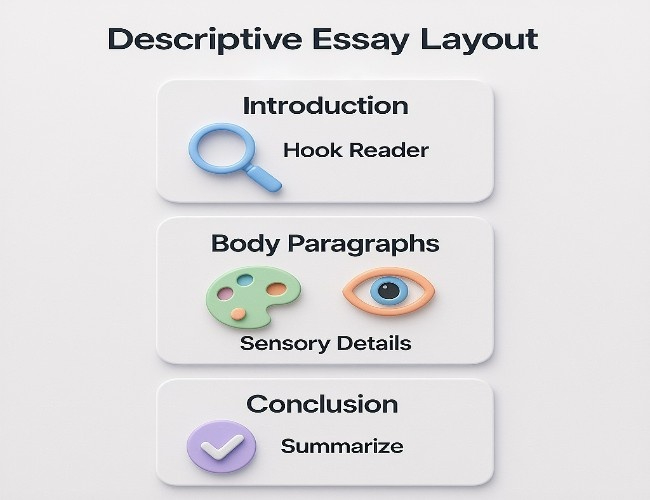
Writing descriptive essays requires different skills from other academic formats. Unlike expository essays presenting information objectively or argumentative essays defending positions logically, descriptive essays immerse readers in sensory experiences through precise language and rich detail.
This shift from telling to showing, from generic to specific, from vague to vivid requires observational skills, sensory awareness, vocabulary precision, and organizational clarity that develop through practice and technique mastery.
Descriptive writing skills extend beyond academic essays into professional communication, creative writing, journalism, marketing, and any field requiring vivid, clear communication. The observation skills and precise language you develop while writing descriptive essays transfer to all writing contexts throughout education and a career.
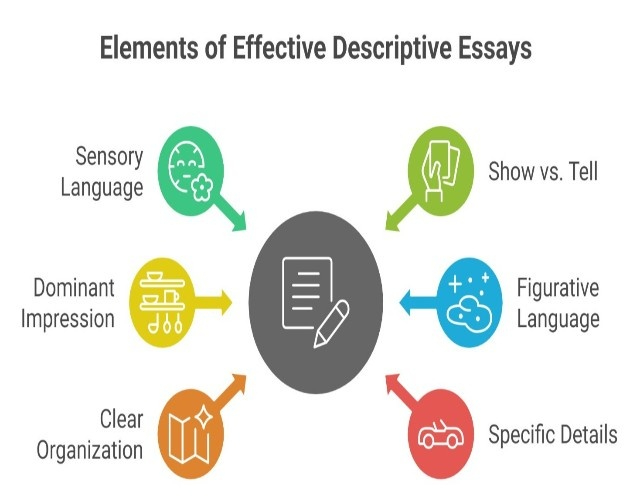
This guide provides a complete step-by-step process with examples at every stage. You'll learn pre-writing, brainstorming and observation techniques, show-versus-tell mastery with extensive conversion examples, a comprehensive sensory language guide for each sense, organizational strategies for different subject types, figurative language techniques enhancing description, revision strategies focusing on sensory richness, and common mistakes with specific fixes.
For a complete overview of descriptive essay fundamentals, visit our comprehensive descriptive essay guide
Pre-Writing Process
Subject Selection and Observation
Choose observable subjects you've directly experienced, enabling authentic sensory detail. Personal observation provides rich sensory data that research cannot match—specific colors, particular sounds, distinctive smells, exact textures from direct contact.
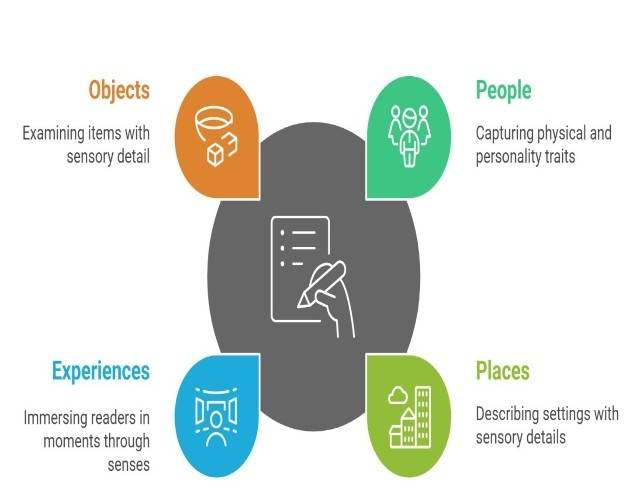
Select topics engaging multiple senses naturally: places visited, people observed extensively, objects examined closely, experiences lived fully. Avoid topics requiring purely research-based description (historical events you didn't witness, places never visited, people never met).
Conduct focused observation systematically.
If possible, revisit or re-examine subjects with fresh sensory focus before writing. Observe deliberately across all senses:
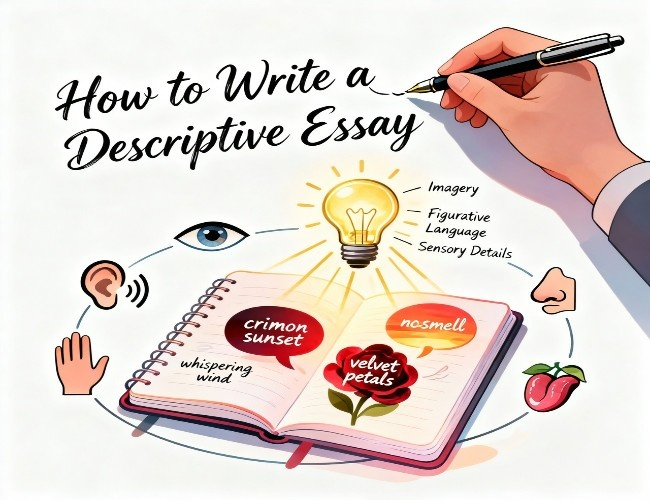
Visual details: colors using specific names (crimson, not red), shapes, sizes, lighting quality and direction, shadows, movements, textures visible to the eye
Auditory details: sounds' volume levels, pitch ranges, sources and directions, rhythms or patterns, qualities (harsh, melodic, rhythmic, chaotic)
Olfactory details: scents with comparisons to familiar smells, intensity levels (faint, strong, overwhelming), pleasantness or unpleasantness, associations triggered
Tactile details: textures (rough, smooth, sticky, soft), temperatures (warm, cool, hot, cold), weights, physical sensations and pressure
Gustatory details: flavors and taste categories, intensities, combinations, aftertastes (when applicable to subjects)
Take notes immediately—sensory memories fade quickly. Record observations while experiencing subjects when possible. Capture specific details: not "blue sky" but "cerulean sky deepening to cobalt toward zenith," not "loud noise" but "metallic screech followed by shattering glass."
For guidance in selecting strong subjects, explore descriptive essay topics organized by type with selection criteria.
You Deserve Better Than a C
Get the Essay — and the Grade — You Actually Want
No AI. No templates. Just essays that get results
Sensory Detail Brainstorming
Create systematic five-senses charts, organizing observations before drafting. This brainstorming generates raw material for description, ensuring multi-sensory engagement.
Sight: List 10+ visual observations—colors using precise names (crimson, azure, amber, not red, blue, yellow), shapes and forms, sizes and proportions, movements and actions, lighting and shadows, contrasts and patterns, textures visible
Sound: List 5+ auditory observations—volumes (whisper, murmur, roar, thunder), pitches (high, low, shrill, deep), sources and origins, rhythms and patterns, qualities (harsh, melodic, rhythmic, chaotic, harmonic)
Smell: List 3+ olfactory observations—scent descriptions using comparisons (like cinnamon, resembling fresh rain, similar to wet dog), intensities (faint, subtle, strong, overwhelming, pervasive), pleasantness levels, and emotional associations
Touch: List 5+ tactile observations—textures (rough, smooth, sticky, soft, hard, grainy, silky), temperatures (scorching, warm, cool, icy), weights (heavy, light, substantial), physical sensations, and pressure
Taste: List 3+ gustatory observations if applicable—flavors (sweet, sour, bitter, salty, umami), intensities, combinations, aftertaste,s and lingering sensations
Brainstorming Tips:
- Generate more details than needed—select the strongest during drafting
- Use specific language: "mahogany" not "brown," "thundered" not "made noise."
- Compare to familiar things: "smelled like wet dog and diesel fuel."
- Note what's NOT there: absence of expected smells or sounds reveals character
- Consider synesthesia: sounds that feel textured, colors that seem loud
See how effective essays layer these details in our annotated descriptive essay examples with sensory language highlighted by type.
Establishing Dominant Impression
Dominant impression is the overall feeling, mood, or idea unifying your description—the single central theme all sensory details reinforce.
Define central feeling: Ask yourself, "What's the single word or phrase capturing this subject's essence?" This becomes your dominant impression, guiding all detail selection.
Examples of dominant impressions: - Grandmother's kitchen: warmth and tradition - Abandoned factory: decay and forgotten industry - Bustling market: vibrant chaos - Mountain summit: peaceful isolation - Child's bedroom: creative disorder - Hospital waiting room: anxious liminal space
Purpose and function: Dominant impression guides detail selection—include sensory details reinforcing impression, omit contradictory details weakening unity. Describing "warmth and tradition" kitchen requires warm colors (golden light, honey-toned wood), comforting smells (baking bread, simmering soup), familiar sounds (humming, soft conversation)—not cold metallic surfaces, harsh fluorescent lighting, or chemical cleaning product scents undermining warmth.
Thesis statement: Your thesis typically establishes a dominant impression explicitly: "My grandmother's kitchen embodied warmth and tradition, a sanctuary where family gathered and memories formed over simmering pots and rising bread." This guides readers toward experiencing your central impression through accumulated sensory evidence.
Show vs Tell Mastery
Understanding the Fundamental Principle
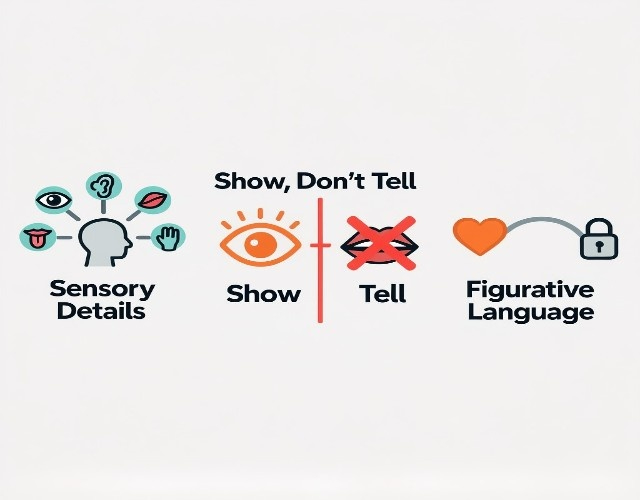
The fundamental principle separating effective from weak descriptive writing is showing through observable evidence rather than telling through statements.
Telling states facts directly, asking readers to accept assessments without sensory evidence: "She was nervous." Readers must trust your judgment without experiencing evidence firsthand.
Showing provides observable sensory evidence, allowing readers to draw conclusions independently: "Her hands trembled as she shuffled note cards repeatedly. Sweat beaded on her forehead despite the cool auditorium." Readers observe evidence and conclude nervousness themselves, creating more engaging, convincing descriptions.
Telling works like lectures—writers inform readers what to think. Showing works like films—readers observe scenes and form impressions from accumulated details. Showing creates immersive experiences; telling provides information at a distance.
The difference appears in every aspect of descriptive writing: emotions, character traits, atmospheric qualities, and physical appearances. Master this principle, and your descriptive writing improves dramatically immediately.
TRY BEFORE YOU BUY
Free Essay. Zero Risk. Real Experts.
Zero risk. 100% human-written. Guaranteed.
Show vs Tell Practice Examples
Emotion (Happiness):
Tell: "She felt happy about the news."
Show: "Her smile stretched wide, crinkling the corners of her eyes. She hummed tunelessly while washing dishes, hips swaying to a rhythm only she heard. When the phone rang again, she nearly danced across the kitchen to answer."
Character Trait (Laziness):
Tell: "He was lazy and never cleaned."
Show: "Dishes piled in the sink for the third day running, crusted food hardening on plates. His unwashed hair stuck up at odd angles. The TV remote lay within arm's reach of the couch where he'd spent the entire Saturday, surrounded by empty soda cans and chip bags."
Setting (Spooky Atmosphere):
Tell: "The house was scary and creepy."
Show: "Wind moaned through cracked windows. Floorboards groaned under each tentative step, threatening collapse. Shadows pressed against walls where wallpaper peeled in long curling strips. Dust and decay hung thick in motionless air, coating the throat with each breath."
Weather (Hot):
Tell: "It was very hot outside that day."
Show: "Heat shimmered off the asphalt in visible waves. Sweat trickled down my back within minutes, soaking my shirt collar. The air hung thick and still—even breathing felt like work. Metal playground equipment radiated heat untouchable to bare skin."
Personality (Kindness):
Tell: "She was kind and considerate to everyone."
Show: "She remembered everyone's coffee order without asking. Her hand found my shoulder at exactly the moment I needed steadying. When speaking to the nervous intern, she lowered her voice to a gentle register and slowed her normally rapid pace, making space for stumbling answers."
Place (Busy Restaurant):
Tell: "The restaurant was very busy during dinner rush."
Show: "Silverware clinked against plates at every crowded table. Servers weaved between chairs, balancing laden trays overhead. Conversation hummed beneath jazz piano melodies drifting from the corner. The kitchen door swung open every few seconds, releasing garlic and butter aromas with each waiter's passage."
Converting Telling to Showing
Follow a systematic process, converting telling statements in your drafts to showing descriptions:
Step 1:
Identify telling statements throughout your draft—adjectives stating qualities directly: "nervous," "beautiful," "sad," "exciting," "boring," "happy," "angry," "peaceful."
Step 2:
Ask, "What observable evidence shows this?" For each telling statement, list what readers would see, hear, smell, taste, and touch that demonstrates the quality without naming it directly.
Step 3:
List specific sensory details proving the quality. Generate 3-5 concrete observations across multiple senses showing the quality through accumulated evidence.
Step 4:
Replace telling adjectives with showing details in your draft. Delete the telling statement entirely, replacing it with sensory evidence that demonstrates rather than states.
Step 5:
Verify effectiveness: Could readers infer the quality from details alone without you stating it explicitly? If yes, you're showing effectively. If readers might miss the implication, add more specific evidence or clarify through additional details.
For extensive examples demonstrating this conversion process, study our descriptive essay example collection which shows versus-tell moments clearly identified.
Sensory Language Mastery
Sight—Visual Language
Vision provides the most descriptive detail since humans rely heavily on sight, but effective visual description requires specificity beyond generic color and shape names.
Move beyond generic colors toward specific shades, creating vivid mental pictures: Not "red" but "crimson," "scarlet," "burgundy," "rust," "cherry."
Not "blue" but "azure," "cobalt," "turquoise," "navy," "cerulean." Not "green" but "emerald," "lime," "sage," "forest," "mint."
Describe lighting quality and direction:
"Harsh fluorescent lights hummed overhead, casting everything in unflattering brightness." "Afternoon sunlight slanted through dusty windows, illuminating floating particles in golden columns." "Shadows pooled in corners where firelight couldn't reach, creating pockets of impenetrable darkness."
Capture movement with strong verbs:
"Leaves fluttered in the breeze," not "leaves moved." "Crowds surged toward the exits," not "people walked out quickly." "Smoke curled upward from the candle's flame," not "smoke rose from the candle." Action verbs create dynamic visual images, replacing weak verb-adverb combinations.
Show textures visually through descriptive details:
"Weathered boards, paint peeling in long strips revealing gray wood underneath." "Polished marble reflecting overhead lights in rippling patterns." "Fabric's intricate pattern of interwoven gold and crimson threads catches lamplight."
What's Your Essay Stress Costing You?
Free Essay. Real Writers. Zero Risk.
Zero risk. 100% human-written. Guaranteed.
Sound—Auditory Language
Sound descriptions require noting volume, quality, rhythm, and source—building sonic landscapes through layered auditory details.
Specify volume and quality precisely:
Quiet sounds include whisper, murmur, rustle, trickle, sigh, hum, and patter. Medium sounds include chatter, buzz, click, clatter, tap, and ring. Loud sounds include roar, thunder, blare, shriek, crash, boom, screech, and bellow.
Identify clear sources and origins:
"Cash register's electronic beep punctuates each transaction." "Children's laughter echoes from a distant playground across the field." "Steam hissing from the espresso machine's valve." Knowing where sounds originate helps readers build complete mental scenes with spatial awareness.
Describe rhythms and patterns creating atmosphere:
"Rhythmic drumming of rain on the tin roof, steady and hypnotic." "Irregular clicking of keyboard typing, starting and stopping unpredictably." "Steady heartbeat pulse of bass from car stereo vibrating through concrete."
Use onomatopoeia when appropriate:
Crash, bang, whoosh, sizzle, thud, creak, gurgle, buzz, snap, pop, hiss, clang. Sound-imitating words create immediate auditory impressions that readers hear mentally while reading.
Layer multiple sounds, creating depth:
"Beneath the conversation's hum, dishes clinked in the distant kitchen while traffic rumbled outside the windows." Describing foreground, middle, and background sounds creates realistic sonic environments where multiple things happen simultaneously.
Smell—Olfactory Language
Since English has a limited smell vocabulary, effective olfactory description relies heavily on comparisons to familiar scents and noting intensity and pleasantness.
Use comparisons to familiar scents:
"Smelled like cinnamon and vanilla with underlying coffee notes." "Metallic scent resembling old pennies or blood." "Fresh-cut grass mixed with gasoline from the nearby mower." "Musty odor like wet cardboard in old basements."
Describe intensity levels affecting prominence:
Faint, subtle, mild, noticeable, strong, overpowering, overwhelming, pervasive, lingering. Intensity affects how prominently smells figure in the overall sensory experience and atmosphere.
Note pleasantness guiding emotional response:
Pleasant smells might be fragrant, sweet, fresh, aromatic, perfumed, or inviting. Unpleasant smells might be acrid, musty, rancid, pungent, stale, fetid, or nauseating. Not all strong smells are unpleasant—freshly brewed coffee is strong but pleasant; rotting garbage is strong and unpleasant.
Connect to emotional associations and memories:
"The yeasty bread aroma triggered memories of grandmother's kitchen instantly, transporting me across decades." Smells often connect powerfully to memories and emotions, adding psychological depth to sensory description.
Touch—Tactile Language
Tactile descriptions communicate textures, temperatures, weights, and physical sensations—often overlooked but crucial for complete sensory immersion.
Describe texture variations precisely:
Rough surfaces might be coarse, grainy, abrasive, scratchy, bumpy, or gritty. Smooth surfaces might be silky, polished, slippery, sleek, satiny, or glassy. Soft things might be plush, downy, cushioned, yielding, spongy, velvety. Hard things might be solid, rigid, unyielding, firm, stony, or concrete.
Note temperatures affecting physical comfort:
Hot descriptions include scorching, warm, tepid, toasty, blazing, and searing. Cold descriptions include frigid, cool, icy, chilly, frosty, arctic, and freezing. Temperature dramatically affects how subjects feel physically and atmospherically.
Communicate weight and pressure:
Heavy, substantial, weightless, crushing, gentle, oppressive, light, burdensome. "The backpack's weight pressed into shoulders, straps cutting into skin." "The blanket felt weightless, barely noticeable covering skin."
Include physical sensations beyond basic texture:
"Rough sandpaper texture scraping against fingertips, leaving them slightly raw." "Cool metal surface conducting warmth away from palms immediately on contact." "Sticky residue clinging to hands despite repeated washing, tacky and unpleasant."
Taste—Gustatory Language
Taste descriptions apply primarily to food and drink but occasionally to other contexts when relevant. Taste vocabulary builds from five basic categories plus combinations.
Basic taste categories:
Sweet (honeyed, sugary, candy-like, syrupy). Sour (tart, acidic, tangy, sharp, citrusy). Bitter (acrid, harsh, astringent, medicinal). Salty (briny, savory, seasoned, cured). Umami (savory, meaty, rich, deeply flavored).
Describe combinations and complexity:
"Sweet with bitter undertones creating complex balance." "Salty and sour combining in mouth-puckering intensity." Most foods combine multiple taste categories, creating layered flavor profiles.
Note aftertastes and lingering sensations:
"Left lingering cinnamon warmth coating the tongue minutes later." "Metallic aftertaste like old pennies or blood." Aftertaste extends the taste experience beyond initial contact, affecting the overall impression.
Use taste primarily when genuinely relevant:
Don't force taste descriptions into subjects where taste doesn't naturally apply. When describing food, restaurants, and cooking experiences, taste becomes central. When describing non-food subjects, taste typically remains minimal or absent.
Imagine Submitting Without the Panic
Your Essay. Written by Pros. Delivered on Time
100% original. 100% human. Satisfaction guaranteed
Organizing Your Essay
Spatial Organization
Spatial organization guides readers through physical space systematically—left to right, top to bottom, near to far, outside to inside, clockwise around spaces. This method works best for places, objects, and scenes where physical arrangement matters.
Common spatial patterns:
- Left to right or right to left across the visual field
- Top to bottom or bottom to top, examining vertical space
- Near to far or far to near based on the distance from the observer
- Outside to inside or inside to outside entering/exiting spaces
- Clockwise or counterclockwise movement around central points
Example spatial outline for kitchen:
- Entrance/door: first impressions entering space
- Counter/sink area: work surfaces, appliances, preparation zones
- Stove/cooking area: heat, activity, smells emanating
- Table: central gathering space, social focus
- Window: view, light, connection to the outside world
Spatial transitions maintaining flow:
"To the left..." "Above the counter..." "In the far corner..." "Across the room..." "Beyond the table..." "Turning toward the window..." These phrases guide readers' mental eyes through space systematically.
Advantages:
Prevents confusion about spatial relationships, creates methodical visualization, feels natural for physical spaces and objects, and helps readers build complete, accurate mental pictures.
Sensory Organization
Sensory organization dedicates paragraphs or sections to different senses or groups of related sensory impressions. This works well for experiences, complex subjects, or situations where multiple sensory impressions layer simultaneously.
Organization patterns:
- Paragraph per sense (sight, then sound, then smell, then touch, then taste)
- Sense groupings (visual and spatial together, then auditory and olfactory combined)
- Dominant sense first, with others supporting
- The most striking sense first captures attention immediately
Example sensory outline for market:
- Visual chaos: colors, movements, displays, crowds, and visual overwhelming
- Auditory assault: vendors calling, conversations, music, transaction sounds
- Olfactory mix: produce smells, spices, flowers, food cooking, crowd
- Tactile experiences: textures of produce handled, crowding and pressing, temperature variations
- Synthesis: how senses combine to create an overall immersive experience
Advantages: Layers impressions naturally, emphasizes sensory richness central to descriptive essays, works for subjects where spatial organization doesn't apply clearly, and allows deep exploration of each sense before moving to the next.
Chronological Organization
Chronological organization follows temporal progression—particularly useful for experiences or events unfolding over time. However, maintain descriptive focus, emphasizing sensory details of each moment rather than narrative plot progression.
Example chronological outline for first-time experience:
- Anticipation and approach: sensory details before beginning, nervous energy, preparation
- Initial moments: first impressions, immediate sensations, shock of newness
- Middle phase: sustained experience, developing impressions, adaptation
- Climactic moment: peak intensity, most memorable sensory details
- Aftermath: lingering sensations, final impressions, reflection on experience
Maintain descriptive focus:
Don't let chronology dominate—emphasize sensory details of each moment rather than just what happened sequentially. Each temporal section should layer rich sensory observations, creating an immersive experience, not merely recounting events.
Advantages: Natural flow for experiences and events, maintains the temporal coherence readers expect, and a familiar structure reduces organizational confusion.
For detailed organizational templates and examples, visit our comprehensive descriptive essay guide with complete structure breakdowns.
Revision Strategies
Sensory Language Check
Systematic revision improves sensory language density and variety dramatically.
Ask these revision questions:
- Have I engaged at least 3-4 senses? Sight typically dominates, but needs support from other senses - Are sensory details specific or vague? "Red" versus "crimson," "nice smell" versus "cinnamon and vanilla"
- Do I layer multiple sensory details per paragraph? Aim for 3-5 per major point
- Can readers experience my description through their senses or only understand it intellectually?
Revision exercise:
Highlight each sense with different colors—visual observations blue, sounds green, smells orange, tactile sensations purple, tastes red. Identify paragraphs lacking sensory variety. Add specific details for underrepresented senses.
Your Time Is Worth More Than This
Get Hours Back. Get a Better Essay
Zero AI. Zero plagiarism. Just expert-level writing.
Show vs Tell Audit
Find telling statements systematically:
Search draft for adjectives stating qualities directly: "beautiful," "scary," "happy," "sad," "boring," "exciting," "nice," "good," "bad," "interesting," "wonderful," "terrible."
Convert each to showing:
Replace every telling adjective with 2-3 specific sensory details proving the quality without naming it directly.
Test effectiveness:
Remove all quality-stating adjectives. Can readers still infer qualities from concrete details alone? If not, you're still telling rather than showing effectively.
Dominant Impression Verification
Check unity throughout the essay:
- Does the thesis establish a clear dominant impression?
- Do all sensory details reinforce that impression consistently?
- Have I included contradictory details weakening unity?
Revise for consistency:
- Identify the thesis's dominant impression clearly.
- Read each paragraph, asking: "Do these details support the dominant impression?"
- Delete contradictory details.
- Add supporting details where the impression weakens.
Specificity Enhancement
Replace generic language with specific, precise vocabulary:
- Colors: "red" ? "crimson," "scarlet," "rust" - Sounds: "loud" ? "thunderous," "deafening," "blaring."
- Smells: "good" ? "like vanilla and cinnamon," "fresh-baked and sweet" - Verbs: "walked" ? "shuffled," "strode," "meandered."
- Nouns: "car," "sedan," "convertible," "station wagon."
Add precision to measurements and descriptions:
"Many people." "At least fifty, according to the entrance counter." "Old" "Weathered by decades, paint peeling in long strips." "Big" "Six feet tall, casting shadows that swallowed smaller neighbors."
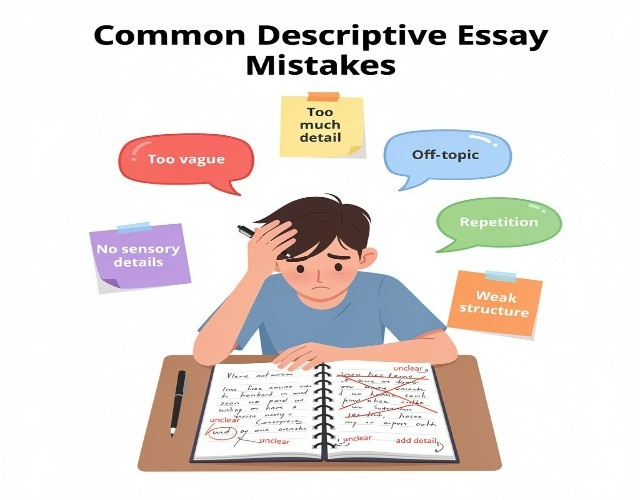
Common Mistakes and Fixes
Telling Instead of Showing
- Problem: "She was nervous" (states quality)
- Fix: "Her hands trembled shuffling note cards. Sweat beaded on forehead. Words caught in throat." (shows evidence)
Vague Generic Language
- Problem: "The room was messy and smelled bad."
- Fix: "Crumpled clothes draped over chairs. Empty pizza boxes teetered on the desk. Stale beer and unwashed laundry created a thick, sour atmosphere."
Clichéd Comparisons
- Problem: "White as snow," "red as a rose," "quiet as a mouse."
- Fix: Create original comparisons: "white as hospital walls," "red as fresh-drawn blood," "quiet as held breath."
Insufficient Sensory Detail
- Problem: One sentence per sense, focus only on sight
- Fix: Layer 3-5 sensory details per paragraph, engage multiple senses throughout
Lack of Dominant Impression
- Problem: Random, unconnected details without a unified focus
- Fix: Establish a clear dominant impression in the thesis, select only details reinforcing it, and delete contradictory observations
Conclusion
Mastering descriptive essay writing develops observational skills, sensory awareness, and precise language use, transferring to all writing contexts throughout education and career. The techniques covered—show versus tell, sensory language across five senses, figurative devices, organization methods, revision strategies—enable you to create vivid mental pictures transporting readers into your observations.
Return to our comprehensive descriptive essay guide for a complete descriptive essay overview whenever needed. Descriptive writing improves with practice and attention to the sensory world around you. Notice details in daily life—how morning coffee smells, how rain sounds on windows, how old books feel. These observations become your descriptive vocabulary.
With techniques and resources here, you have everything needed for vivid, engaging descriptive essays that transport readers into your sensory observations and experiences.
Why Struggle When Experts Can Do It Better? Thousands of students trust us to deliver essays that get the grades they deserve. 100% human-written. Satisfaction guaranteed.