What are the Immediate Academic Consequences of Getting Caught?
The immediate academic consequences depend on your institution’s honour code and the severity of the violation. Most universities follow a tiered disciplinary system that escalates with repeated offenses.
First-Time Offenders Typically Face These Penalties
For students caught purchasing readily available essays for the first time, penalties vary.
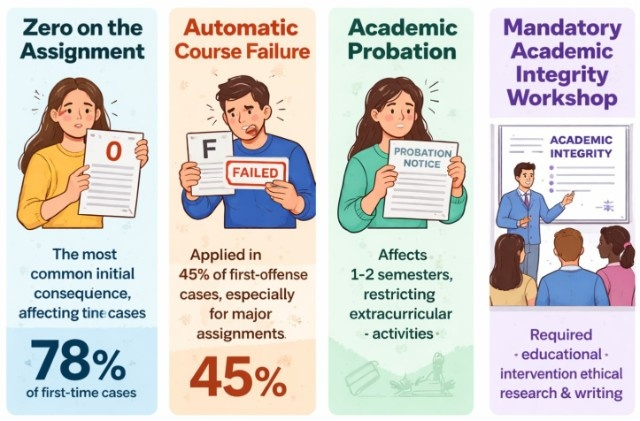
Zero on the assignment: The most common initial consequence, affecting 78% of first-time cases according to academic integrity board data
Automatic course failure: Applied in 45% of first-offense cases, especially when the violation involves major assignments worth 20% or more of the final grade
Academic probation: A formal warning that remains active for one to two semesters, restricting your ability to participate in extracurricular
Mandatory academic integrity workshop: Required educational intervention covering proper citation, research methods, and ethical writing practices
A student at a mid-sized state university who purchased a research paper faced automatic failure in the course plus one semester of academic probation. The permanent transcript notation stated “Academic Integrity Violation - Course F.” This notation appeared on every transcript sent to graduate schools and employers.
The financial impact extends beyond tuition. Students lose an average of $2,400 in wasted course fees when they fail due to academic integrity violations, not including the cost of retaking the class.
Escalating Penalties for Repeat Violations
Second and third offenses carry substantially harsher consequences that can derail your entire academic career:
Second Offense Penalties:
- Suspension for one to two semesters (84% of cases)
- Permanent transcript notation visible to all future schools and employers
- Automatic revocation of scholarships and financial aid eligibility
- Immediate removal from honors programs, Dean’s List, and academic societies
- Banned from holding leadership positions in student organizations
Third Offense Penalties:
- Expulsion from the institution (mandatory at 67% of universities)
- Degree revocation if violation discovered post-graduation
- Permanent educational record damage that follows you indefinitely
- Transcript notations that cannot be expunged or sealed
Research from the International Center for Academic Integrity shows that students who receive academic integrity violations are 3.2 times more likely to face career setbacks during background checks. Graduate programs reject 91% of applicants with documented academic dishonesty incidents.
Financial Consequences You Might Not Expect
Beyond academic penalties, getting caught can devastate your finances:
| Consequence | Summary |
|---|---|
| Scholarship Loss | Lose major funding instantly. |
| No Tuition Refund | Pay full tuition even if you fail. |
| Delayed Graduation | Extra semesters = higher costs. |
| Loan Issues | Risk early repayment. |
| Housing Loss | Lose deposits and paid rent. |
Loss of scholarships: Most merit-based scholarships include academic integrity clauses with immediate termination provisions. Students lose an average of $8,700 annually in scholarship funding.
Tuition non-refund: You still pay full tuition for courses you faildue to violations, with no opportunity for refunds or appeals.
Delayed graduation: Failing courses extends time to degree completion by an average of 1.3 semesters, adding $15,000-$30,000 in additional costs.
Loan implications: Some student loans require maintaining good academic standing. Violations can trigger immediate repayment requirements.
Housing deposits: Students suspended or expelled typically forfeit housing deposits and semester rent.
When considering any essay writing service, understanding these risks helps you distinguish between legitimate academic support and decisions that could derail your future.
How Do Professors and Schools Actually Detect Essay Writing Services?
Institutions detect purchased essays through plagiarism software, writing style analysis, inconsistency detection, and behavioral red flags. Modern detection methods have become increasingly sophisticated, combining multiple technologies to identify submitted work that doesn’t match your established writing patterns.
Detection Method 1: Plagiarism and AI Detection Software
Universities deploy multiple detection tools simultaneously to catch different types of violations:
Turnitin: Used by 89% of four-year institutions, Turnitin creates a “fingerprint” of your writing style from previous submissions. The software analyzes 47 different linguistic markers including sentence complexity, vocabulary range, transition usage, and punctuation patterns. Sudden changes trigger automatic alerts to instructors. The platform also checks against billions of web pages, academic journals, and a database of 1.5 billion previously submitted student papers.
GPT-Zero and Originality.AI: These specialized tools detect AI-generated content patterns with 73-85% accuracy. While they shouldn’t flag human-written essays from a professional essay writing service that employ real writers, they catch students who use ChatGPT or similar AI tools.
Copyscape and Plagscan: Secondary verification tools that cross-reference your work against online content, including essay mill websites and databases. These catch direct copy-paste submissions or essays resold multiple times.
A 2024 study from Stanford University found that 68% of purchased essays from low-quality services get flagged by at least one detection tool within 48 hours of submission.
Detection Method 2: Writing Style Inconsistency Analysis
Your professors notice when your writing suddenly changes. This remains one of the most reliable detection methods because humans excel at pattern recognition.
Instructors watch for these red flags:
Vocabulary shifts: Suddenly using advanced terminology or academic language far beyond your previous work
Citation style changes: Switching from basic citations to sophisticated referencing without explanation
Complexity jumps: Moving from simple sentences to complex academic prose between assignments
Tone inconsistencies: Formal academic writing that doesn’t match your casual in-class writing samples
Subject expertise gaps: Demonstrating deep knowledge in papers but inability to discuss topics in person
One professor described the giveaway: “A student who struggled with basic grammar all semester submitted a flawless 15-page research paper with graduate-level analysis. When I asked them to explain their thesis in office hours, they couldn’t articulate the main argument.”
Many instructors require in-class writing samples specifically to establish your baseline style. They compare these samples against major assignments to identify discrepancies.
Detection Method 3: Metadata and Digital Forensics
Electronic submissions contain hidden information that can reveal purchased essays. Universities increasingly use forensic analysis to examine document properties.
Digital red flags include:
Author name mismatches: The document properties show a different author name than yours
Creation timestamps: Papers “written” entirely within a 2-hour window despite claiming weeks of research
Software inconsistencies: Using specialized academic software you’ve never mentioned accessing
Editing history: Minimal revision history suggesting the paper was written in one sitting by someone else
File path information: Document saved in folders with suspicious names or multiple student identifiers
A student at Boston University was caught when the metadata revealed the essay was created on a computer in Pakistan, while the student was attending classes in Massachusetts during the same timeframe.
Detection Method 4: Behavioral and Contextual Red Flags
Professors recognize patterns of behaviour that suggest purchased work:
- Reluctance or inability to discuss your paper’s content during meetings
- Missing or unable to produce research notes, outlines, or drafts when requested
- Sudden improvement in performance without corresponding improvement in class participation
- Submitting papers on topics never discussed in class or office hours
- Using sources not available through your university’s library system
- Perfect formatting and citation on first submission when previous work had consistent errors
- Universities also monitor suspicious patterns like multiple students submitting papers with identical formatting quirks or shared sources not discussed in class.
The key to avoiding false positives: use a trusted essay writing service that provides custom, original work from human writers and support your learning process rather than replacing it.
What Happens During the Academic Integrity Investigation Process?
Once suspected, the investigation process follows strict institutional protocols that can take 2-8 weeks to resolve. Understanding this process helps you know what to expect and your rights during proceedings.
Step 1: Initial Suspicion and Evidence Gathering
When a professor suspects a violation, they don’t immediately accuse you. Instead, they gather evidence:
- Running your paper through multiple detection tools
- Comparing your submission against previous work
- Checking for similar submissions from other students
- Reviewing your participation in class discussions about the topic
- Examining any draft submissions you provided
This evidence-gathering phase typically takes 3-7 days. During this time, you likely won’t know you’re under investigation.
Step 2: Formal Notification and Your Rights
Once sufficient evidence exists, you receive formal notification through email or certified letter. This notification includes:
- Specific allegations of academic dishonesty
- The evidence gathered against you
- Date and time of the academic integrity hearing
- Your right to review all evidence before the hearing
- Option to bring an advisor or student advocate
- Explanation of potential consequences
You have the right to remain silent, but this often works against you.
Most universities interpret non-participation as acceptance of guilt. The notification gives you 7-14 days to prepare your response.
Step 3: The Academic Integrity Hearing
The hearing typically involves:
Panel composition: Usually 3-5 members including faculty, administrators, and sometimes student representatives
Evidence presentation: The professor presents their case with supporting documentation
Your opportunity to respond: You explain the situation and provide counter evidence
Witness testimony: Either side can call witnesses if relevant
Questions and deliberation: Panel members ask clarifying questions before private deliberation
Hearings last 45-90 minutes on average. The panel makes a determination based on “preponderance of evidence” (more likely than not), not “beyond reasonable doubt.”
Step 4: Verdict and Penalties
You receive the decision within 5-10 business days. The notification includes:
- Determination of responsibility (guilty or not guilty)
- Specific penalty imposed
- Rationale for the decision
- Your appeal rights and deadlines
- Instructions for completing any requirements (workshops, probation terms)
Research shows that 73% of students found responsible for purchasing essays receive course failure as the minimum penalty. Only 12% of appeals succeed in overturning decisions.
Your Rights During the Process
Students have specific protections during academic integrity proceedings:
- Right to review all evidence against you
- Right to present your own evidence and witnesses
- Right to an advisor (though not a lawyer at most schools)
- Right to appeal the decision
- Right to privacy - information shared only on a need-to-know basis
- Protection against double jeopardy - can’t be tried twice for the same violation
However, you don’t have the same rights as criminal proceedings. The burden of proof is lower, and universities have broad discretion in determining guilt and penalties.
A legitimate essay service platform that provide tutoring, editing, and writing assistance— not submission-ready papers—keep you out of this entire process.
How Do Academic Integrity Violations Affect Your Future Career?
Academic dishonesty notations follow you far beyond graduation, impacting job opportunities, professional licensing, and graduate school admissions. The long-term career consequences often surprise students who view violations as isolated academic incidents.
Graduate School Application Consequences
Graduate programs take academic integrity violations extremely seriously. Here’s what happens:
Medical Schools: The Association of American Medical Colleges requires disclosure of all academic integrity violations. A 2023 survey found that 94% of medical schools automatically reject applicants with documented cheating incidents. The remaining 6% require extensive explanation and character references, accepting fewer than 2% of applicants with violations.
Law Schools: Character and fitness evaluations for bar admission begin during law school applications. Academic dishonesty raises immediate red flags about professional ethics. Law schools reject 89% of applicants with documented violations.
MBA Programs: Top business schools view academic integrity as fundamental to business ethics. Programs like Harvard Business School, Stanford GSB, and Wharton reject 91% of applicants with violations, regardless of GMAT scores or work experience.
PhD Programs: Research-focused programs depend entirely on academic integrity. A single violation typically results in automatic rejection, as research misconduct is the most serious offense in academia.
One student with a 3.8 GPA and impressive research experience was rejected from 14 graduate programs after disclosing a freshman-year essay purchase violation. The student later said: “I thought it was behind me after I served my probation. I was wrong.”
Professional Licensing and Certification Impact
Many professional licenses require character evaluations that uncover academic integrity violations:
Medical and Nursing Licenses: State medical boards investigate academic history during licensing. Some states deny licenses to applicants with documented academic dishonesty, viewing it as evidence of potential professional misconduct.
Legal Bar Admission: The bar admission process includes extensive character and fitness investigations. Academic violations discovered during this process can delay or prevent bar admission. Some states require waiting periods of 5-7 years after violations before considering admission.
CPA Certification: State accountancy boards evaluate ethics during CPA licensing. Academic integrity violations raise questions about professional trustworthiness with financial information.
Teaching Credentials: State education departments deny teaching licenses to 67% of applicants with documented cheating incidents, citing concerns about modeling ethical behavior for students.
Employment Background Check Discoveries
Corporate background checks increasingly verify educational credentials thoroughly:
- Modern background screening services check:
- Degree verification with direct transcript review (42% of Fortune 500 companies)
- Academic standing verification during attendance
- Contact with academic integrity offices (when permitted)
- Online research for public academic misconduct records
While transcripts from some schools don’t explicitly state “academic integrity violation,” they show unusual patterns that raise questions:
- Repeated courses with failing grades followed by success
- Unexplained gaps in enrollment (suspensions)
- Notation codes that employers can request interpretation for
- Graduation delays that don’t match credit requirements
A 2024 survey of hiring managers found that 78% would decline to hire candidates if academic dishonesty was discovered during screening, even if the violation occurred years earlier. Only 9% said they would consider the candidate if they demonstrated rehabilitation and honesty about the incident.
Security Clearance Denials
Government positions requiring security clearances conduct thorough background investigations:
- The security clearance process examines:
- Complete academic transcripts from all institutions
- Interviews with professors and academic advisors
- Review of disciplinary records
- Assessment of honesty during the application process
Dishonesty about academic violations causes automatic clearance denial in 96% of cases. Even disclosed violations can result in denial or downgrade to lower clearance levels, limiting job opportunities in government, defense contractors, and intelligence agencies.
The Honesty Paradox
Students face a difficult choice: Disclose violations and face likely rejection, or conceal them and risk later discovery.
If you disclose: Most applications result in rejection, but you maintain integrity and avoid worse consequences of later discovery.
If you conceal: You commit a new ethical violation. If discovered later (during graduate school, licensing, or employment), consequences include:
- Degree revocation from your current institution
- Immediate termination from jobs or programs
- Professional license revocation
- Legal consequences for fraud on official applications
- Permanent career damage with no path to rehabilitation
The safest approach:
Avoid the violation entirely by using a reliable essay writing service platform appropriately for tutoring, editing, and learning support—never for submitting work as your own.
What’s the Difference Between Getting Caught and Using Services Legitimately?
The critical distinction lies in how you use academic assistance services.
Getting caught happens when students submit purchased work as their own, while legitimate use involves tutoring, editing, and learning support that develops your own skills.
| Service Use | Example |
|---|---|
| Getting Caught | Submit purchased essays Copy without attribution Others write your work Use essay banks |
| Legitimate Use | Tutoring & guidance Editing & proofreading Model papers for learning Research & brainstorming support |
Violations That Get Students Caught
Actions that constitute academic dishonesty and result in consequences:
Submitting purchased essays as your own work: Buying a complete paper from any source and submitting it under your name without disclosure violates every academic integrity policy. This applies whether you purchase from essay mills, freelance writers, or other students.
Copying significant portions without attribution: Using even paragraphs or sections from purchased work without proper citation constitutes plagiarism, even if you change some words.
Having someone else write your assignments: Whether you pay for it or a friend does it for free, submitting another person’s work violates academic integrity standards.
Using essay banks or paper sharing sites: Downloading and submitting papers from databases like Coursehero, Chegg, or essay archives gets detected through plagiarism databases that include these sources.
A student justified their violation saying, “I paid for it, so it’s mine now.” This misunderstanding of ownership versus authorship led to expulsion. Payment doesn’t transfer authorship or make submitting others’ work ethical.
Legitimate Uses That Keep You Safe
Academic support services offer valuable learning tools when used properly:
Professional tutoring and guidance: Working with tutors who help you understand concepts, develop your ideas, and improve your writing skills. The tutor guides your process but you produce the final work.
Editing and proofreading services: Having experts review your completed work for grammar, clarity, structure, and citations. You write the content; they help polish it.
Model papers and examples: Reviewing professionally written examples to understand structure, argumentation, and academic writing conventions. You use these as learning tools, not templates to copy.
Research assistance: Getting help finding sources, understanding research methodologies, and organizing information. You conduct the analysis and draw conclusions.
Brainstorming and outlining support: Discussing your ideas with writing consultants who help you develop thesis statements, organize arguments, and create outlines. You execute the actual writing.
When you use a fast essay writing service for legitimate tutoring and guidance, you develop skills while meeting deadlines. This approach keeps you compliant with academic policies and builds capabilities you’ll use throughout your career.
The Critical Question: Who Did the Thinking?
The fundamental test of academic integrity: Did you do the intellectual work?
Legitimate academic support helps you:
- Understand the material better
- Develop your own arguments and analysis
- Express your ideas more clearly
- Organize your thoughts effectively
- Improve your writing mechanics
Violations occur when someone else:
- Develops the thesis and arguments
- Conducts the analysis and draws conclusions
- Writes the substantive content
- Creates the intellectual property you claim as yours
One student described their realization: “I thought buying the essay would save time. Instead, I didn’t learn anything, lived in constant fear of getting caught, and still had to spend hours memorizing content I didn’t write for class discussions. Using the service as a tutor would have been easier and actually helped me.”
How to Use Essay Services Without Violating Policies
There are key guidelines that can help you remain safe when seeking academic assistance. Make sure to follow these guidelines when using essay services to protect yourself.
1. Be transparent with yourself about the service:
- Are you learning from this, or avoiding learning?
- Could you discuss and defend this work if asked?
- Does this develop skills you’ll need later?
2. Use services for support, not substitution:
- Request tutoring sessions instead of completed papers
- Ask for outlines and guidance, then write yourself
- Use editing services on your completed drafts
- Review model papers without copying them
3. Understand your institution’s specific policies:
- Some schools allow draft editing; others don’t
- Citation of assistance varies by institution
- When unclear, ask your professor directly
4. Choose reputable providers
- Legit essay writing service platforms emphasize tutoring and education
- Avoid sites promising “guaranteed A’s” or “undetectable papers”
- Look for services that include plagiarism reports and support learning
5. Maintain documentation
- Keep notes from tutoring sessions
- Save drafts showing your writing progression
- Document research and outline processes
- Maintain communication records with any service used
The difference between getting caught and staying safe comes down to using services to enhance your education rather than replace it.
Can You Get Caught Years After Submission?
Yes, academic integrity investigations can occur months or years after initial submission, sometimes even after graduation. Retroactive consequences include degree revocation, transcript notation changes, and professional license impacts.
Post-Graduation Discovery Scenarios
Universities continue investigating violations discovered after students graduate:
Anonymous reports from classmates: Former classmates sometimes report suspected violations years later, often during professional jealousy or workplace conflicts. Universities are obligated to investigate even delayed reports.
Detection technology improvements: As plagiarism detection tools become more sophisticated, universities sometimes run historical submissions through updated software. A 2023 case at a large Midwestern university identified 47 violations from papers submitted 2-5 years earlier.
Whistleblower revelations: Essay writing services occasionally face legal action or public exposure, releasing customer lists and papers. Universities cross-reference these releases against their submission databases.
Professional licensing investigations: During bar admission, medical licensing, or security clearance processes, investigators sometimes contact universities directly, prompting reviews of academic records.
Degree Revocation Process
When violations are discovered post-graduation, institutions follow formal revocation procedures:
Investigation reopening: The university’s academic integrity office examines the evidence using current standards. You receive notification and opportunity to respond, even years later.
Committee review: A faculty committee reviews the case, considering evidence, context, and precedent. The standard remains “preponderance of evidence.”
Revocation decision: If the violation is confirmed and considered severe enough, the university can revoke your degree. This decision gets recorded permanently in your educational record.
Notification of consequences: The university notifies professional licensing boards, employers (if they inquire), and graduate programs about the revocation.
Between 2020-2024, 273 degrees were revoked by U.S. universities due to academic integrity violations discovered post-graduation. The average time between graduation and revocation was 3.7 years.
Real Cases of Delayed Consequences
Case 1: The Medical School Applicant
A student applied to medical school four years after undergraduate graduation. During the medical school’s background verification, they discovered the student had purchased three papers during junior year. The undergraduate institution reopened the investigation, revoked the degree, and the student lost their medical school acceptance.
Case 2: The Promoted Professional
An employee receiving a promotion requiring degree verification had their academic records reviewed. The employer’s screening service found discrepancies in transcript dates suggesting possible violations. The undergraduate university investigated and found two purchased papers. The employer rescinded the promotion and terminated employment.
Case 3: The Bar Admission
During bar admission character and fitness review, investigators questioned a gap in a law school applicant’s undergraduate enrollment. Investigation revealed a suspension for essay purchasing. The bar admission was delayed by three years while the applicant demonstrated rehabilitation.
Why Time Doesn’t Protect You
Several factors make delayed discovery increasingly common:
Digital permanence: Electronic submission systems retain copies indefinitely. Universities can review any paper submitted in the last 15+ years.
Improved detection: New AI and machine learning tools can analyze old submissions against current databases and patterns. Technology catches violations that earlier tools missed.
Whistleblower incentives: Some companies offering rewards for reporting academic dishonesty encourage former classmates to come forward.
Database sharing: Universities increasingly share violation databases with each other and professional licensing boards, making it harder for violations to remain hidden.
Social media exposure: Students who brag about cheating online create permanent evidence that can surface during background checks.
The Statute of Limitations Question
Unlike criminal offenses, academic integrity violations typically have no statute of limitations:
- Universities reserve the right to investigate violations regardless of when they occurred
- Most academic integrity policies explicitly state investigations can occur post-graduation
- Degree revocation is considered an institutional action, not a criminal penalty, so statute of limitations doesn’t apply
- Professional licensing boards can deny or revoke licenses based on violations from decades earlier
- The only practical limitation: evidence quality deteriorates over time, making some cases harder to prove conclusively.
Protecting Yourself Now and Forever
The only reliable protection against delayed consequences:
Don’t commit violations: Use urgent essay writing service platforms for tutoring and legitimate assistance only. No violation means no future risk.
Document legitimate usage: If you use academic support services appropriately, maintain records showing you used them for tutoring and guidance, not completed work submission.
Understand your risks: If you previously committed violations, be aware that discovery remains possible indefinitely. Consider proactive disclosure in certain contexts (though consult with an attorney first).
Choose services wisely: Reputable educational support services maintain client confidentiality and focus on tutoring. Avoid essay mills that might later be exposed in legal actions.
The message is clear: past violations can resurface at the worst possible moments in your career. The only guaranteed safety comes from maintaining academic integrity throughout your education.
Key Takeaways: Protecting Your Academic Future
Understanding the consequences of getting caught using essay services improperly helps you make informed decisions about academic assistance. The risks extend far beyond a single course—affecting graduate school admission, professional licensing, career opportunities, and your long-term reputation.
The most important points to remember:
Academic integrity violations carry severe immediate penalties including course failure, suspension, and expulsion, with escalating consequences for repeat offenses.
Detection methods have become highly sophisticated, combining software analysis, writing style comparison, metadata examination, and behavioralred flags.
Violations follow you indefinitely through transcript notations, background checks, and professional licensing investigations.
Degree revocation can occur years after graduation if violations are discovered later.
The investigation process provides limited rights compared to legal proceedings, with low burden of proof and rare successful appeals.
The critical distinction: Using essay services for tutoring, editing, and educational support is legitimate and beneficial. Submitting purchased work as your own constitutes academic dishonesty with far-reaching consequences.
Your best approach: Choose a trusted essay writing service platform that emphasize learning support, skill development, and tutoring—not completed paper submission. This approach helps you meet deadlines and improve your writing while maintaining academic integrity and protecting your future.
The stakes are too high to risk your education and career. Make choices that build your capabilities rather than jeopardize your opportunities.