What Can ChatGPT Actually Do for Research?
Understanding ChatGPT's genuine capabilities versus common misconceptions helps students deploy it effectively while avoiding over-reliance.
Topic Exploration and Brainstorming
ChatGPT excels at generating research topic ideas, suggesting angles you haven't considered, and identifying potential research questions. Ask it to propose variations on broad topics, suggest controversial aspects, or identify gaps in existing research areas.
Students using ChatGPT for initial brainstorming generate 52% more diverse topic ideas than those brainstorming independently according to MIT research. This breadth helps identify promising research directions before investing significant time.
However, ChatGPT doesn't know what's been extensively researched versus what presents genuine gaps. Verify topic viability through traditional database searches before committing to ChatGPT-suggested directions.
Concept Clarification and Background Understanding
ChatGPT explains complex concepts in accessible language, breaking down difficult theories, methodologies, or terminology. This accelerates the learning curve when entering unfamiliar research areas.
Use it to understand statistical methods before reading methodology sections, grasp theoretical frameworks before diving into literature, or clarify disciplinary jargon encountered in sources. This foundation makes subsequent reading more efficient and comprehensible.
Research shows students using AI for preliminary concept understanding complete literature reviews 31% faster than those starting without background knowledge. However, ChatGPT explanations sometimes oversimplify or miss important nuances—treat them as starting points requiring verification through authoritative sources.
Search Strategy Development
ChatGPT generates search keywords, Boolean operators, and database query strategies. Describe your research question and ask for keyword suggestions, synonym variations, and search string construction.
This proves particularly valuable for interdisciplinary research where relevant terminology spans multiple fields. ChatGPT identifies connections between disciplines that manual brainstorming might miss.
Literature Review Organization
ChatGPT creates literature review frameworks, suggesting organizational structures, thematic categories, and analytical approaches. Describe your sources and research question, then request organizational suggestions.
However, it can't read your actual sources or create genuine synthesis—it suggests structures based on general knowledge, not your specific literature. You must read sources and create actual connections yourself.
Methodology Suggestions
For research requiring original data collection or analysis, ChatGPT suggests research methodologies, data collection techniques, and analytical approaches appropriate for your research questions.
Use it to explore methodological options, understand advantages and disadvantages of different approaches, and identify potential challenges. However, always verify methodology appropriateness through discipline-specific resources and consultation with instructors or advisors.
Critical Limitations
ChatGPT cannot:
- Access current research published after its training cutoff
- Search actual academic databases
- Read or analyze your specific sources
- Generate legitimate citations to real papers
- Verify information accuracy independently
- Understand your course-specific requirements
- Replace reading and critical thinking
Treating ChatGPT as a research partner rather than research replacement ensures appropriate use that enhances rather than undermines academic work.
How to Write Effective Research Prompts for ChatGPT
Prompt quality determines output usefulness. Vague questions produce generic responses while specific, well-structured prompts generate valuable assistance.
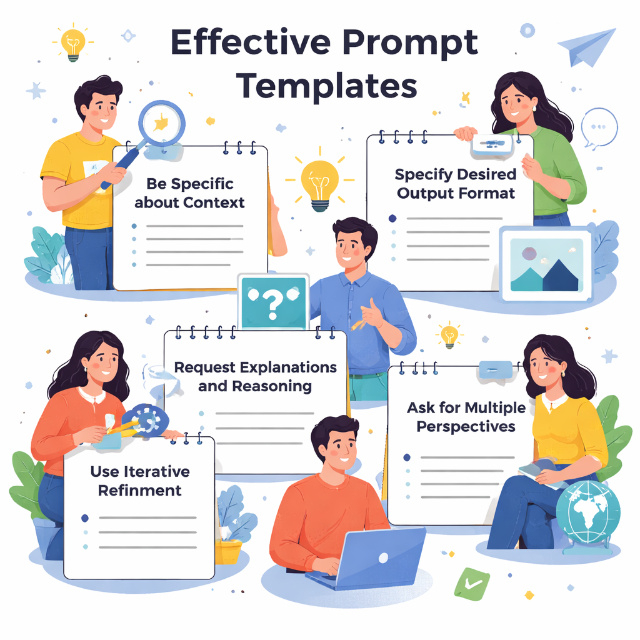
Be Specific About Context
Include relevant details: your academic level, discipline, research question, and assignment requirements. Context dramatically improves response relevance.
Poor prompt: "Help me research climate change"
Better prompt: "I'm an undergraduate environmental science student researching the economic impacts of climate change on agricultural communities in Southeast Asia. Suggest 5 specific research questions I could investigate."
The specific prompt produces focused, actionable suggestions rather than generic information.
Specify Desired Output Format
Tell ChatGPT exactly what you want: bullet points, paragraph explanations, step-by-step instructions, or comparison tables.
Example: "Create a bullet-point list of 10 potential keywords for database searching on this topic, organized by broader terms, specific terms, and related concepts."
Format specification prevents rambling responses and delivers immediately usable output.
Request Explanations and Reasoning
Ask ChatGPT to explain its suggestions rather than just providing answers. This helps you evaluate response quality and learn research thinking.
Example: "Explain why these research questions would be valuable to investigate and what methodological challenges each might present."
Explanations reveal whether ChatGPT actually understands your topic or is generating plausible-sounding but superficial responses.
Use Iterative Refinement
Start broad, then narrow based on initial responses. Treat prompting as a conversation rather than single queries.
First prompt: "Suggest research topics about social media and mental health"
Follow-up: "Focus specifically on Instagram's impact on body image among college women"
Further refinement: "What specific variables should I examine in studying this relationship?"
This progression generates increasingly focused and useful outputs while maintaining conversational context.
Ask for Multiple Perspectives
Request diverse viewpoints, alternative approaches, or contrasting interpretations to avoid bias toward single perspectives.
Example: "Provide three different theoretical frameworks I could use to analyze this phenomenon, explaining the advantages of each."
Multiple perspectives prevent over-reliance on ChatGPT's first suggestion and encourage critical evaluation of options.
Effective Prompt Templates
"I'm a [academic level] student in [discipline] researching [topic]. I need help [specific task]. Please provide [desired format] that [specific criteria]."
"Explain [concept] as it relates to [context], focusing on [specific aspect] and including [specific elements]."
"Compare and contrast [approach A] and [approach B] for researching [topic], considering [evaluation criteria]."
What Verification Steps Are Essential When Using ChatGPT?
Every piece of information from ChatGPT requires verification before inclusion in academic work. No exceptions.
The Citation Verification Protocol
ChatGPT frequently fabricates citations—creating realistic author names, journal titles, publication years, and DOIs for papers that don't exist. A 2024 analysis found 31% of ChatGPT-generated academic citations were partially or completely fabricated.
Verification process:
- Search every citation through Google Scholar or discipline-specific databases
- Verify the paper exists and is retrievable
- Check that authors, title, journal, and year match exactly
- Confirm the paper actually discusses what ChatGPT claims
- Read relevant sections yourself rather than trusting summaries
Never cite sources you haven't personally verified and accessed. Fabricated citations constitute serious academic integrity violations.
The Fact-Checking System
Cross-reference factual claims through authoritative sources. ChatGPT presents false information confidently, making accuracy verification essential.
- For statistics and data: Trace to original sources through government databases, research institutions, or peer-reviewed publications. ChatGPT often misattributes statistics or invents plausible-sounding numbers.
- For historical events: Verify through multiple historical sources. ChatGPT occasionally confuses dates, conflates events, or misattributes actions.
- For scientific claims: Check against current peer-reviewed literature. ChatGPT's training data has cutoff dates, meaning recent discoveries and updated understandings don't appear.
The Currency Check
ChatGPT doesn't know about developments after its training cutoff. For topics with recent developments, supplement with current database searches.
Ask when information currency matters: "What's the most current research on this topic?" Then conduct independent searches to verify whether ChatGPT's response reflects actual current state or outdated information.
The Methodology Verification
When ChatGPT suggests research methodologies or analytical approaches, verify appropriateness through methodology textbooks, discipline-specific guides, or instructor consultation.
ChatGPT sometimes suggests methodologies that sound reasonable but don't align with discipline norms or aren't feasible for undergraduate research. Expert verification prevents methodological errors undermining entire projects.
The Multiple Source Rule
Never rely on ChatGPT as your only source for any important claim. Find at least two independent, authoritative sources confirming information before including it in research.
This redundancy catches ChatGPT errors while ensuring your understanding comes from established knowledge rather than AI generation.
What Are the Ethical Guidelines for Using ChatGPT in Research?
Clear ethical boundaries ensure ChatGPT enhances rather than compromises academic integrity while developing genuine research skills.
Always Disclose AI Use
When institutional policies require or allow AI disclosure, be transparent about how ChatGPT assisted your research. Documentation might include: "ChatGPT was used for initial brainstorming and keyword generation. All sources were independently located and verified."
Transparency demonstrates integrity even when AI use is permitted, building trust with instructors and protecting against misunderstanding.
Never Present AI-Generated Content as Your Own Work
ChatGPT can generate literature review sections, research summaries, or analytical paragraphs. Submitting these as your own writing violates academic integrity regardless of how much you edit them.
The distinction: Using ChatGPT to understand concepts you then explain in your own words is acceptable. Having ChatGPT write explanations you present as your analysis is not.
Verify Before Citing
Never cite sources you haven't personally accessed and verified. Even if ChatGPT provides what seems like a perfect citation, you must confirm the source exists and says what's claimed.
Citing nonexistent sources—even unknowingly—constitutes fabrication, a serious academic integrity violation. Verification is non-negotiable.
Use ChatGPT for Process, Not Product
Acceptable: "Help me understand this statistical concept so I can explain it in my methodology section"
Unacceptable: "Write my methodology section explaining this statistical analysis"
The first develops your understanding. The second outsources your intellectual work.
Maintain Skill Development
Consider whether ChatGPT use helps you learn research skills or prevents their development. If you're using AI to avoid learning necessary skills, reassess your approach.
Research skills—database searching, source evaluation, synthesis, analytical thinking—matter beyond individual assignments. Short-term efficiency shouldn't compromise long-term capability development.
Students working with fast essay writing services should apply similar ethical reasoning: are services helping you learn or enabling avoidance of skill development? The answer determines whether use supports or undermines your education.
Conclusion: Making ChatGPT Your Research Assistant, Not Your Researcher
ChatGPT offers powerful research assistance when used strategically within clear ethical boundaries. The essential principles:
- Use ChatGPT for process improvement—brainstorming, concept clarification, search strategy—not for content generation
- Verify everything independently—every fact, citation, and claim requires confirmation through authoritative sources
- Maintain transparency about AI use according to institutional policies and instructor requirements
- Focus on skill development—use ChatGPT in ways that build rather than bypass research capabilities
- Remember limitations—no database access, frequent citation fabrication, knowledge cutoffs, and inability to replace critical thinking
Students succeeding with ChatGPT treat it as one tool among many—helpful for specific tasks but never replacing traditional research skills, critical evaluation, and original thinking. They spend time saved through AI efficiency on deeper analysis, stronger synthesis, and more thorough verification.
The goal isn't avoiding ChatGPT or using it maximally—it's using it wisely. Ask yourself: "Does this use help me understand better, research more efficiently, or think more clearly?" If yes, it's probably appropriate. If the answer is "Does this help me avoid learning, thinking, or working?" reconsider your approach.
Research skills developed now—database searching, source evaluation, synthesis, analytical thinking—remain valuable throughout your career regardless of how AI evolves. Use ChatGPT to enhance these skills, not as a substitute for developing them.