When Is the Best Time to Transfer Colleges?
The optimal time to transfer is after completing 30-60 college credits, typically at the end of freshman year or during sophomore year. This timing provides enough coursework to demonstrate college capability while leaving sufficient time to complete degree requirements without extending graduation.
Why Timing Matters
Students who transfer after 1-2 years experience 12-15% average credit loss compared to 25-35% loss for junior transfers. Earlier transfers allow better curriculum integration at your new institution.
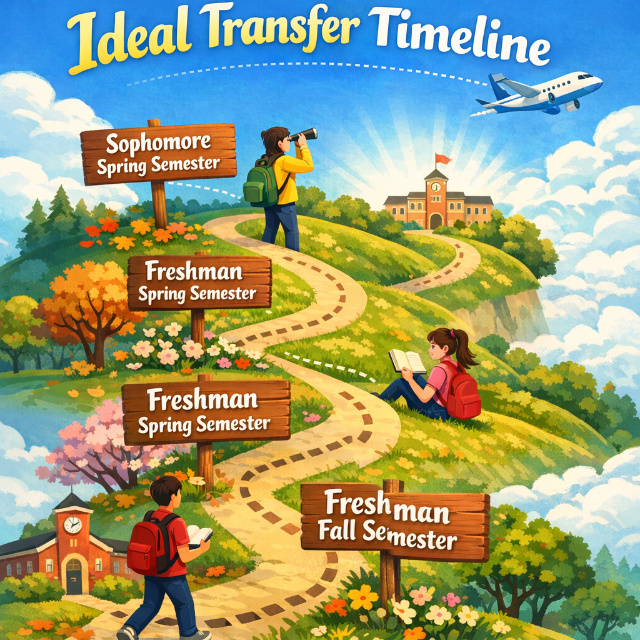
Ideal transfer timeline:
- Freshman fall semester: Research potential transfer schools while earning strong grades
- Freshman spring semester: Visit campuses, review credit transfer policies, maintain strong GPA
- Sophomore fall semester: Finalize school list, prepare essays, request recommendations, submit applications
- Sophomore spring semester: Evaluate offers, make final decision by May 1
Application Deadlines
Most transfer applications are due between January and March for fall enrollment. Priority deadlines typically fall in January-February, offering better financial aid consideration. Regular deadlines are usually March 1-15 for state schools.
Spring transfer applications (due September-November) work if circumstances change suddenly, though social integration proves harder mid-year and housing availability is limited.
Key insight: Students who begin researching transfers during freshman spring while maintaining focus on current coursework receive 33% higher admission rates than those who apply reactively during senior year without adequate preparation.
If you want help writing your application then consider consulting an essay writing service for help.
How Do You Choose the Right Transfer School?
Choose transfer schools by researching academic program strength, evaluating credit transfer policies, assessing realistic financial aid, and visiting campuses to gauge cultural fit. Create a balanced list with 2-3 reach schools, 3-4 target schools matching your credentials, and 1-2 safety schools ensuring acceptance.
1. Evaluate Academic Programs
Research program strength through rankings, faculty credentials, and student outcomes. Check if required courses are offered regularly or only once yearly. Investigate research opportunities, class sizes, and career placement rates.
Questions to ask:
- What percentage of students in my major complete degrees within four years?
- What research or internship opportunities exist for undergraduates?
- How accessible are professors, and what are typical office hour cultures?
- What graduate programs or employers recruit from this program?
Contact current students in your intended major. Their perspectives reveal day-to-day program realities often obscured in official marketing materials. Students who visit campuses and attend classes report 27% higher satisfaction post-transfer compared to those relying solely on websites.
2. Research Credit Transfer Policies
Understanding credit transfer prevents unexpected graduation delays. General education credits like English, math, and sciences typically transfer more easily than specialized courses. Upper-level major courses face more scrutiny and may not receive equivalent credit.
How to minimize credit loss:
- Review transfer equivalency databases on admission websites
- Request preliminary credit evaluation from admissions offices before applying
- Check articulation agreements between your current and prospective schools
- Ask about credit caps limiting total transferable hours
Expect 12-15% credit loss on average nationally. Students who obtain preliminary evaluations before applying lose 18% fewer credits compared to those who wait until after admission to investigate transfer credit.
3. Compare True Costs
Use official net price calculators for realistic cost estimates after aid, not sticker prices. Focus on grants and scholarships (free money) rather than loans when comparing packages.
Financial considerations:
- Calculate four-year total cost factoring in your graduation timeline
- Research transfer-specific scholarships and merit aid opportunities
- Consider cost-of-living differences between locations
- Evaluate whether better career outcomes justify higher costs
68% of transfer students underestimate true costs by focusing on tuition rather than comprehensive net price, leading to unexpected financial stress.
What Does a Transfer Application Require?
Transfer applications require official transcripts from all colleges attended, 1-2 transfer essays explaining your reasons and goals, 1-3 letters of recommendation from college professors, and standardized test scores if required (varies by institution and credits completed).
Transfer Essays: Your Most Important Component
Transfer essays receive intense scrutiny. Admissions committees want to understand why you're leaving and why their institution specifically serves your goals better.
Effective essay structure:
Paragraph 1 (Introduction): Clearly state your transfer reason and goals with positive framing focused on growth rather than complaints. Paragraph 2-3 (Body): Explain specific reasons for transferring tied to academic, personal, or financial factors. Demonstrate what you've learned from your current institution. Provide specific examples of programs, faculty, or resources at the new institution. Paragraph 4 (Conclusion): Summarize how transfer represents a natural next step in your academic journey. Express enthusiasm for contributing to the new campus community. |
What makes essays strong:
- Focus on positive vision for future rather than complaints about current school
- Provide specific examples (name professors, research labs, courses)
- Demonstrate genuine research about the institution
- Take ownership of your decision without blaming others
- Connect past experiences with future goals
Common mistakes to avoid:
- Excessively negative about current institution
- Generic praise without specific examples ("great programs," "strong academics")
- Blaming professors or circumstances for problems
- Focusing solely on social life or superficial factors
Transfer essays explaining substantive reasons with specific examples receive 2-3x higher acceptance rates than essays focused on dissatisfaction without clear positive vision.
Letters of Recommendation
Ask professors from your current institution who taught you in multiple courses or supervised research. Provide them with your resume, transfer essay draft, transcript, and a list of specific accomplishments in their course.
Request recommendations 6-8 weeks before deadlines. Professors write 30-40% stronger letters when given adequate notice and comprehensive background materials.
Why Do Students Transfer Colleges?
Students transfer for academic programs not meeting expectations (63%), financial constraints (58%), geographic considerations (34%), better campus fit culturally (29%), or specific opportunities unavailable at their current school (41%). Multiple substantive reasons correlate with 78% satisfaction compared to 59% for single vague reasons.
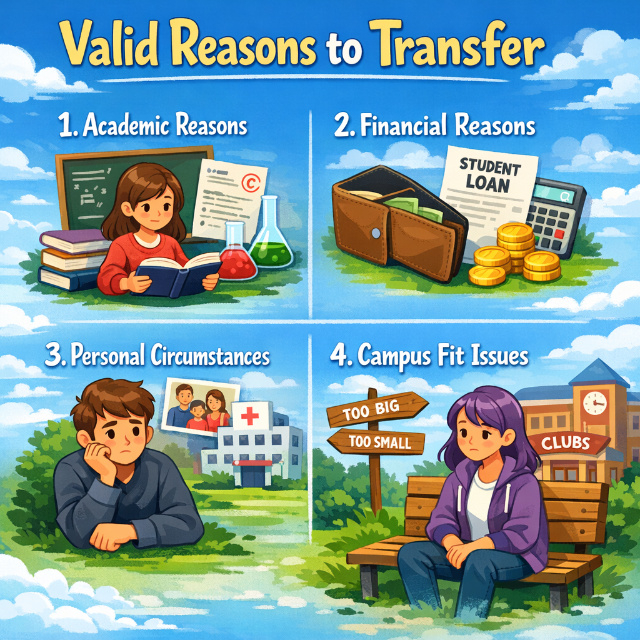
Valid Reasons to Transfer
Academic reasons:
- Your intended major is weak or unavailable at your current school
- Discovered new academic interests your institution doesn't support
- Current program lacks accreditation needed for graduate school or licensure
- Seeking more rigorous academic environment or honors programs
Financial reasons:
- Current institution is financially unsustainable despite aid
- State residency allows significantly cheaper in-state tuition elsewhere
- Family financial circumstances changed dramatically
- Better financial aid packages available at other institutions
Personal circumstances:
- Family illness requiring geographic relocation
- Mental health needs better supported elsewhere
- Career opportunity requiring relocation
- Need to work full-time requiring transfer to school with evening programs
Campus fit issues:
- Campus culture fundamentally misaligned with values
- Size of institution not matching needs (too large or too small)
- Campus lacks diversity, inclusivity, or supportive environment
Red Flags That Staying Might Be Better
Consider staying if you're struggling academically and hope transfer will be easier (problems follow you), haven't given your current institution a full year to adjust, are running from personal problems rather than institutional inadequacies, or lack specific reasons the new institution better serves your goals.
42% of students who initially considered transferring during freshman year but stayed through sophomore year reported satisfaction with their decision to remain, suggesting many early dissatisfactions resolve with time.
What Are Common Transfer Mistakes to Avoid?
Common mistakes include transferring for vague reasons without clear positive vision (38% report moderate regret), applying to too few schools lacking safety options, failing to research credit transfer losing significant progress, burning bridges at former institution, and underestimating comprehensive costs beyond tuition.
Mistake #1: Transferring for Wrong Reasons
Problematic motivations:
- "I don't like my roommate" (temporary problem solvable without transfer)
- "I miss my high school friends" (friendships possible despite distance)
- "Courses are hard and I'm struggling" (academic challenges exist everywhere)
- "I haven't made friends yet" (social integration takes time at any school)
| Students who transfer due to concrete institutional inadequacies report 76% satisfaction compared to 49% for those transferring due to vague dissatisfaction. |
Mistake #2: Poor Application Strategy
Apply to 5-8 schools: 2 reach schools, 3-4 target schools, and 1-2 safety schools. Students who apply to 6-8 strategically selected schools receive 2.3x more acceptances than those who apply to only 2-3 schools.
Verify you meet minimum GPA requirements before applying. Most institutions require 2.0-2.5 minimum, though competitive programs expect 3.0-3.5+ for realistic admission chances.
Mistake #3: Neglecting Credit Transfer Research
Request preliminary credit evaluations before deciding where to transfer. Students who investigate credit transfer before admission complete degrees 0.8 semesters faster than those who research after admission.
Understand you'll likely lose 12-15% of credits minimum. Plan your graduation timeline accordingly, factoring in prerequisite chains requiring courses in sequence.
Mistake #4: Burning Bridges
Leave your current institution professionally. Complete all coursework despite knowing you're leaving. Thank professors who supported you and offer to stay in touch. 58% of transfer students later need transcripts, recommendations, or connections from former institutions.
How Do Transfer Students Overcome Integration Challenges?
Transfer students face social integration challenges (73% report initial loneliness), credit loss extending graduation timelines, academic adjustment to different rigor levels, and navigating unfamiliar campus resources. Proactive students who join two organizations within their first month report 3x higher social satisfaction.
Social Integration Strategies
Transfer students take 6-8 months to feel socially integrated compared to 3-4 months for freshmen because existing social structures are well-established.
Immediate actions:
- Attend all transfer student orientation programs
- Join 2-3 clubs or organizations from day one
- Introduce yourself to classmates and suggest study groups
- Utilize campus recreation and wellness programs
- Share that you're a transfer student; others relate to transition challenges
Academic Adjustment
Transfer students' GPAs drop an average of 0.2-0.3 points first semester due to adjustment challenges, with grades typically rebounding by second semester.
Success strategies:
- Meet with your academic advisor immediately upon arrival
- Visit professors during office hours early in the semester
- Utilize campus tutoring, writing centers, and academic support
- Form study groups to learn expectations
- Consider lighter course load first semester to ease transition
What GPA Do You Need to Transfer?
Most four-year institutions require minimum 2.0-2.5 GPA for transfer consideration, though competitive programs typically expect 3.0-3.5+ for realistic admission chances. Transfer applicants with 3.5+ GPAs achieve 70-80% acceptance rates at target institutions compared to 35-45% for 2.5-2.9 GPAs.
Highly selective institutions expect 3.7-3.9+ GPAs for competitive transfer admission. Less selective schools may accept 2.5-2.7 GPAs, particularly for in-state students or those with compelling transfer narratives explaining specific institutional fit.
Maintain strong grades through your application semester. Students who maintain 3.5+ GPAs through the application process receive 42% higher acceptance rates than those whose grades decline, as admissions committees view grade drops as concerning signals about motivation.
How Many Credits Transfer When Changing Schools?
Credit loss averages 12-15% nationally for transfers, with some credits not transferring due to lack of equivalent courses, credit caps limiting total transferable hours, or major-specific requirements not met by previous coursework.
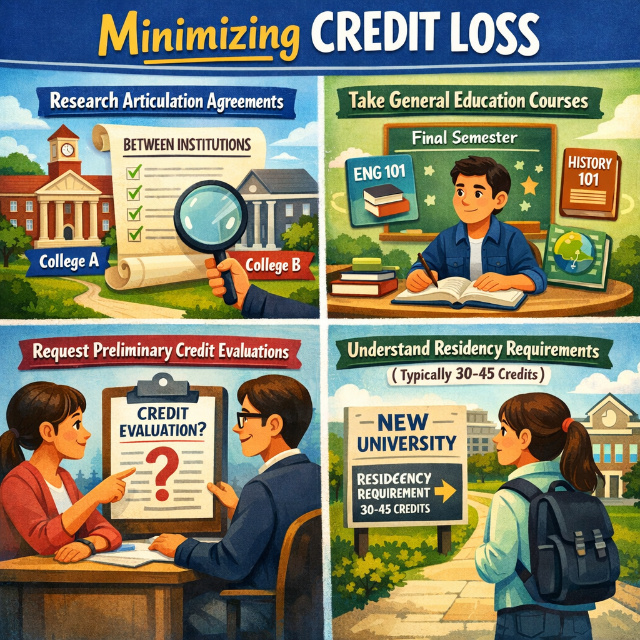
Students transferring after sophomore year lose 13-18 credits on average while junior transfers lose 25-35 credits, making earlier transfers more efficient for degree completion.
Minimizing credit loss:
- Research articulation agreements between institutions
- Take general education courses rather than highly specialized courses your final semester
- Request preliminary credit evaluations before deciding
- Understand residency requirements at new institution (typically 30-45 credits)
Articulation agreements between institutions, particularly community colleges and state universities, guarantee equivalent credit for specified courses, minimizing loss.
Key Takeaways
Transfer successfully by following these evidence-based strategies:
Transfer for substantive reasons like inadequate academic programs, financial necessity, or genuine institutional mismatch, not vague dissatisfaction. Students with clear positive vision report 76% satisfaction versus 49% for reactive transfers.
Optimal timing is sophomore year with 30-60 credits demonstrating college capability while leaving time to complete degree requirements. Earlier transfers lose 12-15% credits compared to 25-35% for junior transfers.
Research thoroughly focusing on academic program quality, credit transfer policies, and realistic financial aid rather than prestige. Students who visit campuses report 27% higher satisfaction.
Craft compelling essays explaining specific reasons for transfer with concrete examples. Strong authentic essays increase acceptance rates 2-3x compared to generic complaints.
Expect adjustment period requiring 6-8 months for social integration. Proactive students joining two organizations immediately report 3x higher satisfaction.
Transferring colleges solves genuine institutional inadequacies but requires strategic planning. When managing transfer applications alongside demanding coursework, consider using a trusted essay writing service for routine assignments, allowing focus on transfer essays requiring deep reflection and maintaining the GPA crucial for competitive admission.