What is an Exemplification Essay?
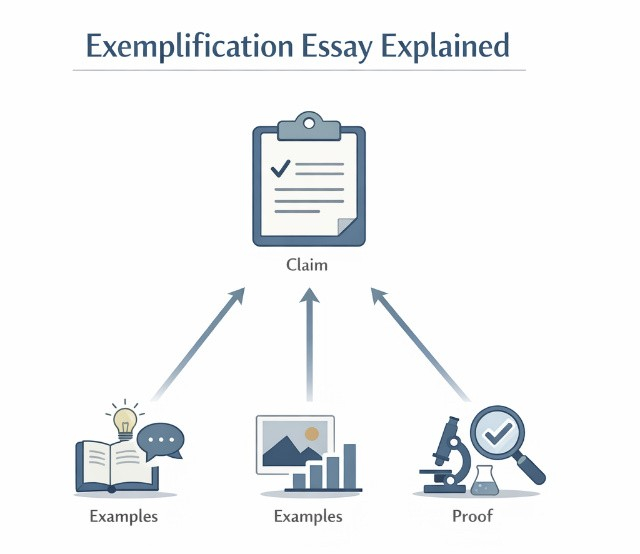
An exemplification essay is a piece of writing that uses specific examples to prove, illustrate, or clarify a general point, written with the goal of convincing readers that your thesis is valid.
Simple definition: You make a claim, then prove it's true by providing multiple relevant examples that support your point.
The Three Essential Elements
- Clear thesis: A specific claim or argument you're proving
- Multiple examples: Concrete instances that support your thesis (not just one)
- Logical organization: Examples arranged to build your case effectively
Think of it this way: if someone says "technology has made communication worse," an exemplification essay would provide 5-7 specific examples showing exactly how, text message misunderstandings, reduced face to face interaction, social media conflicts, email tone problems, and so on.
What Makes a Good Exemplification Essay?
Strong exemplification essays share these qualities:
- Specific, concrete examples: Real instances, not vague generalizations
- Variety of examples: Different types that approach the thesis from multiple angles
- Clear connection to thesis: Every example directly supports your main point
- Sufficient evidence: Enough examples to be convincing (typically 5-7 for standard essays)
- Logical organization: Examples arranged for maximum persuasive impact
Bad exemplification essay: "Social media affects mental health. Many people use Instagram. Facebook is popular. TikTok is new." Good exemplification essay: "Social media harms teen mental health through four mechanisms: constant social comparison (Instagram's highlight reel effect), cyberbullying amplification (anonymous harassment on Twitter), sleep disruption (late night scrolling), and FOMO intensification (seeing events you weren't invited to). Each of these effects is documented and measurable." |
See the difference? Specific examples, clear connections, compelling evidence.
Why Write Exemplification Essays?
- For school: Teachers assign them to develop evidence based argumentation skills
- For critical thinking: Learning to support claims with examples strengthens reasoning
- For persuasive writing: Mastering example based argument improves all persuasive writing
- For real world application: Professional writing constantly requires proving points with evidence
There's no single purpose; exemplification essays teach you to back up what you claim.
Short on Time? We’ll Write Your Exemplification Essay
Too many examples, too little time? Don’t let the deadline win.
- Carefully selected, thesis-driven examples
- Clear analysis that proves your point
- Proper structure and academic tone
- Final editing and proofreading included
Submit with confidence, our exemplification essay writing service does the work for you.
Order NowExemplification Essay vs Other Essay Types
Confused about how exemplification differs from argumentative, persuasive, or expository essays? Here's the breakdown.
| Comparison | Exemplification Essay | Other Essay Type | Key Difference |
|---|---|---|---|
| Exemplification vs Argumentative Essay | • Uses examples as primary evidence • Proves a point through illustration • Examples are the main support | • Uses multiple types of evidence (statistics, expert testimony, examples) • Argues through logic and reasoning • Examples are one tool among many | Exemplification essays rely primarily on examples. Argumentative essays use whatever evidence type works best: examples, data, expert quotes, and logical reasoning. |
| Exemplification vs Persuasive Essay | • Focused on proving through examples • Appeals to logic through evidence • Objective: "This is true because..." | • Focused on convincing readers to act or believe • Appeals to emotion and values • Objective: "You should..." | Exemplification proves points with examples. Persuasive writing aims to change minds or inspire action through any effective rhetorical strategy. |
| Exemplification vs Expository Essay | • Takes a position on something • Uses examples to support a thesis • Purpose: Prove a specific claim | • Explains or informs about a topic • May include examples to clarify • Purpose: Help readers understand | Exemplification makes an argument. Expository writing just explains. |
| Exemplification vs Descriptive Essay | • Examples prove a point • Multiple specific instances • Thesis driven structure | • Describes one thing in detail • Sensory details paint a picture • Scene driven structure | Exemplification uses multiple examples to prove something. Description uses details to show one thing vividly. |
Quick test to identify an exemplification essay:
Is the primary purpose to prove a claim by showing multiple examples of it? If yes, it's exemplification. If the essay argues through logic, appeals to emotion, explains information, or tells a story, it's a different type.
Types of Exemplification Essays
Not all exemplification essays use examples in the same way. Understanding the types helps you approach your assignment correctly.
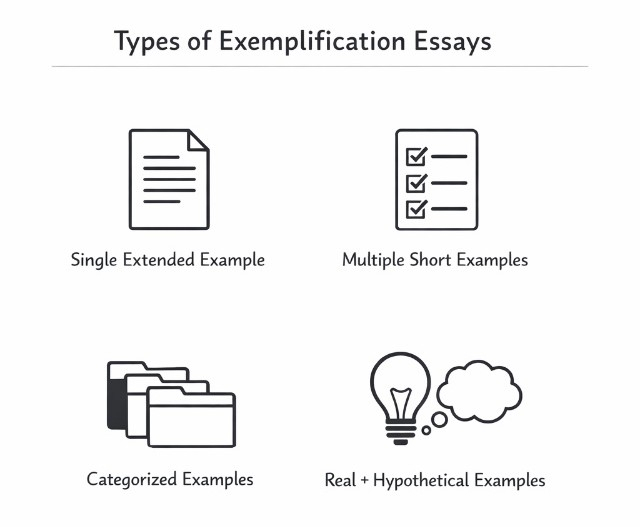
The 4 Main Types
1. Single Extended Example
Uses one detailed, comprehensive example to prove the entire thesis.
When to use: When you have one perfect example that fully demonstrates your point Example thesis: "The 2008 financial crisis perfectly illustrates how unregulated financial markets create economic catastrophe" Structure: Introduction, then Extended development of the one example with multiple aspects, and Conclusion |
2. Multiple Short Examples
Uses several brief examples (typically 5-8) that each illustrate the thesis from different angles.
When to use: When no single example is sufficient, but several together prove your point Example thesis: "Smartphones have eroded face to face communication skills in measurable ways" Structure: Introduction, then Example 1, Example 2, Example 3... and Conclusion |
3. Categorized Examples
Groups examples into categories or types, then provides examples within each category.
When to use: When your examples naturally fall into distinct groups or types Example thesis: "Artificial intelligence threatens jobs across three sectors: manufacturing, service, and creative industries" Structure: Introduction, then Category 1 (with examples), Category 2 (with examples), Category 3 (with examples), and Conclusion |
4. Hypothetical and Real Examples Combined
Blends real world examples with hypothetical scenarios to illustrate the thesis.
When to use: When real examples exist, but hypothetical scenarios can extend the argument Example thesis: "Without net neutrality protections, internet service providers could discriminate against content" Structure: Introduction, then Real examples of what's happened, Hypothetical examples of what could happen, and Conclusion |
Which Type Should You Choose?
Ask yourself:
What's your assignment requirement?
- Doesn't specify: Use multiple short examples (safest approach)
- Says "illustrate thoroughly": Consider a single extended example
- Specifies the number of examples: Follow the requirement
What examples do you have access to?
- One perfect example that covers everything: Single extended
- Many smaller examples: Multiple short examples
- Examples that group naturally: Categorized examples
What's your thesis complexity?
- Simple, focused claim: Single extended or multiple short
- Multi faceted claim: Categorized examples
- Predictive/future claim: Hypothetical + real
Most academic exemplification essays use multiple short examples or categorized examples. When in doubt, start there.
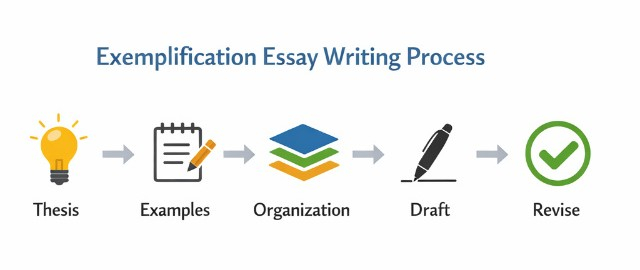
How to Write an Exemplification Essay: Step by Step
Follow this process to turn a claim into a well supported exemplification essay.
Step 1: Choose Your Thesis
Your thesis = the claim you'll prove with examples.
Formula: [Subject] + [Specific claim about it]
Examples:
Strong thesis:
- "Social media companies prioritize engagement over user wellbeing, as evidenced by their platform design choices"
- "Community colleges provide superior value compared to four year universities for most career paths"
- "Standardized testing fails to measure the skills students actually need for success"
Weak thesis:
- "Social media is bad" (too vague)
- "Many people like community colleges" (no argument to prove)
- "Testing is controversial" (just states a fact, doesn't make a claim)
Your thesis should:
- Make a specific claim, not just state a fact
- Be arguable (someone could reasonably disagree)
- Be provable through examples
- Be narrow enough to support thoroughly
You will need to choose a topic to write a thesis, so check out our exemplification essay topics list.
Step 2: Brainstorm Potential Examples
Before writing anything, generate as many relevant examples as possible.
Brainstorming strategies:
Personal observation: What have you personally witnessed?
- Events you've experienced
- People you've known
- Situations you've been in
Current events: What's happening now?
- News stories
- Trending topics
- Recent studies or reports
Historical examples: What's happened before?
- Past events that illustrate your point
- Historical figures or movements
- Previous similar situations
Research: What have experts documented?
- Studies and statistics
- Expert testimony
- Published research findings
Hypothetical scenarios: What could happen?
- "If X, then Y" situations
- Thought experiments
- Logical extensions of current trends
Example brainstorm for thesis "Social media harms teen mental health":
- Instagram likes and dopamine response (research)
- A friend's sister developed an eating disorder after Instagram comparisons (personal)
- CDC report showing teen anxiety rates doubled since 2010 (current data)
- Cyberbullying case leading to suicide (news story)
- FOMO from seeing parties on Snapchat (personal observation)
- Sleep disruption from late night scrolling (research)
- Constant performance pressure for perfect posts (observation)
- Comparison culture destroying self esteem (multiple examples)
Step 3: Select Your Best Examples
Now evaluate your brainstormed examples and choose the strongest ones.
Selection criteria:
Relevance: Does it directly support your thesis?
Specificity: Is it concrete and detailed?
Credibility: Can readers verify or relate to it?
Variety: Do your examples approach the thesis from different angles?
Impact: Is it compelling?
How many examples to use:
|
Step 4: Organize Your Examples
Decide the best order for presenting your examples.
Organization strategies:
Chronological order:
Present examples in time sequence
Works well for: Historical arguments, trend analysis
Example: "Fast food has harmed public health across decades: 1950s (rise of drive throughs), 1970s (supersizing), 1990s (dollar menus), 2010s (delivery apps)"
Least to most important:
- Start with weaker examples, end with strongest
- Works well for: Building to a climax, persuasive impact
Example: Start with minor social media effects, end with severe mental health consequence
Most to least important:
- Lead with strongest evidence, follow with supporting examples
- Works well for: Academic writing, when you need to hook readers immediately
By category:
- Group similar examples together
- Works well for: Complex theses with multiple aspects
Example: "Smartphones harm communication in three ways: [Category 1: Workplace examples] [Category 2: Family examples] [Category 3: Friendship examples]"
Problem solution:
- Show problem examples, then solution examples
- Works well for: Practical arguments, proposals
Alternating perspectives:
- Switch between different types of examples
- Works well for: Keeping reader engagement, showing range
| Most common choice: Least to most important or by category. Both work for academic essays. |
Step 5: Create Your Outline
Turn your organized examples into a structured plan.
Basic Exemplification Essay Outline:
I. Introduction
- Hook (attention grabbing opening)
- Background context
- Thesis statement (the claim you'll prove)
II. Body Paragraph 1 (First Example)
- Topic sentence introducing example
- Detailed presentation of example
- Analysis explaining how it supports thesis
- Transition to next example
III. Body Paragraph 2 (Second Example)
- Topic sentence introducing example
- Detailed presentation of example
- Analysis explaining how it supports thesis
- Transition to next example
IV. Body Paragraph 3 (Third Example)
[Repeat structure]
V. Body Paragraph 4+ (Additional Examples)
[Continue for each major example]
VI. Conclusion
- Restate thesis (in new words)
- Synthesize how examples prove the point
- Broader implications or call to action
Filled Outline Example
Thesis:
Social media harms teen mental health through measurable psychological mechanisms
I. Introduction
- Hook: Statistic about teen anxiety rates
- Context: Rise of smartphones and social media
- Thesis: Social media harms teen mental health through measurable psychological mechanisms
II. Body: Comparison Culture
- Instagram's "highlight reel" effect
- Research on social comparison theory
- Example: Teen depression rates correlate with Instagram use
- Analysis: Constant comparison to curated perfection damages self esteem
III. Body: Sleep Disruption
- Blue light and circadian rhythm research
- Late night scrolling patterns
- Example: Study showing teens average 2 hours of screen time after bedtime
- Analysis: Sleep deprivation amplifies all mental health issues
IV. Body: Cyberbullying Amplification
- 24/7 nature of online harassment
- Anonymity enabling cruelty
- Example: Specific case of teen suicide after prolonged cyberbullying
- Analysis: No escape from bullying unlike traditional school bullying
V. Body: FOMO and Anxiety
- Seeing social events you're excluded from
- Constant awareness of what you're missing
- Example: Research on FOMO scores and social media use
- Analysis: Creates perpetual low level anxiety
VI. Conclusion
- Synthesis of four mechanisms
- Broader implications for regulation
- Call for awareness and boundaries
Step 6: Write Your First Draft
Now, actually write the essay, following your outline.
Introduction strategies:
Start with a surprising statistic: "Teen anxiety rates have doubled since 2010, the exact period when smartphone adoption became universal among adolescents." Open with a compelling example: "At 2 AM on a Tuesday, Sarah scrolls through Instagram for the third consecutive hour. She has a chemistry test in six hours, but the pull of perfectly curated vacation photos, flawless selfies, and party pictures from events she wasn't invited to keeps her thumbs moving." Use a provocative question: "What if the devices we've given teenagers are systematically destroying their mental health?" |
Body paragraph structure:
Each body paragraph should follow this pattern:
- Topic sentence: Introduce the example and connect it to thesis
- Present the example: Describe it in specific detail
- Analysis: Explain HOW this example proves your thesis
- Connection: Tie it to your overall argument
Example body paragraph:
"Social media creates a 'comparison culture' that systematically damages adolescent self esteem. Instagram, in particular, operates as a highlight reel where users share only their best moments, most flattering photos, and most impressive achievements. Teenagers, whose brains are still developing the capacity to critically evaluate information, compare their everyday reality to this curated perfection. A 2022 study published in JAMA Psychiatry found that teen girls who spent more than three hours per day on Instagram were twice as likely to report symptoms of depression as those who didn't use the platform. The mechanism is straightforward: when you constantly see people appearing happier, more attractive, and more successful than you, your own life feels inadequate by comparison. Unlike television celebrities, whose perfection teens could dismiss as unattainable, Instagram shows them as peers, people they know, people from their school, appearing to live perfect lives. This makes the comparison feel more personal and more damaging."
| Notice: Specific example turns into Evidence/data, which becomes Analysis of how it works and leads to Connection to thesis |
Transition between examples:
Don't just jump from example to example. Show how they connect.
Good transitions:
- "Beyond sleep disruption, social media also enables unprecedented cyberbullying..."
- "While comparison culture damages self esteem, FOMO creates a different but equally harmful anxiety..."
- "This pattern repeats across every platform, but TikTok introduces an additional complication..."
Weak transitions:
- "Another example is..."
- "Also, there's cyberbullying..."
- "The next thing is..."
Step 7: Revise and Strengthen
First draft done? Now make it better.
Big picture revision (first pass)
Check your examples:
- Is each one specific and detailed enough?
- Does every example clearly support your thesis?
- Have you explained HOW each example proves your point?
- Are examples varied (not just repeating the same idea)?
Evaluate your organization:
- Do examples build logically?
- Are transitions smooth?
- Does the order make sense?
Test your thesis:
- Do your examples actually prove it?
- Is your claim clear throughout?
- Have you overstated or understated your argument?
Content revision (second pass)
Strengthen weak examples:
- Add more specific details
- Include relevant data or research
- Develop the analysis more fully
Cut irrelevant material:
- Remove examples that don't directly support thesis
- Delete tangents and digressions
- Trim redundant explanations
Enhance analysis:
- Don't just present examples, analyze them
- Explain the "so what?" for each example
- Connect examples to broader implications
Line editing (final pass)
- Fix grammar and spelling
- Vary sentence structure
- Replace weak verbs with strong ones
- Ensure smooth transitions
- Check that citations are correct
Need an Exemplification Essay Done Fast?
When you know what to say but don’t have time to write it.
- Strong, arguable thesis development
- Relevant, concrete examples that support your claim
- Logical organization and smooth transitions
- 100% original, plagiarism-free writing
Meet your deadline without stress. Let our experts handle your exemplification essay.
Get Started NowExemplification Essay Structure and Format
Good content needs good structure. Here's how to organize your exemplification essay professionally.
Exemplification Essay Introduction (10-15% of essay)
Purpose: Establish your thesis and prepare readers for the examples that prove it.
What to include:
Hook (1–2 sentences):
Background context (2–4 sentences):
Thesis statement (1 sentence):
|
What NOT to do:
- Don't provide examples in your introduction (save them for body)
- Don't start with dictionary definitions ("Webster defines exemplification as...")
- Don't announce your structure ("This essay will discuss...")
- Don't be vague ("Many things affect many people")
Example introduction:
"Teen anxiety rates have doubled since 2010, the exact period when smartphone adoption became universal among adolescents. While multiple factors contribute to mental health trends, the correlation is too strong and too consistent across demographic groups to dismiss. Researchers have now identified specific psychological mechanisms through which social media platforms harm teenage wellbeing. Social media harms teen mental health through four measurable mechanisms: comparison culture, sleep disruption, cyberbullying amplification, and FOMO intensification."
Exemplification Essay Body Paragraphs (70-80% of essay)
Each body paragraph develops one major example (or one category of examples).
Standard body paragraph structure:
Topic sentence (1 sentence):
- Introduces the example
- Connects to thesis
- Signals what this paragraph will prove
Example presentation (3–5 sentences):
- Describe the example in specific detail
- Include relevant data, quotes, or evidence
- Make it concrete and vivid
Analysis (3–5 sentences):
- Explain HOW this example supports your thesis
- Discuss the significance
- Connect to broader argument
- Answer the "so what?" question
Transition (1 sentence):
- Link to the next example
- Show how examples build on each other
Example body paragraph:
"Social media platforms engineer addictive behavior patterns that systematically disrupt adolescent sleep schedules. Instagram, TikTok, and Snapchat use infinite scroll features, autoplay videos, and algorithmically timed notifications specifically designed to maximize 'engagement,' a euphemism for time spent on the platform. A 2023 study by the American Academy of Pediatrics found that 72% of teenagers report using social media after they've gone to bed, with the average session lasting 93 minutes. The blue light from screens suppresses melatonin production, delaying sleep onset, while the content itself, which algorithms curate to be maximally stimulating, activates stress responses that make falling asleep difficult. This isn't accidental; internal documents from Meta revealed that the company's research teams discovered their platforms were causing sleep disruption in teens, but proceeded with features they knew would worsen the problem. The result is a generation of chronically sleep deprived adolescents, and sleep deprivation amplifies every mental health issue: anxiety, depression, emotional regulation problems, and even suicidal ideation. While comparison culture and FOMO create psychological distress, sleep disruption creates a physiological vulnerability that magnifies all other harms."
Notice the structure:
- Topic sentence: Sleep disruption
- Example details: Specific statistics, platform features, research findings
- Analysis: How this mechanism causes harm, why it matters
- Transition: Connects to the next section
Exemplification Essay Conclusion (10-15% of essay)
Purpose: Synthesize how your examples prove your thesis without just repeating yourself.
What to include:
Restate thesis (1–2 sentences):
Synthesize examples (2–3 sentences):
Broader implications (2–3 sentences):
Strong closing (1 sentence):
|
What NOT to do:
- Don't introduce new examples
- Don't just summarize ("In conclusion, I discussed...")
- Don't apologize ("While this essay wasn't comprehensive...")
- Don't end weakly ("These are just some examples")
Example conclusion:
"The evidence is overwhelming: social media platforms systematically harm teenage mental health through comparison culture, sleep disruption, cyberbullying amplification, and FOMO intensification. These aren't separate issues but interconnected mechanisms that compound each other's effects. A teenager experiencing sleep deprivation becomes more vulnerable to social comparison, which increases anxiety, which makes them seek distraction through late night scrolling, which worsens sleep deprivation. The cycle is vicious and, for many teens, inescapable. This isn't a call to ban social media or demonize technology, but it demands recognition that we've conducted a massive, uncontrolled experiment on adolescent psychology, and the results are in. Until platforms redesign features with teen wellbeing as the priority rather than engagement metrics, parents, educators, and teenagers themselves must approach these tools with informed caution."
Essential Writing Techniques for Exemplification Essays
These techniques transform basic example listing into compelling argumentation.
1. Use Specific, Concrete Examples
Vague examples don't persuade. Specific examples do.
Vague example: "Many people experience problems with social media." Specific example: "A 2022 study of 10,000 teenagers across 12 countries found that those who used Instagram for more than 3 hours daily were 2.3 times more likely to report symptoms of clinical depression compared to non users." |
How to make examples specific:
- Include numbers, dates, and names when possible
- Use concrete details instead of generalizations
- Cite specific studies, events, or cases
- Add context that makes examples real
2. Analyze, Don't Just Present
The biggest mistake in exemplification essays: listing examples without explaining them.
Presentation only: "Another example is TikTok's algorithm, which keeps users scrolling for hours. Many teens stay up late watching videos."
Presentation + analysis: "TikTok's algorithm creates a particularly insidious sleep disruption pattern. Unlike older platforms that showed content chronologically, TikTok uses machine learning to identify exactly which content keeps each individual user engaged, then serves an endless stream of that content. The result: what TikTok internally calls 'rabbit holes', sessions where users report feeling unable to stop scrolling even when they want to sleep. Teens aren't weak willed; they're fighting sophisticated behavioral psychology designed by engineers whose bonuses depend on maximizing screen time."
The difference: Analysis explains WHY the example matters, HOW it proves your thesis, and WHAT it means.
For every example, answer:
- How does this example support my thesis?
- What does this example reveal or prove?
- Why is this example significant?
- What are the implications of this example?
3. Vary Your Example Types
Don't use the same type of example repeatedly. Mix different kinds for a stronger argument.
Types of examples to blend:
Statistical evidence: "67% of teen girls report feeling worse about themselves after Instagram use" Expert testimony: "Dr. Jean Twenge, psychology professor at San Diego State University, calls smartphones 'a public health crisis'" Case studies: "In 2019, 14 year old Molly Russell died by suicide after Instagram's algorithm repeatedly showed her content about self-harm" Personal observation: "Watch any high school cafeteria, and you'll see tables of teens sitting together while staring at their phones separately" Historical comparison: "Teen anxiety rates were stable from 1990-2010, then doubled in the five years following smartphone ubiquity" Hypothetical scenarios (use sparingly): "Imagine if every social interaction were recorded, curated, and broadcast to hundreds of people who could judge and comment on your every word" |
Strong essays use 3-4 different types of examples rather than just one type throughout.
4. Use Transitions to Show Relationships
Your examples shouldn't feel like a disconnected list. Show how they relate to each other.
Types of transitions for exemplification:
Adding another example:
- "Beyond sleep disruption, social media also..."
- "In addition to comparison culture, platforms enable..."
- "Furthermore, the issue extends to..."
Showing contrast:
- "While Instagram harms through visual comparison, Twitter damages through different mechanisms..."
- "Unlike traditional bullying, which ended after school, cyberbullying..."
Showing cause and effect:
- "This sleep disruption, in turn, worsens..."
- "As a result of these design choices..."
Showing escalation:
- "Even more concerning than comparison culture is..."
- "The most damaging effect, however, is..."
Showing similarity:
- "Similarly, TikTok creates..."
- "Facebook demonstrates the same pattern..."
5. Balance Example Detail and Analysis
Know when to develop an example fully and when to mention it briefly.
Fully developed examples (spend 1–2 paragraphs):
- Your strongest, most compelling evidence
- Complex examples that need explanation
- Examples central to your thesis
Briefly mentioned examples (1–3 sentences):
- Supporting details that reinforce a point
- Additional evidence after you've established the pattern
- Examples that are self evident
Example of balance:
Fully developed: "Instagram's algorithm creates what psychologists call a 'variable reward schedule,' the same mechanism that makes slot machines addictive. Users never know if their next scroll will reveal something boring or something thrilling, a like from their crush, an invitation to a party, or a shocking piece of news. This unpredictability triggers dopamine release, which reinforces the scrolling behavior. Internal Facebook research, leaked by whistleblower Frances Haugen, revealed that the company knew this design choice was 'toxic' for teen mental health but proceeded anyway because it maximized engagement. [Full analysis continues for several more sentences...]" Briefly mentioned: "Similar addictive design patterns appear across all major platforms, Snapchat's streaks, TikTok's infinite scroll, Twitter's notification badges, each engineered to maximize engagement regardless of psychological cost." |
Rule of thumb: Develop 2-3 examples fully. Mention 3-5 more briefly.
6. Anticipate and Address Counterarguments
Strong exemplification essays acknowledge complexity.
Formula:
- Present your example
- Acknowledge potential objections
- Explain why your interpretation is still valid
Example:
"Some argue that correlation doesn't equal causation, that maybe teens who are already anxious gravitate toward social media rather than social media causing the anxiety. However, longitudinal studies tracking teens before and after smartphone adoption show that mental health declines follow social media use, not the reverse. Moreover, multiple randomized controlled trials where teens abstain from social media for several weeks show significant improvement in depression and anxiety scores, suggesting a causal relationship."
This technique:
- Shows you've thought deeply about the issue
- Strengthens your credibility
- Makes your argument more sophisticated
- Prevents readers from dismissing your examples
7. Use the "Three Part Example Structure"
For each major example, use this proven structure:
- Present: What is the example? (2-3 sentences)
- Analyze: How does it work? Why does it matter? (3-4 sentences)
- Connect: How does this prove your thesis? What does it mean for your argument? (2-3 sentences)
Example of three part structure:
Present: "Instagram's 'like' feature quantifies social approval in a way that's unprecedented in human history. Every photo, story, and post receives a public scorecard visible to everyone." Analyze: "For adults, this is uncomfortable. For teenagers, whose brains are hypersensitive to social feedback due to developmental changes in the limbic system, it's devastating. When a post gets fewer likes than expected, teens don't just feel disappointed, they experience it as social rejection, triggering the same brain regions activated by physical pain." Connect: "This transforms normal adolescent insecurity into measurable, quantified inadequacy. It's not just that teens think they're less popular than others; the platform provides numerical proof, updated in real time, visible to all their peers." |
Common Exemplification Essay Mistakes to Avoid
Mistake 1: Using Too Few Examples
The problem: Using only 1-2 examples to prove your thesis.
Why it's weak: One or two examples could be outliers or coincidences. You need multiple examples to show a pattern.
The fix: Use at least 4-5 substantial examples for standard essays. The more complex your thesis, the more examples you need.
Mistake 2: Listing Examples Without Analysis
The problem: Just presenting example after example without explaining what they mean.
Why it's weak: Readers can't connect the dots themselves. You must explicitly show how examples prove your thesis.
The fix: After presenting each example, spend equal or more time analyzing it. Follow the "Present ? Analyze ? Connect" structure.
Mistake 3: Using Examples That Don't Actually Support Your Thesis
The problem: Including examples because they're interesting or because you researched them, even though they don't prove your specific claim.
Why it's weak: Irrelevant examples confuse readers and weaken your argument.
The fix: For every example, ask: "Does this directly support my specific thesis?" If the answer is "sort of" or "it's related," cut it.
Mistake 4: Being Too Vague
The problem: "Many people have experienced this" or "Studies show" without specifics.
Why it's weak: Vague examples don't persuade. Readers need concrete details.
The fix:
Always include specific details:
|
Mistake 5: Poor Organization
The problem: Examples presented in random order with no clear logic.
Why it's weak: Good arguments build logically. Random organization feels scattered.
The fix: Choose an organizational strategy (least to most important, by category, chronological) and stick to it. Make your organization obvious through topic sentences and transitions.
Mistake 6: Forgetting Your Audience
The problem: Using examples that your audience won't understand or find convincing.
Why it's weak: If readers don't understand or relate to your examples, they won't be persuaded.
The fix:
Consider what your specific audience knows, values, and finds credible. Tailor examples accordingly:
|
Mistake 7: Weak Thesis
The problem:
Your thesis isn't actually arguable, or it's too broad to prove with examples.
Why it's weak:
If your thesis is obvious or impossible to prove, examples won't help.
The fix:
Test your thesis:
|
Exemplification Essay Examples
Example 1: Social Media & Mental Health (College Level)
The Documented Harm: How Social Media Platforms Engineer Teen Mental Health Decline
Teen anxiety rates have doubled since 2010, the exact period when smartphone adoption became universal among adolescents. While multiple factors contribute to mental health trends, the correlation is too strong and too consistent across demographic groups to dismiss. Researchers have now identified specific psychological mechanisms through which social media platforms harm teenage wellbeing. Social media harms teen mental health through four measurable mechanisms: comparison culture, sleep disruption, cyberbullying amplification, and FOMO intensification.
Social media platforms engineer comparison culture through features specifically designed to make users evaluate themselves against others. Instagram, in particular, operates as a highlight reel where users share only their best moments, most flattering photos, and most impressive achievements. Teenagers, whose brains are still developing the capacity to critically evaluate information, compare their everyday reality to this curated perfection. A 2022 study published in JAMA Psychiatry found that teen girls who spent more than three hours per day on Instagram were twice as likely to report symptoms of depression as those who didn't use the platform. The mechanism is straightforward: when you constantly see people appearing happier, more attractive, and more successful than you, your own life feels inadequate by comparison. Unlike television celebrities, whose perfection teens could dismiss as unattainable, Instagram shows them as peers, people they know, people from their school, appearing to live perfect lives. This makes the comparison feel more personal and more damaging. The 'like' feature quantifies this comparison, turning social approval into a numbered scorecard visible to everyone.
Beyond psychological comparison, social media platforms systematically disrupt adolescent sleep schedules through features designed to maximize engagement. Instagram, TikTok, and Snapchat use infinite scroll features, autoplay videos, and algorithmically timed notifications specifically engineered to keep users on the platform. A 2023 study by the American Academy of Pediatrics found that 72% of teenagers report using social media after they've gone to bed, with the average session lasting 93 minutes. The blue light from screens suppresses melatonin production, delaying sleep onset, while the content itself, which algorithms curate to be maximally stimulating, activates stress responses that make falling asleep difficult. This isn't accidental. Internal documents from Meta revealed that the company's research teams discovered their platforms were causing sleep disruption in teens but proceeded with features they knew would worsen the problem. The result is a generation of chronically sleep deprived adolescents, and sleep deprivation amplifies every mental health issue: anxiety, depression, emotional regulation problems, and even suicidal ideation.
[Essay continues with cyberbullying and FOMO examples, then conclusion...]
Example 2: Remote Work Benefits (Professional Level)
The Evidence Is Clear: Remote Work Increases Productivity Across Industries
When companies were forced into remote work during 2020, many executives predicted disaster. Without in person oversight, they assumed productivity would plummet. Three years later, the data tells a different story. Remote work increases productivity across virtually every measurable metric when implemented properly, as demonstrated by evidence from technology companies, manufacturing coordinators, customer service operations, and even traditionally office bound industries like finance.
Technology companies provide the clearest evidence that remote work enhances productivity. GitLab, a fully remote company with 1,300 employees across 65 countries, reports that their developers commit code at rates 15% higher than the industry average for in office developers. Their internal metrics show that removing commute time translates directly into additional productive hours, while flexible scheduling allows developers to work during their peak cognitive performance periods rather than forcing everyone into standard 9-5 hours. More tellingly, when Microsoft Japan experimented with a four-day remote work week, productivity increased by 40% while electricity costs dropped 23%. The key factor wasn't just remote work itself but the autonomy and flexibility it enabled. Engineers could concentrate during their most alert hours without the constant interruptions typical of office environments, drop by meetings, loud conversations, and the general ambient noise of shared workspaces.
[Essay continues with examples from other industries, then conclusion...]
Know What Makes Good Structure But Can't Execute It?
Understanding exemplification structure and actually crafting a compelling, well-organized essay are two different skills. Our reliable essay writing service specializes in exemplification essays.
Free Downloadable Resources
Struggling to Turn Examples into a Strong Essay?
Listing examples isn’t enough, they need expert analysis.
- Professionally written exemplification essays
- Deep explanation of HOW examples prove the thesis
- Academic formatting and citation standards
- Final review for clarity and flow
From thesis to submission, we’ll take care of everything.
Order NowBottom Line
A strong exemplification essay proves your thesis through multiple specific, well analyzed examples organized logically. When you select relevant evidence, develop each example thoroughly with clear analysis of how it supports your claim, and arrange examples to build a compelling case, your argument becomes persuasive and convincing.