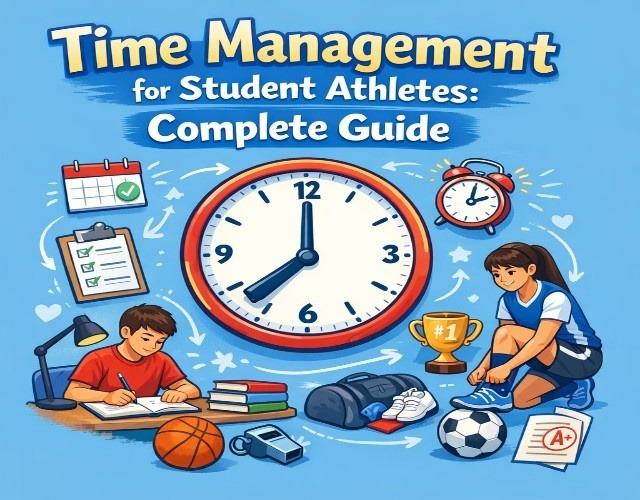
How Do You Create a Realistic Weekly Schedule?
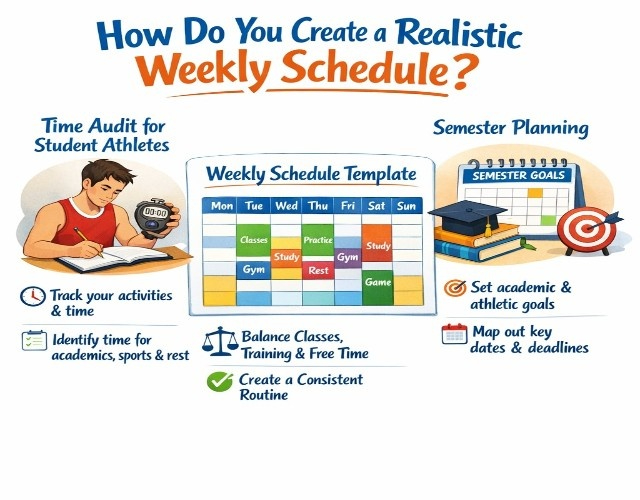
Create realistic schedules by calculating total weekly hours committed to athletics (20 to 30 hours), classes (12 to 18 hours), and studying (20 to 25 hours) totaling 52 to 73 hours, identifying non-negotiable time blocks (practices, games, mandatory study halls), scheduling study time immediately after classes when material is fresh, building in recovery time (7 to 9 hours sleep, meals, rest) essential for athletic performance, planning ahead for high-demand weeks (exam weeks, playoffs, championships), and leaving 2 to 3 hour weekly buffer for unexpected demands.
Time Audit for Student Athletes
Weekly time commitments breakdown:
Athletics (20 to 30 hours):
- Practice: 15 to 20 hours (NCAA limits vary by sport and division)
- Strength and conditioning: 3 to 5 hours
- Team meetings and film study: 2 to 3 hours
- Games/competitions: 2 to 6 hours (varies by sport and season)
- Travel: 0 to 10 hours (varies by distance and frequency)
Academics (35 to 45 hours):
- Class attendance: 12 to 18 hours
- Studying and homework: 20 to 25 hours (2 to 3 hours per credit hour)
- Group projects and meetings: 2 to 3 hours
Essential personal (35 to 42 hours):
- Sleep: 49 to 63 hours (7 to 9 hours nightly, critical for recovery)
- Meals: 7 to 10 hours
- Personal care and hygiene: 7 hours
- Transportation: 3 to 5 hours
Total: 92 to 117 hours of 168 available weekly
This leaves 51 to 76 hours for social life, relaxation, additional study, and flexibility, but only if you're ruthlessly efficient with scheduled time.
Weekly Schedule Template
Monday through Friday structure:
- 6:00-7:00am: Wake up, breakfast, prepare for the day
- 7:00-8:00am: Review notes for morning classes or complete readings
- 8:00-12:00pm: Classes (with study breaks between)
- 12:00-1:00pm: Lunch and brief rest
- 1:00-2:30pm: Study time or office hours (before practice)
- 2:30-6:00pm: Practice, conditioning, treatment, shower
- 6:00-7:00pm: Dinner and decompression
- 7:00-10:00pm: Study blocks (2 to 3 hours focused work)
- 10:00-10:30pm: Prepare for the next day, pack bags
- 10:30-11:00pm: Wind down routine
- 11:00pm-7:00am: Sleep (8 hours)
Weekend adjustments:
- Games or travel may consume 6 to 12 hours Saturday/Sunday
- Use remaining time for larger assignments and projects
- Catch up on sleep if a weekly deficit exists
- Balance recovery with academic deadlines
Semester Planning
At semester start:
- Enter all athletic commitments (games, travel, championships)
- Add all academic deadlines (exams, papers, projects)
- Identify conflict weeks (exams during playoffs, major papers during travel)
- Start assignments early before high-demand athletic weeks
- Communicate anticipated absences to professors immediately
Color coded calendar system:
- Red: Athletic commitments (non-negotiable)
- Blue: Classes and academic deadlines
- Green: Study time (protect zealously)
- Yellow: Personal time (recovery, social, self care)
- Orange: Flexible time (buffer for unexpected demands)
Research shows that student athletes using structured weekly schedules with semester-long planning maintain 0.3 to 0.5 higher GPAs than those managing time reactively, demonstrating planning's substantial impact on academic success.
| When managing demanding athletic schedules alongside rigorous coursework, consider using a professional essay writing service for routine assignments during championship weeks, playoff seasons, or conference tournaments when athletic demands peak, allowing focus on essential academics, athletic performance, and physical recovery without sacrificing grades during the most critical competitive periods. |
How Do You Stay On Top of Coursework During the Season?
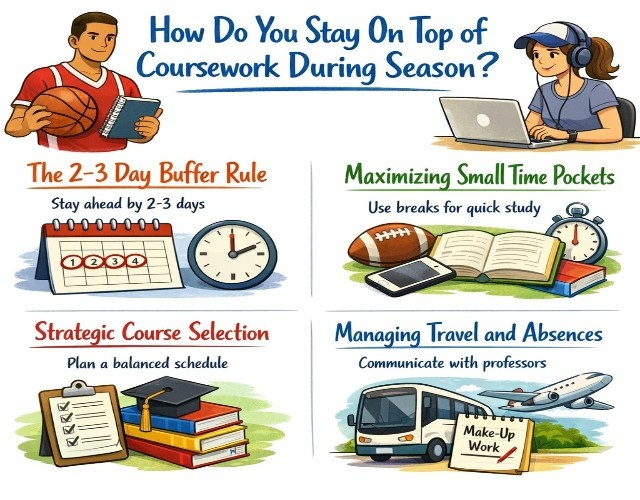
Stay on top of coursework by completing assignments 2 to 3 days before due dates building buffer for unexpected athletic demands, using small time pockets (15 to 30 minutes between classes, during travel, before practice) for quick tasks like readings or flashcards, attending all classes possible despite exhaustion maintaining understanding and professor relationships, batching similar tasks (all reading together, all math problems together) improving efficiency, and communicating proactively with professors about makeup work and extensions when travel or competition creates genuine conflicts.
1. The 2 to 3 Day Buffer Rule
Why buffers matter for athletes:
Implementation strategy:
|
68% of successful student athletes report using buffer systems , preventing late work and all-nighter cramming that undermines athletic performance and academic quality.
2. Maximizing Small Time Pockets
15 to 30 minute productivity opportunities:
Tasks perfect for small blocks:
Tasks requiring longer blocks:
Productivity tools:
|
Student athletes who use 3 to 4 daily small time pockets accumulate 10 to 15 extra study hours weekly, equivalent to 2 to 3 full study sessions without dedicating additional calendar blocks.
3. Strategic Course Selection
Plan course load around athletic demands:
Off season vs. in season planning:
Course format considerations:
|
4. Managing Travel and Absences
Pre travel preparation:
During travel productivity:
Post travel catch up:
|
Communication with professors: Professional email template for travel:
"Dear Professor [Name],
I'm a member of the [sport] team, and we'll be traveling to [location] for a competition on [dates]. I'll miss class on [specific date(s)].
I'm committed to staying current with course material. Could you please:
- Share assignments due during my absence
- Recommend how I can access missed lectures (recordings, notes, office hours)
- Clarify if any assignments need early submission
I will complete all work and remain engaged with the course material. Thank you for your understanding and support.
Sincerely, [Name]"
Research shows professors respond positively to proactive athlete communication, with 87% willing to provide accommodations when contacted at least one week in advance, compared to 42% when notified last-minute or retroactively.
What Athletic Department Resources Should You Use?
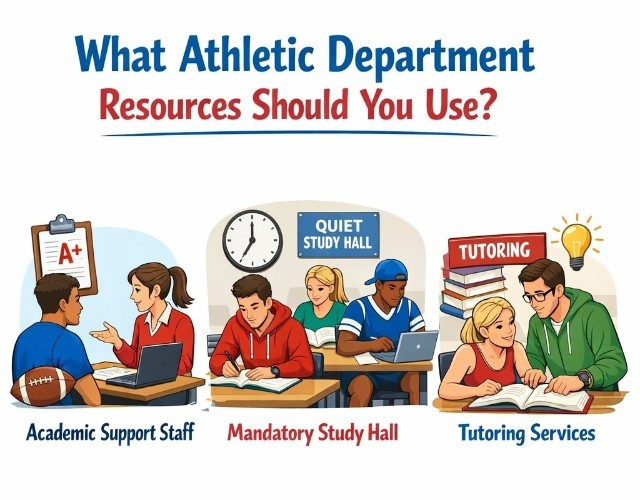
Use athletic academic advisors who understand NCAA eligibility requirements and athlete-specific scheduling challenges, mandatory study halls providing structured study time with tutors available (typically 6 to 10 hours weekly for first-year athletes and those with GPAs below 2.5), sport specific tutors offering one on one or small group subject assistance, learning specialists helping with executive function, time management, and study skills, priority registration allowing course selection before general student population enabling schedule optimization, and athlete-only computer labs and study spaces providing quiet environments outside residence halls.
1. Academic Support Staff
Athletic academic advisor responsibilities:
When to meet with advisor:
Learning specialists and skills coaches:
|
2. Mandatory Study Hall
Who attends:
Benefits beyond compliance:
Maximizing study hall effectiveness:
|
3. Tutoring Services
Available tutoring types:
Common tutoring subjects:
Scheduling tutoring strategically:
|
Research shows that student athletes using tutoring services twice weekly average 0.4 higher GPAs than those avoiding tutoring, with particularly strong impacts in STEM courses, where athletes average 0.6 higher GPAs with regular tutoring support.
How Do You Communicate Effectively with Professors and Coaches?

Communicate effectively by informing professors of athletic commitments and travel schedule first week of semester, providing game schedules showing potential conflicts upfront, asking professors during office hours about their policies on athlete absences and makeup work, similarly communicating academic demands (exams, major papers) to coaches enabling schedule flexibility when possible, advocating for yourself professionally explaining specific needs, and maintaining regular updates with both professors and coaches preventing surprises and building trust.
1. Building Professor Relationships
First week communication: Meet professors during office hours, introducing yourself as a student athlete:
"Hi Professor [Name], I'm [Your Name] in your [course] class. I'm also on the [sport] team. I wanted to introduce myself and share our team travel schedule. I'm committed to keeping up with coursework and wanted to ask about your policies on athlete absences and how I can stay engaged when traveling for competition."
What this accomplishes:
- Personal connection beyond being a student number
- Demonstrates responsibility and commitment
- Identifies you as an athlete before problems arise
- Opens dialogue about accommodations
- Shows respect for their course and time
Ongoing communication:
- Attend office hours regularly (not just before exams)
- Participate actively in class when present
- Submit work on time or early consistently
- Ask thoughtful questions demonstrating engagement
- Thank professors for accommodations and support
When academic challenges arise: Address immediately, not at semester's end:
"Professor [Name], I'm struggling with [specific concept] and want to improve before the next exam. I've attended tutoring and reviewed notes, but would appreciate additional guidance. Could we schedule time during office hours to discuss strategies for mastering this material?"
2. Communicating with Coaches
Sharing academic demands: Coaches want athletes to succeed academically, communicate proactively about academic pressures:
"Coach, I have three exams next week, including two on the same day. I'm planning to attend all practices, but wanted to let you know I'll need to prioritize study time before and after practice. I've prepared ahead so I can stay focused on the team and academics both."
What successful athletes communicate:
- Major exam weeks with specific dates
- Large papers or project deadlines
- Group project meetings requiring evening time
- When workload feels genuinely unsustainable
- Academic support services being used
What not to do:
- Use academics as an excuse for poor practice performance regularly
- Ask to miss practice for routine studying (not emergencies)
- Spring academic issues on coach without prior communication
- Fail to use athletic academic resources before involving coach
3. Balancing Academic and Athletic Priorities
When academics must come first:
- Week before finals (may need reduced practice)
- Midterm exam weeks with multiple tests
- Major presentations or project due dates
- When GPA is at risk of NCAA ineligibility
- When genuinely overwhelmed despite good time management
When athletics must come first:
- Championships or playoff games
- Conference competitions
- Team required events (banquets, service)
- Medical or treatment appointments
- During peak season, when most critical
Finding middle ground:
Most weeks, both matter equally; communication prevents forced choices:
- Plan academic work around athletic schedule
- Use athletic resources for academic support
- Communicate conflicts early, allowing flexibility
- Maintain excellence in both through discipline
89% of successful student athletes report strong relationships with both professors and coaches facilitated by consistent proactive communication, compared to 34% of struggling athletes who communicate only reactively when problems arise.
How Important Is Sleep and Recovery?
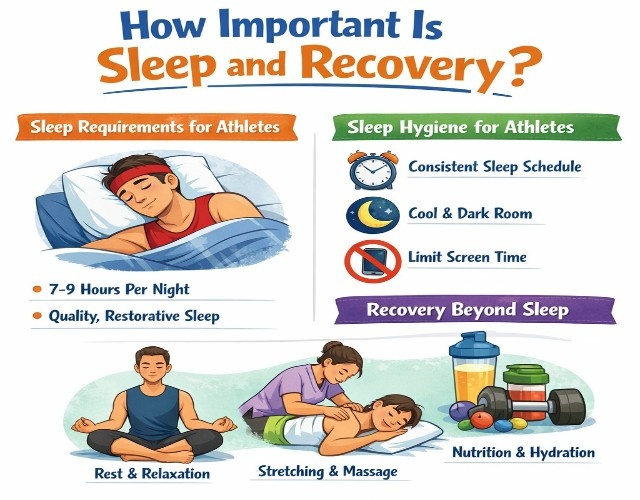
Sleep and recovery are critical for both athletic performance and academic success, with student athletes requiring 8-10 hours nightly (more than non-athletes' 7 to 9 hours) for physical recovery, cognitive function, and injury prevention.
Sleep deprivation reduces athletic performance by 20-30%, impairs memory consolidation essential for learning, increases injury risk by 1.7x, and damages immune function, increasing illness.
Successful student athletes prioritize sleep as non negotiable, planning schedules protecting sleep and treating recovery as an essential training component, not a luxury.
1. Sleep Requirements for Athletes
Why athletes need more sleep:
Recommended sleep:
Sleep debt consequences:
|
2. Sleep Hygiene for Athletes
Consistent sleep schedule:
Pre sleep routine:
Sleep environment:
Strategic napping:
|
3. Recovery Beyond Sleep
Nutrition for recovery:
Active recovery:
Mental recovery:
Medical support:
|
Research shows that student athletes sleeping 8+ hours nightly maintain GPAs 0.4 points higher than those sleeping less than 7 hours, while also experiencing 50% fewer injuries and 30% better athletic performance metrics, demonstrating sleep's profound impact on both academic and athletic success.
Key Takeaways
Successfully balance athletics and academics through these evidence-based strategies:
Create structured schedules protecting all essential time blocks including 20 to 30 hours athletics, 35 to 45 hours academics, and 35 to 42 hours essential personal needs (sleep, meals, recovery), leaving 51 to 76 hours flexibility but requiring ruthless efficiency. Student athletes using structured planning maintain 0.3 to 0.5 higher GPAs than those managing time reactively.
Use a 2 to 3 day buffer rule, completing assignments early before due dates, building a cushion for unexpected athletic demands like games running late, extra practices, travel delays, or injury appointments. Combined with maximizing small time pockets (15-30 minutes between classes, during travel), athletes accumulate 10-15 extra study hours weekly.
Leverage athletic department academic resources proactively, including academic advisors, mandatory study halls with available tutors, one on one tutoring services, learning specialists, and priority registration. Student athletes using tutoring twice weekly average 0.4 higher GPAs than those avoiding support, with a 0.6-point advantage in STEM courses.
Communicate proactively with professors and coaches sharing athletic schedules first week of semester, requesting accommodations at least one week before travel, and informing coaches of academic demands enabling mutual schedule flexibility. Professors respond positively to advance communication (87% willing to accommodate) versus last-minute notice (42%).
Prioritize sleep and recovery as non-negotiable getting 8-10 hours nightly for physical recovery, cognitive function, and injury prevention. Student athletes sleeping 8+ hours maintain GPAs 0.4 points higher while experiencing 50% fewer injuries and 30% better athletic performance than those sleeping under 7 hours nightly.
Student athletes develop exceptional time management skills through necessity, with 89% of former athletes attributing career success partially to discipline learned balancing sports and academics. The challenge is substantial but manageable through planning, communication, resource utilization, and protecting recovery time.
When managing peak athletic demands during championship weeks, playoff seasons, or conference tournaments coinciding with academic deadlines, consider using a trusted essay writing service for routine assignments, allowing focus on critical athletics, essential academics, and physical recovery during most demanding periods without compromising grades or athletic performance determining career opportunities and team success.