Which Certifications Actually Boost Career Prospects?
Certifications providing strongest career ROI include digital marketing credentials like Google Analytics and Google Ads costing $0-200 with 82% of marketing employers valuing these certifications, cloud computing certifications like AWS Cloud Practitioner and Microsoft Azure Fundamentals costing $100-150 with 76% of IT employers requiring cloud knowledge, project management credentials like CAPM costing $225-300 preparing for future PMP certification valued by 68% of employers across industries, data analysis certifications like Tableau Desktop Specialist and Microsoft Power BI costing $0-100 with 71% of data-focused roles preferring certified candidates, and accounting/finance certifications like CPA exam sections and CFA Level 1 costing $200-1000 but required for 85-90% of accounting and finance positions.
Research shows certifications in high-demand technical skills (cloud computing, data analysis, cybersecurity) provide 3-4x better ROI than general business certifications, as technical credentials directly prove capabilities employers struggle to assess through degrees alone. Studies indicate industry-recognized certifications from major vendors like Google, Microsoft, AWS, and professional associations outperform generic online course certificates 5-10x in employer recognition and hiring influence.
| Certification | Career Field | Cost (USD) | Prep Time (Hours) | Employer Recognition | Career ROI |
|---|---|---|---|---|---|
| Google Analytics IQ | Marketing / Business | Free | 10–15 | Very High | 5 stars |
| HubSpot Content Marketing | Marketing | Free | 6–10 | High | 4 stars |
| AWS Cloud Practitioner | IT / Cloud | 100 | 40–60 | Very High | 5 stars |
| Microsoft Azure Fundamentals | IT / Cloud | 99 | 30–50 | High | 4 stars |
| Tableau Desktop Specialist | Data / Analytics | 100 | 40–60 | High | 4 stars |
| Microsoft Power BI Data Analyst | Data / BI | 165 | 50–80 | High | 4 stars |
| CAPM (PMI) | Project Management | 225–300 | 60–100 | High | 4 stars |
| CompTIA A+ | IT Support | 246 | 80–120 | High | 4 stars |
| Salesforce Administrator | Business / CRM | 200 | 60–100 | Medium–High | 3 stars |
| CFA Level I | Finance | 700–1000 | 300+ | Very High | 4 stars |
1. High-Value Certifications by Career Field
Technology and IT:
- AWS Certified Cloud Practitioner: $100 exam, 40-60 hours preparation, demonstrates foundational cloud knowledge
- CompTIA A+: $246 for two exams, 80-120 hours preparation, entry-level IT support credential
- Google IT Support Professional Certificate: $39/month Coursera (typically 4-6 months), complete IT fundamentals
- Microsoft Azure Fundamentals (AZ-900): $99 exam, 30-50 hours preparation, cloud computing basics
- Cisco CCNA: $300 exam, 120-200 hours preparation, networking fundamentals for infrastructure roles
Marketing and Communications:
- Google Analytics Individual Qualification: Free, 10-15 hours preparation, analytics fundamentals
- Google Ads Certification: Free, 8-12 hours per certification (Search, Display, Video), digital advertising
- HubSpot Content Marketing Certification: Free, 6-8 hours, inbound marketing methodology
- Facebook Blueprint Certification: Free courses, $150 exam, social media advertising
- Hootsuite Social Marketing Certification: $199, 8-12 hours, social media management
Project Management and Business:
- CAPM (Certified Associate in Project Management): $225-300, 60-100 hours preparation, entry to project management
- Lean Six Sigma Yellow/Green Belt: $200-500, 40-80 hours, process improvement methodology
- Salesforce Administrator: $200 exam, 60-100 hours, CRM platform expertise
- Microsoft Office Specialist (Excel, PowerPoint): $100 per exam, 20-40 hours, advanced software proficiency
Data Analysis and Business Intelligence:
- Tableau Desktop Specialist: $100 exam, 40-60 hours preparation, data visualization
- Microsoft Power BI Data Analyst: $165 exam, 50-80 hours, business intelligence tools
- Google Data Analytics Professional Certificate: $39/month Coursera (typically 6 months), complete analytics foundations
- SQL certifications (various vendors): $100-200, 40-80 hours, database querying skills
Accounting and Finance:
- CPA Exam sections: $200-300 per section, 100-150 hours per section, required for accounting careers
- CFA Level 1: $700-1000, 300+ hours preparation, investment analysis credential
- QuickBooks ProAdvisor: $0-200, 20-40 hours, accounting software expertise
Research shows certifications from major technology vendors (Google, Microsoft, AWS, Salesforce) and professional associations (PMI, AICPA, CFA Institute) carry significantly more weight than generic online course completion certificates, with 84% of employers recognizing vendor certifications versus 31% recognizing generic certificates from unknown providers.
2. ROI Analysis: Cost vs. Career Benefit
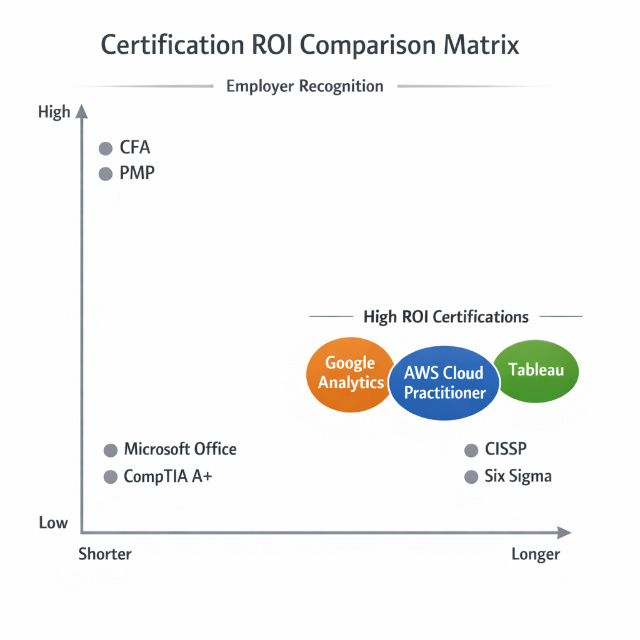
High ROI certifications (strong benefit, low-moderate cost):
- Google Analytics: Free, 10 hours, 82% employer recognition in marketing
- HubSpot certifications: Free, 6-10 hours each, 68% recognition in digital marketing
- AWS Cloud Practitioner: $100, 50 hours, 76% recognition in IT/cloud roles
- Tableau Desktop Specialist: $100, 50 hours, 71% recognition in data roles
Moderate ROI certifications (significant benefit, moderate-high cost):
- CAPM: $300, 80 hours, 68% recognition across industries
- CompTIA A+: $246, 100 hours, 73% recognition in IT support
- Salesforce Administrator: $200, 80 hours, 64% recognition in CRM-heavy industries
- Microsoft certifications: $165 per exam, 60-80 hours, 69% recognition in business/IT
Lower ROI certifications (minimal benefit or high cost):
- Generic "business analyst" certificates from unknown providers
- Extremely expensive certifications requiring years of experience (PMP, most Cisco certs require experience)
- Highly specialized certifications for narrow career paths
- Certifications in declining or obsolete technologies
Studies indicate certifications costing under $300 with 40-80 hour time investments provide optimal ROI for college students, balancing affordability and preparation effort with meaningful employer recognition, while free certifications from major vendors like Google offer exceptional value, requiring only time investment.
How Do You Choose the Right Certifications for Your Career Goals?
Choose certifications by researching job postings in target roles identifying frequently mentioned credentials with 73% of relevant postings mentioning certifications considered valuable signals, consulting with academic advisors and career counselors familiar with industry hiring trends, connecting with alumni or professionals in desired field asking which certifications actually influenced their hiring, prioritizing vendor-recognized certifications over generic course completions as employers recognize major brands, considering certifications building toward higher credentials like CAPM leading to PMP or CFA Level 1 toward full CFA, and evaluating realistic time and cost investments ensuring completion before graduation.
Research shows students earning 2-3 strategic certifications aligned with specific career paths receive 2-3x more interview requests than those collecting 5-6 random certifications without clear focus, as targeted credentials demonstrate deliberate skill development rather than certificate collecting. Studies indicate job posting analysis reveals actual employer preferences more accurately than general certification rankings, with 68% of hiring managers stating they prefer certifications specifically mentioned in job descriptions over other credentials regardless of prestige.
1. Analyzing Job Market Demand
Research target positions before investing time and money in certifications.
Research methodology:
- Find 20-30 job postings for desired roles (entry-level positions you'd apply to after graduation)
- Track which certifications appear in job descriptions
- Note whether certifications are "required" or "preferred"
- Identify certifications mentioned in 30%+ of postings
- Research certification costs, time requirements, and pass rates
What to look for:
- Certifications appearing in multiple postings from different companies
- Specific vendor certifications (Google Analytics) rather than general skills (analytics)
- Credentials marked as "required" or "strongly preferred"
- Certifications mentioned in higher-level positions indicate career progression value
- Patterns suggesting industry standards versus individual company preferences
Research shows job posting analysis reveals certification priorities 3-4x more accurately than generic "best certifications" lists, as actual employer requirements vary significantly by industry, company size, geographic region, and specific role responsibilities.
2. Matching Certifications to Career Stage
Consider timing and prerequisites when selecting certifications.
Certifications ideal for college students (no experience required):
- Google Analytics, Ads, and other free Google certifications
- HubSpot marketing certifications
- AWS Cloud Practitioner
- Microsoft Azure Fundamentals
- Tableau Desktop Specialist
- Entry-level CompTIA certifications (A+, Network+)
- CAPM (requires 1500 hours of project work, achievable through coursework/internships)
Certifications requiring experience (target post-graduation):
- PMP (requires 3+ years experience and bachelor's degree)
- Most advanced Cisco certifications
- CPA (requires degree completion and 150 credit hours)
- Advanced AWS or Azure certifications
- Senior-level Salesforce certifications
Certifications with course prerequisites:
- CFA Level 1 (requires bachelor's degree or senior year standing)
- CPA exam sections (requires accounting coursework)
- Some advanced IT certifications
Studies indicate that students pursuing certifications achievable during college, rather than credentials requiring post-graduation experience, demonstrate better completion rates and earlier career benefits, with 78% of students completing entry-level certifications versus 34% completion rates for certifications requiring experience students lack.
3. Balancing Certification Pursuit with Academics
Certification preparation requires significant time investment alongside coursework.
Time management strategies:
- Pursue certifications during summer breaks when academic demands are minimal
- Limit to one certification per semester alongside a full course load
- Schedule exam dates after semester end, avoiding overlap with finals
- Use winter break for intensive certification preparation
- Join study groups to spread preparation across multiple students
Semester planning:
- Fall senior year: Complete 1 certification before job applications
- Summer before senior year: Pursue 1-2 certifications with dedicated time
- Spring junior year: Begin one certification with summer completion
- Academic year: Study during low-demand weeks, avoid during midterms/finals
Research shows students completing certifications during summer breaks demonstrate 40-50% higher pass rates than those preparing during academic semesters, as dedicated focus without competing coursework allows intensive study and better retention.
How Do You Prepare for Certification Exams Effectively?
Prepare effectively by using official vendor study materials and practice exams ensuring content alignment with actual exam rather than third-party resources potentially outdated, dedicating 2-3 months for most certifications with consistent 5-10 hours weekly study rather than cramming, joining online communities or study groups for accountability and question support, taking multiple full-length practice exams under timed conditions identifying weak areas requiring additional study, creating study schedule with specific topic assignments by week preventing procrastination, and scheduling exam 6-8 weeks in advance creating firm deadline motivating consistent preparation.
Research shows students using official vendor materials pass exams at 72% rates compared to 53% pass rates using only third-party resources, as official materials reflect current exam content while third-party resources lag behind content updates. Studies indicate 5-10 hours weekly study over 8-12 weeks produces significantly higher pass rates than 30-40 hours cramming in final 2-3 weeks before exams, with distributed practice supporting better retention and understanding.
1. Study Resources and Materials
Official vendor resources (highest quality):
- Vendor documentation and study guides
- Official practice exams
- Vendor training courses or learning paths
- Vendor-provided labs or hands-on practice environments
Supplementary resources:
- Udemy or Coursera courses (verify recent creation dates, check reviews)
- YouTube tutorial series covering exam objectives
- Study group forums on Reddit or Discord
- Practice question banks from reputable providers
- Books specifically written for certification exams
Free vs. paid resources:
- Many certifications offer completely free preparation through vendor resources
- Paid courses ($10-50 on sale) provide structured learning for some students
- Expensive prep courses ($200-500+) are rarely necessary for entry-level certifications
- Practice exams are worth investing $20-40 if free options are insufficient
When certification preparation competes with coursework during academic semesters, an essay writing service can handle routine assignments, allowing focus on certification study, producing tangible career credentials rather than dividing attention between generic coursework and career-differentiating certifications that directly impact hiring outcomes and starting salary offers.
Research shows students passing certifications on first attempts save an average $150-300 in retake fees and 40-60 hours in additional preparation time, making thorough initial preparation more cost-effective than rushed attempts requiring retakes.
2. Creating Effective Study Plans
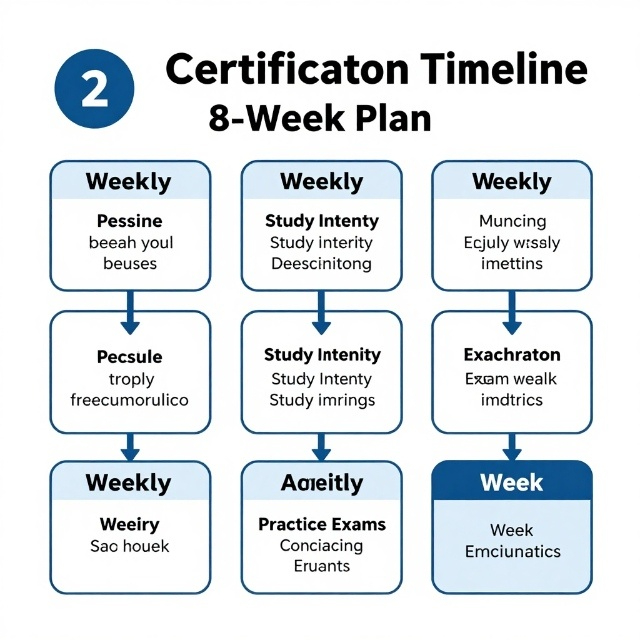
8-week preparation timeline for typical certification:
Weeks 1-2: Foundations
- Review exam objectives and content outline
- Complete 1-2 introductory courses or read overview materials
- Create a study schedule for the remaining weeks
- Join a study community or find a study partner
Weeks 3-5: Content mastery
- Study 2-3 major topics per week, following exam outline
- Complete hands-on labs or practice exercises
- Take section-specific quizzes to test understanding
- Review and reinforce weak areas
Weeks 6-7: Practice and review
- Take the first full practice exam, identifying weak areas
- Review all topics with emphasis on weaknesses
- Take the second practice exam to track improvement
- Review missed questions, understanding the correct answers
Week 8: Final preparation
- Take the final practice exam under timed conditions
- Review key concepts and formulas
- Rest day before exam, avoiding cramming
- Take the exam with confidence
Studies show structured study plans increase pass rates by 30-40% compared to unstructured studying, as specific schedules prevent procrastination and ensure comprehensive topic coverage rather than focusing only on comfortable or interesting material.
How Do You Leverage Certifications in Job Applications?
Leverage certifications by listing prominently in dedicated certifications section on resume separate from education, including official credential names and certification numbers for verification, mentioning relevant certifications in cover letters explaining why they matter for specific roles, discussing certifications in interviews with specific examples of skills applied, adding certifications to LinkedIn profiles with digital badges when available, and including only relevant certifications for specific applications rather than listing every certificate ever earned.
Research shows resumes with dedicated certification sections receive 35-40% more interview callbacks than those burying certifications within education sections, as prominent placement helps keyword matching in applicant tracking systems and catches recruiter attention during initial 6-7 second scan. Studies indicate candidates who explain certification relevance in cover letters rather than just listing credentials demonstrate 25-30% stronger application presentation, as context helps recruiters understand value especially for less common certifications.
1. Resume Presentation Strategies
Effective certification section:
Certifications
- AWS Certified Cloud Practitioner (Credential ID: AWS-ASA-12345); Issued March 2025
- Google Analytics Individual Qualification; Issued January 2025
- Project Management Institute Certified Associate in Project Management (CAPM); Issued December 2024
Poor certification presentation:
- Completed Google Analytics course
- Studied AWS cloud computing
- Learned project management through the PMI course
Resume placement options:
- After the education section for students with limited experience
- After the experience section for students with substantial work history
- Integrated into the skills section when certifications prove specific technical skills
Research shows listing certification numbers and issue dates increases perceived legitimacy by 40-50%, as specificity suggests genuine credentials rather than just course completion, with recruiters often verifying high-value certifications before extending offers.
2. Interview Discussion Strategies
Transform certifications from resume line items into compelling evidence of capabilities.
Strong certification discussion: "I earned my Google Analytics certification because I wanted to move beyond just understanding marketing concepts to actually using the tools marketers rely on daily. During the certification process, I set up Analytics for our student organization's website and discovered we were losing 60% of mobile visitors on our donation page due to load time issues. That hands-on experience showed me how data analysis drives real decisions."
Weak certification discussion: "I have a Google Analytics certification. I completed the online course and passed the exam."
Discussion framework:
- Why did you pursue this specific certification
- How did preparation deepen your understanding beyond coursework
- Specific skills or knowledge gained through the certification process
- How have you applied certification knowledge in projects or work
- Why certification makes you effective in the target role
Studies show candidates who tell stories about certification pursuit and application rather than merely listing credentials demonstrate 50-60% stronger interview performance, as narratives create memorable impressions and prove genuine competency rather than test-taking ability alone.
What Are Common Certification Mistakes to Avoid?
Common certification mistakes include pursuing certifications misaligned with career goals wasting time on credentials employers don't value, attempting too many certifications simultaneously resulting in superficial knowledge without deep competency, neglecting to maintain certifications through continuing education when required causing credentials to expire, listing expired or non-renewed certifications on resumes damaging credibility, pursuing extremely expensive certifications with minimal ROI for students like advanced credentials requiring years of experience, and collecting certificate of completion from online courses rather than industry-recognized certifications employers actually value.
Research shows 68% of students pursue at least one certification providing minimal career benefit due to poor research or following generic advice rather than analyzing specific career path requirements, with average wasted investment of $200-500 and 60-100 hours per irrelevant certification. Studies indicate students who maintain 2-3 relevant current certifications throughout careers achieve 15-20% higher career progression rates than those collecting many expired or irrelevant credentials suggesting unfocused skill development.
1. Mistake 1: Certificate Completion vs. Industry Certification
Online course certificates differ fundamentally from industry-recognized certifications.
Certificates (limited value):
- Coursera/Udemy course completion certificates
- Generic skill badges from unknown providers
- "Certified" programs from non-accredited organizations
- Certificates requiring no exam or competency verification
Industry certifications (strong value):
- Vendor certifications from major companies (Google, Microsoft, AWS, Salesforce)
- Professional association certifications (PMI, AICPA, CFA Institute)
- Credentials requiring proctored exams to verify knowledge
- Certifications with renewal requirements ensuring currency
Research shows employers recognize and value vendor and association certifications 5-10x more than generic course completion certificates, with 84% of hiring managers viewing major vendor certifications positively versus 31% recognizing generic online course certificates.
2. Mistake 2: Certification Collecting Without Focus
Pursuing many random certifications suggests a lack of direction rather than diverse competency.
Unfocused approach:
- Google Analytics + AWS Cloud + Lean Six Sigma + Social Media Marketing + Excel
- No clear narrative connecting certifications
- Appears scattered rather than strategic
- Dilutes resume impact
Focused approach:
- Google Analytics + HubSpot Content Marketing + Facebook Blueprint - Clear digital marketing specialization narrative
- Demonstrates deliberate skill building - Creates coherent professional identity
Studies show candidates with 2-3 related certifications in specific domain receive 40-50% more interview requests than those with 5-6 unrelated certifications, as focused credentials suggest specialization and career clarity versus resume padding.
3. Mistake 3: Neglecting Certification Maintenance
Many certifications require periodic renewal through continuing education or re-examination.
Renewal requirements:
- Google certifications expire after 12-18 months, requiringa retake
- AWS certifications expire after 3 years, requiring renewal
- PMI certifications require continuing education credits
- Professional certifications (CPA, CFA) have ongoing education requirements
Consequences of expiration:
- Listing expired certifications damages credibility when verified
- Lost investment of original preparation time and cost
- Dated knowledge as certification content updates with industry changes
- Need to recertify from scratch rather than simple renewal
Research shows 42% of students allow certifications to expire within 2-3 years of earning them due to lack of renewal awareness, wasting original investment while potentially listing invalid credentials that damage candidacy if discovered during verification.
Key Takeaways
Strategic professional certifications significantly enhance career prospects when aligned with specific goals:
- High-value certifications for students include vendor credentials from Google, Microsoft, AWS, and Salesforce, costing $0-300 typically, with digital marketing (Google Analytics, HubSpot), cloud computing (AWS Cloud Practitioner), data analysis (Tableau, Power BI), and project management (CAPM) certifications providing the strongest ROI
- Choose certifications by analyzing 20-30 target job postings, identifying frequently mentioned credentials, prioritizing vendor-recognized certifications over generic course completions, and ensuring certifications are achievable during college without experience prerequisites
- Prepare effectively by dedicating 2-3 months with 5-10 hours weekly study using official vendor materials, taking multiple practice exams, identifying weak areas, and scheduling exams during breaks when academic demands are minimal
- Leverage certifications by listing prominently in a dedicated resume section with credential numbers, discussing certification relevance in cover letters and interviews with specific skill application examples, and maintaining certifications current through required renewals
- Avoid common mistakes, including pursuing certifications misaligned with career goals, collecting course completion certificates rather than industry-recognized certifications, attempting too many certifications simultaneously, preventing deep competency development, and allowing certifications to expire through neglect
Certifications prove practical competency beyond theoretical coursework, providing concrete evidence of specialized skills that distinguish candidates in competitive job markets. The 2-3x higher interview callback rate for certified candidates versus those with degrees alone justifies strategic certification investment during college.
Focus beats breadth, with 2-3 related certifications in a specific domain outperforming 5-6 random certifications, suggesting unfocused development. Target certifications mentioned in 30%+ of desired job postings are achievable during college, and from recognized vendors or associations, rather than pursuing certifications based on generic "best of" lists without career-specific research.
When certification preparation competes with academic demands during critical study periods, a trusted essay writing service can handle routine coursework, allowing focus on earning valuable certifications that directly impact job prospects, interview success, and starting salary offers rather than choosing between maintaining grades and building career-differentiating credentials during temporary high-demand academic periods.