-19579.jpg)
College friendship struggles stem from multiple factors, including everyone starting simultaneously making initial weeks feel pressured and artificial, academic demands consuming time and energy needed for socializing, social media creating illusions that everyone else already has friend groups, and the reality that deep friendships require months of consistent interaction rather than instant connection. When academic workload becomes so overwhelming that you lack time or energy for social engagement, strategic use of a professional essay writing service for lower-priority assignments during particularly demanding periods can preserve the hours and mental capacity needed to invest in friendship development rather than sacrificing all social connection to meet impossible academic demands.
This guide reveals why college friendship formation feels harder than high school socializing, evidence-based strategies for meeting people and building connections, how to deepen surface acquaintances into genuine friendships, and realistic timelines for friendship development that combat the pressure to form instant close bonds.
Why Is Making Friends in College Harder Than High School?
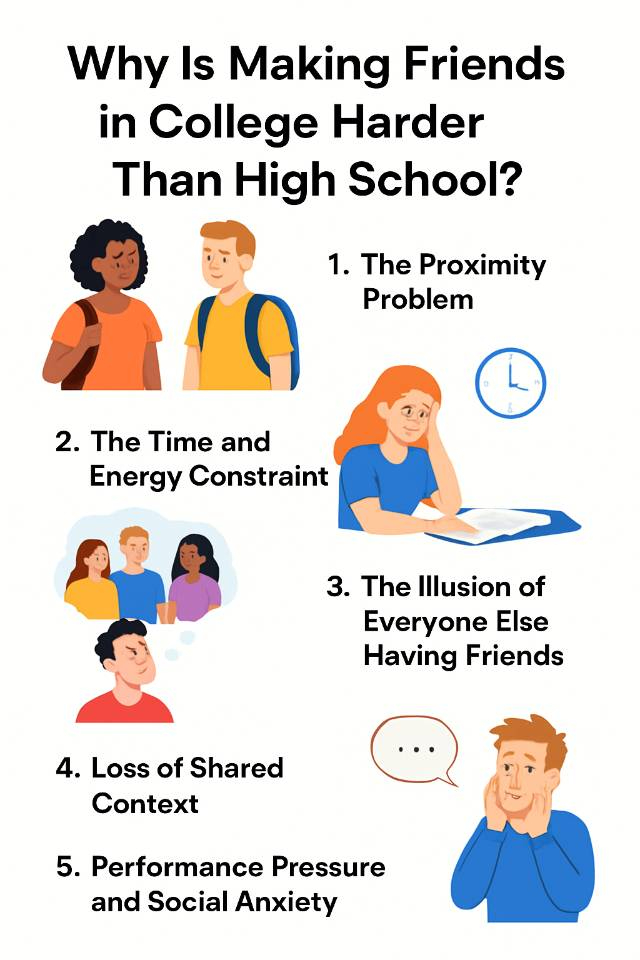
Making friends in college proves harder than high school due to lack of forced proximity where high school schedules created repeated daily contact with the same people across multiple classes while college schedules scatter students across different courses with minimal overlap, absence of built-in social structures like homeroom or lunch periods that facilitated casual interaction, increased academic and work demands leaving less time and energy for socializing, geographic dispersion where students come from diverse backgrounds lacking shared hometown context, and social anxiety intensified by the high-stakes feeling that these should be "the best years of your life" creating pressure that inhibits authentic connection.
Research indicates that 60-70% of college students report finding friendship formation harder than expected, with 55-65% saying they felt lonelier during their first semester than at any previous life stage, despite being surrounded by thousands of peers.
1. The Proximity Problem
High school forced you together with the same 30-50 students repeatedly across multiple classes, lunch periods, and extracurriculars, creating numerous unplanned interactions. College eliminates this structure. You might share one 50-minute class with someone twice weekly, then never see them again.
Research shows that friendship development requires 40-60 hours of interaction time with repeated unplanned encounters proving most crucial. High school provided these encounters automatically, while college requires deliberate effort to create repeated contact.
Dorm living helps, but doesn't guarantee friendships. Living on the same floor creates opportunity, but many students retreat to rooms between classes rather than socializing in common areas. Studies reveal that students who spend 8-10 hours weekly in dorm common areas form 50-60% more close friendships compared to those who use dorms only for sleeping. The physical proximity exists, but behavioral patterns determine whether proximity translates into friendship.
Class size affects friendship formation significantly. Large lecture halls with 200-400 students prevent the repeated interaction with specific individuals needed for friendship. Smaller discussion sections or lab groups create better conditions but still lack the forced daily contact of high school classes. Research indicates that students in smaller majors with cohort models averaging 20-30 students per year form close friendships 40-50% faster than those in large majors, where they rarely see the same classmates twice.
2. The Time and Energy Constraint
College academic demands consume more time than high school, leaving less for socializing. Most students need 2-3 hours of studying for each credit hour, meaning 15 credits requires 30-45 weekly study hours. Add classes, work, commuting, and basic self-care, and little time remains for friendship building.
Research shows that college students average 40-50 hours weekly on academic commitments compared to 25-30 hours in high school. The additional 15-20 hours often come from time previously spent socializing.
Mental energy matters as much as time. Even when you have free hours, academic stress and exhaustion make socializing feel impossible. You're too drained after studying to attend social events or engage meaningfully in conversations. Studies indicate that 50-60% of students report declining social invitations due to fatigue rather than lack of interest. The cognitive load of college work depletes the mental resources needed for the emotional labor of friendship formation.
Part-time work adds another layer. Students working 15-20 hours weekly report 30-40% fewer close friendships compared to non-working peers, despite similar social interest. Work eliminates both time and energy for friendship while creating scheduling challenges that prevent consistent participation in social activities where friendships develop.
3. The Illusion of Everyone Else Having Friends
Social media amplifies loneliness by creating false impressions that everyone else has already found their people. You see photos of friend groups at parties and outings, making you feel left out.
Reality: those groups often formed just days before you saw the photo, and most students feel equally anxious about friendships. Research reveals that 65-75% of first-year students worry they're the only ones struggling to make friends, while 70-80% of their peers feel exactly the same way.
The first weeks create artificial urgency as orientation activities and welcome events make it seem friendships should form instantly. You see the same people repeatedly during these events, creating illusions of established friend groups when actually everyone still feels equally uncertain. Studies show that friendships formed during orientation week have only 30-40% sustainability rates beyond the first semester compared to 70-80% for friendships formed more gradually through shared activities.
Comparison creates anxiety that inhibits authentic connection. When you believe you should already have close friends, you approach new people from a place of desperation rather than genuine interest. This makes interactions feel forced and inauthentic, preventing the natural relationship development that occurs when you're relaxed and genuinely curious about others.
4. Loss of Shared Context
High school friendships developed within the shared context of hometown, local culture, and mutual acquaintances. You had built-in conversation topics and shared references. College brings together students from diverse geographic and cultural backgrounds, lacking a common ground. Small talk feels harder when you can't reference local hangouts or mutual friends.
Research indicates that students attending college in their hometown form close friendships 25-35% faster than those far from home due to a maintained social context and existing friend networks providing social bridges to new connections.
The diversity enriches your experience but creates initial connection challenges. Understanding someone from a completely different background requires more effort than connecting with someone who shares your cultural references. Studies show that cross-cultural friendships form 20-30% more slowly on average than same-culture friendships, though they often become equally close once established.
5. Performance Pressure and Social Anxiety
Cultural narratives about college being "the best four years of your life" create intense pressure to have amazing social experiences. This pressure causes social anxiety that ironically prevents the relaxed, authentic interactions enabling friendship formation. When you approach every social situation as a high-stakes friendship audition, you can't be yourself.
Research reveals that 45-55% of college students report social anxiety symptoms during their first year, with 30-40% saying the pressure to make friends increases rather than decreases that anxiety.
Fear of rejection intensifies in college compared to high school. Rejection in high school meant awkwardness with someone you'd continue seeing. College rejection feels more absolute as you might never see that person again, making each interaction feel more consequential. Studies indicate that 50-60% of students avoid initiating social contact due to rejection fears despite genuinely wanting friendships.
What Are the Most Effective Ways to Meet People?
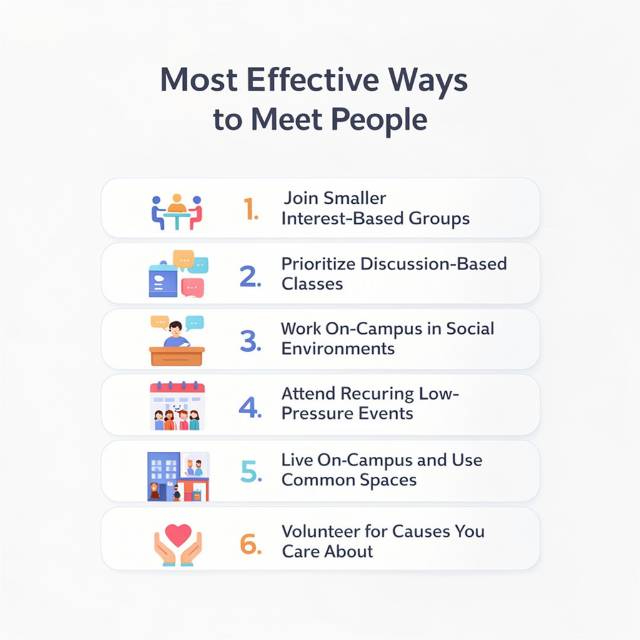
The most effective ways to meet potential friends include joining smaller interest-based clubs of 8-20 members rather than massive organizations where you attend the same weekly meetings creating repeated exposure, taking discussion-based courses or joining study groups for larger lectures where academic collaboration creates natural interaction, working on-campus jobs especially in student-facing roles like dining halls or recreation centers providing consistent coworker contact, attending recurring events like weekly trivia nights or fitness classes where familiar faces reappear, living in residence halls and spending time in common areas where casual encounters happen organically, and volunteering for causes you care about connecting you with like-minded people.
Research on college friendship formation shows that 60-70% of close friendships develop from activities attended consistently for 8+ weeks, creating the repeated unplanned interactions friendship requires, compared to just 10-15% of friendships starting from one-time social events like parties or welcome mixers.
1. Join Smaller Interest-Based Groups
Large clubs with 100+ members prevent intimate connections as you're unlikely to see the same people repeatedly. Smaller groups of 8-20 members create conditions where you interact with everyone regularly, facilitating friendship development.
Research shows that students in clubs with under 25 members form close friendships 55-65% of the time compared to just 15-20% in organizations exceeding 50 members. Look for niche interest groups rather than broad categories, as specific interests attract smaller, more compatible crowds.
Consistent attendance matters more than finding the perfect group. Showing up to the same weekly meeting creates familiarity with other regular attendees. After 3-4 weeks, you'll recognize faces, and after 6-8 weeks, casual conversation evolves naturally. Studies indicate that attending the same activity 8-10 times creates the foundation for friendship, while sporadic attendance prevents relationship development.
Academic clubs related to your major provide both social and professional benefits. You'll see the same people across multiple classes and club meetings, compounding exposure effects. Research shows that students active in major-related organizations form study partnerships that evolve into friendships 40-50% of the time, as academic collaboration provides natural extended interaction time.
2. Prioritize Discussion-Based Classes
Large lectures prevent friendship formation, but discussion sections, seminars, and lab courses create repeated small-group interaction. Enroll in at least one discussion-intensive course per semester, even if not strictly required. Classes meeting 2-3 times weekly for group discussions provide 4-6 hours weekly contact with the same 15-25 students. Research indicates that students form at least one meaningful friendship from discussion courses 50-60% of the time, compared to less than 5% from lecture courses.
Study groups transform academic work into a social opportunity. Propose forming study groups for difficult courses, creating regular meeting schedules. The shared stress of challenging material bonds people while studying together, and provides extended time for conversation beyond coursework. Studies show that study groups meeting weekly for 6+ weeks result in lasting friendships 45-55% of the time.
Group projects get complained about constantly, but they force extended interaction with classmates. Volunteer to organize group logistics or host meetings at your place. Being helpful and proactive in group settings makes you memorable and likable.
Research reveals that students who take leadership roles in group projects form friendships with 30-40% of their groupmates compared to 10-15% for passive participants.
3. Work On-Campus in Social Environments
On-campus jobs provide built-in social structure through required weekly shifts with the same coworkers. Dining halls, recreation centers, libraries, and student unions offer the most social interaction. Working 10-15 hours weekly creates 40-60 monthly hours of contact with coworkers in addition to the natural downtime during slow shifts, enabling conversation. Research shows that students with on-campus jobs report 25-35% larger friend networks compared to those working off-campus or not working.
Choose student-facing positions over isolated roles. Working front desk at the gym creates more interaction than administrative office work. Tour guides, orientation leaders, and resident assistants build friendships through both coworker relationships and student contact. Studies indicate that students in leadership or service roles form 40-50% more friendships than average due to increased social exposure and shared meaningful experiences.
Work friendships often extend beyond work environments more naturally than classroom relationships. Coworkers grab meals together, attend campus events, or hang out on days off. The regular schedule and shared work experiences provide natural conversation topics and inside jokes that bond people. Research reveals that 35-45% of close college friendships start through work relationships.
4. Attend Recurring Low-Pressure Events
Weekly events like trivia nights, game nights, fitness classes, or religious services create repeated no-commitment interaction. You don't need to talk extensively at each event, but familiar faces reappearing build recognition, progressing toward friendship. Research shows that attending the same weekly event 6-8 times makes you a "regular" where others start expecting your presence and seeking interaction.
Fitness classes work particularly well as the physical activity reduces social anxiety while providing built-in topics like class difficulty or instructor quirks. Attend the same class weekly at the same time, seeing the same participants. Studies indicate that students in group fitness classes form friendships 30-40% more frequently than those using gyms individually.
Religious or cultural organizations provide a community for students wanting a connection around shared beliefs or backgrounds. These groups often offer multiple weekly touchpoints, including services, social events, and volunteer opportunities.
Research shows that students involved in religious organizations report 20-30% less loneliness and 25-35% larger support networks compared to uninvolved peers.
5. Live On Campus and Use Common Spaces
Living on campus, particularly during first and second years, dramatically increases friendship opportunities. Dorms concentrate hundreds of potential friends in close proximity, creating chances for casual hallway conversations and spontaneous hangouts. Research reveals that students living on campus report 40-50% more close friendships than commuter students despite similar social skills and interests.
Common area usage predicts friendship formation more strongly than simply living in dorms. Studying in lounges, eating in shared kitchens, or watching TV in common rooms creates visibility and accessibility for interaction. Students who spend 8-10 hours weekly in dorm common areas form 50-60% more friendships than those staying in rooms. Leaving your door open when in your room signals availability for conversation.
Floor events and dorm activities provide low-pressure, structured interaction. Attend your floor meetings, game nights, or study breaks even when you don't feel like it. Showing up consistently makes you a known presence. Studies show that students attending 70-80% of dorm-organized events form close friendships with floormates 55-65% of the time, compared to 15-20% for those attending rarely.
6. Volunteer for Causes You Care About
Volunteering attracts people who share your values, creating a foundation for friendship. Regular volunteer commitments provide weekly interaction with the same people working toward shared goals.
Research indicates that students volunteering 3-4 hours weekly form meaningful friendships through volunteering 40-50% of the time. Choose ongoing commitments rather than one-time service events for repeated exposure.
Service trips and alternative spring breaks accelerate friendship formation through intensive shared experiences. Spending several days together in service contexts creates bonds that form more quickly than typical campus interaction. Studies show that 60-70% of students form lasting friendships from week-long service trips, with 30-40% of those becoming their closest college friends.
When academic demands threaten to consume all your time, preventing social engagement essential for wellbeing, an essay writing service can handle assignments in less critical courses during particularly busy periods, preserving time and energy for friendship-building activities rather than sacrificing social connection that protects mental health and enriches your college experience.
How Do You Turn Acquaintances Into Actual Friends?
Transform acquaintances into genuine friends by initiating one-on-one hangouts outside the context where you originally met moving beyond group settings into individual connection, following up consistently after meetings through texts or social media maintaining connection between in-person interactions, sharing gradually deeper personal information moving beyond surface small talk into genuine thoughts and feelings, being reliably present and supportive when friends face difficulties demonstrating that the relationship matters, and investing consistent time as research shows close friendships require 120-200 hours of interaction time over 4-6 months to develop.
Studies on friendship development reveal that 70-75% of acquaintanceships fail to progress beyond casual recognition due to lack of follow-up or initiative, while those who consistently suggest meetups and maintain contact between encounters form close friendships 55-65% of the time.
Stage | What This Looks Like | Typical Timeframe | Action Items to Progress | % That Advance |
Initial Acquaintance | You recognize each other, brief conversations, mostly surface-level | 1–3 weeks | • Attend the same activity consistently • Sit together or initiate short conversations • Learn basic details (major, interests) | ~65–70% move past this stage |
Familiar Connection | Casual chatting feels easier, some comfort, still group-based | 3–6 weeks | • Show up regularly (same class, club, job) • Reference past conversations • Exchange contact info | ~45–55% progress further |
One-on-One Friend | You meet individually for coffee, meals, or studying | 1–2 months | • Initiate specific hangouts • Follow up between meetings • Spend uninterrupted time together | ~30–35% deepen |
Emerging Friendship | Personal topics appear, and trust begins forming | 2–4 months | • Share moderate vulnerability • Ask thoughtful, open-ended questions • Be reliable and present | ~20–25% reach next stage |
Close Friendship | Mutual support, emotional safety, consistent effort | 4–6+ months | • Offer support during stress • Maintain regular contact • Invest time even when busy | ~10–15% become close friends |
How to Use This Tracker
Identify the current stage of a relationship
Focus only on the next action items, not the final outcome
Use timeframes as guidelines, not deadlines
If a relationship stalls, it often needs more consistency or initiative, not more people
Why Do Some Friendships Fade and How Do You Maintain Them?
College friendships fade when proximity disappears as class schedules change or students move off campus eliminating the repeated casual contact sustaining relationships, when life stages diverge with different priorities around academics, relationships, or social activities creating incompatibility, when effort becomes one-sided with one person consistently initiating contact while the other only responds passively, when shared activities end removing the context where friends regularly saw each other, and when friendship formed from convenience rather than genuine compatibility making it unsustainable beyond the circumstances that created it.
Research indicates that 40-50% of college friendships formed during freshman year fade by junior year as students' lives and interests evolve, with relationship sustainability depending less on initial closeness and more on continued compatible life circumstances and mutual investment in maintaining the connection.
1. The Proximity and Convenience Factor
Many early college friendships form primarily from proximity, floormates, classmates, or people you see regularly rather than deep compatibility. When circumstances change, these friendships often fade naturally. Research shows that 50-60% of dorm-based friendships don't survive after one or both people move off campus due to the elimination of daily casual contact that sustained the relationship. This isn't failure but natural evolution, as proximity-based relationships require deliberate effort once convenience disappears.
Recognize which friendships are truly compatible versus convenient. Convenient friendships serve important purposes during their time but don't require guilt when they fade. Compatible friendships based on genuine shared interests and values warrant effort to maintain. Studies indicate that students who differentiate between these types report 30-40% less guilt and stress about changing social circles.
2. Schedule and Priority Divergence
As college progresses, students' schedules and priorities diverge. Some focus intensely on academics while others prioritize social lives. Some enter serious relationships, consuming free time, while others remain focused on friendships. These diverging priorities strain friendships. Research reveals that 55-65% of fading friendships cite conflicting priorities as the primary issue rather than specific conflicts or personality clashes.
Greek life creates particular divergence as members often invest heavily in fraternity or sorority activities, leaving less time for other friendships. Students in serious romantic relationships typically reduce friend time by 40-50% according to studies. These shifts feel hurtful but usually reflect changed capacity rather than changed feelings about friendships.
3. One-Sided Effort Patterns
Relationships requiring consistently one-sided effort eventually exhaust the initiator, leading to friendship dissolution. When one person always suggests plans, sends texts first, and maintains contact while the other only responds passively, resentment builds. Research shows that when one friend initiates 70-80% of contact, the relationship satisfaction drops by 50-60% for the initiating friend, while the responding friend often doesn't notice the imbalance.
This pattern develops gradually. Initial imbalance seems minor but compounds over weeks and months. Eventually, the initiating friend decides the relationship matters more to them than to the other person and reduces effort. Studies indicate that most faded friendships don't end from arguments but from one person quietly stepping back after feeling consistently deprioritized.
4. Maintaining Important Friendships
Prevent valued friendships from fading through intentional maintenance efforts. Schedule regular catch-ups even when busy, monthly coffee dates or weekly phone calls keep the connection alive. Research shows that friendships receiving scheduled, consistent contact have 60-70% higher sustainability rates compared to those relying on spontaneous meetups. Treating friendship time as non-negotiable appointments rather than only meeting when convenient protects relationships during busy periods.
Communicate about changing schedules and capacities rather than ghosting when overwhelmed. Saying "This semester is intense, but I want to stay connected. Can we grab lunch every other week?" maintains relationships while acknowledging reality. Studies reveal that 70-80% of people prefer honest communication about limited availability over slowly fading contact.
Check in regularly, even with brief messages. Sending occasional "thinking of you" texts or sharing relevant content maintains the connection between meetings. Research indicates that friendships receiving 2-3 weekly brief check-ins sustain 50-60% better than those going weeks without contact between in-person meetings.
Be reliable when you do commit time. If you only have limited friend time, make those occasions count by being fully present rather than distracted or stressed. Quality interactions sustain relationships when quantity is limited. Studies show that one quality 2-hour hangout monthly maintains friendships better than three rushed 30-minute meetings.
What If You're Still Struggling Despite Trying?
Continued friendship struggles despite genuine effort may indicate social anxiety requiring professional support through campus counseling, unrealistic expectations about friendship timelines and depth mismatched with the 4-6 months typically required for close bonds, poorly fitting social contexts where the groups you're joining don't align with your actual interests and personality, depression or mental health conditions affecting energy and motivation for socializing, or being in a particularly isolating major or program with limited social opportunities.
Research shows that 15-20% of college students experience severe, sustained loneliness requiring intervention beyond typical friendship advice, with 60-70% of these students benefiting significantly from combining counseling with strategic social engagement when both address underlying barriers rather than just encouraging more social attempts.
1. Social Anxiety and Professional Support
Social anxiety affects 10-15% of college students severely enough to impair friendship formation despite a genuine desire for connection. If you experience intense physical symptoms like rapid heartbeat, sweating, or nausea before social situations, avoid social events despite wanting friends, or ruminate extensively about social interactions afterward, professional evaluation helps. Research shows that cognitive behavioral therapy for social anxiety produces significant improvement in 70-80% of cases within 8-12 sessions.
Campus counseling centers provide accessible mental health support, usually included in student fees. They offer individual therapy, group therapy for social anxiety, and sometimes social skills workshops. Studies indicate that students receiving treatment for social anxiety increase their close friendships by 50-60% within one semester compared to minimal improvement without intervention.
Medication combined with therapy helps some students, particularly those with severe anxiety interfering with daily functioning. Don't feel embarrassed seeking help, as social anxiety represents a treatable condition, not a character flaw. Research reveals that students who address social anxiety early report 40-50% higher college satisfaction compared to those who struggle without support.
2. Unrealistic Timeline Expectations
Many students expect close friendships to form within weeks, when research shows meaningful bonds typically require 4-6 months of consistent interaction totaling 120-200 hours. This mismatch between expectations and reality creates discouragement, preventing sustained effort long enough for actual friendships to form. Studies show that students who understand these timelines persist 40-50% longer in social efforts compared to those expecting instant results.
The first semester particularly rarely produces the closest lasting friendships. Many first-semester friend groups fragment by the second semester as students find better-fitting social circles. Research indicates that friendships formed during sophomore year have 30-40% higher sustainability rates than freshman year friendships as students better understand themselves and what they want from friendships.
3. Poor Context Fit
Sometimes you're trying hard in the wrong contexts. Joining the most popular club doesn't help if it doesn't match your interests. Attending parties despite hating loud, crowded spaces wastes energy better spent on finding compatible activities. Research shows that students in activities genuinely matching their interests form friendships 50-60% faster than those in activities chosen because "that's where people make friends."
Reassess where you're investing social energy. If you've attended club meetings 8-10 times without forming any meaningful connections, that group may not fit. Try different contexts matching your actual personality and interests. Studies indicate that students find friend groups requiring an average of 3-4 different attempted social contexts before identifying good fits.
When academic demands become so overwhelming that all social attempts feel impossible, requiring extreme effort just to show up anywhere, strategic support for lower-stakes coursework through a trusted essay writing service during peak-demand periods can preserve the energy needed for consistent social engagement rather than sacrificing all friendship-building activities to impossible workloads that leave you socially isolated.
4. Mental Health Impact on Socializing
Depression significantly impairs friendship formation through reduced energy, motivation, and the ability to feel pleasure in social interactions. When struggling with persistent low mood, lack of interest in previously enjoyed activities, or exhaustion unrelieved by rest, a mental health evaluation becomes essential. Research shows that 30-40% of students experiencing friendship difficulties have underlying depression requiring treatment rather than just needing better social skills.
The relationship works bidirectionally. Loneliness increases depression risk while depression makes socializing harder, creating negative cycles. Breaking these cycles typically requires professional support addressing both conditions. Studies indicate that students receiving depression treatment show 50-60% improvement in social connection within 2-3 months as energy and motivation return.
Key Takeaways
Making friends in college requires time, consistent effort, and realistic expectations about relationship development timelines:
- 75-80% of college students experience loneliness during their first year, with friendship formation typically taking 4-6 months of consistent interaction totaling 120-200 hours before close bonds form
- Most effective friendship contexts include smaller interest-based groups attended consistently, discussion-based courses, on-campus employment, and recurring low-pressure events where repeated exposure creates familiarity
- Transform acquaintances into friends through initiating one-on-one hangouts, following up between meetings, gradually deepening conversations beyond small talk, and investing consistent time over months
- Friendships fade naturally when proximity disappears, priorities diverge, or effort becomes one-sided. Maintaining valued relationships requires intentional scheduling and honest communication
- Severe, sustained loneliness despite genuine effort may indicate social anxiety, depression, or poor context fit requiring professional support or different social approaches
College friendship formation feels harder than high school because it lacks forced proximity and built-in social structures, while increased academic demands consume time and energy needed for relationship building. The pressure to form instant close bonds creates anxiety, preventing the relaxed, authentic interactions that enable natural friendship development. Most students feel equally uncertain about friendships while believing everyone else has already succeeded socially.
The key is a consistent presence over months, allowing relationships to deepen naturally without forcing premature intimacy. Attend the same activities weekly, follow up after meetings, initiate one-on-one time, and accept that meaningful friendships develop gradually rather than instantly.
When academic workload threatens to eliminate all time and energy for social engagement essential to wellbeing, strategic management of that workload protects your capacity for building and maintaining the relationships that enrich college experience and support mental health.
Your worth isn't determined by friend quantity or how quickly you form close bonds. Focus on genuine connections based on shared interests and compatible values rather than collecting acquaintances or joining groups because "that's where people make friends." Quality relationships that align with your authentic self matter infinitely more than appearing popular or matching perceived social expectations.