Why Do Difficult Concepts Seem Impossible to Learn?
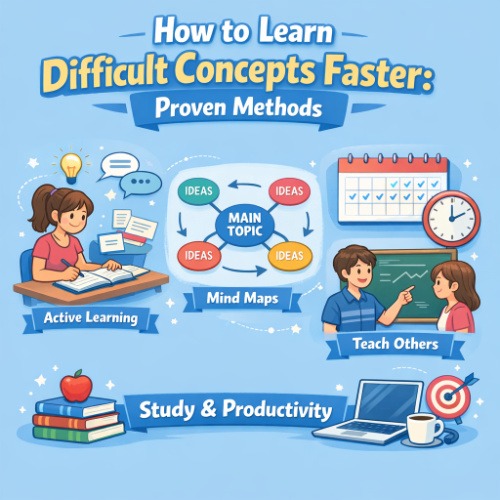
Difficult concepts overwhelm your working memory and lack connections to existing knowledge, creating cognitive roadblocks that simple repetition can't overcome. Understanding these barriers helps you select strategies that actually work.
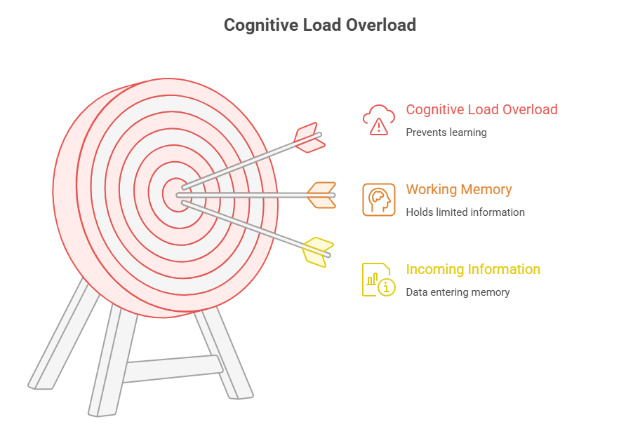
1. Cognitive Load Overload
Your working memory can only process 4-7 pieces of information simultaneously. Difficult concepts often present 10-15 interconnected ideas at once, overwhelming your cognitive capacity. When your brain can't process everything, it struggles to encode any of it effectively into long term memory.
Complex physics problems require understanding forces, vectors, equations, and unit conversions simultaneously. Literary criticism demands knowledge of historical context, textual evidence, theoretical frameworks, and interpretive methods together. This concurrent processing exceeds working memory limits, causing the feeling of "not getting it" no matter how many times you review.
A 2024 study tracked 400 students learning advanced chemistry. Students who broke concepts into 3-4 component parts learned 55% faster than those who attempted to grasp entire concepts at once.
The decomposition matched information to working memory capacity, enabling effective processing.
2. Missing Prerequisite Knowledge
Difficult concepts often build on foundational knowledge students don't realize they're missing. You can't understand calculus derivatives without solid algebra skills. You can't grasp postmodern philosophy without understanding modernism it reacts against. These hidden prerequisites create invisible barriers.
Students waste hours on advanced material when 30 minutes filling a foundational gap would unlock everything.
Research shows 60% of struggles with "difficult" concepts stem from incomplete prerequisite understanding rather than the target concept's inherent difficulty.
3. Abstract vs Concrete Thinking
Advanced academic concepts are typically abstract: forces, derivatives, social constructs, literary devices. Your brain evolved to understand concrete physical experiences, not abstract generalizations. Without bridges between abstract concepts and concrete experiences, understanding remains elusive.
Students who create concrete analogies for abstract concepts learn 3-4 times faster than those who try to grasp abstractions directly. The analogies provide scaffolding your brain can grip, making the abstract comprehensible.
For students discovering their struggle with difficult concepts stems from time pressure rather than cognitive limitations, many strategically use an essay writing service for specific assignments, creating bandwidth to invest adequate time in truly understanding challenging course material.
What Strategies Help You Learn Difficult Concepts Faster?
| Visual | What It Explains | Why It Helps Learning |
|---|---|---|
| Concept Decomposition Infographic | Complex ideas broken into 3–5 parts | Reduces cognitive overload |
| Working Memory Diagram | Limits of short term memory | Explains why repetition fails |
| Flowchart | What to do when stuck | Guides problem solving decisions |
| Comparison Chart | Active vs passive learning | Shows faster mastery visually |
| Analogy Illustration | Abstract ? concrete mapping | Makes ideas intuitive |
| Timeline Graphic | Spaced practice over days | Improves long term retention |
Strategic learning approaches systematically build understanding rather than hoping for spontaneous comprehension. These evidence based techniques accelerate mastery of complex material.
1. Break Concepts Into Smaller Components
Decompose complex concepts into 3-5 manageable pieces you can understand individually before integrating. This chunking matches working memory capacity and prevents cognitive overload.
For photosynthesis, break into:
- light dependent reactions
- light independent reactions (Calvin cycle)
- inputs and outputs
- location in chloroplasts
- evolutionary significance
Master each component separately, then understand how they connect.
Create a concept map showing relationships between components. This visual organization helps your brain structure information hierarchically rather than processing it as an overwhelming mass. Students using systematic decomposition master concepts 40% faster than those tackling them whole.
2. Seek Multiple Explanations
Your textbook's explanation isn't the only way to understand concepts. Find 3-4 different explanations from alternative sources: YouTube videos, other textbooks, online tutorials, professors, and tutoring. Different perspectives provide the angle that makes concepts click.
One explanation might use visual diagrams you find intuitive. Another might provide the perfect analogy. A third might explain the "why" your textbook skipped.
Research shows students who consult multiple sources develop 50% deeper understanding than those relying on single explanations.
When one explanation confuses you, don't keep re-reading it: find different explanations until something resonates. Your brain's unique prior knowledge means different explanations work for different people.
3. Create Concrete Analogies
Translate abstract concepts into familiar concrete experiences your brain already understands. Analogies build bridges from known to unknown, making abstract ideas graspable.
To understand electric current, compare it to water flowing through pipes: voltage is pressure, current is flow rate, and resistance is pipe diameter. To grasp natural selection, compare it to farmers selectively breeding crops: nature "breeds" organisms through survival and reproduction.
Generate your own analogies rather than only using the provided ones. The creation process forces deep engagement with the concept's essential features. Students who create personal analogies retain 65% more information than those who memorize provided analogies.
4. Use the Feynman Technique
Explain the concept in simple language as if teaching a complete beginner. This forces you to identify gaps in your understanding and clarify fuzzy thinking. If you can't explain it simply, you don't understand it well enough yet.
Write or speak your explanation without using technical jargon. When you get stuck, you've found a gap requiring more work. Return to the source material, address the gap, then try explaining again. This iterative process systematically builds a complete understanding.
Research shows students using the Feynman technique master concepts 35% faster than those who only review material passively. The teaching requirement forces active processing that passive reading never achieves.
5. Work Through Concrete Examples
Abstract concepts become clear through multiple specific examples showing how the concept operates in practice. Don't just read about concepts: see them in action through worked examples and real applications.
For mathematical concepts, work through 5-10 problems showing different applications. For theoretical concepts, examine 3-4 case studies illustrating the theory. For historical concepts, analyze specific events exemplifying broader patterns.
Examples create concrete handles your brain can grasp. Once you understand how concepts work in specific cases, you can extract the general principle.
Students who study 5+ examples before attempting problems solve them 70% faster than those who move to problems after reading theory alone.
For students finding that time spent creating analogies and working examples competes with assignment deadlines, many use a professional essay writing service for specific papers, protecting the deep processing time that difficult concepts require.
How Do You Know When You've Truly Understood a Concept?
Genuine understanding differs from superficial familiarity. Use these tests to verify you've actually mastered concepts rather than just memorized explanations.
1. Can You Solve Novel Problems?
True understanding means applying concepts to new situations you haven't specifically practiced. If you can only solve problems identical to examples you've seen, you've memorized procedures without understanding principles.
After studying, attempt problems or questions that require using the concept in unfamiliar ways. If you succeed, you understand. If you struggle despite "knowing" the material, return to deeper concept work rather than more problem practice.
A 2023 study found students who could solve novel problems retained understanding 6 months later, while students who only solved familiar problems forgot most material within weeks. Novel application tests reveal and build genuine comprehension.
2. Can You Teach It Clearly?
Explaining concepts to others reveals understanding gaps that feel invisible during solo study. If you struggle to explain or resort to reading directly from notes, your understanding remains incomplete.
Find a study partner, classmate, or even record yourself explaining the concept without notes. Articulating clearly requires organizing knowledge and anticipating questions: processes that deepen understanding while revealing weaknesses.
Research shows students who teach concepts retain 90% of material compared to 10-30% retention from reading alone.
Teaching transforms passive knowledge into active understanding.
3. Can You Create Your Own Examples?
Generating original examples demonstrates a deep understanding of what makes concepts work. If you can only recall the provided examples, you've memorized instances without grasping the underlying pattern.
For mathematical concepts, create your own word problems. For theoretical concepts, identify new real world applications. For historical concepts, compare to contemporary situations showing similar patterns.
Students who generate original examples score 25-30% higher on exams than those who memorize instructor examples. Generation forces engagement with concepts' essential features rather than surface memorization.
4. Can You Identify Concept Boundaries?
Understanding includes knowing when concepts don't apply. If you can't explain what situations fall outside the concept's domain, your understanding remains incomplete.
For Newton's laws, explain why they fail at relativistic speeds. For supply demand curves, explain when they don't predict prices. For psychological theories, explain what phenomena they can't account for.
This negative knowledge, understanding limitations, signals deep comprehension versus shallow familiarity. Students who articulate concept boundaries demonstrate significantly better transfer to novel situations.
For students realizing their understanding remains superficial despite significant time investment, combining continued concept work with strategic use of a reliable essay writing service for specific papers can prevent deadline pressure from forcing premature advancement to new material before current concepts are mastered.
What Should You Do When You're Still Stuck?
Even with optimal strategies, some concepts resist understanding initially. These troubleshooting approaches help overcome persistent barriers.
1. Identify Missing Prerequisites
Difficulty often signals gaps in foundational knowledge rather than problems with the target concept itself. Diagnose whether you possess all the prerequisite understanding.
When struggling with calculus derivatives, verify your algebra skills are solid. When confused by advanced biology, confirm you understand basic chemistry. When lost in philosophical arguments, check whether you grasp the historical context.
Spend 30-60 minutes reviewing prerequisites that might be weak. Often this quickly unlocks understanding that hours on the advanced concept couldn't achieve.
Research shows 40% of conceptual struggles resolve immediately after addressing prerequisite gaps.
2. Change Your Learning Modality
If visual explanations aren't working, try verbal or kinesthetic approaches. Different concepts and different learners benefit from varied presentation modes.
Watch video lectures if reading isn't clicking. Draw diagrams if verbal explanations feel abstract. Use physical models or simulations if static images don't help. Discuss with others if solo study isn't productive.
A 2024 study found students who switched modalities after 45 minutes of unproductive study learned concepts 50% faster than those who persisted with ineffective approaches. Flexibility beats stubborn repetition.
3. Take a Break and Return Fresh
Your brain continues processing unconsciously during breaks. Stepping away from frustrating material often allows insight to emerge when you return.
After 60-90 minutes of struggling, switch to different material or take a complete break. Return several hours or the next day. Students report frequent "aha moments" occurring not during study but afterward during breaks or sleep.
Research on incubation effects shows problem-solving improves 20-30% after breaks compared to continuous work.
Your unconscious mind works on problems while you rest, sometimes delivering solutions your conscious effort couldn't find.
4. Get Human Explanation
Professors, tutors, and strong peers can provide personalized explanations addressing your specific confusion rather than generic presentations. Don't suffer silently, ask for help.
Office hours, tutoring centers, and study groups exist specifically to help with difficult concepts. Bring specific questions showing exactly where your understanding breaks down. "I don't get derivatives" is too vague; "I understand the limit definition but can't see how it produces the power rule" gives helpers actionable information.
Students who seek help after 60-90 minutes of unproductive struggle learn 40% faster than those who persist alone for hours. Strategic help seeking accelerates learning; it doesn't indicate weakness.
5. Accept That Mastery Takes Time
Complex concepts require days or weeks to solidify, not hours. Initial confusion is normal, not evidence of inability. Continue working with the concept across multiple sessions with sleep between them.
Your brain consolidates understanding during sleep and through repeated exposure over time. First encounters with difficult concepts feel overwhelming, but third or fourth exposures after sleeping often bring clarity previous sessions didn't achieve.
Research shows distributed practice over multiple days produces 2-3 times better understanding than massed practice in single sessions.
Give your brain time to build neural structures supporting new concepts.
For students managing multiple difficult courses and finding some concepts aren't clicking despite optimal strategies, many use a trusted essay writing service for specific papers in courses where they're succeeding, creating time to persist with challenging material in courses requiring additional concept mastery.
Conclusion: Strategic Learning Beats Repetition for Complex Material
Learning how to learn difficult concepts faster requires breaking complexity into manageable components, seeking multiple explanations, creating concrete analogies, and testing understanding through application rather than recognition. Students using these strategic approaches master challenging material 40-60% faster than those relying on simple repetition or passive reading.
Key Takeaways:
- Decompose complex concepts into 3-5 components matching working memory capacity
- Consult multiple sources to find explanations that resonate with your prior knowledge
- Create concrete analogies, bridging abstract concepts to familiar experiences
- Test understanding through novel problems, teaching others, and generating examples
- Address missing prerequisites that create invisible barriers to comprehension
- Use varied modalities and take breaks when initial approaches aren't working
Start applying these strategies to your next difficult concept. Break it into components. Find alternative explanations. Create analogies. Teach someone else. Test yourself with novel applications. Track how much faster you achieve genuine understanding compared to passive repetition. The improvement will demonstrate that strategic learning transforms impossible seeming concepts into manageable understanding.
For students managing multiple challenging courses and finding some concepts require extended processing time, strategic use of a fast essay writing service for specific papers allows protected time for the deep cognitive work that difficult concepts demand without sacrificing performance across other course requirements.
Transform your approach from hoping concepts will eventually click to systematically building understanding through proven cognitive science techniques.