-19941.jpg)
Informative Essay Outline: Copy Paste Template (Standard 5 Paragraph)
I. INTRODUCTION (10-15% of total essay)
- Hook: [Your attention grabbing opening sentence]
- Surprising Statistic: "[Number + Source]"
- Relevant Question: "[Thought provoking question]"
- Brief Anecdote: "[1-2 sentence story]"
- Background Information: [2-3 sentences providing context]
- What readers need to know: [Key context]
- Define main terms: [If necessary]
- Establish relevance: [Why this topic matters now]
- Thesis Statement: [Your specific, concise informative claim]
- Format: "This essay explains [subtopic 1], [subtopic 2], and [subtopic 3]."
- Example: "This essay explains how solar panels generate electricity, their efficiency rates, and their environmental impact."
II. BODY PARAGRAPH 1: [First Main Subtopic]
- Topic Sentence: [States the first main point of the essay]
- Template: "[Subtopic 1] involves [key aspect]."
- Evidence #1: [Fact, statistic, or expert quote]
- Source: [Where this information came from]
- Context: [Any relevant details about the evidence]
- Explanation: [Analyzes how the evidence supports your point]
- Template: "This shows that [connection to topic sentence]."
- Evidence #2: [Additional supporting fact or statistic]
- Source: [Citation]
- Relevance: [Why this specific evidence matters]
- Explanation: [Deeper analysis of the evidence's significance]
- Transition: [Connects this paragraph to the next one]
- Template: "Beyond [current point], [next point] also plays a role."
III. BODY PARAGRAPH 2: [Second Main Subtopic]
- Topic Sentence: [States the second main point]
- B. Evidence #1: [Supporting fact, statistic, or quote]
- Explanation: [Analysis of how this evidence supports the point]
- Evidence #2: [Additional support]
- Explanation: [Significance of this evidence]
- Transition: [Smoothly links to the next paragraph]
IV. BODY PARAGRAPH 3: [Third Main Subtopic]
- Topic Sentence: [States the third main point]
- Evidence #1: [Supporting fact, statistic, or quote]
- Explanation: [Analysis]
- Evidence #2: [Additional support]
- Explanation: [Significance]
- Transition: [Leads the reader into the conclusion]
- Template: "Understanding [all three points] reveals [broader significance]."
V. CONCLUSION (10-15% of total essay)
- Restate Thesis: [Rephrase your main argument do not copy verbatim]
- Template: "[Topic] operates through [subtopic 1], [subtopic 2], and [subtopic 3]."
- Synthesize Key Points: [Briefly summarize the main findings from each body paragraph]
- Point 1 Summary: [1 sentence]
- Point 2 Summary: [1 sentence]
- Point 3 Summary: [1 sentence]
- Closing Statement: [Explain why this information matters the "so what?"]
- Template: "Understanding [topic] helps explain [broader significance or real world application]."
- Avoid: Phrases like "In conclusion," "As you can see," or introducing new information.
Informative Essay Structure: Breakdown by Essay Length
Short Informative Essay Format (500-750 words)
Introduction: 75-100 words (10-15%)
Body: 350-500 words (70-75%)
Conclusion: 75-100 words (10-15%)
|
STUCKED IN THE INFORMATIVE ESSAY OUTLINE?
Bridge the gap from skeleton to substance with our expert writing service.
- Overcoming the "what to write first" block
- Transforming bullet points into flowing paragraphs
- Adding depth and detail to your framework
- Draft Completion Service
The hard part (planning) is done. Let's do the rewarding part (writing).
Get Started NowStandard Informative Essay Format (1,000-1,500 words)
Introduction: 150-200 words (10-15%)
Body: 700-1,050 words (70-75%)
Conclusion: 150-200 words (10-15%)
|
Still choosing your topic? Browse informative essay topics organized by subject area. Find ideas for science, history, technology, health, and current events.
Informative Research Format (2,000+ words)
Introduction: 250-350 words (12-15%)
Body: 1,400-1,800 words (70-75%)
Conclusion: 250-300 words (12-15%)
|
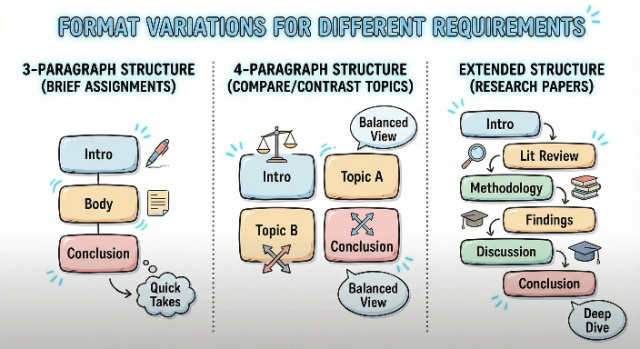
Informative Essay Format Variations for Different Requirements
OUTLINE DONE. ESSAY DUE TOMORROW.
We rapidly develop your informative essay outline into a comprehensive, submission ready paper.
- Fast track 6 hour drafting based on your structure
- Adherence to your specified sources and facts
- Polished, proofread final delivery
- Rapid Expansion Service
From blueprint to finished building overnight.
Order NowInformative Essay Template: 3 Paragraph Structure (Brief Assignments)
I. INTRODUCTION
II. COMBINED BODY (Single comprehensive paragraph)
III. CONCLUSION
|
Best for: Timed essays, short response assignments, 500-700 word limits
Informative Essay Template: 4 Paragraph Structure (Compare/Contrast Topics)
I. INTRODUCTION
II. SIMILARITIES
III. DIFFERENCES
IV. CONCLUSION
|
Best for: Comparing two concepts, systems, or processes
Informative Essay Template: Extended Structure (Research Papers)
I. INTRODUCTION
- Hook + Background + Context + Thesis
II. BACKGROUND/CONTEXT SECTION
- Historical development
- Current understanding
- Key definitions
III. BODY SECTION 1: [Major aspect #1]
- Multiple paragraphs exploring the first main area
IV. BODY SECTION 2: [Major aspect #2]
- Multiple paragraphs exploring the second main area
V. BODY SECTION 3: [Major aspect #3]
- Multiple paragraphs exploring the third main area
VI. IMPLICATIONS/SIGNIFICANCE
- Broader meaning or applications
VII. CONCLUSION
- Comprehensive synthesis
Best for: 3,000+ word research papers, in depth analysis
Paragraph Structure Template (PEEL Method) For Informative Outline
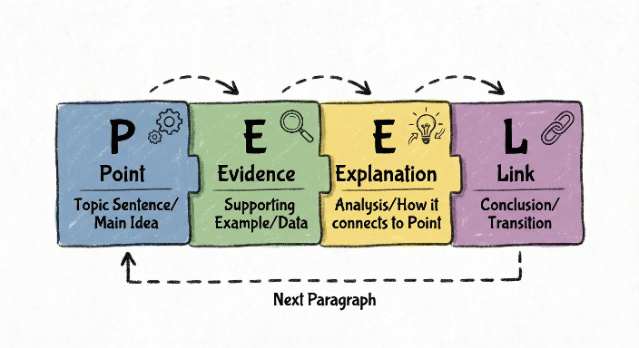
Use this structure for EVERY body paragraph:
P POINT
The first sentence of the paragraph.
States the paragraph's main idea or argument.
Directly supports the essay's thesis or the section's topic sentence.
E EVIDENCE
The data used to support and prove the Point.
Can include:
Facts, statistics, or numerical data.
Quotations from experts, texts, or sources.
Specific examples, case studies, or events.
Anecdotal or observational details (for applicable essays).
E EXPLANATION
The analysis that connects the Evidence to the Point.
Explains how and why the provided Evidence proves the Point is valid.
Interprets the significance of the evidence.
This is the writer's analysis and is the most critical part of the paragraph.
L LINK
The concluding sentence of the paragraph.
Serves one of two primary functions:
Links back to the essay's main thesis or argument.
Links forward to the main point of the next paragraph (acting as a transition).
Ensures the paragraph is connected to the essay's overall structure.
| Why PEEL works: Ensures every paragraph has both evidence and analysis, no dropped quotes, no unsupported claims. |
Informative Essay Format: Filled Outline Sample (Renewable Energy Topic)
This shows the template in use. This is a partially completed structure, not a complete essay. For full essays, see our informative essay examples.
I. INTRODUCTION
A. Hook: "Americans throw away enough renewable energy potential to power 18 million homes."
B. Background: Renewable energy sources like solar and wind generate electricity without depleting resources. As fossil fuel concerns grow, understanding these alternatives becomes crucial.
C. Thesis: "This essay explains how solar panels generate electricity, how wind turbines convert motion to power, and how these technologies compare in efficiency."
II. BODY PARAGRAPH 1: Solar Panel Electricity Generation
A. Topic: "Solar panels convert sunlight through photovoltaic cells."
B. Evidence: "Each cell contains semiconductor materials releasing electrons when struck by photons (Smith, 2024)."
C. Explanation: "This electron flow creates DC electricity."
D. Evidence: "Standard panels achieve 15-22% efficiency (EIA, 2024)."
E. Explanation: "While modest, improving technology increases output."
F. Transition: "Wind energy uses mechanical rather than chemical conversion."
III. BODY PARAGRAPH 2: Wind Turbine Power Generation
A. Topic: "Wind turbines transform kinetic energy into electricity."
B. Evidence: "Blades capture wind, spinning a rotor connected to a generator (Jones, 2024)."
C. Explanation: "Mechanical rotation becomes electrical current."
D. Evidence: "Modern turbines convert 45-50% of wind energy (DOE, 2024)."
E. Explanation: "Higher efficiency than solar but location-dependent."
F. Transition: "Comparing these technologies reveals trade-offs."
IV. BODY PARAGRAPH 3: Efficiency Comparison
A. Topic: "Solar and wind technologies offer different advantages."
B. Evidence: "Solar works anywhere with sunlight; wind requires specific conditions (Green, 2024)."
C. Explanation: "Solar provides broader geographic applicability."
D. Evidence: "Wind generates more power per installation but needs consistent wind (Brown, 2024)."
E. Explanation: "Each suits different environments and needs."
F. Transition: "Understanding both technologies supports informed energy decisions."
V. CONCLUSION
A. Restate: "Solar and wind power generation operate through distinct mechanisms, photovoltaic conversion and mechanical rotation."
B. Summary: "Solar uses semiconductor physics, wind uses kinetic energy, and each offers efficiency advantages in specific contexts."
C. Closing: "As renewable energy adoption grows, understanding these technologies helps evaluate future energy solutions."
Need templates done right? Our professional essay writing service creates custom outlines and completes essays for any topic researched, structured, and cited properly.
Downloadable Templates & Resources
Each template includes:
- Fillable brackets for your content
- Word count guidelines per section
- Formatting instructions
- Example topic sentences
SOLID OUTLINE. LET'S MAKE A REMARKABLE ESSAY.
We elevate your informative essay plan into A grade, reader centric prose.
- Enhancing clarity and engagement of each section
- Strengthening explanatory power and detail
- Perfecting transitions for a smooth reader experience
- Outline to Excellence Upgrade
Don't just follow the plan, bring it to life remarkably.
Order NowKey Takeaways: Informative Essay Outline
Templates save time. Copy the structure that fits your length requirement, fill in brackets with your research, and start writing. These aren't suggestions; they're proven formats that work for every informative essay.
Ready to fill your outline with content? See our informative essay guide for complete writing instructions covering research, drafting, revision, and citation.