
Middle School Informative Essay Example #1: The Water Cycle

- Grade Level: 6-8
- Word Count: 520 words
- Pattern: Process/Sequential
Complete Essay
Understanding the Water Cycle
Water on Earth never disappears, it just moves. Right now, the water you drink could be the same water dinosaurs drank millions of years ago. This happens because of the water cycle, a continuous process where water moves from Earth's surface to the atmosphere and back again. The water cycle consists of four main stages: evaporation, condensation, precipitation, and collection.
Evaporation is the first stage where water transforms from liquid to gas. When the sun heats water in oceans, lakes, and rivers, it turns into water vapor and rises into the air. About 90% of atmospheric water vapor comes from ocean evaporation. Plants also release water vapor through tiny holes in their leaves in a process called transpiration. Together, evaporation and transpiration move approximately 496,000 cubic kilometers of water into the atmosphere every year.
Condensation happens when water vapor cools and changes back into liquid water. As water vapor rises higher into the atmosphere, it encounters cooler temperatures. The vapor condenses around tiny particles of dust, forming water droplets. Billions of these droplets cluster together to create clouds. Different cloud types form at different altitudes cumulus clouds form lower in the atmosphere where warm air rises rapidly, while cirrus clouds form high up where temperatures are extremely cold.
Precipitation occurs when water droplets in clouds become too heavy and fall to Earth. The type of precipitation depends on atmospheric temperature. Rain falls when temperatures stay above freezing throughout the droplet's journey. Snow forms when temperatures remain below freezing, allowing ice crystals to develop. Sleet happens when rain freezes while falling through cold air layers. Hail develops in thunderstorms where strong updrafts carry water droplets up and down through freezing temperatures, building layers of ice.
Collection is the final stage where water gathers in oceans, lakes, rivers, and underground reservoirs. About 78% of precipitation falls directly into oceans. The remaining 22% falls on land, where gravity pulls it downward. Some water flows across the surface as runoff, eventually reaching streams and rivers that flow to oceans. Other water seeps into soil, becoming groundwater stored in underground aquifers. This groundwater can remain stored for thousands of years or slowly flow toward oceans.
The water cycle repeats continuously, driven by solar energy and gravity. The sun provides energy for evaporation, while gravity pulls water back to Earth's surface. This cycle purifies water naturally evaporation leaves salt and impurities behind, so precipitation contains relatively clean water. The entire process takes different amounts of time depending on the pathway. Water in the atmosphere only stays there for about nine days, while groundwater can remain underground for thousands of years. Understanding the water cycle helps explain weather patterns, freshwater availability, and Earth's climate systems.
SAW THE STANDARD? LET'S BEAT IT.
Your custom informative essay will be tailored, unique, and even more focused than our samples.
- Personalized attention to your specific rubric
- Deeper research and more relevant examples
- A final polish that exceeds sample quality
- Bespoke Upgrade
Our samples are great. Your custom essay will be better.
Get Started NowWhat Makes This Informative Example Work
- Clear process organization: Each paragraph covers one stage in logical order, and readers follow the cycle step by step without confusion.
- Grade appropriate language: Uses scientific terms (transpiration, aquifers, condensation) but explains each one clearly. No assumed knowledge.
- Specific data: Numbers like "90% of atmospheric water vapor" and "496,000 cubic kilometers" provide concrete information instead of vague claims.
- Strong transitions: "Condensation happens when..." and "Collection is the final stage..." guide readers through each stage smoothly.
- Focused paragraphs: Each paragraph tackles one stage completely before moving to the next, no mixing topics.
Middle School Informative Essay Example #2: Ancient Egyptian Pyramids
- Grade Level: 6-8
- Word Count: 485 words
- Pattern: Topical
Complete Essay
How Ancient Egyptians Built the Pyramids
The pyramids of ancient Egypt stand as some of history's most impressive structures. The Great Pyramid of Giza, built around 2560 BCE, originally stood 481 feet tall and contains approximately 2.3 million stone blocks. For thousands of years, people have wondered how ancient Egyptians constructed these massive monuments without modern technology. Archaeological evidence reveals they used organized labor, clever engineering techniques, and simple but effective tools.
Ancient Egyptians moved massive stone blocks using manpower and basic mechanical principles. Most pyramid stones came from nearby quarries, though some special casing stones traveled from quarries over 500 miles away. Workers cut limestone blocks from quarries using copper tools and wooden wedges. After soaking wooden wedges with water, the wood expanded and split the rock along natural fracture lines. Each block weighed between 2.5 and 15 tons. Workers transported these blocks by placing them on wooden sledges and dragging them across sand. Recent experiments showed that wetting the sand reduced friction by 50%, making it easier to pull heavy loads.
Ramps played a crucial role in lifting stones to higher levels. Archaeologists have found evidence of several ramp types at different pyramid sites. Straight ramps extended directly from the pyramid base, though these required enormous amounts of material for tall pyramids. Spiral ramps wrapped around the pyramid's exterior, using less material but creating tight corners. Interior ramps ran through the pyramid structure itself, leaving passages that workers later filled. Most likely, Egyptians used different ramp combinations depending on each pyramid's specific design and construction phase.
The workforce consisted of skilled laborers, not slaves as popular movies suggest. Archaeological discoveries at worker villages near pyramids show that builders received payment in food and housing. They worked in rotating shifts, with approximately 20,000 to 30,000 workers on site during construction peaks. Farmers worked on pyramids during flood seasons when they couldn't farm their land. This system provided employment while demonstrating loyalty to the pharaoh. Workers lived in planned communities with bakeries, breweries, and medical facilities. Inscriptions on pyramid stones show work crews competed against each other, creating team identities and pride in their construction.
Precise alignment required sophisticated astronomical observations. The Great Pyramid's sides align almost perfectly with cardinal directions north, south, east, and west with less than 0.05 degrees of error. Egyptians likely achieved this accuracy by tracking star movements. They may have used a merkhet (a sighting tool similar to an astrolabe) to observe stars crossing their meridian. By marking these observations and bisecting the angle, they could determine true north with remarkable precision.
Building pyramids took decades and required coordinating thousands of workers, managing massive supply chains, and solving complex engineering problems. The Great Pyramid took approximately 20 years to complete. These structures demonstrate not just ancient Egyptian engineering skill, but also their sophisticated organizational capabilities and social structure.
What Makes This Work
- Topic based organization: Each paragraph explores one aspect (transportation, ramps, workforce, alignment) without mixing subjects.
- Myth correction: Addresses the common slave misconception with archaeological evidence teaches accurately while engaging interest.
- Concrete details: Specific numbers (2.3 million blocks, 481 feet, 20 years) make abstract concepts tangible for young readers.
- Accessible explanations: Breaks down complex engineering (ramps, friction reduction, astronomical alignment) into understandable chunks.
Ready to structure your own essay? Download our informative essay outline template with plug and play formats for every length short, standard, and research paper structures ready to customize.
High School Informative Essay Example #1: Solar Energy Systems
- Grade Level: 9-12
- Word Count: 890 words
- Pattern: Topical (Three Mechanisms)
Complete Essay
How Solar Panels Convert Sunlight Into Electricity
Every hour, enough sunlight reaches Earth to power the entire planet for a year yet we capture less than 1% of that energy. Solar panels offer a solution by converting sunlight directly into electricity through photovoltaic technology. Understanding how these systems work requires examining three key components: photovoltaic cells that generate electricity, inverters that convert current types, and battery storage that maintains power supply. As solar technology improves and costs decline, these systems are becoming increasingly practical for widespread energy production.
Photovoltaic cells form the heart of solar energy systems, converting light into electricity through the photovoltaic effect. Each cell contains semiconductor materials, typically crystalline silicon, arranged in layers with different electrical properties. The top layer carries negative charge while the bottom layer carries positive charge, creating an electric field at their junction. When photons from sunlight strike the cell, they transfer their energy to electrons in the silicon atoms. This energy boost allows electrons to break free from their atoms, creating electron hole pairs. The internal electric field forces these free electrons to flow in a specific direction, generating direct current electricity. A single cell produces only about 0.5 volts, so manufacturers connect many cells together in panels. Standard residential panels contain 60 to 72 cells and generate between 250 and 400 watts under optimal conditions.
Cell efficiency determines how much sunlight becomes usable electricity. Most commercial panels achieve 15% to 22% efficiency, meaning they convert that percentage of incoming solar energy into electricity. Silicon based cells dominate the market because silicon is abundant and well understood, but researchers are developing alternatives. Thin film cells use materials like cadmium telluride and require less material than silicon cells, though they typically achieve lower efficiency. Perovskite cells, an emerging technology, have reached 25% efficiency in laboratory settings and may eventually surpass silicon. Multi junction cells stack different semiconductor materials to capture various light wavelengths, achieving over 40% efficiency, but their high cost currently limits them to specialized applications like satellites.
Inverters convert the direct current from panels into alternating current used by homes and the electrical grid. Solar panels generate DC electricity where electrons flow in one direction continuously. However, household appliances and the power grid operate on AC electricity where current alternates direction 60 times per second in North America. Inverters accomplish this conversion through electronic switching that rapidly reverses current direction. String inverters, the most common residential type, connect to multiple panels and typically achieve 95% to 98% conversion efficiency. Microinverters attach to individual panels, optimizing each panel independently and avoiding the problem where shading one panel reduces the entire array's output. Power optimizers represent a hybrid approach, conditioning power at each panel before sending it to a central inverter.
The inverter also manages power quality and safety. Modern inverters monitor grid frequency and voltage, shutting down automatically if they detect problems this prevents solar systems from feeding electricity into power lines during outages, which could endanger utility workers. They also implement maximum power point tracking, continuously adjusting electrical load to extract maximum power as sunlight conditions change throughout the day. Smart inverters, increasingly required by utilities, can adjust their power output in response to grid conditions, helping stabilize the electrical system.
Battery storage addresses solar energy's intermittent nature by storing excess electricity for later use. Solar panels only generate power during daylight hours, yet electricity demand peaks in early evening when many people return home. Without storage, solar users must draw from the grid after sunset. Lithium ion batteries, similar to those in electric vehicles, dominate the residential storage market. These batteries charge during sunny periods and discharge when panels aren't producing adequate power. A typical home battery system stores 10 to 15 kilowatt per hours, enough to power essential appliances for several hours or bridge the gap until sunrise.
Battery capacity and depth of discharge determine practical storage capabilities. Capacity measures total energy storage, while depth of discharge indicates how much stored energy can safely be used without damaging the battery. Most lithium ion systems allow 90% depth of discharge, meaning a 10 kWh battery provides 9 kWh of usable power. Battery efficiency how much energy you get back versus what you put in typically ranges from 85% to 95%. Round trip efficiency accounts for energy lost during both charging and discharging. Weather affects battery performance; extreme cold reduces capacity while extreme heat accelerates degradation. Most manufacturers warrant batteries for 10 years or a certain number of charge cycles, typically 3,000 to 6,000, after which capacity gradually declines.
Combining these three components creates a functional solar energy system capable of providing clean electricity for decades. Installation requires assessing roof orientation and shading, sizing the system for energy needs, and integrating with existing electrical infrastructure. South facing panels in the Northern Hemisphere receive maximum sun exposure, though east and west orientations still provide significant generation. Trees, buildings, and even chimneys casting shadows can substantially reduce output. System sizing balances energy needs against available roof space and budget. A typical American home uses about 30 kilowatt per hours daily, requiring a 6 to 8 kilowatt system to offset most electricity consumption. Government incentives, declining equipment costs, and rising electricity rates have made solar systems economically attractive for many homeowners, with payback periods now ranging from 6 to 12 years depending on location and electricity costs.
What Makes This Informative Example Work
- Technical depth appropriate for high school: Explains semiconductor physics and electrical engineering concepts clearly without oversimplifying.
- Logical flow: Moves from energy generation (cells) to conversion (inverters) to storage (batteries) mirrors the actual electricity path.
- Quantitative data: Efficiency percentages, voltage numbers, storage capacities provide specific information needed for true understanding.
- Real world context: Addresses practical considerations (shading, system sizing, payback periods) connecting theory to application.
- Complex vocabulary explained: Terms like "photovoltaic effect," "depth of discharge," and "round trip efficiency" are defined when introduced.
High School Informative Essay Example #2: Artificial Intelligence in Healthcare
- Grade Level: 9-12
- Word Count: 875 words
- Pattern: Applications/Categories
WANT ONE JUST LIKE THE EXAMPLE YOU SAW?
We'll apply the same winning formula to your assignment and topic.
- Replication of the clear, logical structure you admired
- Matching the professional tone and authoritative voice
- Customized research and content for your needs
- Formula-to-Order Service
You've seen the blueprint. Now, let us build your house.
Order NowComplete Essay
How Artificial Intelligence is Transforming Medical Diagnosis
Medical diagnosis involves analyzing symptoms, test results, and patient history to identify diseases a complex process requiring extensive knowledge and experience. Even skilled physicians occasionally miss diagnoses or face difficult cases where symptoms point to multiple possibilities. Artificial intelligence is increasingly assisting doctors by analyzing medical images, predicting disease progression, and identifying patterns in patient data that humans might overlook. While AI won't replace physicians, it's becoming a powerful tool for improving diagnostic accuracy, speeding up analysis, and personalizing treatment plans.
AI excels at medical image analysis because it can detect subtle patterns in X rays, MRIs, and CT scans. Radiologists examine thousands of images annually, looking for abnormalities that indicate disease. This repetitive task is ideal for machine learning algorithms trained on millions of labeled medical images. Deep learning neural networks can now identify lung cancer on chest X rays with accuracy matching experienced radiologists. In one study, an AI system detected breast cancer on mammograms with 94.5% accuracy compared to 88% for human radiologists. The AI caught cancers that radiologists missed while also reducing false positives that lead to unnecessary biopsies and patient anxiety.
Dermatology has seen particularly impressive AI applications. Skin cancer diagnosis traditionally requires removing suspicious lesions and examining them under a microscope an invasive process. AI systems trained on hundreds of thousands of skin lesion photographs can now classify whether a mole is benign or malignant by analyzing smartphone photos. Stanford researchers developed an algorithm that matched dermatologist performance in distinguishing melanomas from benign lesions. This technology could enable early detection in areas lacking dermatology specialists, though it requires validation across different skin tones since early training datasets predominantly featured lighter skin.
Pathology, the study of disease through tissue examination, benefits from AI's pattern recognition capabilities. Pathologists examine tissue samples under microscopes, identifying abnormal cells that indicate cancer or other diseases. This process requires intense concentration over hours of microscopic examination. AI systems can scan entire tissue samples digitally, flagging suspicious areas for pathologist review. For prostate cancer, AI achieved accuracy comparable to experienced pathologists while processing samples much faster. The technology particularly helps identify rare cell types and quantify disease severity tasks requiring careful counting and measurement that AI handles precisely.
Predictive AI helps doctors anticipate which patients face highest risk for developing certain conditions. Sepsis, a life threatening response to infection, kills 270,000 Americans annually and requires immediate treatment. However, early symptoms resemble many other conditions, making early detection difficult. AI systems analyzing electronic health records can predict sepsis onset hours before traditional detection methods by identifying subtle patterns in vital signs, lab results, and patient history. At Johns Hopkins Hospital, an AI system provided sepsis warnings an average of 28 hours before traditional detection, allowing earlier intervention and improving survival rates.
Electronic health records contain vast amounts of patient information that's difficult for physicians to synthesize quickly. AI systems can analyze years of medical history, lab results, medications, and clinical notes in seconds, highlighting relevant information for current decisions. Natural language processing algorithms extract information from unstructured clinical notes that doctors write in free form text. These systems can identify patients who stopped taking medications, flag potential drug interactions, or surface relevant information from records at other healthcare facilities. One study found AI review of medical records improved detection of adverse drug events by 40% compared to traditional methods.
Treatment personalization represents another promising AI application. Cancer treatment increasingly relies on identifying specific genetic mutations driving tumor growth, then selecting drugs targeting those mutations. AI systems analyze tumor genetics, patient characteristics, and outcomes from thousands of previous cases to recommend personalized treatment plans. IBM's Watson for Oncology reviews patient information and suggests treatment options based on medical literature and clinical guidelines. While controversial and not universally adopted, such systems aim to ensure physicians consider all relevant treatment options, particularly for rare cancers where most oncologists have limited experience.
Despite these capabilities, AI faces significant challenges in healthcare. Training algorithms requires massive datasets of accurately labeled medical information, yet patient privacy regulations limit data sharing. Algorithms trained primarily on data from one demographic group may perform poorly on others a serious concern given healthcare's history of disparities. The "black box" problem means even AI creators often can't explain why their system reached a particular conclusion, creating trust and liability issues when AI recommendations affect patient care. Regulatory approval processes haven't adapted to AI's continuous learning capabilities, raising questions about how to validate systems that evolve after deployment.
Integration into clinical workflows poses practical challenges. Physicians already face alert fatigue from electronic health record systems that generate excessive warnings. Adding AI alerts risks overwhelming doctors with information. Successful AI implementation requires carefully designing systems that enhance rather than interrupt physician workflow. The technology works best when augmenting human expertise rather than attempting to replace it AI handles repetitive analysis and pattern recognition while physicians provide contextual understanding, communicate with patients, and make final decisions.
Artificial intelligence is transforming medical diagnosis by analyzing images, predicting complications, and synthesizing patient data at scales impossible for humans alone. The technology particularly excels at tasks requiring review of large datasets or detection of subtle patterns. However, effective healthcare AI requires careful attention to data quality, algorithmic bias, clinical integration, and the continued central role of physician judgment. As these systems mature, they promise to improve diagnostic accuracy, enable earlier disease detection, and help personalize treatment ultimately leading to better patient outcomes.
What Makes This Informative Example Work
- Current, relevant topic: AI in healthcare engages high school students while teaching about real world technology applications.
- Application based structure: Organizes by use cases (image analysis, prediction, personalization) rather than technical mechanisms more accessible.
- Balanced perspective: Presents both benefits and limitations (privacy, bias, black box problem) shows critical thinking.
- Credible evidence: Stanford research, Johns Hopkins implementation, specific accuracy statistics demonstrate thorough research.
- Sophisticated analysis: Addresses complex issues like algorithmic bias and regulatory challenges appropriate for high school level.
College Informative Essay Example: Climate Change Impact on Ocean Ecosystems
- Grade Level: College
- Word Count: 1,245 words
- Pattern: Cause Effect with Multiple Factors
Complete Essay
Ocean Acidification and Coral Reef Degradation: Climate Change's Marine Impact
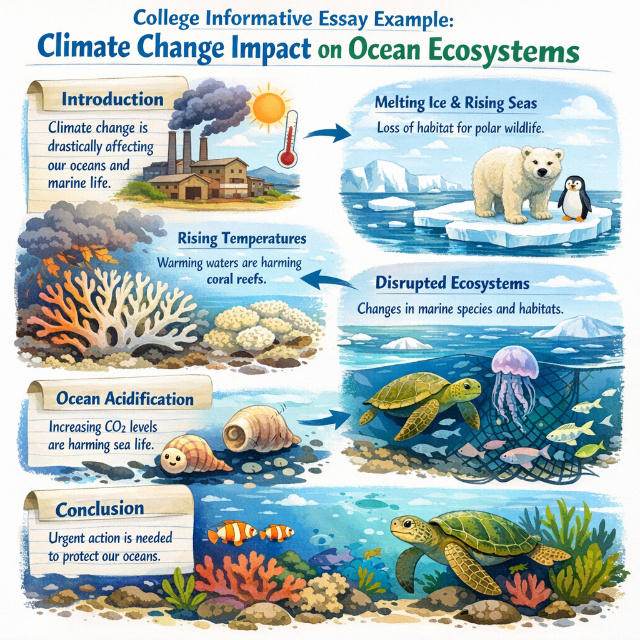
Earth's oceans absorb approximately 25% of anthropogenic carbon dioxide emissions, moderating atmospheric warming but triggering chemical changes with profound ecological consequences. As dissolves in seawater, it forms carbonic acid, lowering ocean pH in a process called ocean acidification. Simultaneously, rising temperatures from climate change cause coral bleaching events that devastate reef ecosystems. These interconnected stressors threaten marine biodiversity, fisheries that feed millions, and coastal communities dependent on reef protection. Understanding these mechanisms and their cascading effects reveals the urgent need for emissions reduction to preserve ocean health.
Ocean acidification occurs through straightforward chemistry with complex ecological ramifications. When atmospheric dissolves in seawater, it reacts with water molecules to form carbonic acid. This weak acid dissociates into hydrogen ions (H?) and bicarbonate ions, increasing hydrogen ion concentration the definition of acidification. Ocean pH has declined from preindustrial levels of approximately 8.2 to current levels around 8.1, representing a 30% increase in acidity. While this change seems minor, pH operates on a logarithmic scale where each 0.1 decrease represents a 30% increase in acidity. Projections suggest pH could drop another 0.3 to 0.4 units by 2100 under high emissions scenarios, reaching acidity levels not experienced in 20 million years.
Calcifying organisms face existential threats from acidification because it reduces carbonate ion availability essential for building shells and skeletons. Marine organisms like corals, mollusks, and certain plankton species construct their structures from calcium carbonate (CaCO?). This process requires combining calcium ions (Ca²?) abundant in seawater with carbonate ions (CO?²?). However, the hydrogen ions produced during acidification bind with carbonate ions, converting them to bicarbonate and reducing carbonate availability. When carbonate concentrations drop below critical thresholds, organisms struggle to build shells, and existing calcium carbonate structures begin dissolving. Laboratory experiments show that pteropods tiny swimming snails forming a crucial food source for salmon and whales develop thinner, more fragile shells under acidified conditions. Shell dissolution has been observed in pteropods from naturally acidified waters in the Southern Ocean, demonstrating that theoretical concerns manifest as actual ecological impacts.
Coral reefs exemplify ecosystems facing multiple climate stressors simultaneously. Corals exist in symbiotic relationships with zooxanthellae algae living within coral tissues that provide up to 90% of the coral's energy through photosynthesis while receiving protection and nutrients. This partnership functions within narrow temperature ranges, typically 23°C to 29°C. When water temperatures exceed tolerance thresholds for extended periods, corals experience stress and expel their zooxanthellae, losing their color in a process called coral bleaching. Without these photosynthetic partners, corals lose their primary energy source and face starvation. Brief bleaching events allow recovery if temperatures quickly return to normal, but prolonged warming or repeated bleaching events cause widespread coral mortality.
Mass bleaching events have increased in frequency and severity. The Great Barrier Reef, Earth's largest coral reef system, experienced unprecedented back to back bleaching in 2016 and 2017, killing approximately 50% of the reef's corals. Before the 1980s, mass bleaching events occurred rarely and locally. Between 1980 and 2017, the Great Barrier Reef experienced eight major bleaching events with increasing frequency. Global analysis shows that the average time between bleaching events has decreased from 25 30 years in the 1980s to just 6 years currently insufficient for reef recovery. Coral reefs typically require 10-15 years to recover from major disturbances, meaning increasingly frequent bleaching events prevent recovery, causing progressive reef degradation.
Acidification compounds heat stress by weakening coral skeletons and reducing growth rates. Even without bleaching, acidification slows coral calcification rates the process by which corals build their calcium carbonate skeletons. Studies on the Great Barrier Reef show that calcification rates have declined 14% since 1990, closely tracking increasing atmospheric CO? levels. Slower calcification reduces corals' ability to repair damage, compete for space, and recover from other stressors. The combination of heat stress causing tissue damage and acidification preventing skeleton repair creates a vicious cycle where corals become progressively less resilient.
Ecosystem wide consequences extend far beyond coral mortality because reefs support extraordinary biodiversity. Coral reefs cover less than 0.1% of ocean area yet harbor approximately 25% of all marine species. Over 4,000 fish species depend on coral reefs for food, shelter, and breeding grounds. When corals die, the complex three dimensional structure they provide collapses over time, eliminating habitat for countless species. Fish abundance and diversity decline sharply on degraded reefs. Herbivorous fish that control algae populations decrease, allowing algae to overgrow remaining live coral and further inhibit recovery. This transition from coral dominated to algae dominated states represents a phase shift where reefs may remain trapped in degraded conditions even if stressors decrease.
Human communities face severe consequences from reef degradation. Over 500 million people worldwide depend on coral reefs for food security, income, and coastal protection. Reef fisheries provide protein for communities across tropical coastlines, particularly in developing nations where alternatives are limited. In Indonesia and the Philippines, reef associated fisheries provide livelihoods for millions. Tourism revenues from reef recreation reach billions of dollars annually in countries like Australia, Indonesia, and Caribbean nations. Reefs also buffer coastlines from wave energy, reducing coastal erosion and storm damage. Economic analyses estimate reefs provide $375 billion in annual ecosystem services globally. As reefs degrade, these services diminish, threatening both economic prosperity and food security for vulnerable populations.
Intervention strategies focus on emissions reduction while exploring adaptation approaches. Since warming and acidification stem from atmospheric CO? accumulation, emissions reduction represents the only comprehensive solution. The Paris Agreement aims to limit warming to 1.5°C above preindustrial levels, though current commitments project 2.5°C to 3°C warming. Each fraction of a degree matters analysis suggests limiting warming to 1.5°C would preserve 10% to 30% of current reefs, while 2°C warming would eliminate 99% of coral reefs worldwide. This narrow window emphasizes the urgency of aggressive emissions cuts.
Adaptation strategies attempt to enhance reef resilience or assist evolution but face significant limitations. Some researchers are identifying and propagating heat tolerant coral strains that survived past bleaching events, creating "super corals" potentially more resilient to future warming. Others are experimenting with assisted evolution, selectively breeding or genetically modifying corals to enhance temperature tolerance. However, these approaches operate at small scales relative to reef systems spanning thousands of kilometers, face uncertain ecological consequences from introducing modified organisms, and cannot address acidification since even heat tolerant corals still require carbonate ions for skeleton construction.
Marine protected areas reduce additional stressors like overfishing and pollution, potentially increasing reef resilience to climate impacts. Healthy fish populations maintain ecological balance, controlling algae and supporting coral recovery. Reducing local pollution improves water quality, decreasing disease outbreaks and coral stress. While protected areas cannot prevent warming or acidification, they may help reefs better withstand these global stressors. Meta analyses show that well managed marine protected areas increase coral cover and fish biomass, though their effectiveness varies based on enforcement, size, and local conditions.
Climate change's impact on ocean ecosystems through warming and acidification represents a planetary scale challenge with profound ecological and human dimensions. The interconnection between atmospheric emissions and ocean chemistry means that stabilizing marine ecosystems ultimately requires transforming global energy systems. While local conservation efforts and adaptation research remain valuable, they cannot substitute for emissions reductions. The narrow remaining window for preserving significant reef coverage demands immediate and substantial action to limit warming, underscoring that ocean health and climate policy are inseparably linked.
What Makes This Informative Example Work
- College level complexity: Discusses carbonic acid chemistry, logarithmic pH scale, symbiotic relationships, and phase shifts without oversimplifying.
- Evidence based arguments: Cites specific data (30% acidity increase, 50% coral mortality, $375 billion in services) supporting every major claim.
- Cause effect structure: Clearly traces how CO? emissions lead to acidification and warming, which cause biological impacts, creating ecosystem changes.
- Critical analysis: Evaluates intervention strategies honestly, acknowledging both potential and limitations shows analytical thinking.
- Sophisticated organization: Moves from mechanism to impacts to consequences to solutions logical progression appropriate for advanced writing.
- Academic vocabulary: Uses discipline specific terms (zooxanthellae, calcification, phase shift) correctly and in context.
Still choosing a topic? Browse informative essay topics organized by subject area and difficulty level. Find ideas for science, history, technology, health, culture, and current events.
Want writing this strong for YOUR topic? Our professional essay writing service specialize in informative essays across every subject from photosynthesis to cryptocurrency. Real humans, real research, real results.
Downloadable Example Resources
Each PDF includes:
- Full annotated essay with highlighting
- Structure breakdown
- Thesis analysis
- Transition identification
CONVINCED BY OUR EXAMPLES? OUR GUARANTEE SEALS THE DEAL.
Order with the confidence that your essay will meet or exceed the sample quality you reviewed.
- "Match or Exceed Sample Quality" Promise
- Direct writer communication for perfect customization
- Unlimited revisions to get the exact tone you want
- Sample Based Guarantee
Let the examples be your proof. Let our guarantee be your peace of mind.
Order NowKey Takeaways: Informative Essay Examples
Examples teach structure and technique, not content to copy. Study how these essays organize information, transition between ideas, and integrate evidence. Then apply those principles to your own topic with original research and writing.
Analyzing strong examples reveals effective frameworks, like placing a central argument within a clear narrative arc or using topic sentences to forecast paragraph content. Notice how evidence is woven into the analysis, not just listed. Mastering these structural and technical elements allows you to build a unique, authoritative essay on any subject, using your own voice and research to fill the framework. Visit our comprehensive informative essay guide to get acuainted with step by step essay writing process.


-19941.jpg)