What Credentials Should Essay Writers Actually Have?
Understanding required qualifications helps you evaluate what services claim and what writers demonstrate.
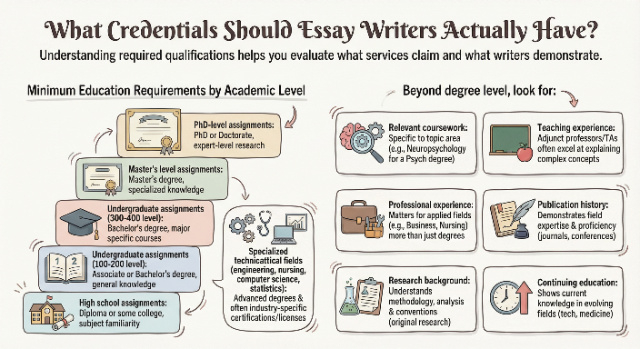
Minimum Education Requirements by Academic Level
High school assignments:
- Minimum: Bachelor’s degree in any field.
- Ideal: Bachelor’s in a relevant subject area.
Why: High school work requires basic academic writing skills and clear explanations, which any college graduate possesses
Undergraduate assignments (100-200 level):
- Minimum: Bachelor’s degree in a relevant field.
- Ideal: Master’s student or graduate in the subject area
Why: Introductory college work requires a subject foundation and academic writing competence
Undergraduate assignments (300-400 level):
- Minimum: Bachelor’s in subject + significant writing experience.
- Ideal: Master’s degree in a relevant field.
Why: Advanced undergraduate work requires deeper knowledge, research skills, and sophisticated analysis
Master’s level assignments:
- Minimum: Master’s degree in a relevant field.
- Ideal: PhD candidate or graduate in the subject area.
Why: Graduate work demands advanced theoretical knowledge, research methodology, and expert-level analysis
PhD-level assignments:
- Minimum: PhD in a relevant field.
- Ideal: PhD with publication record or teaching experience -
Why: Doctoral work requires cutting-edge research knowledge, methodological expertise, and contributions to the field.
Specialized technical fields (engineering, nursing, computer science, statistics):
Add 1 education level: Bachelor’s work needs Master's-level writers; Master’s work needs PhD-level writers.
Why: Technical accuracy requires deep subject expertise beyond general academic writing skills
Subject-Specific Expertise Indicators
Beyond degree level, look for:
Relevant coursework: A psychology degree doesn’t automatically mean expertise in neuropsychology or organizational behavior. Writers should have coursework specific to their topic area.
Professional experience: For business, nursing, engineering, or applied fields, relevant work experience often matters more than additional degrees.
Research background: Writers who’ve conducted original research understand methodology, analysis, and academic conventions better than those with coursework-only backgrounds.
Teaching experience: Adjunct professors or teaching assistants often excel at explaining complex concepts clearly and understanding assignment expectations.
Publication history: Writers with published papers (journals, conferences, books) demonstrate field expertise and academic writing proficiency.
Continuing education: For rapidly evolving fields (technology, medicine, current events), recent coursework or professional development indicates current knowledge.
What Credentials DON’T Guarantee Quality
Advanced degree? automatic quality:
A PhD in literature might struggle with: - Business statistics assignments - Engineering problem sets - Nursing care plans - Programming projects
The credential matching principle: Writer education must align with the assignment subject and academic level. A PhD in biology writing undergraduate economics papers won’t produce expert-level work in economics.
Experience matters as much as credentials:
- Writer A: PhD in English, 2 months of writing experience.
- Writer B: Master’s in English, 5 years of writing experience.
- 500+ papers completed.
Writer B likely produces better results despite lower credentials because experience teaches: assignment pattern recognition, professor expectation understanding, efficient research strategies, quality control techniques, and time management skills.
Quality professional essay writing services consider both credentials AND track record when matching writers to orders.
How Do Essay Services Verify Writer Credentials?
Understanding platform verification processes helps you evaluate service reliability and trustworthiness.
Standard Verification Practices
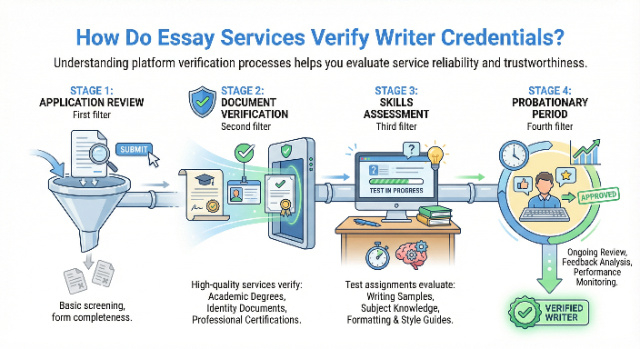
Stage 1: Application Review (First filter)
Writers submit:
- Resume or CV.
- Degree certificates or unofficial transcripts.
- Writing samples (2-3 papers in claimed expertise).
- Subject matter expertise list - Professional references (academic or professional).
Initial screening eliminates:
- Incomplete applications.
- Obvious credential mismatches.
- Below-standard writing samples.
- Insufficient education for platform standards.
Rejection rate: 40-60% of applicants at this stage.
Stage 2: Document Verification (Second filter) High-quality services verify:
Degree authentication:
- Contact universities directly to confirm graduation.
- Use third-party verification services (National Student Clearinghouse, credential verification companies).
- Check diploma details against university records.
- Verify dates, degree types, and majors.
Identity confirmation:
- Government-issued ID verification.
- Address verification.
- Background checks (premium services).
- Anti-fraud database checks.
Why this matters: Prevents credential fraud, identity theft, and diploma mill degrees from entering the writer pool.
Budget services skip this step, accepting self-reported credentials without verification, leading to the 34% misrepresentation rate mentioned earlier.
Stage 3: Skills Assessment (Third filter) Test assignments evaluate:
Subject knowledge:
- Can the writer demonstrate a deep understanding of concepts?
- Do they use discipline-appropriate terminology correctly?
- Can they engage with current research in the field?
Writing quality:
- Grammar, mechanics, and style.
- Argument development and thesis clarity.
- Source integration and citation accuracy.
- Appropriate academic tone.
Process competence:
- Following specific instructions.
- Meeting deadlines.
- Appropriate response to feedback.
- Attention to formatting details.
Scoring criteria:
- Content accuracy and depth (30-40%).
- Writing mechanics and style (25-30%).
- Structure and organization (15-20%).
- Citation and formatting (10-15%).
- Instruction adherence (10-15%).
Passing threshold: 80-85% minimum score.
Rejection rate: 50-60% of applicants who reach this stage.
Total acceptance rate: Only 5-15% of initial applicants become active writers on quality platforms.
Stage 4: Probationary Period (Fourth filter)
New writers face:
- Enhanced quality review (100% of orders checked thoroughly).
- Limited order access (simpler assignments initially).
- Performance monitoring (completion rate, satisfaction, revisions).
- Mentorship or training (some platforms) - Probation duration: 30-90 days.
Promotion criteria:
- 95%+ completion rate.
- 4.5+ average customer rating.
- Under 15% revision rate.
- Positive editor reviews.
Writers failing probation don’t advance to full status.
Ongoing Credential Monitoring
Continuous verification includes:
- Performance tracking:
-Every order receives a customer rating.
-Revision requests tracked.
-Quality rejection rate monitored.
-Completion reliability measured. - Random quality audits:
- 5-10% of completed orders reviewed by senior editors.
- Subject matter experts verify technical accuracy.
- Comparison to credential claims. - Credential updates:
-Writers completing new degrees update profiles.
-Additional certifications verified.
-Specialized training documented. - Misconduct investigation:
-Plagiarism accusations investigated thoroughly.
-Customer complaints reviewed.
-Pattern analysis for quality decline - Red flag triggers:
-Sudden quality drop (indicates possible account sharing)
-Multiple plagiarism flags.
-Consistently poor technical accuracy (credential fraud.)
-Customer complaints about knowledge gaps
Writers showing concerning patterns face investigation, additional testing, or account suspension.
Verification Badges and Certifications
Common platform indicators:
“Verified Writer” badge: Confirms service authenticated identity and credentials through document verification.
“Top Rated” or “Premium” designation: Indicates sustained high performance (typically 4.7+ rating, 95%+ completion over 6+ months).
“Subject Expert” label: Shows advanced credentials (Master’s/PhD) and proven expertise in a specific field.
“Advanced Degree” indicator: Confirms writer holds graduate degrees (Master’s or PhD).
Education level display: Many platforms show “Bachelor’s,” “Master’s,” or “PhD” without revealing specific institutions (privacy protection).
Completion rate percentage: Writers with 98%+ completion rates demonstrate reliability.
Customer satisfaction score: Average ratings from previous customers (4.5+ indicates consistent quality).
Order volume completed: Higher numbers (500+, 1000+) indicate extensive experience.
What Services DON’T Disclose (And Why)
Privacy protections prevent sharing:
Specific institution names: “PhD in Biology from [University Name]” would compromise writer anonymity and violate privacy agreements.
Transcripts or diplomas: Personal documents containing birthdates, student IDs, and other identifying information.
Personal identification: Real names, addresses, or contact information.
Why anonymity matters:
- Protects writers from academic institution employment policy conflicts.
- Prevents harassment or doxxing.
- Maintains legal separation between platform and writers. (independent contractors).
- Reduces credential theft risk.
What you CAN verify:
- Education level (Bachelor’s/Master’s/PhD).
- General field of study (Biology, not “Marine Biology at Stanford”).
- Years of experience.
- Performance metrics.
- Platform verification status.
This balance protects privacy while providing meaningful credential information. A reliable essay writing service verifies credentials thoroughly during recruitment, so customers don’t need to.
What Questions Should You Ask About Writer Credentials?
Strategic questions reveal credential authenticity and expertise depth better than credential claims alone.
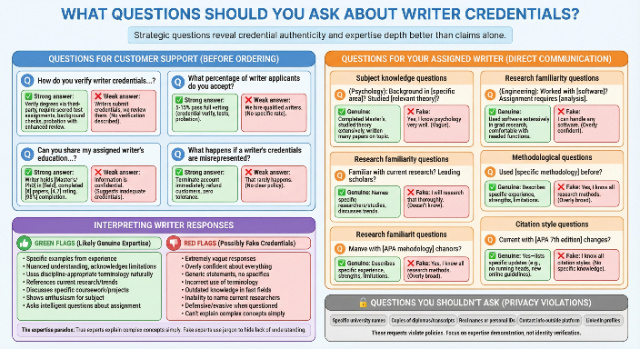
Questions for Customer Support (Before Ordering)
About platform verification:
Q“How do you verify writer credentials during recruitment?”
- Strong answer: “We verify degrees through third-party services contacting institutions directly, require test assignments scored by subject experts, conduct background checks, and maintain 30-90 day probation with enhanced review.”
- Weak answer: “Writers submit their credentials and we review them.” (No verification described).
Q“What percentage of writer applicants do you accept?”
- Strong answer: “5-15% of applicants pass our full vetting process, including credential verification, test assignments, and probationary performance.”
- Weak answer: “We hire qualified writers.” (No specific acceptance rate)
Q“Can you share my assigned writer’s education level and subject background?”
- Strong answer: “Your writer holds a [Master’s/PhD] in [relevant field], has completed [X] papers in this subject area, and maintains a [4.7] rating with [98%] completion rate.”
- Weak answer: “That information is confidential.” (Suggests inadequate credentials or no verification)
“What happens if a writer’s credentials are misrepresented?”
- Strong answer: “We terminate the account immediately, refund affected customers, and have zero tolerance for credential fraud.”
- Weak answer: “That rarely happens.” (No clear policy)
Questions for Your Assigned Writer (Direct Communication)
Ask strategically to assess genuine expertise: Subject knowledge questions:
For a psychology paper:
- “What’s your background in [specific area like developmental psychology]?
- Have you studied [relevant theory like Piaget’s stages]?”
Genuine expert response: “I completed my Master’s in developmental psychology and studied Piaget extensively in my cognitive development coursework. I’ve written about 20 papers on child development topics.”
Fake credential response: “Yes, I know psychology very well.” (Vague, no specific knowledge)
For an engineering project:
- “Have you worked with [specific software like MATLAB or SolidWorks] before?
- This assignment requires [specific analysis].”
Genuine expert response: “Yes, I used MATLAB extensively during my graduate research and am comfortable with [specific functions] needed for your analysis.”
Fake credential response: “I can handle any software.” (Overly confident, no specifics)
Research familiarity questions:
Q “Are you familiar with current research on [your topic]? Who are the leading scholars in this area?”
- Genuine expert response: Names 2-3 specific researchers or recent studies, discusses current debates or trends.
- Fake credential response: “I will research that thoroughly.” (Doesn’t already know field leaders).
Methodological questions (for research-heavy assignments):
Q“This paper requires [specific methodology like regression analysis or qualitative coding]. Have you used this approach before?”
- Genuine expert response: Describes specific experience with the methodology, discusses strengths and limitations.
- Fake credential response: “Yes, I know all research methods.” (Overly broad, no depth)
Citation style questions:
Q “The assignment uses [APA 7th edition]. Are you current with the recent changes from the 6th edition?”
- Genuine expert response: “Yes—no more running heads for student papers, updated guidelines for online sources, and new format for secondary citations.”
- Fake credential response: “I know all citation styles.” (Doesn’t demonstrate specific knowledge).
Interpreting Writer Responses
Green flags (likely genuine credentials):
Specific examples from experience
- Nuanced understanding showing depth.
- Acknowledges limitations or specializations.
- Uses discipline-appropriate terminology naturally.
- References current research or trends.
- Discusses specific coursework or projects.
- Shows enthusiasm for the subject area.
Asks intelligent questions about your assignment.
Red flags (possibly fake credentials):
- Extremely vague responses.
- Overly confident about everything.
- Generic statements without specifics.
- Incorrect use of terminology.
- Outdated knowledge in rapidly evolving fields.
- Inability to name current researchers.
- Defensive or evasive when questioned.
- Can’t explain concepts in simple terms (often indicates lack of true understanding).
The expertise paradox: True experts can explain complex concepts simply. Fake experts use jargon to hide a lack of understanding.
Questions You Shouldn’t Ask (Privacy Violations)
Avoid requesting:
- Specific university names.
- Copies of diplomas or transcripts.
- Real names or personal identification.
- Contact information outside the platform.
- LinkedIn profiles or professional credentials that could identify them.
These requests violate privacy agreements and platform policies. Focus on expertise demonstration, not identity verification.
How Can You Test Writer Expertise Before Major Orders?
Strategic testing confirms credentials practically before committing to high-stakes assignments.
The Small Order Test Strategy
Purpose: Verify expertise with low financial risk
Method:
Step 1: Place a 2-3 page test order
-Choose a topic you understand well (can evaluate accuracy).
-Select standard deadline (5-7 days, not rushed).
-Use the same academic level as your planned major order.
-Request the same citation style and formatting.
Cost: $30-60, depending on service and deadline.
Step 2: Evaluate the test paper
- Content accuracy: Are facts, concepts, and theories correct?
- Knowledge depth: Does analysis go beyond surface-level?
- Source quality: Are sources current, credible, and relevant?
- Technical proficiency: Is specialized terminology used correctly?
- Research approach: Does the paper demonstrate real research vs. a quick Google search?
Step 3: Ask follow-up questions
Message the writer: “Could you explain the reasoning behind [specific argument or approach]?”
Genuine experts can articulate their reasoning. Fake credentials struggle to explain beyond what’s written.
Step 4: Make your decision
Proceed with the major order if:
-Content demonstrates subject expertise
-Analysis shows critical thinking
-Sources indicate real research
-The writer can explain their approach
-Quality matches your needs
Try a different writer if:
- Content has factual errors
-Analysis is superficial
-Sources are inadequate
-The writer can’t explain the reasoning
-Quality disappoints
Investment protection: A $50 test prevents $200-500 mistakes on major projects. Test ordering is the single most effective verification strategy.
The Preview Request Strategy
Purpose: Assess expertise direction before full completion.
Method: For orders 10+ pages or 10+ days:
Request an outline or introduction preview at 25-30% completion
“When you’re about a quarter done, could you send your thesis statement and outline? Want to confirm we’re aligned on direction before you write the full content.”
Evaluate the preview:
- Thesis sophistication: Is it appropriately complex for your academic level?
- Argument structure: Does the outline demonstrate logical progression?
- Source indication: Are sources shown in outline appropriate?
- Understanding demonstration: Does the structure show assignment comprehension?
Green flags:
- Thesis is specific, arguable, and sophisticated.
- Outline addresses all required elements.
- Structure is logical and flows well.
- Sources listed are relevant and credible.
- Writer shows understanding of assignment goals.
Red flags:
- Thesis is vague or off-topic.
- Outline misses required elements.
- Structure is illogical or unclear.
- Sources are inappropriate or inadequate.
- The writer seems to misunderstand the assignment.
Correction opportunity: Preview reviews catch direction problems when 75% of the work remains, allowing major corrections without timeline issues.
The Subject Question Test
Purpose: Verify knowledge depth through direct questioning.
Method: Before or during writing, ask 2-3 subject-specific questions:
- For psychology papers: “How would you distinguish between classical and operant conditioning in this context?”
- For economics papers: “What’s your perspective on using Keynesian versus monetarist approaches for this analysis?”
- For literature papers: “How do you see [specific literary device] functioning in this text?”
- For nursing papers: “What assessment framework would you use for this patient scenario?”
Evaluate responses
Genuine expertise indicators:
- Immediate, confident response.
- Accurate information.
- Nuanced perspective.
- Can compare/contrast approaches.
- Uses discipline-appropriate language.
- Cites recent research or standards.
Credential concern indicators:
- Long delay before response.
- Vague or generic answer.
- Factual inaccuracies.
- Inability to compare approaches.
- Over-reliance on definitions without application.
- Outdated information.
The Research Source Test
Purpose: Evaluate research capability and source judgment.
Method: Request a preliminary source list:
“When you begin research, could you share 4-5 potential sources you’re considering? Want to ensure they align with my professor’s expectations.”
Evaluate source quality:
Strong research indicators:
- Peer-reviewed academic journals.
- Recent publications (last 5-10 years).
- Appropriate to the topic and depth.
- Recognized authors in the field.
- Methodologically sound studies.
Weak research indicators:
- Predominantly websites or blogs.
- Very outdated sources (20+ years old for most fields).
- Questionable source credibility.
- Generic sources not specific to the topic.
- Inappropriate for academic level.
A writer with genuine credentials knows what constitutes quality research in their field. Poor source judgment often indicates a limited academic background.
The Revision Response Test
Purpose: Distinguish content expertise from superficial knowledge.
Method: After receiving your paper, request a small substantive revision
“Could you expand paragraph 3 by about 100 words to include a discussion of [related concept]?”
Genuine experts:
- Add substantive, accurate content.
- Integrate smoothly with existing material.
- Demonstrate additional knowledge depth.
- Complete revisions quickly (understand the subject well).
Questionable credentials:
- Add filler without substance.
- Struggle to integrate new content.
- Show knowledge limitations.
- Take excessive time (need to research concept).
This test works because surface-level writers can produce initial papers through research and compilation, but substantive revisions require actual expertise.
What Are the Red Flags of Fake or Misrepresented Credentials?
Identifying credential fraud prevents poor quality work and wasted money.
Warning Signs in Writer Profiles
Suspiciously perfect qualifications:
“PhD in ALL subjects” or “Expert in every field” - Reality: Expertise is specialized, not universal. No one has PhD-level knowledge across the humanities, sciences, business, and technical fields
“Harvard PhD” or specific prestigious institutions named - Reality: Legitimate services protect writer anonymity; specific institutions aren’t disclosed. Dropping prestigious names suggests fabrication.
“25+ years experience” with a very young-sounding writing style - Reality: Experience should show in sophisticated writing. Mismatch between claimed experience and writing quality indicates fraud.
Too many subject area tags:
Profile claims expertise in: Biology, Engineering, Psychology, History, Philosophy, Business, Nursing, Computer Science, Literature.
Reality: Genuine experts specialize in 2-4 related areas, not 10+ unrelated fields
Warning Signs in Communication
Overly confident about everything:
- Red flag response: “I can definitely handle this. I have multiple PhDs and am an expert in all areas.”
- Realistic response: “This is within my expertise area. I have a Master’s in [field] and have completed about 30 papers on related topics.”
Can’t explain concepts simply:
- Red flag: Uses excessive jargon without a clear explanation often masks a lack of understanding.
- Genuine expertise: Can explain complex ideas in an accessible language, demonstrates deep understanding
Defensive about credential questions:
- Red flag: “Why are you questioning my qualifications? The platform verified me.”
- Professional response: “I have a Master’s in [field] with coursework in [specific areas]. I’ve been writing academic papers for 3 years and am comfortable with this topic.”
Incorrect or outdated information:
Examples:
- Psychology writer unfamiliar with DSM-5 (current edition since 2013, updated 2022).
- Business writer unfamiliar with current financial regulations.
- Nursing writer using outdated clinical protocols.
- Engineering writer unfamiliar with current industry software.
Generic responses lacking specificity:
Question: “What’s your background in qualitative research?”
- Red flag answer: “I know research methods well.”
- Genuine expert answer: “I conducted qualitative research for my Master’s thesis using grounded theory methodology and have experience with NVivo software for coding.”
Warning Signs in Delivered Work
Wikipedia-level understanding:
The paper demonstrates only surface-level knowledge available in encyclopedia entries rather than a deep academic understanding.
Outdated theoretical frameworks:
The paper uses theories or approaches that were current 20+ years ago but have been updated or superseded.
Missing discipline conventions:
- Psychology paper without APA-required elements.
- Scientific paper without a proper hypothesis structure.
- Legal brief without appropriate citation format.
- Business analysis without current industry context.
Factual errors:
Obvious mistakes that a degree holder in the field wouldn’t make:
- Misunderstanding fundamental theories.
- Incorrect formulas or calculations.
- Confusing key concepts.
- Misrepresenting research findings.
Inappropriate source types:
A PhD-level writer using mainly websites and textbooks instead of peer-reviewed research demonstrates a lack of graduate school experience.
Poor grasp of current research:
Papers showing no awareness of recent developments in fast-moving fields (technology, medicine, social issues).
Platform Red Flags
No verification process described:
Service can’t or won’t explain how they verify credentials, suggesting no verification occurs.
Unrealistic writer qualifications:
“All our writers have PhDs from top universities” at budget prices (economically impossible).
Instant writer assignment:
Order assigned within seconds/minutes suggests an algorithm without credential matching.
No writer performance metrics shown:
Inability to see completion rates, ratings, or experience indicates no tracking system.
Resistance to writer questions:
Service discourages or prevents customers from communicating with writers (hiding credential weaknesses).
When working with a trusted essay writing service, credential verification is transparent, realistic, and well-documented.
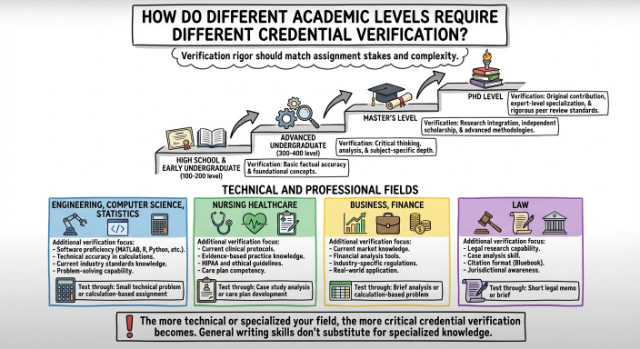
How Do Different Academic Levels Require Different Credential Verification?
Verification rigor should match assignment stakes and complexity.
High School and Early Undergraduate (100-200 level)
Required credentials: Bachelor’s degree minimum.
Verification priority: Writing quality over advanced expertise
Focus verification on:
- Clear communication skills
- Grammar and mechanics proficiency
- Basic research capability
- Instruction-following ability
Testing approach:
- Small test order on a familiar topic
- Check for clear explanations
- Verify proper citation format
- Confirm deadline reliability
Lower stakes = less intensive verification needed
Advanced Undergraduate (300-400 level)
Required credentials: Master’s degree or Bachelor’s + extensive experience.
Verification priority: Subject expertise and analysis depth.
Focus verification on:
- Specialized knowledge in the subject area
- Analytical thinking capability
- Current research awareness
- Advanced writing sophistication
Testing approach:
- Test order in a specific subject area
- Ask subject-specific questions
- Review source quality and analysis depth
- Confirm thesis sophistication.
Moderate stakes = moderate verification intensity
Master’s Level
Required credentials: Master’s in field minimum, PhD preferred.
Verification priority: Methodological expertise and theoretical knowledge.
Focus verification on:
- Graduate-level analytical capability.
- Research methodology competence.
- Theoretical framework understanding.
- Academic discourse proficiency.
Testing approach:
- Test with the literature review or methodology section.
- Ask about research approaches.
- Request outline preview showing theoretical framework.
- Verify familiarity with current scholars in the field.
High stakes = intensive verification required
PhD Level
Required credentials: PhD in a specific field
Verification priority: Original insight and scholarly contribution.
Focus verification on:
- Cutting-edge knowledge
- Methodological sophistication
- Publication-level writing
- Ability to synthesize complex research
Testing approach:
- Test with the complex analysis section.
- Discuss current debates in the field
- Verify understanding of advanced methodology
- Check familiarity with very recent research (last 1-2 years)
Highest stakes = most rigorous verification essential
Technical and Professional Fields
Engineering, Computer Science, Statistics:
Additional verification focus:
- Software proficiency (MATLAB, R, Python, etc.).
- Technical accuracy in calculations.
- Current industry standards knowledge.
- Problem- solving capabilityProblem-solving.
Test through: Small technical problem or calculation-based assignment
Nursing Healthcare:
Additional verification focus:
- Current clinical protocols.
- Evidence-based practice knowledge.
- HIPAA and ethical guidelines.
- Care plan competency.
Test through: Case study analysis or care plan development
Business, Finance:
Additional verification focus:
- Current market knowledge
- Financial analysis tools
- Industry-specific regulations
- Real-world application
Test through: Brief analysis or calculation-based problem
Law:
Additional verification focus:
- Legal research capability
- Case analysis skill
- Citation format (Bluebook)
- Jurisdictional awareness
Test through: Short legal memo or brief
The more technical or specialized your field, the more critical credential verification becomes. General writing skills don’t substitute for specialized knowledge.
What Should You Do If You Discover Fake Credentials?
Discovering credential fraud requires immediate action to protect your academic standing.
Immediate Actions
Step 1: Stop using the paper
Don’t submit work from writers with fake credentials:
- May contain factual errors harming your grade.
- Demonstrates a lack of expertise you paid for.
- Represents fraud and contract violation.
Step 2: Document everything
Gather evidence:
- Writer’s credential claims.
- Communication showing knowledge gaps.
- Specific errors or problems in work.
- Platform verification claims.
- Order details and payment records.
Step 3: Contact the platform immediately
. Submit a complaint through official channels:
- “I have evidence that Writer #[ID] misrepresented credentials for Order #[number].
- Specifically: [list concrete examples of knowledge gaps, errors, or contradictions].
- I request:
1. Full refund
2. Verification of how this writer passed credential checks.
3. Assurance of proper vetting for future orders.
4. Order reassignment to a properly qualified writer.”
Step 4: Request a refund and reassignment
Quality services provide:
- Full refund for credential fraud
- Free order reassignment
- Investigation of verification breakdown
- Account review of the implicated writer
Step 5: Review your academic integrity
If you already submitted the paper:
- Check for factual errors.
- Verify all sources exist and are accurately cited.
- Consider consulting with the professor if errors are significant.
Long-Term Actions
For the specific service:
If they respond well:
- Provide a full refund
- Investigate and discipline the writer
- Offer additional verification for future orders
- Consider continuing with enhanced caution
If they respond poorly:
- Refuse refund
- Defend the writer despite the evidence
- Dismiss your concerns.
Action: Leave a negative review, file a payment dispute, switch services permanently
For future orders:
Implement verification protocol:
1. Always request the writer's qualification information.
2. Ask subject-specific questions before major orders.
3. Use test orders for new writers.
4. Request outline/preview on complex projects.
5. Build relationships with verified-quality writers.
Choose services with transparent verification:
Prioritize platforms offering:
1. Detailed explanation of the verification process.
2. Visible writer performance metrics.
3. Clear credentialing standards,
4. Responsive investigation of credential concerns.
Report to consumer protection:
For serious fraud:
1. Better Business Bureau complaint.
2. State Attorney General Consumer Protection Division.
3. Review platforms (with factual, documented complaints).
4. Payment processor dispute if the refund is denied.
Preventing Future Issues
Risk reduction strategies:
- Build a trusted writer network: Once you find properly qualified writers, maintain those relationships for future orders.
- Test before trusting: Always start with small orders when trying new writers.
- Verify platform credibility: Choose professional essay writing services with transparent, rigorous verification processes.
Ask more questions: Don’t assume credentials are confirmed through strategic questioning.
Review carefully: Check delivered work for expertise indicators before submission.
Stay informed: Understand your field well enough to recognize knowledge gaps.
The best defense against credential fraud is proactive verification combined with choosing reputable platforms that take vetting seriously.
Key Takeaways: Verifying Essay Writer Credentials
What credentials actually matter:
- Education level matching assignment complexity (Bachelor’s for high school, Master’s/PhD for graduate work).
- Subject-specific expertise, not just general degrees.
- Relevant coursework, research, or professional experience in your topic area.
- Platform performance metrics (completion rate 95%+, customer ratings 4.5+, low revision rate).
- Writing experience volume (500+ papers indicates seasoned expertise)
How services verify credentials during recruitment:
- Third-party degree authentication contacting institutions directly (5-15% acceptance rate).
- Test assignments scored by subject experts on content, writing, and process (80-85% passing threshold).
- Background checks and identity verification (premium services).
- Probationary periods with enhanced review (30-90 days).
- Continuous performance monitoring tracking quality, completion, and satisfaction.
Strategic verification methods you can use:
Test orders (2-3 pages, $30-60): Most effective verification before major projects.
Subject-specific questions: Ask about theories, methods, or current research to test knowledge depth.
Preview requests: Review thesis and outline at 25-30% completion for major papers.
Source quality evaluation: Request preliminary source lists to assess research capability.
Revision response test: Request substantive additions to distinguish expertise from compilation
Red flags indicating credential fraud:
- Claims of expertise in 10+ unrelated fields (genuine experts specialize).
- Overly confident responses lacking specific knowledge demonstration.
- Factual errors or outdated information in delivered work.
- Inability to explain concepts simply (true experts simplify complexity).
- Defensive or evasive responses to reasonable credential questions.
- Wikipedia-level understanding instead of deep academic knowledge.
Verification intensity by academic level:
- High school/early undergraduate: Focus on writing quality and instruction-following.
- Advanced undergraduate: Verify subject expertise and analytical capability.
- Master’s level: Confirm methodological competence and theoretical knowledge (test with literature reviews).
- PhD level: Assess cutting-edge knowledge and publication-level sophistication.
- Technical fields: Add software proficiency and current industry knowledge verification.
Actions when discovering fake credentials:
- Stop using the paper immediately (don’t submit work with factual errors).
- Document evidence thoroughly (credential claims, knowledge gaps, errors).
- Contact the platform requesting a full refund, investigation, and reassignment.
- File a payment dispute if the service dismisses concerns.
- Switch to services with transparent, rigorous verification processes.
Protection strategies going forward:
- Choose reliable essay writing services with documented verification processes.
- Always test new writers with small orders before major projects ($50 test prevents $500 mistakes).
- Build relationships with verified-quality writers (2-3 trusted writers in your subject areas).
- Ask strategic questions testing subject knowledge before each order.
- Request outline previews at 25-30% completion for complex assignments.
The credential verification challenge exists because privacy protections prevent sharing personal documents. However, combining platform verification trust with strategic testing (questions, test orders, performance metrics review) effectively confirms writer expertise. Quality services invest 15-25% of revenue in verification infrastructure during recruitment because credential accuracy protects their reputation.
Ready to verify writer credentials confidently?
Start by choosing a trusted essay writing service that explains their verification process transparently, provides writer qualification summaries, and allows customer communication for credential confirmation.
Then implement the test order strategy, a $50 investment, verifying expertise before committing to high-stakes assignments. Remember: legitimate credentials show through demonstrated knowledge, not defensive claims.
When you master credential verification, you protect both your investment and your academic success. The difference between working with genuine experts and credential fraudsters starts with asking the right questions and testing strategically before trusting completely.