What Are Common Types of Difficult Professors?
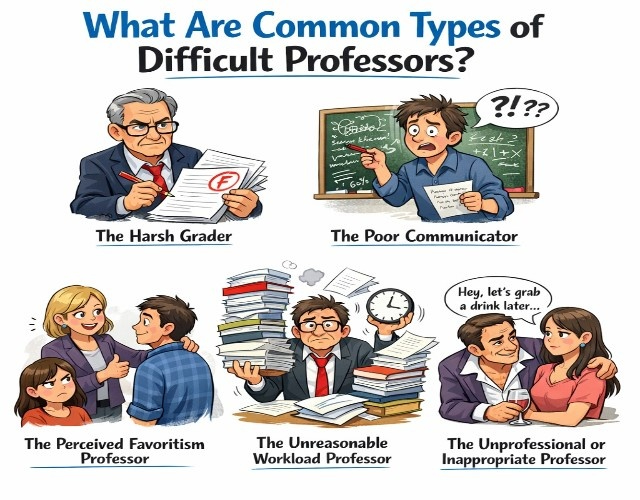
Common types include harsh or inconsistent graders providing minimal feedback or subjective evaluation (32% of student complaints), poor communicators who respond slowly to emails, provide vague assignment instructions, or create unclear expectations, professors perceived as showing favoritism or bias toward certain students or viewpoints, those assigning excessive workloads unrealistic for credit hours, and genuinely unprofessional professors displaying inappropriate behavior, discrimination, or harassment requiring formal reporting.
1. The Harsh Grader
Characteristics:
- Grades significantly lower than those of other professors for similar work
- Provides minimal feedback explaining grade rationale
- Seems to apply grading criteria inconsistently
- Class average is C or below (when department average is B)
- Rejects requests for grade clarification or improvement opportunities
How to handle:
- Request a detailed grading rubric at assignment start
- Ask for sample A-level work examples
- Visit office hours before deadlines for draft feedback
- Document grading inconsistencies with specific examples
- Compare your work to the rubric objectively
- Request grade explanation citing specific rubric elements
- If unfair, appeal through proper department channels
Important distinction: High standards is not equal to unfair grading. Professors challenging you to excel deserve respect, while those grading capriciously or punitively warrant intervention.
2. The Poor Communicator
Characteristics:
- Rarely responds to emails or takes weeks
- Provides vague assignment instructions
- Changes deadlines or requirements without notice
- Office hours are limited or frequently cancelled
- Syllabus is incomplete or contradicts class announcements
How to handle:
- Communicate during class when email fails
- Ask clarifying questions publicly (helps everyone)
- Form a study group to compare understanding
- Document all communications and requirement changes
- Visit the department office for the professor's schedule
- CC department admin on time-sensitive emails if no response
- Keep all course materials proving requirement changes
3. The Perceived Favoritism Professor
Characteristics:
- Calls on the same students repeatedly
- Appears to grade certain students more easily
- Shows enthusiasm for some students' ideas, dismisses others
- Gives extension or accommodation opportunities unequally
- Seems to have "favorite" students
How to handle:
- Participate actively and professionally
- Submit exemplary work, leaving no grading room for bias
- Request specific feedback improving future work
- Build a professional relationship through office hours
- Focus on your performance, not peer comparisons
- If truly discriminatory (based on protected characteristics), report formally
Important note: Perceived favoritism often reflects students who attend office hours, participate actively, and submit quality work consistently, behaviors that anyone can adopt.
4. The Unreasonable Workload Professor
Characteristics:
- Assigns 40+ hours of work for a 3 credit course
- Multiple major assignments due simultaneously
- Reading or project volume clearly exceeds peers' courses
- Expectations seem disconnected from credit hours
- Students consistently report inability to complete work
How to handle:
- Track hours spent on coursework weekly
- Compare with peers in other sections/courses
- Address directly: "I'm spending 15 hours weekly on this 3 credit course. Can we discuss managing the workload?"
- Request deadline extensions citing workload documentation
- Report to department if truly excessive (after documentation)
- Formally drop the course if necessary for wellbeing
5. The Unprofessional or Inappropriate Professor
Characteristics:
- Makes discriminatory comments about race, gender, sexuality, and religion
- Displays inappropriate personal interest in students
- Retaliates against students who disagree or question
- Regularly cancels class without notice or makeup
- Shows up unprepared or discusses irrelevant personal matters
- Creates a hostile learning environment
How to handle:
- Document everything immediately with dates, witnesses, and quotes
- Report to department chair, dean, or Title IX office
- Do not attempt to handle serious misconduct alone
- Understand your rights under university policies
- Seek support from campus advocacy offices
- File a formal complaint through proper channels
When managing conflicts with difficult professors alongside demanding coursework and stress, consider using a professional essay writing service for other course assignments during particularly challenging periods, allowing mental and emotional energy for navigating difficult professor relationships, documenting interactions, and pursuing resolution through proper channels without compromising grades in your other courses.
How Do You Communicate Effectively with Difficult Professors?
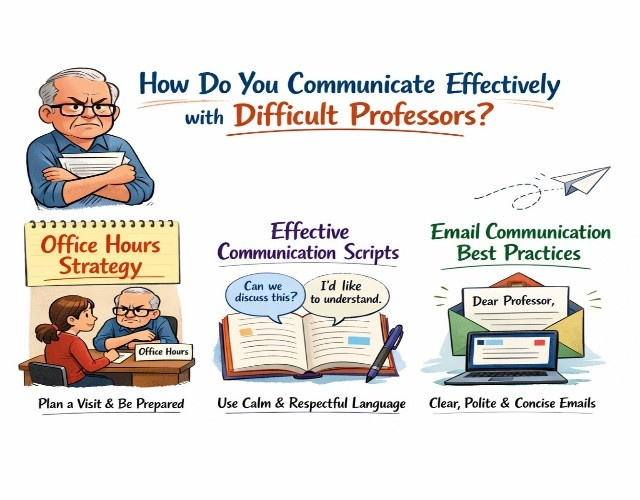
Communicate effectively by scheduling in-person office hours conversations rather than handling complex issues via email, preparing specific examples and questions before meetings, using respectful professional language regardless of frustration, focusing on understanding their expectations rather than arguing, requesting actionable feedback improving future performance, and sending follow-up emails documenting conversations and agreements preventing future misunderstandings.
1. Office Hours Strategy
Why office hours beat email:
- Tone and nuance communicate better in person
- Real-time clarification prevents misunderstandings
- Demonstrates respect and initiative
- Builds relationships beyond student number
- Harder to dismiss or ignore in-person concerns
- Allows reading body language and adjusting approach
Preparing for office hours:
A. Identify specific concerns: Vague complaints ("this class is too hard") go nowhere; specific questions ("I'm unclear how to apply the Marxist lens in essay analysis, could you provide an example?") get answers.
B. Gather evidence: Bring graded assignments, rubrics, syllabi, and notes proving your point objectively.
|
2. Effective Communication Scripts
- Addressing unclear expectations: "Professor [Name], I want to ensure I understand the assignment requirements correctly. The prompt mentions [X], but I'm unsure whether you want [Y] or [Z] approach. Could you clarify or provide an example?"
- Discussing a disappointing grade: "I received [grade] on [assignment] and want to improve for future work. Could you help me understand specifically what was missing or could have been stronger? I'd appreciate concrete feedback I can apply going forward."
- Requesting deadline extension: "I'm working on [assignment] and want to submit my best work. I've encountered [specific challenge. illness, family emergency, multiple deadlines]. Would it be possible to receive a 24 to 48 hour extension? I understand if policies don't allow it, but I wanted to ask."
- Questioning grading inconsistency: "I'm trying to understand the grading criteria better. On [Assignment 1], I received [feedback/grade] for [specific element]. On [Assignment 2], I incorporated that feedback but received a different result. Could you help me understand what I should focus on?"
- Reporting communication problems to department: "I'm concerned about communication in [Course Name]. I've sent [number] emails over [timeframe] without response regarding [specific issue]. I've attempted to visit office hours [describe attempts]. I want to resolve this directly with Professor [Name], but need assistance connecting with them. What would you recommend?"
3. Email Communication Best Practices
When email is appropriate:
- Simple factual questions
- Following up on office hours conversations
- Documenting agreements or discussions
- Providing required information (absences, conflicts)
- When office hours don't fit your schedule (explain this)
Professional email structure:
Subject: [Course Number] [Specific Issue] [Your Name]
Dear Professor [Last Name],
[Context: Your name, course section, reason for email]
[Specific question or concern with relevant details]
[Proposed solution or action you're requesting]
[Polite closing, thanking them for their time]
Sincerely, [Full Name] [Student ID if required] [Course Section]
Email best practices:
- Send from university email (not personal accounts)
- Use professional subject lines
- Proofread thoroughly (errors undermine credibility)
- Keep under 200 words when possible
- Send during business hours (not 2am)
- Wait 48 to 72 hours for a response before following up
- CC department admin only if absolutely necessary
Research shows students who address concerns through respectful in-person office hours conversations resolve 67% of conflicts successfully, compared to 23% resolution for those who rely on email complaints or avoid direct communication altogether.
When Should You Escalate Issues Beyond the Professor?
Escalate issues when direct communication fails after 2-3 good-faith attempts, professor behavior violates university policies (discrimination, harassment, academic misconduct), grading appears arbitrary or punitive without valid academic justification, professor creates hostile learning environment affecting mental health or safety, or administrative errors (missing grades, incorrect recording) go uncorrected despite documentation and requests.
Escalation Hierarchy
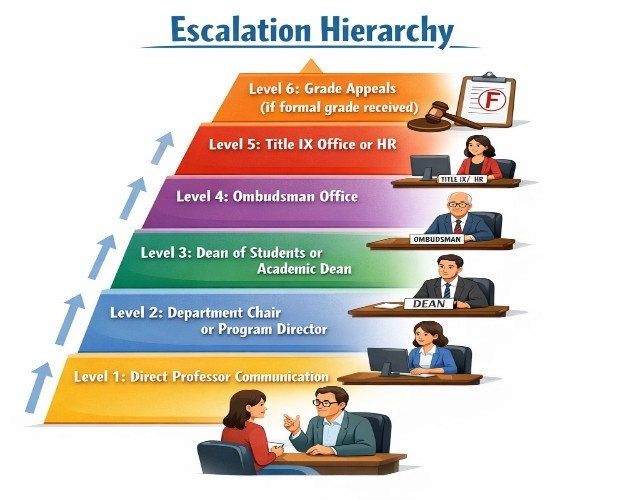
Level 1: Direct professor communication
|
Level 2: Department chair or program director
|
Level 3: Dean of students or academic dean
|
Level 4: Ombudsman office
|
Level 5: Title IX office or HR
|
Level 6: Grade appeals (if formal grade received)
|
What to Document
Keep organized records of:
Documentation practices:
|
Formal Complaint Considerations
1. Before filing formal complaints:
- Exhaust direct communication attempts
- Gather comprehensive documentation
- Consult with ombudsman about process
- Understand potential outcomes and timelines
- Consider impact on grade and professor relationship
- Recognize formal complaints take weeks or months
- Prepare for investigation, including interviews
2. When formal complaints are necessary:
- Clear policy violations with documented evidence
- Discriminatory or harassing behavior
- Academic integrity violations by professor
- Retaliation for protected activity
- Safety concerns for you or others
3. Complaint process typically involves:
- Written statement with specific incidents and dates
- Supporting documentation
- Investigation interviews
- Response from professor
- Finding and resolution (if policy violated)
- Possible remedies (grade changes, course retake, policy changes)
Students should understand that formal complaints are serious undertakings requiring substantial evidence and emotional energy, appropriate for genuine misconduct but not for learning curve frustrations or personality conflicts resolvable through adaptation and communication.
How Do You Succeed Despite Professor Difficulties?
Succeed despite professor difficulties by adapting to their teaching style and expectations rather than expecting them to change, forming study groups sharing understanding and support, attending all classes and participating actively demonstrating engagement, submitting exceptional work minimizing subjective grading discretion, utilizing teaching assistants for additional support and clarification, exploring alternative learning resources (tutoring, online materials, textbooks), and maintaining professional demeanor throughout despite personal feelings.
Adaptation Strategies
1. Understanding different teaching styles:
2. Working within their system:
3. Building positive relationships:
|
Alternative Support Resources
1. Teaching assistants (TAs):
2. Academic support services:
3. Study groups:
4. External resources:
|
Research shows that students who adapt to a difficult professor's teaching style and utilize alternative resources maintain 0.2 to 0.4 higher GPAs in those courses compared to students who complain without adjusting their approach or seeking additional support.
When Should You Drop a Course?
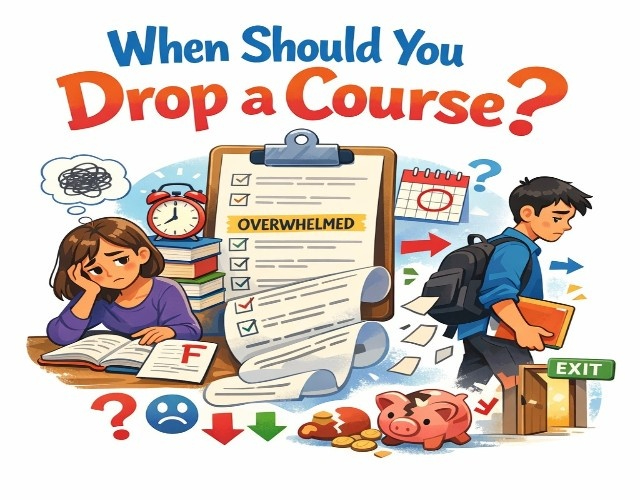
Drop a course when professor behavior creates a genuinely hostile environment affecting mental health, attempts at communication and adaptation fail, and you're failing despite reasonable effort, the course is elective and not worth stress compared to alternatives, dropping wouldn't delay graduation or affect financial aid, and you've exhausted all support resources and intervention attempts. Consider all factors, including financial implications, graduation timeline, and whether difficulty stems from genuine problems versus expected academic rigor.
Drop Decision Framework
A. Good reasons to drop:
B. Poor reasons to drop:
|
Drop Decision Process
Before dropping:
Calculate impact: How does this affect graduation timeline? Financial aid? Prerequisites for other courses?
Explore alternatives: Incomplete grade? Late withdrawal? Taking course pass/fail? Different section next semester?
Consult advisor: Understand full ramifications before acting impulsively.
Review deadlines: Deadlines for dropping without "W" versus with "W" versus withdrawal.
Consider timing: Early semester issue (more likely resolvable) versus late semester pattern?
Document everything: If you drop and need to explain later (grad school, employers).
Drop Timeline Considerations
Drop/add period (first 1-2 weeks): -
Withdrawal period (weeks 3 to 10 typically):
Late withdrawal (after deadline):
Financial considerations:
|
Students who thoughtfully evaluate drop decisions using advisor consultation and documentation typically make better choices than those who drop impulsively, with 68% of non-impulsive droppers reporting satisfaction with decision versus 34% of impulsive droppers who later regret withdrawing.
Key Takeaways
Successfully handle difficult professors through these evidence-based strategies:
Address issues directly through professional office hours conversations using specific examples and questions rather than emotional complaints, as 67% of conflicts resolve through respectful in-person communication compared to 23% resolution via email complaints. Prepare beforehand with documentation, solutions, and professional demeanor.
Document all interactions comprehensively including emails, assignment submissions, graded work, syllabus changes, and office hours notes protecting yourself if disputes escalate to formal complaints or grade appeals. Maintain organized records with dates, times, and witnesses for every significant interaction.
Distinguish genuine problems from adaptation needs recognizing 78% of initially "difficult" professors reflect high standards, different teaching styles, or learning curve challenges rather than actual problems warranting complaints. Adapt to their system, utilize alternative resources, and maintain professional relationships.
Escalate appropriately through proper channels only after 2-3 good-faith direct communication attempts fail, following hierarchy from professor to department chair to dean to ombudsman. Understand formal complaints require substantial evidence, emotional energy, and time (weeks to months) appropriate for policy violations not personality conflicts.
Consider dropping thoughtfully not impulsively after exhausting communication, adaptation, and support resources, calculating impact on graduation timeline and financial aid, and consulting academic advisors. Students who evaluate drop decisions carefully report 68% satisfaction versus 34% for impulsive droppers who later regret withdrawal.
Most perceived professor difficulties resolve through communication, adaptation, and perspective shifts rather than requiring formal intervention. The 67% resolution rate through direct conversation demonstrates that most professors respond to professional, specific concerns with a willingness to help students succeed when approached respectfully.
When managing conflicts with difficult professors alongside other coursework demands and stress, consider using a trusted essay writing service for routine assignments in your other courses, allowing mental and emotional bandwidth for navigating challenging professor relationships, documenting interactions, pursuing appropriate resolutions, and maintaining academic performance despite interpersonal difficulties affecting your learning environment.